Recently I wrote a post titled "Did Jesus Say "I Am God"?" (See here) to answer those who deny the Trinity, whether Muslims, Unitarians, Sabellians, Arians, etc., by asking "where did Jesus ever say that he was God?" I cited several statements of the risen and ascended Lord Jesus Christ in the Book of Revelation where he clearly did claim such, saying that he was "the first and the last," and "the Alpha and Omega," and "the beginning and the ending." We showed how these were titles belonging to God alone. So we read in Isaiah:
“Thus says the Lord (Yahweh), the King of Israel,
And his Redeemer, the Lord (Yahweh) of hosts:
‘I am the First and I am the Last;
Besides Me there is no God." (44: 6 nkjv)
“Listen to Me (Yahweh), O Jacob,
And Israel, My called:
I am He, I am the First,
I am also the Last." (48: 12)
So, Christ is Yahweh. The Father too is Yahweh. The Spirit too is Yahweh. These three are the one Yahweh, for they are three persons and yet one God in substance, essence, and attributes.
As we have pointed out, this title expresses God's eternality, and his Almightiness, and that all created things are his creation and their destinies are determined by him. But, notice this text also from Isaiah:
"Who has performed and done it, Calling the generations from the beginning? ‘I, the LORD (Yahweh), am the first; And with the last I am He.’” (Isa. 41: 4 nkjv)
Notice the slight difference in this verse in relation to the previous ones. This shows that one of the ways that Yahweh (Father, Son, and Spirit) was prior to and in the beginning was in relation to the "generations" of man. He was there when the first man was created and the first generation. He was there "from the beginning" and also will be "with the last" generation.
The Son of God, the second person of the Trinity, was with the Father and Spirit and was co-creator with them. This is why "Elohim" (God) said in the beginning "let US make man in our image, according to OUR likeness" (Gen. 1: 26). In Genesis we see where God is seen as being plural and one all at the same time. Singular verbs are used when speaking of what the plural Elohim did in creation. The word "created" in Genesis 1: 1 is a singular verb. We see this same grammatical construction in many places in the old testament. Interesting too is the fact that in the Quran Allah also uses plural pronouns in regard to himself, a fact that Muslims struggle to deal with.
We also see in the old testament many scriptures that speak of the Spirit of God as being both distinct from Yahweh and yet being himself Yahweh. We also see where the Son of God often appeared as Yahweh, and yet is distinct from Yahweh the Father.
Getting back to Revelation chapter one, let us read further. The apostle John wrote:
"Behold, He is coming with clouds, and every eye will see Him, even they who pierced Him. And all the tribes of the earth will mourn because of Him. Even so, Amen. “I am the Alpha and the Omega, the Beginning and the End,” says the Lord, “who is and who was and who is to come, the Almighty.” (Rev. 1: 7-8 nkjv)
Notice that Christ takes divine titles to himself, being the Alpha and Omega, the Beginning and the End. In the last chapter of Revelation he also says: "I am the Alpha and the Omega, the Beginning and the End, the First and the Last." (22: 13 nkjv)
With this introduction let us read the rest of Revelation chapter one and see how John describes the glorified and risen Christ.
Vision of the Son of Man
"10 I was in the Spirit on the Lord’s Day, and I heard behind me a loud voice, as of a trumpet, 11 saying, “I am the Alpha and the Omega, the First and the Last,” and, “What you see, write in a book and send it to the seven churches which are in Asia: to Ephesus, to Smyrna, to Pergamos, to Thyatira, to Sardis, to Philadelphia, and to Laodicea.”
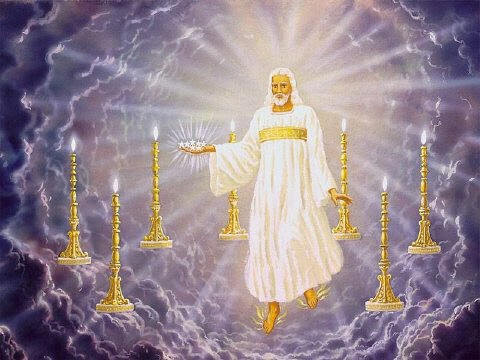
12 Then I turned to see the voice that spoke with me. And having turned I saw seven golden lampstands, 13 and in the midst of the seven lampstands One like the Son of Man, clothed with a garment down to the feet and girded about the chest with a golden band. 14 His head and hair were white like wool, as white as snow, and His eyes like a flame of fire; 15 His feet were like fine brass, as if refined in a furnace, and His voice as the sound of many waters; 16 He had in His right hand seven stars, out of His mouth went a sharp two-edged sword, and His countenance was like the sun shining in its strength. 17 And when I saw Him, I fell at His feet as dead. But He laid His right hand on me, saying to me, “Do not be afraid; I am the First and the Last. 18 I am He who lives, and was dead, and behold, I am alive forevermore. Amen. And I have the keys of Hades and of Death. 19 Write the things which you have seen, and the things which are, and the things which will take place after this. 20 The mystery of the seven stars which you saw in My right hand, and the seven golden lampstands: The seven stars are the angels of the seven churches, and the seven lampstands which you saw are the seven churches."
This description of the Son of God in his divine glory shows that he is God.
Now, let us compare several texts from the old testament that also give us a picture of Christ in visions to Ezekiel, Daniel, and Isaiah.
Ezekiel's Vision of Christ
"22 The likeness of the firmament above the heads of the living creatures was like the color of an awesome crystal, stretched out over their heads.
23 And under the firmament their wings spread out straight, one toward another. Each one had two which covered one side, and each one had two which covered the other side of the body.
24 When they went, I heard the noise of their wings, like the noise of many waters, like the voice of the Almighty, a tumult like the noise of an army; and when they stood still, they let down their wings.
25 A voice came from above the firmament that was over their heads; whenever they stood, they let down their wings.
26 And above the firmament over their heads was the likeness of a throne, in appearance like a sapphire stone; on the likeness of the throne was a likeness with the appearance of a man high above it.
27 Also from the appearance of His waist and upward I saw, as it were, the color of amber with the appearance of fire all around within it; and from the appearance of His waist and downward I saw, as it were, the appearance of fire with brightness all around.
28 Like the appearance of a rainbow in a cloud on a rainy day, so was the appearance of the brightness all around it. This was the appearance of the likeness of the glory of the Lord. So when I saw it, I fell on my face, and I heard a voice of One speaking." (Eze. 1: 22-28 nkjv)
Notice that Ezekiel sees a "man." This is no ordinary man, but is Yahweh the Son of God. Notice the similarities between this vision of Christ and the vision of Christ by John in the Apocalypse. Ezekiel's description of the "voice" was that of "many waters" and "like the voice of the Almighty." This is what John said of Christ: "his voice" was "as the sound of many waters."
Ezekiel also sees a throne, the same that we see described in the Apocalypse (chapter four), and above the throne he sees the "likeness with the appearance of a man high above it." Who is this man that is above the throne of heaven? It is the same man who John sees and it is the Lord Jesus Christ, the second person of the Trinity. His appearance to Ezekiel corresponds to the same appearance in Revelation. There is mention of the rainbow, which though not mentioned in Revelation chapter one, is mentioned in Revelation chapter four in conjunction with the throne of God. Also, Ezekiel's vision says that the "man" was radiating glory, "the appearance of the likeness of the glory of the Lord." Now notice how Ezekiel sees this same glorious "man" again.
"1 Afterward he brought me to the gate, the gate that faces toward the east. 2 And behold, the glory of the God of Israel came from the way of the east. His voice was like the sound of many waters; and the earth shone with His glory. 3 It was like the appearance of the vision which I saw--like the vision which I saw when I came to destroy the city. The visions were like the vision which I saw by the River Chebar; and I fell on my face. 4 And the glory of the Lord came into the temple by way of the gate which faces toward the east. 5 The Spirit lifted me up and brought me into the inner court; and behold, the glory of the Lord filled the temple. 6 Then I heard Him speaking to me from the temple, while a man stood beside me. 7 And He said to me, "Son of man, this is the place of My throne and the place of the soles of My feet, where I will dwell in the midst of the children of Israel forever. No more shall the house of Israel defile My holy name, they nor their kings, by their harlotry or with the carcasses of their kings on their high places. 8 When they set their threshold by My threshold, and their doorpost by My doorpost, with a wall between them and Me, they defiled My holy name by the abominations which they committed; therefore I have consumed them in My anger. 9 Now let them put their harlotry and the carcasses of their kings far away from Me, and I will dwell in their midst forever." (Eze. 43: 1-9 nkjv)
Who is this "man" who stands beside Ezekiel? Clearly he is God. Again his voice is "like the sound of many waters," or the very voice of God. He radiates glory, the glory of Yahweh, the same glory John sees in the risen Christ. Ezekiel says that this "man" is the same man who appeared to him in chapter one, in the previous vision we have noticed. Upon seeing this glorious man Ezekiel, like John, falls down on his face. This "man" says that the throne belongs to him, and is "the place of the soles of my feet." He dwells "in the midst of the children of Israel forever" just like he dwells "in the midst of the seven golden candlesticks" or seven churches. This speaks to the omniscience of God and to his omnipresence. Who else can be fully aware of all things taking place among his people and is presence in them all? Notice also that this glorious man has the "holy name" of Yahweh and is the Lord of the temple, and the one who dwells in the temple, which temple is the "house of Yahweh."
Daniel's Vision of Christ
Vision of the Ancient of Days
"9 “I watched till thrones were put in place,
And the Ancient of Days was seated;
His garment was white as snow,
And the hair of His head was like pure wool.
His throne was a fiery flame,
Its wheels a burning fire;
10 A fiery stream issued
And came forth from before Him.
A thousand thousands ministered to Him;
Ten thousand times ten thousand stood before Him.
The court was seated,
And the books were opened." (Daniel 7: 9-10 nkjv)
Notice how this description of the "Ancient of Days" is like the description John gives of the risen and glorified Christ, the one who was dead and yet lives, and who has the keys of death and Hades. Of course, in the above description it is of Yahweh the Father. Yet, as we will see, both the Father and the Son are Yahweh. John sees Christ with hair and garments that are exactly like the Ancient of Days.
One Like The Son of Man
"13“I was watching in the night visions,
And behold, One like the Son of Man,
Coming with the clouds of heaven!
He came to the Ancient of Days,
And they brought Him near before Him.
14 Then to Him was given dominion and glory and a kingdom,
That all peoples, nations, and languages should serve Him.
His dominion is an everlasting dominion,
Which shall not pass away,
And His kingdom the one
Which shall not be destroyed." (Daniel 7: 13-14 nkjv)
In this part of Daniel's Vision, he sees "One like the Son of Man," one who is "coming with the clouds of heaven," the same thing we see said of the Lord Jesus Christ in Revelation chapter one. In the above words we see how "the Son of Man" is distinct from "the Ancient of Days." This shows that the Son of God is distinct from the Father, though both are Yahweh and both are "the Ancient of Days." The description of the Ancient of Days is the same description that we see of Christ. The hair and garments of the Ancient of Days are the same as we see in the risen Christ of the Apocalypse. Also, in the Old Testament it is said that Yahweh's "dominion is an everlasting dominion" and that "His kingdom" too will last forever. So we read in Daniel chapter four:
"And at the end of the time I, Nebuchadnezzar, lifted my eyes to heaven, and my understanding returned to me; and I blessed the Most High and praised and honored Him who lives forever:
For His dominion is an everlasting dominion,
And His kingdom is from generation to generation." (4: 34 nkjv)
So, what is said of "the Most High" is said of this "Son of Man."
In all these visions we see the Father, the Son, and the Spirit. We see that those three, though distinct persons, are still one Yahweh. We cannot conclude this writing without mentioning this scene on the mount where Christ appeared in his divine glory to Peter, James, and John.
"Now after six days Jesus took Peter, James, and John his brother, led them up on a high mountain by themselves; and He was transfigured before them. His face shone like the sun, and His clothes became as white as the light." (Matt. 17: 1-2 nkjv)
Those who object to the Trinity think that when the Bible says that God is "one" that it means one person. But, this is false. My wife and I are one but we are not the same person. Notice these words of Jesus:
"I and My Father are one.” (John 10: 30 nkjv)
“I do not pray for these alone, but also for those who will believe in Me through their word; that they all may be one, as You, Father, are in Me, and I in You; that they also may be one in Us, that the world may believe that You sent Me. And the glory which You gave Me I have given them, that they may be one just as We are one: I in them, and You in Me; that they may be made perfect in one, and that the world may know that You have sent Me, and have loved them as You have loved Me." (John 17: 20-23 nkjv)
These verses help to show in what sense God is "one." It does not mean that God is one person, but that he is one in nature, essence, substance, attributes, and purpose. Jesus says that all his people become "one" but this does not mean that they all become one person, but that they will be one in thinking, in nature, and in purpose. They will also become fully "one" with God the Father and God the Son, but this surely does not mean that they become the same person as God.
No comments:
Post a Comment