“But this I confess unto you, that after the Way which they call a sect,
so serve I the God of our fathers,
believing all things which are according to the law,
and which are written in the prophets;
having hope toward God, which these also themselves look for,
that there shall be a resurrection both of the just and unjust.”
(Acts 24:14-15)
The resurrection of the unjust, as we have previously seen, does not occur at the same time as the just. The resurrection of the righteous will be first and the resurrection of the unrighteous will be last. We have those remarkable words of Revelation chapter twenty:
"Blessed and holy is he who has part in the first resurrection. Over such the second death has no power, but they shall be priests of God and of Christ, and shall reign with Him a thousand years." (vs. 6; kjv)
Those who are resurrected last will be forever under the power of the second death. So we read in that same chapter:
“The sea gave up the dead that were in it; and death and Hades gave up the dead that were in them: and they were judged every man according to their works. And death and hell were cast into the lake of fire. This is the second death.” (Rev. 20:13-14)
So, how do we reconcile this second death (an eternal never ending death) with the words of the same apostle who recorded these words:
"And God shall wipe away all tears from their eyes; and there shall be no more death, neither sorrow, nor crying, neither shall there be any more pain: for the former things are passed away." (21: 4)
The answer is that the promise of "no more death" is what comes after the millennial age of the kingdom of God and only applies to the redeemed family of God and to those who will be the new citizens of a new human race. The second death is for those who will be cast body, soul, and spirit into "the lake of fire" and not for the chosen people nor for the sheep nations. So the text reads:
"12 And I saw the dead, small and great, standing before God, and books were opened. And another book was opened, which is the Book of Life. And the dead were judged according to their works, by the things which were written in the books. 13 The sea gave up the dead who were in it, and Death and Hades delivered up the dead who were in them. And they were judged, each one according to his works. 14 Then Death and Hades were cast into the lake of fire. This is the second death. 15 And anyone not found written in the Book of Life was cast into the lake of fire." (Rev. 20: 12-15 nkjv)
By "the dead" in this passage are they who are raised in the second or last resurrection, which is, as the context shows, along with many other bible passages, the resurrection of the unjust. All these are judged by their works, and do not have their names written in the Book of Life, and all of them are condemned to suffer eternal torment in the Lake of Fire, which is the same as "Gehenna." In the earlier chapters of this series, we pointed out the distinctions between the three Greek words in the new testament that are called "hell." They were Hades (equivalent to the Hebrew "Sheol" as we previously proved), Tartarus, and Gehenna. The above text differentiates between "Death" and "Hades" and "the lake of fire."
By "death" is meant the grave, the place in the earth where dead bodies are placed. Also, "the sea" giving up the dead denotes a coming to conscious life in a resurrected body. By "Hades" is meant the place where disembodied spirits go when they die; And, since the death and resurrection of Christ, only lost souls go there. By "the lake of fire" denotes the place where the condemned will be sent after their trial and they will go there in body, soul, and spirit. In earlier chapters we showed how "Hades" was a temporary place of confinement, like a "jail," whereas "the lake of fire," or "Gehenna," was the permanent prison.
Jesus refers to Gehenna/hell several times (Matthew 10:28; Mark 9:43; Luke 12:5), as well as to it as an “outer darkness” (Matthew 8:12; 22:13). As we saw in earlier chapters, Hades is a Greek word used in the New Testament to denote the realm of conscious departed spirits and never refers to the grave. Sheol is a Hebrew word in the Old Testament that is generally equivalent to Hades. While Hades never refers to the grave, on very rare occasions Sheol seems refer to the grave. There are separate Greek and Hebrew words for grave. When Sheol is used, it rarely speaks of the body going there. On the other hand, no one is in Hell (gehenna) now, and no one goes there as a disembodied spirit but goes there in body and soul (spirit). Let me cite some of the places where the Lord spoke of Gehenna (which is the same as "the lake of fire") and show how there is always mention of the body going there.
“If your right eye causes you to stumble, pluck it out and throw it away from you. For it is more profitable for you that one of your members should perish than for your whole body to be cast into Gehenna. If your right hand causes you to stumble, cut it off, and throw it away from you. For it is more profitable for you that one of your members should perish, than for your whole body to be cast into Gehenna.” (Matt. 5: 29-30)
“If your eye causes you to stumble, pluck it out and cast it from you. It is better for you to enter into life with one eye, rather than having two eyes to be cast into the Gehenna of fire.” (Matt. 18: 9)
“Don’t be afraid of those who kill the body, but are not able to kill the soul. Rather, fear him who is able to destroy both soul and body in Gehenna.” (Matt. 10: 28)
Albert Barnes in his commentary rightly says of the latter passage:
"This passage proves that the bodies of the wicked will be raised up to be punished forever."
JBF commentary says on it:
"A decisive proof this that there is a hell for the body as well as the soul in the eternal world; in other words, that the torment that awaits the lost will have elements of suffering adapted to the material as well as the spiritual part of our nature, both of which, we are assured, will exist for ever."
John Gill says this in his commentary:
"but he is able to "destroy", that is, to torment and punish both body and soul "in hell", in everlasting burnings; for neither soul nor body will be annihilated; though this he is able to do. As the former clause expresses the immortality of the soul, this supposes the resurrection of the body; for how otherwise should it be destroyed, or punished with the soul in hell?"
So, when we read that Death and Hades are cast into the Lake of Fire, or into Gehenna, we see that this involves both body and soul (or spirit) going to Gehenna and suffering there.
Scripture Witness
“And many of them that sleep in the dust of the earth shall awake, some to everlasting life, and some to shame and everlasting contempt.” (Dan. 12:2)
We cited this text in earlier chapters but cite it now because it is an affirmation of the resurrection of the bodies of the wicked dead. What are the wicked resurrected to? "To shame and everlasting contempt." So, just what does that mean? First, consider the fact that the shame and contempt primarily refers to what will characterize the resurrected bodies of the wicked. Their disembodied spirits, in Hades during the intermediate state, were already in a state of shame and contempt. So, what will a shameful and contemptible body look like? It will be unlike the righteous bodies of the saints which will be beautiful and radiant, having no defect. Their bodies will be ugly and unattractive. Their bodies will be corruptible and dishonorable. So the apostle Paul affirmed when he said:
"Do not be deceived, God is not mocked; for whatever a man sows, that he will also reap. For he who sows to his flesh will of the flesh reap corruption, but he who sows to the Spirit will of the Spirit reap everlasting life." (Gal. 6: 7-8 nkjv)
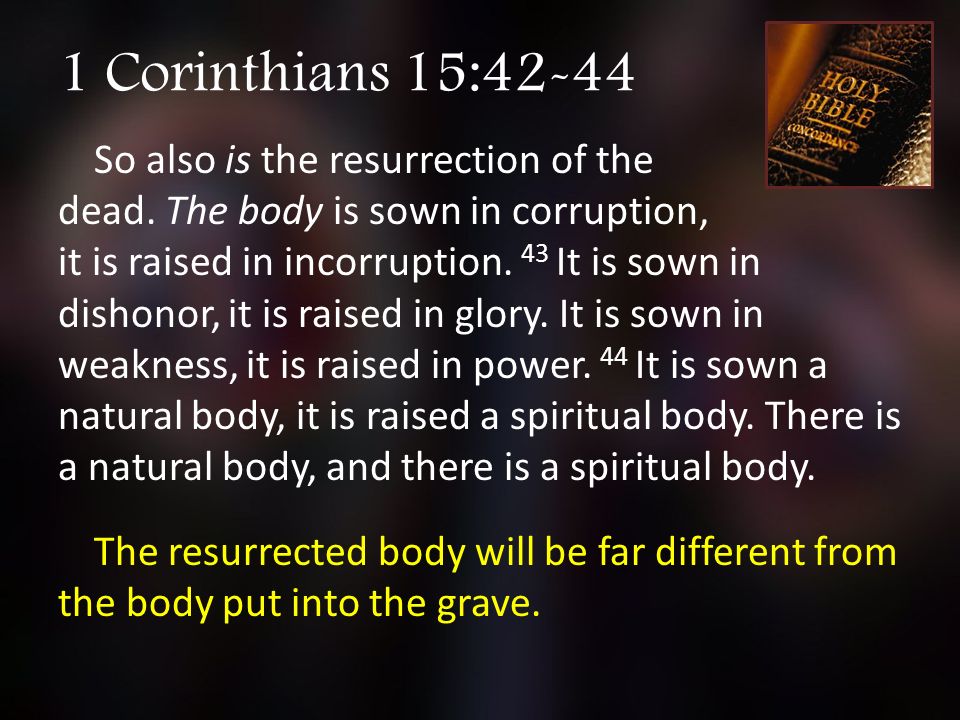
When is the reaping of this text? In the present life? In the afterlife? Or, in both? The latter no doubt. Those who sow to the flesh will reap "corruption" in this life and in the afterlife, yea, even forever while an inmate in the fiery prison of Gehenna (i.e. in the lake of fire). Of the righteous dead it is said that "the body is sown in corruption, it is raised in incorruption." (I Cor. 15: 42) But, with the wicked dead we may say "the body is sown in corruption, it is raised in corruption." Likewise, of the righteous it is said "It is sown in dishonor, it is raised in glory." (vs. 43) Of the unrighteous we may rather say "It is sown in dishonor, it is raised in dishonor," it lacking any glory. (vs. 43) Likewise, of the righteous it is said "It is sown in weakness, it is raised in power." (vs. 43) But, of the wicked it may be said "It is sown in weakness, it is raised in weakness." Likewise, of the righteous it is said "It is sown a natural body, it is raised a spiritual body." (vs. 44) But, as regards the wicked dead, we may say "It is sown a natural body, it is raised a natural body."
Another text which we have previously cited and which also speaks of the resurrection of the wicked dead is this text:
“Marvel not at this: for the hour comes, in which all that are in the tombs shall hear his voice, and shall come forth; they that have done good, unto the resurrection of life; and they that have done evil, unto the resurrection of judgment [damnation—KJV].” (Jn. 5:28-29)