Sunday, August 31, 2025

Two Seed Baptist Ideology (XI)


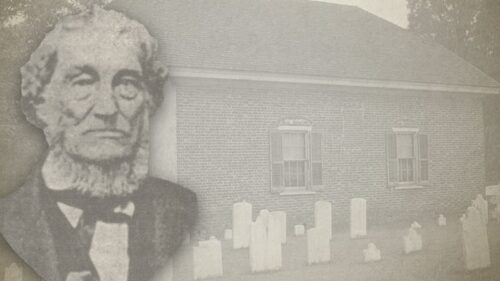
The above picture is of Elder Samuel Trott in his late years and the church building I assume is the old Welsh Tract Baptist Church which was constituted in 1701 in Wales (England) and moved to America and set up church in 1703 in Delaware and became one of the five churches who formed the Philadelphia Association of Baptists, the oldest in America. Trott pastored this church for a while. As we have stated before he was a leading writer for the first Hardshell periodical "The Signs of the Times," and agreed with Beebe on "eternal vital union," though he disagreed with Beebe on the nature and fall of angels and on Beebe's acceptance of the doctrine of "eternal justification," the idea that the elect were justified from sin from eternity. He also agreed with Beebe in saying that Christ had three natures rather than two. With these introductory remarks, I will begin this chapter with what Trott said on the preexistence of the elect in his article titled "Thoughts on Eternal Justification" and published in the Signs of the Times for Nov. 22, 1837 with the ending - Centreville, Fairfax County, Va., July 18, 1849.

Wrote Trott (highlighting mine):

"My first objection to the term "Eternal Justification" as used by my brethren, or to the sentiment that the justification of the elect was an act of God passed in eternity, grows out of that prominent sentiment embraced in our Old School stand, namely: that a "Thus saith the Lord" is requisite to justify us in what we believe as well as in what we practice. I do not mean by this that the doctrine must always be expressed in the Scriptures in so many identical words. The doctrine of the "eternal union" of Christ and His people is not, that I know of, declared in just so many words in the Scriptures, yet I think this doctrine is therein clearly revealed. For instance compare Heb.2:11, "For both He that sanctifieth, and they who are sanctified are all of one for which cause He is not ashamed to call them brethren," with Rom.8:29, "For whom He did foreknow, He also did predestinate to be conformed to the image of His Son that He might be the first-born among many brethren," and they show that the oneness or the union is of as old a date as the predestinating decree of God; and that we know that from Eph.1:4 & 5, to have been from before the foundation of the world. Inference is thus plain, because according to Heb.2:11, Christ recognized His people as brethren on the ground of their oneness with Him; and according to Romans 8:29, the predestinating decree of God recognized them as the many brethren among whom Christ was first-born. This doctrine is also taught by the several figures by which the union is illustrated in the Scriptures. For instance, in the figure of the creation of Adam and Eve. As Eve was of Adam's body, of his flesh, and of his bones, so the church is of Christ. (See Eph.5:25-32) Eve was created in Adam in his original creation. Gen.5:1 & 2. That the figure as used by the Apostle may hold good, we must therefore admit that the church was brought forth and set up in Christ, her head, when He was brought forth from everlasting, when there were no depths, &c. Prov.8:23,24. The same is further confirmed by the general doctrine of the gospel such as that they were chosen in Him, &c. Eph.1:4. I would here remark that the doctrine contained in this text is not that they were chosen into Christ; but chosen in Him."

Most of those Two Seed Baptists who believed in the preexistence of the souls of the elect, and in "eternal vital union," also believed in the doctrine known as "eternal justification." Trott, however, is an exception. He does not believe in the latter but does believe in the former.

Trott also admits that there is no scripture that plainly declares Two Seed ideology. He thinks that it is clearly inferred or implied however in the fact that Adam is a figure of Christ and in the supposition that Eve is a figure of the elect (or the church - Christ' mystical body). That is a weak foundation upon which to build such a fantastic ideology. Two things however disprove the inferences of the Two Seeders on this point. First, Paul wrote:

"Salute Andronicus and Junia, my kinsmen, and my fellow-prisoners, who are of note among the apostles, who also were in Christ before me." (Rom. 16: 7 kjv)

If eternal vital union is true, and if the souls of the elect were already "in Christ" from before the world began, and if they were "created in Christ" when Christ was begotten by the Father (in eternity), then all the elect were "in Christ" at the same time. But, Paul avows the very opposite in the above words. The believers Paul names "were in Christ before me," and not at the same time as he was. 

About vital union with God and Christ, the bible shows that this occurs in conjunction with being "begotten" of the Father, with being regenerated or born again, with having faith in Christ. Wrote Paul:

"Do you not know that your bodies are members of Christ? Shall I then take the members of Christ and make them members of a harlot? Certainly not! Or do you not know that he who is joined to a harlot is one body with her? For “the two,” He says, “shall become one flesh.” But he who is joined to the Lord is one spirit with Him." (I Cor. 6: 15-17 nkjv)

The above text speaks of a believer's union with Christ under the figure of a marital union. This is one of the several figures used to describe the union of a believer with God, Father, Son, and Spirit. Other texts that also speak of the marital union that the elect have with Christ are Romans 7: 1-4 and Ephesians 5: 25-33. In the former passage Paul speaks of believers being "married to" Christ. The latter says that it is in being married to Christ that a believer becomes "one with Christ." Union follows being married to Christ. That union occurs when the believer says "I do" in his vows to the Lord. There can be no marriage union where there is not an agreement between man and woman to be one in marriage. The idea of the Two Seeders and other Hyper Calvinists that the marriage union occurs before faith, before the sinner has agreed to be the spouse of the Lord, yea from even before the foundation of the world, is ludicrous. 

In the above text a person is "joined to" a harlot in fornication by that person's choice. So, likewise, when a person is "joined to" his betrothed wife it is also by his or her choice. That is why many saints, including the Hardshells, sing "Oh happy day that fixed my choice on thee, my Savior and my God," being the day when "he washed my sins away." 

Paul also wrote: "That Christ may dwell in your hearts by faith" (Eph. 3: 17 kjv). 

Union with Christ begins when Christ is received and when Christ enters the heart and makes it his temple, and this is "by faith," by agreeing with Christ. Many marriage vows speak of giving "trust" to a spouse, along with vows and promises. In a spouse's vows to her husband, she promises to love, serve, and obey her husband. So too do believers vow when they are converted to Christ. Recall that Paul said the following to the believers in Corinth:

"For I am jealous over you with godly jealousy: for I have espoused you to one husband, that I may present you as a chaste virgin to Christ." (II Cor. 11: 2 kjv)

How could Paul espouse (betroth, or promise, or help get engaged) them to Christ if they were united to Christ in marriage from before the world began? 

Trott wrote the following under the title "REPLY TO BRETHREN: SONSHIP & UNION" (See here; page 303 and written by him July 18th, 1849):

"In my communication, in the 10th number, present volume of the SIGNS, in replying to brother Barton’s query concerning the churches being created in Christ Jesus before the foundation of the world, I took the ground, that the expressions “created in Christ Jesus,” naturally involved the idea that his church was created in his creation, as the Head of his church, and of course, as far back as he stood as her Head. I referred to I Cor.15:45, as sustaining the same idea, and also to Rev.3:14 & Col.1:15 as further justifying the application of the idea of creatureship to our Lord in reference to his headship. It used to be that in the mouth of two or three witnesses every word should be established; but it seems it is not so now. These brethren in replying to that communication, do not notice the text, Eph.2:10 {“For we are his workmanship, created in Christ Jesus, &c.,”} although I founded my main arguments on it. The other three scripture passages above named they notice, and how they dispose of them shall now occupy our attention." (pg. 303-304)

What an absurd proposition it is to affirm that believers were "created in Christ Jesus before the foundation of the world"! When the scriptures speak of being "created in Christ" it refers to what occurs in the life of persons when they believe and repent, when they are converted, when they are regenerated and born again, and not something that that occurred before the world began or before a person exists. Notice these two leading texts on being newly created in Christ.

"Therefore, if anyone is in Christ, he is a new creation; old things have passed away; behold, all things have become new." (II Cor. 5: 17 nkjv)

"For we are His workmanship, created in Christ Jesus for good works, which God prepared beforehand that we should walk in them." (Eph. 2: 10 nkjv)

This passage is senseless if it refers to an event that happened in past eternity. Two Seeders believe, like Arians, that when Paul speaks of Christ being "the firstborn over all creation" (Col. 1: 15 nkjv) and when John records Christ saying - "These things says the Amen, the Faithful and True Witness, the Beginning of the creation of God" (Rev. 3: 14 nkjv) that this refers to Christ being begotten by the Father before the world began, when he was made a mediator and redeemer. When Christ was thus made or begotten so too were all the elect created in him. But, this is certainly not what Paul is referring to by that experience called a "new creation" (Gal. 6: 15). 

What "old things" did Paul say have "passed away" for the believer? When did this occur? If it occurred from past eternity, old things passing away becomes an absurdity. How did things become new? Paul says that the good works that believers are to do were "prepared beforehand" but did not say that believers themselves were prepared before they were born into the world. 

Wrote Trott:

"They ask, “Do the Scriptures give any information of anything being created before the beginning?” If they mean by beginning the beginning of the creation of God; I answer no, for Christ is that beginning. But, if they mean by it, the beginning of time, as in Gen.1:1, I say yes; for in that beginning God created the heavens and the earth, but Christ, being the Beginning of the creation of God, and the First born of every creature, must in this sense have been created or brought into existence before these, and therefore before time. As no other reading has been attempted to be given to these texts, Rev.3:14 & Col.1:15, I still think them good authority as they read. But as they do not satisfy these brethren, I will produce other corresponding texts." (pg. 304)

The words highlighted above are based upon a misinterpretation of the two texts referred to and is the same interpretation that the Arians give of them. Those texts do not say that the Son of God was ever created, but that he is the Creator and all was created by him. We do not want to go into detail on these texts because it would require much space and would be drifting too far from our main focus, which is to define the leading tenets of Two Seed ideology. In short, these texts are designed to show the superiority of Christ over all, the thesis being "that in all things Christ must have the preeminence." (Col. 1: 18)

Wrote Trott:

"I next pass to their notice of the two texts, Rev.3:14 & Col.1:15. They say in reference to them, “We desire to give the fairest construction we can, according to the tenor of truth.” Why not according to the reading of the texts?" (pg. 305)

I cannot speak to the strength of the arguments that non Two Seed Hardshells offered to Trott and the Parkerites, but he thinks they do not give "the fairest construction" or plain reading of the texts. However, it is actually the Two Seed Arian interpretation of those texts that perverts their meaning.

Wrote Trott:

"To return to our subject, we will now notice how this tenor of truth works in reference to those texts. First. In reference to Rev. 3:14, “The beginning of the creation of God.” They quote the text, and without attempting to show that there is any mistake in the reading, or that the word beginning does not properly mean beginning, but beginner, they try to show that the text does not mean what it says. Their modus operandi it is not necessary for me to notice. They next come to Col. 1:15, “The First-born of every creature.” By quoting the following verses, in which in connection with the 15th verse, Paul is giving such a representation of the Son of God and Redeemer as to show that in his complex person, He in all things has the pre-eminence. But they would thereby make the impression that he is not the first-born of every creature, and of course that in this particular he has not the preeminence over his brethren, and is not like them, though verse 18 says, “That in all things he might have the pre-eminence,” and Heb.2:17, reads, “In all things it behooved him to be made like his brethren,” in that they are born of God, and he not according to these brethren, for if born of God he has a derived existence, and therein is a creature in distinction from the self-existent Godhead." (pg. 306) 

Again, no Arian could have stated Arian belief any better. They affirm that the two texts above (Rev. 3: 14 & Col. 1: 15) teach that Jesus Christ as the Son of God is not uncreated or without a beginning. However, Trott, Beebe, and one group of Two Seeders do not deny that Christ is God, but simply say that his being the Son of God, or the firstborn, or the beginning of the creation of God, has to do with him becoming a mediator and the life of his chosen people. Some of them said that this involved Christ being given a human soul when he was begotten some time in past eternity. Others even affirmed that his human body also was created when his human soul was created and when he was begotten as a mediator and redeemer.

Christ being the firstborn has several aspects. One of those has to do with his being from eternity the Son of the Father, or second person of the Trinity. Christ' sonship is unique and is why he is called "the only" begotten of the Father, and who is always in the bosom of the Father. It has to do with his rank, and his being begotten is not to be interpreted as being in every way the same as humans are begotten. 

When Revelation says that Christ is "the beginning of the creation of God" he means the same thing when he says "I am Alpha and Omega, the beginning and the end." (Rev. 21: 6; 22: 13) The Son of God says this several times in the Apocalypse.

“I am the Alpha and the Omega, the Beginning and the End,” says the Lord, “who is and who was and who is to come, the Almighty.” (Rev. 1: 8 nkjv)

"And when I saw Him, I fell at His feet as dead. But He laid His right hand on me, saying to me, “Do not be afraid; I am the First and the Last." (Rev. 1: 17 nkjv)

In Isaiah God says more than once - "I am the first and the last" (Isa. 44: 6-8; 48: 12). Therefore, being "the first," or "the beginning," does not mean being the first thing created. Both the Father and the Son confess that they are "the first and the last" or "the Alpha." Both therefore are God. Further, in Rev. 1: 8 Jesus says that he is "the Almighty." Ergo, being "the beginning" of all things does not mean that he who is such is a created being. 

If Christ being the "beginning of the creation of God" or the Alpha of creation, means that he was, in his divinity, created, then by the same rule we must say that his being "the ending" or "the last" must mean that he ceased to be God and to exist. 

Wrote Trott:

"And it is evident that the dispute about these texts, is no longer between me and them, but between them and the Holy Ghost. The Holy Ghost says that Christ, is the beginning of the creation of God, and the Firstborn of every creature, and that his people were created in him, &c.; they, in effect, say it is not so. Hundreds of other texts might be named on which the same dispute would arise; but I will forbear." (pg. 307)

Notice the Two Seedism and the error of the preexistence of the souls of the elect. Though, as we will see in upcoming chapters, Beebe wants to backtrack and say that he has never taught the idea of "eternal children," which is not the case. The view of Trott as stated above is also the view of Beebe as we have seen from the several citations I have given from him on the same theme. "His people were created in him" affirms that the children were created some time in eternity past when Christ was made a mediator and when he was begotten. Further, the two texts in dispute do not say that the children of God were created when Christ was created. That is read into the passage. Also, as we have seen, those two texts do not teach that Christ is a created deity.

Wrote Trott:

"The life with which we believe the soul is quickened is Christ – Christ in you the hope of glory. Col.1:27 & 3:3,4. Christ who is the Son of God, the only begotten of the Father, full of grace and truth; begotten or created in the Word, and his people in him, and thus ever existing in personal union with the Godhead, both from eternity, and as he is manifested in the new birth in the believer, as he says, “As thou Father art in me, and I in thee, that they also may be one in us.” Again, “I in them, and thou in me, that they may be made perfect in one.” John 17:21,23. Thus Christ our life existed as the Head and Husband of his church, before the heavens were planted, or the foundations of the earth laid, in the secret place of the Most High, in the shadow of God’s hand, and as one with God, and therefore as God whilst he is the Son of God. Hence when persons are born again, born of the Quickening Spirit, they are manifested as members of Christ’s body, as his seed, and through him – the only begotten of the Father, they are born of God, and are the sons of God." (pg. 308)

Here is another error in interpretation by the Two Seeders. Both Beebe and Trott will argue that "the life" or the "eternal life" is Christ, but that is not what the several texts in the new testament mean when they speak of believers being given eternal life. Yes, Christ is said to be our life, and Christ said that he was the Way, the Truth, and the Life, but being given life ordinarily means simply the opposite of being dead. Notice also the further Two Seed declarations. Notice also how this Christological view of the Arian Two Seeders has led them to believe in the heathen doctrine of the preexistence of souls and to drastically alter what occurs when a person is born of the Spirit. We have already in preceding chapters spoken of some of these alterations. Notice the word "manifested." This is a favorite word with the Two Seeders. Being born again did not make a person a child of the Father but only manifests that he was a child of God, having been such from eternity. Union with Christ is not by faith but only manifests a prior vital union. These are the results of the slippery slope of Two Seedism.

Wrote Trott:

"Another wrong representation of my views, and the views of others, is found in their having throughout their communication, spoken of our views, as though we held that Christ as the Head of his church existed personally distinct from God and therefore distinctly as a creature. Where as we have never admitted that as a person he is a creature, but on the contrary, whilst we say that as man he was a creature, and that as Son, or as the Head of his church, or as Mediator, and Christ he is a creature; that is, that the existence in him which constituted him these, was not self-existent, but was brought into existence of God, yet that he took both of these existences into union with himself as God, the latter in eternity, the former in time, thus existing as God, as the Son of God, and the son of man, in one complex person. He thus exists as a distinct person, having distinct personal qualities from the Father and the Holy Ghost, but one with them in the Godhead, thus constituting him a fit and adequate person to be the one Mediator between the one God, and men." (pg. 309) 

This is why I do not call Beebe's and Trott's views on being created or made "the Son" Arianism but semi Arianism. Arians deny that Christ is in any sense the uncreated God. Two Seeders, however, retained a belief in the divinity of Christ, that as God he is uncreated. But, they do believe that Christ as "the Head of his church, or as Mediator," is "a creature." As stated in previous chapters Beebe and Trott believe that Christ has three natures, a divine, a human, and a mediatorial nature. 

Thursday, August 28, 2025

Two Seed Baptist Ideology (X)


In this chapter I will give additional information from two major apologists for the foundational Two Seed tenet involving the preexistence of souls and of the eternal vital union of the souls of the children of God with God their Father. We pointed out in previous chapters how these ideas did not originate with Daniel Parker, the one who introduced and promoted his idea of the "Two Seeds" in the early nineteenth century. Gnosticism and Manichaeism and Platonism all held to this belief, a belief that has no foundation in the Christian scriptures. I have also traced the idea of "eternal vital union" of all the elect with the man Christ Jesus from past eternity, to men like Joseph Hussey, Isaac Watts, Karl Barth, etc. Many of these men were Hyper Calvinists, and Two Seedism borrowed a lot from Hyper Calvinism in addition to Gnosticism and Manichaeism.

We have noticed how Elder Gilbert Beebe and not Daniel Parker was the leading promoter and apologist for several of the foundational ideas of Two Seedism. In previous chapters we quoted from Beebe wherein he promoted his belief in "eternal vital union" and the preexistence of the souls of the elect from James 1: 18 and Hebrews 2: 14. I also have given a few of the philosophical arguments offered by Two Seed apologists for these tenets, such as in this syllogistic line of argument:

Syllogistic Argument 

Premise One: Christ has always been a mediator on behalf of the elect 

Premise Two: Christ cannot be a mediator without being human 

Conclusion: Christ has always been human (even before his incarnation)

Syllogistic Argument 

Premise One: Christ has always been the head of the church (the elect)

Premise Two: Christ must be human in order to be such a head

Conclusion:  Christ has always been human

We could give more syllogisms that were offered by Beebe, Trott, and other Two Seed apologists but these are sufficient for now. In this chapter I want to provide a few more apologies for Two Seedism by two of its best defenders, Gilbert Beebe and Samuel Trott. We do this because we have several audiences in mind as we write. On one level we write for the layman who wants a Reader's Digest or Cliffs Notes version of the history of Two Seedism in the Baptist family. On another level we write for the historian who wants more detailed information and more source material.

We will begin with Beebe and his article titled "VIRTUAL UNION VS. ACTUAL UNION" for the "Signs of the Times" for March 1, 1860 ( or see the "Editorials of Elder Gilbert Beebe" – Volume 4; See here). In that article Beebe wrote (all emphasis mine):

"We have read some very labored articles which have been written against the doctrine of eternal, vital union of our Lord Jesus Christ and his mystical body, the church, in which the writers have attempted to draw a line between what they call a virtual eternal, and an actual eternal union, admitting the former, but denying the latter. Some of the less discerning of the saints have become perplexed, and we have been frequently called on to define the difference."

These words show us that one of the most important points to discuss in Christian circles, and especially among Two Seeders and other Hardshell "Primitive" Baptists, i.e. the kind of union, if any, the elect had with God or the Son of God, or Christ the "God Man" of Hussey, et als, from eternity past, or before the world began. Could a union exist if one of the parties does not actually exist? The subject of union has historically been an area where many "Primitive Baptists" have lacked understanding and entertained errors. Many today, however, hold that "vital union" between an elect man and the Lord is not created until that man is "regenerated." These modern day Hardshells believe that the regenerated man may not become a believer in Christ and the Gospel. These say a sinner may be born again and not even know that he has been reborn. 

The idea of a vital (pertaining to life) or actual union of the person of Christ and the person of a man from eternity past is another debatable point. Elder Watson, as we have seen, attacked this idea voraciously as did other non Two Seed Hardshell Baptists. Further, as we will see, Elder Beebe in his later years seemed to have revised his views on this part of debate. That is in large part due, in my opinion, to the fact that Two Seeders were gradually losing influence and followers as the end of the nineteenth century neared and some of them sought to revise their views so as not to lose further the non Two Seed Hardshells.  

Wrote Beebe:

"What kind of life does God give to his people? Is it eternal, or is it only time-life? John says, “This is the record that God hath given us eternal life.” – 1 John v; and Jesus says, “I give to them eternal life.” Many other express declarations of Scripture prove that the life given to the children of God is eternal, and consequently did as fully exist before they individually and experimentally received it, as afterwards. If it did not exist before it was implanted in us, or communicated to us by the new birth, then why is it called eternal? The eternity of it is attested by the declaration that it was with the Father and was manifested. (1 John i.)...To us it is very clear that if this union of the life of the church in Jesus Christ existed in him before the world began, it was more than a speculation; that it was a reality. If it was not then a reality, a fact, what is there in the communication of that eternal life to us experimentally in the new birth, that can make the life what it was not before we were made to feel its power?" 

Beebe makes a gigantic unwarranted inferential leap when he thinks that the affirmation that the spiritual life that is given in regeneration or spiritual resurrection, because it is eternally in and of God, must therefore conclude that the ones who are given eternal life in time (in regeneration) simply receive their uncreated spirits. 

Likewise, to affirm that because I am the "seed" of my father I therefore existed in my father as a person with a soul and body, is ridiculous. But, on that we will perhaps have more to say in a later chapter.

Wrote Beebe:

"If the work of the Spirit in the new birth is the action which makes this union actual, then we set aside the reality of grace given us in Christ before the world began, and instead of the gift of God is eternal life, we should read it, the gifts of God, there are as many distinct gifts as there are members in the body."

Here Beebe denies that in being born of God that an actual vital union was effected. He affirms that an actual vital union existed before one was born of God, yea from eternity. This is a complete denial of what the bible says about union with God and his Son. That union does occur when one is born of God by faith. Believers are united to Christ by faith. 

Wrote Beebe:

"Much confusion prevails where brethren confound this vital union with our individual experience of it when brought into it. The union, spiritually, was as perfect before we were brought experimentally into the enjoyment of it, as it is now, or ever will be." 

Again, this is a severe departure from traditional and historic Baptist doctrine, and from orthodoxy. Yes, we have a union with Adam, and with our ancestors, but this union is seminal and representative, and not an actual vital union (for that can only exist where persons actually exist). Beebe and his cohorts read way too much into Paul's statement that Levi was in Abraham when the latter met Melchisedec and gave tithes to him, and said that Levi therefore also paid tithes to Melchisedec. Beebe's reasoning would lead us to say that we are guilty or favorably rewarded for all that our ancestors did. Was I married to my mother when my father married her? Of course not. Of course all men had a representative union with Adam before they were born. They also had a seminal union with him, because we are of his "seed" or sperm. In fact, every plant was in some sense "in" the very first seed. 

In another article by Beebe titled "ETERNAL GENERATION" from the Signs of the Times (Editorials of Elder Gilbert Beebe – Volume 4 pg. 174; Feb. 15, 1860; See here), Beebe wrote:

"That he is the Son of God, the only begotten of the Father, full of grace and truth, and that he was the Son of God before he was sent into the world, and is the same yesterday, today and forever, and that he who is the Son of God, is also the eternal, underived, independent God, we also firmly believe. That in his Mediatorial union with his body, his church, he is the only begotten of the Father, while in his supreme Godhead, he is the fullness of the Godhead, underived and unbegotten."

This stated belief of Beebe is the reason for many non-Two Seeders to accuse Beebe of being "Arian." In an upcoming chapter we will cite at length from Elder Grigg Thompson on this point as well as Elder John Clark, both of whom lived in the nineteenth century and were first generation Hardshell Baptists. Beebe denies that by being the "begotten" Son of God he is God. He does not deny that Jesus is God, but denies that his being begotten by the Father is the reason he is God. He says that Christ was eternally begotten but that this begetting was in order to make him the Mediator of his mystical body (the church).

Wrote Beebe:

"And as the earthly Adam is the figure of the heavenly Adam, (Rom. v. 14; 1 Cor. xv. 47, 48,) we infer that the seed or generation of Jesus Christ the Son of God, is just as ancient as his Sonship. That is, we cannot from the Scriptures learn that our Lord Jesus Christ held the office, or occupied the position of Mediator, before the eternal life, which was with the Father, was given to us in him. That this is what constitutes the relationship between Christ, the seminal Head, and his seed, the Progenitor and the chosen generation."

That is basic Two Seedism as it respects the origin of the elect. This statement of Beebe also reminds us of the teaching of Hussey and others who taught that Christ's human soul was begotten before the foundation of the world or from eternity. However, no believer since the days of Christ has had a physical connection with Christ, i.e. have not a "seminal" union with him. The ancestors of Christ, through Mary and not Joseph, have a physical connection or union with Christ. Christ is said to be the "seed" of Abraham and David, but no physical human sperm from Joseph begat Christ. He is unique in this respect and is why he is the seed of Eve, or "seed of the woman." (Gen. 3: 15; Rev. 12)

In the above affirmations of Beebe we see that he believes in what is called "eternal children." This is important to note here and remember, because as we will see later, Beebe seemed surprised that some would say that he believed in "eternal children." He plainly says, however, in the above citation, that the people who are the seed or generation of the Lord have always existed. 

Wrote Beebe:

"We believe there are some who have held the idea that the flesh of our Redeemer, in which he was born of the Virgin, which suffered on the cross, was laid in the tomb, and which was raised from the dead, was begotten and brought forth by what they call an eternal generation, and so existed a human body and soul, from the ancients of eternity. If that theory be true, we have not so learned it, and must wait for clearer light on that subject. If what is called the humanity of Christ was so generated and did so exist before all time, then, instead of his assumption of our flesh, instead of his taking on him the seed of Abraham, or being made of a woman in his advent to this world, the whole race of mankind must have assumed his human nature when they were born of the flesh."

These words seem to disavow the view of Hussey and others about the preexistent human soul of Christ, it being begotten when the Son of God was begotten in eternity past. Beebe alludes to those who believed that not only the human soul of Christ predated his incarnation, but so too his physical body. Those who held to this view argued that the pre-incarnation appearances of Christ in the old testament proved this. Beebe rejects that view. Yet, he does believe that Christ existed as a human in eternity. He has argued in numerous places, as we have seen, that Christ having been begotten by the Father had to do with Christ becoming a mediator, and also argued that Christ must be a man in order to be a mediator. He opposes the idea that Christ existed in eternity past with a "human body and soul," but he does not seem to deny that the human soul of Christ existed when he was begotten. 

Consider also the fact that Beebe, in defining and defending the idea of the union of the Son of God with the elect, from eternity, has often said that, like Eve was to Adam, "bone of his bone and flesh of his flesh." He has also argued that the elect have a "seminal" union with Christ in the same way they have it with Adam. So, though he is denying that Christ's human body and soul preexisted his incarnation, it is simply a contradiction against what he has stated elsewhere. The words of Beebe do not deny that the human soul of Christ existed when he was eternally begotten of the Father, but denies that the flesh or physical body of Christ was likewise eternally begotten.

Further, as the syllogism at the head of this chapter says, Beebe and the Two Seeders often argued that Christ had to be both God and man in order to be a mediator between them, and since he was a mediator before his incarnation, he existed as a man before his incarnation.

Wrote Beebe:

"Another, to us, equally untenable theory, called eternal generation of the Son of God, sets forth, that his supreme Godhead is a derivative Godhead; that it is not original, self-existent, independent and eternal. This theory, as it appears to us, seems to deny all that is essential to his Godhead. How can we conceive of absolute Godhead that has descended by generation or otherwise from any producing source higher than himself? That Christ exists in a Sonship which is begotten of the Father, is clearly demonstrated in the Scriptures, and confirmed by his own declarations, but this we understand to be in relation to what he is as Head and life of his church."

Beebe accepts the words "eternal generation of the Son of God," but not in the orthodox sense, as denoting the divinity of Christ, that the Father and Son were of the same essence or substance, the same in kind. He believes that Christ being eternally begotten had to do with his being not only the mediator but the "head and life of his church." But, he has affirmed that being a mediator requires that he be human. Therefore, he cannot escape affirming that Christ had a human existence prior to his incarnation. 

Wrote Beebe:

"This doctrine of a begotten Godhead is, to us, equivalent to a denial of his Godhead in all but a nominal sense."

Again, this is what the Arians taught. They said that God cannot be begotten. Beebe however believes that Jesus is God, unlike the Arians. That is why I have said that he and his ilk are better labeled as semi Arians. 

Wrote Beebe:

"The argument, that the son is as old as his father, that a father cannot exist without a son, is quite too feeble to bring conviction to our mind. Stripped of all artificial verbage, the naked question returns; Is Jesus Christ absolutely, eternally, independently, underivedly, the very supreme and eternal God? To this question we emphatically answer, Yes!"

As we saw with the view of Hussey and others about the "God-Man" there seemed to be a connection between believing in the preexistent soul of Christ and a denial of Christ's being begotten as the Son of God in respect to his divinity. Many of today's Hardshells do not realize how many of their founders held heretical views on the Trinity, some like Wilson Thompson were Sabellians or Modalists, others like the Two Seeders were akin to Arians in their belief that Christ' being begotten of the Father denoted an inferiority to the Father. These simply did not properly understand how Christ being "eternally begotten" of the Father affirmed the Son's equality with the Father and did not denote inferiority. As we have seen, Hussey and other Hyper Calvinists of the early eighteenth century believed just as Beebe and said the exact thing he said in the above citation.

Christ is the Son of God in more than one sense. In a posting on this question I cited from David Schrock from an essay published in the Gospel Coalition web page who delineated the ways in which Christ is the Son of God. 

Wrote David Schrock (emphasis mine):

"More specifically, Christ himself receives the title “Son of God” in at least 4 ways. He is the “son of God” in the sense that he fulfills the role of (1) Adam, (2) Israel, and (3) David. Yet, beyond being a covenant mediator who supersedes these previous “sons of God,” Jesus is also the (4) divine Son. Clearly, we can see why this title is “sometimes misunderstood.” (AN ESSAY BY David Schrock at the Gospel Coalition web page here and previously cited from me in this post here)

I have written several posts where I document how many of the first leaders of the anti mission movement and Hardshell or Primitive Baptist sect were deniers of the Trinity. Some were Sabellians and some were Arians. (See here and here and here) I also have cited from Dr. R.E. Pound, himself a believer in some Two Seed principles, and historian of the "Primitive" or "Old School" Baptist sect (who passed away a few years ago and his excellent web page is not now available). I cited Pound in an article titled "Dr. R. E. Pound on Hardshell Factions" (See here) who said:

"In those days the Old School brethren were in three groupings on theology: 1. The Delaware River and the Warwick, Samuel Trott, grouping, the deniers of Nicenism; 2. The Ketocton association, with John Clark, the followers of Niceinism; 3. The followers of Wilson Thompson, a Sabellian, who denied that the Father and the Son entered into an eternal covenant because these were not two distinct Beings, but only personalities of the One Divine Being. It seems to me that at the first, these divisions among the old schoolers was not over absolute predestination, but OVER NICENISM."

What Beebe, Trott, and other Two Seed Baptists did was to follow Hussey et als in their belief that Christ preexisted his incarnation in a sense separate and apart from his divinity, and who saw his being begotten before time as either his becoming a man with a human soul, but not a human body, or becoming a Mediator and Head of his people. 

As I have stated previously, Beebe and Trott believed that Christ had three natures, not two, as the orthodox view asserts. Christ had a human nature and a divine nature. But these Two Seeders said that the third nature was his nature as a mediator and head of the church. Wrote Trott (as cited by me here):

"In John 1st, as already noticed, we have the three natures, "The Word was God;" again, "In Him was life;" again, "The Word was made flesh," verse 1,4 & 14. In Isa. 9:6, we have A child born and a Son given, are not these distinct?"

In that same article I cite these words of Trott addressed to Elder John Clark who opposed him:

"They hold that His sonship relates to His Godhead, so that He is no otherwise God than as He is begotten of the Father; I deny this as contradictory to His being equal with the Father, and to His being the independent and self-existent God; and in distinction, I hold that His sonship consists in His being begotten of the Father as the Head of His church and life of His people and that they thus, in their spiritual life, were begotten in Him and proceed from Him, and that He is the "first born among many brethren" Rom.8:29."

Christ' being eternally begotten of the Father therefore does not relate to his divine nature but to his becoming possessed of a third nature.

Monday, August 25, 2025

A Brother's Comment

Yesterday I got the following comment from brother Paul Jacobs on my recent post titled Blog News Update. In that posting I wrote:

"I desire that my learned preacher brethren would let me know if they disagree with views on something, for I do not want to be wrong. But, I think my points (propositions) are so well defended that very few want to challenge me on them."

Wrote brother Jacobs:

"My name is Paul Jacobs, I say that because my email didn't work. I just want to say to both you and Steven that I have enjoyed this blog for many years now, they have been a joy to my soul. I have been reading through the regeneration before faith series and was shocked to see no comments, for this reason and the proof text I must declare Steven the winner. The opposition has no defense and thanks my brother for all the long hours and dedication you have put into your work."

Your brother in hope Paul Jacobs

To brother Jacobs I say thank you for your encouragement and support. We the editors of this blog are glad that we have been used by the Lord to edify many of the saints and perhaps have even been a means in bringing lost sinners to Christ. 

About no comments on the series I did on the ordo salutis, I also have thought about the reason for no comments. I have had other series where I got comments, such as on one of the postings on the White Horse Rider. I even asked the readers, many of whom are Hardshell Baptists, to correct me if I'm wrong, as the above words I cite from me say. But, I wrote a short article titled No One Wants To Defend It in regard to this lack of rebuttal from the born again before faith folks. One preacher brother, a "Primitive Baptist," and I carried on a lengthy private debate via e-mail on this question and I wanted to publish it but he didn't want it published. Years ago I challenged James White to debate whether regeneration precedes faith. He declined. He thought I was just a protege of Bob Ross, a man who often took him to task over his affirming regeneration before faith. White is a good debater, except on this issue.

So, I agree with your conclusion brother Jacobs. They did not answer because they could not answer it. So, they lose the debate as you said. I was on the college debate team and know something about how to judge debates. If your opponent ignores your arguments, he automatically loses the debate on those arguments. In CEDA debate this is called "dropping" the argument, and you lose the particular argument you failed to respond to. We were taught to make a "flow chart" during the debate where we listed every argument given and the responses (rebuttal) in columns titled "first affirmative," "first negative," etc. A "drop" is where an argument no longer is rebutted, being no longer responded to, a kind of "giving up" on the argument. This is what the Hardshells have done in their dialogues with me. 

Seventeen years ago when I first began writing in blogs, I began to get feedback from several Hardshells, who often would take pot shots and make nasty remarks about me, but who would not engage in gentlemanly and Christian discussion. Hardshell Jason Brown, who I respect, and I did carry on a debate in this blog back when we started this OLD BAPTIST TEST blog. You can read them for postings in the archives for the year 2011 into the year 2012. He even at that time started a blog titled "Primitive Baptist Apologist" - "A blog devoted to the excesses of Stephen Garrett's critiques of the Primitive Baptists." (See here) Well, who won the debate? He gave up and ended the debate. Further, he has not written anything in the above blog since he started it in 2011. He does periodically leave a comment but not in quite a while.

If any of the readers of my writings on any of my blogs read something they believe is a misinterpretation of scripture, I invite them to tell me so. We invite discussion from all our readers on any subject or text we write upon. I often wonder what our Hardshell brothers are afraid of when it comes to having a discussion on soteriology, the ordo salutis, or any other bible topic. 

I sometimes close out an article by saying "what think ye?" I do that again. I desire feedback, both pro and con. I also invite brother Jacobs to write an article for this blog about his thoughts on the ordo salutis series or other articles on other subjects, and tell us about his religious affiliation. He can send them to me via email and I will publish them under his name. My email address is in my blogger profile.

Saturday, August 23, 2025

Two Seed Baptist Ideology (IX)


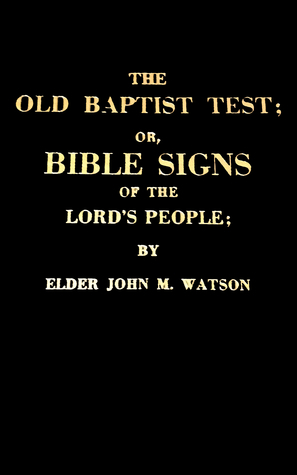
In the previous chapters we have investigated several of the leading propositions of those known as "Two Seed Primitive Baptists." We have cited extensively from the above book by Primitive Baptist leader Elder (Dr.) John M. Watson who lived in the Nashville, Tennessee area in the early to mid nineteenth century. When I was a young Primitive Baptist preacher I visited with the churches in that area, many of which were once pastored by Watson. He was an opponent of Two Seedism and the first part of the above book addressed the heresies of the Two Seeders. On page 190 we have the title "A REFUTATION OF THE MANICHEO PARKERITE HERESY THE IMPERFECTION OF ALL CREATED THINGS THE SOURCE OF EVIL." (See here) He refers to Two Seedism as "the Parkerite heresy" (pg. 191).

Throughout the nineteenth century the newly formed "Primitive Baptist" or "Old School" Baptist church had a large segment who believed in some or all of the leading tenets of that heretical system. In our writings thus far (all now being published together in a blog titled "Two Seed Baptists") I have cited from such leading "Primitive Baptist" elders as Sylvester Hassell, Hosea Preslar, William Conrad, Lemuel Potter, etc., who agreed with Elder Watson concerning how deep was the Two Seed Parkerite infection within the newly formed Hardshell Baptist confederacy. Wrote Watson:

"...our course will be to discuss such things as are producing distress and divorcement among us; for it is both well known and painfully felt by the Baptists of this Association, and the Old Order generally, that many hurtful and untenable notions, unsustained by the word of God, with nothing for their support, but mere Parkerite perversions, have been, for a long time, gaining strength and consideration among us, against which we now protest plainly, yet charitably." (pg. 191-192)

Writing in "The Gospel Messenger" of 1894 (as cited by me in another posting - See here) Sylvester Hassell testified:

"...the heathenish perversions of Scriptural truth set forth by Eld. Daniel Parker, of Tennessee, about 1835, in his pamphlet called "My Views on the Two Seeds," have corrupted Primitive Baptist doctrine more, and rent off more members and churches from our fellowship, than any and all other causes combined...May it please the God of Israel soon to dispossess all their minds of the blighting Satanic delusions with which their churches have been cursed for nearly sixty years."

In that same article he also said:

"It would be impossible to tell how many changes and forms, each one inconsistent with itself, with the others, and with the Scriptures, Two-Seedism has assumed during that period...this heathen corruption of the gospel that has, for sixty years, poisoned, hardened, chilled, confused, and divided the Church of God?"

Throughout this series I have on several occasions had reason to say that there were differences of opinion among Two Seeders. For instance, some believed the Devil was uncreated, while others rejected the idea of an eternal Devil. Some denied that the non-elect had souls, while others rejected that idea. Some denied the resurrection of the bodies, while other Two Seeders believed it. This is what Hassell meant when he spoke of the "many changes and forms" of "Two-Seedism." The one idea that they all held to most firmly however was the belief that the elect, or "seed" of the Lord, always existed in Christ, even from eternity, in the doctrine of the eternal vital union of Christ and the elect.

Watson lists some of the leading errors of the Two Seeders when he wrote the following agenda for his rebuttal against them, giving his views in opposition to them:

"As we have to shape our address according to the subjects of controversy among us, we will proceed according to the following order: to show,

1. That the imperfection of all created things is the source or origin of evil, and not an eternal principle of evil, or an eternal Devil.

2. Prove that all the human family, elect and non-elect, fell in Adam, in opposition to the Parkerite notion, that only the elect, or Church, fell in him! and give an exposition of the two texts of Scripture which they quote in confirmation of that error.

3. Set forth the Scriptural account of the different kinds of Union between Christ and His people, contradistinct to the Parkerite view of the subject.

4. Offer an exposition of the revealed doctrine of the change and resurrection of our natural or mortal bodies, in opposition to the fallacy of the non-resurrectionists.

5. Conclusion. We will now consider our first proposition-that the imperfection of all created things is the source or origin of evil, and not an eternal principle of evil, or an eternal Devil!" (pg. 192-193)

Wrote Watson about the various tenets of Two Seedism:

"Let us, then, make out a synopsis of the Parkerite creed:

1. They believe there is an uncreated, self-existent and eternal God, infinite in Wisdom, Power and Holiness.

2. They believe there is an uncreated self-existent, eternal Evil Spirit, or Devil, intelligent, wicked, cunning and antagonistic to God.

3. They say that the soul of Christ is uncreated and eternal.

4. They fancy that the souls of the Children of God, or the Elect, are uncreated and eternal, and were always in actual union with God.

5. They contend that all the souls of the Children of God were infused into Adam, and pass, by a procreation of human bodies, into the persons of the elect.

6. They assert that the reprobates have no souls, and that their bodies are a multiplication of the woman's conception for the reception of a connate Satanic seed, uncreated and eternal, instead of souls, with which Satan was eternally united.

7. They affirm that, at death, the soul returns to God, and the seed of Satan to him.

8. They deny the resurrection of the bodies of the just and unjust." (pg. 229)

In response to these errors Watson wrote:

"The third article confounds Christ's soul and his divinity, and involves the untenable notion that Christ suffered in his divinity when he made his soul an offering for sin, and when his soul was exceeding sorrowful unto death. If the soul of Christ be uncreated, unoriginated and eternal, it is nothing less than divinity itself."

This is what we have already stated relative to this idea of being "eternal children" of God. It makes little gods of them all. The bible teaches, however, that men are created when conceived and born, this being the time when they came into actual existence. When they believe in Christ and turn to him they are created anew, becoming "new creatures in Christ." (See II Cor. 5: 17; Eph. 2: 10) But, if being saved is simply defined as becoming possessed of the soul or spirit of an eternal child of God, how is that a new creation? Two Seedism, as we will see in chapters dealing with its views on "regeneration" or "rebirth," has all kinds of problems explaining how an eternal spirit can experience regeneration. This led them to embrace what was called the no change view of regeneration, or "hollow log" regeneration.

Wrote Watson:

"Their fourth proposition that human souls are uncreated and eternal-blends them, in such a manner, with the divinity of God, that it is impossible to distinguish between them. Then, strange to tell, after they have been infused into Adam, they fall in him, become dead in trespasses and sins, roll sin under the tongue as a sweet morsel, and drink in iniquity as the ox doth water. Divine souls, uncreated souls, souls blended with the divinity of God, become thus defiled, by Satan and sin, until comparable to a cage of unclean birds! What absurdities! Human souls are certainly not of the high order ascribed to them by Parkerites, but a part of God's creation, and were capable of transgressing the Law of God, and taking the ruinous course of sin which we have just seen. In what way we are personally endowed with souls has not been revealed, and as no physiological researches have ever solved the problem we shall not attempt it." (pg. 230)

Yes, Two Seedism is an absurdity. What purpose did God have in creating human beings and placing within some human bodies his eternal children, children who from eternity were divine, holy, and perfect? Especially if there is no resurrection of their bodies? God is then seen as planting his children into bodies knowing that it would make them unholy! This makes regeneration a case where eternal holy spirits are made degenerate! Many Two Seeders affirmed that the eternal spirits of God's children experienced no change in regeneration, and no change to the body either. The only change that they acknowledged is that this implanting created a conflict between the flesh and the implanted spirit.

Wrote Watson:

"Nor is this all; it goes forth with a hard spirit here; has, of course, no sympathy or concern for the children of the devil: hints that prayer is useless in our pulpits, or elsewhere; dries up the sincere milk of the word; poisons the strong meats of the gospel; and confusion, contentions, disunion and chilling winds of doctrine follow in its serpentine wake! This is Parkerism, when stript of its Pagan patches, of its semi-christian garments, and made to stand forth in all its naked ugliness!" (pg. 233)

Today's Hardshell "Primitive" Baptists still retain remnants of Two Seed ideology, as I have stated in previous chapters and writings on Two Seedism. I have shown how it was Two Seedism that first proposed that the word of God or the gospel was no means in regeneration and today's Hardshells still hold to this idea. They also hold to a view of regeneration that has little or no change, for they tell us that people in heathen lands are regenerated even though they know nothing of Christ, or if they do, reject him and yet are born of God. They also retain remnants of Two Seedism in that they have that "hard spirit" that Watson mentions, wherein there is "no sympathy or concern for the children of the Devil," and that think "prayer" for sinners "is useless." I have written several articles about this characteristic of Hardshell Baptists through the years. You never hear them pray for the lost. As I pointed out about the origin of Satan, there are remnants of Two Seed views on that subject also, for they are skittish on it, not willing to say that Satan or angels fell from heaven.

Watson gives the truth against the errors of Parkerism, writing thusly:

"The Lord loved them with an everlasting love when they did not actually exist, when they had only a representative existence in His foreknowledge, and when they are brought into existence in time, He draws them with loving kindness, through regeneration into actual union with Himself...This vital actual union, begins with quickening--the receiving of those spiritual blessings, with which the people of God were blessed, before the foundation of the world, when they had no actual existence, but which they receive in the day of the Lord's visitation, and through which a vital actual union is brought about, between God and the soul, and when all these spiritual blessings shall have been received, a vital, actual union will ensue likewise between God and our vile mortal bodies. Ro 8:11,30." (pg. 221 of "The Old Baptist Test")

Watson says, in agreement with scripture, that no one's soul existed prior to being born into the world. He wrote further:

"The remarks made in the introduction to the subject of eternal union between God and his people, apply with equal force to that of justification; which is eternal in the same sense that the union of Christ and His church is..." (pg. 221)

Thus Watson denied the Two Seed teaching of eternal justification. He also affirmed that actual union with Christ does not occur until one receives Christ in regeneration.

Watson wrote:

"Before dismissing the present subject, we will refer to another text greatly perverted by the Parkerite: "For as much then, as the children are partakers of flesh and blood, He also himself likewise took part in the same, etc. Heb 2:13. The Parkerite supposes that they were the children of God actually, before the creation of Adam, and that they partook of flesh and blood through Him, hence they say, Christ "also Himself likewise took part of the same" etc. And to indicate Parkerism more fully, we will state their counterpart to this, they say "the children of the devil, or seed of the devil were his children or seed actually, before the creation of Adam, even from everlasting, and that they partook of flesh and blood, through the multiplied conception of the woman! Hence their eternal union with Satan." (pg. 222-223)

We have already called attention to this text, along with James 1: 18, wherein Gilbert Beebe sought to teach the idea that the elect were begotten in eternity past when the Son of God was begotten. They come down from heaven and become flesh (incarnation) just as Jesus did. There is as much foundation for that belief as there is for the incarnation of Krishna, the eighth avatar, or incarnation, of the Hindu god Vishnu.

In 1875 in the Hardshell Baptist periodical "The Baptist Watchman," a weekly paper published out of Nashville, Tennessee just after the Civil War, we read of a letter written to that paper wherein there is still mention of the "eternal children" doctrine. That letter begins as follows:

"To the Editors of the Baptist Watchman"

"I am pained, also, to see some differences among some of the Primitive Baptist, on doctrinal points. Some (a minority or majority? - SG) holding what is called "eternal children doctrine," (associated with "Two Seedism" - SG) which I cannot see that the scriptures justify. I believe the church stood complete in the purpose of God in Christ from the beginning of time in the covenant between the Father and the Son, for he spoke of things that were not as though they were. Again, some (a minority or majority? - SG) say he works without means. I just as well say that Jesus did not open the eyes of the blind man without the clay and spittle, or that the fish was not used to carry Jonah to land, or a Jonah to preach to the Ninevites; or that God did not use Ezekiel and the wind in resurrecting the dry bones of the valley. To say that he does not use man to speak to man, and his purposes not carried out by it, is strange to me indeed. The Apostle said he was not ashamed of the gospel of Christ, because it is the power of God unto salvation (not the power after salvation) to every one that believe. If then it is the power of God, we ought not to limit it. The book says, "We preach not ourselves, but Christ Jesus the Lord and ourselves your servants for Jesus sake." (Feb. 6, 1875 Issue) (See my posting "Means Still Taught In 1875" - See here)

This writer mentions two errors of the Two Seeders that were prevalent among the "Primitive Baptist Church" in 1875, the error of "eternal children" and the error that God does not use means in the salvation of souls.

Friday, August 22, 2025

More On "Eis"

There has been a lot of debate over the meaning of the Greek preposition "eis" (pronounced like "ice" though some say "ace"), especially as it relates to Acts 2: 38 where it is translated by the English word "for" in the words "for the remission of your sins." (KJV) I have written on "eis" previously (See here). I have also written much on the debate on that text as it relates to whether it teaches that water baptism is "in order to obtain" in that text. (See here and here)

I agree with most Greek scholars that "eis" means "into, to, towards, for, in order to." However, the meaning is more nuanced than that. It generally means: 1. to or into (indicating the point reached or entered), of place, time 2. (figuratively) to or into a purpose (result, etc.)

The larger question is whether "eis" can ever carry the meaning of "because of." Or, whether it can point to something in the past. I think it can. This is because the preposition may also be translated as "with reference to" or "concerning." In fact, in Acts 2: 25 "eis" is translated by the word "concerning" in the KJV. Said the apostle Peter: "For David speaketh concerning him" - Δαυεὶδ γὰρ λέγει εἰς αὐτόν.

Therefore, we may say that people are baptized "with reference to" remission of sins, which translation would not necessarily imply that the remission followed the baptizing. We are baptized in reference to the death of Christ on the cross, which looks back. We could also say that we are baptized concerning the remission of sins, which again would not necessarily mean baptism preceded remission. When David spoke "concerning" Christ, or "with reference to" Christ, he was looking forward, but when we speak "eis Christ" we are often looking backward.

"Eis" is a Pointer

One word that is often used as a translation of "eis" is "towards." In debates on this issue with members of the "Church of Christ" I have stated that "eis" may look forward, backward, or sideways and when I said this I got all kinds of strange looks from those in that sect. If I am pointing "towards" something, that something may be in the past, present, or future. We hear people say all the time "towards the rear" or "to the past." The words "towards" and "to" are words that are often translated from "eis." So we may look towards the cross, a thing of the past, for salvation. When we read that Israelites, when they passed through the Red Sea, were "all were baptized unto Moses" - καὶ πάντες εἰς τὸν Μωϋσῆν ἐβαπτίσαντο (I Cor. 10: 2 kjv), eis was pointing to Moses of the past and present, to what Moses had taught prior to their baptism, and to what he was then teaching when they were baptized "unto" him, or "into" him, or "concerning" him, or "with reference to" him.

Baptism unto Moses was the way the people "identified" themselves with Moses and with his leadership. So too being baptized unto Christ is a way we further identify with Christ.

Notice also Acts 19: 3.

"And he said to them, “Into what then were you baptized?” So they said, “Into John’s baptism.” - εἶπέν τε Εἰς τί οὖν ἐβαπτίσθητε; οἱ δὲ εἶπαν Εἰς τὸ Ἰωάνου βάπτισμα.

A better translation of this verse would be to use the word "concerning" or the words "with reference to" rather than "into." The English preposition does not make much sense in this passage. Nor do the words "in order to obtain" make a lot of sense. "Unto" would make better sense, or the words we just mentioned. People were baptized unto, or with reference to, or concerning, John's baptism. People who were being baptized by John the Baptist were doing it in reference to what John had been doing, and what he was then doing, and people who requested baptism were doing it in regard to what had been done and what was being done, and so "eis" was pointing to the past and present, or looking to something in the past or present. Yes, it often does look to what is future, but not always. Since "eis" is a pointer, a pointer may point towards something in the past, present, or future. Since "eis" may mean "toward" we may say that in baptism we look back to the cross and to Christ' baptism into suffering and of his death, burial, and resurrection, but we also look to the present work of Christ, and also look to the future resurrection.

On Contentment

One of my oldest blogs (began in 2007) and one in which I do not write any longer, is called "My Daily Bread" and I have a link to it on this blog. Each entry is a short bible study or meditation. The following is the one I wrote for this day back in 2007. (See here)

Contentment

"But godliness with contentment is great gain. For we brought nothing into this world, and it is certain we can carry nothing out. And having food and raiment let us be therewith content. But they that will be rich fall into temptation and a snare, and into many foolish and hurtful lusts, which drown men in destruction and perdition. For the love of money is the root of all evil: which while some coveted after, they have erred from the faith, and pierced themselves through with many sorrows." (I Timothy 6: 6-10)

"Having food and raiment," said Paul, "let us be therewith content." Some are never contented, for they never have enough. They are always trying "to keep up with the Joneses." Peace and contentment go together like a horse and carriage.

People are generally spoiled, at least in the Western nations. The Bible warns us - "Labor not to be rich." (Proverbs 23: 4) Why not? For the very reasons given in the warning by Paul above. Men "fall into temptation."

"...give me neither poverty nor riches, but give me only my daily bread. Otherwise, I may have too much and disown you and say, 'Who is the LORD ?' Or I may become poor and steal, and so dishonor the name of my God." (Proverbs 30: 8,9)

"Give me neither poverty nor riches," prayed Solomon. Give me what I need, my daily bread. Do not make me wealthy lest I become proud, too independent, and say "Who is the Lord?" Do not make me poor "lest I steal." Of course, God did make Solomon wealthy, but not because he sought it, but because he sought it not.

Oftentimes our wealth comes when we quit seeking it. "Mammon" is the name given to the "god of money." Many people serve that god as much as any Christian serves Jesus. I wish Christians served God with the same enthusiasm and zeal that the covetous show in the quest for wealth! Or even praised God with the thrill of the sports fanatic!

No, I am glad that I am contented. Jesus said, "Seek first the kingdom of God and his righteousness and all these things (food, raiment, etc.) shall all be added unto you. For after all these things do the Gentiles seek."

Most men set their hearts on their possessions and today a man is measured by his financial statement. By this standard the man Jesus was an utter failure for he owned only the clothes on his back. But Jesus wisely said: "A man's life consists not in the abundance of the things he possesses." (Luke 12: 15)

The true measure of a man's life is in his inner peace and fellowship with God, in his spiritual possessions. Did not Jesus say, "Lay not up for yourselves treasures on earth where theives steal and rust corrupts, but lay up for yourselves treasures in heaven"? (Matthew 6: 19) To be "rich in faith" and "rich in wisdom" is far better than all the rubies and diamonds in the world.

"Let your conversation be without covetousness; and be content with such things as ye have: for he hath said, I will never leave thee, nor forsake thee." (Hebrews 13: 5)

The preaching of "contentment" should be a large part of the message of the minister. It was with John the Baptist. When sinners came to him and asked "what shall we do?" John the Baptist responded saying - "...be content with your wages." (Luke 3: 14)

Friends, are you covetous? "Covetousness is idolatry," wrote the apostle. (Colossians 3: 5) Are you "laboring to be rich"? Has your lust for wealth brought you anything but heartache and sorrow? Has it not been a "snare" to your soul? Do you not realize that a person who is not content with food and clothing is not a happy soul?

Paul gave us the equation for peace and happiness. He said "godliness with contentment is great gain." In other words, godliness + contentment = great gain.

Wednesday, August 20, 2025

Two Seed Baptist Ideology (VIII)


There are several difficult questions to answer when it comes to discussing human souls. One of those concerns their origin. Another concerns defining a soul. Another concerns how the soul is related to the spirit of a human. As it relates to the origin of souls, there are basically three views. One says that souls were in some sense created in Adam and reproduced somehow when the body is reproduced. This view is called traducianism. In this view a soul begets another soul as a body begets another body. Another view says that each soul is newly created when a body begins to be formed in the womb. This is the creationist view. A third view says that souls preexisted the creation of the world. In the history of the church there have been theologians who have believed each of these three views. The belief in the preexistence of souls however has been generally rejected by the Christian world.

Two Seedists believe in the preexistence of souls. Though there are some differences of opinion among them on certain tenets of Two Seedism, yet they all affirm the preexistence of the souls or spirits of all the elect, who are believed to have been begotten at the same time that Christ was begotten in eternity past. Some will say that all the souls of the non-elect were likewise always a part of Satan, the counterpart of Christ. Satan, in their minds, was never begotten or created by God. All the non-elect are "the seed of the Devil" in the same way the elect are the seed of God or Christ.

Got Questions web page asks "How are human souls created?" (See here) and gives the following answer (emphasis mine):

"A third view, but one that lacks biblical support, is the concept that God created all human souls at the same time, and “attaches” a soul to a human being at the moment of conception. This view holds that there is sort of a “warehouse of souls” in heaven where God stores souls that await a human body to be attached to. Again, this view has no biblical support, and is usually held by those of a “new age” or reincarnation mindset."

Many Two Seeders will say that all the souls of the elect were created simultaneously in Christ when he was begotten some time in eternity past. But, you also at times hear them say that all souls were created in Adam. They will then say that as all human souls were created in Adam so were all the souls of the elect created in Christ the second Adam. They also say that as Eve was in Adam before her creation proper, so too was the bride of Christ in Christ before the world began.

In "Systematic Theology" by Louis Berkhof, we have these comments in section II, "The Constitutional Nature of Man" (See here emphasis mine) and under the sub-heading "B. THE ORIGIN OF THE SOUL IN THE INDIVIDUAL.":

"1. HISTORICAL VIEWS RESPECTING THE ORIGIN OF THE SOUL. Greek philosophy devoted considerable attention to the problem of the human soul and did not fail to make its influence felt in Christian theology. The nature, the origin, and the continued existence of the soul, were all subjects of discussion. Plato believed in the pre-existence and transmigration of the soul. In the early Church the doctrine of the pre-existence of the soul was practically limited to the Alexandrian school. Origen was the chief representative of this view and combined it with the notion of a pre-temporal fall."

So, as I have previously stated, Two Seedism's idea of the preexistence of souls was not new, being borrowed from other sources. In the first chapter in this series I stated that Two Seedism borrowed its basic tenets from other sources, and this is another example. 

Berkhof writes further:

"2. PRE-EXISTENTIANISM. Some speculative theologians, among whom Origen, Scotus Erigena, and Julius Mueller are the most important, advocated the theory that the souls of men existed in a previous state, and that certain occurrences in that former state account for the condition in which those souls are now found. Origen looks upon man's present material existence, with all its inequalities and irregularities, physical and moral, as a punishment for sins committed in a previous existence. Scotus Erigena also holds that sin made its entrance into the world of humanity in the pre-temporal state, and that therefore man begins his career on earth as a sinner. And Julius Mueller has recourse to the theory, in order to reconcile the doctrines of the universality of sin and of individual guilt. According to him each person must have sinned willingly in that previous existence. This theory is open to several objections. (a) It is absolutely devoid of both Scriptural and philosophical grounds, and is, at least in some of its forms, based on the dualism of matter and spirit as taught in heathen philosophy, making it a punishment for the soul to be connected with the body. (b) It really makes the body something accidental. The soul was without the body at first, and received this later on. Man was complete without the body. This virtually wipes out the distinction between man and the angels. (c) It destroys the unity of the human race, for it assumes that all individual souls existed long before they entered the present life. They do not constitute a race. (d) It finds no support in the consciousness of man. Man has absolutely no consciousness of such a previous existence; nor does he feel that the body is a prison or a place of punishment for the soul. In fact, he dreads the separation of body and soul as something that is unnatural."This doctrine was not allowed to be taught during the dark ages. There were a few men who contended for it; one leader by the name of Donatist who lived 250 years after Christ was here on earth in visible form; and later Peter Waldo, the founder of the Waldenses, of medieval times. The theory of the Two-Seed as a principle of doctrine has existed since apostolic times and farther back."

Berkhof says that one of the objections to the belief in the preexistence of souls is that the physical body becomes an unnecessary burden. In Gnosticism the idea of living forever in a physical body is repudiated, salvation being a freedom from the physical realm. This led many Two Seeder Baptists to deny the resurrection of the dead. Notice that Berkhof says that "the theory of the Two-Seed as a principle of doctrine has existed since apostolic times and farther back." So, again, the Two Seedism of the "Primitive" or "Old School" Baptists was not new, a confirmation of Solomon's affirmation that "there is nothing new under the sun." (Eccl. 1: 9)

Creation of Souls in Adam

"The idea that all souls were created within Adam is a concept primarily found in some interpretations of Jewish and Islamic thought, particularly within the Kabbalah and Islamic traditions related to Adam and his descendants." (AI)

Jewish Kabbalah: Some Kabbalistic texts suggest that Adam contained all future souls within him.

Islamic scriptures (Quran) suggest that all souls were created at the same time as God created Adam.

If one accepts the idea that all souls were created in Adam, it becomes easy to embrace the idea that all the souls of the elect were begotten when the Son of God, or "God-Man," or "second Adam," was begotten some time before the world began.

In "Christianity in the First and Second Century: Growth, Persecution and Transformation" (See here) we have these scholarly words:

"The term Gnosticism refers to a broad spectrum of groups founded on a dualist view of existence. They viewed our physical bodies as prisons for our celestial souls which are the essence of our being. Our souls are a fragment of the eternal divine light but are trapped in the darkness of our dirty, corrupt, evil physical bodies. Because humans live in darkness, we forget our divine origins and live in ignorance."

As we stated in the first chapters in this series, Two Seedism says that righteous souls preexisted in the "God-Man" and all unrighteous souls originated from "particles" coming from Satan and being then planted in mother Eve. That is, the "seed" that gave birth to the non-elect was the Devil's seed, though the non-elect don't have souls as do the elect. Some Two Seeders said that the Devil planted his seed in Eve "in spirit" while other Two Seeders said it was by the Devil having sex with Eve, and so we have two groups of Two Seeders, one called "Two Seed in the Spirit" and one called "Two Seed in the Flesh." 

The Two Seed View

I have given in my blogs many citations from the first Two Seeders that affirmed their belief in the preexistence of the souls or spirits of the elect. In my blog book titled "The Hardshell Baptist Cult" (See here) I have three chapters on "Eternal Vital Union" which gives those citations. I have placed those two chapters into my blog that contains all my writings on the Two Seed Primitive Baptists (See here and here) In this series I will give a couple citations where the preexistence of the souls of the elect are taught and that from the leading apologist for Two Seedism, Elder Gilbert Beebe. In chapter VI of this series I cited from two of his editorials, one that discusses James 1:18 and another that discusses Hebrews 2:14, both which showed the Two Seed view on the preexistence of the souls of the saved.

Gilbert Beebe and Samuel Trott, the two leading writers for the "Signs of the Times," promoted their own version of Daniel Parker's "Two Seedism." Who would have ever interpreted James 1: 18 or Hebrews 2: 14 in the absurd fashion of these Two Seeders? As the man Christ Jesus (or Hussey's, Watts', et.al, "God-Man") was begotten before the world began, so too were the souls of the elect begotten in Christ. This is an affirmation of the preexistence of the souls of the man Christ Jesus and of the elect among men.

In "The Salvation Of Infants" from an Editorial by Elder Gilbert Beebe in the "Signs of the Times" for December 1st, 1856, Beebe wrote:

"But generation and regeneration imply a prior existence in a progenitor. Levi was in the loins of his great grandfather, Abraham, when Melchisedec met him and blessed him. And all the saints were in Christ Jesus, their spiritual immortal progenitor, when the eternal Father blessed him, and all his saints in him, with all spiritual blessings, according as he had chosen them in him before the foundation of the world." (See here)

On "ROMANS 5:14" Beebe wrote the following on March 15, 1864 in the "Signs of the Times":

"All who have, or hereafter shall descend from the earthly Adam were created in and identified with him...Being in him from his creation, we sinned in him before any of us were brought into personal manifestation." 

This is where I see a contradiction in what Beebe and the other advocates for Two Seedism affirm about the creation of human souls. Sometimes they affirmed that the souls of the elect or all believers were begotten and had an existence when Christ was begotten sometime in eternity past. At other times, they will affirm that the souls of the elect were "created in" Adam. The two citations above demonstrate  this fact.

Elder W.T. Pence as a young minister wrote to Elder Gilbert Beebe a letter that was published in the "Signs of the Times" for June 15th, 1864 and now in Volume 6 and pages 33 through 43. Elder Pence was one of the men who contended for the historic Baptist view that God uses the preaching of the Gospel or word of God in the regeneration of sinners when that issue came to a head in the late nineteenth century. The letter to Beebe was long, but the written response of Beebe was several times longer. You can read it online (here) under the title "Eternal Union." 

Wrote Pence (all emphasis mine):

"The first to which I shall refer I find in Volume Thirty-two, No. 5, p. 37. In your reply to a request on the fifth chapter of Romans, you say that the whole human family were a unit in the first Adam, that they all acted in him, sinned in him, and were made sinners by his transgression. Again on page 46, No. 6, you say, “Being in him from his creation, we sinned in him before any of us were brought into personal manifestation; hence, when death passed upon him it passed on all that he was, as the embodiment of his entire race.” Now, if I apprehend the meaning of your words, the conclusion is this: that all of Adam’s posterity were created in and simultaneous with him, were all embodied in and had an actual existence with him, and in consequence of what they did in him in the first transgression, death is passed upon all. Thus far we agree, or rather thus far light has been given." (pg. 34)

If Beebe believes that all of Adam's posterity were created in him, then how can Beebe say that all the souls or persons of the elect were created long before that, in eternity past when Christ was begotten?

Wrote Pence:

"But in the 14th verse it is said, “Adam is a figure of him that was to come, which is Christ,” of which you say, page 37, No. 5, “The second Adam, the spiritual progenitive Head of the spiritual family, or posterity or seed, embodied them all in himself before the world began, and as sin, condemnation and death came by the one earthly Adam, so justification unto life and immortality came by the second, or anti-typical Adam, to all his seed.” Again you say on page 46, No. 6, “As it was totally impossible for any who were in the loins of the earthly Adam to escape the guilt and consequences of his disobedience, so it is also and equally impossible that any who were created in Christ Jesus, chosen and embodied in him before the foundation of the world should fail to participate in his righteousness, and the free gift by it unto justification of life.” Now, my understanding of your views is this: That judgment unto condemnation and death is passed upon all the seed of the first Adam, in effect, of their participating in his transgression. (Like as it is said by Paul of Levi, who paid tithes in Abraham; for he was yet in the loins of his father, when Melchisedec met him. Hebrews 7:9.) Likewise after the same similitude, righteousness is imputed to all those who were created and embodied in the second Adam, by virtue of their being participants in the one great transaction that brought justification unto life, for, in effect of what they did in him. (f) This would seem to conflict with what I regard as a Christian experience."

Notice again the contradiction. Created in Adam and created in the second Adam a long time prior.

Wrote Pence:

"...I cannot arrive at any other conclusion, if justification be based on the supposition of being created and embodied in Christ before the world began."

In "Reply to Brother W. T. Pence" Beebe wrote:

"But if it be necessary to review the whole of his communication, and compare it with our own views, as expressed in all that we have written and published for the past thirty-two years on the subject of the eternal vital union of Christ and his church, and the union and identity of the earthly Adam and his posterity in the flesh, or even what we wrote on Romans 5, and published in No. 5 of the current volume, then indeed the field before us is very large." (pg. 36)

Wrote Beebe:

"Query First. – “Was Christ brought into being as a creature simultaneous with his elect?”

"Here our brother takes us beyond our depth; for we know nothing of Christ being brought into being as a creature at all. It is true, as an apostle has said, we have known Christ after the flesh; but henceforth know we him no more. If by creatureship, brother Pence means manifestation in his mediatorial character, or when the Word was made flesh, or was made under the law, made of a woman, to redeem them that were under the law, we hold that his elect were in him as the Christ of God, long anterior to his incarnation; as long anterior as his existence was to that of Abraham. See John 8:58."

Here we see a couple other contradictions in the ideology of Beebe. He wants to say that Christ was not a creature, and yet wants to say that he was begotten in his human or mediatorial nature. However, it is well known that a person is created when he is conceived in the womb. Notice also the word "manifestation." This is a word that is used quite frequently by Two Seeders. So, when Christ was begotten or became flesh (incarnation) he did not then begin to exist, but his birth of Mary was but a manifestation of his previous human existence. Likewise, in regard to being reborn of the Spirit, Beebe would say that it was but a time when the preexistent spirit of the elect entered into them in time and manifested itself. Even today we see how Hardshells often used this same word in similar ways and once again manifests (pun intended) their two seed ancestry.

Wrote Beebe:

"We can conceive of no period when Christ did not exist as the mediatorial Head of his church; nor can we conceive of the existence of the Head without the body of Christ. We now speak of his spiritual or mystical body. If it be admitted that they are one with Christ, even as is Christ one with God the Father, we can no more deny the eternal vital union of Christ and his members than we can deny the eternal identity of the Father and the Son in the Godhead."

Notice the heresy stated in these words. He affirms 1) that the human nature of Christ had no beginning and 2) that the persons of the elect also had no beginning. That makes the humanity of Christ to be divinity, much like Mormon theology, and it makes the persons of the elect to be uncreated, and therefore divine beings. The doctrine of the preexistence of souls is not a bible teaching but is an idea borrowed from other religions, such as Gnosticism, as I have stated in previous chapters. What about Adam? When was he created? There is every reason to believe that he was a believer in the Lord, and if so, then a child of God, one of the elect. That being so, Beebe and the Two Seeders would have to say that he was not created when the Lord formed his body of the dust and breathed into his nostrils the breath of life, and yet the bible says that when the Lord did this that Adam "BECAME a living soul." (Gen. 2: 7)

Wrote Beebe:

"As we know of no beginning of the existence of Christ, we will take the liberty to so change the form of the enquiry as to substitute the word manifestation for that of existence, and then we hesitate not to answer the question affirmatively. As the second Adam, his church – his bride – was always in him, as Eve was originally in the earthly Adam, or as the human race was all in Adam from his creation. But as we are extending our article too far for our limited space, we will now pass to consider the other question of brother Pence, viz.: “Was the spiritual family of God ever corrupted in sin?”"

When Beebe says "no beginning of the existence of Christ" he means the man Christ, the humanity of Christ. Certainly there was no beginning to the divinity of Christ, but there was indeed a beginning to the humanity of Christ at the time when he was conceived in the womb of the virgin Mary. This is what we saw was the teaching of many Hyper Calvinists of the past, along with several others, such as Joseph Hussey, Karl Barth, Isaac Watts, etc. Notice again how Two Seeders substitute the word "manifestation" for the word "existence." Pence asks a most important question for those who believe that the elect existed in Christ from eternity; "was the spiritual family of God ever corrupted in sin?" 

Wrote Beebe in reply:

"Our relationship as children of God was not predicated upon our becoming “partakers of flesh and blood;” for the relationship was complete before Adam’s dust was fashioned into a man. But for his own glory God ordained that his children should become in time partakers of flesh and blood, share in the apostasy of that flesh and blood, and in that condemnation consequent thereon, and from that condemnation and wrath be redeemed, and these bodies washed, cleansed, purified and adopted in due time into the fellowship and liberty of the children of God. Our life of God in Christ required no adoption; for it is born of God." 

It is this belief of the preexistence of God's children that led to it being called "eternal children doctrine" by those who opposed Two  Seedism. This is not sound orthodox doctrine but a perversion of the scriptures. It makes "the children of God" to be a bunch of little gods who eternally existed in God.

Wrote Beebe:

"As the children of God they have a glorious birthright; but as the children of Adam, we were predestinated to the adoption of children by Jesus Christ to himself, according to the good pleasure of his will. That this adoption relates to the resurrection and immortality of our now mortal bodies is clear from the arguments of Paul in Romans 8:11-25."

Beebe thinks that the children of God become the children of Adam, and that being children of Adam is only true in regard to the physical existence or body that the incorporeal children come to reside in. Beebe and some other Two Seeders not only rejected the idea of an uncreated Devil, but also opposed other Two Seeders who began to deny the resurrection of the bodies of saints. Beebe says that "adoption" pertains only to the physical body and not the uncreated soul or spirit of the elect. Why would God adopt those who were his children by being eternally begotten?

I see another contradiction in the ideology of Two Seedism besides the few I have already mentioned. When talking about the Trinity Beebe, Trott, and others want to deny that the Son of God was God by having been begotten from eternity, and yet they have no problem believing that the man Christ was eternally begotten along with his children.