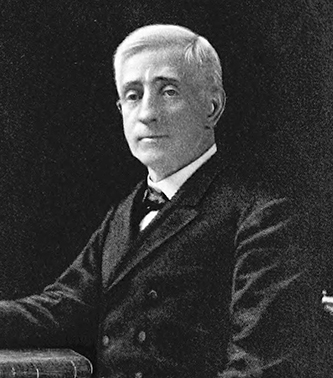
Elder Sylvester Hassell
1842-1928
Elder Sylvester Hassell is an intriguing figure. He was probably one of the most learned and scholarly ministers of the "Primitive" or "Old School" Baptist church and yet, ironically, he took some positions in theology that betrayed that learning. He was the son of Elder Cushing Biggs Hassell and both were leaders in the Kehukee Association of Primitive Baptists (1765), the fourth oldest Baptist Association in America), and it was this association that first published a declaration of non-fellowship against those Baptists who supported missionary enterprises in 1827, five years before the "Black Rock Address" (1832), though the latter is generally given as the date when the "Primitive" or "Old School" Baptist sect originated. Both father and son were also leaders over the general body of that sect. They were elected each year to be the moderator of the Kehukee Association, an association that became the "flag ship" of the sect. Elder C.B. Hassell was moderator of the association from 1859-1880 and Elder Sylvester Hassell was moderator from 1880 until his death in 1928.
Sylvester's influence rose dramatically in the 1880s as a result of writing, along with his father, the "History of the church of God, from the creation to A.D. 1885; including especially the history of the Kehukee Primitive Baptist Association," which was published in 1886 and authorized by the Kehukee Association and which paid the Hassells for it. Most of the earlier sections of this work were written by the senior Hassell, Sylvester writing most of the later sections. I have read through this voluminous work, and though it contains much historical information, it was also written, mostly by the junior Hassell, as a polemic to try and show that the new sect of "Primitive Baptists" were right in their contention that they were the true "original" Baptists and that the "Missionary Baptists" were the new kids on the block. The later chapters, mostly written by Sylvester, contain much false information and were written with a bias that is quite evident. I have over the years written several articles demonstrating this fact. He often omits pertinent information and gives a false interpretation of other historical events.
Many of the first generation of "Primitive Baptists" died in the early 1880s. Elder C.B. Hassell died in 1880. Elder Gilbert Beebe died in 1881. Elder John Clark died in 1882. Elder R.W. Fain died in 1876. All these men were editors and writers for several of the first periodicals of the Old Schoolers. The 1880s was a decade that saw much inner fighting among the new sect. The death of the first generation of the "Old School" leaders created a vacuum in leadership and several arose who were competitors for filling that vacuum. A new generation of "Hardshells" then arose and steered the sect in another direction. In 1892 Sylvester was a contributing editor of the periodical "The Gospel Messenger" which he purchased in either 1895-96 and became its owner and editor. He was a good writer and wrote often against some of the extremes that were becoming far too prevalent within the sect.
In February 1893 Hassell wrote another article in his series titled "The Literal Interpretation of Scripture" where he denounced how many "Primitive Baptists" were mishandling the word of God in their failure to take the Bible literally. I wrote about this (here) and cited from that article the following, where Hassell wrote:
"It is especially in what claims to be the spiritual interpretation of the Scriptures that these ultra, wild, chilling, deadening, bewitching, confusing, dividing, and ruinous errors prevail among us."
Hassell began writing about the gross perversions in bible interpretation that had been plaguing his brethren in the final months of 1892 and continued his series on bible interpretation throughout the year 1893. I wish all of today's "Primitive Baptists" would read this man's writings in this series.
It is sad to say, however, that Hassell himself was not faultless in his manner of interpreting the scriptures. Particularly is this true relative to his ideas about the doctrine of regeneration or the new birth and how it is effected. Though his father, as I have shown in several writings, believed in means, yet Sylvester would come to deny them. Yet, as we will see, he made contradictory statements on this question, both as a Baptist historian and as a theologian.
If one reads what Elder Sylvester Hassell wrote on the troubling question as to whether the written word of God, or the gospel, or preachers of it, were "means" in the eternal salvation of sinners, he will find that Hassell tried to bridge the divide, or straddle the fence, between those "Primitive Baptists" who espoused means and those who denied means. It was in the last quarter of the 19th century where this question came to a climax and brought about a formal division. That was also true with regard to other doctrines that divided the new sect, such as the extent of predestination, Two Seed ideology, perseverance of the elect, whether evangelical faith was necessary for eternal salvation, "conditional time salvation," and several other more minor issues.
I have shown in numerous articles in this blog, over the past twenty years, that the overwhelming majority of the first generation of "Primitive Baptists" did not reject means altogether. Though some of them said that "regeneration" or "begetting" was without means, they affirmed that the new birth (which came later after one was begotten) involved being converted to Christ by the gospel or by faith. The first "Primitive Baptists" did not believe that unbelievers in Christ were regenerated, as they do today.
Elder John M. Watson (1798-1866) of middle Tennessee was one of the foremost leaders of the newly formed sect. He battled the "Two Seed Primitive Baptists," including its chief proponent, Elder Daniel Parker, and wrote a book titled "Old Baptist Test." He, along with others of his brethren who fought against Two Seedism, said that the "no means" view was a leading distinctive tenet of many Two Seed Primitive Baptists, although few of them, at that time, would affirm that people could be saved who did not believe in Jesus. Today, however, most "Primitive Baptists" of the "Hardshell" variety embrace the view that millions of God's born again people remain in idolatry and do not come to faith in Jesus or the God of the Bible.
Though many "Primitive Baptists" have asserted that the split that occurred as a result of the Black Rock Address was over the question of whether the gospel or word of God was a means in the eternal salvation of sinners, that is a falsehood that has no evidence to support it. In several posts in past years I have shown that this is not true. For instance, in this post (here) I first cited from Elder David Montgomery who in the not too distant past wrote the following in his attempt to assert that the Black Rock Address document condemned the means view and when they spoke of salvation through the word that they did not have eternal salvation in mind but a temporal salvation (evangelical conversion) that is not necessary for eternal salvation:
"The Black Rock Address of 1832 gives an excellent admonition: "Brethren, while we rejoice in the glorious truth that salvation is of the Lord, may it be manifested by our lives that we are under the influence of that grace which teacheth that denying ungodliness and worldly lusts, we should live soberly, righteously and godly in this present world." This is what I would define as time salvation."
Elder Michael Gowens of the present day has also said that the main issue in the 1832 division of the "Primitive" or "Old School" Baptists from the general Baptist family was over the means question, writing the following (emphasis mine):
"The primary issue at stake might be defined by the question, “Does God employ the use of external means in the eternal salvation of sinners? Is grace mediated to the sinner through human agency? Does the church play an instrumental role in eternal salvation?” Those answering in the affirmative were loosely and informally termed “means” Baptists, and those responding in the negative were labeled “anti-means” Baptists." ("Christ The Only Mediator" - See here)
That assertion, however, is against the historical facts. Gowens also wrote:
"Of course, a label can be misleading, for it never tells the whole story. I don’t particularly like the “anti-means” label, for it suggests an impression that is not entirely accurate. The Bible clearly teaches, for instance, that “means” are involved in Christian discipleship: “Sanctify them through thy truth: thy word is truth” (Jno. 17:17). I could not in good conscience, therefore, wear the label “anti-means” without the caveat that Scripture does teach that means are employed in a certain sense."
That sanctification for which Jesus prayed cannot be divorced from eternal salvation. But, since it is by the truth of God, Gowens and his Hardshell brethren must say that it is a sanctification that has nothing to do with being eternally saved from sin and death.
I wrote the following in response to Montgomery's assertion about the Black Rock Address supposedly condemning the doctrine of means:
"It is very clear that Montgomery is reading "time salvation" into these words of the founding fathers of Hardshellism. There is no mention of "time salvation" in those words from the Address. They are "read into" it by Montgomery. What "salvation" was under consideration when mention is made of "the glorious truth that salvation is of the Lord"? Is it "time salvation"? Should their words be read as follows - "we rejoice in the glorious truth that time salvation is of the Lord"?"
But, let us notice these words from the Black Rock Address.
"The plans of these [protracted or 'revival'] meetings are equally as objectionable; for, in the first place, all doctrinal preaching, or in other words, all illustrations of God's plan of salvation, are excluded from these meetings. Hence they would make believers of their converts without presenting any fixed TRUTHS to their minds to believe. Whereas God has chosen his people to salvation through sanctification of the Spirit and belief of the TRUTH.--2 Thess. 2:13." (Black Rock Address, pp. 35, 36, Primitive Publications' reprint)."
"Obviously the Black Rock Address did not object to the use of gospel truth in salvation. What salvation is under consideration in the passage? Is it not that salvation which is the result of eternal election? How can the Hardshells deny that this is eternal salvation? The first Hardshells objected to certain evangelistic methods whereby converts are made where there no doctrine or biblical truth is taught, where there is no instruction in "God's plan of salvation." When the Black Rock Address speaks of "salvation," it never refers to some "time salvation." Montgomery simply tries to read "time salvation" into the Address."
"The plans of these [protracted or 'revival'] meetings are equally as objectionable; for, in the first place, all doctrinal preaching, or in other words, all illustrations of God's plan of salvation, are excluded from these meetings. Hence they would make believers of their converts without presenting any fixed TRUTHS to their minds to believe. Whereas God has chosen his people to salvation through sanctification of the Spirit and belief of the TRUTH.--2 Thess. 2:13." (Black Rock Address, pp. 35, 36, Primitive Publications' reprint)."
"Obviously the Black Rock Address did not object to the use of gospel truth in salvation. What salvation is under consideration in the passage? Is it not that salvation which is the result of eternal election? How can the Hardshells deny that this is eternal salvation? The first Hardshells objected to certain evangelistic methods whereby converts are made where there no doctrine or biblical truth is taught, where there is no instruction in "God's plan of salvation." When the Black Rock Address speaks of "salvation," it never refers to some "time salvation." Montgomery simply tries to read "time salvation" into the Address."
"The Address said:
"There is, brethren, one radical difference between us and those who advocate these various institutions which we have noticed to which we wish to call your attention. It is this: they declare the gospel to be a system of means; these means it appears they believe to be of human contrivance; and they act accordingly...we would still be content to preach the word, and would be instant in season and out of season; knowing it has pleased God, not by the wisdom of men, but by the foolishness of preaching to save them that believe. And that his word will not return unto him void, but it shall accomplish that which he please, and prosper in the thing whereunto he sends it."
"There is, brethren, one radical difference between us and those who advocate these various institutions which we have noticed to which we wish to call your attention. It is this: they declare the gospel to be a system of means; these means it appears they believe to be of human contrivance; and they act accordingly...we would still be content to preach the word, and would be instant in season and out of season; knowing it has pleased God, not by the wisdom of men, but by the foolishness of preaching to save them that believe. And that his word will not return unto him void, but it shall accomplish that which he please, and prosper in the thing whereunto he sends it."
Not only have the Hardshells misinterpreted the Black Rock Address, so too have they misinterpreted the 1689 London Baptist Confession of Faith. In the year 1900 fifty one leading elders of the "Primitive Baptist" church met in Fulton, Kentucky and endorsed that confession as being the confession their forefathers endorsed. However, they distorted that old confession by putting footnotes to those sections that they disagreed with, and did so under the guise that they were explaining what was meant in those sections. That old confession taught that God used means in the calling of sinners to salvation. So, the Hardshells had to do one of two things; either reject the confession's teachings on those points or embrace it but give a twisted interpretation of what it said on the question of means.
I have cited from many Hardshells who have agreed that the elders who assembled in Fulton purposely twisted the meaning of the 1689 London Baptist Confession of Faith on several sections of the confession, especially on the question of whether the word of God is a means in salvation and whether evangelical faith is a necessary condition for salvation. We will talk more about that in the next chapter.


No comments:
Post a Comment