I highly recommend that you take a few minutes and listen to Todd's video and the words of Dr. Lawson.
Tuesday, September 22, 2020
Passion In Preaching
Todd Friel in his video "Dr. Steve Lawson: A plague of passionless preaching" (here on Wretched) gives some excerpts from Lawson's sermon. What Lawson says about passion in preaching, and about how today's exegetical or expository preaching has become stoic and dry, is a point I have made also. See my posting Preaching Has Become Dry As Dust.


Saturday, September 12, 2020
The Modalist God
Is the Father, Word (Son), and Holy Spirit to be thought of as mere "expressions" of the one person God? Is the Trinity a Trinity of "manifestations," "modes," and "roles" of the one person God? Modalists are fond of using various words to denote what is meant by Father, Son, and Spirit, but they are opposed to the use of the word "person." God is "three expressions." God is "three modes" and "three roles." However, it is not scripturally apropos for me to think of Father, Son, and Spirit as impersonal entities. Under Modalistic paradigms, the "Father" is not God but simply one of the several "ways" in which God "appears." Likewise, the "Son" and the "Spirit" are not God, but simply "reflections" of God.
Many Modalists think that Father, Son, and Spirit are titles that do not denote persons, but simply "masks" that the one God wears at various times, like a primitive actor in theatre who plays various roles by wearing different clothes and masks. But, these masks cannot be identified as being de facto the person (actor) himself. In Modalism, the real actor's personality is hidden behind the various masks and roles. In Modalism, not even the Father is a person, but is simply one of several ways that God reveals himself.
It seems to me that Modalism makes God into a "transformer," one who "morphs" himself into various forms. In Science Fiction, such as Star Wars and Star Trek, certain alien creatures had the ability to "morphe" or "transform" into various shapes and appearances. Is this the way we are to conceive of the Father, Son, and Spirit? Is God simply a "holographic image" as in Star Trek? A "hologram"? It seems to me that this is exactly the way God is pictured under the Modalist model of God.
It is foolishness to read of the Father talking to the Son and think that it simply is the same actor talking to himself with different masks on his face. It is foolishness to think that one holographic image of God can have fellowship with another holographic image of God.
It is interesting how Paul says that Satan "transforms himself into an angel of light." (II Cor. 11: 14) Satan can take many forms, whether a serpent or angel. He is a "shape shifter." But, Modalists must say that God also, like Satan, "transforms himself" into Father, Son, and Spirit.
It is a simple task to refute Modalism. All one has to do is to show from scripture that the Father is a person and likewise are the Son and Spirit, and that they are clearly not the same person.
Jesus said:
"If a man love me, he will keep my words: and my Father will love him, and we will come unto him, and make our abode with him." (John 14: 23)
Clearly the Father is not Jesus. This is proven by "my words" and "my Father," which shows that the one designated by "my" (Jesus) is not the same person as the Father. It is also proven by the use of the plural personal pronouns "we" and "our."
If Jesus and the Father are the same person, such language would make no sense. If Jesus and the Father are but "expressions" of God, then Jesus and the Father, as persons, do not dwell in me, but only their "expressions." How can one have fellowship with an holographic image of God?
Many Modalists think that Father, Son, and Spirit are titles that do not denote persons, but simply "masks" that the one God wears at various times, like a primitive actor in theatre who plays various roles by wearing different clothes and masks. But, these masks cannot be identified as being de facto the person (actor) himself. In Modalism, the real actor's personality is hidden behind the various masks and roles. In Modalism, not even the Father is a person, but is simply one of several ways that God reveals himself.
It seems to me that Modalism makes God into a "transformer," one who "morphs" himself into various forms. In Science Fiction, such as Star Wars and Star Trek, certain alien creatures had the ability to "morphe" or "transform" into various shapes and appearances. Is this the way we are to conceive of the Father, Son, and Spirit? Is God simply a "holographic image" as in Star Trek? A "hologram"? It seems to me that this is exactly the way God is pictured under the Modalist model of God.
It is foolishness to read of the Father talking to the Son and think that it simply is the same actor talking to himself with different masks on his face. It is foolishness to think that one holographic image of God can have fellowship with another holographic image of God.
It is interesting how Paul says that Satan "transforms himself into an angel of light." (II Cor. 11: 14) Satan can take many forms, whether a serpent or angel. He is a "shape shifter." But, Modalists must say that God also, like Satan, "transforms himself" into Father, Son, and Spirit.
It is a simple task to refute Modalism. All one has to do is to show from scripture that the Father is a person and likewise are the Son and Spirit, and that they are clearly not the same person.
Jesus said:
"If a man love me, he will keep my words: and my Father will love him, and we will come unto him, and make our abode with him." (John 14: 23)
Clearly the Father is not Jesus. This is proven by "my words" and "my Father," which shows that the one designated by "my" (Jesus) is not the same person as the Father. It is also proven by the use of the plural personal pronouns "we" and "our."
If Jesus and the Father are the same person, such language would make no sense. If Jesus and the Father are but "expressions" of God, then Jesus and the Father, as persons, do not dwell in me, but only their "expressions." How can one have fellowship with an holographic image of God?
(Taken from "The Baptist Gadfly" for April 2012 - here)
Thursday, September 3, 2020
Calvinist Extremism
My dear friend Bob L. Ross has written extensively in defense of "altar calls" and answered many of the objections offered by many Calvinists against them. In this posting I want to join brother Ross in defending them and answering the objections made against them. In an Internet posting titled "The Altar Call" - "CONVERTS FREQUENTLY MADE IN RELATION TO PUBLIC INVITATIONS" (see here), brother Ross wrote:
"Perhaps the most popular "whipping boy" of the Reformed Hybrid Calvinist camp of theology is the "altar call" or the "public invitation."
I have often read items critical of public invitations and in most cases they were written by persons whose own conversions were related to public invitations. Some, after their "indoctrination" into the Hybrid Calvinism of the Reformed camp, later say they were saved "despite" the invitation.
Oh, well, it is no marvel that it has been observed that a number of the anti-invitation churches fail to evangelize by any method and thus fail to make converts, their memberships dwindled, and some of them have even closed their doors. They didn't seem to have a "better idea" on how to invite lost men and women to come to Christ and confess Him as Lord and Saviour.
I have written several articles in which I think I have just about replied to every conceivable objection to public invitations, and you can find a number of these articles at this link: Select Writings of Bob L. Ross."
I recommend all to go to the above web page and read Bob's writings on this subject.
The Sinner's Prayer
"And the publican, standing afar off, would not lift up so much as his eyes unto heaven, but smote upon his breast, saying, God be merciful to me a sinner. I tell you, this man went down to his house justified rather than the other: for every one that exalteth himself shall be abased; and he that humbleth himself shall be exalted." (Luke 18: 13-14)
Bob points out that the great Calvinist evangelist, Charles Spurgeon, had no qualms with calling upon sinners to pray the sinner's prayer for salvation. For a sinner who is under conviction of sin, and who is seeking salvation, what better advice to give to such than to pray as did the publican? For the life of me I cannot comprehend why so many Calvinists decry giving sinners this advice. Jesus said that the publican "went down to his house justified" after having so prayed. Certainly sinners must be exhorted to pray such a prayer in earnest, but who can doubt that a sinner who does so will enjoy the same result as did the publican?
Giving one's heart to the Lord
"My son, give me thine heart, and let thine eyes observe my ways." (Prov. 23: 26)
"And this they did, not as we hoped, but first gave their own selves to the Lord, and unto us by the will of God." (II Cor. 8: 5)
Many times I have heard Calvinists decry others for exhorting sinners to give their hearts to Jesus for salvation. When I have challenged these extreme Calvinists about this ridiculing I have found that they often take the tactic of saying, especially about the words of Solomon, that they are not addressed to the lost, but to those who are already the saved children of God. Thus, what they are denouncing is the indiscriminate calling upon sinners to give their hearts and lives to Christ. They think that such exhortations should only be made to those sinners who appear to already be saved. But, this is simply Hyper Calvinism at its worst. Some of these extreme Calvinists will decry such an exhortation by saying - "what does Jesus want with your depraved and corrupt heart?" But, the fact is, no one will ever be saved who has not given himself wholly unto the Lord. So what if some do this insincerely? Such is to be expected. But, this does not invalidate the exhortation itself.
Inviting Jesus into your heart
"Behold, I stand at the door, and knock: if any man hear my voice, and open the door, I will come in to him, and will sup with him, and he with me." (Rev. 3: 20)
Extreme Calvinists decry calling upon sinners to "invite Christ into your heart," thinking that to do such promotes Armnianism. Yet, this is a non sequiter. These same Hyper Calvinists will even try to defend themselves by saying that the above words of Christ were addressed to those who were already saved and therefore cannot be used as justification for advising lost sinners to do as Christ bids. But, the ones Jesus addressed are described as being "wretched, and miserable, and poor, and blind, and naked." Such could not be a better description of a lost soul. Why would Calvinists deny that there are many lost and unconverted members of the church?
Some extreme Calvinists will argue the Christ is not knocking on the door of the alien sinner's heart, but on the door of the church, who had locked out Christ. But, this is not tenable. First, the exhortation is not to the church as a body but to individuals. It is to "any man" and "to him." The singular pronouns "him" and "he" show this to be the case. Second, the door cannot be the door of the church, but to the door of the individual sinner's heart. Christ is speaking to the individual sinner, knocking on the door of the sinner's heart. It is the individual sinner who hears the voice of Christ and opens the door to Christ. Third, it is not a promise of communion with the church as a group, but with the individual. "I will come in to him" and "I will sup with him." Fourth, Christ is viewed as being on the outside, not of the church, but of the sinner's heart and inner being. Fifth, no individual sinner in the church at Laodicea can open the door of the whole church by obeying the words of Christ. Christ does not say "if any man will hear my voice and open the door then I will come in to them (the church)," but "in to him." The focus is on Christ entering the heart of the individual, not his entering into the corporate entity of the church. I can see no harm in telling sinners who are hearing the voice of Christ and who sense that he is knocking on the door of their hearts, to open their hearts to him with the promise that he will indeed come and dwell in them.
Accepting Christ
"Unto you therefore which believe he is precious: but unto them which be disobedient, the stone which the builders disallowed, the same is made the head of the corner, And a stone of stumbling, and a rock of offence, even to them which stumble at the word, being disobedient: whereunto also they were appointed." (I Peter 2: 7-8)
"As ye have therefore received Christ Jesus the Lord, so walk ye in him." (Col. 2: 6)
I hear extreme Calvinists decrying the practice of calling upon sinners to "accept Christ" for salvation. There is no essential difference between "receiving" Christ and "accepting" Christ. In the words of Peter there is the use of the word "disallowed." To disallow means to reject. Those who reject Christ are they who do not "allow" him, do not receive him, do not accept him. On the other hand, those who receive Christ are they who accept and allow Christ. Disallowing Christ is to disbelieve him, while to allow Christ is to believe him. Doing the former brings damnation, while doing the latter brings salvation. Again, there is no denying that this must be done sincerely, but this is no reason to be against calling upon sinners to accept Christ and be saved.
Easy Believism
"And brought them out, and said, Sirs, what must I do to be saved? And they said, Believe on the Lord Jesus Christ, and thou shalt be saved, and thy house." (Acts 16: 30-31)
If some of my Calvinist brethren had been present on this occasion, they would have accused the Apostle Paul of practicing what they call "easy believism." If it makes my Calvinist brothers feel better, let them always insist that the sinner do this sincerely and with the heart. If it makes them feel better, let them warn the sinner that such a believing is more than simple mental assent, that it must be done with full conviction. Still, nothing is wrong with simply telling sinners that they can be saved by simply believing and trusting in Christ alone for salvation.
It is argued that these kinds of invitations or altar calls are "Arminian," and therefore cannot be acceptable. It is argued that these kinds of invitations lead to many false professions. But, are Calvinistic churches free of false professions? Certainly not. Has it not been the claim that the success of the preaching of the Gospel depends upon the work of the Spirit making such invitations successful? Why should we worry about the matter? The parable of the sower and the seed shows that we should expect there to be fase conversions. Even the preaching of the Apostles produced such false conversions. So, no matter how we try to give the invitation, there will always be such.
"And the Spirit and the bride say, Come. And let him that heareth say, Come. And let him that is athirst come. And whosoever will, let him take the water of life freely." (Rev. 22: 17)
"Repent ye therefore, and be converted, that your sins may be blotted out, when the times of refreshing shall come from the presence of the Lord." (Acts 3: 19)
"But what saith it? The word is nigh thee, even in thy mouth, and in thy heart: that is, the word of faith, which we preach; That if thou shalt confess with thy mouth the Lord Jesus, and shalt believe in thine heart that God hath raised him from the dead, thou shalt be saved. For with the heart man believeth unto righteousness; and with the mouth confession is made unto salvation. For the scripture saith, Whosoever believeth on him shall not be ashamed. For there is no difference between the Jew and the Greek: for the same Lord over all is rich unto all that call upon him. For whosoever shall call upon the name of the Lord shall be saved." (Rom. 10: 8-13)
Here are some examples of how we may invite and call sinners to salvation. We should tell them that Christ and the church says to them "come." That is an invitation as well as a command. We should exhort them that they can be saved "if" they but confess and acknowledge Christ as Lord and Savior. Our preaching should be filled with such exhortations and no church is going to grow which does not have preaching that is full of them. We should constantly be calling upon sinners to "repent," and to "convert," and to "call upon the name of the Lord," and to "come" to Jesus for salvation. Such is not "Arminianism," but if it is, then count me one!
"Perhaps the most popular "whipping boy" of the Reformed Hybrid Calvinist camp of theology is the "altar call" or the "public invitation."
I have often read items critical of public invitations and in most cases they were written by persons whose own conversions were related to public invitations. Some, after their "indoctrination" into the Hybrid Calvinism of the Reformed camp, later say they were saved "despite" the invitation.
Oh, well, it is no marvel that it has been observed that a number of the anti-invitation churches fail to evangelize by any method and thus fail to make converts, their memberships dwindled, and some of them have even closed their doors. They didn't seem to have a "better idea" on how to invite lost men and women to come to Christ and confess Him as Lord and Saviour.
I have written several articles in which I think I have just about replied to every conceivable objection to public invitations, and you can find a number of these articles at this link: Select Writings of Bob L. Ross."
I recommend all to go to the above web page and read Bob's writings on this subject.
The Sinner's Prayer
"And the publican, standing afar off, would not lift up so much as his eyes unto heaven, but smote upon his breast, saying, God be merciful to me a sinner. I tell you, this man went down to his house justified rather than the other: for every one that exalteth himself shall be abased; and he that humbleth himself shall be exalted." (Luke 18: 13-14)
Bob points out that the great Calvinist evangelist, Charles Spurgeon, had no qualms with calling upon sinners to pray the sinner's prayer for salvation. For a sinner who is under conviction of sin, and who is seeking salvation, what better advice to give to such than to pray as did the publican? For the life of me I cannot comprehend why so many Calvinists decry giving sinners this advice. Jesus said that the publican "went down to his house justified" after having so prayed. Certainly sinners must be exhorted to pray such a prayer in earnest, but who can doubt that a sinner who does so will enjoy the same result as did the publican?
Giving one's heart to the Lord
"My son, give me thine heart, and let thine eyes observe my ways." (Prov. 23: 26)
"And this they did, not as we hoped, but first gave their own selves to the Lord, and unto us by the will of God." (II Cor. 8: 5)
Many times I have heard Calvinists decry others for exhorting sinners to give their hearts to Jesus for salvation. When I have challenged these extreme Calvinists about this ridiculing I have found that they often take the tactic of saying, especially about the words of Solomon, that they are not addressed to the lost, but to those who are already the saved children of God. Thus, what they are denouncing is the indiscriminate calling upon sinners to give their hearts and lives to Christ. They think that such exhortations should only be made to those sinners who appear to already be saved. But, this is simply Hyper Calvinism at its worst. Some of these extreme Calvinists will decry such an exhortation by saying - "what does Jesus want with your depraved and corrupt heart?" But, the fact is, no one will ever be saved who has not given himself wholly unto the Lord. So what if some do this insincerely? Such is to be expected. But, this does not invalidate the exhortation itself.
Inviting Jesus into your heart
"Behold, I stand at the door, and knock: if any man hear my voice, and open the door, I will come in to him, and will sup with him, and he with me." (Rev. 3: 20)
Extreme Calvinists decry calling upon sinners to "invite Christ into your heart," thinking that to do such promotes Armnianism. Yet, this is a non sequiter. These same Hyper Calvinists will even try to defend themselves by saying that the above words of Christ were addressed to those who were already saved and therefore cannot be used as justification for advising lost sinners to do as Christ bids. But, the ones Jesus addressed are described as being "wretched, and miserable, and poor, and blind, and naked." Such could not be a better description of a lost soul. Why would Calvinists deny that there are many lost and unconverted members of the church?
Some extreme Calvinists will argue the Christ is not knocking on the door of the alien sinner's heart, but on the door of the church, who had locked out Christ. But, this is not tenable. First, the exhortation is not to the church as a body but to individuals. It is to "any man" and "to him." The singular pronouns "him" and "he" show this to be the case. Second, the door cannot be the door of the church, but to the door of the individual sinner's heart. Christ is speaking to the individual sinner, knocking on the door of the sinner's heart. It is the individual sinner who hears the voice of Christ and opens the door to Christ. Third, it is not a promise of communion with the church as a group, but with the individual. "I will come in to him" and "I will sup with him." Fourth, Christ is viewed as being on the outside, not of the church, but of the sinner's heart and inner being. Fifth, no individual sinner in the church at Laodicea can open the door of the whole church by obeying the words of Christ. Christ does not say "if any man will hear my voice and open the door then I will come in to them (the church)," but "in to him." The focus is on Christ entering the heart of the individual, not his entering into the corporate entity of the church. I can see no harm in telling sinners who are hearing the voice of Christ and who sense that he is knocking on the door of their hearts, to open their hearts to him with the promise that he will indeed come and dwell in them.
Accepting Christ
"Unto you therefore which believe he is precious: but unto them which be disobedient, the stone which the builders disallowed, the same is made the head of the corner, And a stone of stumbling, and a rock of offence, even to them which stumble at the word, being disobedient: whereunto also they were appointed." (I Peter 2: 7-8)
"As ye have therefore received Christ Jesus the Lord, so walk ye in him." (Col. 2: 6)
I hear extreme Calvinists decrying the practice of calling upon sinners to "accept Christ" for salvation. There is no essential difference between "receiving" Christ and "accepting" Christ. In the words of Peter there is the use of the word "disallowed." To disallow means to reject. Those who reject Christ are they who do not "allow" him, do not receive him, do not accept him. On the other hand, those who receive Christ are they who accept and allow Christ. Disallowing Christ is to disbelieve him, while to allow Christ is to believe him. Doing the former brings damnation, while doing the latter brings salvation. Again, there is no denying that this must be done sincerely, but this is no reason to be against calling upon sinners to accept Christ and be saved.
Easy Believism
"And brought them out, and said, Sirs, what must I do to be saved? And they said, Believe on the Lord Jesus Christ, and thou shalt be saved, and thy house." (Acts 16: 30-31)
If some of my Calvinist brethren had been present on this occasion, they would have accused the Apostle Paul of practicing what they call "easy believism." If it makes my Calvinist brothers feel better, let them always insist that the sinner do this sincerely and with the heart. If it makes them feel better, let them warn the sinner that such a believing is more than simple mental assent, that it must be done with full conviction. Still, nothing is wrong with simply telling sinners that they can be saved by simply believing and trusting in Christ alone for salvation.
It is argued that these kinds of invitations or altar calls are "Arminian," and therefore cannot be acceptable. It is argued that these kinds of invitations lead to many false professions. But, are Calvinistic churches free of false professions? Certainly not. Has it not been the claim that the success of the preaching of the Gospel depends upon the work of the Spirit making such invitations successful? Why should we worry about the matter? The parable of the sower and the seed shows that we should expect there to be fase conversions. Even the preaching of the Apostles produced such false conversions. So, no matter how we try to give the invitation, there will always be such.
"And the Spirit and the bride say, Come. And let him that heareth say, Come. And let him that is athirst come. And whosoever will, let him take the water of life freely." (Rev. 22: 17)
"Repent ye therefore, and be converted, that your sins may be blotted out, when the times of refreshing shall come from the presence of the Lord." (Acts 3: 19)
"But what saith it? The word is nigh thee, even in thy mouth, and in thy heart: that is, the word of faith, which we preach; That if thou shalt confess with thy mouth the Lord Jesus, and shalt believe in thine heart that God hath raised him from the dead, thou shalt be saved. For with the heart man believeth unto righteousness; and with the mouth confession is made unto salvation. For the scripture saith, Whosoever believeth on him shall not be ashamed. For there is no difference between the Jew and the Greek: for the same Lord over all is rich unto all that call upon him. For whosoever shall call upon the name of the Lord shall be saved." (Rom. 10: 8-13)
Here are some examples of how we may invite and call sinners to salvation. We should tell them that Christ and the church says to them "come." That is an invitation as well as a command. We should exhort them that they can be saved "if" they but confess and acknowledge Christ as Lord and Savior. Our preaching should be filled with such exhortations and no church is going to grow which does not have preaching that is full of them. We should constantly be calling upon sinners to "repent," and to "convert," and to "call upon the name of the Lord," and to "come" to Jesus for salvation. Such is not "Arminianism," but if it is, then count me one!
(Taken from "The Baptist Gadfly" for Jan. 22, 2013 - here)
Monday, August 31, 2020
Black Horse Of The Apocalypse VI
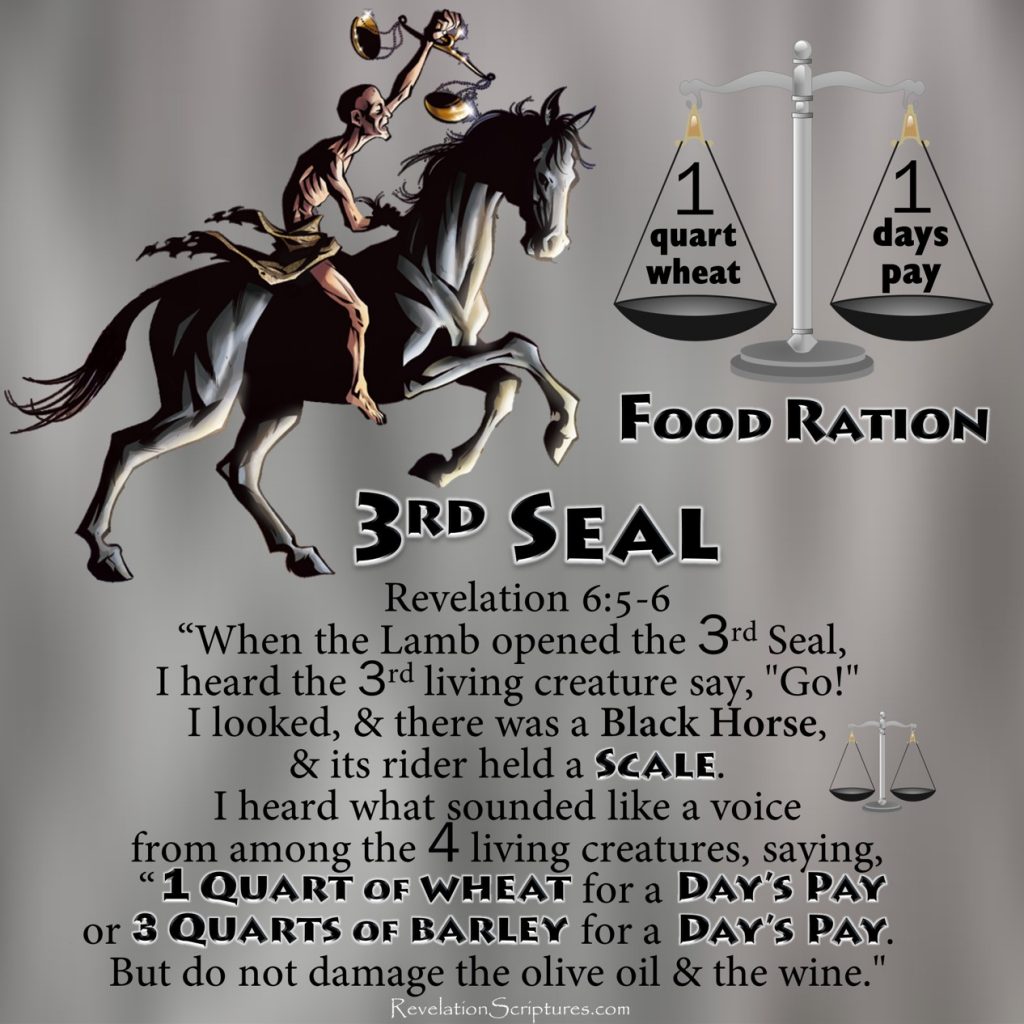
"they shall eat bread by weight, and with care"
(Eze 4: 16)
"I will destroy your food supply"
(Lev. 26: 26)
Commented Dr. Gill on these verses:
"behold, I will break the staff of bread in Jerusalem: that is, take away bread, which is the staff of life, the support of it, and which strengthens man's heart; and also the nourishing virtue and efficacy from what they had. The sense is, that the Lord would both deprive them of a sufficiency of bread, the nourishment of man; and not suffer the little they had to be nourishing to them; what they ate would not satisfy them, nor do them much good; see (Leviticus 26:26 ) (Isaiah 3:1 ); and they shall eat bread by weight, and with care; that they might not eat too much at a time, but have something for tomorrow;
and consume away for their iniquity; their flesh upon them black through famine, putrid and noisome; and they wasting, pining, and consuming; reduced to skin and bones; and disagreeable to look upon; and all because of their sins and iniquities." (Commentary)
Though the famine mentioned by Ezekiel concerned "Jerusalem" and her citizens yet it describes the famine that is coming under the black horse rider of the Apocalypse. Under the black horse rider we see wheat and barley, "bread," being carefully weighed.
At this point in our look at the black horse rider and his judgment, we plan to address the following questions.
Questions
1. What food is scarce? What crops?
2. What "harm" or "damage" is done to these food sources and supplies?
3. What food stuffs are particularly mentioned?
4. What about the food stuffs not particularly mentioned?
5. Why the command to "damage not the olive oil and the wine"?
6. What earthly power is controlling food distribution (or the scales)?
7. What effect will the famine have on the previous murdering under the red horse?
8. How long will the bloodshed and famine last?
9. How many will die by the famine and sword?
10. Will the righteous suffer as the wicked?
Assumptions
1. People will still be working for a day's supply is given for a day's wage.
2. Commerce, buying and selling, will still be occurring.
3. Some authority is in control of rationing food.
4. All food crops harmed except for grapes and olives.
In the first chapter in this series on the black horse rider, I cited from Seiss. Recall his words:
"The arrival of things at such a pass, accordingly argues a severity of hard times, distress, and want, almost beyond the power of imagination to depict. Yet, it is but the natural result of the state of things under the red horse. The two are closely connected as cause and effect. Take away peace from the earth, and inaugurate universal wars, civil strifes, and bloody feuds, and terrible scarcity of the means of subsistence must follow."
As has been pointed out previously, it seems more natural for the famine to precede the civil strife and manslaughter. But, with the four horsemen, the strife precedes the famine, a thing Seiss addressed, saying that the famine is "the natural result of the state of things under the red horse." We also observed, however, that Seiss has also been cited as affirming that the first four seals are opened rapidly, each seal being opened immediately upon the opening of the others, so that the effect is that the four horsemen may be said to appear together.
We also observed how it is likely that the judgment of each horse rider continues along with the others. In other words, the bloodshed and absence of peace does not stop when the black horse rider comes, but rather the red horse rider keeps right on riding but this time accompanied by the black horse rider.
No doubt but that the famine will in some cases increase the mutual manslaughter, people killing to steal another's supply of wheat and barley. On the other hand, when people get weak from malnutrition, they are not as able to kill another, and so there will rather be a decrease in the manslaughter.
One wonders also how the populous can still keep working, receiving their "day's wage," when they become weak and ill. One wonders about the elderly, the disabled. Will they be denied a day's supply of food because they are not working? Will it be a case of "lifeboat ethics"? More on that later.
It seems clear that the coming of the white, red, and black horse riders, with their judgments, acts like "Dominoes," and/or a "Slippery Slope," where things go "spiraling" out of control. There is, in the coming judgments of the Apocalypse, beginning with the four horsemen, a chain of events that, once initiated, cannot be halted.
The Food Supply
The foods specifically mentioned are wheat, barley, wine, and oil (probably olive oil). There is no mention of meat nor of fruits and vegetables other than grapes and olives. No other grains are mentioned, such as oats, rice, sorghum, millet, rye, etc.
It seems unlikely that it is only wheat and barley that are harmed or damaged by the judgment of the black horse rider. The words "harm not the wine and oil" imply that all other crops are harmed. Everything is harmed except the vine and olive tree. If wheat and barley are in scant supplies, then so it is likely other grains, fruits and vegetables, will also be "harmed" or "damaged."
We know that there are several causes for the famine. In one sense, it is the sin of the world. In another sense, it is the judgment act of God. But, what second causes are there? What means does the Lord use to damage the food supply? Drought? Civil chaos?
The food supply has often been an object of God's wrath when punishing sinners. In the long ago the Lord warned the Israelites:
“And if, in spite of all this, you still disobey me, I will punish you seven times over for your sins. 19 I will break your proud spirit by making the skies as unyielding as iron and the earth as hard as bronze. 20 All your work will be for nothing, for your land will yield no crops, and your trees will bear no fruit. 21 “If even then you remain hostile toward me and refuse to obey me, I will inflict disaster on you seven times over for your sins. 22 I will send wild animals that will rob you of your children and destroy your livestock. Your numbers will dwindle, and your roads will be deserted. 23 “And if you fail to learn the lesson and continue your hostility toward me, 24 then I myself will be hostile toward you. I will personally strike you with calamity seven times over for your sins. 25 I will send armies against you to carry out the curse of the covenant you have broken. When you run to your towns for safety, I will send a plague to destroy you there, and you will be handed over to your enemies. 26 I will destroy your food supply, so that ten women will need only one oven to bake bread for their families. They will ration your food by weight, and though you have food to eat, you will not be satisfied. 27 “If in spite of all this you still refuse to listen and still remain hostile toward me, 28 then I will give full vent to my hostility. I myself will punish you seven times over for your sins. 29 Then you will eat the flesh of your own sons and daughters. 30 I will destroy your pagan shrines and knock down your places of worship. I will leave your lifeless corpses piled on top of your lifeless idols,[a] and I will despise you. 31 I will make your cities desolate and destroy your places of pagan worship." (Lev. 26: 20-31 NLT)
Though these curses and punishments are threatened against Israel for her disobedience to the Sinai Covenant yet they are applicable to all men in that all men have covenant obligations to render faith and allegiance to their Creator. In this description of God's judgment he threatens the "food supply." It is the same kind of judgment upon the food supply that is coming at the time of the black horse rider.
Notice that more than once, due to the increased disobedience of the people (or as the Lord says, "for your sins") and for their continued refusal to repent, the Lord promises to increase the severity of the judgments "seven times over."
The Lord says that he will be "hostile" (or furious) towards the rebellious Israelites, to "give full vent to my hostility (fury)" This is in keeping with what we observed in previous chapters about God being cruel, terrible, severe, etc.
The Lord will employ "armies" who will "carry out" or execute "the curse," which curse includes devastation to the food supply. Recall that we have already referred to the various locust "armies" sent by God to destroy the crops, via the prophecy of Joel. Further, as we have observed, the white horse rider refers to the coming of Christ in judgment, and so the red, black, and pale horses are but agents of the judgments determined and executed by Christ, and each of these three calvary riders may be viewed as generals who are in charge of other heavenly angels who will help to bring about the calamities described.
Hard Lessons For The Evil World
"Yea, in the way of thy judgments, O Lord, have we waited for thee; the desire of our soul is to thy name, and to the remembrance of thee. With my soul have I desired thee in the night; yea, with my spirit within me will I seek thee early: when thy judgments are in the earth, the inhabitants of the world will learn righteousness." (Isa. 26: 8-9)
What are the judgments of the four horsemen designed to teach the Omega wicked generation? What lessons does the Lord want the inhabitants of the earth to "learn" by these awful judgments of the Apocalypse? Further, do they accept the teaching God is giving them? Or, do they rebel against it?
On the above words of the prophet, Barnes said:
"the punishments which he inflicted were intended to lead people to learn righteousness...Learn righteousness - The design is to warn, to restrain, and to reform them." (Commentary)
Wrote John Calvin:
"The inhabitants of the earth will learn righteousness. We must observe the reason assigned, when he says that “the inhabitants of the earth learn righteousness from the judgments of God,” meaning that by chastisements men are taught to fear God. In prosperity they forget him, and their eyes are as it were blinded by fatness; they grow wanton and petulant, and do not submit to be under authority; and therefore the Lord restrains their insolence, and teaches them to obey. In short, the Prophet confesses that he and others were trained, by God’s chastisements, to yield submission to his authority, and to intrust themselves to his guardianship; because if God do not, with uplifted arm, claim his right to rule, no man of his own accord yields obedience." (Commentary)
These comments are in keeping with what we have observed about the wicked prosperity of the very last days and of the judgments that shall come upon it. The prophet's words tell us, in so many words, that "God’s judgments are the best schoolmasters." (John Trapp commentary) But, as we will see, the Omega generation will be most hardened in their sins and enmity against God and his Christ, and rather than reforming or repenting of their wicked behavior, they rather curse and blaspheme God who they finally recognize is sending these awful calamities of judgment.
Wrote another:
"For when thy judgments are in the earth, the inhabitants of the world will learn righteousness: and good reason it is that we should thus desire and seek thee in the way of thy judgments, because this is the very design of thy judgments, that men should thereby be awakened to learn and return to their duty; and this is a common effect of them, that those who have been careless in prosperity, are made wiser and better by afflictions." (Matthew Poole's English Annotations on the Holy Bible)
But why does God visit us with judgments? Not that He delights in the miseries of His creatures. “He afflicteth not willingly, nor grieveth the children of men.” He would rather “draw them by the cords of love”; and “by His goodness lead them to repentance.”
It is, as we have observed, it is in order that God uproot unrighteousness and in justice judge the world.
God's Lesson To Omega Man
"Jesus answered, “It is written: ‘Man shall not live on bread alone, but on every word that comes from the mouth of God.’” (Matt. 4: 4)
This is one lesson the Lord intends to teach the Omega generation!
The bible teaches that it is God "who supplies seed to the sower and bread for food." (2 Corinthians 9:10 NIV) It teaches that "he gives to all life, and breath, and all things." (Acts 17: 25)
The Lord warned by Moses:
"But thou shalt remember the LORD thy God: for it is he that giveth thee power to get wealth." (Duet. 8: 18)
John the Baptist taught similarly, saying:
"A man can receive nothing, except it be given him from heaven." (John 3: 27)
But, this is a truth that man has forgotten. For, like Israel, the creature has "forgotten his Maker" (Hosea 8: 14) Not only is he not thankful to his Creator, he actually is at war with him. This is why fallen man is called a "rebel" in scripture. Yet, the Lord warns:
"If you are willing and obedient, you will eat the good things of the land; but if you resist and rebel, you will be devoured by the sword.” For the mouth of the LORD has spoken." (Isa. 1: 19-20)
When the red and black horse riders appear, then masses around the world will be "devoured by the sword" and will not any longer "eat the good things of the land." And why? Because the world will be full of "rebels" who "resist" God, who are unwilling and disobedient.
The World's Reaction
"And the rest of the men which were not killed by these plagues yet repented not of the works of their hands, that they should not worship devils, and idols of gold, and silver, and brass, and stone, and of wood: which neither can see, nor hear, nor walk: Neither repented they of their murders, nor of their sorceries, nor of their fornication, nor of their thefts." (Rev. 9: 20-21)
Throughout the varied judgments of the coming Apocalypse we are sometimes told of the reaction that these judgments are having upon the wicked inhabitants of the earth. The above is the first. Though it is mentioned only in chapter nine, yet it truly characterizes the reaction of the people up to that time and must include the reaction of the earth's peoples under the calamities of the four horsemen. Notice that it is repeated that they did not "repent." They kept right on doing those things that were the cause of the judgments. Though the judgments are designed to teach the people their errors and to teach them the way of salvation and righteousness, yet the people are bad students, failing to get the lesson. They do not react as the Ninevites, who repented in sackcloth over the announced doom that the prophet brought to them from the Lord.
"And men were scorched with great heat, and blasphemed the name of God, which hath power over these plagues: and they repented not to give him glory...And blasphemed the God of heaven because of their pains and their sores, and repented not of their deeds...And there fell upon men a great hail out of heaven, every stone about the weight of a talent: and men blasphemed God because of the plague of the hail; for the plague thereof was exceeding great." (Rev. 16: 9, 11, 21)
Notice that this is said in chapter 16 when many more awful judgments have come on the earth. Have the people finally learned their lesson and repented? No, they rather become more hardened in their sin and rebellion against the Lord.
Notice these other statements by the sufferers of the judgments:
"And the same hour was there a great earthquake, and the tenth part of the city fell, and in the earthquake were slain of men seven thousand: and the remnant were affrighted, and gave glory to the God of heaven." (Rev.11: 13)
"Who shall not fear thee, O Lord, and glorify thy name? for thou only art holy: for all nations shall come and worship before thee; for thy judgments are made manifest." (Rev. 15: 4)
The first verse gives us some hope that some of the earth's wicked inhabitants will begin to "get the lesson," or "get the point," recognize the judgment as coming from God, and rather than blaspheming God, as others, "give glory to the God of heaven."
Several times the Lord said (Lev. 26) "if you fail to learn the lesson." It seems that the Omega generation will indeed "fail to learn the lesson."
On the above words of the prophet, Barnes said:
"the punishments which he inflicted were intended to lead people to learn righteousness...Learn righteousness - The design is to warn, to restrain, and to reform them." (Commentary)
Wrote John Calvin:
"The inhabitants of the earth will learn righteousness. We must observe the reason assigned, when he says that “the inhabitants of the earth learn righteousness from the judgments of God,” meaning that by chastisements men are taught to fear God. In prosperity they forget him, and their eyes are as it were blinded by fatness; they grow wanton and petulant, and do not submit to be under authority; and therefore the Lord restrains their insolence, and teaches them to obey. In short, the Prophet confesses that he and others were trained, by God’s chastisements, to yield submission to his authority, and to intrust themselves to his guardianship; because if God do not, with uplifted arm, claim his right to rule, no man of his own accord yields obedience." (Commentary)
These comments are in keeping with what we have observed about the wicked prosperity of the very last days and of the judgments that shall come upon it. The prophet's words tell us, in so many words, that "God’s judgments are the best schoolmasters." (John Trapp commentary) But, as we will see, the Omega generation will be most hardened in their sins and enmity against God and his Christ, and rather than reforming or repenting of their wicked behavior, they rather curse and blaspheme God who they finally recognize is sending these awful calamities of judgment.
Wrote another:
"For when thy judgments are in the earth, the inhabitants of the world will learn righteousness: and good reason it is that we should thus desire and seek thee in the way of thy judgments, because this is the very design of thy judgments, that men should thereby be awakened to learn and return to their duty; and this is a common effect of them, that those who have been careless in prosperity, are made wiser and better by afflictions." (Matthew Poole's English Annotations on the Holy Bible)
But why does God visit us with judgments? Not that He delights in the miseries of His creatures. “He afflicteth not willingly, nor grieveth the children of men.” He would rather “draw them by the cords of love”; and “by His goodness lead them to repentance.”
It is, as we have observed, it is in order that God uproot unrighteousness and in justice judge the world.
God's Lesson To Omega Man
"Jesus answered, “It is written: ‘Man shall not live on bread alone, but on every word that comes from the mouth of God.’” (Matt. 4: 4)
This is one lesson the Lord intends to teach the Omega generation!
The bible teaches that it is God "who supplies seed to the sower and bread for food." (2 Corinthians 9:10 NIV) It teaches that "he gives to all life, and breath, and all things." (Acts 17: 25)
The Lord warned by Moses:
"But thou shalt remember the LORD thy God: for it is he that giveth thee power to get wealth." (Duet. 8: 18)
John the Baptist taught similarly, saying:
"A man can receive nothing, except it be given him from heaven." (John 3: 27)
But, this is a truth that man has forgotten. For, like Israel, the creature has "forgotten his Maker" (Hosea 8: 14) Not only is he not thankful to his Creator, he actually is at war with him. This is why fallen man is called a "rebel" in scripture. Yet, the Lord warns:
"If you are willing and obedient, you will eat the good things of the land; but if you resist and rebel, you will be devoured by the sword.” For the mouth of the LORD has spoken." (Isa. 1: 19-20)
When the red and black horse riders appear, then masses around the world will be "devoured by the sword" and will not any longer "eat the good things of the land." And why? Because the world will be full of "rebels" who "resist" God, who are unwilling and disobedient.
The World's Reaction
"And the rest of the men which were not killed by these plagues yet repented not of the works of their hands, that they should not worship devils, and idols of gold, and silver, and brass, and stone, and of wood: which neither can see, nor hear, nor walk: Neither repented they of their murders, nor of their sorceries, nor of their fornication, nor of their thefts." (Rev. 9: 20-21)
Throughout the varied judgments of the coming Apocalypse we are sometimes told of the reaction that these judgments are having upon the wicked inhabitants of the earth. The above is the first. Though it is mentioned only in chapter nine, yet it truly characterizes the reaction of the people up to that time and must include the reaction of the earth's peoples under the calamities of the four horsemen. Notice that it is repeated that they did not "repent." They kept right on doing those things that were the cause of the judgments. Though the judgments are designed to teach the people their errors and to teach them the way of salvation and righteousness, yet the people are bad students, failing to get the lesson. They do not react as the Ninevites, who repented in sackcloth over the announced doom that the prophet brought to them from the Lord.
"And men were scorched with great heat, and blasphemed the name of God, which hath power over these plagues: and they repented not to give him glory...And blasphemed the God of heaven because of their pains and their sores, and repented not of their deeds...And there fell upon men a great hail out of heaven, every stone about the weight of a talent: and men blasphemed God because of the plague of the hail; for the plague thereof was exceeding great." (Rev. 16: 9, 11, 21)
Notice that this is said in chapter 16 when many more awful judgments have come on the earth. Have the people finally learned their lesson and repented? No, they rather become more hardened in their sin and rebellion against the Lord.
Notice these other statements by the sufferers of the judgments:
"And the same hour was there a great earthquake, and the tenth part of the city fell, and in the earthquake were slain of men seven thousand: and the remnant were affrighted, and gave glory to the God of heaven." (Rev.11: 13)
"Who shall not fear thee, O Lord, and glorify thy name? for thou only art holy: for all nations shall come and worship before thee; for thy judgments are made manifest." (Rev. 15: 4)
The first verse gives us some hope that some of the earth's wicked inhabitants will begin to "get the lesson," or "get the point," recognize the judgment as coming from God, and rather than blaspheming God, as others, "give glory to the God of heaven."
Several times the Lord said (Lev. 26) "if you fail to learn the lesson." It seems that the Omega generation will indeed "fail to learn the lesson."
Tuesday, August 25, 2020
Black Horse Of The Apocalypse V

"I will consume them by the sword, and by the famine, and by the pestilence."
(Jer. 14: 12)
"Before their face the people shall be much pained: all faces shall gather blackness."
(Joel 2: 6)
The Black Death Of Famine
"Black, in the Scriptures, is the image of fear, of famine, of death. Lamentations 5:10; "our skin was black like an oven, because of the terrible famine." Jeremiah 14:2; "because of the drought Judah mourneth, and the gates thereof languish; they are in deep mourning (literally, black) for the land." Joel 2:6; "all faces shall gather blackness." Nahum 2:10; "the knees smite together, and there is great pain in all loins, and the faces of them all gather blackness." Compare Revelation 6:12; Ezekiel 32:7. See also Bochart, Hieroz. P. i. lib. ii. c. vii. pp. 106, 107. From the color of the horse here introduced we should naturally look for some dire calamity, though the nature of the calamity would not be designated by the mere use of the word "black." What the calamity was to be must be determined by what follows in the symbol. Famine, pestilence, oppression, heavy taxation, tyranny, invasion - any of these might be denoted by the color of the horse." (Barnes Commentary on Rev. 6: 5-6)
It must be kept in mind that the famine that comes with the black horse rider is a judgment from God upon a sinful world. In the Lord's first great worldwide destruction he "brought in the flood upon the world of the ungodly." (II Peter 2: 5) In the judgments of the Apocalypse, including that of the black horse rider, God will again bring worldwide destruction "upon the world of the ungodly."
"For the hurt of the daughter of my people am I hurt; I am black; astonishment hath taken hold on me." (Jer. 8: 21)
Black is associated with the negative aspects of human experience, such as death, and so accounts for people wearing black clothing, the clothing of mourning, at ceremonies for the dead, or at funerals. It is also a color associated with disease and famine, with deep lamentations (hence the association of sackcloth, which is black, with such mourning), all of which are the results of sin. On the above words of the prophet ("I am black") we have these comments from the commentaries:
"I am black — I look ghastly, as those who are dying." (Benson Commentary)
"black—sad in visage with grief (Joe 2:6)." (JFB)
"I am black; I am as those that are clad in deep mourning, Psalm 38:6 Jeremiah 14:2." (Matthew Poole's)
"I am black; with grief and sorrow. The Targum is,"my face is covered with blackness, black as a pot.'" (Gill)
Of the judgment of God upon the crops via the various kinds of locusts narrated in the Book of Joel, we have this testimony concerning the locust "armies" God sent: "Before their face the people shall be much pained: all faces shall gather blackness." (Joel 2: 6) Such will be the "face of the people" of the planet (except for a favored few) at the time when the famine of the black horse rider comes. Recall too the words of Jeremiah - "our skin was black like an oven, because of the terrible famine."
Some think that a good God would never inflict such an evil upon men. They think God is being too harsh, too strict and severe in his punishments, to do such. Of course, as we know, even in human courts the guilty often think their punishment is either undeserved or too severe. But, God is severe in his judgments, but they are nevertheless deserved by fallen man.
The Severity Of God
On the "severity" of God Paul wrote:
"Behold therefore the goodness and severity of God: on them which fell, severity; but toward thee, goodness, if thou continue in his goodness: otherwise thou also shalt be cut off." (Rom. 11: 22)
Severe does not mean unjust nor "cruel and unusual punishment." The severity of the judgment will be in proportion to the severity of the evil of men upon whom it is executed. Men have been severe in their judgments (criticisms) of God, of each other, and of the good and righteous. Thus, men do not get more than they deserve in the day of tribulation and wrath. Nor do they get less than they deserve. They get exactly what they deserve.
Further, God is the judge of what is too harsh and severe. Men have no right to question God's just judgments or call him to account. God answers to no man. All answer to him. Only a fool would try to convince God that he has acted too harshly, cruelly, and severely in condemning him. Few criminals acknowledge the justice of their punishment.
"Behold, the day of the LORD cometh, cruel both with wrath and fierce anger, to lay the land desolate: and he shall destroy the sinners thereof out of it." (Isa. 13: 9)
Is God cruel and fierce? Apparently so. But, the cruelty of the Lord is not cruel in the sense of unjust or unfair. The Hebrew word translated "cruel" involves "terror." God is both cruel and terrible in his judgments. Wrote the Psalmist:
"For the LORD most high is terrible; he is a great King over all the earth." (Psa. 47: 2)
By terrible is meant causing intense fear and foreboding. In this sense God also is "awful," not in the sense of bad, but in the sense of inspiring awe.
When we think about God being strict and severe, what we are really talking about is his "having judgment without mercy." (James 2: 13) To have judgment without mercy, or leniency, is to be severe, strict, and exacting. Merciless execution of punishment is indeed cruel and terrible, but so too is the crime of humanity in rejecting its creator and his proffered salvation. The wrath of man is cruel. But, God's wrath is justly cruel and is far more marvelous than that of depraved man. Notice these words of the prophet Jeremiah:
"All thy lovers have forgotten thee; they seek thee not; for I have wounded thee with the wound of an enemy, with the chastisement of a cruel one, for the multitude of thine iniquity; because thy sins were increased." (Jer. 30: 14)
Here the Lord testifies that he had sent wounding and chastisement as "of a cruel one." But, again, notice how the cruelty of the Lord is just retribution for it is "for the multitude" and "increase" of the "iniquity" and "sins" of the people.
The day of judgment under the four horsemen will see what is called the "fierce anger of the LORD" by the prophets.
By Sword & Famine
"They shall die of grievous deaths; they shall not be lamented; neither shall they be buried; but they shall be as dung upon the face of the earth: and they shall be consumed by the sword, and by famine; and their carcases shall be meat for the fowls of heaven, and for the beasts of the earth." (Jer. 16: 4)
This has been God's previous means of punishment in Israel's history and in the history of other nations over whom the Lord reigns. But it will be superbly so at the time of the end when the red and black horse riders appear with their awful calamities.
"When I shall send upon them the evil arrows of famine, which shall be for their destruction, and which I will send to destroy you: and I will increase the famine upon you, and will break your staff of bread: So will I send upon you famine and evil beasts, and they shall bereave thee; and pestilence and blood shall pass through thee; and I will bring the sword upon thee. I the LORD have spoken it." (Eze. 5: 16-17)
There are many verses in the old testament that couple together the sword and the famine, the very things we see with the coming of the red and black horse riders. In the above verse, a verse we called attention to when we discussed the white horse rider with his "evil arrows of famine" shot from his "toxon," the arrows are sword and famine. Further, the above promised judgment is not for sinners in Israel alone but are the very same which will be sent upon the Omega generation of "this evil age." Further, the sword and the famine are also linked with sending "evil beasts," the very thing we see in the coming of the deathly green or pale horse. Ezekiel also wrote of this oracle from Jehovah:
"Son of man, when the land sinneth against me by trespassing grievously, then will I stretch out mine hand upon it, and will break the staff of the bread thereof, and will send famine upon it, and will cut off man and beast from it." (Eze. 14: 13)
Notice again the attack upon "the bread," which is also what we see with the black horse rider, who is measuring out in meagre quantities both wheat and barley, grains used for making bread. But, more on that later. Notice again the reason for this famine. It is for "the land sinning against me by trespassing grievously." Also, notice again the coupling of sword and famine. Notice also that the purpose of the famine is to "cut off man and beast" from the land. Wrote Isaiah:
"These two things are come unto thee; who shall be sorry for thee? desolation, and destruction, and the famine, and the sword: by whom shall I comfort thee?" (Isa. 51: 19)
These "two things" are what we see in the sword of the red horse and the famine and scales of the black horse. Though there are four things seemingly mentioned in the above text, yet there are really only two. Wrote Dr. Gill:
"desolation, and destruction, and the famine, and the sword; which may be the two things before mentioned, for though there are four words, they are reducible to two things, desolation, which is the sword, and by it, and destruction, which is the famine, and comes by that, as Kimchi observes: or the words may be rendered thus, "desolation, and destruction, even the famine and the sword"; so that there is no need of making these things four, and of considering them as distinct from the other two..." (Commentary)
Now notice this sampling of other verses that couple the sword and famine together.
"Therefore thus saith the LORD of hosts, Behold, I will punish them: the young men shall die by the sword; their sons and their daughters shall die by famine." (Jer. 11: 22)
"And it shall come to pass, if they say unto thee, Whither shall we go forth? then thou shalt tell them, Thus saith the LORD; Such as are for death, to death; and such as are for the sword, to the sword; and such as are for the famine, to the famine; and such as are for the captivity, to the captivity." (Jer. 15: 2)
"And I will send the sword, the famine, and the pestilence, among them, till they be consumed from off the land that I gave unto them and to their fathers." (Jer. 24: 10)
In this verse we have all three horse riders depicted by the sword (red horse), famine (black horse), and pestilence (pale horse).
"They have belied the LORD, and said, It is not he; neither shall evil come upon us; neither shall we see sword nor famine." (Jer. 5: 12)
"Therefore thus saith the LORD of hosts, Behold, I will punish them: the young men shall die by the sword; their sons and their daughters shall die by famine." (Jer. 11: 22)
"I will consume them by the sword, and by the famine, and by the pestilence." (Jer. 14:12)
"And I will send the sword, the famine, and the pestilence, among them, till they be consumed from off the land that I gave unto them and to their fathers." (Jer. 24: 10)
The famine and the sword are rewards for rebellion against God. Let us consider these words of the prophet Obadiah:
"For the day of the LORD is near upon all the heathen: as thou hast done, it shall be done unto thee: thy reward shall return upon thine own head." (Oba. 1:15)
When the sword and famine come to the world through the coming of the red and black horse riders, then it will be sent as "reward," for the doing unto sinners what they have done to God, his word, and unto their fellow man.
Open Rebuke or Silent Love?
"Open rebuke is better than secret love." (Prov. 27: 5 KJV)
What does this proverb mean? Open rebuke we can fairly understand. There is a difference between "open rebuke" and "public rebuke." One may openly confront another about a wrong without it being public. The Hebrew word for "open" is galah and is not the normal word for "open." The Hebrew word means "to uncover, remove" (Strong)
The KJV translates the same Hebrew word with these words: uncover (34x), discover (29x), captive (28x), carry away (22x), reveal (16x), open (12x), captivity (11x), shew (9x), remove (6x), appear (3x), miscellaneous (18x).
Thus, by "open" we mean a "spoken" reprimand. It is one thing to form a judgment about a wrongful act by an actor and another to communicate that judgment to the actor. As long as the judgment is left unspoken, residing only in the mind, then it is covered, unrevealed, hidden, or otherwise not known (i.e., the opposite of open or uncovered). An example is when we feel hurt by an action of another, as a spouse, and are angry, and yet we say nothing to the one who hurt us. So, rather than confronting the one who caused the harm, anger and bitterness are harbored, covered, and hidden. We should think of the word "disclosed" versus "undisclosed" rather than discovered or undiscovered. Love discloses the wrong.
A "rebuke" is spoken. It is not merely a thought or mental judgment. It is the judgment of the mind made known or uncovered towards the person judged to have done wrong.
Being overly judgmental is warned against in scripture, but it also warns against failing to condemn the crimes and wrongs of others. This is the essence of the proverb. When we see wrongs done and fail to protest or say anything to the wrongdoers, then we are doing wrong ourselves.
Open rebuke is good when done with the right motive and in the right spirit. That is implied in the text. It is also what the scriptures elsewhere teach.
Some will not criticize or reprimand another because they feel that "love" demands that the one say nothing, to overlook the fault or wrong, to not judge. But, this is not love, for love rather "speaks up" and rebukes the ill behavior.
Silence can be a form of acquiescence and approval. Many wrongdoers have said to others (parents, friends, etc.) "you never said a word to me" in regard to the bad behavior.
Give me the person who will confront me face to face with my wrongdoings and who will, in love and yet sternly tell me of my wrongs rather than the one who forms a judgment of my wrongs and then goes around telling others of my wrongs! Give me the open rebuker over the "backstabber"!
What is meant by "secret (or hidden) love"?
It is the opposite of "open rebuke." Love for another cannot be silent, hidden, or unrevealed when that other person is involved in acts that are criminal or immoral. Love must condemn the wrongful acts and seek the correction of the wrongdoer. So, by "secret love" we may understand a "silent love," a love that never makes a judgment, a love that never rebukes the evil doer, that never uncovers wrongdoing, a love that never says anything against the wickedness of the wicked.
It is in every way "better" to rebuke face to face those who do wrong, for the good of all, than to say nothing, or to judge no one in anything. Love will not keep silent. Love will not overlook sin. Love will rather rebuke and correct.
P.S. For an entry on rebuking, see my posting Rebuke Them Sharply.
What does this proverb mean? Open rebuke we can fairly understand. There is a difference between "open rebuke" and "public rebuke." One may openly confront another about a wrong without it being public. The Hebrew word for "open" is galah and is not the normal word for "open." The Hebrew word means "to uncover, remove" (Strong)
The KJV translates the same Hebrew word with these words: uncover (34x), discover (29x), captive (28x), carry away (22x), reveal (16x), open (12x), captivity (11x), shew (9x), remove (6x), appear (3x), miscellaneous (18x).
Thus, by "open" we mean a "spoken" reprimand. It is one thing to form a judgment about a wrongful act by an actor and another to communicate that judgment to the actor. As long as the judgment is left unspoken, residing only in the mind, then it is covered, unrevealed, hidden, or otherwise not known (i.e., the opposite of open or uncovered). An example is when we feel hurt by an action of another, as a spouse, and are angry, and yet we say nothing to the one who hurt us. So, rather than confronting the one who caused the harm, anger and bitterness are harbored, covered, and hidden. We should think of the word "disclosed" versus "undisclosed" rather than discovered or undiscovered. Love discloses the wrong.
A "rebuke" is spoken. It is not merely a thought or mental judgment. It is the judgment of the mind made known or uncovered towards the person judged to have done wrong.
Being overly judgmental is warned against in scripture, but it also warns against failing to condemn the crimes and wrongs of others. This is the essence of the proverb. When we see wrongs done and fail to protest or say anything to the wrongdoers, then we are doing wrong ourselves.
Open rebuke is good when done with the right motive and in the right spirit. That is implied in the text. It is also what the scriptures elsewhere teach.
Some will not criticize or reprimand another because they feel that "love" demands that the one say nothing, to overlook the fault or wrong, to not judge. But, this is not love, for love rather "speaks up" and rebukes the ill behavior.
Silence can be a form of acquiescence and approval. Many wrongdoers have said to others (parents, friends, etc.) "you never said a word to me" in regard to the bad behavior.
Give me the person who will confront me face to face with my wrongdoings and who will, in love and yet sternly tell me of my wrongs rather than the one who forms a judgment of my wrongs and then goes around telling others of my wrongs! Give me the open rebuker over the "backstabber"!
What is meant by "secret (or hidden) love"?
It is the opposite of "open rebuke." Love for another cannot be silent, hidden, or unrevealed when that other person is involved in acts that are criminal or immoral. Love must condemn the wrongful acts and seek the correction of the wrongdoer. So, by "secret love" we may understand a "silent love," a love that never makes a judgment, a love that never rebukes the evil doer, that never uncovers wrongdoing, a love that never says anything against the wickedness of the wicked.
It is in every way "better" to rebuke face to face those who do wrong, for the good of all, than to say nothing, or to judge no one in anything. Love will not keep silent. Love will not overlook sin. Love will rather rebuke and correct.
P.S. For an entry on rebuking, see my posting Rebuke Them Sharply.
Saturday, August 22, 2020
Black Horse Of The Apocalypse IV
"they shall be consumed by the sword, and by famine"
(Jer. 16: 4)
"I will kill thy root with famine, and he shall slay thy remnant"
(Isa. 14: 30)
As we have observed in regard to the circumstances that led to the numerous sins of Sodom, one of them was having "excess of food." Not having enough is bad, as all would agree. But, how many would agree that having too much is also bad in many cases? When the black horse rider comes, then the world will go from having plenty, or too much, to not having enough, to having scant supplies.
Having considered already the intemperate and gluttonous times that precede the Apocalyptic judgment of the red and black horses, we add these pertinent words of the prophet to that previous description of the "fat cats" of the last days.
"Yea, they are greedy dogs which can never have enough, and they are shepherds that cannot understand: they all look to their own way, every one for his gain, from his quarter. Come ye, say they, I will fetch wine, and we will fill ourselves with strong drink; and to morrow shall be as this day, and much more abundant." (Isa. 56: 11-12)
The religious and governmental leaders of the above texts are characterized; And, the description of them is also a description of the character of the world's citizens at the time of the coming sword of the red horse rider and of the famine of the black horse rider. The description is similar to other passages that we have already studied and which describes the evil characteristics of the Omega generation.
"Yea, they are greedy dogs - Margin, 'Strong of appetite.' Literally, 'Strong of soul' (עזי־נפשׁ ‛azēy-nephesh. Jerome renders it, Canes impudentissimi. So the Septuagint, Κύνες ἀναιδεῖς τῇ ψυχῇ Kunes anaideis tē psuchē - 'Dogs impudent in soul.' They were greedy and insatiable in that which the soul or the appetite demands. The idea here is, that the prophets to whom reference is here made were sensual, and disposed to gorge themselves; living only for carnal indulgence, insensible to the rights of others, and never satisfied." (Barnes Notes)
Surely if there was ever a description of a Hedonistic people it is here in these words of the prophet. Surely the final generation will be Hedonistic on a scale never before seen. People today are never satisfied, "can never have enough," and they are selfish, caring for no one but themselves, and are totally given over to serving their own carnal desires. As Solomon said, "the eyes of man are never satisfied." (Prov. 27: 20) On these words Dr. Gill commented: "so neither the eyes of the carnal mind, or the lusts of it, which are insatiable things, let the objects of them be what they will; as in an ambitious man, a covetous person, or an unclean one." (Commentary)
Men today think that if they can simply make enough money that they will be "satisfied." They work hard, oftentimes "by hook or crook," to obtain freedom from want and care, longing for the day they dream of, a day when they can "relax," and to "take it easy," to "live on easy street" for awhile, to be served rather than to serve (or to employ rather than being employed), etc. Yet, Solomon also warned:
"He that loveth silver shall not be satisfied with silver; nor he that loveth abundance with increase: this is also vanity." (Eccl. 5: 10)
Rich people are no better than poor people, morally speaking. They also do not enjoy more peace and contentment than the poor or the not so rich. The rich are not exempt from family troubles, nor with addiction evils, nor with lack of self control, nor with other numerous consequences of being human and sinful. People who thought that wealth would bring them wealth find, once they have become wealthy and self sufficient, that it did not solve all their problems. Ironically, it often brings further tribulation. They thought it would "satisfy" but find out that it does not. The reason is, of course, is that they do not know "contentment."
Wrote the prophet:
"Shall I acquit someone with dishonest scales, with a bag of false weights? Your rich people are violent; your inhabitants are liars and their tongues speak deceitfully. Therefore, I have begun to destroy you, to ruin you because of your sins. You will eat but not be satisfied; your stomach will still be empty. You will store up but save nothing, because what you save I will give to the sword." (Mic 6:11-14 NIV)
These same words may be spoken by the Lord unto today's wicked generation. Much ill gotten gain with very few honest people in the world! Notice how the judgment of the Lord was against "your rich people" specifically and the "inhabitants" in general and is economic in nature. What would our description of today's rich people be? Would it be all that different from that given by Micah the prophet? What also would be our description of most of the world's citizens as respects honest dealings? Again, would it be all that better than as described above?
Barnes also added these thoughts on our opening text (Isa. 56: 11-12):
"Come ye, say they - (compare the notes at Isaiah 22:13). That is, one says to another, 'I will fetch wine;' or as we would say, 'I will take another glass.' The object is to describe a drinking-bout, or carousal, when the glass is shoved around, and there is drinking to excess. The language denotes the state of exhilaration and excitement when sitting at the table, and already under the influence of wine."
Again, of this kind of "lifestyle" we have already spoken much about. Recall how the apostle described the people of the world in the last days in these words:
"People will be lovers of themselves, lovers of money, boastful, proud, abusive, disobedient to their parents, ungrateful, unholy, without love, unforgiving, slanderous, without self-control, brutal, not lovers of the good, treacherous, rash, conceited, lovers of pleasure rather than lovers of God" (II Tim. 3: 2-4 NIV).
The same apostle spoke of how true love (agape) does not "rejoice in iniquity" (I Cor. 13: 6). "Rejoice in iniquity"? Is that not a description of the "rejoicing" (happiness, enjoyment) that characterizes sinners who are today lost in sin and depravity? Paul not only spoke of "rejoicing not in iniquity" but also of how love "rejoices in the truth," in what is right and real. Those who rejoice in iniquity do not rejoice in what is right and real, but in what is false and myth. These unrealities, call them dreams or aspirations, are false beliefs and realities; And, in these men take mental refuge. So said the prophet in the long ago: "for we have made lies our refuge, and under falsehood have we hid ourselves." (Isa. 28: 15)
As we have pointed out, being wealthy is generally a temptation that few escape. Wrote the apostle:
"But they that will be rich fall into temptation and a snare, and into many foolish and hurtful lusts, which drown men in destruction and perdition. For the love of money is the root of all evil: which while some coveted after, they have erred from the faith, and pierced themselves through with many sorrows." (1 Tim. 6: 9-10)
Taking the principle above and applying it to the world in general, we can say that the Omega generation will be one given to luxury and extravagance and that this state will precede the bloodshed and famine under the coming of the red and black horse riders. The world will, being rich, at the time of the end, "fall into temptation (trial) and a snare (trap)," and will experience "many foolish and hurtful lusts" and "pierce themselves through with many sorrows," such as we see under the judgments that begin the Apocalypse via the four horsemen.
Wrote the prophet Jeremiah:
"How shall I pardon thee for this? thy children have forsaken me, and sworn by them that are no gods: when I had fed them to the full, they then committed adultery, and assembled themselves by troops in the harlots' houses. They were as fed horses in the morning: every one neighed after his neighbour's wife. Shall I not visit for these things? saith the LORD: and shall not my soul be avenged on such a nation as this?" (Jer. 5: 7-9)
Notice that it is when the people had been "fed to the full" that they were led astray. Sinners today, with so much wealth on every hand, and likewise "fed to the full," arise each day as "fed horses," ready to go "neighing" (lusting). Upon these the Lord promises vengeance, and this is what we see in the coming famine under the black horse rider. Then it will be like that described by Jeremiah who wrote:
"The tongue of the sucking child cleaveth to the roof of his mouth for thirst: the young children ask bread, and no man breaketh it unto them. They that did feed delicately are desolate in the streets: they that were brought up in scarlet embrace dunghills. For the punishment of the iniquity of the daughter of my people is greater than the punishment of the sin of Sodom, that was overthrown as in a moment, and no hands stayed on her." ( Lam 4: 4-6)
They will also be living "after the manner of the Zidonians."
"Then the five men departed, and came to Laish, and saw the people that were therein, how they dwelt careless, after the manner of the Zidonians, quiet and secure; and there was no magistrate in the land, that might put them to shame in any thing; he and they were far from the Zidonians, and had no business with any man." (Judges 18: 7)
Every man at the time of the coming judgment of the four horsemen will be "doing their own thing," being fully "Libertine," or "Libertarian," even anarchists and antinomians. Again, in the Book of Judges we read where the people did "every man did that which was right in his own eyes" (Judges 21: 25)
Famine Is The Fruit Of Covetousness
"For from the least of them even unto the greatest of them every one is given to covetousness." (Jer. 6: 13)
OT word for covetousness is betsa`and means "profit, unjust gain, gain (profit) acquired by violence" (Strong) The NT Greek word is pleonexia and means "greedy desire to have more, covetousness, avarice." And, people are addicted or "given to" their covetousness. It controls them.
Wrote Dr. Henry Morris:
“And He said unto them, Take heed, and beware of covetousness: for a man’s life consisteth not in the abundance of the things which he possesseth” (Luke 12:15).
The sin of covetousness perhaps has been the most besetting sin of the human race since Eve, and God finally wrote it into the Decalog itself: “Thou shalt not covet” (Exodus 20:17). The apostle Paul even made the sweeping statement: “The love of money is the root of all evil” (I Timothy 6:10). “For no covetous man, who is an idolater, hath any inheritance in the kingdom of Christ and of God” (Ephesians 5:5).
In view of such warnings, the Christian should indeed greatly beware of covetousness. Nevertheless, one of the distressing characteristics predicted for the “last days” is a great increase of covetousness, even among professing Christians. “In the last days...men shall be lovers of their own selves, covetous...Having a form of godliness, but denying the power thereof” (II Timothy 3:1,2,5).
It is sad to see so many modern “Christian” movements promoting what might be called a “prosperity cult,” teaching that “gain is godliness.” Stressing “positive mental attitude,” “self-help,” “creative visualization,” and various other supposed spiritual psychotherapies, these modern false teachers and their affluent life styles have deluded multitudes of coveting Christians into thinking they have some sort of divine right to material prosperity.
The Greek word for “covetous,” describing men of the last days (II Timothy 3:2) is the same as that for “love of money” (I Timothy 6:10), an undue attention to material things. It is also used (in negative form) in Hebrews 13:5, and this is the true Christian standard. “Let your conversation be without covetousness; and be content with such things as ye have: for He hath said, I will never leave thee, nor forsake thee.” (Covetousness In The Latter Days BY Dr. HENRY M. MORRIS - here)
The word "content" is from the Greek arkeō and "primarily signifies "to be sufficient, to be possessed of sufficient strength, to be strong, to be enough for a thing;" hence, "to defend, ward off;" in the Middle Voice, "to be satisfied, contented with," Luk 3:14, with wages; 1Ti 6:8, with food and raiment; Hbr 13:5, with "such things as ye have;" negatively of Diotrephes, in 3 Jo 1:10, "not content therewith."(Vine)
Rather than having contented citizens in the world today we rather have "malcontents." We also have rampant "materialism," which is "a doctrine that the only or the highest values or objectives lie in material well-being and in the furtherance of material progress."
Notice these verses on covetousness:
"For the iniquity of his covetousness was I wroth, and smote him: I hid me, and was wroth, and he went on frowardly in the way of his heart." (Isa. 57: 17)
"Woe to him that coveteth an evil covetousness to his house, that he may set his nest on high, that he may be delivered from the power of evil!" (Hab. 2: 9)
"Let your conversation be without covetousness; and be content with such things as ye have: for he hath said, I will never leave thee, nor forsake thee." (Heb. 13: 5)
"And the soldiers likewise demanded of him, saying, And what shall we do? And he said unto them, Do violence to no man, neither accuse any falsely; and be content with your wages." (Luke 3: 14)
We have already observed how one of the characteristics of people at the time of the end time judgment is one of being "covetous." Further, the Bible says that "covetousness is idolatry." (Col. 3: 5)
Friday, August 21, 2020
Revelation Of Christ & Salvation
"All things are delivered unto me of my Father: and no man knoweth the Son, but the Father; neither knoweth any man the Father, save the Son, and he to whomsoever the Son will reveal him." (Matt. 11: 27)
"And Simon Peter answered and said, Thou art the Christ, the Son of the living God. And Jesus answered and said unto him, Blessed art thou, Simon Barjona: for flesh and blood hath not revealed it unto thee, but my Father which is in heaven." (Matt. 16: 16-17)
These two verses are important to consider when analyzing the basic tenets of Neo Hardshellism. The tenets of Neo Hardshellism include a total divorcing of evangelical faith, repentance, and conversion from the experience of regeneration or rebirth.
Questions For Neo Hardshells
1. Is the experience of having Christ revealed to a person a regeneration experience or a conversion experience?
2. If regeneration, then how can one say that a heathen, who knows not Jesus Christ, is regenerated?
3. If conversion, is this as much the sovereign work of God as regeneration?
4. If not regeneration, then Hardshell regeneration does not reveal Christ?
5. Is having Christ revealed necessary for final salvation?
6. How have Hardshells historically interpreted this revealing work?
7. Is the revelation of Christ a work of the Spirit apart from gospel means?
8. How have the following scriptures about Spirit revelation been applied by Hardshells historically?
a) "who hath believed our report? and to whom hath the arm of the Lord been revealed?" (John 12: 38)
b) "But God hath revealed them unto us by his Spirit" (I Cor. 2: 10)
c) "But I certify you, brethren, that the gospel which was preached of me is not after man. For I neither received it of man, neither was I taught it, but by the revelation of Jesus Christ...But when it pleased God, who separated me from my mother's womb, and called me by his grace, To reveal his Son in me, that I might preach him among the heathen; immediately I conferred not with flesh and blood." (Gal.1: 11-12, 15-16)
9. Is not the faith of Eph. 1: 19 equated with evangelical revelation?
10. If you were regenerated in mother's womb, was Christ then revealed to you?
11. Can you have Christ revealed to you without believing in him?
12. Can you have Christ revealed to you and you not know it?
"And Simon Peter answered and said, Thou art the Christ, the Son of the living God. And Jesus answered and said unto him, Blessed art thou, Simon Barjona: for flesh and blood hath not revealed it unto thee, but my Father which is in heaven." (Matt. 16: 16-17)
These two verses are important to consider when analyzing the basic tenets of Neo Hardshellism. The tenets of Neo Hardshellism include a total divorcing of evangelical faith, repentance, and conversion from the experience of regeneration or rebirth.
Questions For Neo Hardshells
1. Is the experience of having Christ revealed to a person a regeneration experience or a conversion experience?
2. If regeneration, then how can one say that a heathen, who knows not Jesus Christ, is regenerated?
3. If conversion, is this as much the sovereign work of God as regeneration?
4. If not regeneration, then Hardshell regeneration does not reveal Christ?
5. Is having Christ revealed necessary for final salvation?
6. How have Hardshells historically interpreted this revealing work?
7. Is the revelation of Christ a work of the Spirit apart from gospel means?
8. How have the following scriptures about Spirit revelation been applied by Hardshells historically?
a) "who hath believed our report? and to whom hath the arm of the Lord been revealed?" (John 12: 38)
b) "But God hath revealed them unto us by his Spirit" (I Cor. 2: 10)
c) "But I certify you, brethren, that the gospel which was preached of me is not after man. For I neither received it of man, neither was I taught it, but by the revelation of Jesus Christ...But when it pleased God, who separated me from my mother's womb, and called me by his grace, To reveal his Son in me, that I might preach him among the heathen; immediately I conferred not with flesh and blood." (Gal.1: 11-12, 15-16)
9. Is not the faith of Eph. 1: 19 equated with evangelical revelation?
10. If you were regenerated in mother's womb, was Christ then revealed to you?
11. Can you have Christ revealed to you without believing in him?
12. Can you have Christ revealed to you and you not know it?
Subscribe to:
Posts (Atom)