The animals the scriptures warn us about are these: dogs, wolves, foxes, serpents (or snakes), lions. Though there are some warnings about locusts, birds of prey, etc., we will not focus on them.
Paul said:
"What do I gain if, humanly speaking, I fought with beasts at Ephesus? If the dead are not raised, “Let us eat and drink, for tomorrow we die.”
(I Cor. 15: 32 esv)
What does Paul mean when he says that he fought with "beasts" (wild animals)? Commentators say it may have been literally true, for many of the martyrs in the days of Paul (and Nero) were thrown into the arenas with wild beasts to be devoured by them. Others think that by "beasts" Paul is speaking of human beings who are often labeled as animals in the bible.
Dr. Barnes in his great commentary said "it is not easy to determine the true sense of this difficult passage." I agree. Barnes says: "others regard this as a supposable case; on the supposition that I had fought with wild beasts at Ephesus." He then says:
"The following thoughts, however, may perhaps make it clear:
(1) Paul refers to some real occurrence at Ephesus. This is manifest from the whole passage. It is not a supposable case.
(2) it was some one case when his life was endangered, and when it was regarded as remarkable that he escaped and survived; compare 2 Corinthians 1:8-10.
(3) it was common among the Romans, and the ancients generally, to expose criminals to fight with wild beasts in the amphitheater for the amusement of the populace."
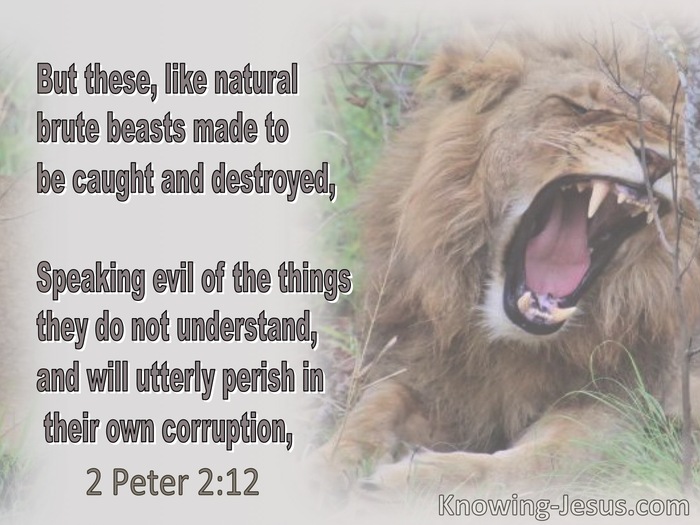
My own view is that Paul is speaking of men who are labeled as animals by him as such or by other men of God. People use the word "animal" in this way all the time when referring to certain depraved persons, saying "he is an animal." The apostle Peter in the text at the heading of this chapter refers to the rage filled oppressors and persecutors of Christians, and of the heretics, as "natural brute beasts."
In this short series I will use one chapter or post for each of the several animals mentioned at the start of this page. We will in the next chapter talk of "the dogs" that Paul warns believers about. Following that we will give a post about the other human animals.
The animals that we will focus our attention on are not always used in a bad sense or as a pejorative. So, though Satan is a "roaring lion seeking whom he may devour" (I Peter 5: 8) yet Christ is "the lion of the tribe of Judah" (Rev. 5: 5) and Christians, though in one sense are sheep, in another sense are also lions as Christ. "The righteous are bold as a lion" (Prov. 28: 1) said Solomon.
What may be said about wild dogs and cats may not be true of domesticated dogs and cats. However, in scripture wild animals are generally viewed as emblems of bad people.
Both the Bible and every day language are filled with similes and metaphors comparing certain peoples to certain animals. You hear some say "he is a weasel," or "he is a snake," or "he is a dog," or "he is a fox," or "he is a chameleon," or "he is an ass," etc. Sometimes people will simply say "he is a beast," or "a monster," or "he is an animal." Job spoke of men who are "born as a wild ass's colt." (Job 11: 12) Jesus said "go tell that fox," referring to Herod. (Luke 13: 32) Peter compared apostates to dogs who eat their own vomit and to pigs wallowing in the sty. (II Peter 2: 22)
Daniel Parker, who caused much trouble among the Baptists in the early nineteenth century with his opposition to missions, theological education, and who embraced Hyper Calvinism and other falsehoods found among heretical groups and heathen peoples, was likened to a wild boar.
"Doctor Carroll, of Texas, in a speech before the Southern Baptist Convention at Hot Springs, Arkansas, in 1900, compared Parker in his violence to a wild boar rooting up the tender plants in a garden." (William Dudley Nowlin
The Anti-Missionary Controversy
of Baptists in Kentucky from 1832 to 1842; See here)
It is also interesting that the bible writers likened tyrants to ferocious wild animals. In the prophetic writings of Daniel the prophet the Babylonian kingdom is likened to a lion, the Medo-Persian is likened to a bear, the Greek empire is likened to a leopard, and the Roman empire to a monstrous beast.
The counterpart of these beastly worldly governments is seen in the Book of Revelation's "four beasts," or rather "four living creatures." (Rev. 4) They are angelic, or cherubic, beings surrounding God's throne, each with a different face—a lion, an ox (or calf), a man, and an eagle. These creatures are constantly worshiping God, proclaiming His holiness, and are described as being covered in eyes and having six wings.
When Satan appeared to Eve he came in the serpent. Satan himself is called "the serpent" (Rev. 12: 9; 20: 2) When God the Holy Spirit appeared to men when Christ was baptized, he appeared as a dove. (Matt. 3: 16)
In the next chapter we will begin to look at some of the leading animals that are used to describe certain evil men and of whom Christians are to be on guard against.


No comments:
Post a Comment