In this chapter we will continue to look at what T. P. Dudley wrote in defense of Two Seedism in his pamphlet "The Origin, Nature, and Effects of the Christian Warfare." We will also give the views of Dudley and the Two Seed Primitive Baptists regarding "the old man" and "the new man" in Paul's epistles. We will begin by citing from some of the things Dudley wrote in that writing. Wrote Dudley:
"It is contended by some, yea, many professors of religion, that the soul is regenerated. We confess we know but little about the soul...If the soul were regenerated, would it not be as wholly devoted to God, subsequently, as it had been to sin, antecedently to the new birth? If it be the soul that exercises volition for the body, and that soul is “born of God,” and consequently “cannot sin,” how are we to account for the wicked actions of David, of Peter, and thousands of other christians, even down to the present day?"
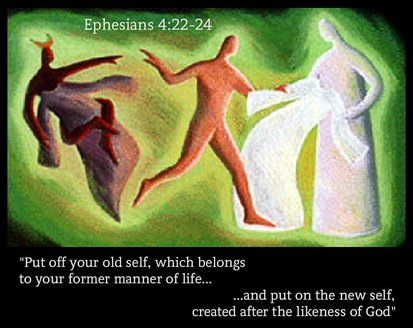
The "soul" is often put for the "spirit," or what Paul calls the "inner man" in contrast to the "outer man," which is the body. (2 Corinthians 4:16; Ephesians 3:16; Romans 7:22–23) How does the inner and outer man relate to the "new man" or the "old man"? The expressions “old man” and “new man” occur in basically four places in Paul’s letters, namely, Romans 6:6; Ephesians 2:15; 4:22-24; and Colossians 3:9-11. The way Dudley and the Two Seeders interpret these terms is strange. To them, the "new man" is their preexistent self, begotten or made when Christ was begotten or made before the world began. To them the "old man" is the man who was created in Adam and the man born with his depraved fallen nature. Upon this foundation they then say that "regeneration" or being "born again" does not change anything about the "Adam man." The new man is not changed, for it enters into a man and remains as it was from eternity, a holy spiritual being who needs no regeneration. So too the old man is not changed because he remains degenerate. That is why in the above citation Dudley denied that "the soul" is "regenerated." A man when "born again," according to Dudley, experiences no change to his depraved Adam nature, to his natural soul, spirit, or body, and the divine nature he receives is not changed. So, how did the opponents of Two Seedism, such as Watson, Potter, etc., reply to this narrative? Before we answer that question, let us first notice a few more citations from Dudley on this point.
Wrote Dudley:
"But, it is contended, that the same soul, exercises wicked volition for the “old,” and holy volition for the “new man?” If so, is not the soul divided against itself? Others tell us, it is the mind which exercises volition for the body."
Yes, the soul (self, spirit, mind, heart, etc.) is divided. Within a born again believer there is both a depraved human nature and a holy divine nature. That is, there is within his innermost being both natures. Sometimes the one is followed and sometimes the other. But, this implies a third person. I am the one who decides whether to follow the old man or the new man. That makes three men. There is but one soul or spirit and within it there are two natures, principles of law, that are influencers.
Even in the unregenerate there is a duality for he has within him 1) a conscience (spirit or nature) wherein the law of God is inscribed (See Rom. 2: 14-16) and which convicts him of sin, and restrains him in his immoral conduct, and wherein the Spirit of God "strives" with him (See Gen. 6: 3) and 2) an innate depravity of soul, mind, heart, and spirit which tempts, entices, or lures him to do immoral acts. This is sometimes caricatured by showing a person trying to make a moral decision and having a good angel whisper in one ear and a bad angel whispering in the other. In the life of the Christian these two entities are called "flesh" and "spirit." The flesh, like the term "old man," stands for the depraved nature, for inward carnality and lust, while "spirit" refers to the "spirit of a man" that is now indwelt by the Holy Spirit. So Paul wrote:
"For the flesh lusts against the Spirit, and the Spirit against the flesh; and these are contrary to one another, so that you do not do the things that you wish." (Gal. 5: 17 nkjv)
By "the spirit" here is not the Holy Spirit, but the spirit of the believer which is united to the Spirit of God. This inner spirit of the believer has been, and continues to be, renewed, so Paul exhorts believers to be "renewed in the spirit of your mind" (Eph. 4: 23), which exhortation speaks of "the spirit" of the "mind." The spirit of the mind is not always pure and holy even in the believer and is why continual cleansing and renewal are needed. Sometimes the believer is operating from a "pure mind" (II Peter 3: 1) and sometimes from an impure mind, but in either case it is the same mind (or faculty) that is alternating between states.
Notice also the three entities in the above text. There is 1) "the flesh" (or old man), and 2) "the spirit" (or new man), and 3) "you." If the flesh and spirit denote persons or selves, then we must say that, according to Two Seedism, a man is composed of three persons or selves.
Wrote Paul:
"21 I find then a law, that evil is present with me, the one who wills to do good. 22 For I delight in the law of God according to the inward man. 23 But I see another law in my members, warring against the law of my mind, and bringing me into captivity to the law of sin which is in my members. 24 O wretched man that I am! Who will deliver me from this body of death? 25 I thank God—through Jesus Christ our Lord!
So then, with the mind I myself serve the law of God, but with the flesh the law of sin." (Rom. 7: 21-25 nkjv)
Two men, two minds, two laws controlling thought and behavior, two hearts, etc. Or, is it not a case where the same heart, soul, mind, or spirit is the source of both obedience and disobedience? We read of people who are "double minded" (James 1: 18) but we do not interpret that to mean two brains, or two separate thinking entities, but two ways of thinking by the same faculty. So, likewise, we sometimes read of a person having two hearts: Psalm 12:2: "Everyone utters lies to his neighbor; with flattering lips and a double heart they speak." Again, that does not mean that there are literally two separate hearts, but one heart that sometimes is divided.
The "heart" in scripture often carries the idea of what is the core of being, what is the innermost or center of self. In the believer Christ, as well as the Father and Spirit, take up residence in that place. But, within that heart there yet remains sin and lust, its complete eradication not occurring when a person has God within, but occurs gradually. Paul warned believers, those who had been given a "new heart" and "new spirit" when they were converted, to "take heed lest there be in any of you an evil heart of unbelief." (Heb. 3: 12) A Christian is not always singular in his heart. Yet, God gives to Christians, according to his promise, "singleness of heart" (Eze. 11: 19; Jer. 32: 39; Acts 2: 46-47).
Is God making a new man out of the old man? Is God making a new heart out of the old heart? Is God making a new spirit out of the old spirit? Is God making a new nature out of the old nature? Is regeneration a change or an exchange? These are the central questions that Dudley and other Two Seeders frequently asked of their opponents. This is why Dudley and his ilk did not like referring to regeneration as a "reformation," "restoration," or a being "born over" as opposed to being born anew. However, the bible writers did speak of restoration and reformation. Does partaking of the divine nature change the human depraved nature? Dudley would say no.
Wrote Moore:
"And so they reverse the scriptures, and have the old man, put off the old man, if it is only one man with two natures. On this subject Elder Dudley says: “I find no authority in my Bible for dividing the man. The old man is an entire old man, and the new man is an entire new man.”
The scriptures show that it is the same soul, heart, mind, or spirit, or the same person, that is changed when it experiences conversion, regeneration, or rebirth. The words the apostles used to describe this experience show this to be the case, such as "renewed," "transformed," "conformed," "resurrected," "converted," "repented," etc., all which means that the inner man, the incorporeal self, a person's innermost being, soul and spirit, or his mind or way of thinking, is changed or being changed. This change is drastic at the start, but not completed. Transformation of the inner self continues throughout the life of the born again child of God.
We would ask the Two Seeders:
1. Is not what is dead in a lost sinner quickened?
2. Is not what is degenerate in a man the very thing regenerated?
3. Is not what is transformed or renewed in the believer changed?
Wrote Moore:
"But I have a letter before me, written by Elder Dudley, in which he states that, “I [Dudley] have various letters from John Clark, of Virginia, pledged to the belief of the doctrine I maintain, and in one or more of which he [Clark] uses the language, ‘I [Clark] have read the Circular on the Warfare and I see nothing in it, which should disturb the fellowship of brethren.’ ”
I have to question whether John Clark, a first generation leader of the newly formed "Primitive" or "Old School" Baptists, believed in Two Seedism. Perhaps he did believe in some portions of it early in his ministry, as did Lemuel Potter, but later turned away from it. Much of what Dudley wrote in his book on the Christian Warfare is biblical. The only part that is not is: 1) the belief that the new man is a preexistent man who enters into the old man, 2) the belief that nothing of the man is changed in regeneration.
J. Taylor Moore in his biography of Dudley (from which we cited in the previous chapter) also wrote:
"Elder Dudley, in his defense against the very same characters wrote: “How, then, can they contend that some part – for I have not met with one who contends that the entire Adamic man or the old man – is born of God?” And on another occasion, when asked by an aged Baptist minister why he did not tell the people that it was the Adam man that is born of the Spirit, his reply was: “My Bible don’t say so.”
If the unregenerate man is not born of the Spirit, then who or what is born again? Obviously the person who is born again is the same person who was born the first time, i.e. an "Adam man." So Paul wrote: "and you has he quickened who were dead in trespasses and sins." (Eph. 2: 1). The "you" that was dead is the you that was brought back to life.
Wrote Moore:
"Their principal charge was that Elder Dudley denied the “new birth.”"
This is a valid objection to the Two Seed idea of the preexistence of the souls of the elect. The Two Seed idea is that being born of God occurred in eternity past when Christ, as a human mediator, was begotten by the Father, and that a person being born again in time is but a manifestation of that previous birth, being the time when the eternal child of God is incarnated (enters into a person). That is certainly foreign to how the new testament describes the new birth.
In Chapter IV Moore wrote:
"Elder Dudley soon learned that there would be no lack of an attempt to overthrow the faith that he maintained, for correspondents now began to write to him from almost every state in the Union, and from Canada; some desiring further explanation on certain points contained in the Circular, others urging him to visit their section, others assuming to teach him the way more perfectly, while some others aspiring to greater and public notoriety, began an attack on garbled extracts from the Circular, through the different religious periodicals, to the greater number of which he replied in the most humble and Christian-like spirit."
The debate over "Two Seedism" was very intense in the first decades after the formation of the Hardshell Baptist sect. It continued to be a hotly debated and divisive issue with them through the entire nineteenth century, as Elder Sylvester Hassell stated at the end of that century.
Wrote Moore:
"I have frequently heard him speak of a visit to the Red River Association where he had been most outrageously misrepresented by a Dr. Fain, one of the editors of the Baptist Watchman. When Dudley was put upon the stand to preach he had been speaking but a little while when some man in the congregation cried out “If that man is a heretic so am I.” He had proceeded but a little while when the same expression was used, and immediately it was taken up throughout the congregation. When the excitement had quieted, one of the preachers in the stand behind him, said, “Yes, we are all heretics.” On Sunday Dr. Fain followed him in a very excited manner, and had progressed but a short while when he said, in a very excited way, “Yes, yes, a few years ago, you pronounced what you have just heard, the worst kind of heresy, and now you swallow it down greedily, greedily, greedily,” reminding us very forcibly of what we have heard Elder Dudley say, about a Baptist coming to him in a certain section, where he had been libelously reported, and saying to him, “Brother Dudley, when I hear others tell what you believe, and preach I don’t believe a word of your preaching, but when I hear you preach, I believe every word of it.”
R.W. Fain was an associate with John Watson, and they were not only fellow "Primitive Baptists" but fellow physicians, and lived in the same area around Nashville. When Watson died in 1866, Fain, along with others, such as Elder (Dr.) J. B. Stephens, began a weekly periodical titled "The Baptist Watchman." I have cited from this periodical several times and have shown how Fain, Stephens, et.al, published articles supporting the view that God saves his people through the means of the gospel. That paper was also intended to carry on the work and teachings of Watson, being the publishers and promoters of Watson's book "The Old Baptist Test." Fain, like Watson, was a fervent opponent of Two Seedism.
Wrote Moore:
"He (Dudley) says in his writings, that one of the first objections he heard urged against the Circular on the Warfare was, that it taught that man had two souls. Then one Elder White, of Missouri, concluded that he taught in his writings that man had not even one soul; and one charge became proverbial among his antagonists; namely, “that he taught that in the atonement of Christ, there was nothing done for the sinner,” another, “that he denied the resurrection of the dead,” and still another, “that God had a family of spiritual children in heaven before time began, fully developed, who from time to time come down to earth, take up their abode in the Adamic man, engage in mortal combat, carry on the unequal strife, til man dies, and then returns to heaven without accomplishing anything else than opposition to man.” All of these charges with a multitude of others he met and refuted with that Christian-like spirit that characterized his whole public life."
Well, Dudley did not refute all these charges. He did in fact believe in the "Eternal Children" doctrine.
Wrote Moore:
"To the honest reader, I wish to say, that this is but a brief extract from Elder Dudley’s writings, and I have many of a like nature, and for which many withdrew their correspondence, fellowship, and Christian intercourse, from him, his churches and the Licking Association. This was in reply to a man who claimed that the soul is “born again,” “or a part of the Adamic man.” This turn was taken in order to avoid the idea, that the man is born over again. Elder Dudley reputed the idea that the Adamic man, or sinner in whole or in part, in order to constitute the child of God, is born of the Spirit. For he says, “I have ever conceived that the corn of wheat, which falls into the ground and dies, contains within its germ everything, and nothing more than will spring up and grow out of it. Now I ask, was anything born of that incorruptible seed which was not in the germ? Was the natural seed deposited in Christ? I think brethren will answer each of these questions in the negative. How then can they contend that it is some part [for I have not met with one who contends that the entire Adamic man or the old man] is born of God.” In view of such clear expressions, such a positive position, what must be thought by every honest, intelligent Christian of such men as Elder S.H. Durand, of Pennsylvania, and others, who claimed such harmony with Elder Dudley while living, to come among us after he is gone claiming that it is the sinner, that is born again, but in vain pretending they don’t mean “born over;” don’t mean that the Adamic man is changed. Who is the sinner? Is he not the Adamic man?"
So, Dudley did believe that the man who is born into the world and of the lineage of Adam was not the man who was saved, or born again. This is why Two Seeders were accused of believing in the "no change view" of regeneration or "hollow log" doctrine (of which I have spoken about in other articles).
Wrote Moore:
"I have a private letter written by Elder Dudley in which he says, in speaking of the doctrinal sentiments of the Circular on the warfare, that he believed the time would come when that sentiment would be made a test of fellowship."
Dudley's prophecy was true, although it took the "Primitive Baptist" church nearly a century to rid themselves of it, although as we have said, citing Crowley, that if one knows what to listen for, he can still hear remnants of Two Seed thinking among today's Hardshells.
Wrote Moore:
"Not only did Elder Dudley have Elder John Clark of Virginia, committed in writing of his hearty endorsement of the faith he maintained of the vital oneness of Christ and his people, but many others, among whom was Elder Wilson Thompson and his son, John A. Thompson, who said publicly on the stand at the Conn’s Creek Association in following Elder Dudley [who preached the introductory on that occasion at the request of Elder McQuary,] I [J.A.T.] have heard Brother Dudley once before, and then said, “If I ever heard the gospel preached Brother Dudley preached it,” and Elder Dudley writes: “He [Thompson] then endorsed most fully and feelingly on that occasion.” Elder D. says of the occasion: “When we went on the stand I determined within myself, ‘If I can find language plain enough to make myself understood, a future misrepresentation should be willful.’ I had been so often and so grossly misrepresented.” While discussing the question a brother in the congregation cried out aloud, “If that man is a heretic so am I.” He was responded to by another, and it was Elder Wilson Thompson, who proclaimed aloud from the stand, “Yes, brethren, if that is heresy, we are all heretics.”
I do believe that Wilson Thompson, a founding father of the "Primitive Baptist Church," did believe in Two Seed ideas. I have read where he considered himself a friend of Daniel Parker, and never wrote anything in opposition to Parker. According to Moore, Wilson Thompson wrote letters to Dudley endorsing his views. However, I have also read in the past where Wilson's eldest son, Grigg, who also was a first generation leader of the newly formed denomination, denied that his father believed in Two Seedism. I think, however, that Grigg was not telling the truth. I am sorry that I cannot recall where I read this about Grigg defending his father relative to whether he was a Two Seeder.
The fact is, a large portion, possibly the majority, of those who became part of the anti mission movement and of the sect that called itself "Primitive" or "Old School" or "Hardshell" Baptist, were Two Seeders. It was not till we got towards the end of the nineteenth century that the Two Seeders began to decrease dramatically.
Wrote Moore:
"And the idea of having the old man, the Adamic man, and sin and lust or corruption, making three men, then boiling these three down into one sinner man, then throwing a little essence of spirit in, and by its operation, making all into one spiritual man, did not originate with one P.G. Lester, who a few years ago came amongst us, backed by an eastern syndicate, sizzling like a trembling crater, ready for an eruption for a number of years, for Elder Dudley had the same heretical notion to meet in a controversy with Elder John A. Thompson, of Lebanon, Ohio. In that controversy with Thompson, Elder Dudley says: “If I were as entirely confident of interest in the atoning blood and righteousness of the Lord Jesus Christ, as I am that the earthly, fallen and depraved Adam, is the old man, I do not think I should entertain a doubt of reaching the heavenly glory."
So, is any part of a man changed in being born of God? The Two Seeder would say no. Those who oppose them would say yes. So, what does the Bible say? The word "repent" means either to "turn" or to "change your mind." It is from the Greek word metanoia, meta meaning change, and noia meaning mind. So, the mind of the Adam man is changed. This involves a change in a person's psychology, and "psuche" is the new testament Greek word meaning psyche. To change a soul is to change a personality, including a change in attitude, beliefs, etc. The word "convert" also means to change, the thing being changed is the way of thinking, or the things believed. In other words, the soul of man is changed. So the Psalmist said:
"The law of the LORD is perfect, converting the soul: the testimony of the LORD is sure, making wise the simple." (Psa. 19: 7)
The Psalmist David also prayed:
"Create in me a clean heart, O God, and renew a right spirit within me." (Psa. 51: 10)
The word "renew" means to make new again, and is similar to the word "regeneration." It is not something foreign to an Adam man that is made new, but what was part of the man.
One of the errors of Primitive Baptists is in thinking that in regeneration, rebirth, renewal, etc., there is a change to the essence or substance of the soul and spirit, a physical change, rather than being a moral, spiritual, psychological, change. They not only believe this is true in regeneration, but also in being generated in physical birth, for they will contend that the doctrine of "total depravity" means that a degenerate sinner lacks the physical faculties to do anything pleasing to God. The great theologian, Jonathan Edwards, however, taught that in becoming degenerated by sin did not remove any faculties of body or soul, there being no physical inability in the lost sinners to believe, repent, etc. He does not have moral or spiritual ability is what Edwards taught and many Baptists agreed. In my early writings against Hardshell Baptist teachings I cited from Elder R.V. Sarrels who wrote a "Systematic Theology" from a Hardshell point of view. In his section on regeneration he advocated that there was a change is the soul's essence when it was regenerated.
Also, the word "restore" is used to describe the change that occurs when a sinner believes and is renewed. David said "He restores my soul" (Psa. 23: 3). The Two Seeders, however, opposed using such words to describe the change that occurs when a person is born of the Spirit. They opposed the word "reformed" also for the same reasons, although the word "repent" carries with it the idea of being reformed.
Wrote Moore:
"One man now living made an insidious attack on his views of “quickened spirits,” in the Baptist Watchman, a paper published in the South that never was regarded as sound in the old Baptist faith, and this man at the same time was professing great love, fellowship and “perfect harmony of sentiment,” but since the death of Elder Dudley the turpitude of the spirit by which he was acting then has been so clearly demonstrated, that we wonder how any can respect him for such baseness of character."
This is a biased statement made by a Two Seeder who is writing in defense of Dudley. We have already seen where Moore referred to the opposition coming from Elder (Dr.) R.W. Fain who was one of the editors of "The Baptist Watchman." Dr. Fain was far more sound in the faith than other Two Seed or Primitive Baptists.


No comments:
Post a Comment