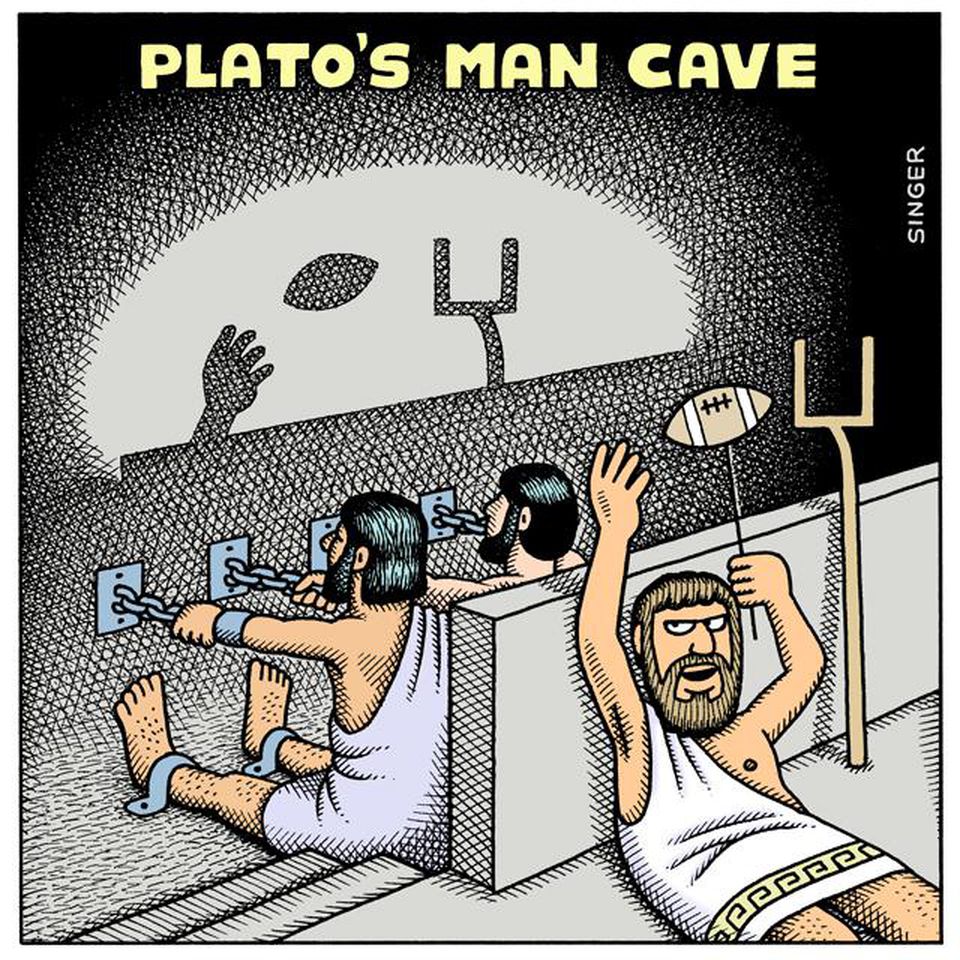
, and the journey of education. The prisoners
, representing the philosopher's journey from ignorance to enlightenment and the pursuit of true knowledge.
We see this famous allegory at work on a large scale in our day in many ways. Certainly AI is making it harder to discern the real from the false with so many fake AI videos. It is also true in politics and religion when people embrace lies, deceptions, false narratives, false explanations, revisionist histories, and such like. Many of these make people feel comfortable, a kind of refuge. Certainly the teaching of
"evolution" is a false system of reality, and for many it alleviates cognitive dissonance for them, at least until they are given information that contradicts it. When a person attacks such false systems, as Socrates often did, one may find himself the object of wrath, scorn, and even be put to death as he was.
Refuge in Lies
In Isaiah chapter twenty eight there are people who are said to "have made lies our refuge, And under falsehood we have hidden ourselves." (28: 15 nkjv) Lies and falsehoods are not really safe refuges at all, however. These lies and falsehoods include false systems of theology. Dr. Barnes in his commentary says: "They sought security in false doctrines." That is true. We must ask therefore why this is true and what is the danger in taking refuge or finding comfort in such falsities. Who can deny that the false doctrine of Universalism is such? Who can doubt that a denial in eternal punishment and the belief in annihilationism also brings comfort? Such false systems are attempts to deal with cognitive dissonance. When faced with new, contradictory information, individuals may cling to familiar, comforting falsehoods to avoid the pain of changing their beliefs or worldview.
Those in cults and heretical sects are happy and contented in their theological paradigms or constructs and experience severe cognitive dissonance when a theological inspector, like a home inspector, points out flaws in the construct, which makes the dissonance worse. This is why cult members and heretics often avoid inspection or criticism, or new information that goes against the accepted belief, for they feel comfortable in their refuge of theological lies and false doctrines. They do not want anyone to upset their religious apple cart. So they "resist the truth" (II Tim. 3: 8); And, truth is reality, and error and falsehood are not realities. The new testament Greek word for "truth" is "aletheia" and not only means what is true and correct, but what is real. Yes, the lie or false system of belief, is a real thing, but not being truth, is not what is really true or factual.
We also see the same in social or political constructs where people are deceived by cunning and crafty leaders and given false narratives to believe, and facts that are not really facts. Such Paul wrote about when he wrote:
"For the weapons of our warfare are not carnal but mighty in God for pulling down strongholds, casting down arguments and every high thing that exalts itself against the knowledge of God, bringing every thought into captivity to the obedience of Christ, and being ready to punish all disobedience when your obedience is fulfilled." (II Cor. 10: 4-6 nkjv)
"Arguments" is also translated as "imaginations" or "reasonings" in other translations, so we have "destroy arguments and every lofty opinion" (esv), "destroying speculations" (nasb 1977), "tear down speculations" (lsb), "destroying sophisticated arguments" (Amplified). The Greek word for "strongholds" is "ochyrōma" and refers to a castle, stronghold, fortress, or some other high place, like "Masada," the rocky height to which the Jews fled from the Romans in A.D. 70 and fought off the legions for a good while until finally taken.
In fact, we often use the word "castle" to refer to mental constructs, which is a well-established metaphor in psychology, literature, and common idiom, representing complex, internal, and often fortified mental spaces. Psychologically, "people often build "castles" to protect their egos from emotional threats, insecurities, or vulnerabilities," says Psychology Today, "for the purpose of providing themselves a mental or emotional refuge and a sense of safety and control, and comfort. These mental castles, strongholds, are a kind of coping strategy where individuals hide behind walls to avoid dealing with emotional or theological realities. The danger in such imaginary theological or social constructs is that the walls of those castles can become too thick and become a prison."
We might call these belief systems "imaginary" schemes. It is interesting to do a word study of the texts in the bible where the word "imagination" is used, such as where we read that "every imagination of the thoughts" of the hearts of men are continually evil. (Gen. 6: 5; 8: 21) It is in the imagination where people are "inventors of evil things" (Rom. 1: 30), including inventors of heresies. There are people who, in departing from God and the truth of his word, "walk in the imagination" of their own hearts. (Deut. 29: 19; See also Jer. 3: 17, 7: 24, 9: 14, 11: 8, etc.) There are those who "imagine deceits all the day long" (Psa. 38: 12; 140: 2). In Ezekiel chapter eight the prophet was shown the gross idolatry that had been brought into the temple of Yahweh. Notice what God says about this:
"Then said he unto me, Son of man, hast thou seen what the ancients of the house of Israel do in the dark, every man in the chambers of his imagery? for they say, the Lord seeth us not; the Lord hath forsaken the earth." (Eze. 8: 12 kjv)
The temple had small rooms or private chambers and in each of these there were depictions of idol gods and demons and where whoredom took place. But, I also think that by "chambers of his imagery" may also allude to the chambers of the mind, to man's imagination. The idols and false religious ideas were first imagined in the chambers of the mind before they were engraven on the walls of the temple. We might well call these images "figments of the imagination." They are "shadows" as in the allegory of the cave. They are not real, not true. What is needed to remedy the people's tendency to create their own dark ideas about God and the world is the light of God's word, the light of truth. Light not only dispels darkness but shadows too, shadows that are symbols of man's theological falsehoods.
Satan's Involvement
"The coming of the lawless one is according to the working of Satan, with all power, signs, and lying wonders, and with all unrighteous deception among those who perish, because they did not receive the love of the truth, that they might be saved. And for this reason God will send them strong delusion, that they should believe the lie, that they all may be condemned who did not believe the truth but had pleasure in unrighteousness." (II Thess. 2: 9-12 nkjv)
In the above passage "the lie" is contrasted with "the truth," and the definite article is in both. Satan and his emissaries are the instigators of every false system of religion and philosophy. God is the reason for anyone coming to see "the truth." So the apostle stated elsewhere:
"Now the Spirit expressly says that in latter times some will depart from the faith, giving heed to deceiving spirits and doctrines of demons, speaking lies in hypocrisy..." (I Tim. 4: 1-2 nkjv)
We have people today who say about people's differing views on a subject -- "that is his truth," as if truth can be whatever people want it to be. It is a true saying that says: "You are entitled to your own opinion, but you are not entitled to your own facts." (made famous by former senator Daniel Patrick Moynihan) Truth is absolute and not relative. This reminds me of the student who said to his teacher -- "there are no absolutes." The teacher then asked, "are you absolutely sure?" You can see the contradiction. The very claim that there are no absolutes is an absolute proposition.
With the help of Satan and the demons, and the false teachers he employs, people imagine or invent all kinds of religious fables (fictions), some of which can be quite elaborate. These are but shadows of the allegorical cave, mere illusions.


No comments:
Post a Comment