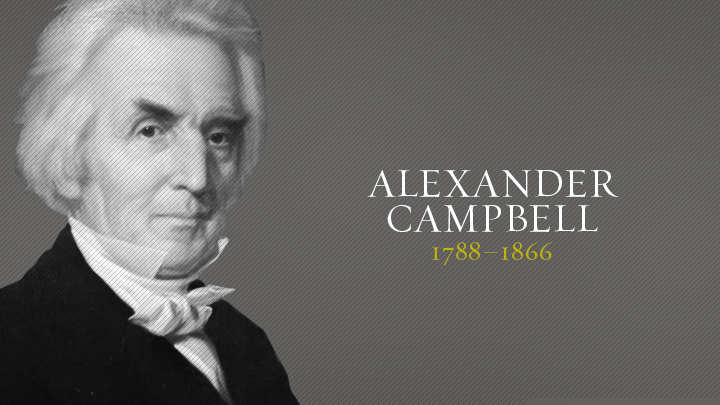
Back in 2009 I wrote a synopsis of the arguments I used in a debate over whether water baptism is essential for eternal salvation. (See here) I have had several debates with the "Church of Christ" sect, sometimes known as "Campbellites" (because Alexander Campbell was the chief leader of those who were first called "Reformers" and who caused some division in Baptist churches), on this issue. Alexander Campbell and his father Thomas Campbell were at first Presbyterians, then became Baptists when they came to believe that only immersion was the proper mode of baptism. As time went on, however, he began to teach things that Baptists could not accept. He was one of the leaders in the "anti mission movement" along with those who came to be known as "Primitive" or "Old School" or "Hardshell" Baptists and for awhile was quite popular with the Baptists, even having debates with others in which he defended Baptist beliefs. This is why B.H. Carroll Jr. called Campbellites and Hardshells religious twins. (See these postings on this here and here)
In the following citation Campbell taught the truth about water baptism, arguing that water baptism does not really or actually remit sin, arguing that the blood of Christ does that. Rather, he taught, at the first that water baptism is when sins are washed away "formally," and follows actual cleansing by the blood of Christ applied by faith. I agree with this Baptististic view of Campbell. I cited these words of Campbell from his debate with Presbyterian W. L. McCalla (1823):
"The blood of Christ, then, really cleanses us who believe from all sin. Behold the goodness of God in giving us a formal proof and token, of it, by ordaining a baptism expressly "for the remission of sins." The water of baptism, then, formally washes away our sins. The blood of Christ really washes away our sins. Paul's sins were really pardoned when he believed, yet he had no solemn pledge of the fact, no formal acquital, no formal purgation of his sins, until he washes them away in the water of baptism."
"The intelligent and well instructed Christian, however, is baptized to obtain the formal remission of his sins."
"He appointed baptism to be, to every one that believed the record he has given of his Son, a formal pledge on his part of that believer's personal acquittal or pardon..." (pg. 135-37)
The debate can be read (here)
In baptism a person makes a public confession and makes a pledge of fealty to Christ and the church. I Peter 3: 21 is a good text that helps to sustain Campbell's idea of "formal" remission of sins. I wrote on this in the context of my debates on water baptism with Campbellites. (See here) This is why baptism is called a "sacrament." In that post I wrote:
The English is simply a transliteration of the Latin word "sacramentum" which means an oath. That is the basic meaning of a sacrament. It means an oath, an obligation, a vow. In legal terminology it means a pledge...But this word had a particular meaning. It was used of a military oath of allegiance. A military oath of allegiance was called the sacramento, when the Roman armies made their oath of allegiance to their country and to their emperor."
Water baptism ceremoniously, pictorially, ritually, and "formally" washes away sins. This is what Annanias meant (who would be the one to baptize the one who was to become the Apostle Paul) when he said to Paul:
"And now why are you waiting? Arise and be baptized, and wash away your sins, calling on the name of the Lord." (Acts 22: 16 nkjv)
Water baptism served to show to others that new believers were identified with Christ and his followers. It is what a "badge" is to soldiers. It is a token, or formal proof, that sins have been washed away.
I am thinking about putting all my writings on the debate over the necessity of water baptism for salvation into its own blog as I have done with other subjects.


No comments:
Post a Comment