Wednesday, February 15, 2023

Beliefs about the Afterlife (ix)


"Now that he ascended, what is it but that 
he also descended first into the lower parts of the earth?" 
(Ephesians 4: 9)

In the previous chapters we have seen how the scriptures positively and expressly state that the Lord Jesus Christ descended in his soul or spirit to the place where all the spirits of dead humans go when they die, to the spirit world of Sheol or Hades. 

Presumption also is in favor of this view seeing that Christ was fully human and that he died. That means his human body and spirit separated, and that his body was laid in the earth (via a cave in the rock) and that his spirit descended to "the land of the dead," to the realm of spirit, into the very place where Lazarus and Dives descended in the story of their afterlife experiences (as we have seen). In this much he shows himself truly human as we are. Of course, as we have shown, his descent into Hades also shows in what respect he is different from every other human being. His experience with Death and Hades was both common and uncommon. 

In this chapter let us begin to discuss more fully what Christ did in Hades for the 72 hours that his body and spirit were separated. Let us begin with a discussion of

Abraham's Bosom & 
Leading Captivity Captive

Appearing to the righteous dead on the side of Hades, where the people of God are gathered together, Christ spoke to them and led them out and into heaven, in a triumphal procession. He leads the procession and this is in agreement with his being "forerunner" to heaven, and death and hell's conquering victor, with the keys of death and Hades, as we have seen. There goes with him, or closely following him, all those occupants on the side of Hades where Lazarus and Abraham, and their ilk, were located. This is referred to in a number of passages. Let us begin with this text:

"Wherefore he saith, When he ascended up on high, he led captivity captive, and gave gifts unto men. (Now that he ascended, what is it but that he also descended first into the lower parts of the earth? He that descended is the same also that ascended up far above all heavens, that he might fill all things." (Eph. 4: 8-10)

We have already addressed the idea in this verse that states that Christ "descended first into the lower parts of the earth," and showed that the words denote Hades. What we will analyze further now is what is meant by his having "led captivity captive." We have already affirmed that it was an allusion to the triumphal procession of the conqueror. So, what is meant by "he led captivity captive"? That is a question where there is disagreement among interpreters. "Led captivity captive" and giving gifts to men is a reference to Psalm 68. John MacArthur (as cited here) comments on Paul's use of Psalm 68: 18 noting that this psalm 

"is a victory hymn composed by David to celebrate God’s conquest of the Jebusite city and the triumphant ascent of God (represented by the Ark of the Covenant) up Mount Zion (cf. 2 Sa. 6-7; 1Chr 13). After a king won such a victory he would bring home the spoils and enemy prisoners to parade before his people. An Israelite king would take his retinue through the holy city of Jerusalem and up Mount Zion. Another feature of the victory parade, however, would be the display of the king’s own soldiers who had been freed after being held prisoner by the enemy. These were often referred to as recaptured captives—prisoners who had been taken prisoner again, so to speak, by their own king and given freedom." (See The MacArthur New Testament Commentary - emphasis mine)

That is correct and other leading commentators agree. This is that triumphal procession we have been describing and which was the likeness Paul used to teach about Christ' victory over Death and Hades. The words "led captivity captive" is in the context of Christ victory and celebratory parade. Who are these captives? Are they his enemies? The Devil, fallen angels, and demons? The wicked spirits of the dead? Or, the chosen and redeemed of the OT, or from both testament periods? Or, all of the above? All of the above no doubt, in some sense. However, the text itself directly refers to one specific event that occurred when Christ ascended out of Hades and to Heaven. 

Paul sees "led captivity captive" as an event of the past (as are the other verbal participles in the text). They are all aorist tense and refer to a past event (meaning "it happened"). He does not see the action of "leading captivity captive" as ongoing, although he does not necessarily exclude that there are any present and future instances of leading captivity captive. However it does not specifically or directly refer to Christ saving people via conversion nor to something apocalyptic or eschatological (resurrection). Yes, when a person is brought out of spiritual death when converted to Christ, he or she is delivered from being prisoners or captives of sin, moral death, and of Satan, and that would also be an instance of taking captivity captive. Those who were slaves to sin become slaves to Christ. 

The problem is, the "leading captivity captive" of the text is viewed as a finished act, all the captives being recaptured or liberated from their confines at the same time, when Christ ascended. "When" did he lead captivity captive? "When he ascended up on high." As that ascension is a completed act, so too is his leading captivity captive viewed as such in this passage. I was taken captive by Christ, and freed from the captivity of sin and Satan, in 1972, not when Christ ascended.

Following the ascension into heaven the conquering Christ "gave gifts to men" (a kind of distributing the "spoils of war"). The giving of gifts followed both the ascension and the taking captivity captive. However, as I have said, that does not preclude the idea that Christ is still taking captivity captive, though in a different aspect or context than in liberating the righteous dead from Hades. We can argue this because "he gave gifts to men" is also aorist tense and denotes what occurred "when" Christ ascended into Heaven. Yet, we do not deny that he is still giving gifts to men and still conquering and leading captivity captive.

The spoiling of Satan, and Death and Hell, is alluded to in these words of Christ:

"When a strong man armed keeps his palace, his goods are in peace; but when a stronger than he comes upon him, and overcomes him, he takes from him all his armor wherein he trusted, and divides his spoil." (Luke, 11, 21. 22)

Though these words describe the conversion experience, they also describe what Christ did when he descended into Hades as the Victor over sin, Satan, and the evil world. That being so, it is affirming the same thing. The "gifts" to men that Christ gave after his victorious ascension and resurrection of the text are equated with the "goods" or "spoil" of Satan's kingdom. Christ spoiled Death and Hades. This prophecy of the Messiah also affirms the same:

"Therefore I will divide Him a portion with the great, And He shall divide the spoil with the strong, Because He poured out His soul unto death, And He was numbered with the transgressors, And He bore the sin of many, And made intercession for the transgressors." (Isa. 53: 12)

The words "led captivity captive" sometimes alludes to capturing (rescuing) "prisoners of war" from the hands of the enemy. This happens a lot in war. When an American soldier was freed from a Nazi prison camp, as an example, that was an instance of taking captivity captive. That is not to say, however, that the righteous who were in the comforting side of Hades were prisoners of this kind.

Capture and captive are very similar words. We could also speak of the act of "captivating." We might interpret the words "led captivity captive" simply by the word "recaptured." Christ recaptured what the enemies of our race had captured, what Death and Hades had captured or taken as hostages.

Redemption also involves recapture (as I showed in my series on Redemption). As a near kinsman, a redeemer was obligated, if able, to "deliver" a family member from kidnappers, or from being imprisoned by invading armies, and to "execute vengeance," or "render justice," to be the "avenger." 

There is reluctance among some bible students to think of Old Testament period saints being described as "captives" or "prisoners" while in the comforting side of Hades. But, it ought not to when we consider the various meanings of the words and their varied contexts. To say that Lazarus was a captive or prisoner while with Abraham in the comforting side of Hades does not mean that there was any suffering. 

Israelites knew well the meaning of the word "captive." They were captives in Egypt. They also were captives in Babylon for seventy years. Also, Jesus prophesied that they would be scattered after the Temple was destroyed (A.D. 70) and be carried away as "captives" into all the nations. (Luke 21: 24)

If this leading captivity captive refers to Christ leading the saved who were in the good side of Hades into Heaven and Paradise, then we are led to confess that those who died before Christ death and resurrection and who were in Abraham's Bosom were "captives" or "prisoners" of Hades. That is distasteful and makes many reluctant to accept this interpretation. But, it ought not to do so upon further scrutiny. 

Who can deny that the physical bodies of OT saints (decaying in graves) show that they were Death's captives? Was not the resurrection of "many bodies of the saints" (that we have referred to previously) after Christ's resurrection a freeing from captivity? Who can deny it? The next question then would be to ascertain whether the souls or spirits of the OT saints were also captives in Hades. I think they were, in much the same way the Israelites were captives in Babylon, or even in Egypt, or among the nations into which they were scattered after A.D. 70 (when the Temple was destroyed by the Roman legions and the Jews scattered into other parts of the word in the "diaspora"). Consider that even though the Israelites were captives in Babylon, nevertheless they were given much freedom, so that they lived normal happy lives. Many of them were so happy with life in Babylon that they chose not to return to Palestine when they were allowed to do so after seventy years there. This is in some ways like it was in Hades prior to Christ going to Hades and from thence exiting the place with the redeemed who were there with Abraham and his kind. 

The righteous in Hades at the time of Christ's death and descent into Hades were "captives" in the sense that they were confined, that they did not have liberty to go to earth or the heavens, or occupy the heavenly city in the third heaven. They were restricted too. But, they were all in comfort, and though they still had expectations of good things to come they were not unhappy. They were happy in waiting. They had not received their full inheritance (and neither have any, for this must await the resurrection). 

Some of the early church fathers who believed that OT saints were in Hades, in Abraham's bosom, believed that this was what is called "Limbo." Let me say a few words about that.

We can affirm that neither the OT saints nor NT saints go into a perfect or final condition when they die. That end perfection comes after the resurrection of the dead. That is why we call it an "intermediate state." The OT believers went to such an interim state or place though it is inferior to the interim state or place where NT believers go. The intermediate state for OT believers (elect) was not the same as the intermediate state for NT believers. So, if we define "Limbo" as meaning entering into a heavenly place, without being perfected in every way, then all who are in heaven in spirit at this moment may be said to be in Limbo. Here is what the encyclopedia Britannica says (emphasis mine): 

"Two distinct kinds of limbo have been supposed to exist: (1) the limbus patrum (Latin: “fathers’ limbo”), which is the place where the Old Testament saints were thought to be confined until they were liberated by Christ in his “descent into hell,” and (2) the limbus infantum, or limbus puerorum (“children’s limbo”), which is the abode of those who have died without actual sin but whose original sin has not been washed away by baptism. Traditionally, this “children’s limbo” included not only dead unbaptized infants but also the mentally impaired." (here)

If Limbo is another term for Abraham's bosom, for that side of the gulf of Hades where the righteous were gathered, then count me a believer. But, I do not believe in a Limbo for infants, idiots, or those who died without having a chance to be saved. There is no salvation after death. We may apply the language of Revelation 22: 11 to every person who dies, which says -- "He that is unjust, let him be unjust still: and he which is filthy, let him be filthy still: and he that is righteous, let him be righteous still: and he that is holy, let him be holy still." It ought to have no connection with "purgatory." 

Recall that Dives was told by Abraham that he could not escape the tormenting side of Hades and move to the other side where there was no suffering. He was given no hope of salvation. Limbo or Limbus means a border or department. The church fathers and early Christians who first held this doctrine believed that the righteous were situated on the limb, i.e., on the edge or border of Hades proper. 

Wrote Philip Schaff in "History of the Christian Church" (here) on page 121 "The Future State":

"The Limbus patrum is exclusively reserved to the saints of the Mosaic dispensation. They suffer only by the consciousness that they are deprived, in consequence of original sin, from beholding God, and by an ardent longing for the coming of their Messiah. Since Christ has atoned for original sin, and freed them from imprisonment, this limbo is empty, and no longer of any importance in a religious sense." 

He also said (emphasis mine):

"Christ’s descent into hades was carefully discussed by the Schoolmen. It occurred as soon as his soul was separated from the body at his death. He was in the infernal regions during the three days of his burial, but did not assume their pains. The reason for this visit was twofold, says Bonaventura, —to release the Old Testament saints and to confound the adversaries of the Gospel, the demons. Job 17:16, "my hope shall go down to the bars of Sheol," or into the "deepest hell," as the Vulgate puts it, he meant that he went no farther than the limbus patrum and not to the abode of the lost. The bars of hell—vectes inferni,—that is, by "spoiling principalities and powers," Col. 2:15; and third, to make show of his divinity—manifestatio divinitatis — to the demons by preaching, 1 Pet. 3:19, and by enlightening those dark spaces with his presence, as it is said, Ps. 24:7, "Lift up your doors, O ye princes, and the king of glory shall come in." Here again the Vulgate is responsible for a mistake, the word "gates" being translated "princes.""

I believe, like many of the church fathers and early Christians, what Schaff says. On that text in First Peter we will have much to say in the next chapter, and also on the proclamations Christ made in Hades, and of his purpose in going there.

The intermediate or limbo state of the righteous OT dead may well be alluded to in the Book of Hebrews, such as the text therein which says - "And these all (OT Believers), having obtained a good report through faith, received not the promise: God having provided some better thing for us, that they without us should not be made perfect." (Heb. 11: 39-40) 

In their commentary on this text Jamieson-Fausset-Brown wrote in their commentary (emphasis mine): 
 
"...in their state, beyond the grave their souls also seem to have attained an increase of heavenly bliss on the death and ascension of Christ; and they shall not attain the full and final glory in body and soul (the regeneration of the creature), until the full number of the elect (including us with them) is completed."

Old Testament saints were in an "intermediate state," and entered into another "intermediate state" when they left the comforting side of the gulf of Hades and went to Paradise or Third Heaven. Even believers who now die in the Lord go to an "intermediate state," which is not their final perfected state. That will not come till their bodies are resurrected and made spiritual and immortal. The intermediate state of believers since Christ ascended to heaven as the forerunner is better than the intermediate or temporary state of OT believers in Abraham's bosom. JBF also said - "Heb 9:12 shows that the blood of Christ, brought into the heavenly holy place by Him, first opened an entrance into heaven (compare Joh 3:13)." This is in agreement with the words of the apostle Paul who said:

"Therefore, having obtained help from God, to this day I stand, witnessing both to small and great, saying no other things than those which the prophets and Moses said would come— that the Christ would suffer, that He would be the first to rise from the dead, and would proclaim light to the Jewish people and to the Gentiles.”" (Acts 26: 22-23 nkjv)

Necessary for "rising from among the dead" would be his soul leaving Hades and reentering his body and his body rising up. 

Wrote Dr. Barnes (Barnes Notes - emphasis mine):

"...that he would be the first that should rise. This cannot mean that the Messiah would be the first dead person who should be restored to life, for Elijah had raised the son of the Shunammite, and Jesus himself had raised Lazarus, and the widow's son at Nain. It does not mean that he would be the first in the order of time that should rise, but first in eminence; the most distinguished, the chief, the head of those who should rise from the dead - πρῶτος ἐξ ἀναστάσεως νεκρῶν prōtos ex anastaseōs nekrōn. In accordance with this he is called Colossians 1:18 "the beginning, the first-born from the dead," having among all the dead who should be raised up the pre-eminence of primogeniture, or what pertained to the first-born."

Agreed. However, as some believe, being the first to rise from the dead may mean "as the first for ever risen" (Meyer), or first risen in a glorified immortal body. 

Leading Captivity Captive 
Informative Tidbits

The Greek word for "led captivity" is the same in the following text as in the Ephesians 4 text (one of the two places it is used). It reads:

"For of this sort are they which creep into houses, and lead captive silly women laden with sins, led away with divers lusts." (II Tim. 3: 6)

We might say that these false smooth talking teachers "captivated" their audiences, the "suckers," the folks who are easiest to con. They take people captive with their false ideologies. Their disciples may also be called prisoners to these smooth talking cult leaders and their enticing ideas. 

We might interpret the words "led captivity captive" simply by the word "recaptured." Christ recaptured what the enemies had captured. This is alluded to in the following text dealing with what occurs when a sinner is converted to Christ: "And that they may recover themselves out of the snare of the devil, who are taken captive by him at his will." (II Tim. 2: 26) 

Anyone who is dead is a prisoner of death as far as his body is concerned. Anyone in Hades is also a prisoner, though there is a vast difference between those who are "imprisoned" or a "captive" on the upper side of Hades where the righteous are assembled. As we will see in the next chapter, "spirits in prison" (I Peter 3: 19) means spirits "under guard." We might say that both Lazarus and Dives were "guarded," but in different senses for each.

Wrote Coffman's Commentary:

"Christ is represented as the mighty conqueror, leading in his train of captives "captivity" itself, a personification of all of the bondage which oppresses human life, such as "captivity to death," the imprisonment of our mortality, "the captivity to sin" (2 Timothy 2:26), etc."

We find this same expression in the time of the Judges (Deliverers) in Israel's history, before they had their first king, when Judge Deborah wrote the lyrics to this song:

"Awake, awake, Deborah, awake, awake, utter a song: arise, Barak, and lead thy captivity captive, thou son of Abinoam." (Judges 5: 12)

Says Ellicott in his commentary:

"Lead in triumph thy long train of captives. For the expression, comp. Revelation 13:10." In other words, "make captives of those who have formerly captivated us." (Clarke's commentary) Or "...take prisoner those who took thee prisoner." (Cambridge) 

We also have the same or similar expression in these words:

"He that leads into captivity shall go into captivity" (Rev. 13: 10).  

There is irony in these word. It is like preparing to hang someone and getting hung yourself. (Esther 7) It is like the irony we saw in the preceding chapter where the king of Babylon or Lucifer were kings who imprisoned many people (mostly for the wrong reasons or unjustly) and yet they end up in the prison of Hell themselves. "He that leads into captivity" is a reference to people who capture and imprison people. To "lead captivity captive" is to capture the captives of others.

The kind of captivity in Hades that the OT saints experienced there may be more like "protective custody." We will look into that more closely in the next chapter when we discuss I Peter 3: 18-20 and Peter's reference to Christ in spirit going to Hades and "preaching" to the "spirits in prison." In this way it is like the word "reserved" (KJV) that we wrote about in the opening chapters of this series. We saw how the Greek word denoted a "guarding" and showed how it was applied to both things in Hell and things in Heaven. 

So, people who are in Hades, by whom are they guarded? By the god Hades as in Greek mythology? By Satan as some Christians believe? Or by God himself through angelic guards?  By the latter no doubt.

Tuesday, February 14, 2023

Baptist-church of Christ/Campbellite Debate


   Last week, I debated a so called "Church of Christ" preacher. He was what you might call a "hardline" Campbellite. As much as they like to claim that their movement is unified, that is false. I have found three strains of them with regards to baptism alone, not to mention many other issues. Some have recently started to embrace a more baptistic view of baptism. Although they are few, that view is growing. The next view, which I call "middle of the road" will say baptism is the equivalent of being born again, but dying without baptism doesn't necessarily consign you to hell. They would say it is like a baby who is aborted or dies in the mother's womb, but was never "born". The child still is saved and goes to heaven. So baptism completes the process, but the lack of it does not negate the personhood or new nature that is in progress. Most of the churches who hold this view go by the name of "Christian Church" (both Independent and Disciples of Christ) although many are called "Church of Christ". The third view is the hardline view, that even if you make it to the water, but die of a heart attack before being immersed, you are lost and go to hell. 

   The subject of the debate was supposed to be baptism. When I gave my view of John 3:5, he rejected it, saying "No Christian in the first two centuries ever espoused such a view". I explained that my interpretation was that Jesus was speaking of a physical birth when he said "born of water" and the spiritual birth when He spoke of "born of the Spirit". Why do I hold this view? Because in the very next sentence Jesus said so. Jesus compared born of water and being born again, when He said "Flesh gives birth to flesh, but the Spirit gives birth to spirit". Why would Jesus even say "born AGAIN" if He were not referring to two different births, one physical and one spiritual? Right after that, He said "born of water" alluding to the physical birth, when a woman's water breaks and a child is born. "Born of the Spirit" comes AFTER being "born of water" so if being baptized is the equivalent of being born again, that would place the new birth BEFORE Spirit birth, and that statement would make no sense. From there, he went on many rabbit trails, as he thought this was his opening to attack me on other things.

   After this, the Campbellite went on a rampage and began to quote the church fathers and others who lived in the first 200 years after Christ. I told him, that while I studied what the fathers and others wrote, that they did not determine doctrine for me. (The Campbellite also believes this, but it wasn't convenient for him at that time to say it). They give us a picture of what things were like at that time, and sometimes they mean different things by words than we mean today. For example, I could say that I agree that baptism "saves", but saves from what? If it saves from sin, and places me into union with Christ, and puts me into contact with Christ's blood as the Campbellites teach, then in essence the Campbellites believe in transubstantiation of the water, like the Catholics do of the Eucharist or Lord's Supper. After all, Jesus did say "Unless you eat my flesh and drink my blood, you have no life in you". I asked him "how do we eat Christ's flesh and drink His blood in order to have life? Obviously you reject taking this literally, yet you take the washing away of sins literally in baptism. Tell me how we can know which things are literal and which are symbolic." Without a response, he began to quote from more ante Nicene fathers. At that point, I realized he was going to use others to prove his view, even tho his own tradition rejects anything but the Bible itself.

   Without missing a beat, no pun intended, he went straight to the use of musical instruments, also quoting the ante Nicene fathers. I explained that the church had "errors" before the canon of Scripture was even complete, look at the mess they made of celebrating the Lord's Supper and Paul's rebuke of them. So while the ante Nicene fathers are useful study for a picture of the church at that time, they are not necessarily inspired or authoritative. I explained that many things were cultural, because in that day, once Christianity had come to be a mostly Gentile movement, the only "music" they knew of involved paganism, so they rejected music. There was no such thing as "neutral" music like love songs, or pop and country songs. He quoted Clement, and his view of music in the church. I suppose he didn't expect me to be knowledgeable enough to know that Clement condemned ALL music in or out of the church. So once I quoted Clement on this fact, I asked the Campbellite , that if he holds Clement as a standard of truth, why does he listen to the radio, or teach his kids piano and guitar? He eventually started to quote Baptists like Spurgeon, who clearly said he did not like instruments in worship. However, Spurgeon also said that others like Luther and Calvin did use instruments and if it helped in their praise of God, he respected that, and that we had "gospel liberty" on such issues. Again, he tried to employ someone he thinks to be in hell, to be the truth bearer.

   At my closing remarks, I stated the following propositions which the Campbellite had ignored. I suppose I "may have" (lol) started to use my preaching voice and I fear I "cleared and cleansed the temple", and I then felt truly what Jesus felt in His anger at the Pharisees for the valuing their traditions more than truth, and their self righteousness more than souls. I ended my rebuttal by saying the following 16 points below. When it says "I" its refers to me, and where it says "you" it refers to the Campbellite. After I said these things there was total silence for what seemed like an eternity. I wondered if soldiers might come at any moment and take me to Pilate for execution. That's what happened to Jesus when He silenced the crowd and got no response. Whether it was a "good silence" or a "bad silence" I will leave that for you to judge.  

My closing remarks:

 1. You said "no one in the first 3 centuries ever taught that John 3:5 referred to physical birth". I said "Jesus made it plain when He said in the VERY NEXT SENTENCE "flesh gives birth to flesh and spirit gives birth to spirit". So in verse 5 Jesus referred to 2 things, "born of water" and "born of the spirit", the word "and" being a conjunction indicating two separate things. In the next verse He refers to the SAME TWO things and says "flesh/birth" and "spirit/birth". You kept appealing only to those in the first 3 centuries, and I said I don't base my doctrine on what others say", and then YOU appeal to them AGAIN, even tho your own churches say they also do not look to what others say, but "the bible alone is our creed". hypocrite 

 2. You use Spurgeon and call him the greatest Baptist preacher of the 17th century and use him as "proof" that instruments are wrong. Then I asked if you accept his 5 point Calvinism since he is your "expert" in doctrine. You gave no response 

 3. You continually appeal to the "church fathers, esp Clement (Clementine as you call him) and his denunciation of music in worship. I tell you that he also condemned ALL music as sinful even outside the church, and asked since you hold Clement in such high esteem, do you also follow his teaching that ALL music is sinful, and you should never listen to music on the radio since he said all music was "pagan". You gave no response. 

 4. You made a huge deal about a few Baptist churches having female pastors, even tho they are NOT in fellowship with my type of Baptists. Then I showed you several examples of female elders in "churches of Christ" and you gave no response or apology. You love to shoot those arrows, but when those same arrows are shot back at you, there's no response or apology.

5.You said churches of Christ do not teach that you must be baptized by them to be valid, even tho in your opening statement you affirmed this teaching. I gave you several links to churches who affirm what I said. You gave no apology and no response. 

6. You made a big deal that some Baptists are landmarkers, I mentioned that your churches teach the exact same thing, no response. 

7.I showed you that ALL churches, and the early church fathers either believed that BOTH communion AND baptism were literal (born again in water, literal flesh and blood in the bread and wine or some variant like consubstantiation) OR that they are BOTH symbolic. NO one has ever taught that one was symbolic and the other literal. I asked you how do you follow Jesus' command when He said "Unless you eat my flesh and drink my blood, you have no life in you." You gave no response  

8.You said you only do what the early church did. I said no you don't, you have hymnals, pitch pipes, sing songs other than psalms, have Sunday schools, fellowship halls and church property, meet on Sunday nights and Wednesday nights, while the early church did not. You have added to what the early church practiced. Do such additions help your worship and knowledge and fellowship, or hinder it? You had no response 

 9. You said that there were many different kinds of Baptists and that's proof we aren't the "real church". I proved that there are at least 12 different kinds of Campbellite churches and listed them. Your own church split because they could not agree on how many cups to use in Communion. You gave no response. 

10. You kept mentioning "so and so wasn't done in the first 500 years" blah blah blah. I mentioned that four part harmony was not done in the first 600 years, yet you practice that. You gave no response  

11. I said the early church ONLY sang the psalms and they sang in monotone. I asked what authority said you could sing gospel songs that had a tune. You gave no response  

12.I mentioned that the early church only baptized in living water and had no indoor baptistries, yet you do. You gave no response  

13. I asked why do you sing songs written my Methodists, Presbyterians, Lutherans etc, since they were NOT baptized by immersion, thus according to your doctrine they can't be saved. I asked if they are burning in hell while you are singing their songs. You gave no response  

14. You said baptism IS the new birth, I asked, well if it is, then you must be rebaptized when you "lose" your salvation, in order to put you into union with Christ again for you have essentially "died" and need another birth. Since you do not believe in "original sin" you cannot make the argument that baptism only washes away Adam's sin as the Catholics teach. So if you are not washing away Adam's sin, you are washing away your own. Thus, when more sins accumulate, you must be rebaptized for your doctrine to make sense. You gave no response. 

  15. I told you that women in the early church covered their heads and didn't wear pants, yet you do not follow that practice even tho it is explicit in scripture. No response.

  16. I also showed many of your churches acknowledge Christmas and Easter, and even those that do not, the people still celebrate in their homes. If all this was considered pagan by the early church, why even celebrate privately, much less in the church? I gave proof that the early church did indeed celebrate the "Passover of Christ" especially when it was still a mostly Jewish movement by keeping Passover, which would be Easter albeit with no bunnies etc, yet many of your churches ignore it. I showed you the debates on when the church should observe Easter even during the time of the ante Nicene fathers. I was certainly willing to acknowledge that Paul was speaking of a lifestyle when he said "Therefore let us keep the feast...with the unleavened bread sincerity and truth". Yet you have, by example at least, forbade the reading in December of Scriptures which speak of Christ's birth, and forbade the reading of the Gospel accounts of the crucifixion and resurrection in March or April. I asked where was there any command in Scripture, or example of the early church that said we may not read some Scriptures at certain times of the year? You gave no response.  

As for using Scripture only in this debate, you can't debate someone who keeps changing the rules, decides on his own what verses are literal and which are symbolic, and who comes from a church that denounces all churches except their own, then uses those same churches who agree with you on one point, to defend your beliefs. You are a hypocrite and a Pharisee, it is clear that your "tradition" has become your god, just as the Law became the god of the Pharisees. And finally, if you are so zealous that you have the truth, why don't you go out and witness for that truth and start baptizing everyone? There are 3 CoC churches around me, and not one person has ever invited me to any of your churches, or tried to love me into their "kingdom" or shown the love of Jesus in any way! ahh but you have a debate and they will show up in droves! That's all you guys wanna do. debate debate debate. All the while, the world is going to hell and you couldn't care less. You care more about being the exclusive "church". You build up walls to keep people out, when Jesus came to break down walls so people could enter. "Woe to you, scribes and Pharisees, you hypocrites! You shut the kingdom of heaven in men’s faces. You yourselves do not enter, nor will you let in those who wish to enter.Woe to you, scribes and Pharisees, you hypocrites! You traverse land and sea to win a single convert, and when he becomes one, you make him twice as much a son of hell as you are. You blind guides! You strain out a gnat but swallow a camel. Woe to you, scribes and Pharisees, you hypocrites! You are like whitewashed tombs, which look beautiful on the outside, but on the inside are full of dead men’s bones and every kind of impurity. On the outside you appear to be righteous, but on the inside you are full of hypocrisy and wickedness!"

   In closing, we must all be mindful that we do not impose barriers that keep people from coming to Christ. We Baptists can be guilty of this as well, especially when we impose legalism which requires a "turning from sin" before the person has even been saved. We must be careful when we use the word "repentance" when calling on sinners to do so. "Repentance" simply means "a change of mind", but it can also mean "to turn around". A sinner can have a change of mind, and see their sin as it really is, but still have no power to actually stop sinning. The power that helps us turn from our sins, comes AFTER we are born again, and even then usually slowly as we grow in the faith, altho it can also be instantaneous. It is a fine line we must walk, but to imply that a sinner must turn from their sin in order to be saved, not only requires of them something they are unable to do, but it places works as a part of salvation, rather than the result of it. Remember that Jesus chose to spend His time with sinners, not those who imposed so many rules that kept them from entering the Kingdom.

                                                       Love them as He loved us!  Ken Mann                                 

Friday, February 10, 2023

Beliefs about the Afterlife (viii)


Christ Descent Into Hades

"24 Whom God hath raised up, having loosed the pains of death: because it was not possible that he should be holden of it. 25 For David speaketh concerning him, I foresaw the Lord always before my face, for he is on my right hand, that I should not be moved: 26 Therefore did my heart rejoice, and my tongue was glad; moreover also my flesh shall rest in hope: 27 Because thou wilt not leave my soul in hell, neither wilt thou suffer thine Holy One to see corruption. 28 Thou hast made known to me the ways of life; thou shalt make me full of joy with thy countenance. 29 Men and brethren, let me freely speak unto you of the patriarch David, that he is both dead and buried, and his sepulchre is with us unto this day. 30 Therefore being a prophet, and knowing that God had sworn with an oath to him, that of the fruit of his loins, according to the flesh, he would raise up Christ to sit on his throne; 31 He seeing this before spake of the resurrection of Christ, that his soul was not left in hell, neither his flesh did see corruption." (Acts 2: 24-31)

This text is decisive on the question of whether Christ, like King David, went to "hell" (being "Sheol" in the Psalm quoted by Peter, and "Hades" in the Greek text of Acts 2). 

The text above affirms that Christ went to Hades in the words "his soul was not left in Hades." Also, notice that Hades or Sheol is not the grave where the body is located. This is clearly seen by the word "neither" in the words "neither his flesh see corruption." His soul or spirit being not left in Hades is a distinct thing from "his flesh" not experiencing "corruption" (decay) in the grave. 

Another text which affirms the same truth are the words of the Lord Jesus Christ. He said: 

"As Jonas was three days and three nights in the whale's belly; so shall the Son of man be three days and three nights in the heart of the earth." (Matt. 12: 40)

Recall also that Jonah said - "out of the belly of hell cried I, and you heard my voice." (Jonah 2: 2)

"Hell" is from Sheol. Sheol is the equivalent for Hades. But, in the above text, Christ identifies Hades by the words "heart of the earth." Thus, we have another plain truth witness on the question of whether Christ was in Hades. Not only that, but the text says that "the Son of man" will be 72 hours in Hades. This is not a reference to the place of his physical body (which was in the cave) but to the place of his human soul or spirit. Christ was in his disembodied human spirit conscious and alive in Hades, among the dead. We will discuss this in more detail but it is necessary that we begin by first giving plain declarations of the fact that Christ was in Hell (Sheol or Hades). In addition to the two texts given above (Acts 2 & Matt. 12), let us add these important ones.

"Wherefore he saith, When he ascended up on high, he led captivity captive, and gave gifts unto men. (Now that he ascended, what is it but that he also descended first into the lower parts of the earth? He that descended is the same also that ascended up far above all heavens, that he might fill all things." (Eph. 4: 8-10)

"But the righteousness which is of faith speaketh on this wise, Say not in thine heart, Who shall ascend into heaven? (that is, to bring Christ down from above:) Or, Who shall descend into the deep? (that is, to bring up Christ again from the dead." (Rom. 10: 6-7)

What Jesus called "the heart (or core) of the earth" is here styled "the lower parts of the earth" and "the deep." All these are equivalent terms for "Sheol" or "Hades." In his resurrection and ascension Christ went from the lowest Hell to the highest Heaven. That is what Paul is affirming. Christ descended in order that believers might ascend out of hell into heaven. 

Now that we have seen that it is positively and unequivocally stated that Christ went to Hades, let us see what the scriptures say or intimate what he did while his spirit was in Hades.

When we speak of Christ's descent, we may allude to two different things. The Son of God coming down from Heaven and being born of a virgin, i.e. his "incarnation," is one descent. Christ said "I came down from heaven." (John 6: 38) But, another descent was his descent from earth to the underworld. Likewise the ascension of Christ may be viewed in two respects. He ascended bodily from the grave and into heaven. But, his spirit also ascended from Hades. 

Raised Out From Among The Dead

"But Christ has indeed been raised from (Greek "ek") the dead, the firstfruits of those who have fallen asleep." (I Cor. 15: 20)

“and killed the Prince of life, whom God raised from (ek) the dead, of which we are witnesses." (Acts 3: 15)

"...that the Christ would suffer, that He would be the first to rise from (or out from among) the dead, and would proclaim light to the Jewish people and to the Gentiles.” (Acts 26: 23 NKJV) 

"...and declared to be the Son of God with power according to the Spirit of holiness, by the resurrection from (or out from among) the dead." (Romans 1: 4 NKJV)

The Greek word "ek" means "out of," or "out from among." When Jesus was resurrected, all the dead were not resurrected with him. He therefore "came out from among" the dead (implying that the others were not resurrected, his resurrection being special, or eclectic, or selective). The Greek prefix "ek" or "ex" literally denotes a selection or the removal of something from a group, taking some but leaving some too. The point is simply this: Christ could not have come out from among the dead if he were not among the dead. This is true in regard to both his body and soul, though each were not in the exact same place. Death is a separation of body and spirit. His body was in the earth, like other bodies in graves, but his spirit was in Hades or Sheol. So, how can anyone deny that Christ was among the dead in Hades? 

At the conclusion of this section of our series we will look at some of the objections for believing that Christ went to Hell, examining the reasons for the reluctance to believe that fact. But, we cannot dismiss what is plainly stated in scripture no matter how much it may be disagreeable to us.

Wrote one author on this subject in an Internet encyclopedia (See here):

"The descent of Christ into hell denotes the belief that His soul, separated from His body but remaining united to His Divine Person, passed into the abode of the dead and stayed there as long as His body, likewise remaining united to His Divine Person, reposed in the tomb, that is, until the Resurrection. The English word "hell" in this context corresponds to the Hebrew še'ōl (sheol), the Greek Ἅιδηζ (hades), and the Latin inferus, or infernus, and therefore means the abode of souls after death. The ancients thought and spoke of this abode as being in the underworld. Although the notion of the structure of the universe has changed, the ancient terminology persists."

Before we examine what the scriptures say of Christ's going in spirit to Hades, let us first look at how --

Hades Reacts To New Inmates

Since Hades is a kind of prison, a place where people are under guard, or are captives, we may consider what kind of reaction those who enter Hades as the "new inmates," or the new arrivals, get from the occupants. We have such reaction recorded for us in Isaiah chapter fourteen, in talking about the death of the king of Babylon and of "Lucifer."

“Hell (Sheol) from beneath is excited about you, To meet you at your coming; It stirs up the dead for you, All the chief ones of the earth; It has raised up from their thrones All the kings of the nations. They all shall speak and say to you: ‘Have you also become as weak as we? Have you become like us? Your pomp is brought down to Sheol, And the sound of your stringed instruments; The maggot is spread under you, And worms cover you.’" (Isa. 14: 9-11)

How was Christ received by the inhabitants of Sheol or Hades? The day the king of Babylon died they were "excited" about seeing such a great man as the king of Babylon come to where they were (per the above text). I am sure that there was far greater excitement in Hades when Christ descended there! I am also really sure that those on the comforting side of Hades, the place of Lazarus and Abraham, were excited! Of that we will have more to say as we move along in our thoughts. I am also sure that there was another kind of excitement and stirring among the dead spirits on the torment side of the gulf of Hades, the place where Dives was confined. I am also sure that the entrance of Christ into the Underworld raised all kinds of questions in the minds of the occupants there, much like the descent of the king of Babylon to Hades raised questions in the minds of the captives in Hades. 

What questions would be proposed to Christ by Sheol's occupants when Christ entered? What answers would he give? If they ask Christ "are you become weak as we? or like us?" what would Christ say in response? Of course, the answer would be quite different from that of the king of Babylon, or any other person who had ever entered the afterlife. Could they say of Christ that the maggots and worms are devouring his body via the decaying process, as they said to the evil king of Babylon? No, they could not. This is because, as the scriptures testify, his body did not decay at all while in the grave, and suffered no decay. Christ descent into Hades was unlike any other. 

I do not doubt that when Christ entered the afterlife, entered Sheol or Hades, he went there in spirit emanating light and glory so that all who were there recognized this person as the Lord of glory. Some would wonder why he was there and have many questions. Others would know why he is there and Hades would be filled with jubilation by "Abraham's seed" or family of God. 

“How you are fallen from heaven, O Lucifer, son of the morning! How you are cut down to the ground, You who weakened the nations! For you have said in your heart: ‘I will ascend into heaven, I will exalt my throne above the stars of God; I will also sit on the mount of the congregation On the farthest sides of the north; I will ascend above the heights of the clouds, I will be like the Most High.’ Yet you shall be brought down to Sheol, To the lowest depths of the Pit. “Those who see you will gaze at you, And consider you, saying: ‘Is this the man who made the earth tremble, Who shook kingdoms, Who made the world as a wilderness And destroyed its cities, Who did not open the house of his prisoners?’ (vss. 12-17)

Jesus "came down from heaven" by a voluntary act, he being the eternal "Son of God." But, Lucifer, the archangel, was rather cast out of heaven (Rev. 12: 9; Luke 10: 18), or was "fallen from heaven," which is one major distinction between Christ and Lucifer. 

Lucifer, like the king of Babylon, wanted to become God, to ascend higher than God, to the highest place in the highest heaven, but ironically, he was brought down to the lowest place in the lowest hell (in the person of the king of Babylon). He went to the place of fallen angels, to Tartarus, "to the lowest depths of the pit." There is irony seen in the fact that this new inmate in Hades, with such a reputation as the king of the empire of Babylon, housed many "prisoners" when he was alive upon earth, and yet he himself ends up a prisoner in the lowest hell in the afterlife, where there is nothing but pain and punishment. It is the same kind of irony and reversal of fortune we saw in the story of Lazarus and Dives where the one who had as a rich man never begged as did Lazarus, while on earth, becomes a beggar in hell. The rich man becomes the poor man and the poor man becomes a rich man.

We also see some of the same excitement and queries at the entrance of Lucifer as with the king of Babylon. We also are told that those in Hades will "see" and "gaze" upon this new inmate of the infernal regions, and they will "consider" what his entrance in Hades says, what message it sends.  Of course such a description demonstrates that Hades is not the grave for the occupants see, talk, and think. 

Appearing In Each Side of Hades 

As I stated in a previous chapter, Christ went to Hades in his human soul or spirit (and his divine nature or person was united with his human spirit). We also have seen how Hades, up till the time of Christ descent into Hades, was divided by a "great gulf" and that the blessed departed spirits of the saved from previous times were on the upper side of it and that the condemned were on the lower side of the Hades gulf. We have affirmed that Christ went to each side of Hades, each for its own purposes. We will offer additional proofs for this proposition in the next chapters.

In the next posting we will continue our examination of Christ's descent into Hades and what he did while he was there.

Look Who's Watching


"For I think that God has displayed us, the apostles, last, as men condemned to death; for we have been made a spectacle to the world, both to angels and to men." (I Cor. 4: 9 nkjv)

"Spectacle" is from the Greek word "theatron" and is used three times in the Greek New Testament. (Acts 19:29; 19:31; 1 Corinthians 4:9) It is translated "theater" twice and "spectacle" once. It means basically what our English words theater and spectacle mean today. It denotes "a place in which games and dramatic spectacles are exhibited, and public assemblies held" or "a public show," and "metaphorically a man who is exhibited to be gazed at and made sport of." (Strong)
 
Of course, being the object of gaze in a coliseum or theater, or a show or spectacle, implies not only the thing being watched, but the audience doing the gazing. 

Christianity has often been made a "spectacle" throughout the past two thousand years. 

All that being true, who is watching us as Christians? If we are the spectacle, who are the spectators? Paul mentions three of them; 1) "the world" 2) "angels" 3) "men" (Greek "anthropos" meaning human being). 

Of course, though God is not mentioned, he is not excluded. He too is watching Christians, and not them only, but has his eye on all. Notice these texts on God's watching over and observing his people.

Lord God Is Watching

"For a man's ways are before the eyes of the Lord, and he ponders all his paths." (Prov.5: 21)

"For the eyes of the Lord are over the righteous, And his ears are open unto their prayers: But the face of the Lord is against them that do evil." (I Peter 3: 12)

"O Lord, you have searched me and known me! You know when I sit down and when I rise up; you discern my thoughts from afar. You search out my path and my lying down and are acquainted with all my ways. Even before a word is on my tongue, behold, O Lord, you know it altogether. You hem me in, behind and before, and lay your hand upon me. Such knowledge is too wonderful for me; it is high; I cannot attain it." (Psa. 139: 1-6 ESV)

Angels Are Watching

"Are they not all ministering spirits sent out to serve for the sake of those who are to inherit salvation?" (Heb. 1: 14 ESV)

"It was revealed to them that they were serving not themselves but you, in the things that have now been announced to you through those who preached the good news to you by the Holy Spirit sent from heaven, things into which angels long to look." (I Peter 1: 12 ESV)

When Paul says that the apostles were a spectacle "to angels," does he mean both holy angels and unholy angels? To fallen angels? To the demons? 

The above two verses speak of that special "watching" of believers (born again people) that the holy angels of heaven do as their job. But, it is not something that they are unexcited about doing, but rather are eager to do. They are interested in anything dealing with the gospel and with redemption, or with Christ the Son of God, and this would include observing Christians and the church. That fact is also evident in these words of Paul to the Corinthian Christians:

"For this cause ought the woman to have power on her head because of the angels." (I Cor. 11: 10 kjv) 

"For this reason, and because the angels are watching, a woman should wear a covering on her head to show she is under authority." (NLT)

There are texts also that reveal that even the demons and fallen angels, including Satan their leader, are familiar with the saints. Let us notice those texts.

"But the evil spirit answered them, “Jesus I know, and Paul I recognize, but who are you?” (Acts 19: 15)

"Suddenly, a man in the synagogue who was possessed by an evil spirit cried out, "Why are you interfering with us, Jesus of Nazareth? Have you come to destroy us? I know who you are — the Holy One of God!" (Mark 1:23-24 NLT)

The World Is Watching

"But recall the former days in which, after you were illuminated, you endured a great struggle with sufferings: partly while you were made a spectacle ('gazingstock' kjv) both by reproaches and tribulations, and partly while you became companions of those who were so treated." (Heb. 10:32-33 nkjv) 

The Greek word translated "spectacle" or "gazingstock" is "theatrizō." It means "to bring upon the stage," or "to set forth as a spectacle," to "expose to contempt."  

People are concerned today because we are always being watched or surveilled, since cameras are everywhere, and people have cameras built in to their phones. The idea of being constantly spied, especially by some agency of government, can be alarming. It can also be alarming to know that our enemies are watching over us for evil purposes. Some even think aliens from other worlds are watching us. 

So, what about being watched by God? By angels? By society or the world? How should we react to being watched? Should it not make us more "circumspect"? (See Eph. 5: 15) Should it not make us more careful how we behave?

Tuesday, February 7, 2023

Beliefs about the Afterlife (vii)

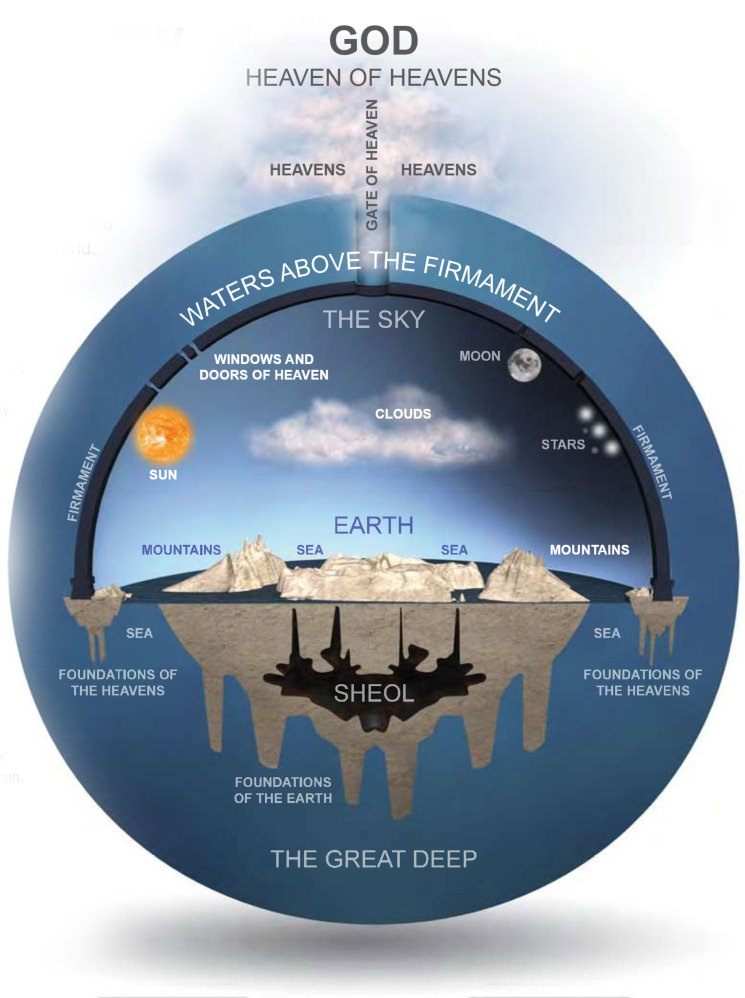
Bible Cosmology

The drawing above represents the cosmological dimensions that were addressed in the previous chapter. In that chapter we listed these things upon which to elucidate. 

1) The place called Hades described
2) Biblical Cosmology

These two we wrote about in the preceding chapter. The remaining items are:

3) Christ Descent Into Hades
4) Conquering of Hades by Christ and the Church
5) Believers Moved From Hades to Heaven
6) Unbelievers Sentence Announced and Inmates Addressed in Proclamation
7) No Offers Of Pardon Given (salvation after death)
8) Christ Becomes Lord Of Hades & The Damned

First, however, let me first add some preliminary thoughts that could have been placed in a preceding chapter, such as the fact that --

Spirits To Hades - Bodies To Gehenna

“And if your right hand causes you to sin, cut it off and cast it from you; for it is more profitable for you that one of your members perish, than for your whole body to be cast into hell." (Matt.5: 30) 

In this passage "hell" is from the Greek word Gehenna and not Hades. Of the distinction between the two I have already spoken. Jesus used both words, though he used Gehenna more than Hades. It is an interesting study to see the contexts of each word's usage and see what distinctions Christ saw between those two places. One such passage is the above. The Lord Jesus spoke of the "whole body" being cast into Gehenna. He did not speak of the physical body being cast into Hades. The reason is because Hades contains no bodies, but only disembodied spirits. What we have affirmed is that Gehenna is the future eternal abode of Satan, fallen angels, demons, and the wicked spirits of humans, and will hold both the body and spirit of lost men and women who will suffer punishment there. People who die now go to Hades, and only lost people now go there, and none go there in body. 

Battle To The Gate of Hades

"In that day shall the Lord of hosts be for a crown of glory, and for a diadem of beauty, unto the residue of his people, And for a spirit of judgment to him that sitteth in judgment, and for strength to them that turn the battle to the gate." (Isa. 28: 5-6)

In the previous chapter we introduced Matthew 16: 18 where Christ said that "the gates of Hades" would not "prevail against" the "church." Many erroneously think that Christ is picturing the church as under attack by Hades and that the promise is that Hades will not prevail in its attack upon the church. But, "gates" do not attack, but are rather the focus of attack (in ancient times armies attacked the walled cities of city states, especially the gates). This is alluded to in the above text and words "turn the battle to the gate." We see this also described in Isaiah 45: 1-2 where the Lord foretold that a man would be born in the future named Cyrus (the great) who would conquer Babylon and would attack the city of Babylon via its famed "two leaved gates" which went across the river Euphrates. Wrote the prophet:

“Thus says the LORD to His anointed, To Cyrus, whose right hand I have held— To subdue nations before him And loose the armor of kings, To open before him the double doors, So that the gates will not be shut: ‘I will go before you And make the crooked places straight; I will break in pieces the gates of bronze And cut the bars of iron."

Ancient Babylon was situated on the river Euphrates (see Jeremiah 51:63, 64). The city was surrounded by massive walls considered impregnable. The river Euphrates ran through Babylon, entering and exiting through two spiked gates whose bars reached down to the riverbed. Cyrus able to take the city with scarcely a fight. He dried up the Euphrates, just as Isaiah foretold. Many years earlier, God had predicted of Babylon and the Euphrates, "I will dry up thy rivers." (Isaiah 44:27) 

Isaiah spoke of strength being required to "turn the battle to the gate." This is what the church, viewed as an army, is doing, or will do, as it attacks the "gates of Hades," the citadel of the church's enemies. So, it is not the church that is being attacked by the gates of Hades, in Christ's words, but it is rather Hades that is being attacked by the church, via her captain and Lord, at the very gates of the walls of the city of Hades. Not only is the mass of saved people (church body) compared to an army on the attack, but the present denizens of Hades are also viewed as an army. In the Apocalypse we read:

"So I looked, and behold, a pale horse. And the name of him who sat on it was Death, and Hades followed with him. And power was given to them over a fourth of the earth, to kill with sword, with hunger, with death, and by the beasts of the earth." (Rev. 6: 8)

We read in the scriptures of "the army of heaven" (Dan. 4: 35) and here we read of the army of hell. Later in the Apocalypse we see other platoons and brigades from this infernal army alluded to and described. We have a heavenly cavalry composed of glorified saints and heaven's holy angels in Revelation chapter nineteen. But, we also see an hellish cavalry. When the bottomless pit is opened by the one with the keys (via his angel) we see the sky filled with demonic locusts/scorpion hybrids and in verse seven it is said "The shape of the locusts was like horses prepared for battle."

The Lord Jesus, the Warden of Hades, will unlock the doors of Hades, including Tartarus, and let these hellish inmates loose upon men, in the day of judgment. Why would he do such a thing? As a punishment for sin (which will be at its worst at the time when this happens). He will also "let loose" the four leaders (Generals) of this hellish army who are "bound in the river Euphrates." (Rev. 9: 14) 

Hades was conquered by the Lord Jesus Christ when he died and went to Hades in spirit as the one who had conquered sin, Satan, and the powers of darkness, and finally by his bodily resurrection. Paul testified that believers (the church) are "more than conquerors" through Jesus Christ glorious victory. (Rom. 8: 37) Christ victory over death, Hell, and the grave is the believer's victory over the same. They are overcomers as a result of his overcoming. This is what Paul concludes when talking about the victory over death in that famous chapter on death and resurrection (I Cor. 15). He says: "The sting of death is sin, and the strength of sin is the law. But thanks be to God, who gives us the victory through our Lord Jesus Christ." (vss. 56-57) He also specifically mentions the --

Victory Over Hades

"O death, where is thy sting? O Hades, where is thy victory?" (I Cor. 15: 55)

By conquering sin Christ conquered death. By his keeping the law he showed that "the law" had no power to condemn him to death. Further, his keeping of the law and his reward for doing so, for being victorious, was not for his own benefit, but was for the people he represented, his chosen people, the body of those who believe and trust in God. His victory becomes their victory. 

Christ victory was seen in several battles with several enemies, as we have seen. He conquered sin by his obedience and sinless perfection. As David slew the giant Goliath, so Christ, the son of David, slew the giant named "Sin." He triumphed over temptation, and over the tempter. He conquered Hades by 1) going there and taking from thence all the righteous dead and by 2) demonstrating that he is the Warden and Lord of Hades and the possessor of the keys, and by 3) announcing the sentence against the wicked dead. This triumph over Hades and Death is alluded to in several bible texts, in addition to the text above. For instance, Paul wrote: 

"...having canceled the certificate of debt consisting of decrees against us, which was hostile to us; and He has taken it out of the way, having nailed it to the cross. When He had disarmed the rulers and authorities, He made a public display of them, having triumphed over them through Him." (Col. 2: 14-15 nasb)

Notice those words "disarmed." It speaks to the very thing I am talking about. Christ "disarmed" Death, Hades, Satan, and all the demons. It is like defanging a viper. The Lord Jesus Christ by his victory over Hades and Death, over Satan and his angels and demons, "ruined" or "rendered powerless," the one "who had the power of death," and to "destroy the works of the Devil." (Heb. 2: 14; I John 3: 8) 

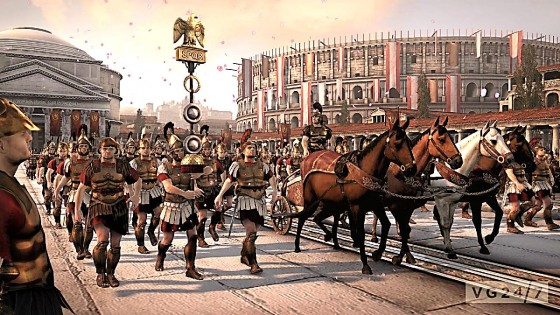
Paul alludes to the practice of famous conquerors, in celebration of their victories, making public displays by returning to the capital city with the spoils of wars, bringing "captives" too, in a kind of parade or procession that has also the sounds of the trumpets and the cheers of the citizens of the conqueror. He does this to describe how Christ has defeated his enemies, stripped them of their powers, confiscated their weapons and instruments of war, of his "spoiling" the foes of God and his people.


It was a common scene for Roman citizens to see a triumphant Roman general enter the city of Rome in a victory procession with his subjugated foes coming behind his chariot as captives. So, Christ is pictured as leading a triumphal parade with his enemies defeated, disarmed and disrobed, and often caged, or else in shackles. Paul says that Christ, via his trial and temptation, through his death and resurrection, "made a public display" of his triumph (or "made a show of them openly" KJV). 

Paul also writes of this kind of triumphal procession which Christ leads in this text:

"But thanks be to God, who always leads us in His triumph in Christ, and manifests through us the sweet aroma of the knowledge of Him in every place." (II Cor. 2: 14)

Better translations are these however:

- "who always leads us as captives in Christ’s triumphal procession" (NIV)
- "who in Christ always leads us in triumphal procession" (NRSV)

The text alludes to the "triumphal procession" we have been describing and also to how the conqueror would have his "captives" as part of the parade. Keep in mind too that the defeated foes are Sin, Death, Hades, Powers of Darkness, etc. Also, as we will see, another group of special captives, those OT people of God who went to Abraham's Bosom, the happy side of Hades, were taken to much better facilities when Christ "led captivity captive." We will be looking at that a little closer as we progress in our thoughts and study. It entails much more than we are now considering. But, we will mention two as a sample.

1. When Jesus was resurrected we are told that -  "The tombs also were opened. And many bodies of the saints who had fallen asleep were raised, and coming out of the tombs after his resurrection they went into the holy city and appeared to many." (Matt. 27: 52-53)

How is that for a "public display" of power over that enemy who goes by the name of Death? Or the enemy known as "the devil"? 

2. "When he ascended up on high, he led captivity captive." (Eph. 4: 8)

When Christ led OT believers out of peaceful rest in Hades up to Paradise and the "Third Heaven," they ascended with him, he leading the way as the "forerunner." (Heb. 6: 20) That was at least a public display for the wicked dead in Hades who would see the redeemed host exit the place with their Lord in the lead. 

Wrote the great Charles Spurgeon (as cited here) upon Colossians 2: 15:

"Exhibiting them as his prisoners in a triumphal procession, as the victorious Roman Generals did when they returned from war. His cross was his triumph. Then he led captivity captive. What more do you want? Your enemy is vanquished, your sins blotted out, your death changed to life, your necessities all supplied...The Lord Jesus Christ has done everything for his people, fought their battle, won their victory, and, on their behalf, celebrated the triumph in the streets of heaven, “leading captivity captive.” What more, then, do we want? Surely Christ is enough for us." 

We will continue in the next chapter with our look at the work or mission of Christ in Hades.

Saturday, February 4, 2023

Beliefs about the Afterlife (vi)


"I am he that liveth, and was dead; 
and, behold, I am alive for evermore, Amen; 
and have the keys of hades and of death." 
(Rev. 1: 18)

Christ went into Hades* with the keys of it in his possession, showing his Lordship over the souls there. He did not go merely to the side called "Abraham's Bosom," but also to the side where the unforgiven were tormented in the flames, where Dives was. He went to both sides. 

(*Hades is actually pronounced as "hah'-dace" (or Haw Dace) in Greek though I am in the like habit of many who say "Hay-Dees," for this is how most have learned to pronounce it. It literally means the unseen, and thus the unseen realm of the spirits of the dead. Of course, in Greek mythology Hades was the name of the god of the underworld) 

In this chapter I will begin to cover these points in this order:

1) The place called Hades described
2) Biblical Cosmology
3) Christ Descent Into Hades
4) Conquering of Hades by Christ and the Church
5) Believers Moved From Hades to Heaven
6) Unbelievers Sentence Announced and Inmates Addressed in Proclamation
7) No Offers Of Pardon Given (salvation after death)
8) Christ Becomes Lord Of Hades & The Damned

The Place Called Hades 

"And I say also unto thee, That thou art Peter, and upon this rock I will build my church; and the gates of hell (Hades) shall not prevail against it. And I will give unto thee the keys of the kingdom of heaven: and whatsoever thou shalt bind on earth shall be bound in heaven: and whatsoever thou shalt loose on earth shall be loosed in heaven." (Matt. 16: 18-19)

When we put together what is said in both texts (Rev. 1:18 & Matt. 16: 18-19) concerning the placed called "Hades," we learn several things. First, it is likened to a place with gates, which implies walls, which implies location. Is it then a physical space? Or, is it a place in the realm of spirit and the gates and the keys are spiritual or non physical? Second, the purpose of keys is so that something could be either freed (loosed) or bound (confined as in a prison). Or, we might say, for opening or shutting doors of entry or exit. (See Rev. 3: 7) Third, we have mention of two sets of keys, or possibly three (depending upon whether the keys of Hades are the same set of keys for the keys of Death). We have the 

1) keys of the realm of Hades (and Death) and 
2) the keys of the realm or kingdom (sovereignty) of heaven. 

Sovereignty and authority are inherent ideas in the idea of having possession of these keys. In Greek mythology, Hades was the name of the god of the underworld. In the NT, however, it is always used as the name of a place, not of a person. 

The Lord Jesus Christ is the Lord of Heaven, Earth, and the Underworld. As we will see, the underworld is in scripture called "the lowest parts of the earth," and "prison." As the one with the keys of Hades he is the "Warden" of that place and has deputy wardens guarding the place (angels). Warden means "a person responsible for the supervision of a particular place or thing or for ensuring that regulations associated with it are obeyed."

In Matthew 16:18, Jesus refers to the “gates of Hades (Hell)” (i.e., the gates of death). Interesting is the double use of the word “gates” in the story of Lazarus and Dives where the same word is used of the gate (pulōn) of the rich man's palace where Lazarus lay (Luke 16:20). "Inside the gate" for the rich man, while on earth, was to be in his own palace, fairing well, Lazarus being the lowlife beggar lying on the street outside of his palace gates. However, being "inside the gate" of Hades for the rich man, after death and in spirit, meant that he was now the beggar. These same gates are referred to by Isaiah. "I said, “In the prime of my life I shall go to the gates of Sheol; I am deprived of the remainder of my years.” (Isa. 38: 10)

We need to keep in mind as I have before stated, that Sheol or Hades for the body was the earth, or the grave. I wrote in the preceding chapter - "as Sheol or Hades sometimes intends the grave, so his body went there." That may not be completely accurate as the citations and proofs to follow from one scholar on the issue will perhaps show. That scholar affirms that Sheol never referred to the grave, to the place where the body or ashes are located, but always to the place of departed souls or spirits. That is probably right, although some OT texts speak of Sheol in the context of the grave, which may be because it is the "realm of the dead" for the bodies of the dead, and distinct from the "realm of the dead" for the spirits of the dead. It could be viewed as "circles of hell" (Dante) of a sort. The bodies are in the topsoil of the earth, while the spirits are in the heart of the earth (more on this later). 

So we have the words "unto the dust you will return." (Gen. 3: 19; Eccl. 12:7) Man came forth out of the earth, so far as his body is concerned, and so it returns to the earth. However, when the soul or spirit is focused upon, Sheol or Hades does not refer to the grave. The grave may be a reminder, or symbol, however, of Sheol, the place of departed spirits. Spirits are not buried in the dirt as are bodies. Spirits do not become dust. Rather, a place far below the topsoil where bodies are buried, in the lowest parts of the earth (which would be the center of the earth), is where the spirits go. "Then shall the dust return to the earth as it was," said Solomon, "and the spirit shall return unto God who gave it." (Eccl. 12: 7)

Hades Has Levels & Regions

Further, Hades has a top and a bottom, not being viewed as a flat place. In fact, in the story of the rich man and Lazarus we read where Dives "lifted UP his eyes" to see Lazarus "afar off." Thus, though there be a "great gulf" or chasm between the two sides of Hades, one side is higher than the other. We also learn that it is a large place. So it must be of course to house so many souls. 

We must define Hades by space and dimension, by location, by surrounding conditions, by things present in it and other appurtenances, by its intended purpose and use, by its functions, by its citizens or occupants, etc. So, let us look at these things in more detail.

We have already referred to the Greek word "tartarus" (tartaroo) It is translated as "hell" in the KJV and used only once in the New Testament, but alluded to in others. (II Peter 2: 4; Jude 1: 6; Rev. 9: 11; 20: 2-3) The Greek word is ταρταρόω (pronounced like tartar rah o) but we generally say in English vernacular "Tartarus." It is indeed unfortunate that the KJV uses the word "hell" for three distinct words, they being Hades, Gehenna, and Tartarus. It is the place where the fallen apostate angels are located. It is referred to in these two verses:

"For if God did not spare the angels who sinned, but cast them down to hell and delivered them into chains of darkness, to be reserved for judgment." (II Peter 2: 4)

"And the angels who did not keep their proper domain, but left their own abode, He has reserved in everlasting chains under darkness for the judgment of the great day." (Jude 1: 6)

It is defined as "the lowest place in Hades." That being true, we are further confirmed in our assertion that Hades is three dimensional, having height and width, and has a location. It is a literal place.

We see the language fitting of a "prison" in these verses, in addition to the mention of gates and bars (Job 17: 16), such as chains, darkness, and of awaiting judgement and trial, etc. This is no doubt the same place Peter refers to in I Peter 3: 19 where he speaks of "the spirits in prison" (which we will examine soon). It is a picture of a gloomy dungeon type confinement. Jesus called it "outer darkness" and a place where there is "weeping and gnashing of teeth." (Matt. 25: 30; Etc.) 

Though Dives was in fire (without being consumed) he nevertheless was in darkness. That is paradoxical, for fire emits light. It well could mean that the place is poorly lit, like many dungeons of old. Further, it doesn't take much flame to torment a soul. Further, Dives was a departed spirit, and we don't know a whole lot about fire that burns spiritual bodies. Peter in his short second epistle speaks of the lost souls "to whom the mist of darkness is reserved forever." (II Peter 2: 17)  Jude also says that these same lost souls are destined to exist in, and are "reserved," unto "the blackness of darkness forever." (Jude 1: 13) The Greek word translated as "reserved" (KJV) is "tereo" and is better translated as "guarded," "watched over," "kept an eye on," or simply to "keep." Guarding and keeping of course will mean something slightly different in different contexts. 

Prison guards watching over or guarding inmates gives one connotation and meaning to the idea of guarding or observing. But, chaperones also watch over persons in their custody and care. Security guards watch over people under threat. There is a difference between guarding for the purpose of securing and making safe good people, on one hand, and guarding and keeping bad people (such as violent criminals), on the other hand. The keeping of them is keeping them confined, bound, not so much for their own safety, as for the safety of others, i.e. keeping them "locked up" so they can harm no one else. 

That Greek word "tereo" is used in several places in reference to the guardians or keepers of Hell. (See II Peter 2: 4, 17; 3: 7; Jude 1: 6, 13) But, Peter also used it to describe something that is in Heaven under guard, saying of the Christian inheritance, which is "incorruptible and undefiled," and "fades not away," is also "reserved" (watched over, meaning it is safe and secure, protected). 

There is little doubt in my mind that the guardians of both heaven's goods (Christian inheritance) and of hell's prisoners (fallen angels, demons or wicked spirits of the dead) are the holy angels. One of the reasons why I know this is because their unloosing hell's prisoners from chains is done by the holy angels of heaven. This is seen in several instances in the book of Revelation. (Rev. 9: 14-16; etc.) In fact, we call angels "watchers." (Dan. 4: 17) The Book of Enoch 1 uses the title frequently for the holy angels and the Book of Enoch is alluded to in several places in the writings of Peter and Jude. More on that later. 

We can also see how Sheol/Hades has levels from these words of God to Moses:

"For a fire is kindled in My anger, And shall burn to the lowest hell; It shall consume the earth with her increase, And set on fire the foundations of the mountains." (Deut. 32: 22; see also Psalm 86: 13)

Tartarus would be "the lowest hell," the lowest part of Sheol or Hades, and it implies other levels. If we allowed the idea that bodies in graves are in the realm of Hades, then it would be a higher hell. But, what of Abraham's Bosom, the place of the gathering of the righteous spirits of the dead? It would be the highest hell, right? Another verse that shows that there are dimensions and levels to Hades is this from Job, the oldest book in the Bible: "They are higher than heaven— what can you do? Deeper than Sheol— what can you know?" (Job 11: 8) It is also defined as "the deepest abyss," or "deepest pit." 

Hades Is Down

"The way of life is above to the wise, that he may depart from hell (sheol) beneath." (Prov. 15: 24)

"Yet thou shalt be brought down to hell (sheol) to the sides of the pit." (Isa. 14: 15)

Notice how hell is often viewed as a "pit," as an "abyss." "Bottomless pit" is frequent in the Book of Revelation. "Pit" is from the Greek word "abyssos." 

"Though they dig into hell (sheol), thence shall mine hand take them; though they climb up to heaven, thence will I bring them down." (Amos 9: 2)

"For I will go down into the grave (sheol) unto my son mourning." (Gen. 37: 35 - Jacob says)

This may be simple, but it is true. Earth is a level of existence between two other levels and Heaven is up above the earth plane, and Hades is below the Earth plane. Just as there are three heavens, so we may say that there are three hells (Hades, Tartarus, Gehenna). Or we might say that as there are three levels to Heaven so there are levels to Hades and Earth. 

Because Sheol (place of the dead) is viewed as being down in the earth, on a level below the surface (where the living abide), it was also called "the pit," "the bottomless pit," and "the abyss," or "the deep." These are all terms for the afterlife, for the place of departed spirits of the unrighteous. A lower hell would be occupied by Dives and his kind, who must look up to the righteous who are in the upper part of Sheol. Just as Earth is often said to be "under heaven" (Gen. 7: 19; etc.), so Sheol is said to be under the Earth.

Heaven, Earth, and Under the Earth 
(Biblical Cosmology)

"And no man in heaven, nor in earth, neither under the earth, was able to open the book, neither to look thereon...And every creature which is in heaven, and on the earth, and under the earth, and such as are in the sea, and all that are in them, heard I saying, Blessing, and honour, and glory, and power, be unto him that sitteth upon the throne, and unto the Lamb for ever and ever." (Rev. 5: 3, 13)

Notice those three spheres, heaven, earth, under-earth. The latter expression "under the earth," has other similar ways to express the same thing, as we will see. They all allude to what is called in nearly all languages and cultures, "the underworld," what the Hebrews called "Sheol," the Greeks called "Hades," and the Egyptians called "Duat." It is also called "the spirit world." 

What occupant of the underworld praises God saying "blessing, and honor, and glory, and power, be unto him who sits upon the throne (of heaven), and unto the Lamb for ever and ever"? Is it those in the afterlife who are in the side of Hades where the lost are found (as Dives)? How can it refer to those who are "under the earth" in Hades on the comforting side where Lazarus is? None of the righteous, however, as we have seen, go to the underworld since the death and resurrection of Christ. So, those blessing the Lord from "under the earth" cannot be them. The holy dead were "under the earth" in Hades before the death and resurrection of Christ. But, is that the way it continued to be for the righteous dead since? Have we not seen how the righteous dead do not go to Hades now but to Heaven? This explanation would be acceptable if John was writing in Revelation chapter three of what happened in old testament times, but he is not, but is writing of what was happening after Christ's resurrection, or what would happen in the future when the Lamb of God begins to take in possession the scroll with seven seals. 

So, how can we explain this burst of praise from the "creatures" who are "under the earth"? Is it talking about worms or about people in Hades? Could it mean simply that the brute creation (animals and insects) that live underground will praise the Lord and say these things (metaphorically, as the trees are said to clap their hands in praise - Isa. 55: 12). But, that does not seem to be the general meaning of the term "under the earth." That terminology seems equivalent to "the underworld" (Hades) than to the words "in the ground." However, the following text might seem to suggest that animals may be referred to.

“You shall not make for yourself a carved image—any likeness of anything that is in heaven above, or that is in the earth beneath, or that is in the water under the earth." (Exo. 20: 4)

The creatures that are in the earth beneath, or in subterranean waters, may well allude to the animals inhabiting those areas. However, in Rev. 5: 13 it seems that the praise is coming from rational creatures who know of God's throne and of the Lamb of God. I have not seen a commentary yet that sees the occupants in the space "under the earth" of that text as denoting animals. 

In checking Gill's Commentaries on these verses, Gill's comments on verse three indicate that the creatures who occupy the area known as "under the earth" include those who are the lost, who are in torment. He wrote (emphasis mine): 

"the dead buried there, good or bad; which may be said agreeably to the notions of the ancient Jews, who believed the immortality of souls, and that they were rewarded or punished, "under the earth", according to their virtue or vice in life: or the devils in hell; or whoever on the earth are influenced by them, as magicians, sorcerers, soothsayers, and necromancers."

So, John heard such people praising God? Gill in his commentary says: "even the enemies of Christ, wicked men and devils, will be obliged to own Christ to be Lord, to the glory of God the Father, as well as angels and saints."

Wrote Albert Barnes in his Commentary:

"Under the earth - Supposed to be inhabited by the shades of the dead. See the Job 10:21-22 notes; Isaiah 14:9 note."

Jamieson-Fausset-Brown Commentary says: "under the earth—the departed spirits in Hades." 

Is it possible that the demons and fallen angels, together with the spirits of the wicked dead, will, at some point in the future, bless and praise God as Rev. 5: 13 says? We have already referred to the words of Christ who described those wicked spirits in Hades as continuously "weeping and gnashing of teeth." So, how do we explain this discrepancy? I would think that they were continuously blaspheming God and his word rather than saying "blessing, and honor, and glory, and power, be unto him that sits upon the throne, and unto the Lamb for ever and ever." Let us check some of the commentaries to see what they say.

"It seems harsh to understand the words of an unwilling cooperation of the devils (Or the unrighteous dead - SG) in glorifying God and His Son, besides that Judges 6 seems hardly to prove that all fallen spirits are yet confined “under the earth:” Matthew 8:29 compared with Luke 8:31 suggests the contrary. It is more possible to suppose the dead, even the holy dead, to be described as “under the earth.” (Cambridge Bible for Schools and Colleges) 

That is an interesting question about whether this burst of praise was given by a willing and sincere heart, and as an expression of belief. Those who believe that there is a chance of salvation after death, in the afterlife, will no doubt see this burst of praise as bringing salvation from the fires of Hades. But, this is not the case. As we will see, even those doomed to reside in the flames of Hades and Gehenna forever will nevertheless be forced, in the day of their trial and judgment, to confess the sovereignty of God and Christ. Wrote Paul:

"That at the name of Jesus every knee should bow, of things in heaven, and things in earth, and things under the earth; And that every tongue should confess that Jesus Christ is Lord, to the glory of God the Father." (Phil. 2: 10-11)

The Greek word "katachthonios" ('things under the earth') is used to refer to what is under the earth, to the subterranean or core of the planet, to the "infernal world." 

I think that Rev. 5: 13 is saying the same thing. Yes, every creature, including every demon, fallen angel, wicked men and women, and even Satan himself, shall be forced at times by the evidence to confess the truth of God's sovereignty and of his justice, and to acknowledge Christ as the only Lord and Savior.  

Now, let us look at a couple other texts dealing with the simple cosmology we are affirming. 

"Therefore He says: “When He ascended on high, He led captivity captive, And gave gifts to men.” (Now this, “He ascended”—what does it mean but that He also first descended into the lower parts of the earth? He who descended is also the One who ascended far above all the heavens, that He might fill all things.)" (Eph. 4: 8-10)

"But the righteousness of faith speaks in this way, “Do not say in your heart, ‘Who will ascend into heaven?’" (that is, to bring Christ down from above) or, “‘Who will descend into the abyss?’ ” (that is, to bring Christ up from the dead)." (Rom. 10: 6-7)

There is no question but that "lower parts of the earth" and "the deep" (or abyss) refer to Hades. That would locate it right in the center of the earth, where many Christians have traditionally located it. In the OT the righteous went in spirit "down" to Hades, down to the Abraham's Bosom side of Hades. But, in the NT they go in spirit "up" to Heaven, to the place where Christ is seated at the right hand of God the Father.

In the next chapter we will continue answering the questions listed at the heading of this chapter. We will look in greater detail at the descent of Christ into Hades and what he accomplished there as one who has "the keys of Hades." 

In conclusion of this chapter, however, let us look at one other text on Hades and make some observations.

"And the sea gave up the dead which were in it; and death and Hades delivered up the dead which were in them: and they were judged every man according to their works. And death and Hades were cast into the lake of fire. This is the second death." (Rev. 20: 13-14)

The words "death and Hades" shows us that the grave (for the body), alluded to by the word "death," is distinct from Hades. The grave holds the body, but Hades holds the soul or spirit. Death or the grave will one day "deliver up" the dead bodies which are in it, and Hades will "deliver up" the spirits who are in it. 

This rising of the bodies and spirits of the dead (of the above text) comes after the millennial reign of Christ. All the righteous dead were delivered up from death and the grave just prior to the commencement of the millennium. They are of "the first resurrection," for they are "blessed and holy." None of them are judged by their works as to salvation or condemnation. Their fate is determined by their names being in the "book of life." On the other hand, all those who are in the second resurrection are neither blessed or holy, but rather unholy and cursed, and they all are judged by their works and none are saved on that basis. They all are condemned. The only occupants of the grave or of Hades, at the end of the Millennium, are lost souls. 

Hades and death are finally incorporated into the "lake of fire," to "gehenna," to the "second death." As we said in previous chapters, Hades is the temporary holding place of lost souls today, like "jail," whereas "Gehenna" is the everlasting residence of the inmates of Hades, their "prison."