Thursday, September 14, 2023

Clarence Darrow: Determinism & Responsibility


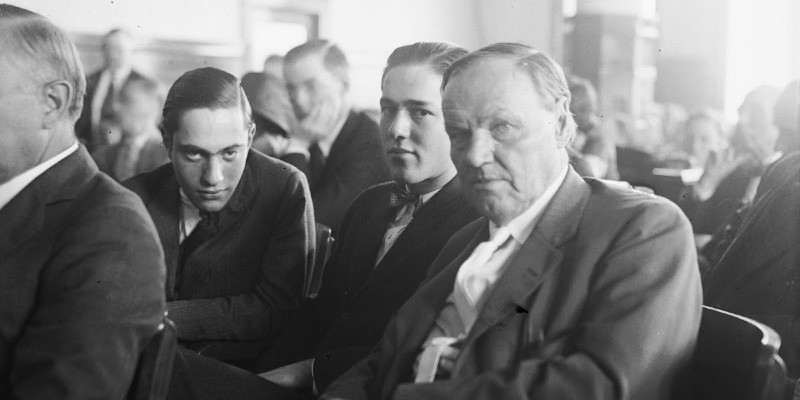
Leopold and Loeb trial of 1924, 
attorney Clarence Darrow

In this posting I will address how the debate over free will, determinism, and responsibility was the focus of one of the most watched criminal trials in history. In the above photo is a picture of Clarence Darrow seated in the forefront, famous attorney of the early twentieth century, along with his two teenage clients who were charged with murder. The speech that Darrow gave at the close of the trial was designed not to prove their innocence of doing the crime, but their not being so guilty as to deserve the death penalty, and he does this by arguing from the deterministic standpoint, which is the basis of nearly all modern sociological and psychological science. He argued that the boys were not guilty because they could not help doing what they did due to sociological and other factors. This is an example where "the rubber meets the road" so far as theories about responsibility and free will go. I majored in Sociology for one reason. My adviser (who had both a juris doctorate and a phd.) advised this when I asked him "what would be a good major for me as a pre-law student, and wanting to go to law school?"). I see why. Lawyers argue about free will and responsibility all the time. Those who represent the criminal will often plead for leniency, if not innocence, because of some sociological, psychological, or economic reason. The prosecutors, however, will always retort by saying "others have experienced the same circumstances and yet did not commit the crimes of the accused. Thus, it was their choice and are therefore guilty." 

Here is a write up for this trial (see here emphasis mine).

In the Leopold and Loeb trial of 1924, attorney Clarence Darrow achieved what many thought impossible. He saved the lives of two cold-blooded child-killers with the power of a speech.

Nathan Leopold and Richard Loeb were teenagers living in a wealthy Chicago suburb when they were arrested for murder. Loeb had recently graduated, at 17 years old, from the University of Michigan, and planned to begin law school in the fall. He was obsessed with the idea of the perfect crime. His neighbor, a brilliant young man, Nathan Leopold, was a law student and a believer in Frederick Nietzsche's concept of the "superman" — the idea that it is possible to rise above good and evil.

The two boys seemed an odd match. "Dickie" Loeb charmed everyone with his good looks and cool manner. Awkward-looking Nathan Leopold tended to hide in his friend's shadow. But the two young men formed a powerful bond. Nathan was in love with Richard and would do anything he wanted for sexual favors. He later wrote, "Loeb's friendship was necessary to me — terribly necessary." His motive for the murder, he said, "was to please Dick."

Inspired by this odd mix of nihilistic philosophy, detective fiction, and misguided love, Leopold and Loeb hatched a plan to commit the "perfect crime." It was not so much the idea of murder that attracted them, but the idea of getting away with murder.

On May 21, 1924, Leopold and Loeb lured a young neighbor boy, 14-year-old Bobby Frank, into their car. They killed him with a chisel, and stuffed his body in a culvert. The next morning the Frank family received a special delivery letter — a ransom note demanding $10,000 in unmarked bills for the return of the boy.

Before Mr. Frank could pay the ransom, police discovered the child's body. There was nothing linking the criminals to the crime except for a single pair of glasses. Police traced the glasses to a Chicago optometrist who had prescribed them for Nathan Leopold. If he hadn't lost his glasses, Leopold and his friend Loeb might have indeed gotten away with murder.

Leopold's and Loeb's parents hired the best, and most expensive, criminal attorney they could find — Clarence Darrow. Darrow knew his clients would be convicted. His goal, as always, was to save them from the death penalty.

Americans read every detail of the Leopold and Loeb trial with fascination and repulsion. By 1924, automobiles like Ford's popular Model T were increasing criminal mobility; rising fears about crime would ultimately cause citizens to support a national police force. Chicago's WGN radio considered broadcasting the trial live, but decided it wasn't appropriate "entertainment" to send to families in their living rooms.

The trial reached its climax with Clarence Darrow's closing argument, delivered over twelve hours in a sweltering courtroom. Darrow admitted the guilt of his clients but argued that forces beyond their control influenced their actions. Law professor Phillip Johnson describes Darrow's argument this way: "Nature made them do it, evolution made them do it, Nietzsche made them do it. So they should not be sentenced to death for it." Darrow convinced the judge to spare his clients. Leopold and Loeb received life in prison.

The following year, Clarence Darrow played a leading role in another "trial of the century." He defended John Scopes for teaching evolution in violation of a Tennessee law. WGN radio did send their microphones to Dayton, Tennessee. It seemed a much better idea to cover a trial over ideas than to broadcast a sensational murder.

In 1936 Richard Loeb was killed in a prison fight with another inmate. In 1958, after thirty-four years behind bars, Nathan Leopold was released from prison. He died in 1971.

Said one author on Clarence Darrow's famous defense of two teenagers accused of murder (here emphasis mine):

"When teenagers Nathan Leopold and Richard Loeb went to trial after killing an acquaintance "for the thrill of it," their lawyer, Clarence Darrow, delivered a twelve hour summation over three days to save his clients from the hangman's noose. Darrow used three strategies of transformation to invert prevailing concepts of justice and crime. Through such reversals, he deflected criminal culpability from his clients to their upbringing, the prosecutors, and the legal system itself."

In another write up, "Crime and Criminals: Address to the Prisoners in the Chicago Jail" (1902) (see here) we have these words of Darrow to the criminals in Jail (emphasis mine).

"If I looked at jails and crimes and prisoners in the way the ordinary person does, I should not speak on this subject to you. The reason I talk to you on the question of crime, its cause and cure, is because I really do not in the least believe in crime. There is no such thing as a crime as the word is generally understood. I do not believe there is any sort of distinction between the real moral condition of the people in and out of jail. One is just as good as the other. The people here can no more help being here than the people outside can avoid being outside. I do not believe that people are in jail because they deserve to be. They are in jail simply because they cannot avoid it on account of circumstances which are entirely beyond their control and for which they are in no way responsible."

This philosophy regarding crime and punishment was a minor view of a few in 1924, but now 99 years later, it is the philosophy of the Liberals today and is behind the idea of being sympathetic to lawbreakers, as seen in the "no bail" policy of many municipalities, and of allowing felons to go back to the streets after arrest, and of giving mere slaps on the wrist for many crimes (in California, it is no crime to steal anything less than roughly a thousand dollars, and thus we now have mobs robbing stores). But, more on all this shortly.

Darrow also said:

"I suppose a great many people on the outside would say I was doing you harm if they should hear what I say to you this afternoon, but you cannot be hurt a great deal anyway, so it will not matter. Good people outside would say that I was really teaching you things that were calculated to injure society, but it’s worth while now and then to hear something different from what you ordinarily get from preachers and the like. These will tell you that you should be good and then you will get rich and be happy. Of course we know that people do not get rich by being good, and that is the reason why so many of you people try to get rich some other way, only you do not understand how to do it quite as well as the fellow outside."

Believe it or not, I was taught this very thing in some of my Sociology classes in a conservative university founded by Baptists and supported by a large endowment from a Presbyterian. I took a class in "Deviant Behavior." It had a black liberal professor and we only had about 6-8 students. Deviants or criminals are only such because a powerful group decided to call a certain behavior deviant or criminal. This is typical of Marxists, who see that many labels and definitions are created by the power elite and forced on the poor working class. Is adultery deviant behavior? It was once illegal, as was homosexuality. If we define "deviant" or "criminal" as that which is against how the majority has defined them, then adultery and homosexuality are no longer deviant or criminal because the majority no longer judges or defines them so. We are more and more calling law abiding citizens the deviants, and those who do not support drag shows in churches and schools, including grammar schools. Paul called them "despisers of those who are good." (II Tim. 3: 3) The moral (godly or righteous) are becoming a small minority and are being made the criminal!   

Darrow also said:

"There are people who think that everything in this world is an accident. But really there is no such thing as an accident. A great many folks admit that many of the people in jail ought not to be there, and many who are outside ought to be in. I think none of them ought to be here. There ought to be no jails, and if it were not for the fact that the people on the outside are so grasping and heartless in their dealings with the people on the inside, there would be no such institution as jails."

This is where Determinism presents dangers if not properly taught and handled. It leads people to say that no one can be blamed for anything. No one is responsible. But, that is why I subscribe to "free will" to some extent and am a Compatibilist. There are causes to the choices we make. That is why in our striving to make the right choices we must understand what influences are operating upon our wills. Further, we are responsible for what we choose and do, even though the reasons or causes of our choosing and doing are not known and cannot be shown to be of such a nature as to take away liability or responsibility. The two young teenagers defended by Darrow were guilty of a heinous murder. They chose to do the crime. Yes, there were causes or reasons behind their choice, but not such as could excuse or justify them. It may however often lead to a smaller sentence and leniency. 

Wednesday, September 13, 2023

Satan's Mindset


12 “How you are fallen from heaven, O Lucifer, son of the morning! How you are cut down to the ground, You who weakened the nations! 13 For you have said in your heart: ‘I will ascend into heaven, I will exalt my throne above the stars of God; I will also sit on the mount of the congregation On the farthest sides of the north; 14 I will ascend above the heights of the clouds, I will be like the Most High.’ 15 Yet you shall be brought down to Sheol, To the lowest depths of the Pit." (Isaiah 14: 12-15 nkjv)

What was Lucifer thinking when he rebelled against his Creator? How could he do such a thing? Was he being foolish? If so, how can that be seeing he was full of wisdom by his creation? Even if he had the freedom of will to choose to rebel, why would he do that? Surely he knew what the consequences would be, right? 

Satan was a rebel. All rebels against legitimate authority follow his example. Satan believed that God was a dictator, a tyrant who ruled autocratically, arbitrarily, and who was unfair because he did not allow his creatures to "be all they can be," or to share his rule. 

He could also be called the first one to contend that sovereigns must be chosen by creatures, and the majority vote getter should be ruling sovereign. Since God was a self declared sovereign, and not elected to it by his creatures, by the angels, he therefore had no legitimate right to rule. He was the first insurrectionist, involving himself in treason against the sovereign Lord. 

He thought that love for God ought not to be obligatory (as do many theologians), but ought to be freely given and deserved, and that a creature should not be punished for refusing his rule. God must prove that he is the best qualified to rule and his creatures should be the judges. God demands, or commands love, but this is untenable to Satan and many religious minds. God must earn our love. Our love must be freely given, but if love is demanded, it is not love given freely but love given under threat of punishment. 

This is the same lie, in essence, which he taught to Eve. It is the same thinking that Satan (via the serpent) attempted to implant in the mind of Eve. 

One Satanist wrote (here):

"My hero  (Satan) is fearless, proud, resolute, farseeing, self-sacrificing, and profoundly engaged in the struggle against tyranny and oppression."

This has been a popular view of Lucifer or Satan throughout history. Satan is a hero, one who wants man to free himself from the tyranny of the sovereign God, as he has done. He is adored for his "pride," his hubris, by his followers, but his pride is rather his downfall, as the bible teaches. It brings him down to the lowest Hell as the text from Isaiah above affirms. Solomon said "pride goes before destruction and a haughty spirit before a fall" (Prov. 16: 18). Satan calls his pride "ambition." Milton has Satan confessing - "To reign is worth ambition though in Hell: Better to reign in Hell, then serve in Heav'n." (Book I) 

He was the first to covet, to lust, to envy, to be vain, to attempt theft, to usurp, to rebel, to disobey law, etc. His "ambition" was to topple the rule of the Almighty. This was the "hazardous enterprise" (Milton), the "vain attempt," in which Lucifer's ambition engaged him. He was brave enough, though foolish, to take on the best, to challenge the undefeated one. He was in a word "brash." However he is not "fearless." He does, in fact, like all the demons fear and tremble before the sovereign God. (James 2: 19) He knows that he can do no more than what the Almighty suffers him to do. This is seen in the story of Job. 

Said the Satanist:

"I don’t say he’s perfect. He’s a bit of a snob, somewhat lascivious, and, gravest of all, willing to harm innocent third parties in his battle against injustice." 

Satan's followers love the evil character of Satan for they are evil themselves and his spirit is in them and controls them. (Eph. 2: 2) Of this the bible is clear. To them he is heroic for taking on one stronger than he, like an underdog, for whom many feel sympathy for that reason. Satan sees nothing attractive or beautiful in the God who created him. So too do his followers. They rather think that Satan is beautiful as Satan sees himself too. They think he was involved in a good cause in trying to overthrow God, the tyrant. He, as Milton said in Paradise Lost, "put to proof God's supremacy." God claimed to be omnipotent, but Satan questions it, thinking maybe he is not. The only way to find out is to challenge God. A real hero is willing to take on the best in order to test one's own muscle and fighting acumen. We see this in modern boxing matches, and other athletic contests, where the underdog wants to fight the best to prove himself the best. So, Satan's rebellion may be seen as a test of God's omnipotence and reign and a test of the strength of Satan. So, was Satan deluded? What was his sin? What was his crime? Pride? Self love (narcissism)? Unbelief?

The great work by John Milton, "Paradise Lost," attempted to get into the psychology and mind of Lucifer at the time of his rebellion and his ejection from Paradise. Satan says he cannot be blamed for God made him who he is. He says he cannot help being who he is

The bible teaches that Satan was the first and true Narcissus. He saw his own beauty and powers and he fell in love with himself. Rather than admiring God for making him such, he seeks to rob God of this rightful praise and seeks to take it to himself by proclaiming himself the decider of his own destiny. Satan is the first blasphemer. What is blasphemy? Easton's Bible Dictionary says: "In the sense of speaking evil of God this word is found in Psalm 74:18; Isaiah 52:5; Romans 2:24; Revelation 13:1, 6; 16:9, 11, 21. It denotes also any kind of calumny, or evil-speaking, or abuse (1 Kings 21:10; Acts 13:45; 18:6, etc.)." It means to revile, rail against, to slander.

Satan says in the first book: God “tempted our attempt, and wrought our fall.” Satan is never willing to own up to his own responsibility in this; he wants to figure out a way to make it someone else’s fault. He wants to say it is God's fault, because 1) God made him the way he is, and 2) provoked him to rebel, and 3) God is an unjust tryrant. 

Wrote one author (here emphasis mine):

"Milton through Satan also raises the question about whether or not choice itself, freedom, is about having lots of possibilities. Does Satan think he had a choice, or does he think he was set up? He seems to oscillate wildly between these two extremes. When he thinks about his own condition, he blames God—“God set me up for this”—but when he thinks about his own ambitions, he thinks of himself as doing it himself, as wholly unsponsored."

That is quite insightful and well stated. I believe it is true of the mindset and psychology of Satan. Said the same writer further:

"Milton tries in his poetry to represent Satan’s thinking as he does this. How can Satan do this? What is the motive for Satan’s sinning? What is Satan’s inner life like? We get some of this when Satan tries to talk to other people, to the other fallen devils and especially sometimes to, say, Adam and Eve."

We could ask the same question of why the other angels sinned, and why Adam and Eve sinned.

I find it interesting that Satan says this about the power of his will and self determination: 

"All is not lost; the unconquerable will, And study of revenge, immortal hate, And courage never to submit or yield." (Book I, pages 305-308)

This is the word of the leader of the fallen angels after they have been cast out of heaven and lay knocked out in the fiery regions of Tartarus. 

What is the thinking of Satan? Why did he choose to rebel against God? If he was being stupid, how could that be such seeing God made him perfect? 

John Milton in "Paradise Lost" attempted to explain the thinking of Satan and did a fairly good job, as we have seen. In the movie "The Devil's Advocate" (with Keanu Reeves and Al Pacino) we have Satan existing as a man, the head of a New York law firm, and his name is "John Milton." The speech he gives to Reeves (his son), an attorney from the South, is given below. Let me give the speech and then make some comments about his diatribe against God.

John Milton: Who are you carrying all those bricks for anyway? (guilt - SG) 

God? Is that it?

God? Well, I tell ya, let me give you a little inside information about God.

God likes to watch. He’s a prankster. Think about it.

He gives man instincts. He gives you this extraordinary gift and then what does He do? I swear, for his own amusement, his own private cosmic gag reel, he sets the rules in opposition. It’s the goof of all time. Look, but don’t touch. Touch, but don’t taste. Taste, don’t swallow. *laughter* And while you’re jumping from one foot to the next, what is He doing? He’s laughing his sick, f-ing ass off. He’s a tight-ass. He’s a sadist. He’s an absentee landlord. Worship that? Never!

Kevin Lomax: Better reign in hell than to serve in heaven, is that it?

John Milton: Why not? I’m here on the ground with my nose in it since the whole thing began! I’ve nurtured every sensation man has been inspired to have! I cared about what he wanted and I never judged him. Why? Because I never rejected him, in spite of all his imperfections! I’m a fan of man! I’m a humanist. Maybe the last humanist. Who, in their right mind, Kevin, could possibly deny the 20th century was entirely mine? All of it, Kevin! All of it! Mine! I’m peaking, Kevin. It’s my time now. It’s our time.

In the movie, however, Satan (Milton) acknowledges his limits. He cannot force or coerce Kevin Lomax (Keanu). Kevin must use his free will and choose the Devil.

In closing let me cite some well written verses from Book I of Paradise Lost. Milton gave us this speech of Satan to his fellows in Hell. (highlighting mine)

Th' infernal Serpent; he it was whose guile,

Stirred up with envy and revenge, deceived
The mother of mankind, what time his pride
Had cast him out from Heaven, with all his host
Of rebel Angels, by whose aid, aspiring
To set himself in glory above his peers,
He trusted to have equalled the Most High,
If he opposed, and with ambitious aim
Against the throne and monarchy of God,
Raised impious war in Heaven and battle proud,
With vain attempt. Him the Almighty Power
Hurled headlong flaming from th' ethereal sky,
With hideous ruin and combustion, down
To bottomless perdition, there to dwell
In adamantine chains and penal fire,

Who durst defy th' Omnipotent to arms.

Milton then gives the words of Satan to Beelzebub

One next himself in power, and next in crime,
Long after known in Palestine, and named
Beelzebub. To whom th' Arch-Enemy,
And thence in Heaven called Satan, with bold words
Breaking the horrid silence, thus began:--
"If thou beest he--but O how fallen! how changed
From him who, in the happy realms of light
Clothed with transcendent brightness, didst outshine
Myriads, though bright!--if he whom mutual league,
United thoughts and counsels, equal hope
And hazard in the glorious enterprise
Joined with me once, now misery hath joined
In equal ruin; into what pit thou seest
From what height fallen: so much the stronger proved
He with his thunder; and till then who knew
The force of those dire arms? Yet not for those,
Nor what the potent Victor in his rage
Can else inflict, do I repent, or change,
Though changed in outward lustre, that fixed mind,
And high disdain from sense of injured merit,
That with the Mightiest raised me to contend,
And to the fierce contentions brought along
Innumerable force of Spirits armed,
That durst dislike his reign, and, me preferring,
His utmost power with adverse power opposed
In dubious battle on the plains of Heaven,
And shook his throne. What though the field be lost?
All is not lost--the unconquerable will,
And study of revenge, immortal hate,
And courage never to submit or yield:
And what is else not to be overcome?

That glory never shall his wrath or might
Extort from me. To bow and sue for grace
With suppliant knee, and deify his power
Who, from the terror of this arm, so late
Doubted his empire--that were low indeed;
That were an ignominy and shame beneath
This downfall; since, by fate, the strength of Gods,
And this empyreal sybstance, cannot fail;
Since, through experience of this great event,
In arms not worse, in foresight much advanced,
We may with more successful hope resolve
To wage by force or guile eternal war,
Irreconcilable to our grand Foe,
Who now triumphs, and in th' excess of joy
Sole reigning holds the tyranny of Heaven."
So spake th' apostate Angel, though in pain,

Vaunting aloud, but racked with deep despair;

“Is this the Region, this the Soil, the Clime,”

Said then the lost Arch Angel, “this the seat
That we must change for Heav’n, this mournful gloom
For that celestial light? Be it so, since he
Who now is Sovran can dispose and bid
What shall be right: farthest from him is best
Whom reason hath equall’d, force hath made supreme
Above his equals
. Farewell happy Fields
Where Joy for ever dwells: Hail horrors, hail
Infernal world, and thou profoundest Hell
Receive thy new Possessor: One who brings
A mind not to be chang’d by Place or Time.
The mind is its own place, and in itself
Can make a Heav’n of Hell, a Hell of Heav’n
.
What matter where, if I be still the same,
And what I should be, all but less than he
Whom Thunder hath made greater?
Here at least
We shall be free
; th’Almighty hath not built
Here for his envy, will not drive us hence:
Here we may reign secure, and in my choice
To reign is worth ambition though in Hell:
Better to reign in Hell, than serve in Heav’n.
But wherefore let we then our faithful friends,
Th’associates and co-partners of our loss
Live thus astonish on th’oblivious Pool,
And call then not to share with us their part
In this unhappy Mansion, or once more
With rallied arms to try what may be yet
Regain’d in Heav’n, or what more lost in Hell?

Saturday, September 9, 2023

RISE UP AND WALK!

 How many times have you heard the phrase “the rich and powerful”? These words always seem to go together. Like everything else though, God sees things the differently than we do. Being rich has no power with God. In Matthew 19:24, Jesus says it’s harder for a rich man to go to heaven, than for a camel to go through the eye of a needle. The rich man may have money, but he has no power, at least not with God.

   There is a story of a Catholic monk named Thomas Aquinas, who when visiting the Pope was taken to the Vatican treasury. The Pope said, “Look at all the silver and gold we have Thomas! No longer can we say silver and gold have I none!” Thomas looked at the Pope and said “neither can we say rise up and walk.” How perceptive Thomas was. The Catholic church had grown rich and powerful in the eyes of men and kings. But it had no power to save or heal. It had sold out whatever moral and spiritual power it may have had, for riches or wealth, and earthly power.
 
   I think of all the pastors and missionaries, teaching a small flock, or feeding a growing one, who may ask "Is it worth it?" Well that depends on how you define "worth". Which is more valuable, the easy way of the world, or the "hard" way of Christ? Do you want wealth, whether monetary or otherwise, or do you want power that comes from God? You see, for me, having His power IS wealth. I am a rich man! My Father gives to me the power to proclaim the Good News, to help the spiritually lame to walk, the spiritually blind to see, the thirsty soul to drink the water of Life!
 
   When you find yourself feeling low and weary, not being "rich" according to the world, remember the power you have, that might be forfeited if you had the riches of men. In Christ, you have the power to show the world that God does indeed provide. You have the power to show them that joy doesn’t come from things. You have the power to show others how to RISE above their circumstances and WALK by faith. You still have the power to say “RISE UP AND WALK.” If you have this power, you are indeed rich, for faith is worth more than anything this world possesses. It is the power of God unto salvation. Now get out there, take the power He has given you, and command the lost and lame, to "RISE UP AND WALK".

Thursday, September 7, 2023

Free Will & Determinism (vii)


I suppose it was quite natural for me, in talking about how God works on the will of his creatures, to at some point talk about the conversion/regeneration experience, seeing it is a place where the difference of opinion on the freedom of the will becomes intense between Arminians and advocates of "free will," and their Calvinist and Determinist opponents. I have alluded to the bondage of the will as respects man's natural depravity, how he is compelled by his nature to sin, though not necessarily any particular sin. When it comes to changing the will of man in conversion the Calvinists believe in what is called "irresistible grace," or "effectual calling." Those who oppose this idea say that it amounts to forcing salvation on people who do not want it. There is much we could say about this but will not go into great detail on it now in this condensed series. 

I believe that what we have seen already shows that God can and does, thankfully, mess with free will. Perhaps a better term for "irresistible grace" would be "conquering grace," or "victorious grace," for God does conquer and capture the will of sinners, taking the will captive to Christ and freeing it from depravity. It is like taming wild horses by "breaking" them by a "bronco buster." Man is born like a wild ass's colt (Job 11: 12) and has a stubborn obstinate will like a mule or jackass. His will must be broken by Christ. When he rides the sinner the sinner will be convicted (against his will I might add) and his will tamed to serve Christ. So we see this in the conversion experience of the apostle Paul. We are born with a will that is naturally disposed to sin and to reject God and righteousness and this is because of the will of Adam bringing sin into the race. It is also irresistible and effectual, for who has not been born with a depraved will? But, the will of "the last Adam," Jesus Christ, also assuredly brings about a change in the will of sinners without fail. 

I have also shown how coming to love God and his Son Jesus Christ is compelling and irresistible with some (and these are the elect) so that they fall in love passively and yet actively too for they set their affections and love upon Christ whom they have seen as "altogether lovely." So Paul says - "For the love of Christ constraineth us." (II Cor. 5: 14 kjv) Or, as the ESV -  "For the love of Christ controls us." Or, as the NIV - "For Christ’s love compels us." Further, doing something freely does not exclude being compelled. As stated previously, I came to Christ willingly and freely and yet I was also effectually drawn and compelled. Jesus spoke of this when he charged servants to "Go out into the highways and hedges, and compel them to come in, that my house may be filled." (Luke 14: 23) Yes, the compelling was done by words, by exhortations, by persuasive speech, but still it is compelling. Those whom God especially wills to persuade compellingly, he does so without fail. To show that God can successfully persuade any time he chooses, let us observe this text from the old testament.

"Then Micaiah said, “Therefore hear the word of the LORD: I saw the LORD sitting on His throne, and all the host of heaven standing by, on His right hand and on His left. “And the LORD said, ‘Who will persuade Ahab to go up, that he may fall at Ramoth Gilead?’ So one spoke in this manner, and another spoke in that manner. “Then a spirit came forward and stood before the LORD, and said, ‘I will persuade him.’ “The LORD said to him, ‘In what way?’ So he said, ‘I will go out and be a lying spirit in the mouth of all his prophets.’ And the LORD said, ‘You shall persuade him, and also prevail. Go out and do so.’ “Therefore look! The LORD has put a lying spirit in the mouth of all these prophets of yours, and the LORD has declared disaster against you.” (I Kings 22: 19-23 nkjv)

Think about planning a surprise birthday party for someone. You need to get the person (Sam) whose birthday it is to be at a certain place at a certain time and so you ask others who are helping to plan the surprise party - "how can we get Sam to the place at that time without him suspecting?" Oftentimes it involves telling Sam a lie to get him to that place and time. The spirit in the above story offers to go and "persuade" Ahab, the wicked king whom God had decided to kill, or be killed, and God asks him how he will do this persuading. At this point we think of some questions that ought to be asked, and some observations made.

1) The spirit does not seem to be in doubt of his ability to persuade Ahab and this being so, says something about what the spirit believes about being able to persuade human beings

2) If the spirit believed that Ahab could successfully resist being persuaded, he could not speak so certainly of success in persuading Ahab, but would have said "I will go and try to persuade Ahab and hope and expect him to be persuaded."

3) Further, God tells the spirit that he will succeed in persuading Ahab. But, if the Open Theists are correct, then God could not know whether the persuading will be successful since Ahab would have a free will and may or may not be persuaded. 

So, we may say that Ahab was compelled by the persuasive abilities of an angel of heaven. God is a persuader and he is able to persuade any man or angel if he so will and work it. He knows what will persuade this or that man. God does not fail to convince or persuade when he chooses to put forth the right amount of power and means to effect persuasion

This of course, brings up the question as to whether God is limited in his efforts to persuade. Some say that God is self limited in the degree of effort he can put forth in persuading sinners to repent or trust in him as their Lord and Savior. Some say that God cannot "force" or "compel" sinners to believe and repent or do anything good. That would take away from a creature's "free will" and make them only puppets, it is argued. Therefore, God must limit the degree of "influence" he exerts upon the heart, mind, and will of sinners so that he is not guilty of "coercion" or forcing a person against his will. Defining when God crosses the line or Rubicon so that his influence and persuasion becomes "forced" and "coercive," is the crux of the debate. But Job says: "How forceful are right words! But what does your arguing prove?" (Job 6: 25) So, if God's word is "forceful," does it not "force"

I take it as a basic proposition of my understanding of the scriptures to say that it teaches that God can save any sinner any time he pleases. (Or, in a broader context, can turn the heart of anyone in whatever direction he pleases) If you want to call that God forcing salvation on people against their will and decision, then so be it (though it really is a more involved question and needs much discussion and clarification). Who can deny that God uses force (or power) against the force of depravity and other factors operating upon the will? Does he not, metaphorically speaking, use force to pry people away from their lusts and sinful desires? 

Is it true to say "to know Christ (or God) is to love Christ"? To my mind, this is one of those most difficult questions that must be answered with both a "yes and no." Those who truly come to know Christ deeply and insightfully, will admire him, adore him, and love him. Those who do not love Christ may know a lot about him from reading the scriptures, or from hearing others speak of him, but they only know Christ intellectually, abstractly, and superficially.  Further, there are different kinds of love (hence the several different Greek words translated "love" in NT English translations), and many who know about Christ and his teachings, about his biographical story, have warm feelings, and sympathies, friendship love, for Jesus, but who do not love him in the most intimate of manners, with "agape" or deep penetrating love in the heart and spirit. 

Chris is beautiful, or "altogether lovely" (Song of Sol. 5: 16) The beauty of Christ is alluded to in these words addressed to Christian women:

“Your beauty should not come from outward adornments, such as braided hair and the wearing of gold jewelry and fine clothes. Instead, it should be that of your inner self, the unfading beauty of a gentle and quiet spirit, which is of great worth in God's sight.” (I Peter 3: 3-4)

When we speak of the beauty of Christ, we are not talking about his physical appearance while on earth. Of Christ the Messiah Isaiah said: "He had no beauty or majesty to attract us to him, nothing in his appearance that we should desire him." (Isa. 53: 2b NIV) His beauty was and is in his "inner self," and in "the unfading beauty of a gentle and quiet spirit," the kind Peter calls on holy women to work on obtaining. 

So, why do many who come to know about Jesus choose not to love and serve him? Why are they not attracted to him as are others? Is it not because it takes a secret internal work of the Holy Spirit to give new eyes to see the beauty of Christ? Is it not because he removes the veil that keeps them from seeing the "perfection of beauty" (Eze. 28: 12) in Christ? Wrote Paul regarding this:

"But even if our gospel is veiled, it is veiled to those who are perishing, whose minds the god of this age has blinded, who do not believe, lest the light of the gospel of the glory of Christ, who is the image of God, should shine on them." (II Cor. 4: 3-4)

"Blinded minds" and a "veil" keep sinners from seeing the full beauty and glory (those two things are linked together in many verses) of the Savior presented in the gospel and coming to love and believe in him. When this veil is removed and one can see the real beauty of Christ, he then finds it impossible to keep from adoring and loving him and then placing faith in him (for "faith works by love"; Gal. 5: 6). This is when the sinner comes to love Christ and to effect union with him by covenant. The sinner chooses Christ, but it is a choice both done freely and yet done by being irresistibly drawn to Christ

Is love a voluntary choice or an involuntary emotion? Or both? Is love active, passive, or both? Is love instantaneous and progressive (growing and increasing)? Surely it is both a conscious choice and a spontaneous reaction. It is both active and passive. Thus we see texts which exhort people to love God, Christ, and the way of the Lord, all which demonstrates that love is a choice. Paul said to believers "set your affection on things above and not on things of the earth." (Col. 3: 2) Men are responsible to love what is lovely, morally speaking. If they love sin and evil, they are responsible for choosing to do so. 

Christ speaks of the "first love" of professing Christians. (Rev.2: 1) This means that Christ becomes the one loved more than anyone else. It may also describe the love that characterizes the newly converted Christian, in his initial love for Christ and of the honeymoon period he has with his new master who he has fallen in love with, and with whom he is infatuated. 

People not only ought to love Christ, since he is beautiful and worthy, but they will be condemned for not loving him, and for choosing rather to love themselves, to love the world, to love sin, to love carnal pleasures, etc. Wrote Paul: “If any man love not the Lord Jesus Christ, let him be Anathema Maranatha.” (I Cor. 16: 22) "Anathema Maranatha" means to be cursed at the second coming of Christ. This is why men are called to the love of Christ and condemned for choosing not to do so. They refuse to love him because they are blinded and veiled by Satan and by depravity and lust.

All should be "lovers of God" (II Tim. 3: 4). The Greek word philotheos (another genitive) is contrasted in the context with "lovers of their own selves " (vs. 2) and "lovers of pleasures" (vs. 4). In conversion and in being born again (becoming God's offspring), God turns hearts and minds in a new direction. He does not give a faculty for loving, for all already have that, but he changes what it is that is loved. Prior to conversion to Christ a person's heart and mind, yea, his love and affection, are towards self, pleasures, and the world (which is governed by Satan), but afterwards it is turned in a new direction, and Christ is now loved more than self, pleasures, and things of the world. Further, we have already noticed at least two texts which speak of God's turning the hearts of people. He turns the heart of kings as he turns the courses of rivers, which are both by his omnipotence. He turned the heart of the Egyptians to hate his people and to deal with them harshly. So, we may say in summary that the cause for anyone falling in love with God and with Christ, and with the things of both, is from God's initiative and doing, i.e. his act of turning the heart. 

This, of course, does not exclude God calling upon people to turn themselves and their own hearts and minds. Both can be true, as I have shown many times. So we hear Ephraim say - "turn Thou me, and I shall be turned, for Thou art the Lord my God." (Jer. 31: 18)

So, we confess that God calls all who hear the gospel to behold the full glory and beauty of Christ and to love and to serve him and yet, they cannot because they have a veil or blinder that is preventing them from obtaining that full vision and revelation of Christ which is necessary for conversion and salvation. (See Matt. 11: 25-27; 16: 16-17) Thus it is only when the Spirit sovereignly removes the blinders, the veil, that the lost sinner is able to see clearly the full beauty of Christ and be fully drawn to him. Jesus spoke of this when he said "everyone who sees the Son and believes in him" or "beholding the Son." Seeing Christ through the veil of ignorance, depravity, blindness, hardness, mist of spiritual darkness, etc. makes lovers and believers of Christ. Here we may say that it is true that "to see him, or to know him, is to love him." If we look at Christ as through opaque glass, and get not a full clear sight of him, we will not be so affected by his beauty. There is nothing unattractive about the person of Jesus Christ. 

"How We Come To Love God

"God’s love has been poured out into our hearts through the Holy Spirit, who has been given to us." (Rom. 5: 5 NIV)

Said one Greek scholar (See the note for Rom. 5: 5 here - emphasis mine)

"The phrase á¼¡ ἀγάπη τοῦ θεοῦ (hÄ“ agapÄ“ tou theou, “the love of God”) could be interpreted as either an objective genitive (“our love for God”), subjective genitive (“God’s love for us”), or both (M. Zerwick’s “general” genitive [“Biblical Greek”, §§36–39]; D. B. Wallace’s “plenary” genitive [ExSyn 119–21]). The immediate context, which discusses what God has done for believers, favors a subjective genitive, but the fact that this love is poured out within the hearts of believers implies that it may be the source for believers’ love for God; consequently an objective genitive cannot be ruled out. It is possible that both these ideas are meant in the text and that this is a plenary genitive: “The love that comes from God and that produces our love for God has been poured out within our hearts through the Holy Spirit who was given to us” (ExSyn 121)."

I certainly do believe that it includes the objective genitive, and means "love for God." Paul is not describing how God came to love people (sinners) but how people come to love God. In the previous text, he tells us why people do not set their affection upon the Lord. It is because their vision of Christ is greatly obscured by the blinders they have over their eyes. In the above verse in Romans, on the other hand, he describes how people come to love God and Christ. He says that "the love of God" (a genitive) "has been poured out" or "shed abroad" (KJV) and may be either middle or passive voice, the latter no doubt since the one doing the pouring is the Holy Spirit. The heart is passive in being poured upon, and then becomes quickly active and responsive. 

In all this divine working in conversion God is messing with the heart, mind, and will of people, to one degree or another, and for one purpose or another. And, thank God he did. If God were waiting on me to turn my own heart, or to change my inner desires by an act of will, then I would never be turned nor choose Christ. So the apostle whom Jesus loved said - “We love him, because he first loved us.” (1 John 4:19) Also, the prophet Jeremiah records this word: "The LORD hath appeared of old unto me, saying, Yea, I have loved thee with an everlasting love: therefore with lovingkindness have I drawn thee." (Jer. 31: 3) It is out of love that God draws sinners, and it is love for him unto which they are drawn. This is described by the young love of king Solomon in the Song of Solomon. She says:

"Let him kiss me with the kisses of his mouth: for thy love is better than wine. Because of the savour of thy good ointments thy name is as ointment poured forth, therefore do the virgins love thee. Draw me, we will run after thee: the king hath brought me into his chambers: we will be glad and rejoice in thee, we will remember thy love more than wine: the upright love thee." (Song of Solomon 1: 2-4)

"His mouth is most sweet: yea, he is altogether lovely. This is my beloved, and this is my friend, O daughters of Jerusalem." (5: 16)

I believe this love is both passive and active. The young woman fell in love with Solomon and became infatuated with his person. Love for him controlled what she chose to do. We see this same type of falling in irresistible love in the story of -

Hosea & Gomer 

There are excellent lessons from the story of Hosea's love for Gomer the prostitute and how it pictures God's love for his people Israel and how it becomes the cause of the people coming to love God, illustrating the truth that "we love him because he first loved us," for Hosea loved Gomer before she was ever drawn to love him. In an excellent writing titled "THE GREATEST LOVE STORY NEVER TOLD (SONG OF SOLOMON)" Leland Acker wrote (See here; emphasis mine):

"The Song of Solomon is often overlooked in Bible studies for a variety of reasons. First, it’s located in the middle of the Old Testament. Secondly, the imagery of passionate romance depicted in the book can seem awkward for groups with young children, or groups with both genders. Thirdly, and possibly the biggest reason, is that the book can be difficult to understand."

"Even the great Bible expositor Charles Haddon Spurgeon expressed difficulty in interpreting the Song of Solomon when he said the book could only be understood by the “initiated,” and that the book stood in the middle of the Old Testament like the Tree of Life in the Garden of Eden, whose fruit you cannot eat unless you are brought by Christ past the cherubim with the fiery sword. Apparently, Spurgeon was incapable of simply saying, “This book is hard.”

Says Acker further:

"Song of Solomon is often preached as a book about marriage. However, Spurgeon believed, as do many other Bible teachers, that Song of Solomon is an allegory for the love Christ has for His people.

It’s with that context that we examine the book, Song of Solomon. The Song of Solomon can be divided into three parts… the romance, the wedding, and the marriage. Each mirrors a stage in our walk with Christ." 

(Yes; It not only is an allegory depicting the love of Christ for his people but also of the love his people have for him as their chosen companion)

Says Acker further:

"In the beginning of Song of Solomon, we see the romance develop between the Shulamite woman and King Solomon. In Verses 1:5-6, the Shulamite woman notes that she is black, that she keeps vineyards for others, and her mother’s children were angry with her. The fact that she is black indicates that she has spent her life in hard field labor. She has not known luxury, nor has she been able to preen or care for herself. While she says that she is comely (she looks good,) her body shows the effects of her life of hard labor.

She also says that she has not kept her own vineyard, which means she has no vineyard. She has no wealth, she has no assets. (Just as every sinner comes to Christ, saying "just as I am without one plea") She is hardly a bride suited for a king

(She was chosen by Solomon for reasons we do not know. We only know that she had no personal attributes or assets that earned her favor with him; so God's people are chosen to salvation apart from any worthiness) 

Says Acker further:

"In Old Testament times (as well as medieval times, and even modern times), royalty married those who could bring peace or prosperity to their kingdoms. Alliances, trade agreements, and even mergers were orchestrated through royal weddings. The Shulamite woman can offer none of theseYet, despite her destitute situation, King Solomon loves her. In Verse 2:4, the Shulamite woman says, “He brought me to the banqueting house. His banner over me was love.” This is a Cinderella-type story if there ever was one. King Solomon not only loves the Shulamite woman, and cares for her, but he brings her to the banquet. There’s a banquet, a ball. The creme de la creme are there. And King Solomon has this Shulamite woman on his arm, is introducing her to every one, and his proud to be in love with her.

It means a lot that King Solomon makes this romance public. He loves the Shulamite woman. She is the object of his love, and he is driven by his love to care for her. She is not a scandal to him, and he is not ashamed of her.

This is a mirror to how Christ loves us. He loves us in spite of the fact there is nothing we can do for Him. He loves us in spite of the rejection we suffer at the hands of others. He lifts us out of our hopelessness and takes us into His kingdom, where we can know love, care, and be provided for."

This will conclude this series on this subject. Combined with what I have written over the years on this subject, it is extensive. 

Saturday, September 2, 2023

Free Will & Determinism (vi)


I want to show in this posting the way the scriptures speak of how God does in fact "mess with free will" and credit his internal influence or working with causing people to make the choices he wants them to make. Also, I want it to be known that I believe in "free will," but not as it is often defined. When I came to Christ in evangelical conversion, I came in some ways with a sense of freeness, and in some ways I felt compelled. I was being drawn by the Father, by the power of the Gospel and Spirit of God, but I did not feel like I was being dragged but drawn like a magnet attracting metal. My conversion was the result of my having willingly chosen and received Christ but it was the Lord who made me willing by attracting me. (Psa. 110: 3; Phil. 2: 13) 

God's Operation on The Will of Man

"And they came, every one whose heart stirred him up, and every one whom his spirit made willing, and they brought the LORD'S offering to the work of the tabernacle of the congregation, and for all his service, and for the holy garments. And they came, both men and women, as many as were willing hearted, and brought bracelets, and earrings, and rings, and tablets, all jewels of gold: and every man that offered offered an offering of gold unto the LORD...And all the women whose heart stirred them up in wisdom spun goats' hair...The children of Israel brought a willing offering unto the LORD, every man and woman, whose heart made them willing to bring for all manner of work, which the LORD had commanded to be made by the hand of Moses." (Exo. 35: 21-22, 26, 29)

Notice first what the text says was the cause for the people described above (red letters) doing what they did (bringing offerings and gifts). It was because they had a "heart" that was "stirred up," a "willing heart," and a "spirit" that was "made willing." Second, notice that it says that "every one," "every man," who had such a willing heart and spirit did the giving. If responding to this inner influence depended upon the kind of free will that extremists define, then we would expect some to resist that influence. In other words, once a person got this heart and spirit, this willingness, he did not fail doing what he was being urged and desirous to do. Now, let us ask - "how did these people get this willing heart and spirit?" Who can deny that it was God who "made" them "willing"? That God makes his people willing is asserted in scripture. (Psa. 110: 3; Phil. 2: 13) Another text that shows that God creates the willing heart and spirit and it effectually brings about the behavior God desires, as in the above case, is the following, and it is good behavior that he produces by creating a right heart and spirit. 

"And the LORD stirred up the spirit of Zerubbabel the son of Shealtiel, governor of Judah, and the spirit of Joshua the son of Josedech, the high priest, and the spirit of all the remnant of the people; and they came and did work in the house of the LORD of hosts, their God, In the four and twentieth day of the sixth month, in the second year of Darius the king." (Hag. 1: 14-15)

This is similar to the text of Moses in Exodus. Let us ask some questions pertaining to the text. Why did "all the remnant of the people," along with Zerubbabel and Joshua, "come and work" in the house of God? Answer: because the LORD "stirred up the spirit" of them all. How many who were stirred up by LORD God came to work? Answer: all of them. How many resisted the stirring of God and did not come? Answer: None. What are we to infer or deduce from that fact? Answer: that 1) God predetermined to do this stirring, and that 2) it was the effectual and irresistible cause of the good choices and behavior, and 3) the people acted with a feeling of freeness though the work of God in stirring predetermined their willing obedience.

Now let us notice these texts which show God bringing about the choices and behavior of the Egyptians towards the Hebrews. 

"Speak now in the hearing of the people, and let every man ask from his neighbor and every woman from her neighbor, articles of silver and articles of gold.” And the Lord gave the people favor in the sight of the Egyptians. Moreover the man Moses was very great in the land of Egypt, in the sight of Pharaoh’s servants and in the sight of the people." (Exo. 11: 2-3)

"The LORD had made the Egyptians favorably disposed toward the people, and they gave them what they asked for; so they plundered the Egyptians." (Exo. 12: 36)

How did the Lord give the Hebrews "favor in the sight of the Egyptians" and make the Egyptians "favorably disposed toward" the Hebrew slaves? Did not that involve God messing with the free will of the Egyptians? Were the Egyptians robots as a result of God altering their attitudes and decisions? What resulted from God making the Egyptians desirous and willing to show favor to the Hebrews? They lent them the things mentioned in the text. That demonstrates that God does mess with free will and that he can turn one's heart and will in another direction any time he pleases. Note also how the Lord caused the Egyptians to lend valuables to the Hebrews so that they could "spoil" (or we might call rob or steal) those items borrowed from the Egyptians. Many would argue that God was supporting theft. But, it is really not so because everything already belongs to the Lord, including all the silver and gold. Further, it is not theft for a victorious army to take the "spoils of war" and it not be considered theft.

We also see where Moses was in Egypt when he turned forty because God messed with his free will. Said Stephen in his marvelous dying sermon concerning Moses:

"And when he was full forty years old, it came into his heart to visit his brethren the children of Israel."  (Acts 7: 23)

How came into his heart? By accident? By chance? Or, by divine purpose and work? The latter, no doubt. Further, it seems that every time in the scripture that God is said to put something into the heart or mind of a person, or to move them, they certainly were made to will and do something. Never do we read where God put something into the heart of persons, or "stirred" hearts to do something, and yet they did not do the thing God was influencing them to do. That is noteworthy and significant. It really is summed up well by Solomon who said by inspiration: "The king's heart is in the hand of the LORD, as the rivers of water: he turns it wheresoever he will." (Prov. 21: 1) God's will is behind the turning of the will of his creatures. It is that simple. It may be hard to accept, but God does "mess with free will." Notice another text dealing with God "turning" the heart to choose and do what God purposes. "He turned their heart to hate his people, to deal subtilly with his servants." (Psa. 105: 25)

Most of the above examples show God making people's hearts willing to do something pleasing to God. But, notice how the above text, with some others, show God stirring hearts to bring calamity or to do something that does not seem right, such as hating the Hebrew chosen people. Notice this text:

"And again the anger of the LORD was kindled against Israel, and he moved David against them to say, Go, number Israel and Judah." (II Sam. 24: 1)

This text is difficult for several reasons. First, let us cite the parallel passage which reads differently.

"And Satan stood up against Israel, and provoked David to number Israel." (I Chron. 21: 1) 

So, who "moved" or "provoked" David to number Israel (a census for conscription)? In the text in Samuel it is the LORD who did the influencing; However, in the Chronicles passage it is Satan. Further, what David was doing was against the stated will of God who forbade it. Here is what one author wrote (originally posted in Table Talk Magazine and published by Ligonier here; emphasis mine):

"Joab warned David that such a census would be sinful, most likely because it reflected a reliance on human strength in the form of a large standing army. The text also tells us that Joab did not include Levi in the census, “for the king’s command was abhorrent to Joab” (21:6). The best explanation for this is that David asked Joab to include Levites in the army even though the law of God expressly ordered Israel to exclude Levites from a military census (Num. 1). So, it seems that David sinned because he was relying on military strength, not on the Lord, and was breaking God’s regulations for military eligibility."

Since it is clear that the census David ordered was an act of transgression, displeasing God and his godly military leader (Joab), we must consider the ramifications of the text affirming that God was the one who was a cause in David's becoming willing to do it. How do we then reconcile the text above which says LORD God "moved" David to number Israel with the words of James who says "God tempts (entices) no one"? Wrote the same author:

"Note also that the text tells us Satan “incited David to number Israel” (1 Chron. 21:1). Given that the devil is involved in at least some temptations to sin for believers (1 Cor. 7:5), this statement in 1 Chronicles 21:1 is not in itself surprising. However, the parallel account of the event in 2 Samuel 24:1 explains that God incited David to take the census. Here we must understand that both God and Satan were involved, though at different levels. Scripture is clear that God never Himself sins, nor is He ever morally responsible for sin (James 1:13). At the same time, Scripture plainly teaches us that nothing happens apart from God’s sovereign will (Eph. 1:11). So, putting this all together, God ordained this sin but He did so without committing sin Himself. Only David and Satan were blameworthy in the matter of the census."

I believe this is the best way to harmonize the texts. But, in doing so, we must also harmonize it with the words of James who said God "tempts" no man to sin. In the above texts it seems that God did "move" or "provoke" Israel and David to sin. It was because God was angry with "Israel," not David, that he operated within the psyche of David, on his heart and mind, and on his will, to decide to order the census in violation of the recorded oracle of Yahweh. It was the anger of the Lord that "moved" God to "move" David to order the numbering, and it was the sin of Israel that moved and provoked God to anger. We thus see a small chain of causes. Israel's sin produces divine anger which produces David's sin. Of course there are other causes on either side of this small chain, for there are causes to Israel's action which angered God, and there are effects of David's ordering the numbering of the people, including the Levites. So, we may say that the numbering was the will of God in one sense, but not the will of God in another sense. We may also say that the decision to number Israel was "of" God in one sense and not "of" God in another sense. 

Let us see what some of the leading commentaries say about this difficult text. First, Ellicott's Commentary says (emphasis mine):

"The pronoun here stands for “the Lord,” yet in 1 Chronicles 21:1, the temptation is attributed to Satan, and Satan is clearly meant of the devil, and not simply of “an adversary.” This is a striking instance of attributing directly to God whatever comes about under His permission."  

The words highlighted above state a proposition that I have affirmed many times with those who deny that God is in any way a cause of evil or sin. I have argued that God's permissive will was still the will of God even though the adjective is given to it. (Note: when we say "permissive will" we imply that there is more than one kind of "will," yea, a will that is not permissive. So, those who decry the term "two kinds of will of God" must quit using the term "permissive will" for that implies more than one kind) I have also argued that to say that all comes to pass because God has permitted it is the same thing as saying it all comes to pass because God willed it. Don't you see? Ellicott, the Anglican bishop, was no Calvinist (as I remember) and promoted free will and decried determinism at times. Yet, he admits that God permitting a thing equates to God being the cause of that thing. Similar to this proposition is the one that says God's inaction, or his doing nothing in regard to something, or his removal of a moral restraint, are likewise causes of action on the part of his creatures, or has consequences. 

Cambridge Bible for Schools and Colleges gives these comments: 

"The subject of the verb is Jehovah. The nation had sinned and incurred His anger, and He instigated David to an act which brought down a sharp punishment on the nation. The statement that God incited David to do what was afterwards condemned and punished as a heinous sin cannot of course mean that He compelled David to sin, but that in order to test and prove his character He allowed the temptation to assault him. Thus while we read that “God himself tempteth no man” (James 1:13), we are taught to pray “Bring us not into temptation” (Matthew 6:13). In 1 Chronicles 21:1 we read “Satan stood up against Israel and moved David to number Israel.” The older record speaks only of God’s permissive action: the latter tells us of the malicious instrumentality of Satan. The case is like that of Job (Job 1:12; Job 2:10)." 

Again, this commentary attempts to explain how God can be said to have caused David to sin by his moving, provoking, and stirring, and yet how it can also be said that God did not cause it. It also says that God moving David to number Israel meant only that he willed to suffer Satan to move David to do so. For my own self, I readily confess that the text shows that God can, when angered (anthropomorphically speaking), react in such a way that one of his creatures (in this case one who he dearly loved) will be successfully tempted of Satan to sin. This is similar to the hardening of the heart by God, wherein God's judicial hardening of the heart of the rebellious leads them to have less restraint on their sinful course and so they commit greater sins. I see the same thing at work in the texts above. God's anger at Israel led him to lesson his restraints upon the sinful activity of his people, including David, and this led him to have no sufficient means to resist doing what Satan was moving him to do. All must therefore admit that God caused the sin indirectly, by his permission, and by his removing of defenses, and for this reason, it is believed, he may be said to be not unjust. However, many would argue that this does not excuse God. They would say that if we acted in the same way towards others, then we would be judged as having acted wrongly. So, we have another conundrum, another paradox. 

 Barnes Notes and Commentary says:

"And he moved David - In 1 Chronicles 21:1 the statement is, "and an adversary" (not "Satan," as the King James Version, since there is no article prefixed, as in Job 1:6; Job 2:1, etc.) "stood up against Israel and moved David," just as 1 Kings 11:14, 1 Kings 11:23, 1 Kings 11:25 first Hadad, and then Rezon, is said to have been "an adversary" (Satan) to Solomon and to Israel. Hence, our text should be rendered, "For one moved David against them." We are not told whose advice it was, but some one, who proved himself an enemy to the best interests of David and Israel, urged the king to number the people."

It matters not, for the purpose of our study on determinism and free will, to discuss whether the words "and Satan stood up to provoke David to number Israel" are a reference to Satan the fallen angel or to an adversary of Israel, as Barnes and others suggest. Whether it be Satan or some other adversary, the point is still the same relative to God being able to mess with free will, to actually cause a person to choose to do a particular thing. In the text we see that David did what he did (numbering) because he chose to do so, and we are told that he chose to do so because both God and Satan incited him to do it. If this bothers us, and does not fit well with our paradigm about how God works, and about his responsibility in events and occurrences, and have cognitive dissonance therefrom, let us not twist the text, but let us rather say that we cannot comprehend this mystery. 

Now, let me cite some other texts which show how God messes with free will and actually works internally in people to bring them to make the decisions he wants them to make, and to do what he wants them to do. I will offer little comment, since they are similar to the texts above, but are given simply as additional proof of our several theses. 

"And it came to pass, when the captains of the chariots saw Jehoshaphat, that they said, It is the king of Israel. Therefore they compassed about him to fight: but Jehoshaphat cried out, and the LORD helped him; and God moved them to depart from him." (II Chron. 18: 31)

"And it was told the house of David, saying, Syria is confederate with Ephraim. And his heart was moved, and the heart of his people, as the trees of the wood are moved with the wind." (Isa. 7: 2)

This verse seems to completely overthrow the common notion of free will. It says that the action of heart being "moved" (which we must assume was God's causing) was "as the trees are moved by the wind." That statement is not consistent with free will. It affirms that the will was determined, that the heart's movement (in choosing and in decision) was an effect of a irresistible cause. God messed with the heart and the will of the house of David.

"And the God of Israel stirred up the spirit of Pul king of Assyria, and the spirit of Tilgathpilneser king of Assyria, and he carried them away, even the Reubenites, and the Gadites, and the half tribe of Manasseh, and brought them unto Halah, and Habor, and Hara, and to the river Gozan, unto this day." (I Chron. 5: 26)

"Moreover the LORD stirred up against Jehoram the spirit of the Philistines, and of the Arabians, that were near the Ethiopians: And they came up into Judah, and brake into it, and carried away all the substance that was found in the king's house, and his sons also, and his wives; so that there was never a son left him, save Jehoahaz, the youngest of his sons." (II Chron. 21: 161-7)

"Now in the first year of Cyrus king of Persia, that the word of the LORD spoken by the mouth of Jeremiah might be accomplished, the LORD stirred up the spirit of Cyrus king of Persia, that he made a proclamation throughout all his kingdom, and put it also in writing, saying, Thus saith Cyrus king of Persia, All the kingdoms of the earth hath the LORD God of heaven given me; and he hath charged me to build him an house in Jerusalem, which is in Judah. Who is there among you of all his people? The LORD his God be with him, and let him go up." (II Chron. 36: 22-23; Ezra 1: 1)

"And the LORD stirred up an adversary unto Solomon, Hadad the Edomite: he was of the king's seed in Edom...And God stirred him up another adversary, Rezon the son of Eliadah" (I Kings 11: 14, 23)

This text is similar to the ones mentioned above about David numbering the people at the instigation of both LORD God and Satan. 

“For God has put it into their hearts to fulfill His purpose, to be of one mind, and to give their kingdom to the beast, until the words of God are fulfilled." (Rev. 17: 17)

Here is another case where what results from God's "putting into hearts" to do something that "fulfills God's purpose" is something that is unrighteous. In this case the ten wicked confederate kings unite with Antichrist to set up his evil empire. Will we also explain this by saying "put into their hearts" means "he permitted" such and such? It seems God is doing more than just permitting behavior. Actually, the same words could have been used in regard to the people and groups who conspired together to have Christ murdered. (See Acts 2: 23; 4: 27-28) There is a sense in which God willed the murder of his Son Jesus Christ. There is also a sense in which he did not will it. It was against the will of God to murder the innocent. But, God chose to suffer it, and to bring infinite good from the murder.  

What all this shows is that human choice and decision can be caused by things outside of a person and yet the person may be said to have acted freely and voluntarily, that is, without sensing that he was being compelled or effectually moved by those exterior causes operating upon the desire, mind, spirit, soul, and will of that person. Men often fail in their attempts to move the heart and will to do a thing, but God does not fail. Yet, someone may say, in kind response, "I have been urged by the Spirit to do many things and yet I rebelled and chose not to do as urged. So, how do you explain that in lieu of your view that the urging of the Lord is always successful or effectual? Do the scriptures not speak of people resisting the Spirit and grieving him?" Yes, that is true. But, do they not also say that men "could not resist the wisdom" by which the apostles and Stephen the martyr spake? (See Luke 21: 15; Acts 6: 10) My view, and that of many others, is that the difference lies in the amount of force or power exerted by God. When the power of X (lust, for instance) is greater than the power of Y (divine power or influence exerted against the power of X), then lust will successfully resist. However, when divine power is increased and become greater, lust will not be able to insure successful resistance in a man. Lust will then be overcome.

In the scriptures we read of a "willing heart" (Exo. 35: 35), and a "willing mind" (I Chron. 28: 9; II Cor. 8: 12), and about how "the spirit is willing" (Matt. 26: 41), and we are told to attribute the reason for such hearts and spirits to the working of God. So too when the apostle uses such language as 1) "as he purposes in his heart" (II Cor. 9: 7), and 2) "intents of the heart" (Heb. 4: 12) does he give God the credit for producing such hearts. So Paul says - "for it is God who is at work in you, both to will and to work for His good pleasure." (Phil. 2: 13) 

Why do Christians pray for God to control their actions, as the words in the picture at the head of this posting affirm? I recall one hymn that says "Prince of peace, control my will." Here are two lines in particular:

Prince of peace, control my will;
Bid this struggling heart be still:
Bid my fears and doubtings cease:

Hush my spirit into peace.

May Thy will, not mine be done;
May Thy will and mine be one;
Chase these doubtings from my heart,
Now Thy perfect peace impart.

Notice not only how the Christian prays for his will to become enslaved to God and righteousness (yet free from sin and lust), and also affirms that all God has to do is to "bid" my heart to feel or do for it to feel and do. All he has to do is "chase" doubtings away and they cannot remain or "hush" the spirit into peace. 

I expect to finish this condensed series with one further post. This is not a subject that should be made into a hobby horse. I affirm both free will and predestination and divine causality. My efforts to show how they may be viewed as not inconsistent no doubt falls short, and in this I am not alone. We cannot fathom the deep things of God. One day we will understand it all better by and by.