Saturday, January 22, 2022

Benjamin Franklin on George Whitefield


Benjamin Franklin was acquainted with George Whitefield. He heard him preach many times and even printed his sermons. I want to cite a few things Franklin wrote about Whitefield and make a few comments. The citations are taken from (here). 

Wrote Franklin in his journal (emphasis mine):

"In 1739 arriv’d among us from England the Rev. Mr. Whitefield, who had made himself remarkable there as an itinerant Preacher. He was at first permitted to preach in some of our Churches; but the Clergy taking a Dislike to him, soon refus’d him their Pulpits and he was oblig’d to preach in the Fields. The Multitudes of all Sects and Denominations that attended his Sermons were enormous and it was [a] matter of Speculation to me who was one of the Number, to observe the extraordinary Influence of his Oratory on his Hearers, and how much they admir’d and respected him, notwithstanding his common Abuse of them, by assuring them they were naturally half Beasts and half Devils. It was wonderful to see the Change soon made in the Manners [behavior] of our Inhabitants; from being thoughtless or indifferent about Religion, it seem’d as if all the World were growing Religious; so that one could not walk thro’ the Town in an Evening without Hearing Psalms sung in different Families of every Street."

This is how the "Great Awakening" began. It began with the preaching of the word of God, including preaching on the depravity of sinners. Franklin finds it remarkable how a preacher can tell sinners how evil they are and yet that message become the means of their salvation and Whitefield loved for it. What would Franklin rather have him do? Flatter them like the Sophist orators? Lie to them? I agree that it is remarkable to see how the gospel first brings conviction, by proclaiming the law and declaring man's guilt and depravity, as a means for drawing them to Christ for salvation. No one will ever seek a physician till he first sees that he is deathly sick and has need of one. So said our Lord - "they who are whole need not a physician but they who are sick." (Matt. 9: 12) All are sick and unrighteous, but all do not know it or confess the fact. It is only those who have come to see and feel that they are morally sick, unrighteous and evil, who come to see their need of a physician and savior. Those who think they are morally healthy and good people, who are deserving of divine gifts, will never find healing, righteousness and justification. The self righteous sees no need of a remedy for he sees himself as sound. 

Wrote Franklin:

"Some of Mr. Whitefield’s Enemies affected to suppose that he would apply these Collections (for an orphanage) to his own private Emolument [profit]; but I, who was intimately acquainted with him (being employ’d in printing his Sermons and Journals, etc.) never had the least Suspicion of his Integrity, but am to this day decidedly of Opinion that he was in all his Conduct a perfectly honest Man. And methinks my Testimony in his Favor ought to have the more Weight, as we had no religious Connection. He us’d indeed sometimes to pray for my Conversion, but never had the Satisfaction of believing that his Prayers were heard. Ours was a mere civil Friendship, sincere on both Sides, and lasted to his Death."

Franklin was a Deist like several of the founding fathers. Notice also how Whitefield, a Calvinist, believed in both the means of preaching the word and prayer for the salvation of others. He was no Antinomian Hyper Calvinist. He prayed for the salvation of Franklin, even though Franklin never converted to faith in Christ. God "has mercy on he will have mercy and whom he wills he hardens." (Rom. 9: 15) Or, we may say that God did not "give the increase" to the word that Franklin heard from Whitefield. (I Cor. 3: 6) I am sure that Franklin, now in Hell, wishes he had heeded and believed the preaching of Whitefield.

Wrote Franklin:

"He had a loud and clear Voice, and articulated his Words and Sentences so perfectly that he might be heard and understood at a great Distance, especially as his Auditors [audience], however numerous, observ’d the most exact Silence. He preach’d one Evening from the Top of the Court House Steps, which are in the middle of Market Street, and on the West Side of Second Street which crosses it at right angles. Both Streets were fill’d with his Hearers to a considerable Distance. Being among the hindmost in Market Street, I had the Curiosity to learn how far he could be heard, by retiring backwards down the Street towards the River; and I found his Voice distinct till I came near Front Street, when some Noise in that Street, obscur’d it. Imagining then a Semicircle, of which my Distance should be the Radius, and that it were fill’d with Auditors, to each of whom I allow’d two square feet, I computed that he might well be heard by more than Thirty Thousand. This reconcil’d me to the Newspaper Accounts of his having preach’d to 25,000 People in the Fields, and to the ancient Histories of Generals haranguing whole Armies, of which I had sometimes doubted."

Oh that we could see such a great awakening today! 

Wrote Franklin:

"By hearing him often, I came to distinguish easily between Sermons newly compos’d, and those which he had often preach’d in the Course of his Travels. His Delivery of the latter was so improv’d by frequent Repetitions that every Accent, every Emphasis, every Modulation of Voice, was so perfectly well turn’d and well plac’d, that without being interested in the Subject, one could not help being pleas’d with the Discourse, a Pleasure of much the same kind with that receiv’d from an excellent Piece of Music. This is an Advantage itinerant Preachers have over those who are stationary: as the latter cannot well improve their Delivery of a Sermon by so many Rehearsals." 

This journal entry shows that Franklin was well acquainted with the preaching of Whitefield. I am sure that Franklin, being a well read man, must have also read the bible at some point. Sad to say, he rejected it as the word of God.

I am sure that Whitefield did preach the same sermon many times, though to different congregations at different times. His basic sermon would have been designed for the ears of people who knew little or nothing about the bible or the gospel. So, the preaching must surely have stuck with the basic message of the gospel. Also, why change it if it is being used to save sinners? 

The New Heart


The above prayer of the Psalmist is the same prayer that every sinner prays in faith in order to be saved. God first brings the sinner to the realization that his heart and spirit, yea his very nature, is opposed to God and righteousness. When he comes to this realization, this epiphany, this Eureka moment, he is prepared to see his need of a new heart and spirit, the need of being "renewed" so as to have a "pure heart" and a "right spirit." Wrote Ezekiel:

"Cast away from you all your transgressions, whereby ye have transgressed; and make you a new heart and a new spirit: for why will ye die, O house of Israel? For I have no pleasure in the death of him that dieth, saith the Lord GOD: wherefore turn yourselves, and live ye." (Eze. 18: 31-32)

"A new heart also will I give you, and a new spirit will I put within you: and I will take away the stony heart out of your flesh, and I will give you an heart of flesh. And I will put my spirit within you, and cause you to walk in my statutes, and ye shall keep my judgments, and do them." (Eze. 36: 26-27)

A new "heart" implies an old heart. So too a new "spirit" implies an old spirit. The old heart and spirit are the heart and spirit of sinners who are in rebellion against God. It is an unregenerate heart and spirit. In being saved God, like a surgeon, "takes away" the old "heart of stone" and replaces it with a new heart. Before the surgeon can operate on the heart and make it new, the patient must 1) agree that he needs a new heart, and 2) trusts the surgeon to do the work of removing his old heart and giving a new one. The Psalmist knew he needed a new heart and spirit and so he seeks the heavenly physician to do the work needed in his heart and spirit.

Our Hardshell and Hyper Calvinistic brothers think that the Lord does not first show the spiritually sick his need of surgery. He rather believes that God does this work without the consent or choice of the patient. He also absurdly teaches that a sinner who prays such a prayer as that of the Psalmist shows that he already has a new heart. But, the Psalmist in such case is praying for what he already has, and is deceived in his prayer. The prayer of the Psalmist is not evidence of a pure heart and renewed spirit but the want of it. The same Hyper Calvinists will say that the heart that is created or given is one that does not include faith and repentance, for these he says come after the fact. Well, what does the bible say? What are the adjectives used to describe the new heart and spirit versus the old heart and spirit?

First let us take notice of what the bible says about the old heart that needs removing.

The Stony Heart

1. Heart alienation from God ("their heart is far from me" - Mark 7: 6) 

2. Hardness of heart (stubbornness - Mark 16: 14)

3. Heart not right with God (Acts 8: 21)

4. Foolish heart (Rom. 1: 21)

5. Impenitent heart (Rom. 2: 5)

6. Blind heart (Eph. 4: 18)

7. Evil heart ("evil heart of unbelief" - Heb. 3: 12)

8. Unbelieving heart ("evil heart of unbelief" - Heb. 3: 12)

Now let us notice the descriptors for the new heart.

The New Heart

1. Good heart ("honest and good heart" - Luke 8: 15)

2. Honest heart ("honest and good heart" - Luke 8: 15)

3. Heart of flesh (soft heart - Mark 16: 14)

4. Pure heart (I Tim. 1:5; etc.)

5. Believing heart (Heb. 3: 12; Rom. 10: 9; etc.)

6. Penitent heart (Rom. 2: 5)

7. Wise heart (Rom. 1: 21)

8. Reconciled heart (Mark 7: 6)

The new heart is a believing and penitent heart. It is a heart that is wise, pure and clean, soft, sincere, and honest.

New Spirit vs Old Spirit

"But he that is joined unto the Lord is one spirit." (I Cor. 6: 17)

Not till a heart and spirit are joined to the Lord by faith are the heart and spirit renewed and recreated. That is when the sinner's spirit becomes one with the Spirit of the Lord. When the spirit becomes one with the Spirit of Christ it goes from being unholy in spirit to being holy. (I Cor. 7: 34) 

The bible also speaks of the "spirit of faith" in opposition to a spirit of unbelief. (II Cor. 4: 13) The new spirit given in regeneration is a believing trusting spirit, a spirit that believes God and his word.

The bible also speaks of the morally filthy spirit (II Cor. 7: 1), which spirit is washed in regeneration. The new spirit is a holy, righteous, and pure spirit. The apostle Paul spoke of being "renewed in the spirit of the mind." (Eph. 4: 23) The mental and intellectual spirit is renewed so that a man does not think as he did previously when the spirit of the mind was evil and unrenewed.

Paul also spoke of the "spirit of wisdom and revelation in the knowledge of Christ" (Eph. 1: 17). This certainly is a description of the new spirit God promised to give to believing sinners. It is called by Peter a "meek and quiet spirit" (I Peter 3: 4). John says it is a "spirit that confesses that Jesus is the Christ." (I John 4: 2) He also spoke about the "spirit of truth" in contrast to the "spirit of error" (I John 4: 6). The promised new spirit is a spirit of truth, the old spirit was a spirit of error. Paul spoke of the "spirit of fear" that lost sinners possess, contrasting it with the liberating spirit, the spirit "of power," the spirit "of love," and the spirit "of a sound mind." (II Tim. 1: 7)

When we read of the new heart and spirit that God gives, let us not therefore divorce it from being as described in the above verses. 

Wednesday, January 19, 2022

Nihilism & Its Effects (VII)


I think it appropriate to mention Machiavellianism in the context of study of nihilism and Existentialism. Recall that in a previous posting we mentioned several different areas where nihilistic thinking manifests itself. One of those was in the area of politics and power (social control). Machiavellianism is also seen expressed by politicians and revolutionaries, by the rich elite who control large work forces. So what is Machiavellianism? It is of course the political theory of Niccolo Machiavelli, the view that politics should be amoral and that any means may be used in achieving, retaining, or increasing political power.

Wrote one author on the political philosophy of Niccolo Machiavelli and the "Politics of Fear" (here - emphasis mine)

"Only a few years before Martin Luther shook the world with his 95 Theses, Niccolo Machiavelli wrote a short book that would revolutionize political theory for the next 500 years. Since that time, Machiavelli’s thought has been applied not only to politics but also to education and business. As this month marks the anniversary of Machiavelli’s birth, it is an appropriate occasion to reflect on his legacy."

Anyone with power over others, be they politicians, bureaucrats, bosses, business leaders, the rich, leaders in science and technology, etc., with few exceptions, use every available means, good or bad, to hold on to power. The means they use are very old and time tested. These are they who have power to coerce, to control, to manipulate, to makes slaves of all. Today we see this philosophy at work on a large scale in America and in the world. The "power elite" have power to "cancel" you out with threats of job firing, persecution, and other evils. It can truly be said that Satan himself is the archetype Machiavellian. It is the same kind of power relationship that peasants and serfs of old were under to their land "lords." If you did not do the will of the lord you would be kicked off the land and made to starve.

The same author wrote further:

"Machiavelli, in a distinct break from historical political philosophy, is among the first to remove any concern of morality from the exercise of political power. The Prince (book title - SG) reveals that Machiavelli rightly understood that human nature is deeply corrupt and selfish. Therefore, a prince must be vigilant in order to prevent rebellion and disorder if he is to maintain his kingdom or if he wishes to secure new territories."

In believing that human nature was so evil, the princes and other rulers needed to keep it in check by political power. That this is good and right so far as it goes no Christian would deny. Good leaders and those with power over others should be "a terror to evil works." (Rom. 13: 3). This is the ideal situation, but it has rarely been the norm historically with governments and other autocratic authorities. Oftentimes those in power become a terror themselves, and become a terror to good works, persecuting the godly and extolling the ungodly. This was the case with the Nazis. The Nazis were both nihilistic and Machiavellian. The liberals and socialists today are also Machiavellian in theory and practice.

The author says further:

"If a state loves and respects its leader, there is little cause for unease in his heart. However, it is impossible for a prince to please all of his people all of the time. Therefore, in almost all circumstances, the best course of action for a ruler is to instill fear in the people. If fear overwhelms the hearts of the citizens, there is no chance of rebellion. Machiavelli writes, “It has to be noted that men must be either pampered or crushed because they can get revenge for small injuries but not for grievous ones”. The spirit of rebellion must be so severely punished that there is no chance of the dissenters ever recovering."

It is when the people are in fear of an enemy that they give their governmental leaders more power to fight that enemy. The giving of such power takes away from the freedom of citizens. Each of the two world wars gave power and authority to the federal government that it had not had before. Liberals today want to create fears, and to create enemies (real or imagined), such as climate change (carbon), Covid and other diseases, or a certain ethnic or social group, etc. In doing this they are looking for more power to be given to them by the citizens to fight those enemies, and that is what those in power want - more power. Hitler was good at labeling certain groups as "enemies to be feared," such as the Jews. So too was Stalin. So too are the world's worst tyrants and dictators.

The author says further:

"The most famous passage from The Prince is in an answer to the question “Is it better to be loved than feared?” Machiavelli’s answer to this question is quite familiar to modern day readers. He writes, “The answer is that one would like to be both one and the other; but because it is difficult to combine them, it is far better to be feared than loved if you cannot be both”. The underlying logic for this answer comes in Machiavelli’s next sentence regarding human nature: “One can make this generalization about men: they are ungrateful, fickle, liars, and deceivers, they shun danger and are greedy for profit”. The deep-seated wickedness within the heart of man forces the ruler to strike fear into his people, though, Machiavelli argues, not in such a way as to arouse hatred."

Of our first president, George Washington, it was said that he was "loved" by Americans. He was not feared but loved and that love for him is what helped to unify our young nation. Our politicians, especially on the liberal left, do not want to be loved, though they do want to be "admired," but want power, want control over the lives of their citizens. Further, most often the rulers, the bosses, whether in government or business corporations, are morally worse than their citizens. How can they expect to be an example of good? How can they punish evil if they do not punish themselves?

The author says further:

"Machiavelli’s principles are so menacing because they lead a ruler to act in his best interest rather than in the best interest of those in his care." 

Sad to say, this is commonplace among the ruling elite in both government and business. When leaders care more about their own interest above and beyond that of its citizens, then the consequences are bad for the citizens. The author says further:

"According to Machiavelli, a ruler must always behave in his best interest. A ruler need not keep his word, if it is to his advantage, but he should keep his word when it is beneficial to do so." 

Such rulers, however, as the bible teaches, are a curse to people.

The author says further:

"Again, recognizing the inherent corruption of the human heart, Machiavelli argues, “If all men were good this precept would not be good, but because men are wretched creatures who would not keep their word to you, you need not keep your word to them”. Here, Machiavelli abandons all notions that a leader is or should be held to a higher moral standard than the average person. He adopts something like an inversion of the Golden Rule “do evil unto others as they would do evil unto you.” Men will not always love you, but “fear is strengthened by a dread of punishment which is always effective”. The fear of punishment and the fear of a ruler will never fade, while love for a ruler will."

This philosophy about ruling over others has taken over our leaders and citizens are suffering for it. Said David, a ruler who did not follow the philosophy of Machiavelli:

"The God of Israel said, The Rock of Israel spoke to me: ‘He who rules over men must be just, Ruling in the fear of God." (II Sam. 23: 3)

Rulers ought to be "servants" of the people, of the workers.

The author says further:

"The lasting legacy of Machiavelli’s authoritarian pragmatism is evident in the political philosophy that follows. While he rightly understands the problem of human sinfulness, he mistakenly proposes a solution that requires the use of fear and punishment rather than justice and righteousness. Machiavelli influenced men such as Thomas Hobbes who, in his 1651 work Leviathan, identified the need for a strong, authoritarian government to correct the natural state of man which is “solitary, poor, nasty, brutish, and short.” Meanwhile, in the present, certain candidates for the United States presidency have signaled their willingness to abandon morality and justice in order to combat terrorism, even carrying the fight so far as to punish and kill the families of terrorists in order to prevent such acts from occurring in the future. This Machiavellian mentality can only lead to the oppression of the masses and to the sad destruction of liberty."

"The need for a strong, authoritarian government" is exactly what our ungodly leaders affirm. They look upon their "subjects" as vastly inferior and they themselves examples of the highest values. Yet, often it is they who are the true "poor, nasty, brutish" sort. 

Machiavelli Quotations

“There is no avoiding war, it can only be postponed to the advantage of your enemy.”

This is the philosophy of Mao Tse Tung, who formed China into the totalitarian monster it is today. It is also the thinking of gangster mobs. It was the philosophy of Hitler and of every tyrant.

“The first method for estimating the intelligence of a ruler is to look at the men he has around him.”

That is true. What type of people do our leaders have around them? Any Rasputin types?

“Never attempt to win by force what can be won by deception.”

This is also one of the "wiles of the Devil." He used deception in the Garden of Eden to ruin our race. Are our leaders deceiving us? 

“The best fortress which a prince can possess is the affection of his people.”

This was the view that our forefathers who saw Washington as a man to be esteemed and loved, who was "first in the hearts of his countrymen." Our leaders today, however, would rather be feared than loved.

Said Solomon, one who possessed great power as a leader:

"Confidence in an unfaithful man in time of trouble is like a broken tooth, and a foot out of joint." (Prov. 25: 19)

It is painful indeed to live under the power of such rulers.

Tuesday, January 18, 2022

Nihilism & Its Effects (VI)


"O LORD, I know that the way of man is not in himself: 

it is not in man that walks to direct his steps." 

(Jer. 10: 23)

Today we hear a lot about people experiencing an "existential crisis." What most mean by that term is that some adversity or looming catastrophe is judged to be a threat to existence. But, philosophically, among the Existentialists, most people today do not use the term properly, for it involves far more than just being seriously and immediately threatened with death, and greater than experiencing a minor anxiety. This is not its complete meaning. So, just what is an "existential crisis"?

Existential Crisis

 In "What Is an Existential Crisis?" (here) we have these good observations on the term.

"An existential crisis refers to feelings of unease about meaning, choice, and freedom in life. Whether referred to as an existential crisis, or existential anxiety, the main concerns are the same: that life is inherently pointless, that our existence has no meaning because there are limits or boundaries on it, and that we all must die someday."

The first decision that a human is faced with is this - do I live or die? Or, "to be or not to be"? Is life worth living? I know I can kill myself, so should I? Those who commit suicide believe that this world is not worth living in, that life is not worth the effort. If I choose to live, they surmise, it will likely be a life of pain and suffering, and I could save myself a lot of pain and suffering by just ending my existence. But, if I believe it is possible for life to be for me one of pleasure and freedom from pain, it may be worth it, on balance. 

Some choose to live and sometime later in life say to themselves "maybe I should have killed myself." Many young people think about suicide at some point, especially if they are born in adverse circumstances, into a bad family, into poverty. Why should I live then, especially if I see little escape from such a cursed life? Who cares if I do? When these feelings are expressed to other young people, there are sadly some peers who actually encourage the depressed teen to commit suicide. The courts have dealt with this problem. Are kids who encourage a depressed peer to commit suicide guilty of a crime? Are they partners in murder? Is it at least immoral? 

Existentialism & Suicide

The Existentialist cannot, with his philosophy about the meaninglessness of life, and nihilism, convince the suicidal individual not to kill himself by warning that his act of suicide will have ramifications in an afterlife, or with being judged by God, for God and the afterlife are presumed to be myth. They cannot give the suicidal any meaning to life, nor give good reasons for living, and cannot condemn suicide for ethical or moral reasons, because there is no universal and absolute moral code. The Existentialist may in fact agree with the suicidal and say "it may be the best thing for you." It is your free will right to do so, after all. It can also be seen as an act of courage and a way to say no to the world into which they were born. 

Some Existentialists will retort by saying that they would attempt to assure the suicidal that he can create his own world and give it the meaning he wants, that he has the power to "will" himself into a better situation, and that this is why he should not commit suicide. But, all their reasoning with the suicidal mind must prove ineffectual and is a contradiction to the principles of Existentialism. In all cases they are trying to get the suicidal to believe there is reason for living, even though they cannot believe in it themselves. They will tell the suicidal that there is meaning to life and existence, but that it is only what you yourself give to it. That, however, proves to be ineffectual, I am sure, in convincing the suicidal that his justification for wanting to end existence is what, unreasonable? But, Existentialists often decry reason. 

First, it requires the suicidal to believe in himself, that he can be successful in giving his life meaning and purpose. Second, it requires the suicidal to believe that there is indeed a better life. The Existentialist can offer no assurance or guarantee and so can offer little hope.

I do not see how the Existentialist can discourage the one contemplating suicide. What reason for living can the Existentialist offer? Very little, if any. The reason is that they know that suicide may be best, and is the right that the person has, for he has free will and there are no consequences in the afterlife. Many would actually encourage the suicidal person, thinking that the person may actually be doing the right thing. What can he tell the suicidal mind about his purpose and meaning in life? We see this same thinking in those who promote "euthanasia." 

So, the first "existential crisis" that humans face is the fact of their mortality. Each person is gripped with the thought "I am going to die" at some point(s) in life. What decisions each person makes to that awful realization is the stuff of Existentialism. It is also the stuff of religion, and psychology too. Albert Camus, who is considered an Existentialist, though he denied being such, nevertheless attempted to deal with the problem of suicide within the Existentialist framework.

Camus opens “An Absurd Reasoning,” the first essay in his collection The Myth of Sisyphus, with these words: 

There is but one truly serious philosophical problem, and that is suicide. Judging whether life is or is not worth living amounts to answering the fundamental question of philosophy. All the rest — whether or not the world has three dimensions, whether the mind has nine or twelve categories — comes afterwards. These are games; one must first answer.” (As cited here under "The Absurd Courage of Choosing to Live")

All the Existentialist can say to a suicidal individual is "life is not all bad." The pleasure you can get can exceed the pain life will bring. But, they cannot guarantee this, so the individual is left to go on hope or take a "leap of faith." 

Said the same article:

"Camus writes that it is no more than wordplay to conclude that because life has no ultimate meaning it is not worth living. The lack of overall purpose or goal does not imply that there is no value to living."

In reading what the Existentialists say about suicide, I can say 1) they give no reason for living to the suicidal (though they think they do), and 2) they call for the suicidal to believe (and in this they go against what they say about faith and religion): 

a) life is worth living (though he cannot guarantee it) 

b) that deciding to live in spite of the absurdity of life gives meaning to life.

There is value in living? Where is the nihilism here? Again, this only shows the contradiction in Existential belief and practice.

Said the author further:

"While he explicitly sets himself against ‘existentialist philosophies’ (Camus 2000a, p. 35), Camus is commonly understood as belonging to the existentialist tradition..." (Ibid)

Said another writer on Camus and his thoughts on Suicide:

"Therefore, rather than seeking to understand suicide by attempting to determine which events are ‘an important causal factor’, Camus’s work suggests that the individual who has committed suicide has made a declarative judgement about the worth or the value of life, has undergone a ‘crisis’ in which the value of existence has been questioned and, in reaching the conclusion that it does not possess worth or value, has responded by committing suicide." ("Suicide: an existentialist reconceptualization" - pdf here - pg. 8)

This upholds my thesis that Existentialists really offer no hope to the suicidal and contradict themselves.

Said the same writer:

"Not every individual, however, will respond to the apparent absurdity of existence by reaching the nihilistic conclusion that life possesses no value or worth. Indeed, driven by what is referred to as the ‘nostalgia for unity’ or ‘appetite for the absolute’ that is said to reflect ‘the essential impulse for the human drama’ (Camus 2000a, p. 23), many will adopt a great idea or grand narrative that satisfies the desire for life to possess a meaning. As Camus (2000a) proposes, there are a variety of grand narratives - religious, philosophical and political (p. 35, p. 189) - that purport to disclose the supra-historical, transcendent and overarching explanation of the world and provide the individual with a context in which to situate the meaning of their own life. However, in accordance with the repeated suggestion that modernity is characterized by a growing incredulity towards such overarching explanations or grand, metanarratives (see, e.g. Nietzsche 1974, p. 279, Lyotard 1997, p. xxiv, Vattimo 1999, p. 28, Deleuze & Guattari 2000, p. 308, Frankl 2004, p. 111, Roberts 2007, p. 277), Camus’s (2000a) work suggests that for many the acceptance of these ostensible explanations will be unacceptable in so far as they necessitate ‘the leap’ to believe, or maintain faith, in their validity (pp. 42-3). Rather than addressing the absurd, rather than resolving the confrontation between the human desire to discern life’s meaning and the apparent meaninglessness of life, Camus (2000a) makes it clear that the leap of faith involved in accepting such supra-historical, overarching explanations of the world is a way to ‘escape’ the absurd that, for some individuals, demands an unacceptable ‘sacrifice of the intellect’ (p. 40)" (pg. 10)

Such is the confusion and contradiction that Existentialism entails. What the suicidal needs is a reason for living and the Existentialists say that belief in a transcendent metaphysical world, though a myth, though having to "sacrifice the intellect," is nevertheless the best means to convince the suicidal to choose to live! 

The same article says:

"Existential anxiety tends to arise during transitions and reflects difficulty adapting, often related to losing safety and security. For example, a college student moving away from home or an adult going through a difficult divorce might feel as though the foundation on which their life was built is crumbling. This can lead to questioning the meaning of their existence."

How the bible counsels us regarding such anxieties is the only answer to them. It gives meaning to life and to its manifold and sundry difficulties. 

The same article says:

"For existentialists, an existential crisis is considered a journey, an awareness, a necessary experience, and a complex phenomenon. It arises from an awareness of your own freedoms and how life will end for you one day."

The same article says:

"Existentialism emphasizes that we are all free to make choices in life, and with this freedom to make choices, comes responsibility. However, given the ultimate fate of death, your actions can appear meaningless when viewed in relation to the bigger picture of your life."

But, if there is no afterlife, and if eternal life and salvation are myths, then one can easily see how this produces angst, depression, anxiety, fear, dread, despair, hopelessness, anger, bitterness, hate, hardness of heart, and other psychological problems. 

The apostle Paul spoke of how different is the Christian outlook on death for the believer versus that of the unbeliever, admonishing believers to "sorrow not as others which have no hope" (I Thess. 4: 13). There is both a qualitative and quantitative difference between the believer and the unbeliever in regard to how they view life, death, and the reason for life and existence. He also spoke as the writer of Hebrews how it is "through fear of death" that men "throughout their lifetime," are "in bondage." He says that Christ came to deliver from death, which includes the fear of it. (Heb. 2: 15) That fear is overcome by faith in the resurrection of Christ, in believing that he "is the resurrection and the life." (John 11: 25) This "fear of death," the "existential crisis" that is so much the topic in Existential literature, is the consequences of our being born under condemnation, with guilt being embedded in the conscience, with a sense of alienation from God and a better life. 

The same article says:

"In this way, freedom can lead to despair, and the responsibility that comes with this freedom can cause anxiety. How often have you struggled with a decision and feared it was the wrong one? That fear of making the wrong choice reflects angst about freedom related to existential concerns."

Again, the fears that men experience are such as is common to fallen creatures who have lost their faith and confidence in God, and who have become aliens to him. Even believers have fears and anxieties, because they do not have perfect faith, because they yet still have a sinful nature, the source of doubt and unbelief, from which comes fear, anxiety, depression, etc. Everyone has anxiety when making hard choices. How the Christian is taught to handle anxiety is far different than how non Christian Existentialists do.

The same article says:

"Existentialists believe that we have this anxiety or angst because there is no "right" path and no guide to tell us what to do. In essence, each of us must make meaning in our own lives. If this responsibility feels too great, we may retreat into ways of behaving that shield us from this feeling of anxiety." 

How troublesome to think of journeying through life without chart or compass! Without any sense of direction! With the belief that it matters not which path we go, that there are no wrong paths! It is failure to look to the Creator for guidance that has caused his human creatures all the ills they suffer.

The same article says:

"An existential crisis might move you toward authenticity, which may also bring anxiety. You might have thoughts about the fleetingness of your existence and how you are living it. When you stop taking for granted that you will wake up each day alive, you might experience anxiety, but at the same time deeper meaning."

"Deeper meaning"? Again, what contradiction! In Existentialist thought there is no "deeper meaning" to anything, not to life or existence.

The same article says:

"You might notice that all the day-to-day mundane problems that bothered you so much no longer seem to matter, and all the thoughts and fears and anxiety about the mundane fall away, because you are faced with a much bigger problem."

Something bigger than life's difficulties and adversities? What could that be in Existentialist thinking, seeing that there is no God, no afterlife, no eternal life, no heaven or hell?

The same article says:

"At the end of your life, will any of this matter? Will it matter what career you chose, how much money you had, or what car you drove?"

The bigger question has to do with one's explanation for his being, for his individual existence. Is there any meaning in it by design of a Creator? Once it is settled that the Creator has created you, you then can seek him and find the answers to the why of things and answer the age old philosophical question - "who am I?" And, "why am I here?" 

The same article says:

"Given that existential anxiety is related to an awareness of the ultimate boundaries in life, which are death and chance, anxiety of this type can be seen as unavoidable rather than pathological. Because of this, each of us must find a way to "live with" this anxiety rather than eliminate it—or so existentialists argue."

The only way to "live with" the hardships of life, and with the distresses of the mind about pain, suffering, death, and extinction, is to find it in God and his word. Any other way will not bring peace, joy, or salvation.

In "Christ and the Existential Imagination" by CALVIN MILLER (here) we have these good words:

"In every generation Christologists have sought to keep the Christ of the Gospels from being displaced by philosophically generated substitutes. One such alien Christ has arisen out of existentialist fiction, in a form that the four Evangelists would not have recognized. Since the vastly influential symbolism of the existential imagination is “anti-Christ,” Christian apologetics must offer a persuasive refutation. Let us seek to counter that existential symbolism by using three of its favorite terms: freedom, being, and reason."

As stated in previous posts, Nietzche not only titled one of his works "The Antichrist," he actually promoted an anti God and anti Christ thinking. 

Miller also says:

"The disturbing thing about one prominent existentialist view of the freedom of man is its insistence that freedom can be realized only in the “death of God.”

But, that "freedom" is not freedom but bondage. It reminds us of the words of the apostle Peter who said "while they promise them liberty, they themselves are the slaves of corruption." (II Peter 2: 19) This is a case of calling good evil, and evil good, of calling darkness light, and light darkness, of calling what is bitter sweet and what is sweet bitter. (Isa. 5: 20) True freedom and salvation comes from realizing that God is real, that he is "the true and living God," and that he is "a rewarder of them who diligently seek him." (Heb. 11: 6)

Miller also says:

"But in philosophy since Nietzsche, the death of God has been considered a valid philosophical position and, oddly enough, one whose acceptance grants man freedom. Thomas Altizer may not have spoken for very many theologians but he did speak for a host of existentialists when he wrote: “Yet the ‘good news’ of the death of God can liberate us from our dread of an alien beyond” (The Gospel of Christian Atheism, p. 145)."

What a lie of the devil! What a delusion!

Miller also says:

"The creators of existentialist fiction have tended to see man as free only when he is free from the necessity of God." 

That was Satan's mindset. But, about that we will have more to say in a separate post.

Sunday, January 16, 2022

The Tyranny of Totalitarianism (sermon)

I recommend listening to a sermon titled "The Tyranny of Totalitarianism - Romans 13:1-4" (January 2, 2022- See here).

It is a good sermon from one of the elders at GraceLife Church of Edmonton. It is the first time for my  hearing of this church and her teachers. Their web page which lists the various sermons on YouTube is (here

In this he deals with the question of governments intruding into religion as a result of the Covid pandemic. There is no question in my mind that the nigh universal phenomenon of governments becoming totalitarian as a result of the pandemic is the result of a global conspiracy to bring about a one world government based upon a socialist/communist foundation. It will be a prelude to the coming of Antichrist and his global empire. The 2030 Vision of the World Economic Forum has announced its end purpose for the pandemic, saying by 2030 "you will own nothing and you will be happy." 

The elder rightly shows that Romans 13 does not mean that Christians must obey unjust laws that are against the scriptures. He may justly practice "civil disobedience." That is my view. It was also the view of Daniel and the three Hebrews who refused to do as commanded by the king and worship the idol. 

I am not endorsing anything this elder or his church may believe seeing I do not know it. However, I do endorse this sermon and recommend all to listen to it. He certainly speaks as one who knows his subject well, with authority, and is a good teacher.

Nihilism & Its Effects (V)


One can come to see the essential principles of Existential thinking, as in other philosophies, by reading their sayings, their little maxims that sum up their beliefs, their tidbits of wisdom. So, with that in mind let us examine some of those statements of Existential belief. In "The sayings of Existentialists" (See here) we find these summary statements or examples along with some of my observations:

"It is vital to have an approach that emphasizes the existence of the individual self as a free and responsible agent and outlook is what determines the development through the mere act of the will." 

“If something burns your soul with purpose and desire, it’s your duty to be reduced to ashes by it. Any other form of existence will be yet another dull book in the library of life” as quoted by Charles Bukowski, purpose and will are essential aspects of a person’s existence; otherwise, it is tedious to watch paint dry." 

"Existentialism empowers a different and a singular sense of self-appreciation and gives a weight to our imagination and how we may decide to live, which is highly liberating. Hence, you must undertake efforts to master the concepts of existentialism. Master existentialism through these Albert Camus quotes, Samuel Beckett quotes, and more about the ethics of ambiguity."

If you want to be a male, though born female, it is your choice and no one can condemn you, according to Existentialist thinking. If you are a homosexual, who is to say that is not a person's right? It is the result of having free will and the right to be whoever you want to be. Or if not justified on the basis of free will, then it is justified because they are born that way, and is natural, and whatever is natural cannot be condemned. This is the kind of thinking we see predominate today, where all moral codes are reduced to subjectivity or else excused because it is judged to be "natural." 

“Life has no meaning the moment you lose the illusion of being eternal.” - Jean-Paul Sartre. 

But, all men are eternal. They will never cease to exist. They will spend eternity somewhere, in heaven or in hell. The afterlife and the immortality of the soul are not illusions. To assume that they are illusions is truly consequential if they are in fact real.

“There is scarcely any passion without struggle.” - Albert Camus. 

So what? If there are no morals, no higher values, then why value passion? Why devalue struggle? Why exalt free will and self determination? How can one who believes in nothing or meaninglessness believe in, and highly value, free will? Is this not a contradiction in Existentialism? Oh, I forgot, there is no such thing as contradiction in Existentialism. 

“Let us do something, while we have the chance!...Let us make the most of it, before it is too late! Let us represent worthily for one the foul brood to which a cruel fate consigned us! - Samuel Beckett. 

You will find in Existentialism a conflict in how they speak on one hand of free will and then on the other speak of what is "fate," or what is "determined" by biology, psychology, nature, and environment, etc. Another case of irony in Existentialism is that they can speak highly of free will, independence, and self determination, and then decry the awful consequences of liberty. Man is, as it were, cursed with free will, cursed with responsibility.

“We do not know what we want and yet we are responsible for what we are - that is the fact.” - Jean-Paul Sartre. 

But, this is not believed by all Existentialists. How are we responsible for being born who we are? Am I responsible for what nature made me? This is where Existentialists will talk about the difference between "existence," bare existence without meaning, while "essence" is the meaning a person gives to that existence. Existence is the result of fate and what prior causes, or nature, has produced. Not so the essence of that existence. Many Existentialists claim to be guided by their souls, by their reason, by science, by their intuition, by sense (or phenomenology, the way in which they make sense of their world), by their inner selves. It is up to the individual to imagine and then create his or her own existence in life and the shock of this responsibility creates man's chief "existential crisis." 

“I took a test in Existentialism. I left all the answers blank and got 100.” - Woody Allen. 

We see this same attitude among the liberal elite in America today. The "new math" does not tell a student that he has a "wrong" answer. It may be wrong to you, but it is not really wrong. There is no absolute right and wrong, but only what is in accordance with the will of the individual. The right answer is to say there are no right answers.

 We fear death, we shudder at life’s instability, we grieve to see the flowers wilt again and again, and the leaves fall, and in our hearts, we know that we, too, are transitory and will soon disappear. When artists create pictures and thinkers search for laws and formulate thoughts, it is in order to salvage something from the great dance of death, to make something last longer than we do.” - Hermann Hesse. 

Of course, humankind in its present state, is one of suffering and evil, where humans are doomed to die. The scriptures acknowledge this. "Man is born unto trouble as the sparks fly upward." (Job 5: 7) There are trials that are "common to man" said the apostle. (I Cor. 10: 13) And the same apostle Paul said that since Adam death has reigned over humankind (Rom. 5), saying "in Adam all die." (I Cor. 15: 22) Or as John Milton began his verse in "Paradise Lost" who wrote:

"OF Mans First Disobedience, and the Fruit Of that Forbidden Tree, whose mortal taste Brought Death into the World, and all our woe, With loss of Eden, till one greater Man Restore us, and regain the blissful Seat..."

All human suffering, every evil he experiences, is the result of the fall of Adam. It is not because we are human that we suffer and die, as the Pelagians of old, and the Existentialists today, affirm. This is taught clearly in scripture, especially in Romans chapter five. There was no suffering, nor fear of death, in Eden before our parents rebelled against the command of the Lord. There is none now among the angels of heaven, nor any with believers who are now there with the Lord. There will be none in the ages to come when believers are living life as immortal beings. These facts are disallowed, however, in most Existential thinking. They can envision a time when science will bring all to the point of living a very long life, yet still die. We see this in Science Fiction movies about the future, such as we see in the many Star Trek movies. In fact, there are lots of Existentialist ideas manifested in those movies. 

Consider the fact that the idea of "alien" worlds, beings other than mankind (some of whom are human like and some not), is depicted in those movies. Some are pictured as immortal and all powerful such as "Q," and his kind. Each alien world has inhabitants who are a unique race, often having its own moral code. The Klingon moral code, which glorified war and violence (being a wolf people as envisioned by Nietzche), who lusted for dominance and power, has a far different moral code and ethical values than other more peaceful worlds. It is wrong, according to the world of humans (which has become a part of a "federation" of other worlds), to the Federation, to impose its moral code on other worlds. What is forbidden in one world and community is promoted in another. So, humans must be true to themselves, i.e., be human, and Klingons must be true to themselves, be who they have chosen to be, but also to the tradition and social entity into which they were born. We also see in such movies where inhabitants of the various worlds intermarry and produce hybrids, such as we see in "Spock." The Existentialists, in like manner to the writers of the Star Trek script, view our human world as composed of various alien communities, or kinds of humans. The "gay community" therefore should have its own moral code to govern them, the "evangelical community" its own moral code, the "Muslim community" its own code, etc. It may also be applied to the criminal community in today's Existential thinking.

Though "the natural man," the man guided by his psyche, by his senses, by his thoughts, feelings, by his logic and reason, does not like this divine arrangement, i.e. God blaming all Adam's descendants for the sin of father Adam, yet is is scriptural and just for God so to order and arrange. There might be some weight to this objection to the divine arrangement if God had not, on the same order, arranged it so that one not only can be condemned for the sin of Adam but can also be justified and saved by the righteousness of another, that of Christ the second Adam.

The burden that comes with knowing that we shall die, that we are mortal, is frightening indeed, and does produce thoughts and feelings within humans that are often very troubling. The bible addresses these, and in a far more superior way than does Existentialism. God's answers to the question of man's existence, and of the why of evil and suffering, the why of death, are the truth while the answers given by Existentialists are simply plain lies. They are "forgers of lies" and "physicians of no value."

“The rightful claim to dissent is an existential right of the individual.” - Friedrich Durrenmatt. 

Though God has given man the liberty to dissent from him, yet man has no "right" to do so. With the liberty came the threatened consequences for choosing the evil over the good. 

“He was free, free in every way, free to behave like a fool or a machine, free to accept, free to refuse, free to equivocate; to marry, to give up the game, to drag this death weight about with him for years to come. He could do what he liked, no one had the right to advise him, there would be for him no Good or Evil unless he thought them into being.” - Jean-Paul Sartre.

For Martin Luther, who said "free will is a myth," in his great work "Bondage of the Will," the above would be seen as foolishness, a myth. So too do I. As previously stated, Existentialists seem to speak out of both sides of their mouths concerning the nature and extent of the freedom of will possessed by humans. Humans are not "free in every way." His freedom is very limited, and acts of will are not made without forces acting upon the will. The bible in its tenor tell us that men are not so free as they imagine, certainly not as the Existentialists have imagined, certainly not as the Nazis imagined. 

Good and evil, right and wrong, are not mere individual constructs. One cannot say that murder and rape are judged good by one and not good by another and that is okay. The Existentialism that predominates today does not allow for God to be in the paradigm of moral codes. Well, if we presume that God does not exist, then who can say that what is right and wrong for me must be forced on another?

Existentialists do have a moral code though they decry them all except the ones a person judges to be appropriate for himself. Their moral code is that there is no moral code.

Another web source lists these quotes. (See here)

"There is something infantile in the presumption that somebody else has a responsibility to give your life meaning and point… The truly adult view, by contrast, is that our life is as meaningful, as full and as wonderful as we choose to make it." ― Richard Dawkins, The God Delusion

By this statement any believer in God is "infantile," for he believes that God is responsible for giving life purpose and meaning, for giving his creatures a moral code. To ascribe all our good to ourselves, to the power of our own intellect and right choices, is to ascribe to the creature far too much. The bible credits God for all the good that men receive and for all the good they do. Apart from God a man can do no good and be no good.

"What I really need is to get clear about what I must do, not what I must know, except insofar as knowledge must precede every act. What matters is to find a purpose, to see what it really is that God wills that I shall do; the crucial thing is to find a truth which is truth for me, to find the idea for which I am willing to live and die."― Søren Kierkegaard 

Though there are some things about Kierkegaard's theology of the will and of providence that is to me unbiblical, yet his version of Existentialism is better than that of the atheists. He seems to make truth wholly subjective rather than absolute. Of course, if he is speaking of "truth" as what is right for me, in things like what job or career should I pursue, then it is to a good degree subjective. The problem is that we do not generally know what is best for us and we therefore often turn right when we should have turned left. But, God knows which choices we should make. To help us in these choices he has given us his word to guide us, and which, in most cases, is successful in aiding a person to make the correct choice. Sometimes however there are cases where this is not sufficient and prayer becomes another means to aid in making decisions. We pray for God to give us signs or ways to point us in the right direction.

"You are free and that is why you are lost."― Franz Kafka

Well, that is true in some sense, yes. It can be said it was true of Satan in his fall and Adam and Eve in theirs. But, in another sense this is not so. What about the angels that did not sin and fall? 

"The only way to deal with an unfree world is to become so absolutely free that your very existence is an act of rebellion." - Camus

That was no doubt the thinking of Satan, yet he was not in an "unfree world," but in heaven. Also, what is meant by becoming "absolutely free"? Did not Satan promise such a freedom to Eve when he tempted her to rebel against her Maker? Criminals today have this thinking. They view their acts of rebellion as being acts of liberation from imposed moral codes.

"You will never be happy if you continue to search for what happiness consists of. You will never live if you are looking for the meaning of life." - Camus

The bible gives a different message, however. Only God can define and give happiness. A society which suffers each man to do his own thing without consequences, is doomed. Only God can give meaning to life for he is the Creator of life. Of old it was written that a time existed when "every man did what was right in his own eyes" (Judges 21: 25). That is a violent chaotic state of lawlessness.

"I had only a little time left and I didn’t want to waste it on God." - Camus

This is, sadly, the thinking of billions in our world today. We are reaping the consequences of it.

"Since we’re all going to die, it’s obvious that when and how don’t matter." - Camus

So, by this thinking, if I want to die killing others, as we see happening often, that is okay for it doesn't matter how you die. If I want to commit suicide, at least I show that I have control of death's time and place.

"I cannot make you understand. I cannot make anyone understand what is happening inside me. I cannot even explain it to myself."- Franz Kafka 

Well, if that is the case, how does that move us towards desiring to make ourselves our own interpreters of life? How can we rely only upon ourselves, listening only to ourselves? The truth is, no one understands us better than the God who made us. 

In the next posting we will look further into the Existentialist mind and worldview.

Movie On Spurgeon's Life

C.H. Spurgeon: The People's Preacher (2010) | Full Movie | Christopher Hawes | Stephen Daltry (here)

It is a very good film on Spurgeon's life. It is a little over an hour in length and the actor Christopher Hawes did an excellent job playing Spurgeon when young, as did Stephen Daltry who played Spurgeon when old.

Saturday, January 15, 2022

Nihilism & Its Effects (IV)


As I said in a previous posting, I took a semester course in college on Existentialism. That does not make me an expert of course, but it does mean that I am familiar with the leading Existentialists. So, before I cite from the definitions and descriptions that scholars and philosophers give to the term, let me give the humble or layman's description of it, which is mine.

I recall one thought that continually came to my mind as I read from the Existentialist authors. How they see themselves and the world, their worldview, yea, how they think, was foreign to me as a theist, or as a Christian. I kept thinking how animalistic was the thinking about the human being. 

In fact, many Existentialists, except those in the Kierkegaard tradition, it is safe to say, believe that man is nothing but an animal, though the highest animal. The only "existence," the only "beingness," they say, is the one which is their own personal and unique physical existence, what they are in space and time. What kind of existence that is, or becomes, will be determined largely by fate, by the environment of the man, by forces outside his control. What kind of "essence" will result from an individual's existence is both a matter of choice and free will and a matter of fate. 

Yes, the choices a human makes will determine his kind of existence, or "essence," but choices are not made in a vacuum, without outside causation. To many Existentialists free will is rarely a reality, but an ideal, a thing to strive to obtain. Some Existentialists, like Soren Kierkegaard, who was a Christian, emphasized an individual's "free will," and taught that each must therefore take full responsibility for what he does or becomes. His focus was upon the supremacy of the individual. To him, one either chooses the aesthetic life (of pleasure) or the ethical or moral life, hence his book "Either/Or." There was no Hegelian "synthesis" in Kierkegaard. The greatness of faith was because it did not rely upon science, philosophy, nor logic and reason. He spoke of "the leap of faith," how faith escapes the confines of reason. It is a faith in the "absurd," that is, a faith in something that most think is foolishness (as does Paul - I Cor. 1: 18). 

Of course, faith and reason have their place and are related just like the physical world is related to the transcendent or spirit world. The physical world has witnesses that prove the reality of the spirit world, that all being is not material or physical. There is a legitimate metaphysical sphere. 

Free will decisions were not necessarily an integral part of atheistic Existentialism as seen in Nietzche. Nietzche taught that a man is not truly free if he is controlled by God or under any moral code. To be truly free once must be free of divine influence as well as all other influences other than his own self. In this thinking, Satan becomes a hero for he sought to "become his own man" apart from God. Nietzche did not believe in any other world other than the physical world, rejecting all metaphysics or talk of another transcendent world. He saw belief in a spirit or transcendental realm as shackles, keeping men from enjoying true freedom to be who they want to be. He pushed the idea of creature self determination to the extreme.

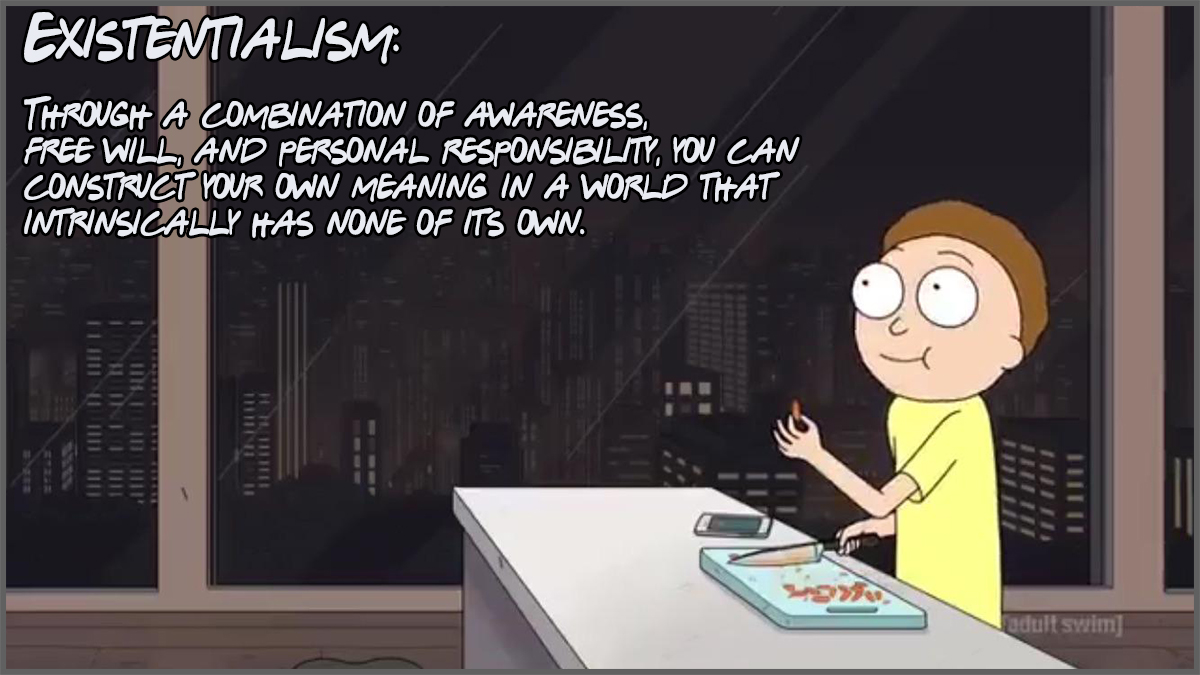
Existentialism is a philosophical theory which emphasizes the existence of the individual person as a free and responsible agent determining his or her own defining existence, through acts of the will. It says that humans define their own meaning in life, and try to make rational decisions despite existing in an irrational universe. This thinking leads men to see themselves as their own creators and saviors. They are not only the clay but their own potters. This is also the philosophy of Freemasonry. This does not, however, reflect the Existentialism of Kierkegaard, who saw himself as not a philosopher, or promoter of philosophy, but rather as an opponent of philosophy. He thought philosophy begat elitist thinking.

The Existentialist Worldview

Said one author on the subject (here):

"It focuses on the question of human existence, and the feeling that there is no purpose or explanation at the core of existence. It holds that, as there is no God or any other transcendent force, the only way to counter this nothingness (and hence to find meaning in life) is by embracing existence."

People today, more than ever, or at least since the days before the flood, are acting upon this premise. It is an enthymeme, an implied premise behind all their thinking and behavior. Life is meaningless. Such a thought produces psychological and social effects, and of these the Existentialists enumerate, such as angst, guilt, suffering, boredom, depression, anguish, dread, and various "existential crises." 

Said the same author further:

"Thus, Existentialism believes that individuals are entirely free and must take personal responsibility for themselves (although with this responsibility comes angst, a profound anguish or dread). It therefore emphasizes action, freedom and decision as fundamental, and holds that the only way to rise above the essentially absurd condition of humanity (which is characterized by suffering and inevitable death) is by exercising our personal freedom and choice (a complete rejection of Determinism)."

Being a "Determinist" while in college (I wrote several papers on it), both theologically and in the various sciences (i.e. determinism in physics, in both the hard sciences and soft, in the psychological and social sciences as well). That is not to say that I reject all definitions of free will. I always defined free will as never being unlimited except in God himself. He is the only true "free" being. Creature freedom is limited. A man may be free in one sense and not in another. I have always viewed "free" as synonymous with the word "independent." None is as independent as God. And, again, we may be independent in one sense but not in another. Satan asserted his freedom and independence from God. He asserted his "freedom of will," his will to be who he wanted to be without any interference or say from God. 

Though many Existentialists exalted the idea of creature free will in imitation of Satan, who was the first Existentialist, yet they confessed that most creatures do not exercise their free will, but rather show how their wills are enslaved to the ideas of others, to their moral codes. Existentialists today claim to live by "science," to abide by only what is "proven" by "science." But, science has proven, especially in the fields of biology and psychology, that a human's choices or acts of will are the result of prior causes, many of them determinative of those acts. If that were not so, then no choice can be predictable. But, we can predict, with fairly good certainty, how certain individuals will choose and act under certain circumstances. 

Often, Existentialism as a movement is used to describe those who refuse to belong to any school of thought, repudiating of the adequacy of any body of beliefs or systems, claiming them to be superficial, academic and remote from life. Although it has much in common with Nihilism, Existentialism is more a reaction against traditional philosophies, such as Rationalism, Empiricism and Positivism, all which sought to discover an ultimate order and universal meaning behind the structure of the observed world, and who believed that the physical world gave evidence of the metaphysical world.

Guilt, angst, dread, anguish, anxiety, etc., were facts of existence and one must simply "deal with it." Trying to find solace in a god or an afterlife of bliss made slaves of all in Existential thinking. How you deal with it, how you live with this awful fact of existence, is where the Existentialism offers its advice. You are in an awful situation, says the Existentialist, but "such is life." "Life is suffering," so just deal with it. Make the most of it. No wonder such a philosophy produces angst and anxiety with loads of depression.

Hitler and the Nazis often talked about the power of the human will (the "iron will") to make supermen of themselves, and apart from God and religion. The Christian message, however, teaches otherwise. It teaches that men cannot simply will themselves into superior beings, not make themselves supermen. It teaches that salvation is available from the evils of our fallen existence and that God is the Potter and we are the clay. His will is to work to change our wills. To Nietzche Christians, and all religious people, were sheep to be devoured by wolves. The wolves are those who are the masters, the ones with power. 

Said another author on this point (See here):

"Think of it this way: If you are a sheep, then what will seem good to you as a sheep? Being able to graze peacefully, sticking close together with others just like you, being part of the herd and not straying off. What will seem bad to you? Well, wolves will seem bad, and anything wolf-like, predatory, aggressive. But what if you are a wolf? Then strength, viciousness, and contempt for the sheep will come naturally to you and seem good. There is nothing the wolves and the sheep can agree on morally—their natures are different, as are their needs and goals, as is what feels good to them. Of course it would be good for the sheep if they could convince the wolves to be more sheep-like—but what self-respecting wolf would fall for that?"

The Nazis had this mentality and worldview. Today's atheistic social and economic elite also think that they are wolves and this is what fate has made them. Wolves must devour the sheep. This is their mission. Who can condemn the wolf for doing such? 

Under "Main Beliefs" the previous author wrote:

"Unlike René Descartes, who believed in the primacy of consciousness, Existentialists assert that a human being is "thrown into" into a concrete, inveterate universe that cannot be "thought away", and therefore existence ("being in the world") precedes consciousness, and is the ultimate reality. Existence, then, is prior to essence (essence is the meaning that may be ascribed to life), contrary to traditional philosophical views dating back to the ancient Greeks. As Sartre put it: "At first [Man] is nothing. Only afterward will he be something, and he himself will have made what he will be."

But, the bible teaches that man is not nothing when he is born. He is rather a creature made in the image of God and therefore has importance, and is something unique and good. Further, it teaches that man is not born "tabula rasa," a blank slate, without Existential "essence," but with only mere "existence." Humans are born with innate knowledge of right and wrong, having the moral code of God written into their nature.

The author said further:

"Kierkegaard saw rationality as a mechanism humans use to counter their existential anxiety, their fear of being in the world. Sartre saw rationality as a form of "bad faith", an attempt by the self to impose structure on a fundamentally irrational and random world of phenomena ("the other"). This bad faith hinders us from finding meaning in freedom, and confines us within everyday experience."

What is the role between faith and reason? That was the chief issue with Kierkegaard. But, these are not unrelated. God is reasonable in his works. His commands to his creatures are also reasonable. But, God is not reason, but reason is his creation. But, faith goes beyond reason. 

Said the author further:

"Kierkegaard also stressed that individuals must choose their own way without the aid of universal, objective standards. Friedrich Nietzsche further contended that the individual must decide which situations are to count as moral situations. Thus, most Existentialists believe that personal experience and acting on one's own convictions are essential in arriving at the truth, and that the understanding of a situation by someone involved in that situation is superior to that of a detached, objective observer (similar to the concept of Subjectivism)."

Keirkegaard was a Christian but Nietzche was Anti Christian. He titled one of his works "The Antichrist." These two Existentialist philosophies have certain things in common and some not. We see such Existential thinking today when people are advised to "be your self," "be true to yourself," "love your self," "indulge yourself," "deny not yourself," "find yourself, "assert yourself," etc. It is also reflected in the belief that no one can understand you but you yourself. This would mean that you can simply listen to yourself and reject what others say. 

Said the author further:

"According to Camus, when an individual's longing for order collides with the real world's lack of order, the result is absurdity. Human beings are therefore subjects in an indifferent, ambiguous and absurd universe, in which meaning is not provided by the natural order, but rather can be created (however provisionally and unstable) by human actions and interpretations."

There is no "lack of order" in the world God created in the beginning. As respects the physical world, it is very orderly. As respects the world of beings, be they angels or men, there is order first in their origins. Some disorder has in fact occurred and brought chaos. The bible calls this "the fall," be it the fall of angels, or the fall of humans. This fall of angels and men was the result of "free will," on which the Existentialists have much to say, as well as theologians. Christians see it as a power that God gave to his creatures whereby they could choose their own destiny, determine who they will become. Atheistic and agnostic Existentialists will say that free will, where it exists, is simply the result of being born human. Said Sartre: "Man is condemned to be free; because once thrown into the world, he is responsible for everything he does."

That sense of being free, and therefore responsible, brings adverse psychological traumas, such as guilt, self abnegation, depression, angst, etc. So, freedom of choice comes with consequences, generally not good. This is certainly true with the gift of free will in the case of the fallen angels and of Adam and Eve and their descendants. This is why most theologians will say that Christians will not have this kind of free will when they are glorified and living out their eternal life. Falling and rebelling against God will not be possible because the will of believers will be fixed and determined and truly and in the highest sense "free." They will be free from the possibility of willing to rebel against God.

Said the author further:

"Existentialism can be atheistic, theological (or theistic) or agnostic. Some Existentialists, like Nietzsche, proclaimed that "God is dead" and that the concept of God is obsolete. Others, like Kierkegaard, were intensely religious, even if they did not feel able to justify it. The important factor for Existentialists is the freedom of choice to believe or not to believe."

"Kierkegaard and Nietzsche, like Pascal before them, were interested in people's concealment of the meaninglessness of life and their use of diversion to escape from boredom. However, unlike Pascal, they considered the role of making free choices on fundamental values and beliefs to be essential in the attempt to change the nature and identity of the chooser. In Kierkegaard's case, this results in the "knight of faith", who puts complete faith in himself and in God, as described in his 1843 work "Fear and Trembling". In Nietzsche's case, the much-maligned "Übermensch" (or "Superman") attains superiority and transcendence without resorting to the "other-worldliness" of Christianity, in his books "Thus Spake Zarathustra" (1885) and "Beyond Good and Evil" (1887)."

Do we not see this philosophy, respecting free will, at work in the debate over transgender people? It is my choice to be male or female, they say. These promote a vulgar idea of what is "free will." It includes the right to be free to choose to do evil. It thinks that being free to do a thing justifies doing it.

Said the author further:

"Christian critics complain that Existentialism portrays humanity in the worst possible light, overlooking the dignity and grace that comes from being made in the image of God. Also, according to Christian critics, Existentialists are unable to account for the moral dimension of human life, and have no basis for an ethical theory if they deny that humans are bound by the commands of God. On the other hand, some commentators have objected to Kierkegaard's continued espousal of Christianity, despite his inability to effectively justify it."

Amen.

In the next posting we will look further at Existentialism and then look at Machiavellianism. 

Good videos on Existentialism

"Nietzsche: Sheep and Wolves" (here)

"The Bible and Western Culture - Nietzsche and the Death of God" (here)

"Nietzsche: Master and Slaves" (here)

"Kierkegaard's Christian Existentialism" (here)

"Nietzsche's Critique of Christianity: The Genealogy of Morals" (here)