Thursday, November 17, 2022

Contradictions or Paradoxes?


A paradox is "a statement that seems to go against common sense but may still be true" or "a false statement that at first seems true" or "a person or thing having qualities that seem to be opposites." Thus, it involves contradictions, seeming contradictions. We call it a paradox when we believe two propositions are true but we cannot see how they both can be true. 

Here are some thought-provoking paradox examples: 

Save money by spending it. 

If I know one thing, it's that I know nothing. 

This is the beginning of the end. 

Deep down, you're really shallow. 

I'm a compulsive liar.

"What are some examples of paradox in the Bible?" at Got Questions (here) has some paradoxes. They say (emphasis mine):

"A paradox is a seeming contradiction that, when properly understood, may prove true. The Bible uses paradox at times to explore the full scope and nuance of truth. One of the most famous paradoxes in the Bible is the teaching that God is triune: there is one God who eternally exists in three Persons."

Some examples of paradox in the Bible occur within the same verse. These statements seem, at first blush, to be self-contradictory: 

2 Corinthians 6:8–10 – “We are treated as impostors, and yet are true; as unknown, and yet well known; as dying, and behold, we live; as punished, and yet not killed; as sorrowful, yet always rejoicing; as poor, yet making many rich; as having nothing, yet possessing everything” (ESV).

Yes, that text is full of paradoxes. Others point to these examples:

• Matthew 10:39 – “Whoever finds their life will lose it, and whoever loses their life for my sake will find it” (see also Matthew 16:25; Mark 8:35; Luke 17:33; John 12:25). 

• Philippians 3:7 – “But whatever gain I had, I counted as loss for the sake of Christ” (ESV). 

• Matthew 23:11 – “The greatest among you will be your servant.” 

• 2 Corinthians 12:10 – “When I am weak, then I am strong.”

Commenting upon these, the article says:

"Each of these paradoxes is meant to contrast an earthly view with a heavenly view. There is a difference between our material situation and our spiritual reality, although we experience both at the same time. The book of Proverbs contains paradox among its wise sayings. One example is Proverbs 11:24, which says, “There is one who scatters, yet increases more” (NKJV)."

"Paul uses a quote from the poet Epimenides, “One of Crete’s own prophets has said it: ‘Cretans are always liars, evil brutes, lazy gluttons’” (Titus 1:12), which presents a paradox. Epimenides was himself a Cretan, and so his statement that Cretans are “always liars” seems self-contradictory. Is Epimenides telling the truth about his own lying? How can there be a truth-telling liar? Or is it possible that his paradoxical description of his countrymen is both true and false, in certain respects?" 

Other examples of paradox in the Bible are found in separate passages that seem to teach opposing ideas: 

• “For we hold that one is justified by faith apart from works of the law” (Romans 3:28, ESV) vs. “You see that a person is justified by works and not by faith alone” (James 2:24, ESV). 

• “I did not come to judge the world” (John 12:47) vs. “For judgment I have come into this world” (John 9:39). 

• “The way is hard that leads to life” (Matthew 7:14, ESV) vs. “My yoke is easy, and my burden is light” (Matthew 11:30). 

• “Judge not, that you be not judged” (Matthew 7:1, ESV) vs. “Judge with right judgment” (John 7:24, ESV). 

Again, these are seeming contradictions, are what appears to be on first look. 

Wrote the same authors of the article:

"In the Bible we are confronted with paradoxes such as a virgin birth, justified sinners, rich poor men, and happy mourners. The use of paradox in the Bible is startling at times, but it reveals a deep spiritual richness and beauty. Paradox causes us to take time to reflect on the meaning of certain passages and investigate the truth, which is sometimes complex."

Yes indeed, "in the bible we are confronted with paradoxes." We must not be surprised at this, for life itself is full of them. “Life is full of paradoxes, as roses are of thorns” said Fernando Pessoa in "The Book of Disquiet." 

If one person says that the earth rotates clockwise and another says the earth rotates counter clockwise, can they both be true? Seemingly or at first glance, no. But consider how one person is in outer space above the north pole and the other person is in outer space below the south pole. 

The article goes on to say:

"One of the most perplexing paradoxes in the Bible concerns the interplay of God’s sovereignty and human responsibility. We see this in the matter of salvation: John 1:12 says, “To those who believed in his name, he gave the right to become children of God”; but then John 1:13 describes those children as “born not of natural descent, nor of human decision or a husband’s will, but born of God.” So, which is it? One verse says that we must believe to be saved, and the next verse says it’s not our decision, but God’s. It’s a paradox, but both verses are true."

The bible teaches that all things are determined by God, that nothing comes to pass apart from his willing or suffering it and yet it also teaches that angels and humans are responsible for the things they do. In other words, that both divine predestination and creature free choice are true, though it cannot be fully shown how they can both be true and thus we have what is called "Compatibilism," or a paradox, or a conundrum. We may well also call them "mysteries," or enigmas, or oxymorons. 

One author who writes upon this subject quotes both D.A. Carson and Charles Spurgeon (See here).

"Compatibilism teaches that the following two propositions are both true and mutually compatible, even if we can’t fully reconcile them: 

1. God is utterly sovereign, but his sovereignty never functions to mitigate human responsibility. 

2. Human beings are morally responsible creatures, but their moral responsibility never functions to make God absolutely contingent."

Without ever using the term compatibilism, Spurgeon often made precisely the same point Carson does. 

The author of this article cites these three comments from Spurgeon:

"That God predestines, and that man is responsible, are two things that few can see. They are believed to be inconsistent and contradictory; but they are not. It is just the fault of our weak judgment. Two truths cannot be contradictory to each other.

If, then, I find taught in one place that everything is fore-ordained, that is true; and if I find in another place that man is responsible for all his actions, that is true; and it is my folly that leads me to imagine that two truths can ever contradict each other.

These two truths, I do not believe, can ever be welded into one upon any human anvil, but one they shall be in eternity: they are two lines that are so nearly parallel, that the mind that shall pursue them farthest, will never discover that they converge; but they do converge, and they will meet somewhere in eternity, close to the throne of God, whence all truth doth spring.”

I agree. We don't have explanations for everything that is a seeming paradox. Let us keep this in mind.

Wednesday, November 16, 2022

Obeying God - Hard or Easy?


"You also say, ‘Oh, what a weariness!’" 
(Malachi 1: 13) 

What a burden! How tiring to keep God's commandments! This is what the unsaved religious man says concerning the service of God. Even true believers are often heard to murmur such words when they become weary in doing all that God commands of them. After all, there is a lot to do! Got to read, pray, and study God's word every day. I got to work, support my family. I got to spend play time with my spouse and children. I got to go to two or three meetings at the church each week. So much to do and so little time and energy! 

Most other translations of Malachi 1: 13 say "what a burden!" The idea is the same. It is a complaint against the Lord, affirming that God is demanding too much of them as his servants. This complaint is never really valid. It only reveals the state of the murmurer and complainer. 

Testified the apostle John:

"For this is the love of God, that we keep his commandments: and his commandments are not grievous."
 (I John 5: 3 kjv)

Again, many translations have "his commandments are not burdensome." This is so true. The reason, therefore, that many find God's commandments and service a weary burden, an odious chore, is because there is something defective in those people. It reminds me of that time when the Lord had requested that his disciples watch and pray and then came and found them asleep. (See Matt. 26: 36-41) He says to them "the spirit indeed is willing, but the flesh is weak." The flesh (the term for the carnal nature) does judge service to God and obedience to righteousness as a drudgery, as something too difficult. The carnal man thinks that a life of religious service to God is a waste of time, taking all the fun out of life. He finds pleasure in his sins (Heb. 11: 25), and has no delight in God. Were his delight in the Lord and his law, and his word, he would not become so weary in obeying and serving. 

Many scriptures speak of delighting in God and in his word. Psalm 1 promises prosperity to the person who delights in the law of the Lord day and night. Later in the Psalms the Psalmist said:  "Delight yourself also in the LORD, And He shall give you the desires of your heart." (Psa, 37: 4) And, "I will delight myself in Your statutes; I will not forget Your word...Your testimonies also are my delight And my counselors." (119: 16, 24) 

Obviously there are times when believers become weary in their service to God and such is not a sign or symptom of spiritual deformity but is simply because the believer is working too hard and not giving enough time to rest and recuperation. Even Christ became weary. (John 4: 6) So too did his disciples and he said to them "come apart and rest awhile." (Mark 6: 31) Many of the Lord's servants "burn the candle at both ends" and fail to obtain the necessary amount of rest. So it was with Epaphroditus, of whom Paul said: "for he nearly died for the work of Christ, risking his life to complete what was lacking in your service to me."

Believers are warned that they must "endure hardness, as a good soldier of Jesus Christ." (II Tim. 2: 3) Service to the Lord will not always be easy. In fact, it oftentimes involves hard work and hard times. But, again, if we love the Lord and his service, it will not seem so. If we enjoy the work we are doing, it is then enjoyable rather than wearisome. 

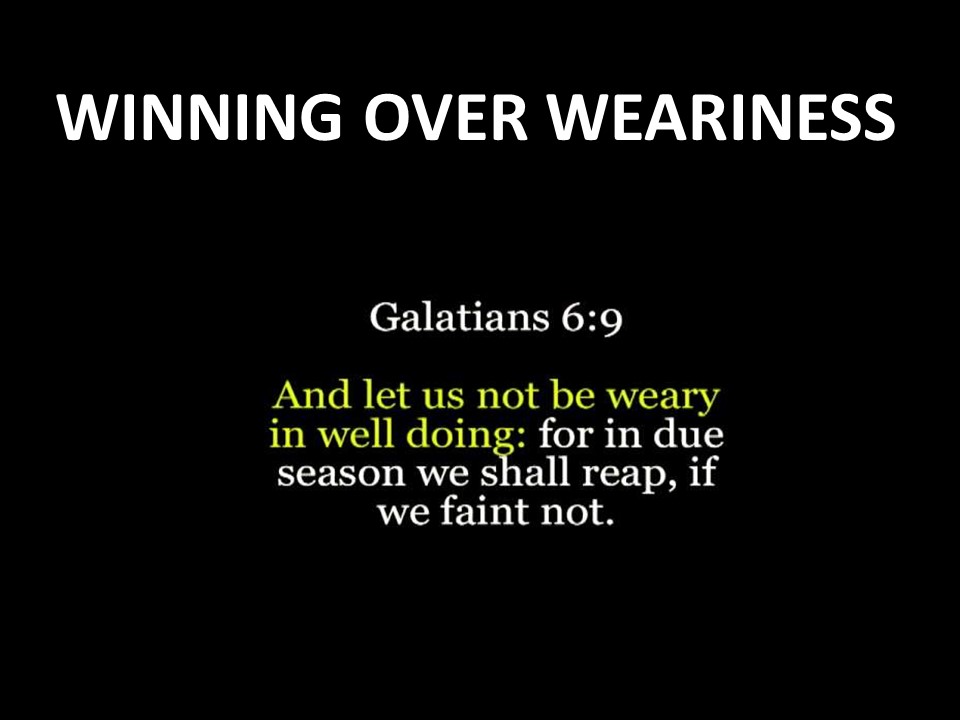
According to the text at the head of this article, we ought not to become "weary in well doing." We ought not to "faint," but to keep strength. So, how can we keep from wearing ourselves out in doing right? How do we keep our strength up? 

So, why is it hard to tell the truth? Why is it so hard to put God first in our lives? Why is serving God and living right tiresome and of ill delight to us? Is it not because we are morally and spiritually weak and impotent? When a person falls in love with another it becomes an easy thing to do things for the beloved. So too when one falls in love with Christ, with God, and he then can say "I delight to do your will O my God." (Psa. 40: 5) The apostle advised us in this matter, saying "by love serve one another." (Gal. 5: 13) Being of service to those we love is much easier than serving those we care nothing about.

Is it hard to keep from lusting, from coveting, etc.? Does it weary you in the fight with sin? Then go to Jesus for strength and for help. Also, keep your eyes on the prize. Those who win in the Olympics are they who worked hard and exhausted themselves in practice and they were able to endure the rigors of such training by keeping their eyes on the prize. So too does the apostle advise us. (Phil. 3: 13-14) Also, we should learn to pace ourselves, realizing the kind of race we are in as servants of righteousness. We are not in a 100 yard dash, which is why Solomon said - "the race is not to the swift." (Eccl. 9: 11). Rather, the Christian race is a long distance marathon. That is why we must "run the race with patient perseverance" (Heb. 12: 1). 

Remember that Christ says "For my yoke is easy, and my burden is light." (Matt. 11: 30) A good song that sings this truth is titled "His Yoke Is Easy" can be heard (here).

Well did one say of Spurgeon on the question of weariness in service to God (See here):

"Charles Spurgeon knew that even the greatest of saints, “in toiling towards heaven often grow faint.” Paul knew this as well. He tells of his many burdens to the Corinthian church: the “toil and hardship, through many a sleepless night….” and “the daily pressure on me of my anxiety for all the churches.” (2 Cor. 11:27-28) Though we might not be “weary of God’s work….we often grow weary in it.”

So Paul would later say:

"And I will very gladly spend and be spent for you; though the more abundantly I love you, the less I be loved." (II Cor. 12: 15)

Spending in service to the Lord is rewarding. What a paradox! Spending to become rich! 

"One crisp November evening in 1877, Spurgeon addressed the Sunday School Union. His address was titled “The Cause and Cure of Weariness in Sabbath School Teachers,” and his text that evening was Gal. 6:9, “Let us not be weary in well doing: for in due season we shall reap, if we faint not.” Towards the end of the address, he encouraged those teachers who had grown weary in their work. He urged them to “Pluck up courage. Do not be a coward. Hope on, Hope ever. Work on, even though the task becomes more and more trying to you. Do not despise your vocation, nor stay your hand, be not weary in well doing.” (Ibid)

Excellent advice! Citing Spurgeon the author says:

"As we pursue Christ by living as citizens of his Kingdom, “there are such fresh things in the Christian’s experience…that we run and are not weary.” As God fed the grumbling Israelites in the wilderness and “‘day by day the manna fell,’ so hour by hour fresh grace streams into our souls.” Come to Christ for “He has never refused to bear your burdens, He has never fainted under their weight.” In the midst of our weariness and fatigue, let us heed Spurgeon’s invitation to, “Come hither, all ye sin-sick ones, and behold the glorious Son of God, made in the likeness of human flesh, breathing out his life upon the cross!” and surrender ourselves “….into those dear hands which were pierced for [us].”

Christians who are doing the will of God, obeying his teachings and commands, will grow weary if they do not regularly and daily seek and find rest and recuperation in Christ. In him is rest for the weary worker, the source of refreshment, regeneration, and renewing. He is the thing that sweetens our arduous labors for him and godliness. He makes the job easy and rewarding. Honest hard toil for the Master is greatly rewarded by the Lord Jesus Christ. His service brings joy and gladness that is inexpressible. (I Peter 1: 8) The happy servant of Christ receives, for his labors, great reward, both now and forever in the future. Said the Lord Jesus:

"And he said unto them, Verily I say unto you, There is no man that hath left house, or parents, or brethren, or wife, or children, for the kingdom of God's sake, Who shall not receive manifold more in this present time, and in the world to come life everlasting." (Luke 18: 29-30)

It is good to serve God for the good that results from it. Many of those good things come "in this present time," during the term of service (in a person's lifetime). It is rewarding work, enjoyable and fulfilling work. It goes beyond this life for it brings eternal benefits and rewards, yea, "life everlasting." The believer's life's work for Christ and righteousness is "not in vain" says the apostle (I Cor. 15: 58) and should be kept in mind as one labors for Christ and for God. He also testifies that God is "a rewarder of them who diligently seek him," (Heb. 11: 6) rewards that come in one's life for the Lord while living, and eternal rewards that come after this present life, when one transcends into eternal life and blessedness. 

"Therefore, my beloved brothers, be steadfast, immovable, always abounding in the work of the Lord, knowing that in the Lord your labor is not in vain." 
(I Cor. 15: 58)

Monday, November 14, 2022

Does God Toy With His Creatures?


"There go the ships: there is that leviathan, whom thou hast made to play therein." 
(Psalm 104: 26)

"Can you make it (Leviathan) a pet like a bird, or give it to your little girls to play with?" 
(Job 41:5 NLT) 

In the verses above the great sea monster, Leviathan, is pictured as being one of God's pets. Think of that! Then ponder how God describes this monster in Job 41! 

In Pagan mythology many of the gods had pets. Hades was famous for his pet Cerberus, the ferocious three headed dog and Athene had her pet owl which was with her always. So, does the God of the bible also have pets? Yes, and Leviathan is one. Think of that again. A creature of such chaos and calamity as Leviathan is nothing but a lap dog to its Creator!  So God asks Job - “Will you play with him as with a bird or will you put him on a leash for your girls?” Or, "will you make a pet of him?" The implied answer is, “Of course not!” Also implied is the fact that apparently God did make Leviathan to be his pet.  Can you (Job) tame him? Make him your pet?

So does God have pets? Toys? Does he toy or play with any of his creatures besides Leviathan? Does he view the elect angels and his redeemed people as pets? 

Was God toying with Job in suffering him to be played with by "the Satan"? Was God playing a game with Satan when he made wager with him concerning Job? Was God toying with Abraham when he told him to go to Mt. Moriah and kill his son (presenting him as a burnt offering), knowing all along that he would not suffer Isaac to be killed? Do you ever feel like God is toying with you? In testing and trying us, does it not at least seem to us that God is toying with us? Do we ever feel like we are a pawns in the chess game of providence? 

I did a Google search on this question ("does God have pets") and saw where very few suggested web pages addressed that question and those which did affirmed that God does have pets. But, Google kept referring me to pages where the question of God loving animals, or of whether they go to heaven, etc. is addressed, but that is not the subject of this investigation.

Did Jesus have pet animals when he was a child? I see no reason to think that he did not. Perhaps he did have a pet dog. He was a normal child in such respects. 

Got Questions web page addresses the question "What does the Bible say about pets?" and says:

"In Western society, pets have never been more popular. Many homes are graced with the presence of a cat or a dog—or a hamster, turtle, goldfish, chinchilla, newt, parakeet, or gecko. Everything from albino pythons to hissing cockroaches are caged and kept as pets. The Bible does not really address the issue of keeping pets. The only possible example of a pet owner is the poor man in Nathan’s parable, a man who “had nothing except one little ewe lamb he had bought. He raised it, and it grew up with him and his children. It shared his food, drank from his cup and even slept in his arms. It was like a daughter to him” (2 Samuel 12:3). We can draw some conclusions about pets, however, based on what the Bible says on other topics.

Psalm 147:9 tells us that God is concerned for all His creation, including the animals He created: “He provides food for the cattle and for the young ravens when they call.” In Psalm 104:21, we see that “the lions roar for their prey and seek their food from God”; it is implied that God feeds them. Also, in Luke 12:6 Jesus says, “Are not five sparrows sold for two pennies? Yet not one of them is forgotten by God.”

So, it does seem that all may be viewed to be God's pets on some level.

We have all heard of the expression "teacher's pet." We also know that many parents, if they have several children, will often have a favorite among them. Does God also? We know that Joseph was the favorite son of old Jacob, loving him more than his other sons (See Gen. 37: 3-4). We also may surely say that the Lord Jesus Christ, "the man Christ Jesus," was God's favorite Son! 

Said one writer (See here):

"God does not play favorites. This isn’t my opinion. It’s in His word. Ephesians 6:9 says, “And there is no favoritism with him.” In Acts chapter 10 verse 34, Peter even said “I now realize how true it is that God does not show favoritism.”

But those texts are an interpretation rather than a translation, for most translations say "there is no respect of persons with him." To show respect of persons is not the same thing as having favorites. To respect persons means to show favor because someone's person is different in socio-economic circumstances. A case example would be God favoring the rich because he is rich. 

Some argue that for God to unconditionally elect one to salvation and refuse another is an example of God showing respect of persons. But, this is not so for God is not choosing one because he has made himself different from another. Ironically, it is the Arminian idea of a conditional election that says God chooses those who make themselves believers (and thus different) by their own free will and effort. 

However, consider that David is said to be "a man after God's own heart," and this seems to mean he was more favored by God. Not all are equally favored in every respect. The angel Gabriel greeted Mary with these words: “Greetings, you who are highly favored! The Lord is with you” (Luke 1:28). Got Questions web page addresses the question "Does God have favorites?" (here) They say: "Whether or not God has favorites is a tricky question because it is based upon our human understanding of favoritism, which usually means unfair treatment of anyone who is not favored." 

Consider also the fact that anyone's personal circumstances are the result of God's providence. So Paul asked rhetorically - "For who makes you different from anyone else? What do you have that you did not receive? And if you did receive it, why do you boast as though you did not?" (I Cor. 4: 7 NIV) 

Further, the apostle John is specially called "the disciple whom Jesus loved." (John 21:20, etc.) Though many think that such a title does not mean that Christ had more love for John than for other of his disciples, others do not agree, nor do I. However, though we will all be equally loved and favored in heaven, it is not so as respects our relationship to the Lord while we live and serve him on earth. I agree with Spurgeon on this point. Said Spurgeon in preaching upon this text (see here for sermon):

"Our Lord loved all his disciples:— “having loved his own which were in the world, he loved them unto the end.” He said to all the apostles, “I call you not servants; for the servant knoweth not what his Lord doeth: but I have called you friends; for all things that I have heard of my Father I have made known unto you.” And yet within that circle of love there was an innermost place in which the beloved John was favoured to dwell: upon the mountain of the Saviour’s love there was a knoll, a little higher than the rest of the mount, and there John was made to stand, nearest to his Lord. Let us not, because John was specially loved, think less, even in the slightest degree, of the love which Jesus Christ gave forth to the rest of his chosen. I take it, brethren, that those who display an extraordinary love to one are all the more capable of great affection to many; and therefore, because Jesus loved John most, I have an enhanced estimate of his love to the other disciples. It is not for a moment to be supposed that any one suffered from his supreme friendship for John. John was raised, and they were not lowered, but raised with him. All believers are the dear objects of the Saviour’s choice, the purchase of his blood, his portion and inheritance, the jewels of his crown. If in John’s case one is greater in love than another, yet all are eminently great, and therefore if it should so happen that you dare not hope to reach the height of John, and cannot look to be distinguished above others as “the disciple whom Jesus loved,” yet be very thankful to be among the brotherhood who can each say, “He loved me, and gave himself for me.” If you have not attained unto the first three, be happy to belong to the host of those who follow the Son of David. It is a matchless privilege, and an unspeakable honour, to enjoy the love of Jesus, even if you march among the rank and file of the armies of love. Our Lord’s love to each of us hath in it heights immeasurable and depths unfathomable it passeth knowledge."

That view however is rejected by many who refuse to believe that the words imply that John was loved more than the other disciples, or was more favored. But, I agree with Spurgeon. That is the ordinary meaning of the words. 

Spurgeon went on to say:

"Yet would I not utter this word of good cheer to make you remain at ease in a low state of grace; far rather would I excite you to rise to the highest point of love; for if already the Lord has loved you with an everlasting love, if already he has chosen you and called you, and kept you and instructed you, and forgiven you, and manifested himself to you, why should you not hope that another step or two may yet be taken, and that so you may climb to the very highest eminence? Why should you not ere long be styled like Daniel, a “man greatly beloved”? or like John, “that disciple whom Jesus loved”?"

I agree. He also said:

"To be loved as John was, with a special love, is an innermost form of that same grace with which all believers have been favoured. You must not imagine when I try to exhibit some of the lovable traits of John’s character, that I would have you infer that the love of Christ went forth towards John in any other way than according to the law of grace; for whatever there was that was lovable in John it was wrought in him by the grace of God. Under the law of works John would have been as surely condemned as any of us, and there was nothing legally deserving in John. Grace made him to differ, just as truly as grace separates the vilest sinner from among the ungodly. Though it be granted that there were certain natural characteristics which made him amiable, yet God is the creator of all that is estimable in man, and it was not till the natural had been by grace transformed and transfigured into the spiritual that these things became the subject of the complacency of Christ Jesus. Brethren, we do not speak of John to-day as if he were loved because of his works, or stood higher in the heart of Christ on the ground of personal merit, whereof he might glory. He, like all the rest of his brethren, was loved of Jesus because Jesus is all love, and chose to set his heart upon him. Our Lord exercised a sovereignty of love, and chose John for his own name’s sake; and yet at the same time there was created in John much that was a fit object for the love of Christ. The love of Jesus was shed abroad in John’s heart, and thus John himself was made fragrant with delightful odours. It was all of grace: the supposition of anything else is out of place. I look upon this special form of our Lord’s love as one of those “best gifts” which we are bidden earnestly to covet— but a gift most emphatically, and not a wage or a purchasable commodity. Love is not bought. It never talks of price or claim. Its atmosphere is free favour."

Perhaps we can say that John was "the teacher's pet," the favorite of Christ. This reminds me of a scene in one of the episodes of "Andy Griffith Show" involving Opie and his words about being the "teacher's pet."

Andy- If that's homework you're doin', this is a fine time. Why didn't you do it last night? 

Opie - I'll be finished in just a minute, Paw. 

Andy - You better buckle down. You got another report card due, you know. 

Opie - I ain't worried. 

Andy - What makes you so sure? 

Opie - I think the teacher likes me now. 

Andy - Liking's got nothing to do with it. The teacher don't give out good marks 'cause she likes you, you know. 

Opie - Look at Barbie Tyler. She's teacher's pet, and she always gets good marks. 

Andy - Maybe she's teacher's pet because she gets good marks. You ever think of that?

Maybe John was more highly loved by our Lord because John had a greater love for the Master, wanting a more intimate relationship to the Lord than did the others. After all, it is also said of him uniquely, not only that the Lord loved him, but that he is the one who rested on the chest (breast) of Christ on the sofa. So it is written - "Now there was leaning on Jesus' bosom one of his disciples, whom Jesus loved." (John 13: 23) Oftentimes a parent has a closer tie and more loving affection for a child who has an inordinate desire to spend time in the lap of his or her parent, or being more interested in spending time with a parent. Not only is John singled out as being one who Jesus loved, but we are also told in scripture that Jesus loved Mary and Martha and Lazarus. (John 11: 5)

God says to us via "Wisdom""I love them that love me; and those that seek me early shall find me." (Prov. 8: 17) That seems to suggest that God's love towards his children is in proportion to their love for him. Yes, all are loved by the Lord and will be forever equally loved by him in glory throughout eternity. Yet, in this life, while they are immature children, some of them may be more loved and favored of God, and this will be shown by God's relationship with them. Another verse that seems to show this is the word of Jude, the brother of the Lord, who said: "Keep yourselves in the love of God, looking for the mercy of our Lord Jesus Christ unto eternal life." (Jude 21)

But, back to God toying with us. I listened to a video by Muslims titled "Is God toying with us? Are we entertainment for Him?" (here) They did not really address the issue, not really giving a clear and definitive answer. So, when we say that someone is toying with us, what do we mean? Merriam-Webster says it means "to deal with or control (someone or something) in a clever and usually unfair or selfish way."

Another dictionary gives these definitions and examples (See here):

1. To consider or think about an idea or plan. I've been toying with the idea of starting my own business. 

2. To deliberately attempt to evade, deceive, or misinform someone (about something) in order to manipulate them or achieve some desired outcome. Quit toying with me, Karen—I know that you're involved in this deal! The serial killer is toying with the police, leaving false clues everywhere to muddy the investigation. 

3. To tease someone. I'm just toying with you, James—I really do like that jacket. 

4. To treat something as a plaything in order to idly amuse oneself. Cats are known for toying with their prey. I don't think she's actually interested in him at all. I think she just likes toying with his emotions.

Well, with those definitions, let us ask 1) Does God toy with his creatures? with humans? 2) Do Christians sometimes feel as if God is toying with them? That he seemingly toys with us? 

Did God tempt Abraham? Yes. (See Gen. 22: 1) Was his tempting Abraham in the matter of the killing of Isaac not a kind of toying with him? Also, as we have already mentioned, did God not also tempt and try the prophet Job? Was it also not a kind of toying with Job? 

In fact, there are several places in scripture where God is said to do something for the purpose of seeing what will happen. Of course, this is to be interpreted anthropomorphically, for God foresees all things. An example is in these words:

"You shall remember all the way which the Lord your God has led you in the wilderness these forty years, that He might humble you, testing you, to know what was in your heart, whether you would keep His commandments or not." (Deut. 8: 2)

Again, literally, God already knew what was in the heart of the people before he tested them. But, he speaks as a man in the language of men, anthropomorphically, and says he tests in order to know. It was language that expresses the fact that obedience would be the proof of the condition of the heart or inner man.

"And he said, Lay not thine hand upon the lad, neither do thou any thing unto him: for now I know that thou fearest God, seeing thou hast not withheld thy son, thine only son from me." Gen. 22: 12)

Again, in testing or toying with Abraham, God said after Abraham passed the test "now I know that you fear God." But, again, God already knew and such language is intended to simply tell us that Abraham's faith and loyalty to Jehovah had been proven real and authentic.

So, does God ever deceive in any way? I expect some who are quick to answer without thinking first will immediately say "no God doesn't deceive anyone." But, a deeper consideration might yield a different answer. Let us see this by asking the question - "does God give all the facts to a person that would be of help in decision making?" Well, in the case of Job he did not. 

Jeremiah spoke to God frankly:

"O LORD, thou hast deceived me, and I was deceived: thou art stronger than I, and hast prevailed: I am in derision daily, every one mocketh me." (Jer. 20: 7)

I realize that this is not an easy text to understand and accept. Commentators are not agreed on what it says. Many argue that the Hebrew word should be translated "persuaded" rather than "deceived." But, I think the feeling of the prophet is one which God's people often have when they contemplate God's providential dealings with them. 

No one doubts that it is right in war for a nation to deceive an enemy. If an enemy asks a captured soldier to tell where his commander and his army are, may he not deceive them in some way? So we see where God so deals with his enemies, such as they who willfully reject him and accept the rule of the Devil and Antichrist. "And for this cause God shall send them strong delusion, that they should believe a lie." (II Thess. 2: 11)

So, in conclusion, how can we answer the question - "does God toy with his creatures?" Or the question, "Does he treat them as pets in any way?" Or, "does his providence over our lives not make us often feel as if we are being manipulated, played with, toyed with?" As if we are one pawn in this cosmic chess game? 

At least, if we are trusting in the Lord, we can be assured that all our circumstances and experiences are planned and purposed of the Lord and all with the purpose of working all for our good. (Rom. 8: 28)

Friday, November 4, 2022

Baptist Watchman Tidbits

The Baptist Watchman was one of the leading periodicals of the "Primitive Baptists" after the Civil War and was published out of Nashville, Tennessee and edited by Dr. R.W. Fain and later by Dr. J.B. Stephens and B.E. Mullins, all elders of the PB church. I have previously shown how this periodical and its editors held to the means view, the original view of the Baptists and of the Hardshell faction. (See these postings - hereherehere, here)
Here are some tidbits of information from that periodical. 

Baptist Watchman July 3rd, 1875 (highlighting mine):

"Bro. John Clark, Zion's Advocate Vol. 15, no 3 Calls on the "Baptist Watchman" to inform its readers whether its Editors are of like-faith with a paper called the "Signs Of The Times." We can only say to Bro. Clark, that we suppose both himself, and others of the readers are acquainted with the leading traits of doctrine contended for by the "Baptist Watchman." These we regard as our true sentiments, and we expect if favored by Divine providence to continue in their defence, having as we trust true regard to the admonition by the Apostle, to "contend earnestly for the faith once delivered unto the saints." Editors 

This is interesting because elder Clark was an opponent of the "Signs of the Times" periodical and its editors and leading writers, mainly Elders Gilbert Beebe and Samuel Trott. One of the main reasons for Clark's opposition was the denial of the Trinity by that periodical and the above named writers. It is also due to their entertaining the idea of eternal vital union, or Two Seedism, and their idea that the mediatorial Christ, his human existence, was created sometime in eternity past. Clark charged them with being Arians for this reason, but I have shown how it is also akin to Sabellianism, a view held by Hardshell leader Wilson Thompson. (See these postings - hereherehereherehere) It seems that Elder Clark wanted Dr. Fain and the other editors of the Baptist Watchman to declare against Beebe and the Signs and Dr. Fain, et. als., did not want to do so but they did say that their beliefs were well known (meaning that they were not in league with the views of Beebe and Trott)

I think that Dr. Fain and his brethren (Dr. Stephens, Mullins, etc.) did not want to declare against certain sects within the PB or anti mission brotherhood, probably because it would have hurt their circulation and influence. I have also thought that this is why they did not more forcefully fight against those who were beginning to increase in numbers who denied means. I believe had they been more forceful in defense of the means question, it would have hindered the denomination from declaring against the means view (which they did later in the end of the century). 

Further, this shows that Elder Clark was a frequent reader of the Baptist Watchman and I have not seen where he ever objected to the means view held to by Elders Fain and Stephens. This would seem to disprove the accusation of Elder Lemuel Potter (also a frequent reader of the Baptist Watchman) who said that Elder Clark denied means and debated the subject with Elder Stephens. 

Wrote Dr. Fain in reply to an Arminian letter to the paper:

"We would say, if election is true, all the elect will be saved through the means of His own appointment; and the shining of the Christian light is one of His appointed means on whatever subject he wish to make it bear." (July 31, 1875)

This is another proof that shows the position of Fain, Stephens, and the Baptist Watchman. They supported means, which was the original position of the "Old Baptists."

Wednesday, November 2, 2022

In God's Hands


"In whose hand is the life of every living thing, And the breath of all mankind?"
(Job 12: 10)

"In whose hand are the depths of the earth, The peaks of the mountains are His also."
(Psalm 95:4)


"He's Got the Whole World in His Hands"
is a traditional African-American spiritual, first published in 1927. It became an international pop hit in 1957–58 in a recording by English singer Laurie London, and has been recorded by many other singers and choirs." (Says Wikipedia - here)

In everyday language we say to another "its in your hands" meaning it is under your care and supervision, under your control. All is under control of the the sovereign Lord. He "upholds" all things. (Heb. 1: 3)

Believers are said to be "in the Father's hand" and as such are safe and secure, none being able to snatch them out of his hand. (John 10: 29) It is similar to another verse dealing with another anthropomorphism, with the "arms" of the Lord. "The eternal God is your refuge, And underneath are the everlasting arms." (Duet. 33: 27) God upholds and undergirds all things, especially believers in their standing with God. Another verse that upholds this same idea of God upholding (pun intended) is this:

"Who are you to pass judgment on the servant of another? It is before his own master that he stands or falls. And he will be upheld, for the Lord is able to make him stand." (Rom. 14: 4 ESV)

A man who is upheld by the Lord will be kept from falling, will be "made to stand." So too the Psalmist testified: "Though he fall, he shall not be utterly cast down; For the LORD upholds him with His hand." (Psa. 37: 24)

Not only is the believer in the hands of the Lord, but so too are his daily experiences. Said the Psalmist: "My times are in Your hand." (Psa. 31: 15) Such a statement is pregnant with meaning. Think upon it. It is similar to these words of the prophet:

“Can I not, O house of Israel, deal with you as this potter does?” declares the Lord. “Behold, like the clay in the potter’s hand, so are you in My hand, O house of Israel." (Jer. 18: 6)

The hand of God may be under or upon us for good, or for evil (judgment). His hand may be employed in helping and upholding you, or perhaps in destroying you. In this way the hand of the God is like that "stone" Jesus referred to when he said:

"And whosoever shall fall on this stone shall be broken: but on whomsoever it shall fall, it will grind him to powder." (Matt. 21: 44; Luke 20: 18)

The very same stone (which is Christ) will save some and destroy others. Again, this is similar to the words of James who wrote:

"There is one Lawgiver, who is able to save and to destroy. Who are you to judge another?" (James 4: 12)

The hand of God, like the stone and like this one Lawgiver, will be either the instrument of salvation or of destruction. 

Benevolent Hands

"You open Your hand And satisfy the desire of every living thing." (Psalm 145:16) 

"You give to them, they gather it up; You open Your hand, they are satisfied with good." (Psalm 104:28)

"...in Your hand is power and might; and it lies in Your hand to make great and to strengthen everyone." (I Chron. 29: 12)

There is a charity organization called "helping hands." We may surely view God's hands as such! He has helping hands like no other! Think about the hands of Christ Jesus! How he laid his hands upon the sick and dying and he healed them! Think of how he laid his hands upon even the dead and they came back to life! Think of how he takes his people by the hand and leads them! Oh those precious hands! The very ones that the wicked pierced with nails to the cross! 

Arresting Hands

"Now, behold, the hand of the Lord is upon you, and you will be blind and not see the sun for a time.” And immediately a mist and a darkness fell upon him, and he went about seeking those who would lead him by the hand." (Acts 13: 11)

“Pity me, pity me, O you my friends, For the hand of God has struck me." (Job 19: 21)

It is said that you cannot outrun the hand of the law, and to some extent that is true. But, men sometimes do escape the long arm of the law and escape arrest and judgment. But, it is not so with the hand and arm of the Lord!

"And the hand of the Lord was with them

and a great number believed, and turned unto the Lord." 

(Acts 11: 21)

Monday, October 31, 2022

Perfect


“That you may be perfect and complete, lacking nothing”
(James 1: 4)

Last night I woke at 4 A.M. and my thoughts were upon Christian perfection, chiefly in two things, in love and holiness and want to share my thoughts.

Perfected In Love

"But whoever keeps His word, truly the love of God is perfected in him. By this we know that we are in Him." (I John 2: 5)

"No one has seen God at any time. If we love one another, God abides in us, and His love has been perfected in us." (I John 4: 12)

"There is no fear in love; but perfect love casts out fear, because fear involves torment. But he who fears has not been made perfect in love." (I John 4: 18)

In these verses the words "perfected" or "made perfect" are from the Greek word "teleioō," a verb meaning "to make perfect, complete to carry through completely, to accomplish, finish, bring to an end to complete (perfect)," or to "add what is yet wanting in order to render a thing full to be found perfect to bring to the end (goal)" and "proposed to accomplish bring to a close or fulfilment by event of the prophecies of the scriptures." (Strong) Both the verb and the noun are the basis for English words like "telescope," "telephone," etc. 

So, what does it mean to have love perfected? Who has such love among the saints? From the words of the apostle John we know that a person who has a spiritual divine love that is perfect is one who 1) is keeping God's word, and 2) is loving God's people (and not merely in word but in action), and 3) is free from tormenting and slavish fear. 

A perfect love is not a childish immature affection, but a mature love that has no mixture of fear. Why would we fear those we love and know that they love us? If we fear God's wrath, we manifest that our love to him is not perfected, not full and complete. So, we should ever be seeking to love God and Christ more and more. So believers ever sing "I want to love him more." Further, there is always danger that our love for the Lord may grow cold. (See Matt. 24: 12) There is the danger that we may leave our "first love." (Rev. 2: 4) So, let us ever be examining ourselves in regard to this thing. Let us be always asking ourselves "how dwells the love of God in me?" So the apostle in this epistle asked this very question:

“But whoso hath this world's good, and sees his brother have need, and shuts up his bowels of compassion from him, how dwells the love of God in him?” (I John 3: 17)

I like to think of mature love as what some call "companionate love," the love that one has with a marital companion after years of living together and experiencing life's joys and sorrows as one. I loved my wife when we first married thirty seven years ago, but my love for her today is more mature, more firm, more a privilege than a mere duty. So we are told by the apostle Paul "by love serve one another." (Gal. 5: 13) Perfect love is a love that is complete and cannot increase any more, for it has reached its fullness. 

The divine love is fully and well described by the apostle Paul in these words:

"Love suffers long and is kind; love does not envy; love does not parade itself, is not puffed up; does not behave rudely, does not seek its own, is not provoked, thinks no evil; does not rejoice in iniquity, but rejoices in the truth; bears all things, believes all things, hopes all things, endures all things. Love never fails." (I Cor. 13: 4-8a)

Love has been completed and perfected when it fully obeys the word and law of the Lord, when it no longer is envious, condescending, egotistical, narcissistic, hedonistic, selfish, or sinful. It is perfect when it is as kind and longsuffering as God himself, when it rejoices only in truth and righteousness, and when it never fails or decreases. This being so, love is never fully perfected in this life, but is the goal to which we are striving, and the end to which we have been predestined as believers in Christ. 

In closing my thoughts on love being perfected, I want to include some other scripture that additionally shows how love comes in degrees and how it is demonstrated in service and obedience. 

As John said, the one who is keeping God's word is the one who has love perfected. To the degree we are disobeying the word of God, we are showing that our love for God is still lacking, is not perfect. Jesus also taught this when he said -

If you love Me, keep My commandments...He who has My commandments and keeps them, it is he who loves Me. And he who loves Me will be loved by My Father, and I will love him and manifest Myself to him.” (John 14: 15, 21)

To show that some love more than others, read the story about the time when Christ was in the home of Simon the Pharisee in Luke chapter seven. 

“And Jesus answered and said to him, “Simon, I have something to say to you.” So he said, “Teacher, say it.” “There was a certain creditor who had two debtors. One owed five hundred denarii, and the other fifty. “And when they had nothing with which to repay, he freely forgave them both. Tell Me, therefore, which of them will love him more?” Simon answered and said, “I suppose the one whom he forgave more.” And He said to him, “You have rightly judged.”Therefore I say to you, her sins, which are many, are forgiven, for she loved much. But to whom little is forgiven, the same loves little.” (Luke 7: 40-43, 47)

This shows that love may be little or strong in us. When love is perfected, it is superlative, has reached its greatest degree.

Perfecting Holiness

"Therefore, having these promises, beloved, let us cleanse ourselves from all filthiness of the flesh and spirit, perfecting holiness in the fear of God." (II Cor. 7: 1)

The Greek word for "perfecting" is "epiteleō" which again has telos as the base word with the prefix "epi." It means "to bring to an end, accomplish, perfect, execute, complete." 

So, how do we perfect holiness, that is, how do we complete our sanctification? From the text itself we see how it involves first of all a being cleansed from "all moral and spiritual filthiness of both flesh and spirit." When we will have had all sin and propensity to sin removed from our very being we will then be perfected in holiness. Until then we are to be striving towards perfect holiness. 

Holiness involves being separate from what is sinful and unclean. It means to be set apart from other things so as to be special, peculiar or unique. This is what it means for God himself to be holy. Said the apostle Paul: 

"For God did not call us to uncleanness, but in holiness." (I Thess. 4: 7)

It is our vocation, our calling, our duty, to be striving towards greater holiness of character and life. Just as we are daily cleaning ourselves (taking baths or showers, washing our hands, etc.) so too we should be daily washing away our moral filth in pursuit of holiness. Cleansing is regularly available to us through the word of God (Psalm 119:9; Eph. 5: 26; etc.) and through the application of the blood of Christ via confession of sin (I John 1: 7-9).  Further, becoming more holy involves becoming more godly, more righteous in our character and conduct. Wrote Paul:

"...slaves of righteousness for holiness...now having been set free from sin, and having become slaves of God, you have your fruit to holiness, and the end, everlasting life." (Rom. 6: 19, 22)

To the degree we are living righteously and are free from sin and disobedience we are holy. In this life we never reach sinless perfection. That will not become a fact of our existence till we leave this world and enter the next. It will be our confirmed state throughout eternity. Hallelujah! 

In the following text we see how being perfected in both love and holiness are joined together. Wrote Paul:

"And may the Lord make you increase and abound in love to one another and to all, just as we do to you, so that He may establish your hearts blameless in holiness before our God and Father at the coming of our Lord Jesus Christ with all His saints." (I Thess. 3: 12-13)

The words state several of the points I have been making in this homily. Notice also how the level or degree of holiness is connected with the degree of being blameless. Notice also how perfect holiness is looked to as a future reality and connected with the second coming of Christ and the time of the believer's glorification.

Perfecting = Accomplishing

"Whom resist stedfast in the faith, knowing that the same afflictions are accomplished in your brethren that are in the world." (I Peter 5: 9)

In this verse the word "accomplished" is the same Greek word as in our text where the English word "perfecting" is used. It denotes a finished product or workmanship, a completed work. For the present life of a believer, he is a work in progress. God is accomplishing his work by making the believer more obedient and more like Christ. Often the afflictions that believers experience are meant to purify them, and to improve them. So Paul says "no one should be shaken by these afflictions; for you yourselves know that we are appointed to this." (I Thess. 3: 3) Why appointed? Is it not part of our training, a means to perfect us in holiness? The apostle Peter wrote in support of this thesis:

"But may the God of all grace, who called us to His eternal glory by Christ Jesus, after you have suffered a while, perfect, establish, strengthen, and settle you." (I Peter 5: 10)

One day all believers will be perfect, fully established in righteousness, and fully strengthened and settled, but while we live this life we are being worked upon by God our Potter. 

The Process of Being Made Perfect

“I in them, and You in Me; that they may be made perfect (teleioō) in one, and that the world may know that You have sent Me, and have loved them as You have loved Me." (John 17: 23)

This was the prayer of our Lord for us as believers. He prayed that we be made perfect, that God finish his work in us, in we who are "his workmanship." (Eph. 2: 10) This leads us to say as did Isaiah - "For You have also done all our works in us." (Isa. 26: 12) The same thing is said by Paul in Hebrews.

"Now may the God of peace who brought up our Lord Jesus from the dead, that great Shepherd of the sheep, through the blood of the everlasting covenant, make you complete (perfect kjv) in every good work to do His will, working in you what is well pleasing in His sight, through Jesus Christ, to whom be glory forever and ever. Amen." (Heb. 13: 20-21)

He also said to the Philippian believers: 

"...being confident of this very thing, that He who has begun a good work in you will complete it until the day of Jesus Christ." (Phil. 1: 6)

God is accomplishing his purpose to make us like Christ and that work is progressive and will be finished at the return of Christ.

Another verse that shows that growth in love and holiness is progressive and continuous is this:

"And He Himself gave some to be apostles, some prophets, some evangelists, and some pastors and teachers, for the equipping (perfecting KJV) of the saints for the work of ministry, for the edifying of the body of Christ, till we all come to the unity of the faith and of the knowledge of the Son of God, to a perfect man, to the measure of the stature of the fullness of Christ; that we should no longer be children, tossed to and fro and carried about with every wind of doctrine, by the trickery of men, in the cunning craftiness of deceitful plotting, but, speaking the truth in love, may grow up in all things into Him who is the head—Christ—" (Eph. 4: 11-15)

Again "perfect" is from the Greek word teleios but is used as an adjective to describe the chosen people of God. While we are growing and maturing we are still advancing towards perfection. Again, Paul wrote:

"Not as though I had already attained, either were already perfect: but I follow after, if that I may apprehend that for which also I am apprehended of Christ Jesus." (Phil. 3: 12)

For Paul, perfection was the goal, the end product. In this advancement towards perfection, Christ as a man is our example. Of him it is written:

"...though He was a Son, yet He learned obedience by the things which He suffered. And having been perfected, He became the author of eternal salvation to all who obey Him..." (Heb. 5: 8-9) 

Saturday, October 29, 2022

Presumptive Regeneration & Seed Faith


Abraham Kuyper
(1837 - 1920)

Abraham Kuyper is one who promoted the PedoBaptist idea that infants may be presumed to be regenerated and it is an idea that, sadly, infected those who call themselves "Primitive" or "Old School" Baptists with few exceptions. When I was a young PB elder and pastor I was taught that many of God's elect were regenerated in infancy and is the reason why many of them speak of having always loved God. This idea of Kuyper is called "Presumptive Regeneration," concerning which Travis Fentiman (here) says the following, citing Curt Daniel (emphasis mine):

"Regarding presuming the regeneracy of Covenant-children, Abraham Kuyper (1837-1920), a great popularizer of presumptive regeneration, “taught that God can and often does regenerate his elect as infants” and that “covenant parents are to presume that their covenant children are regenerate until they give prolonged and conscious evidence in their mature years that they are unregenerate.” (Curt Daniel, The History and Theology of Calvinism (Dallas: Scholarly Reprints, 1993, p. 131)"

Concerning the views of Kuyper regarding regeneration and its similarity to the views of most PBs of the twentieth century and today see my postings in Chapters 111-113 of that series titled - "Mediate or Immediate?" (See here, herehere) In those chapters I give the views of Kuyper and offer critical analysis of them.

Now let me cite from "Regeneration" by Abraham Kuyper (see here) as it relates to this idea of presumptive regeneration of infants. Kuyper wrote (all emphasis mine):

"Before we examine the work of the Holy Spirit in this important matter, we must first define the use of words. The word "regeneration" is used in a limited sense, and in a more extended sense.

It is used in the limited sense when it denotes exclusively God's act of quickening, which is the first divine act whereby God translates us from death into life, from the kingdom of darkness into the kingdom of His dear Son. In this sense regeneration is the starting-point. God comes to one born in iniquity and dead in trespasses and sins, and plants the principle of a new spiritual life in his soul. Hence he is born again.

But this is not the interpretation of the Confession of Faith, for article 24 reads: "We believe that this true faith, being wrought in man by the hearing of the Word of God and the operation of the Holy Ghost, doth regenerate and make him a new man, causing him to live a new life, and freeing him from the bondage of sin." Here the word "regeneration," used in its wider sense, denotes the entire change by grace effected in our persons, ending in our dying to sin in death and our being born for heaven. While formerly this was the usual sense of the word, we are accustomed now to the limited sense, which we therefore adopt in this discussion.

Respecting the difference between the two--formerly the work of grace was generally represented as the soul consciously observed it; while now the work itself is described apart from the consciousness."

Kuyper states what has been stated by others about how the use of the word "regeneration" has changed since the days of Calvin and the Reformation. At first the Calvinists defined regeneration broadly as including conversion (faith and repentance). 

Bob Ross, citing Berkhof, wrote:

"Berkhof taught that "new life is often implanted in the hearts of children long before they are able to hear the call of the gospel," and that they may receive the "seed of regeneration long before they come to years of discretion," and therefore this rules out the Holy Spirit's use of the Gospel as a means (pages 471, 472)." (See here)

Bob Ross also writes in further detail to show that the first Calvinists and Reformers, and the first Confessions of faith, spoke only of regeneration broadly defined and I cite from him extensively in this blog posting (here). Kuyper is simply agreeing that the first Calvinists spoke only of regeneration that included evangelical conversion, this being the only kind the bible spoke about. For instance, here is some of what is posted in that entry:

W. G. T. Shedd, Dogmatic Theology, Volume 2, pages 492-494, attributes the distinction between "regeneration" and "conversion" to Turretin, and Shedd adopted this approach. He says:

"The divines of the seventeenth century [Puritans] very generally do not distinguish between regeneration and conversion, but employ the two as synonyms. Owen does this continually: On the Spirit, III. v. And Charnocke likewise: Attributes, Practical Atheism. The Westminster [Confession] does not use the term regeneration. In stead of it, it employs the term vocation, or effectual calling. This comprises the entire work of the Holy Spirit in the application of redemption. . . ." Shedd then alleges: "But this wide use of the term regeneration led to confusion of ideas and views. As there are two distinct words in the language, regeneration and conversion, there are also two distinct notions denoted by them. Consequently, there arose gradually a stricter use of the term regeneration, and its discrimination from conversion. Turrettin (XV. iv. 13) defines two kinds of conversion, as the term was employed in his day. . . . After thus defining, Turrettin remarks that the first kind of conversion is better denominated 'regeneration,' because it has reference to the new birth by which man is renewed in the image of his Maker; and the second kind of conversion is better denominated 'conversion,' because it includes the operation and agency of man himself. . . ."

Then Shedd says: "We shall adopt this distinction [by Turretin] between regeneration and conversion. . . . Regeneration is a cause; conversion is an effect."

J. I. Packer also contends that the theory arose in "later Reformed theology:" Packer says:

"Many seventeenth century Reformed theologians equated regeneration with effectual calling and conversion with regeneration . . . LATER REFORMED THEOLOGY has defined regeneration more narrowly, as the implanting of the 'seed' from which faith and repentance spring (I John 3:9) in the course of effectual calling."

Louis Berkhof:

Berkhof likewise acknowledged that the theory had post-Creedal development:

"It is true that some Reformed authors have occasionally used the term 'regeneration' as including even sanctification, but that was in the days when the ORDO SALUTIS was not as fully developed as it is today" (Systematic Theology, page 468).

So, the question is whether Kuyper and others who restricted the original meaning were rightly fine tuning the teaching of scripture or obscuring it?

That infants who die in infancy are regenerated at some point before they enter heaven I do not question, yet the scriptures do not address this in any detail. But, that is not the question in the present discussion. The question is whether many adults who have been converted to Christ were previously regenerated when they were infants, which if true, might lend support to the idea that regeneration is distinct from conversion, and may exist apart from evangelical knowledge, faith, and repentance. 

Kuyper continued:

"But this subjective representation, more or less incomplete, can not satisfy us now. It was to be expected that the supporters of "free will" would abuse it, by inferring that the origin and first activities of the work of salvation spring from man himself. A sinner, hearing the Word, is deeply impressed; persuaded by its threats and promises, he repents, arises, and accepts the Savior. Hence there is nothing more than a mere moral persuasion, obscuring the glorious origin of the new life. To resist this repulsive deforming of the truth, Maccovius, already in the days of the Synod of Dort, abandoned this more or less critical method to make regeneration the starting-point. He followed this order: "Knowledge of sin, redemption in Christ, regeneration, and only then faith." And this was consistent with the development of the Reformed doctrine. For as soon as the subjective method was abandoned, it became necessary in answer to the question, "What has God wrought in the soul?" to return to the first implanting of life. And then it became evident that God did not begin by leading the sinner to repentance, for repentance must be preceded by conviction of sin; nor by bringing him under the hearing of the word, for this requires an opened ear. Hence the first conscious and comparatively cooperative act of man is always preceded by the original act of God, planting in him the first principle of a new life, under which act man is wholly passive and unconscious."

Again, Kuyper admits that the old original Calvinist and Reformed view that saw regeneration and conversion as the same thing was unacceptable to him and later Calvinists and so they spoke of two kinds of regeneration, one which excluded conversion, and one which included it. We have shown where men like Gill and Charles Hodge admit that the bible defines it in terms of conversion, or broadly.

Kuyper continued:

"This led to the distinction of the first and second grace. The former denoted God's work in the sinner, creating a new life without his knowledge; while the latter denoted the work wrought in regenerate man with his full knowledge and consent.

The first grace was naturally called regeneration. And yet there was no perfect unanimity in this respect. Some Scottish theologians put it in this way: "God began the work of grace with the implanting of the faith-faculty (fides potentialis), followed by the new grace of the faith-exercise (fides actualis), and of the faith power (fides habitualis). Yet it is only an apparent difference. Whether I call the first activity of grace, the implanting of the "faith-faculty," or the "new principle of life," in both instances it means that the work of grace does not begin with faith or with repentance or contrition, but that these are preceded by God's act of giving power to the powerless, hearing to the deaf, and life to the dead."

So, not only did later Calvinists redefine regeneration but they also began to redefine "faith." The Hardshells did the same thing. They too began to speak of "seed faith," a faith that did not believe anything, or know anything, a faith that was non cognitive, a faith that was "dormant" in the regenerated infant, imbecile, or heathen idolater. They also, like Hardshell apologist Zack Guess, defined faith as "the ability to believe." Of course, the bible knows nothing of these altered definitions. (See our posting on this here) Also, the bible does not define regeneration or initial salvation as occurring when God first begins to work on the heart of a sinner for it speaks of prevenient grace or preparatory work towards regeneration. We have several postings where we show that the first Calvinists saw conviction of sin as a preparation towards regeneration and not an effect of it (as the Hardshells believe). We have also shown how the bible and Calvinists such as Jonathan Edwards and Archibald Alexander said that regeneration cannot be defined alone by what causes it but also by what is effected by it. (See our postings here and here) In those postings here is what Edwards and Alexander said:

Jonathan Edwards wrote and I commented as follows:

"If we compare one Scripture with another, it will be sufficiently manifest, that by regeneration, or being begotten, or born again, the same change in the state of the mind is signified with that which the Scripture speaks of as effected in true repentance and conversion. I put repentance and conversion together, because the Scripture puts them together, Acts iii. 19, and because they plainh signify much the same thing."

"This inward change, called regeneration and circumcision of the heart, which is wrought in repentance and conversion, is the same with that spiritual resurrection so often spoken of, and represented as a dying unto sin, and living, unto righteousness."  (THE WORKS of PRESIDENT EDWARDS," pg. 213, Chapter II)

Edwards defines "regeneration" by the effect, by the actual "change" of heart.  Again, it is just pure nonsense to say that a man is changed (act of God, or cause alone) before he is actually changed.  But, that is the foolish consequence of defining regeneration by cause alone.

Alexander wrote:

"Curious inquiries respecting the way in which the word is instrumental in the production of this change are not for edification. Sometimes regeneration is considered distinctly from the acts and exercises of the mind which proceed from it, but in the Holy Scriptures the cause and effect are included; and we shall therefore treat the subject in this practical and popular form. The instrumentality of the word can never derogate from the efficient agency of the Spirit in this work. The Spirit operates by and through the word. The word derives all its power and penetrating energy from the Spirit. Without the omnipotence of God the word would be as inefficient as clay and spittle, to restore sight to the blind."

Alexander pinpoints the error of those Hyper Calvinists who restrict the definition of regeneration to include only the "cause."  He correctly states that the scriptures include what is effected in the definition.  A man cannot then be said to have been "regenerated" who lacked the "effects," or constituent elements of regeneration.  In other words, a man cannot be said to have been "saved" who lacks the "things which accompany salvation."  Thus, to say a man is regenerated before he believes and repents is to define regeneration strictly by the cause to the exclusion of the effect.

Kuyper continued:

"For a correct idea of the entire work of grace in its different phases let us notice the following successive stages or milestones: 
 
1. The implanting of the new life principle, commonly called regeneration in the limited sense, or the implanting of the faith-faculty. This divine act is wrought in man at different ages; when, no one can tell. We know from the instance of John the Baptist that it can be wrought even in the mother's womb. And the salvation of deceased infants constrains us, with Voetius and all profound theologians, to believe that this original act may occur very early in life
 
This view is very close to that view of the first Hardshells that saw the new birth as much like physical birth, where there are three stages, first the implanting of the seed, then the time of formation in the womb, then the time of emergence or delivery from the womb. But, the bible knows nothing of such a thing and such a view creates lots of theological problems.

And, as far as John the Baptist is concerned, even if we allow that his being filled with the Holy Spirit in the womb was his regeneration, it was not divorced from cognitive faith and knowledge. His regeneration was not unconnected from conversion. His faith was not dormant but active in "leaping for joy." Further, his experience ought to be viewed as the exception and not the rule. 

Kuyper continued:

2. The keeping of the implanted principle of life, while the sinner still continues in sin, so far as his consciousness is concerned. Persons who received the life-principle early in life are no more dead, but live. Dying before actual conversion, they are not lost, but saved. In early life they often manifest holy inclinations; sometimes truly marvelous. However, they have no conscious faith, nor knowledge of the treasure possessed. The new life is present, but dormant; kept not by the recipient, but by the Giver--like seed-grain in the ground in winter; like the spark glowing under the ashes, but not kindling the wood; like a subterranean stream coming at last to the surface. 
 
Before their conversion they are not lost? That is hyper Hyper Calvinism, or neo Hardshellism. However, the bible says that all unconverted people are lost. Again, the Hardshell notion of dormant "seed faith" is a pedobaptist idea stemming from their view about "covenant children." 

Kuyper continued:

3. The call by the Word and the Spirit, internal and external. Even this is a divine act, commonly performed through the service of the Church. It addresses itself not to the deaf but to the hearing, not to the dead but to the living, altho still slumbering. It proceeds from the Word and the Spirit, because not only the faith-faculty, but faith itself--i.e., the power and exercise of the faculty--are gifts of grace. The faith-faculty can not exercise faith of itself. It avails us no more than the faculty of breathing when air and the power to breathe are withheld. Hence the preaching of the Word and the inward working of the Holy Spirit are divine, correspondent operations. Under the preaching of the Word the Spirit energizes the faith-faculty, and thus the call becomes effectual, for the sleeper arises
 
Again, this is Hardshellism in a nutshell. The gospel does not address itself to the spiritually dead? The bible does not teach such a thing. Jesus himself addressed his gospel message to people who he identified as spiritually dead. 

Kuyper continued:

4. This call of God produces conviction of sin and justification, two acts of the same exercise of faith. In this, God's work may be represented again either subjectively or objectively. Subjectively, it seems to the saint that conviction of sin and heart-brokenness came first, and that then he obtained the sense of being justified by faith. Objectively, this is not so. The realization of his lost condition was already a bold act of faith. And by every subsequent act of faith he becomes more deeply convinced of his misery and receives more abundantly from the fulness which is in Christ, his Surety. Concerning the question, whether conviction of sin must not precede faith, there need be no difference. Both representations amount to the same thing. When a man can say for the first time in his life "I believe," he is at the same moment completely lost and completely saved, being justified in his Lord. 
 
No, conviction of sin is not an evidence of regeneration or salvation! (See my posting here, which posting gives links to several other postings on this question). In those postings I cite from Hardshell founding father Wilson Thompson who did not believe conviction of sin by itself was evidence of regeneration. Notice these words from him and others:

Elder Wilson Thompson wrote:

"We shall now proceed to show what men may experience and not be under the work of the spirit of grace. He may feel all that weight of guilt which the law of God charges upon him; and yet not be a subject of the spirits operation, for the law is the ministration of condemnation and death."

Stephen Charnock wrote:

"The soul must be beaten down by conviction before it be raised up by regeneration..."

John Owen (1616-1683) addresses the subject in the third volume of his Works in a section entitled, "Works of the Holy Spirit Preparatory Unto Regeneration." Owen writes:

"Ordinarily there are certain previous and preparatory works, or workings in and upon the souls of men, that are antecedent and dispositive unto it [i.e. regeneration]. But yet regeneration doth not consist in them, nor can it be educed out of them."

Wrote Thomas Boston  (emphasis mine): (here)

"A person may have sharp soul-exercises and pangs, and yet die in the birth. Many "have been in pain," that have but, "as it were, brought forth wind." There may be sore pangs of conscience, which turn to nothing at last. Pharaoh and Simon Magus had such convictions, as made them to desire the prayers of others for them. Judas repented: and, under terrors of conscience, gave back his ill-gotten pieces of silver. All is not gold that glitters. Trees may blossom fairly in the spring, on which no fruit is to be found in the harvest: and some have sharp soul-exercises, which are nothing but foretastes of hell."

Again, this is the teaching of Scripture and of the old Baptists and Calvinists. Boston also wrote:

"Some have sharp convictions for a while: but these go off, and they become as careless about their salvation, and as profane as ever, and usually worse than ever; "their last state is worse than their first," Matt. 12:45. They get awakening grace—but not converting grace; and that goes off by degrees, as the light of the declining day, until it issues in midnight darkness."

He also wrote:

"There may be a wonderful moving of the affections in souls that are not at all touched with regenerating graceWhen there is no grace, there may, notwithstanding, be a flood of tears, as in Esau, who "found no place of repentance, though he sought it carefully with tears," Heb. 12:17. There may be great flashes of joy; as in the hearers of the word, represented in the parable of the stony ground, who "with joy receive it," Matt. 13:20. There may be also great desires after good things, and great delight in them too; as in those hypocrites described in Isa. 58:2, "Yet they seek me daily, and delight to know my ways – they take delight in approaching to God."

I have also pointed out how the affirmation that those under conviction of sin (and not yet converted) are nevertheless regenerate makes the Spirit of God a liar (See herehere). 

Kuyper continued:

5. This exercise of faith results in conversion; at this stage in the way of grace the child of God becomes clearly conscious of the implanted life. When a man says and feels "I believe," and does not recall it, but God confirms it, faith is at once followed by conversion. The implanting of the new life precedes the first act of faith, but conversion follows it.

Again this is Hyper Calvinism, or Hardshellism. The idea that men may be regenerated without being converted is foreign to the scriptures. There is no such thing as a regenerated unbeliever.

Kuyper continued:

"Conversion does not become a fact so long as the sinner only sees his lost condition, but when he acts upon this principle; for then the old man begins to die and the new man begins to rise, and these are the two parts of all real conversion. In principle man is converted but once, viz., the moment of yielding himself to Immanuel. After that he converts himself daily, i.e., as often as he discovers conflict between his will and that of the Holy Spirit. And even this is not man's work, but the work of God in him. "Turn Thou me, O Lord, and I shall be turned." There is this difference, however, that in regeneration and faith's first exercise he was passive, while in conversion grace enabled him to be active. One is converted and one converts himself; the one is incomplete without the other." 
 
So, according to Kuyper's paradigm, a soul who is convicted of his lost condition is regenerated (and not really lost) but is not converted. So, it is evident that the separating of conversion from regeneration logically led to its being separated chronologically. Yea, it even led to the heresy that unconverted heathen who worship false gods are saved and regenerated. 

Kuyper continued:

6. Hence conversion merges itself in sanctification. This is also a divine act, and not human; not a growing toward Christ, but an absorbing of His life through the roots of faith. In children of twelve or thirteen deceased soon after conversion, sanctification does not appear. Yet they partake of it just as much as adults. Sanctification has a twofold meaning: first, sanctification which as Christ's finished work is given and imputed to all the elect; and second, sanctification which from Christ is gradually wrought in the converted and manifested according to times and circumstances. These are not two sanctifications, but one; just as we speak sometimes of the rain that accumulates in the clouds above and then comes down in drops on the thirsty fields below. 
 
There is no such thing as a person who is regenerated and converted and who has not been sanctified. Yes, sanctification is progressive, but it is begun in conversion, when he becomes a saint, when he is "sanctified by faith" in Christ Jesus. (Acts 26: 18; Etc.)

Kuyper continued:

7. Sanctification is finished and closed in the complete redemption at the time of death. In the severing of body and soul divine grace completes the dying to sin. Hence in death a work of grace is performed which imparts to the work of regeneration its fullest unfolding. If until then, considering ourselves out of Christ, we are still lost in ourselves and lying in the midst of death, the article of death ends all this. Then faith is turned into sight, sin's excitement is disarmed, and we are forever beyond its reach. 

If one is completely sanctified at death, why can we not say the same of those who die in infancy? I.e., that they were regenerated, converted, and sanctified in death? They certainly do not go to heaven as infants or idiots, right? Don't they transition to adulthood immediately and miraculously?

Kuyper continued:

"The work of grace must begin with quickening the dead. Once implanted, the still slumbering life must be awakened by the call. Thus awakened, man finds himself in a new life, i.e., he knows himself justified. Being justified, he lets the new life result in conversion. Conversion flows into sanctification. Sanctification receives its keystone through the severing of sin in death. And in the last day, glorification completes the work of divine grace in our entire person."

Why must the work of grace begin with quickening? Kuyper has already spoken of preparatory work that God does before he quickens. What about the quickening of the dry dead bones in Ezekiel? Was there not much movement and coming together of bones and sinew, etc, before coming to life? The idea that infants have spiritual life but it is "slumbering" or "dormant" is ridiculous. Again, however, this is the language of hardshellism. In their minds many of the elect are regenerated in infancy and such is not known until that life is awakened by preaching. Thus, in their minds, many Muslims, Hindoos, and other idolaters fit this description. They would say that this was the case with the Athenian idolaters of Acts 17, affirming that many of them were regenerated (though believers in false gods) and not converted, and that the preaching of Paul "brought to light" those who were previously alive by regeneration. Such nonsense!

Kuyper continued:

"From the preceding it is evident that preparatory grace is different in different persons; and that distinction must be made between the many regenerated in the first days of life, and the few born again at a more advanced age."

Again, he speaks of "preparatory grace" but in essence he does not believe in it (since he has said that regeneration is the first thing). Further, though there is indeed a difference in the amount of grace at work in the elect before their salvation as opposed to the non elect, still common or prevenient grace was operative in both. Notice also how Kuyper believes that many of the elect are born again in infancy and that only a minority of them are regenerated as adults. This is what many Hardshells also believe. 

Kuyper continued:

"Of course, we refer only to the elect. In the non-elect saving grace does not operate; hence preparatory grace is altogether out of the question. The former are born, with few exceptions, in the Church. They do not enter the covenant of grace later on in life, but they belong to it from the first moment of their existence. They spring from the seed of the Church, and in turn contain in themselves the seed of the future Church. And for this reason, the first germ of the new life is imparted to the seed of the Church (which is, alas! always mixed with much chaff) oftenest either before or soon after birth."

Again, all this is an invention and not what is affirmed in scripture. It is also the belief of the Hardshells. It shows again that their doctrine came not only from the Two Seeders but also from the pedobaptists. We showed how Spilsbury debated pedobaptist Bakewell on this very point back in the 17th century. (See my posting on this debate here)

Kuyper continued:

"The Reformed Church was so firmly settled in this doctrine that she dared establish it as the prevailing rule, believing that the seed of the Church (not the chaff of course} received the germ of life even before Baptism; wherefore it is actually sanctified in Christ already; and receives in Baptism the seal not upon something that is yet to come, but upon that which is already present. Hence the liturgical question to the parents: "Do you acknowledge that, altho your children are conceived and born in sin, and therefore are subject to condemnation itself, yet that they are sanctified in Christ, and therefore as members of His Church ought to be baptized?"

Here he speaks of infants who are sanctified when they are regenerated and yet earlier he spoke of young people being converted but dying before being sanctified. That is a contradiction. 

This is not Baptist doctrine, nor is it Bible doctrine. All this is the result of divorcing conversion from regeneration, a thing the scriptures do not do.