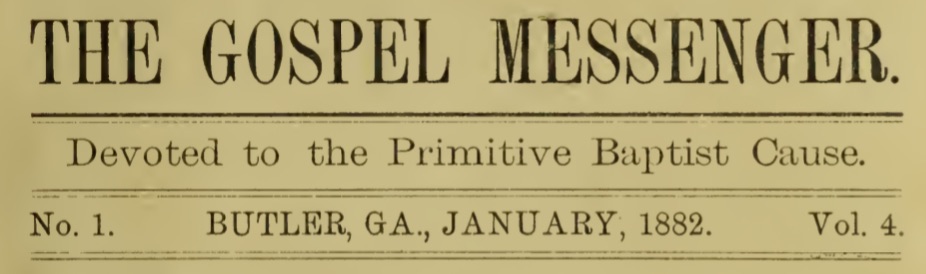
The above picture is of the periodical in which Elder Sylvester Hassell did most of his writing. It is from this periodical that I have been citing and will continue to do so. The previous two chapters in this short series have been an introduction for further analysis of Elder Hassell and his polemical writings on the "means question."
The Primitive Baptist Library's web site has a page titled
"Divisions in Ohio, Indiana, Missouri, Kentucky, and Virginia, over the Means Doctrine, 1882-1892" (See
here). This shows that up until the time period mentioned there existed within the
"Primitive" or
"Old School" Baptists some who believed that the Bible taught that God used the means of his word and gospel in saving sinners from sin and death and some who denied that God used such means, nor any other
"human means." Those on the
"anti-means" side accused those of the means side of introducing the means doctrine into the sect in that time period. On the other hand, those of the means side argued that it was the
"no means" side which were the innovators, arguing that the means view was the historic view of their forefathers.
I am one of the most knowledgeable person alive today who has studied the history of the "Primitive Baptist" sect far more than others, having once been one of their ministers for several years, and my father being a leading minister with them for well over fifty years. I can tell you that my many years of studying the history of this sect led me to see that those of the anti-means side were the ones who pushed their views on everybody else, declaring non-fellowship for all their brethren who believed in means. This blog is filled with citations from the first leaders of the "Primitive Baptist" sect, from the 1830s and 1840s, that showed they believed in means.
I have many posts under the title
"What the First Hardshells Believed" wherein I cite from such leaders and show this to be true. (See this post
HERE which is one such post and also gives links to others in that series) For instance, I cited from Elder James Osbourn who historians acknowledge was one of the ringleaders of the newly formed sect of
"Primitive" or
"Old School" Baptists. You can read about him in this post (
here). One example is seen in this citation:
"But if so be that the specific object which the Deity had in-view, and designed to accomplish by means of, or in a way compatible with the gospel which he ordained and promulgated, was the eternal salvation of the bride, the Lamb's wife, Rev. 21; 9; we then of course may safely conclude, that that specific object must and will be accomplished, just in that way and manner as infinite wisdom may have dictated. And lo, this is what we do believe and rejoice in; and in the gospel we also believe, every necessary arrangement and provision is made and permanently settled for the effecting the salvation of that church which was the object of God's everlasting love and delight, and which he gave to his Son before time began...That God ordained the GOSPEL, and promulgated the same, with a settled purpose to save sinners thereby..."
Elder Osbourn was a close ministerial friend of elder C.B. Hassell, the father of Sylvester, and even died in C.B. Hassell's home in 1850. I have shown also that C.B. Hassell believed in means. In this post (
here) I cited these words of the senior Hassell, taken from the first periodical called
"The Primitive Baptist":
"On the contrary we believe, the gospel is God's system of salvation for ruined man, and that He saves them by grace of His and not by works of theirs. Kehukeeites believe, that the Saviour took the law place and stead of his people, and for them and in their behalf fulfilled it to a punctilio...This they are made to believe by the teaching of the Holy Spirit, and this belief is counted to them for righteousness without the deeds of the law. They are then no longer under the law but under grace--no longer dead in trespasses and sins but alive to holiness,-- having their fruit unto the same and the end thereof everlasting life. This belief in Christ, caused by the teaching of the Holy Spirit, is their creation anew in Christ Jesus unto good works, which God hath before ordained that they should walk in; and henceforward they abound in good works to God, begotten by the active principle of grace within them, not from a principle of slavish fear, by which they expect to escape eternal punishment." (March 8, 1845 issue of "The Primitive Baptist"; See here)
Certainly Elder John M. Watson of middle Tennessee was a recognized leader of the new sect when it separated from the larger Baptist community and he believed in means. This is evident if one reads his book "The Old Baptist Test." I have numerous posts where I cited from this work and showed that Watson believed in means. Here are some citations from him in that work:
"Means admit of a similar exposition. The Lord has gone out before us also in them. He not only gave us His Gospel, but ordained means by which it would become savingly efficacious to all His chosen. Isa. 55: 11...So we may say of Gospel means, without the power of God they never prevail over the hearts of sinners; but means in His power, whether great or small, in our estimation, are always efficacious. He derives no strength or advantage from them as adjuncts to His work. He employs them because it is His will to do so. Eph. 1: 11." (page 357)
"Paul, however, does not affirm, like some of our modern innovators, that means or instrumentalities are not employed by the Lord in the divine plan of salvation; for he asks: "How shall they hear without a preacher?" Rom. 10: 14." (pages 399-400)
"The Antinomian will not regard any thing in the light of means, and in his doctrine will not allow even the Lord to employ them, says that the Lord is not dependent on means, and can do all His work without them. Now, the truth is, had it been the will or the way of the Lord, He could have breathed upon the dry bones as well without the prophesying of the prophet as with it, and could have given repentance to John's converts, or to Paul's, without their preaching; but their preaching to such, even to those dead in trespasses and sins, had been included in the divine plan, and it needs must be done, let it be termed means, the will or way of the Lord, as you please." (pages 327-28)
I could multiply such citations from the first generation leaders of the new sect who called themselves "Primitive Baptists." Surely Elder Hassell knew what Osbourn believed, knew what Watson believed, knew what his father believed, knew what the 1689 confession taught and what the signatories to it believed. It is therefore bewildering that in his "Questions and Answers" (that was published by his disciple, Elder R.H. Pittman, in 1935), that Hassell would say the following in answer to a question on the means debate (emphasis mine).
(You can find this publication by Pittman
here; A lot of the answers to questions by Hassell were taken from his paper
"The Gospel Messenger")
"Q. Have Baptists always denied the use of means in regeneration?
A. In careless expressions some Baptists have advanced this error, but the same men, when taking into consideration the entire teaching of the Scriptures on this point, have, in their more exact expressions, repudiated it."
I am stunned that Elder Hassell answered this question as he did. Surely he knew that nearly all Baptists prior to the rise of the Hardshells believed that the gospel or word of God was a means in saving sinners. It is true that some made a distinction between a restricted versus a broad definition of "regeneration," and some of them (especially among the founders of the "Primitive Baptist" sect) believed that regeneration was not the same as the new birth, that regeneration was the giving of spiritual life and often took place apart from the means of the word of God, but spiritual birth followed regeneration, often after a long period of time, and occurred when a sinner was brought to faith in Christ or was evangelically converted.
Why did Hassell not tell the truth in this question? Why did he not elaborate? Why did he not say that it was the almost universal belief of Baptists of prior centuries that the gospel was a "means" in saving sinners and giving them eternal life? Surely Hassell knew what the 1689 London Confession taught about the means of salvation. Surely he was familiar with Keach's catechism which was attached to the confession shortly after it was published. In that catechism we have these questions and answers:
Q. 34. How does the Spirit apply to us the redemption purchased by Christ?
A. The Spirit applies to us the redemption purchased by Christ, by working faith in us, and thereby uniting us to Christ in our effectual calling.
(Eph. 2:8; 3:17)
Q. 92. What does God require of us, that we may escape His wrath and curse, due to us for sin?
A. To escape the wrath and curse of God due to us for sin, God requires of us faith in Jesus Christ, repentance unto life, with the diligent use of all the outward and ordinary means whereby Christ communicates to us the benefits of redemption.
Q. 93. What is faith in Jesus Christ?
A. Faith in Jesus Christ is a saving grace, whereby we receive and rest upon Him alone for salvation, as He is offered to us in the Gospel.
(Heb. 10:39; John 1:12; Phil. 3-9; Gal. 2:15,16)
Q. 96. How is the Word made effectual to salvation?
A. The Spirit of God makes the reading, but especially the preaching of the Word an effectual means of convincing and converting sinners, and of building them up in holiness and comfort, through faith unto salvation.
(Ps. 119:11,18; 1 Thess. 1:6; 1 Peter 2:1,2; Rom. 1:16; Ps. 19:7)
Q. 97. How is the Word to be read and heard that it may become effectual to salvation?
A. That the Word may become effectual to salvation we must attend thereunto with diligence, preparation and prayer, receive it in faith and love, lay it up in our hearts and practice it in our lives.
(Prov. 8:34; 1 Peter 2:1,2; 1 Tim. 4:13; Heb. 2:1,3; Heb. 4:2; 2 Thess. 2:10; Ps. 119:11; James 1:21,25)
These sentiments are not simply what "some Baptists" believed. They are also not "careless expressions" but "exact expressions," therefore Hassell's statement is out of place and shows that he is attempting to create a false narrative for the benefit of the Hardshell cult. But, let us notice some more of these "careless expressions" where Baptists have taught the means view.
The Baptist catechism of the Charleston association, which was organized in 1751 (second oldest in America), and put forth in 1813, says the same things about salvation as did Keach's catechism.This association preceded the formation of the Kehukee Association by many years. Notice these questions and answers:
Q. How may we know there is a God?
A. The light of nature in man and the works of God plainly declare there is a God (Rom. 1:19,20; Ps. 19:1, 2, 3; Acts 17:24); but his word and Spirit only do it fully and effectually for the salvation of sinners (1 Cor. 2:10; 2 Tim. 3:15,16).
Q. How are we made partakers of the redemption purchased by Christ?
A. We are made partakers of the redemption purchased by Christ, by the effectual application of it to us (John 1:11,12) by his Holy Spirit (Titus 3:5,6).
Q. How doth the spirit apply to us the redemption purchased by Christ?
A. The Spirit applieth to us the redemption purchased by Christ, by working faith in us (Eph. 1:13, 14; John 6:37, 39; Eph. 2:8), and thereby uniting us to Christ, in our effectual calling (Eph. 3:17; 1 Cor. 1:9).
Again, these also are not "careless expressions" but "exact expressions," affirming means.
John Gill in his section of "Regeneration" in his "Body of Divinity" wrote:
"Though after all it seems plain, that the ministry of the word is the vehicle in which the Spirit of God conveys himself and his grace into the hearts of men; which is done when the word comes not in word only, but in power, and in the Holy Ghost; and works effectually, and is the power of God unto salvation; then faith comes by hearing, and ministers are instruments by whom, at least, men are encouraged to believe: "received ye the Spirit", says the apostle, "by the works of the law, or by the hearing of faith": (Gal. 3:2), that is, by the preaching of the law, or by the preaching of the gospel? by the latter, no doubt."
On I Cor. 4: 15 Gill wrote:
"...which is to be understood of regeneration, a being born again, and from above; of being quickened when dead in trespasses and sins; of having Christ formed in the soul; of being made a partaker of the divine nature, and a new creature..."
"...he preached Christ unto them, and salvation by him, and the necessity of faith in him; he directed them to him to believe in him, and was the means of bringing of them to the faith of Christ; and it was the power and grace of Christ accompanying his ministry, which made it an effectual means of their regeneration and conversion..."
"...no regeneration, no quickening grace, no faith nor holiness come this way, but through the preaching of the Gospel; in and through which, as a vehicle, the Spirit of God conveys himself into the heart, as a spirit of regeneration and faith..."
On James 1: 18 Gill wrote:
"Of his own will begat he us...The apostle instances in one of those good and perfect gifts, regeneration...it is done at once; there are no degrees in it...is born again, at once...no one is more regenerated than another, or the same person more regenerated at one time than at another...it is called a being born from above, in Joh 3:3...who in it produces light, in darkness, and whose gifts of grace bestowed along with it...This act of begetting here ascribed to God, is what is elsewhere called a begetting again, that is, regeneration; it is an implantation of new principles of light and life, grace and holiness, in men; a quickening of them, when dead in trespasses and sins; a forming of Christ in their souls; and a making them partakers of the divine nature...Earthly parents cannot beget in this sense; nor ministers of the word, not causally, but only instrumentally, as they are instruments and means, which God makes use of..."
Again, these also are not "careless expressions" but "exact expressions," affirming means.
Hassell in his history says this about the 1689 London Confession's signatories:
"And they say in their Appendix: "If any of the servants of our Lord Jesus Christ shall, in the spirit of meekness, attempt to convince us of any mistake, either in judgment or practice, we shall diligently ponder his arguments, and account him our chiefest friend that shall be an instrument to convert us from any error that is in our ways; for we cannot wittingly do anything against the truth, but all things for the truth." (page 525)
Those who call themselves "Primitive Baptists" today and who deny means do not have this same attitude. They do not want anyone to show them their errors. I have the same attitude as these old Baptists, for I desire all who read the articles in this blog to come and show me where I am wrong. I have invited and challenged the Hardshells to come and reason together out of the scriptures. None want to do that. That is a characteristic of cults. They do not heed the wise words of the inspired king who wrote: "The first one to plead his cause seems right, Until his neighbor comes and examines him." (Prov. 18: 17 nkjv) The Hardshells do not want anyone to come and examine them.
I find it interesting that Sylvester Hassell never had a public debate, and yet in his day his fellow ministers were often engage in debates with those of the "Church of Christ," with "Missionary Baptists," with "Universalists," etc.


No comments:
Post a Comment