Tuesday, January 11, 2022

When The Hardshells Died

The Hardshells died when they quit making "soul winning" their main business. What does the bible say of the soul winner?

"And they that be wise shall shine as the brightness of the firmament; and they that turn many to righteousness as the stars for ever and ever." (Dan. 12: 3)

The soul winner will be rewarded for turning many to righteousness. Spurgeon was such an one indeed. How many Hardshells will shine as the stars forever for their soul winning? How do I measure up?

"The fruit of the righteous is a tree of life, And he who is wise wins souls." (Prov. 11: 30)

In the passage in Daniel, as well as in Proverbs, wisdom is needed to be a good soul winner. If we do not win souls, how can we claim to be wise?

Said the apostle Paul:

"For though I am free from all men, I have made myself a slave to all, so that I may win more." (I Cor. 9: 19)

Soul winning was important to the apostle Paul. It ought to be important to us. If it is not, something is truly amiss. 

Said James:

"He who turns a sinner from the error of his way will save his soul from death and will cover a multitude of sins." (James 5: 20)

How many sinners have we turned from the error of their ways? How many have we saved from death? 

Jude admonished believers to "save others, snatching them out of the fire" (Jude 1: 23). Can we be like firemen who save those in danger of being consumed by fire? Can we tell sinners that they are in a house that is on fire? Can we say this with some urgency? 

The Hardshells are happy to tell you that they don't believe the commission to go into all the world and preach the gospel to every creature applies to them, because 1) it has been fulfilled, or 2) it is the duty of the ordained ministers and I am not a minister. Well, what can I say? Let me ask them this - "will you be willing to go across the street to your neighbor to preach to him the gospel?" 

Do you feel any duty to "go" in any sense? A dead church is one that has lost all sense of need to go and tell sinners the gospel with the intent of saving them. This has happened to those who call themselves "Primitive Baptists" with few exceptions. Thankfully there are exceptions as in the Eastern Association of Primitive Baptists. In this sense we may say that such Hardshell churches "have a name that they live, but are dead." (Rev. 3: 1)

Monday, January 10, 2022

Does Rebirth Begin or End with Faith?

The bible teaches, and many Calvinists and Arminians agree, that rebirth begins with faith. Some Calvinists, but no Arminian, teach that the new birth either always, usually, sometimes, ends in faith, that is, the new birth produces faith. Some Calvinists put a gap in time between being reborn and being converted, or coming to faith and repentance. Some, like the Hardshells of today, say that most of those who are born again will never come to faith, denying that the new birth ends in faith. These Hyper Calvinists believe that faith has no part in it. This is a slippery slope theologically as the history of Hyper Calvinism and Hardshellism demonstrates. The fruits of that theory are evident. The forefathers of the Hardshells did not teach that regeneration could be separated from faith in Christ.

What think ye?

Give Me Just a Little More Time

The above is the title of a song I first heard just after I was converted. Though I had embraced Calvinism and Hardshellism shortly after conversion, nevertheless I could still sing this song. Back then I used to think about the idea of a believer wanting more time to stay (before death) in order to save sinners by preaching the word. Well, I do not know how much time I have left, but I have prayed "Lord, give me just a little more time." I always think I have good reasons. Lord, I have more teaching to do, more articles to write, etc. I also say "Lord, my wife needs me to care for her, so give me just a little more time." But, my highest reason for such a request should be to preach the holy word so that sinners might be saved. So many old Christians act like unbelievers in wanting to live a little longer so they can fulfill their "bucket list." I am not condemning that, but we should put preaching to our friends and love ones about their need of salvation top on the list.

Anyway, the song lyrics are given below. It is sung (here) acapella by a colored congregation. I just love the enthusiasm and spirit in which they sing it.

Give Me Just a Little More Time

I'm busy every day as I travel on my way
To the city far beyond the sky
And there is not a doubt that time is running out
And the harvest time is drawing nigh

Gonna need a little time to gather in the grain
Before I leave this world behind
I'm ready any time when you call me, Lord
But give me just a little more time

Give me just a little more time,
Give me just a little more time
So many precious souls are lost in sin
So many may be left behind

I've got a lot of things I need to do
Before I leave this earthly clime
I'm ready any time when you call me, Lord
But give me just a little more time

I need a little time to labor for my Lord
Before the final judgment day
I need a little time to preach the holy word
To the sinner man along life's way

Every moment that I have to tarry here below
I will try to make my lamp to shine
I'm ready when you call me, Lord,
But give me just a little more time

Give me just a little more time, Lord
Give me just a little more time
So many precious souls are lost in sin
So many may be left behind

I've got a lot of things I need to do
Before I leave this earthly clime
I'm ready any time when you call me, Lord 

But give me just a little more time.

Another rendition of the song can be heard (here).

The first group I heard sing it was the Chestnut Grove Quartet (here).

How do you want to spend the rest of your time on earth? Hezekiah asked for more time and God gave it to him. What did he do with his extra time?

For another good acapella song about the old Christian's hope and prayer listen to "Sail Away Home" (here).

Spurgeon on Ordo Salutis

In talking about being "LEGALLY, SPIRITUALLY, ETERNALLY DEAD," Charles H. Spurgeon in his sermon "Free Will a Slave" (here) gave his text and made these comments.

"And ye will not come to me, that ye might have life." (John 5:40)

"And now, every man, so far as spiritual things are concerned, is “dead in trespasses and sins” spiritually (Eph 2:1). Nor is the soul less dead in a carnal man than the body is when committed to the grave. It is actually and positively dead—not by a metaphor, for Paul speaketh not in metaphor when he affirms, “You hath he quickened who were dead in trespasses and sins” (Eph 2:1)."

Every Calvinist and many classical Arminians would agree with this. Where the disagreement comes is in the deductions that are made upon the fact of a sinner's spiritual death. 

Spurgeon said:

"Thou wouldst not choose to live with a corpse sitting at thy table; nor doth God love that thou shouldest be in His sight. He is angry with thee every day, for thou art in sin—thou art in death. Oh! Believe this, take it to thy soul, appropriate it; for it is most true that thou art dead, spiritually as well as legally."

These remarks show that Spurgeon did not make erroneous deductions upon the doctrine of total depravity as do many Calvinists, especially of the Hyper Calvinists. Had he done so he would not have been trying to persuade the spiritually dead nor admonish them to believe in order to live.

Spurgeon said:

"The first means whereby we get life is by feeding upon the flesh and blood of the Son of God: living in Him, trusting on Him, believing in His grace and power."

This might not be logical with the carnal or soulish mind, but it is the plain teachings of Christ. He taught that one who was dead came to life by partaking of his flesh and blood (in heart and mind by faith) and by drinking the water of life, the water that brings life to the dead. He clearly teaches that spiritual life is by faith, by becoming joined with Christ.

Spurgeon said:

"Then, secondly, there is spiritual life in Christ Jesus. As the man is spiritually dead, God has spiritual life for him: for there is not a lack that is not supplied by Jesus; there is not an emptiness in the heart that Christ cannot fill. There is not a desolation that He cannot people; There is not a desert that He cannot make to blossom as the rose. O ye dead sinners, spiritually dead, there is life in Christ Jesus; for we have seen—yes, these eyes have seen—the dead live again! We have known the man whose soul was utterly corrupt, by the power of God seek after righteousness. We have known the man whose views were carnal, whose lusts were mighty, whose passions were strong, suddenly, by irresistible might from heaven, consecrate himself to Christ, and become a child of Jesus."
 
Spurgeon, like Christ and the apostles, had no problem speaking about spiritual truth to those who were spiritually dead. He knew that God could use the word he preached to raise the dead just as he did through the preaching of Ezekiel to the dry dead bones.

Spurgeon said:

"We know that there is life in Christ Jesus of a spiritual order; yea, more, we ourselves, in our own persons, have felt that there is spiritual life. Well can we remember when we sat in the house of prayer, as dead as the very seat on which we sat. We had listened for a long, long while to the sound of the gospel, but no effect followed, when suddenly, as if our ears had been opened by the fingers of some mighty angel, a sound entered into our heart. We thought we heard Jesus saying, “He that hath ears to hear, let him hear” (Matt. 11:15). An irresistible hand put itself on our heart and crushed a prayer out of it. We never had a prayer before like that. We cried, “O God, have mercy upon me a sinner.” Some of us for months felt a hand pressing us as if we had been grasped in a vice, and our souls bled drops of anguish. That misery was a sign of coming life." 

Spurgeon believed that his "coming to life" occurred when he was converted while in the Methodist chapel. He did not divorce regeneration from conversion. When faith was born in him, he was reborn. Notice also how he intimates how things occur in the heart of the believing sinner before his regeneration. 

Spurgeon said:

"When persons are being drowned, they do not feel the pain so much as while they are being restored. Oh, we recollect those pains, those groans, the living strife that our soul had when it came to Christ. Ah, we can recollect the giving of our spiritual life as easily as could a man his restoration from the grave. We can suppose Lazarus to have remembered his resurrection, though not all the circumstances of it. So we, although we have forgotten a great deal, do recollect our giving ourselves to Christ." 

I too can remember my coming to life. I will never forget that day when salvation was no longer sought, but found. When I rose from my knees, when I had committed my life to Christ, and heard him speak covenant words to me, I immediately "went forward" before all and confessed my new found peace and my next earnest desire was to be baptized. Though many may be born again who cannot recall the precise moment when they experienced it, yet many can. If we see our conversion, our faith and repentance, as the signs of our coming to life, then we ought to know when we first believed and turned to the Lord. I do no doubt my salvation because I do not doubt that I truly do believe, and do not doubt God's word.

Spurgeon said:

"We can say to every sinner, however dead, there is life in Christ Jesus, though you may be rotten and corrupt in your grave. He Who hath raised Lazarus hath raised us; and He can say, even to you, “Lazarus, come forth” (Joh 11:43)."

Well, that is the kind of preaching God has commanded of us. Go like Ezekiel and preach to the dead.

Sunday, January 9, 2022

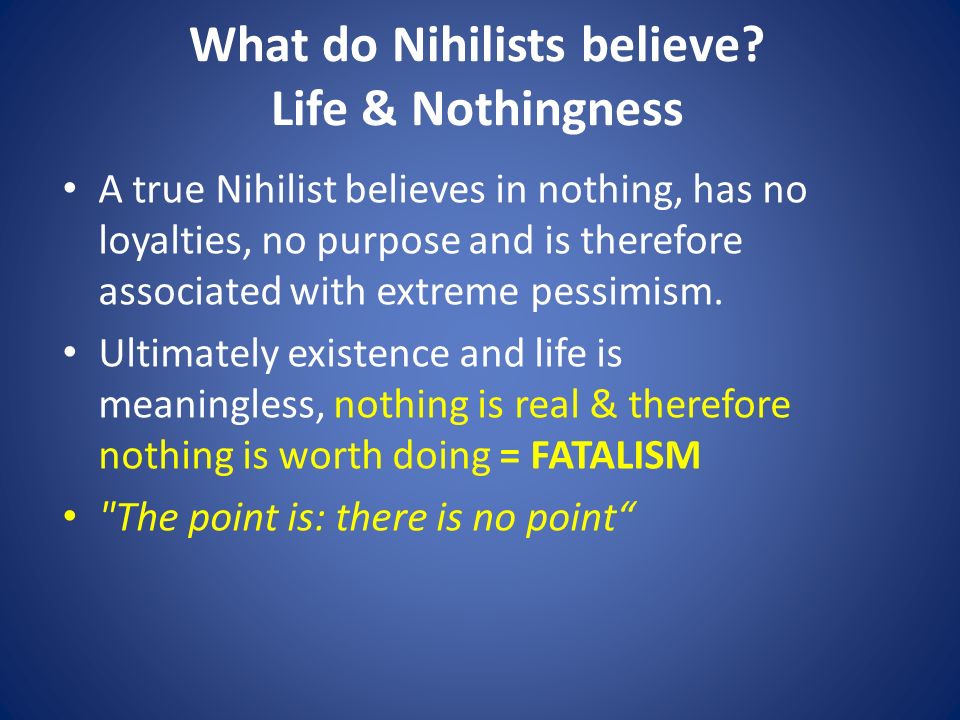
Nihilism & Its Effects (III)


Britannica Encyclopedia says of nihilism: 

"nihilism, (from Latin nihil, “nothing”), originally a philosophy of moral and epistemological skepticism that arose in 19th-century Russia during the early years of the reign of Tsar Alexander II. The term was famously used by Friedrich Nietzsche to describe the disintegration of traditional morality in Western society. In the 20th century, nihilism encompassed a variety of philosophical and aesthetic stances that, in one sense or another, denied the existence of genuine moral truths or values, rejected the possibility of knowledge or communication, and asserted the ultimate meaninglessness or purposelessness of life or of the universe."

The apostle Paul warned of the "doctrines of demons" (I Tim. 4: 1), and surely the philosophy of nihilism is such. It is just what Satan wants men to believe. This might seem to contradict the fact that he wants people to believe that he is god. If they believe in him then they do not believe in nothing. But, perhaps he knows that being a nihilist is a good trap for him to capture souls. This is his business, as we know from scripture. Wrote the apostle Paul:

"And a servant of the Lord must not quarrel but be gentle to all, able to teach, patient, in humility correcting those who are in opposition, if God perhaps will grant them repentance, so that they may know the truth, and that they may come to their senses and escape the snare of the devil, having been taken captive by him to do his will." (II Tim. 2: 24-26 nkjv)

The philosophy of nihilism is a snare or trap of Satan and by it he enslaves them "to do his will." Oh how so few escape his traps and snares! How large a portion of the world's population "do his will" rather than the will of God. No wonder Paul called Satan "the god of this age." (II Cor. 4: 4) Believers pray that the will of God might be done on earth as it is in heaven (Matt. 6: 10) for they see that his will (his expressed code of conduct) is not done on earth as it is in heaven. There is no violation of the will of God in heaven and there is no doing the will of Satan there. But, this is not so with "this present evil age" (Gal. 1: 4). In this present evil world it is the will of Satan that is mostly done. Our Lord called Satan "the ruler of this age" (14: 30). 

Nihilism is one avenue for Satan to "have opportunity" (Eph. 4: 27) to deceive, to entrap, to destroy. The apostle Peter says this of the work of Satan:

"Be sober-minded; be watchful. "Your adversary the devil prowls around like a roaring lion, seeking someone to devour." (I Peter 5: 8)

Satan is on the prowl and he is highly successful in his work. His methods and wiles, his traps and snares, are effective. He has billions of captives today and each are, knowingly or unknowingly, doing his will. These prisoners of Satan are also his servants, his offspring. Said the apostle John:

"Whoever makes a practice of sinning is of the devil, for the devil has been sinning from the beginning. The reason the Son of God appeared was to destroy the works of the devil." (I John 3: 8)

So, even though Satan wants people to worship and follow him, and not strictly in nothing, yet he uses such nihilistic thinking to make believers of them. 

Satan also has no problem with people believing in their own divinity, so long as he remains the "god of gods." He is the "father of lies," said our Lord (John 8: 44), and every false idea about God and the meaning and purpose of life is from his inspiration. The only meaning in life, according to those who reject God and his purpose, is what each person is free to define and create for himself. There are no rules and each one is on his own. 

Solomon begins Ecclesiastes by saying "all is vanity," meaning "all is meaningless," all is nothingness. This is a fairly good description of nihilism. Thankfully, Solomon was no longer speaking from a mere human and demonic perspective at the end of Ecclesiastes for he said "let us hear the conclusion of the whole matter: fear God and keep his commandments: for this is the whole duty of man." (12: 13) Solomon spoke of the fruit of thinking "all is without meaning." He lived by that philosophy in his middle life and describes it in Ecclesiastes. Though there was pleasure in life, pleasures for the eyes, ears, and bodily cravings, etc., there was the consequential despair in knowing that death makes paupers of all. 

The Britannica also wrote in the same article:

"Mikhail Nikiforovich Katkov, a well-known conservative journalist who interpreted nihilism as synonymous with revolution, presented it as a social menace because of its negation of all moral principles.

It was Ivan Turgenev, in his celebrated novel Fathers and Sons (1862), who popularized the term through the figure of Bazarov the nihilist. Eventually, the nihilists of the 1860s and ’70s came to be regarded as disheveled, untidy, unruly, ragged men who rebelled against tradition and social order. The philosophy of nihilism then began to be associated erroneously with the regicide of Alexander II (1881) and the political terror that was employed by those active at the time in clandestine organizations opposed to absolutism.

Nihilism represented a crude form of positivism and materialism, a revolt against the established social order; it negated all authority exercised by the state, by the church, or by the family. It based its belief on nothing but scientific truth; science would be the solution of all social problems. All evils, nihilists believed, derived from a single source—ignorance—which science alone would overcome."

This philosophy is destroying civilization today as it has in the past. It is bringing the world into chaos once again, yet on a grander scale than both world wars. The spread of the gospel and word of God has often hindered the proliferation of nihilistic thinking, yet today that hindrance is no longer as effective in keeping back such thinking and we are seeing the evil effects of it.

Though the nihilist claims to be guided only by "scientific truth," it interprets that science in ways to promote destruction and evil ends. The Nazis thought they were following scientific truth when they were slaughtering those ethnic groups that they thought were inferior and worthy of death. Dictators do many things in the name of science, but it is a fake science, a "science falsely so called." (I Tim. 6: 20) Today's "science" is telling us that there are no distinctions between male and female, that sexual identity is a result of choice, not of nature. 

It is ironic that nihilists would promote education and science and decry ignorance in view of their theory of meaninglessness. If life is meaningless, what is the purpose of education? Is this not what many young people believe? And, as a result, are they not leaving high school without being able to read or read well? Further, who can condemn them? If they want to be uneducated, so what? Are they not free to create their world and give it the meaning they want? 

Further, there is a distinction between knowledge of the physical sciences and of the social sciences. In regard to the latter, there is much put out as scientific fact which is but unproven theory.

The article also says:

"Since nihilists denied the duality of human beings as a combination of body and soul, of spiritual and material substance, they came into violent conflict with ecclesiastical authorities. Since nihilists questioned the doctrine of the divine right of kings, they came into similar conflict with secular authorities. Since they scorned all social bonds and family authority, the conflict between parents and children became equally immanent, and it is this theme that is best reflected in Turgenev’s novel."

They are therefore "materialists." Man is but a material being with no soul or spirit. His "mind" is nothing more than his brain. His thoughts are but chemical reactions. This leads to fatalistic thought. Man is only physical and not in any sense metaphysical or spiritual. 

On "existential nihilism" we have this by the same source:

"Existential nihilism is the philosophical theory that life has no intrinsic meaning or value. With respect to the universe, existential nihilism suggests that a single human or even the entire human species is insignificant, without purpose and unlikely to change in the totality of existence. According to the theory, each individual is an isolated being born into the universe, barred from knowing 'why'. The inherent meaninglessness of life is largely explored in the philosophical school of existentialism, where one can potentially create their own subjective 'meaning' or 'purpose'. Of all types of nihilism, existential nihilism has received the most literary and philosophical attention."

Involved in the lie of the serpent to Eve, was his tempting her with the thought that she could become a divinity, a creator, herself, and that God (Elohim) knew this, and because of his not wanting her to become such, not wanting her best condition, forbade her to eat of the tree of the knowledge of good and evil. After thus enticing her, and producing distrust of her Creator in her, he then said "you will not surely die" but rather "become as Elohim." It was not really logical for it basically said - "become like Elohim by disobeying him." 

Said another scholar (here):

"Outside Russian revolutionary circles, nihilism has been a term whose alleged exponents rarely embrace it, particularly because it is seldom used favorably. Some scholars have attempted to classify it into several subtypes. Donald A. Crosby, in The Specter of the Absurd, sees five types of nihilism: political (essentially the Russian revolutionary sort), moral (in which all moral judgments are rejected as individual or arbitrary), epistemological (in which all truth claims are seen as purely relative), cosmic (in which the cosmos is seen as meaningless), and existential (in which human existence is seen as pointless). Karen L. Carr, in The Banalization of Nihilism, proposes a similar taxonomy. In her view, there are five types of nihilism: epistemological ("the denial of the possibility of knowledge"), alethiological ("the denial of the reality of truth"), metaphysical ("the denial of an independently existing world"), ethical ("the denial of the reality of moral or ethical values"), and existential or axiological ("the feeling of emptiness and pointlessness that follows from the judgment, 'Life has no meaning'")."

The same encyclopedia author says:

"With categories as broad as these, nihilism can be applied to a host of phenomena associated generally with a loss of values or centeredness. One might even say that nihilism as a label became so popular in the second half of the twentieth century that it was often left unspoken. A famous issue of Time magazine in 1966 posed the question "Is God Dead?" in stark red letters against a black background on its cover. In the article, whose immediate inspiration was the rise of the "death-of-God theology" practiced by a particular group of American theologians, John T. Elson reflected on his age as "a time of no religion," cited Søren Kierkegaard (1813–1855) and Nietzsche as prophets of modern godlessness, and offered this comment on modern art: "From the scrofulous hobos of Samuel Beckett to Antonioni's tired-blooded aristocrats, the anti-heroes of modern art endlessly suggest that waiting for God is futile, since life is without meaning."

The nihilists today in the USA are creating "anti heroes." They pull down statues of real heroes and make heroes of criminals, rioters, looters, and destroyers of property. Nietzsche is a hero, yea, even Lucifer himself. The Sodomites also are openly supported and eulogized. It is what the new testament writers referred to as "the spirit of antichrist." (I John 4: 1-6)

The author says further:

"Although nihilism and its accompanying existential despair are hardly anything but a pose for Americans, as the language derived from nihilism has become a part of their educations and insinuated itself into their daily lives, they pursue happiness in ways determined by that language. There is a whole arsenal of terms for talking about nothing—caring, self-fulfillment, expanding consciousness, and so on, almost indefinitely."

Oh how true this is today in America and the world. Again, it is fulfilling prophecy and bringing on the day of wrath, judgment, and tribulation. Warned the Spirit of God: "The wicked shall be turned into hell, and all the nations that forget God." (Psa. 9: 17) Hell on earth is coming and it is in large part due to saying "God is dead" and living a life without meaning and purpose, without a will to do what their Creator created them to do.

The author says further:

"Many, however, have not hesitated to name the illness. In 1987, for example, Allan Bloom (1930–1992) published his assault on American higher education, The Closing of the American Mind. He titled Part 2 of that book "Nihilism, American Style," taking aim at a pathological condition he saw in America both inside and outside the academy: "value relativism." The ultimate culprit is none other than Nietzsche. As Bloom saw it, Nietzsche's target was not only God but modern democracy. Displaying Nietzsche's own fondness for unsubstantiated, sweeping claims, Bloom declares, "Nobody really believes in anything anymore, and everyone spends his life in frenzied work and frenzied play so as not to face the fact, not to look into the abyss."

This is so true, except that I would say that "the ultimate culprit" is none other than Satan. Nietzche was but a parrot and puppet of the Devil. The nihilists today, whether they realize it or not, have become Faustian. 

"Faust is the protagonist of a classic German legend, based on the historical Johann Georg Faust (c. 1480–1540). The erudite Faust is highly successful yet dissatisfied with his life, which leads him to make a pact with the Devil at a crossroads, exchanging his soul for unlimited knowledge and worldly pleasures. The Faust legend has been the basis for many literary, artistic, cinematic, and musical works that have reinterpreted it through the ages. "Faust" and the adjective "Faustian" imply sacrificing spiritual values for power, knowledge, or material gain." (See here)

This is what today's young people are doing. They are selling their souls to the devil for earthly pleasure. They are turning away (the great falling away?) from God and religion and the evil consequences of this are seen proliferating in our time. Satan's business is to turn away people from "the way of truth," from God and Christ. He is having a "hey day." 

Friday, January 7, 2022

Nihilism & Its Effects (II)


"If in this life only we have hope in Christ, we are of all men most miserable." (I Cor. 15: 19)

If there is no life after death, no heaven or hell, then all men are indeed "miserable." This is especially true for Christians. This is because they do not live hedonistically, do not indulge in physical and sensual pleasures. But, if there is no future life, no coming judgment, then men are at liberty to do whatever pleases them, or whatever they can get away with, though such kind of living brings misery and consequential evils. 

The nihilist philosophy, like similar philosophies, such as existentialism, anarchism, etc., live and act on the principle that "God is dead," and that there is no afterlife, and no coming judgment after death. The meaning of life for such people is to "live in pleasure" (I Tim. 5: 6), to "eat, drink, and be merry" (Luke 12: 19), for they say "let us eat and drink, for tomorrow we die" (I Cor. 15: 32), acting on the belief that death is the end of all existence. To such people "nothing matters" except the present life. The point in life is to "enjoy" it as much as possible, taking no thought of what lies beyond the grave. 

It is sometimes called Epicureanism, being a form of hedonism, which declares that pleasure is the only good there is. It says that the absence of pain is the greatest pleasure; it also advocates a simple life. Or, it is also called Dionysian (or Bacchus in Roman culture, thus bacchanalia), mostly because of its love of drunken parties, orgies, and other "fun" things. These have always been an enticement to carnal people, and have been a cause for the apostasy of many professed followers of the Lord. Of these the apostles warned against. 

Paul wrote of "being drunk, having wild and wasteful parties, and doing other things like these." (Gal. 5: 21) 

Peter wrote:

"In the past you wasted too much time doing what nonbelievers enjoy. You were guilty of sexual sins, evil desires, drunkenness, wild and drunken parties, and hateful idol worship. Nonbelievers think it is strange that you do not do the many wild and wasteful things they do, so they insult you." (I Peter 4: 3-4) 

This is the kind of world that existed in Genesis chapter six and that brought on the flood that destroyed them all but the elect few. Said our Lord:

"They did eat, they drank, they married wives, they were given in marriage, until the day that Noe entered into the ark, and the flood came, and destroyed them all." (Luke 17: 27) 

They lived nihilistically. They lived as if there were no God, no judgment for sin. It was a life of sinful pleasure. So the record of Genesis says of that people:

"And God saw that the wickedness of man was great in the earth, and that every imagination of the thoughts of his heart was only evil continually." (Gen. 6: 5)

Said one writer (here) on nihilism (emphasis mine):

"Jacobi – the accuser - put his finger on the fundamental issue of nihilism. Most religions, many philosophies, and the common beliefs of many people suppose that the source of value is something beyond the individual, beyond humans, beyond the physical world, beyond the natural world. If not God, perhaps a transcendent realm of forms, as Plato thought. Nihilism as an accusation is a challenge: if you don’t believe in God, or something else transcendent and eternal, why does anything matter?

This has become the thinking of the masses of the population. Even in Christian nations, like the USA, people live as people who think that death is the end and that there is no God and no afterlife. If they do give any credence to the idea of God and the afterlife, they live in the belief that all, or nearly all, will be favorably received by God after death and enjoy "Nirvana." The same author also said:

"And by the time we come to Nietzsche, we have a philosopher embracing nihilism, in a way. He says, God is dead, everything is permitted, and hurray for that." 

What kind of life did Nietzsche live? How did he die? That he suffered from psychological illness and depression is well documented. He died of dementia that was brought on, many believe, by syphilis. 

Said another (here):

"The proliferation of nihilist memes and thoughts on social media today has meant that viewing reality as fundamentally meaningless has become more widespread than ever before, and has, to some extent, infiltrated day-to-day thinking amongst many of today’s youth."

"Camus would be proud of today’s younger generations, staring into the abyss and laughing."

Said another (See here)

"Nietzsche’s ‘superman,’ the perfection of humanity, would be a nihilist, not bound by inherited ideas, creating his or her own meaning, according to their will."

The philosophy of Nietzsche involved his description of the ideal human and the ideal society. It is anti biblical, anti God, and is in perfect agreement with the teachings of Satan. 

The same author also said: 

"Nietzsche recognized that developments in philosophy were going to encourage all of us towards nihilism—rationalism, materialism, skepticism, science, and the recognition of cultural relativity. Many philosophers saw this ‘problem’ and many agree that Nietzsche’s predictions were correct, that we have been living through the horrors that he foresaw resulting from nihilism. It would be easy to argue that much of the immorality and pointless violence we see in the world today is partially rooted in nihilism; but, we must then also note that a lot of violence is also caused by the opposite of nihilism—faith in traditional beliefs."

We are truly seeing the effects of nihilistic thinking. It fulfills prophesy.

The same author also stated:

"If 19th century philosophers saw nihilism as an approaching demon, 20th century philosophers saw it as a fact of life and searched for ways to cope with it." 

The 19th century philosophers were correct. But, it is true that now, in the 21st century, nihilistic thinking has become a "fact of life." Cope with it? Who can cope with the superabounding lawlessness of our day?

The same author also stated:

"Existentialism, the central philosophy of the 20th century, was certainly nihilistic. And depressingly so for many; existential nihilism focuses on the ultimate meaninglessness of existence. Existentialism taught that there is no objective meaning; but, existentialists also emphasized our freedom to create meaning. And this is where nihilism began to move in a better direction. The existentialists, although often depressed, promoted the idea that we can (in fact must) give life our own meaning."

In the next posting I will talk a little more about "existentialism," but it is clearly nihilistic. 

The same author also stated:

"Every version of nihilism (see section five) has been feared by people who felt that without a foundation in objective truth or faith, it is impossible to have morality, life-meaning, or knowledge. However, there are many philosophies, such as secular humanism, Buddhism, and post-modernism which claim that it is possible to develop new and better forms of morality, knowledge, and life-meaning, without reliance on faith, which may be seen as deceptive and limiting."

It is true that nihilistic thinking is without a solid foundation. Further, secular humanism, Buddhism, etc., also provide no reason for living the right kind of life.

The same author also said this about "existential nihilism."

"The philosophy that existence ultimately has no meaning, including no God, no afterlife, and no transcendental domain of any kind. Often thought of as a philosophy of despair."

Because of this, it is no wonder that cynicism, pessimism, hopelessness, misery, etc., reigns. 

In "The age of American nihilism" by T. KEITH GURNEE (here), we have these insightful words in regard to the effects of nihilistic thinking today in America and the world:

"In this election year of 2020, America is tearing itself apart. It’s more than the Trump versus Biden election. I’ve never seen this country as divided as it is today, and I went through the sixties! The coronavirus, the resultant lockdowns and their economic repercussions, the repugnant murder of George Floyd, and the social upheavals it spurred have rocked America to its core. With COVID-19 infections continuing, ours is a country in chaos."

The widespread lawlessness, and the evils that accompany it, such as violence and chaos, that we see today, are the result of the masses declaring that "God is dead" and living life in a selfish, animalistic, manner. 

Said the author further:

"Today’s heated political discourse seems dominated by “ists.” Whether it be “racist,” “sexist,” “ageist,” “extremist,” these pejorative words are indiscriminately hurled as epithets at anyone who doesn't agree with everything their snarling speakers stand for. For example, anyone who dares say “all lives matter” is immediately branded a racist. But there’s one word that best personifies the purveyors of today’s social unrest. It’s called nihilism."

Amen.

Said the author further:

"Webster’s defines nihilism as “a belief that conditions in a social order are so bad as to make destruction desirable” or “a revolutionary doctrine of destructiveness for its own sake.” The term was derived as a 19th century Russian political philosophy advocating the violent destruction of social and political institutions to make way for a new society."

This is the philosophy of the Nazis under Hitler. It was the philosophy of Stalin, Mao, and is the philosophy of dictators. They were revolutionaries who sought to destroy society in order to remake it. It intends to bring chaos in order to bring order. In all cases, however, the society created was far inferior to the one that was destroyed.

Said the author further:

"We are now living in an age of American nihilism, one that looks like it won’t be ending anytime soon. That prospect tells us that we should all be concerned about the very future of our democracy."

Once we lose our freedoms, such as freedom to practice our religion, we will be forced to believe and act contrary to our religion. When that happens it will be war upon the godly, and upon believers.

Wrote another (here):

"According to Nietzsche, this state of nihilism – the idea that life has no meaning or value – cannot be avoided; we must go through it, as frightening and lonely as that will be."

This philosophy was reflected in the Nazi mind.

The author also said:

"As he writes in Daybreak, God’s “death” removes the threat of divine punishment, leaving us free again both to experiment with different ways to live and to make mistakes along the way. He wants us to seize this opportunity with both hands."

God help us! This being the thinking of the ungodly masses, the judgment of the Almighty is imminent.

Thursday, January 6, 2022

Regeneration Before Faith Proof Texts (summation)

With this post I will summarize my thoughts on this series.

I presented twelve affirmative arguments to show that regeneration and spiritual life follow union with Christ by faith. I do not see how anyone can overthrow them. They also represent the views of the first Reformers, such as Luther and Calvin, and also of such great men as John Owen and the signers of the 1689 London Confession of faith. Because these affirmative arguments or proofs from holy scripture are so strong, it accounts for the fact that very few of the Hyper Calvinists want to take on the task of disproving them. 

After giving the affirmative case I then looked at the main scriptures and arguments used by the born again before faith advocates use to prove their view. I showed that none of them taught their proposition. 

I have shown how regeneration and conversion are viewed in scripture as denoting the same initial salvation experience and have affirmed that those later Calvinists and Reformers who divorced regeneration from conversion, gave to the term "regeneration" a strict narrow meaning (which is not biblical), and who then spoke of two kinds of regeneration, one narrowly defined and one broadly defined, and thus caused a theological slippery slope, leading to Hyper Calvinism and an apostasy from true Calvinism and of the Reformed doctrine of Protestants. The narrow kind of regeneration was divorced from faith and repentance, or from conversion, but the new testament clearly defines regeneration as conversion. It only knows of regeneration broadly defined.

I also in a series preceding this series showed how logically justification preceded sanctification, which latter included regeneration and all spiritual and moral transformation. I showed that both the Bible and the first Reformers emphasized that justification was by faith, by evangelical faith in Christ, and that following faith and justification, the sinner received spiritual life and a new nature. 

I also have shown that the first Reformers, in keeping with the teaching of scripture, taught that all spiritual blessings followed union with Christ and union was by faith.  But, the Hypers, in divorcing faith from regeneration, taught that union with Christ preceded faith, thus denying that union was by faith. On this the later Reformers, or Hyperists, would speak contradictorily, saying in one place that union is by faith, and then in another teach that regeneration (union) precedes faith.

If I put all these chapters in these series together into one book, and titled it "The Ordo Salutis Debate" and published it, how many would read it? Knowing the answer, I have simply put it out there in a blog for any to read who really want to know the answer to this hotly debated question. I invite any to show where I have erred in my writings on this subject. 

What think ye? 

Regeneration Before Faith Proof Texts (XIV)

Proof Text #7 - Eze. 36: 25-27 

24 For I will take you from among the nations, gather you out of all countries, and bring you into your own land. 25 Then I will sprinkle clean water on you, and you shall be clean; I will cleanse you from all your filthiness and from all your idols. 26 I will give you a new heart and put a new spirit within you; I will take the heart of stone out of your flesh and give you a heart of flesh. 27 I will put My Spirit within you and cause you to walk in My statutes, and you will keep My judgments and do them. 28 Then you shall dwell in the land that I gave to your fathers; you shall be My people, and I will be your God. 29 I will deliver you from all your uncleannesses. I will call for the grain and multiply it, and bring no famine upon you. 30 And I will multiply the fruit of your trees and the increase of your fields, so that you need never again bear the reproach of famine among the nations. 31 Then you will remember your evil ways and your deeds that were not good; and you will loathe yourselves in your own sight, for your iniquities and your abominations. 32 Not for your sake do I do this,” says the Lord God, “let it be known to you. Be ashamed and confounded for your own ways, O house of Israel!” (Eze. 36: 24-32 nkjv)

First, the context shows that this regeneration, this giving of a new heart and spirit, is specifically directed to members of the Israelite nation. It has reference to what God will do in the end for the remnant of the nation. That it is applicable to Gentiles even now is not doubted. In fact, it is applicable to all who believe in Christ and repent of their sins. That it is pictured as being wholly the work of God I do not doubt. God says "I will" and "you shall." It is an unconditional promise. The thing that we must determine is what role, if any, faith and repentance play in this promised salvation. Does the above description of salvation and regeneration exclude evangelical conversion? 

In the conversion of the apostle Paul on the road to Damascus we have an individual example of God doing what he had promised to do in the above passage. In that Damascus road encounter with the risen Lord the apostle Paul was brought to faith and repentance. This was his regeneration. It did not exclude his conversion. Paul also, in writing of this experience, said that it was a pattern to them who would, like him, believe to everlasting life. 

"However, for this reason I obtained mercy, that in me first Jesus Christ might show all longsuffering, as a pattern to those who are going to believe on Him for everlasting life." (I Tim. 4: 16)

On the Ezekiel passage Dr. Gill comments:

"Our countryman, Mr. Mede, thinks that the sense is, that the conversion of the Apostle Paul was a pattern of the conversion of the Jews in the latter day; and his thought seems to be a very good one: the apostle's conversion is a pledge and earnest of theirs, and showed that God had not cast away all that people; and carries in it some likeness and agreement with theirs: as his, theirs will be in the midst of all their blindness and unbelief; and when they have filled up the measure of their sins; and they will be a nation born at once, suddenly, and by the immediate power and grace of God, without the ministry of the word, which they will not hear: thus they will be converted as he was, and become as hearty lovers and friends of the Gentile churches."

When Gill says that Paul's conversion was "without the ministry of the word," he means as preached by human messengers of the gospel during the moment of his conversion. He certainly knew the gospel. He knew what the Christians said about Christ. He had heard Stephen's sermon. So, though it was without the word, i.e., apart from hearing it at the time of his conversion by a preacher, yet he heard it directly from the Lord. Paul left the Damascus road encounter a believer that Christ was the Messiah, the Son of God. Thus, his regeneration, his obtaining a new heart and spirit, occurred at the same time as his conversion, at the time when he was made a believer by sovereign grace and love. 

But, he agrees with Mede that it is talking about "the conversion of the Jews in the latter day." Notice how he calls it "conversion," by which he also includes regeneration. But, as stated, it also is true of Paul, yea, of every Christian, be he Jew or Gentile, when they are converted by faith. 

Another verse that shows that the conversion/regeneration of Paul was a picture of the final conversion of the Jews en mass is this one:

"Then last of all He was seen by me also, as by one born out of due time." (I Cor. 15: 8)

I believe that Paul is saying that he was seemingly born again prematurely, ahead of time (Greek τῷ ἐκτρώματι aborted). It does not mean that he was born of God late, as some translations suggest. Rather it is like an abortive delivery, denoting that it was before the expected time. On this text Dr. Gill wrote: "it seems best to understand him of an abortion, a miscarriage, or birth before its time." 

In respect to the time of his conversion, in comparison with the first apostles, his conversion and apostolic ordination, he was born later than they. But, in respect to the Jews at the end of the age, just prior to the coming of the Lord, he was born before them. His words "last of all" may give credence to the view that his conversion (birth) was past the "due date" of his expected birth. No doubt both ideas are true. As respects his birth as an apostle in comparison to Peter, James, John, etc., he was born late. As respects his birth in comparison with the end time Jews, he was born ahead of time. 

Commented Albert Barnes:

"As of one born out of due time - Margin, Or, "an abortive." Our translation, to most readers, probably, would not convey the real meaning of this place. The expression, "as of one born out of due time," would seem to imply that Paul meant to say that there was some unfitness "as to the time" when he saw the Lord Jesus; or that it was "too late" to have as clear and satisfactory a view of him as those had who saw him before his ascension. But this is by no means the idea in the passage. The word used here (ἔκτρωμα ektrōma) properly means an abortion, one born prematurely. It is found no where else in the New Testament..." 

That the end time conversion of the Jews is to happen miraculously as in the case of the apostle Paul is a view that seems to be the teaching of the scriptures, and many commentators recognize it. Still, the point to emphasize is that his being given a new heart and spirit was not separated from his believing in Christ. That the promise of a new heart and spirit involves conversion (faith and repentance) there can be no doubt. All of the descriptive terminology of the passage involves or implies faith. The salvation experience involves being cleansed and in the bible this occurs by faith in the word of God. It also involves receiving the Holy Spirit and this also occurs by faith. The new heart and spirit is the effect of receiving the Spirit by faith.

The giving of a new heart and the taking away of the heart of stone is not a physical work, but moral or spiritual. This is what many Calvinists fail to understand. A change of heart is not so much different from a change of mind, which is repentance. In fact Paul speaks of the "impenitent heart" (Rom. 2: 5). Surely the new heart is a penitent heart. Paul also speaks of the "evil heart of unbelief." (Hebrews 3: 12) The new heart is a repenting and believing heart. This is the heart God gives or produces in the work of conversion.

Now let us notice this passage dealing with the same saving experience:

“Therefore I will judge you, O house of Israel, every one according to his ways,” says the Lord GOD. “Repent, and turn from all your transgressions, so that iniquity will not be your ruin. “Cast away from you all the transgressions which you have committed, and get yourselves a new heart and a new spirit. For why should you die, O house of Israel? “For I have no pleasure in the death of one who dies,” says the Lord GOD. “Therefore turn and live!” (Eze. 18: 30-32 nkjv)

This passage shows that the Hyper Calvinistic interpretation on the passage from Ezekiel 36 is not correct. It shows that repentance and faith are the means for obtaining the new heart and spirit. Do the Hyper Calvinists believe in commanding dead sinners to "get yourselves a new heart and a new spirit"? And, just how do sinners obtain this new heart that is characterized by repentance and faith? It is through union with Christ and that is by faith. Now notice these words of the apostle:

"For you are the temple of the living God. As God has said: “I will dwell in them And walk among them. I will be their God, And they shall be My people.” Therefore “Come out from among them And be separate, says the Lord. Do not touch what is unclean, And I will receive you.” “I will be a Father to you, And you shall be My sons and daughters, Says the Lord Almighty.” (II Cor. 6: 16-18 kjv)

This text also finds God calling upon spiritually dead sinners, who have hearts of stone, to "come out," and to "separate," i.e., to disattach themselves from the world, and why? So that they might attach themselves to the Lord. Receive the Lord, attach yourself to him, so that God becomes a Father to you, and so that you become his child. Receive Christ and Christ will receive you. 

Yes, God does the cleansing. But, it is a cleansing that is sought by the morally filthy. Yes, their desire for cleansing is of the Lord, but it precedes the cleansing. Yes, God receives the sinner but it follows the sinner receiving Christ; And, again, such a will to receive Christ is the work of God in making him willing to do so. (See Psa. 110: 3; Phil. 2: 13) 

In conclusion we see how the experience described by Ezekiel was a description of evangelical conversion, which always results from faith and repentance, and is not a watered down description of "regeneration," a regeneration that excludes conversion.