Monday, May 9, 2022

A Dollar AND Fifty Cents


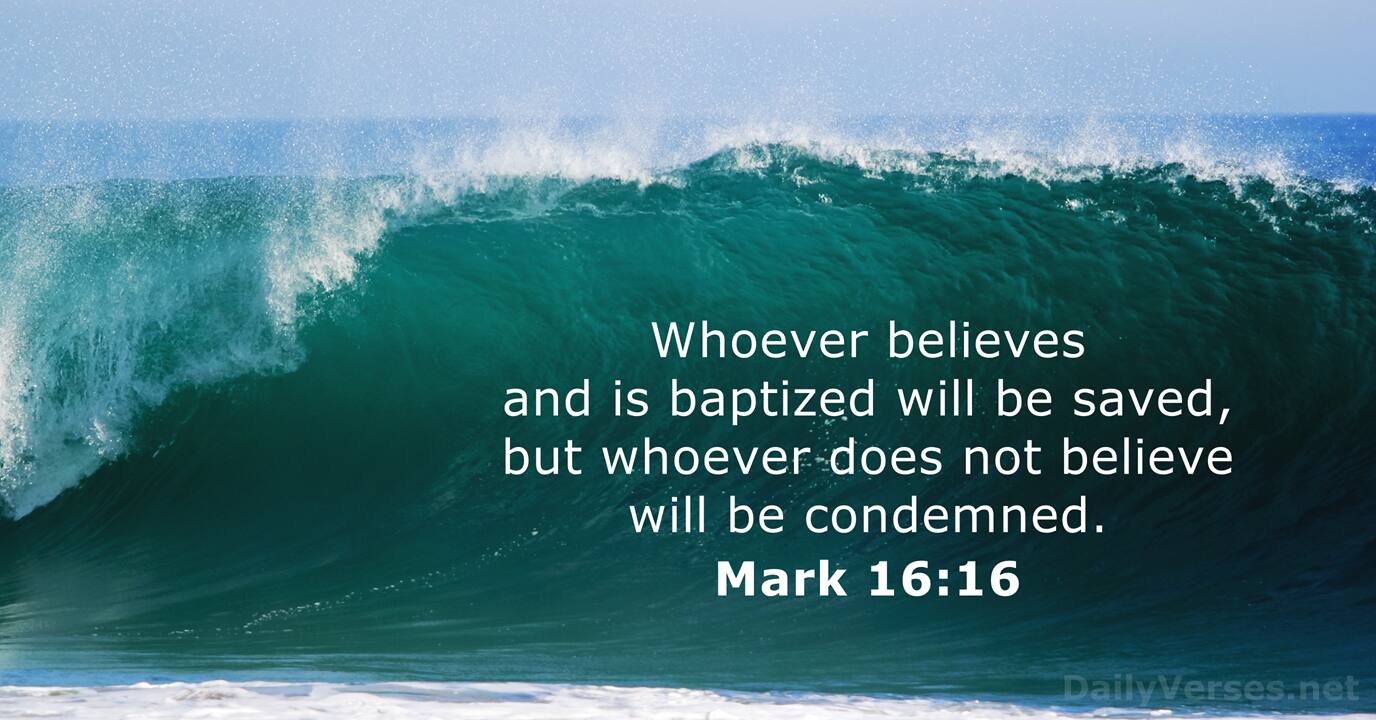
In a debate with an elder with the "Church of Christ" (aka "Campbellite"), my father told me of how the elder said "if I told you that this sack of potatoes requires one dollar AND fifty cents you will not get it with only a dollar. Therefore, when the text says you will be saved if you believe And are baptized, you will not get it with faith alone." 

In response, let me say these things. I do not believe that the latter verses of Mark 16 were originally written by Mark but added later. 

Second, in response to the example given above, let us suppose that the same person later told you that you could have the sack of potatoes for one dollar. Are there not many passages that say it is by faith alone? Why would I say one dollar sometimes and say one dollar and fifty cents another time?  

Addendum on Acts 2: 38


I have written on this question before. See "Exegeting Acts 2: 38" (here). 

I believe that in English we would best translate by using a parenthesis: 
 
"You all repent (and be baptized each one of you in the name of Jesus Christ) for the remission of your sins." 
 
This is exactly what Acts 3:19 teaches (only Peter there omits the parenthesis). Said Peter: “Repent ye therefore, and be converted, that your sins may be blotted out.” 

Says one author (Charles Baker - here):

"Notice that in this verse Peter says nothing about water baptism. If water baptism is essential for the forgiveness of sins, why does Peter say nothing of this in Acts 3:19? If water baptism is essential for forgiveness of sins, why does Peter say nothing of this in Acts 10:43 (“To him give all the prophets witness, that through his name whosoever believeth in him shall receive remission (forgiveness) of sins”)? If water baptism is an essential part of the preaching of salvation, then why does Luke 24:46-47 mention repentance and the remission (forgiveness) of sins but say nothing about water baptism?"

He then enumerates the strengths behind the parenthetical view of the words "and each of you be baptized," saying: "The strengths of this view are as follows: 
 
1) it is theologically sound and avoids the error of making water baptism a condition for forgiveness; 
 
2) it harmonizes with the other passages which speak about repentance and the forgiveness of sins; 
 
3) it understands the preposition eis in its most natural meaning (though other meanings are possible); 
 
4) it agrees with the parallel passage of Acts 3:19; 
 
5) it best suits the context of Acts 2:38 where Peter is offering forgiveness to Christ-rejecting Jews. Peter was not speaking "with reference to" or "because of" or "on the basis of" a forgiveness which they did not yet have! 
 
6) it employs a figure of speech (chiasmus) that was not uncommon or unusual to the Semitic mind, though in English it may seem somewhat awkward."

He then cites from another author, writing:
 
"Stanley D. Toussaint (The Book of Acts in The Bible Knowledge Commentary, p. 359) gives several reasons why the parenthetical view is the correct view: 
 
"Several factors support this interpretation: (a) The verb makes a distinction between singular and plural verbs and nouns. The verb "repent" is plural ["repent ye"] and so is the pronoun "your" in the clause, "so that your sins may be forgiven" (lit., "unto the remission of your sins," (eis aphesin ton hamartion humon). Therefore the verb "repent" must go with the purpose of forgiveness of sins. On the other hand the imperative "be baptized" is singular, setting it off from the rest of the sentence. (b) This concept fits with Peter's proclamation in Acts 10:43 in which the same expression "sins may be forgiven" (aphesis harmartion) occurs. There it is granted on the basis of faith alone. (c) In Luke 24:47 and Acts 5:31 the same writer, Luke, indicates that repentance results in remission of sins."

Here is an example:

All of you vote (and each one of you signify it by placing an "I voted" sticker on your vest) for your chosen candidate. 

Voting is essential but not placing the sticker.

Saturday, May 7, 2022

More On Dr. Piper's Wishy Washiness

I just read today's entry by Dr. Piper titled "Why Dead Men Must Die" (here). In the previous posting on Dr. Piper we showed how he came down firmly on the belief that faith follows rebirth. But, in this entry he says:

"So this union with Christ in his death happens through faith. When we believe in Christ, God counts his death to be our death."

That is the opposite of his view that faith follows rebirth. I wish Dr. Piper would be consistent on this.

Friday, May 6, 2022

The Prophet Job a Type of Christ


"And beginning at Moses and all the Prophets, He expounded to them in all the Scriptures the things concerning Himself."

"Then He said to them, “These are the words which I spoke to you while I was still with you, that all things must be fulfilled which were written in the Law of Moses and the Prophets and the Psalms concerning Me.”" (Luke 24: 27, 44)

"The Scriptures testify of me," said the Lord Jesus to those who knew the scriptures (old testament). (John 5: 39) This is one of the rules for judging the canonicity and inspiration of books written in the old testament time period. Is there testimony concerning Christ in the writing? In the above texts we see how all the books of scripture speak "concerning" Christ. Moses and "all the prophets" spoke of the coming Messiah. Job, being a prophet, therefore must have said something about Christ, or prefigured him in some way. Notice these words of the prophet Job:

"For I know that my Redeemer lives, And He shall stand at last on the earth; And after my skin is destroyed, this I know, That in my flesh I shall see God, Whom I shall see for myself, And my eyes shall behold, and not another. How my heart yearns within me!" (Job 19: 25-27)

Not only did "all the prophets" "testify" "concerning" Christ, the Messiah, Savior, and Redeemer by words heard from God or otherwise were inspired to write (i.e. the scriptures), but some of them were particularly chosen to be "figures" of Messiah in their work, status, and character. 

Adam (who was also a prophet) was a "figure of him who was to come" (Rom. 5: 14). Adam knew of "the coming one." He knew that a Redeemer had been promised from the word of God to the Serpent. One of the oldest names for this promised Redeemer was therefore both "the coming one" and "the desired one." He also knew that the promised Savior (from the guilt of transgression) would be of "the seed of the woman." He knew of the virgin birth and that the promised seed would be both human and divine. (Gen. 3: 15) This was written in the constellation of Virgo by Adam, Seth, Enoch, et al. 

So too was Moses a figure of Christ. In Deuteronomy 18:15 Moses said: “The LORD thy God will raise up unto thee a Prophet from the midst of thee, of thy brethren, like unto me; unto him ye shall hearken.” 

To those who knew the writings of Moses our Lord said: “For if you believed Moses, you would believe Me; for he wrote about Me." (John 5: 46)

We could also speak of such figures as Joseph and David whose lives and character prefigured the life and character of Christ. However, let us now consider how the prophet Job is a figure or type of Christ.

Though there are lots of similarities between Job and Christ (one writer sees 22; see footnote below). I will focus on the main similarities. In what way is the book of Job a sign post that points to Jesus Christ?

Job The Prophet

"Take, my brethren, the prophets, who have spoken in the name of the Lord, for an example of suffering affliction, and of patience. Behold, we count them happy which endure. Ye have heard of the patience of Job, and have seen the end of the Lord; that the Lord is very pitiful, and of tender mercy." (James 5: 10-11)

Job was a prophet, though he is not generally thought to be such among the Christian community in general. In the Islamic tradition, however, Job is frequently called "the prophet Job." In my recent postings, and in the series I wrote years ago, I show how the scriptures intimate that he was a prophet. He certainly has all the qualifications of a prophet. Foremost, he heard the oracles of God and reported them. Said one author (here):

"The figure of Job in the Old Testament has commonly been considered a prophet for most of Christian history because of his stalwart preaching to his friends during the afflictions he suffered and because he was thought to be a type–a prefiguration–of Christ because of his patient, innocent endurance." 

Some have rejected Job as a prophet and have instead believed that Elihu is the true prophet of the story. In the series on Elihu it was seen how wrong is this view.

It seems to me that James, in the above words, identifies Job as a prophet who "spoke in the name of the Lord," one who was "an example of suffering affliction and of patience." He then says "you have heard of the patience of Job" in his suffering afflictions. Does he not identify Job as a prophet, as an example of suffering prophets? The prophecy of Job about his coming Redeemer, and the resurrection of his body, show that he was a prophet and spoke concerning Christ. Further, God testified that Job has spoken correctly about God. (Job 42: 7) Job as prophet (God's spokesman) is a type of Christ.

As a prophet who suffered affliction as an innocent victim he is a picture of Christ. But, more on that shortly. For now let us consider that Christ also was a prophet. Wrote Moses long ago:

“The Lord your God will raise up for you a prophet like me from among you, from your countrymen, you shall listen to him." (Deut. 18: 15; Cited in Acts 3: 22; 7: 37)

Throughout the gospels Christ is constantly referred to as "the prophet" or "that prophet." In the preaching of the apostles after the resurrection of Christ they said to the people: "And it will be that every soul that does not heed that prophet shall be utterly destroyed from among the people." (Acts 3: 24)

So, not only was Moses a prophet foreshadowing the greater prophet (Christ), so too was Job.

The Righteous Character of Job

"There was a man in the land of Uz, whose name was Job; and that man was blameless and upright, and one who feared God and shunned evil...Then the Lord said to Satan, “Have you considered My servant Job, that there is none like him on the earth, a blameless and upright man, one who fears God and shuns evil?" (Job 1: 1, 8) 

Of Christ, Job's Redeemer, we may superlatively say that there is "none like him on the earth." Christ was without sin, blameless, righteous in every respect. So too the Father says to men through the preaching of the gospel and word of God "have you considered my servant Christ Jesus?" Who shunned evil more than Christ Jesus? Satan could obtain no victory over him though he tempted him with cunning craftiness. 

Job was righteous in his deeds and in his theology (thoughts about God). Lord God said that he had "spoken of me the thing which is right." (Job 42: 7) So too of the Lord Jesus we know that he "went about doing good, and healing all that were oppressed of the devil; for God was with him." (Acts 10: 38) He was "holy, harmless, undefiled, separate from sinners, and made higher than the heavens..." (Heb. 7: 26) Testified the apostle Peter of the righteous character of Christ:

“Who committed no sin, Nor was deceit found in His mouth”; who, when He was reviled, did not revile in return; when He suffered, He did not threaten, but committed Himself to Him who judges righteously..." (I Peter 2: 22-23)

There was no error uttered by the Lord. He knew only truth and spoke only truth. He never transgressed against God. One of the titles of the Messiah is "Jesus Christ the righteous." (I John 2: 1) He is "the LORD our righteousness" (Jer. 23: 6). 

All true prophets are types of Christ the Messiah (Yeshua). Those prophets who suffered the greatest trials, temptations, persecutions, tribulations, etc., however, were even more so like Christ the antitypical prophet, the prophet of prophets (just as he is King of kings, Lord of lords, priests of priests or high priest). 

The trials of the prophet Joseph and the prophet David were prefigures of the trials of Messiah, for example; And, the trials of Job are also likenesses to those of Christ during his time on earth.

Job was tested in his allegiance to God and his moral code. So too was Jesus, as the temptation in the wilderness by the Devil shows. Christ "was in all points tempted as we are, yet without sin." (Heb. 4: 15) Upon this let us expand our thoughts.

The Tried and Tested One

"Therefore thus saith the Lord GOD, Behold, I lay in Zion for a foundation a stone, a tried stone, a precious corner [stone], a sure foundation: he that believeth shall not make haste." (Isa 28:16 (KJV)

This prophecy speaks of the Messiah as the corner stone in Zion and as a "tried stone." Albert Barnes commented: "A tried stone - The word which is used here is applied commonly to "metals" which are tried in the fire to test their quality (see Job 23:10; Psalm 66:10; Jeremiah 9:6; Zechariah 13:9)." 

John Calvin said (commentary): 

"As to the words, the genitive בחן, ( bōchăn,) of trial, which is used instead of an adjective along with stone, may be taken both in an active and in a passive sense, either for a stone by which the whole building is “tried,” or examined as by a standard, or for a “tried stone.” The former meaning appears to me to be more appropriate, and undoubtedly the usage of the Hebrew language requires us to interpret it rather in an active sense. He calls it therefore a trying stone, or a trier, on account of the effect produced; because by this stone the whole building must be squared and adjusted, otherwise it must unavoidably totter and fall."

Christ is the "tried stone" in two senses. First, he is "tried stone" by the trials he endured, and Second, he is the "tried stone" because he is the one who tries all men. Of the latter sense the prophet wrote:

"Behold, He is coming,” Says the Lord of hosts. “But who can endure the day of His coming? And who can stand when He appears? For He is like a refiner’s fire And like launderers’ soap. He will sit as a refiner and a purifier of silver; He will purify the sons of Levi, And purge them as gold and silver, That they may offer to the Lord An offering in righteousness." (Mal. 3: 1-3)

Christ is the stone of testing. Speaking of himself as that "tried stone" he said:

“And whoever falls on this stone will be broken; but on whomever it falls, it will grind him to powder.” (Matt. 21: 44; Luke 20: 18)

Job was tested by God when he was tempted and tried by the devil (via the ills he brought upon Job and through his emissaries, i.e., Job's wife, three friends, and Elihu). 

Said Job: "But he knows the way that I take: when he has tried me, I shall come forth as gold." (Job 23: 10) Job's faithful endurance in his sufferings and sore trial pictured that of Christ. 

Jesus was tested by God when He was tempted by the devil (personally in the wilderness, and via his confrontations with the heretics among the Pharisees, Sadducees, etc.). 

How was Christ tested and tried? How was he refined by the fires of trial and persecution? When the apostle says Christ was in all points "tempted" as we are, the temptations intend not only allurements or enticements to sin, but also denotes trying circumstances. It denotes a test, a trial, a way of proving and improving. The purpose of which is to demonstrate quality, to refine, to purify, to make better.

How could Messiah be purified by fire? If he was of a metal that needed no purification, or improvement, then why experience his crucible? We can understand why sinners, including Job, needed to be "refined" by fiery trial, such as by the heat of persecution or severe affliction. But, Christ was perfect, without sin, so why did he need to be "tried" and "refined" by the crucible of trials (ordeals)? 

First of all, though Christ was "without sin" and any moral imperfection, yet he was still a man, a human being, and therefore knew hunger, thirst, weariness, weakness and limitation. Wrote the apostle Paul:

"For though He was crucified in weakness, yet He lives by the power of God. For we also are weak in Him, but we shall live with Him by the power of God toward you." (II Cor. 13: 4)

Here we see how Paul ascribes "weakness" to Christ. This respects his humanity. As a human he was first an infant, then a boy, then a man. In his growth from infancy to manhood he "grew in wisdom and in stature."(Luke 2: 52) Christ growing from infancy to adulthood is called his being "perfected." Wrote Paul:

"Though he were a Son, yet learned he obedience by the things which he suffered; And being made perfect, he became the author of eternal salvation unto all them that obey him." (Heb. 5: 8-9)

Christ "learned obedience" in all his growing up time, when he was "being made perfect." He also was perfected for his work as a priest, king, and savior by his sufferings. In this way Christ was "tried and tested." He has been proven or demonstrated to be really what he claimed to be. He is therefore trustworthy. 

When we think of the words "the trial of Christ" we might merely focus on the trials he experienced the day before and day of his Crucifixion, when he was tried by both Jewish and Roman courts. But, the trials of Christ included all the temptations, adverse circumstances, hardships, persecutions, etc., that he faced during his life.

Job is a type of Christ in his being a prophet, and in being an innocent sufferer, a righteous endurer, a patient persevering person, a truly righteous servant. Job's trials are pictures of the sufferings of Christ. Both experienced the crucible of trying circumstances. In the next chapter we will continue to compare Job and Christ.

Footnote:

Wrote one writer (see here) 

"My collection continues to grow, but here are some ways to see Jesus in the book of Job. 

1. In the book of Job, the most upright man on earth (Job 1:8) suffers the most of anyone on earth. That definitely reminds me of Christ’s cross. 

2. Trembling with pain, Job cried, “Naked I came from my mother’s womb, and naked shall I return there” (Job 1:21). That statement describes Jesus perfectly, who died naked on a cross. 

3. Job was so disfigured by his sufferings that his friends didn’t recognize him (Job 2:12). Similarly, Jesus’ “visage was marred more than any man” at His execution (Isa 52:14). 

4. Eliphaz taunted Job to call out to God for help (Job 5:1). And they said of Christ at His death, “He trusted in God; let Him deliver Him now if He will have Him” (Matt 27:43). 

5. Psalm 22 is a messianic psalm about Christ’s sufferings. Some of the things said by the Messiah in that psalm remind us of Job’s speeches. For example, consider this comparison. “They gape at Me with their mouths, like a raging and roaring lion” (Ps 22:13). “They gape at me with their mouth, they strike me reproachfully on the cheek, they gather together against me (Job 16:10). 

6. Job cried out, “O earth, do not cover my blood” (Job 16:18). We are grateful today that the earth didn’t cover Jesus’ blood, but that it speaks before God on our behalf. 

7. Job bemoaned, “Why do You hide Your face, and regard me as Your enemy?” (13:24). This reminds us of Jesus cry on the cross, “My God, My God, why have You forsaken Me?” Both Job and Jesus asked the why question. 

8. In the hour when Job needed his friends most, they failed him. Same for Jesus. At His arrest, His friends forsook Him. 

9. When you look at the source of Job’s trial, you realize Job was attacked by people, by Satan, and by God. And when you look at the cross, you realize that Jesus was killed by the same trilogy. He was crucified by people (the Roman soldiers and Jewish leaders), by Satan (who entered Judas Iscariot, and who filled the Jewish leaders with envy), and by God (who gave His Son for us all). 

10. Job’s best friend, Eliphaz, became so frustrated at Job that he leveled concocted charges at his friend (Job 22:6-9). Similarly, Jesus was falsely accused by false witnesses at His trial before the high priest. 

11. Job was raised up from his sufferings when He interceded for his friends. (Job 42:7-10). And Jesus was raised up as our great Intercessor, Heb. 7:25. 

12. When God accepted Job (42:9) He raised him up; when God accepted Christ’s sacrifice (Rom 4:25) He raised Him up. 

13. In the bitterness of his soul, Job cried, “He destroys the blameless and the wicked” (Job 9:22). And when you look at the three crosses on Golgotha’s hill, you’re looking at the death of both the blameless and the wicked. 

14. Job and Jesus are both cornerstones. As the first book of the Bible put on paper, the book of Job is the cornerstone of the edifice we call Holy Scripture. And Jesus was called the cornerstone of the church (Ps 118:22; Isa 28:16). 

15. In placing the book on Job’s story as the cornerstone of Scripture, the Holy Spirit put in place a foundation stone that was pointing ahead to the cross of Christ. Job was the first signpost of Scripture to the cross. 

16. Job had to endure horrific suffering in order to qualify as the cornerstone of Scripture; and Jesus had to endure an agonizing death in order to qualify as the High Priest of our confession and as the cornerstone of the church. Suffering qualified both of them for a greater rank. 

17. God said this to Satan about Job: “You incited Me against him, to destroy him without cause” (Job 2:30). Job did nothing wrong to deserve his suffering. Nor did Christ. He was a blameless sacrifice. 

18. Job spoke of his sufferings as labor, Job 9:29. And Christ was said to labor for our salvation on the cross, Isa. 53:11. 

19. In order for men of all ages to gain consolation from Job’s example, Job had to suffer in every major area of life (family, relationships, finances, livelihood, and physical health). And in order to save sufferers of every generation, Christ had to suffer in every area of life. 

20. Both Job and Jesus suffered in the will of God (1 Pet 4:19). 

21. Job said, “He did not hide deep darkness from my face” (Job 23:17). And Scripture said of the Father that He “did not spare His own Son” (Rom 8:32). 

22. Furthermore, I see Jesus in the book of Job when Job said, “I have heard of You by the hearing of the ear, But now my eye sees You” (Job 42:5). Referring to the Father, John said that “No one has seen God at any time” (John 1:18; 1 Jo 4:12). Therefore, it seems evident that when Job saw God, he saw Christ. It was Jesus Christ Himself who interrogated and exonerated Job in Job 38-42. With the words of Jesus Himself quoted in the last five chapters of Job’s book, His presence in the book seems clear and undeniable.
Thursday, April 28, 2022

How Is That Possible?

How do Hyper Calvinists explain the fact that one may "die daily" (I Cor. 15: 31)? We might also ask - how can a person be "half dead"? (Luke 10: 30) How is that possible?

Those who teach the born again (regenerated) before faith view argue that going from death to life, and from life to death, is instantaneous. A man is either dead or alive, they argue, and there is no in between. But, it seems to me that the above texts (and others like them) show that this is not the case. Necrosis (Greek word used to describe dying) does not always denote an instantaneous action but may be a process. One is dying, that is, he is losing life (strength or life force). The fact is, we can be both more dead than we are, and we can be more alive than we are. If this is so, then the Hyper Calvinist' argument about being dead or alive, and not being linear, is false. 

What think ye?  

Will Technology Save or Destroy Us?


That is a much discussed question in our day when knowledge is increasing at faster and faster velocity and technological innovation and invention is changing dramatically. I wrote on this recently in "Observations on "The New World Order"" (here). 

“But you, Daniel, shut up the words, and seal the book until the time of the end; many shall run to and fro, and knowledge shall increase.” Dan. 12: 4)

Great advancement in knowledge, leading to improvements in technologies such as travel and dissemination of knowledge (science), is foreseen by the oracle given to Daniel the prophet. 

There is no question that many of the prophecies of the end time, to the time of judgment, could not have been fulfilled in any preceding time, but only in an age in which such advances in technology have taken place. For example, we read that the Antichrist will do as follows.

"He causes all, both small and great, rich and poor, free and slave, to receive a mark on their right hand or on their foreheads, and that no one may buy or sell except one who has the mark or the name of the beast, or the number of his name." (Rev. 13: 16-17)

Such control over the buying and selling of every person on the planet was not possible in previous times. Only now is such technology able to regulate commerce to such a degree.

It seems to me that this was the same thing that occurred before the Noahic flood. The scientific knowledge of the antediluvian world may have been as great as now in some respects. Even today we find evidences of a previous world that was highly advanced. That world certainly was advanced in astronomy and mathematics and geometry. They were also advanced in stone cutting technology. 

Our Lord said that the world, at the time of his returning, would be like that world that was destroyed by the great flood. (Matt. 24: 37-39)

So, the answer to the question is "yes, technology will destroy us." To escape this destruction, you must get into Christ, the ark of safety and deliverance. If you live in the time of Antichrist, you must refuse his mark, even if it means you cannot buy or sell, and may mean your death. Let us be among those who are described in this way:

“And they overcame him by the blood of the Lamb and by the word of their testimony, and they did not love their lives to the death." (Rev. 12: 11)

They loved Christ even though it meant their martyrdom. 

Wednesday, April 27, 2022

Called To Die


The apostle Paul prayed -

"That I may know him, and the power of his resurrection, and the fellowship of his sufferings, being made conformable unto his death." (Phil. 3: 10)

Experiencing the power of Christ's resurrection follows experiencing his death. "Being made" is linear in tense and means "being continually made to conform." It also precedes "that I may know...the power of his resurrection." In other words, if you would know the power of his resurrection and to participate in his sufferings, you must be experiencing his death.

But, what does it mean, practically, to be made "conformable unto his death"? We know what it means to be conformed to Christ (to obtain his character). Paul said: "For whom he did foreknow, he also did predestinate to be conformed to the image of his Son" (Rom. 8: 28). 

To be conformed to the image and likeness of Christ is opposed to being "conformed to this world" (Rom. 12: 2). The work of "being conformed" is also called a being transformed, being a spiritual and moral metamorphosis, involving being "renewed" in "mind." (ibid)  It is a "coming to be" more and more like Christ in character so that one has "the mind of Christ" (I Cor. 2: 16), and "the spirit of Christ" (Rom. 8: 9), and "the heart of Christ." Such a person thinks like Christ, feels as Christ felt, and behaves as Christ. 

Being conformed to his death is a "being made like him in his death." So, how are we like Christ in death? Does that mean we must die by Crucifixion as he? Though many Christians have so imitated Christ by dying as a martyr, even by crucifixion, many have not. Yet, they nevertheless imitate Christ in other ways by experiencing death. Wrote Paul:

"For if we have been united with him in a death like his, we shall certainly be united with him in a resurrection like his. We know that our old self was crucified with him in order that the body of sin might be brought to nothing, so that we would no longer be enslaved to sin. For he that is dead is freed from sin. Now if we be dead with Christ, we believe that we shall also live with him: Knowing that Christ being raised from the dead dies no more; death has no more dominion over him. For in that he died, he died unto sin once: but in that he lives, he lives unto God. Likewise reckon you also yourselves to be dead indeed unto sin, but alive unto God through Jesus Christ our Lord." (Rom. 6: 5-11)

To be in union with the resurrection life of Christ one must also experience union with his death. In regeneration or new birth the believer dies in one sense and revives in another sense. Paul says that one of the things put to death (mortified or crucified) is the "self," what he calls the "old self." When the self has been put to death by apprehending the death of Christ (in conversion) the person is "alive to God." Where there has been no death of the old self (or "old man") there is no new man, no new self. When the self is alive to itself and to sin and the world, it is dead to God. When the old self rules the heart the sinner is enslaved to sin. When Christ and his resurrection life and power kill the old self, the self no longer has dominion, but Christ has the dominion. Believers are dead to self, dead to sin and the "body of sin", but they are alive to God. This is what it means to be "united with him in a death like his."

Death of Ego (self)

"For I (ego) through the law died to the law that I might live to God. I have been crucified with Christ; it is no longer I (ego) who live, but Christ lives in me; and the life which I now live in the flesh I live by faith in the Son of God, who loved me and gave Himself for me." (Gal. 2: 20)

Of the six times the pronoun "I" is used by Paul in the above words, only two of them are translations of the Greek word "ego." The other times the pronoun is part of the verb. 

Says Vine's NT Words

"I: is the nominative case of the first personal pronoun. The pronoun, "I," however, generally forms a part of the verb itself in Greek; thus luo itself means "I loose," the pronoun being incorporated in the verb form. Where the pronoun ego is added to the verb, it is almost invariably, if not entirely, emphatic. The emphasis may not be so apparent in some instances, as e.g., Mat 10:16, but even here it may be taken that something more of stress is present than if the pronoun were omitted. By far the greater number of instances are found in the Gospel of John, and there in the utterances of the Lord concerning Himself, e.g., Jhn 4:14, 26, 32, 38; 5:34, 36, 43, 45; 6:35, 40, 41, 48, 51 (twice), 63, 70; instances in the Epistles are Rom 7:9, 14, 17, 20 (twice), 24, 25; there are more in that chapter than in any other outside the Gospel of John."

Simply put, when a sinner turns to the Lord in faith, he both dies and is resurrected to life. He dies to self, to the world, to sin. When Paul was converted he says that his "ego," his self, died. Before that time his ego or self was sitting as king of his heart but afterward Christ took that place. In Paul's Roman epistle he wrote:

"I was alive once without the law, but when the commandment came, sin revived and I (ego) died." (Rom. 7: 9) 

The pronoun "I" is from the Greek word "ego." As previously noticed, it is rarely used because Greek verbs included the pronoun in their forms. The exceptions, as in this case, are pregnant with meaning. When a sinner is converted and made to believe the gospel and trust in Christ, his ego is dethroned in his heart and Christ takes the ruling place. Ego dies. The self becomes the "old self," and the self becomes a new self, a new man. A converted sinner becomes what he was not before. 

Taking Up The Cross

"And he said to all, “If anyone would come after me, let him deny himself and take up his cross daily and follow me." (Luke 9: 23)

"For whoever would save his life will lose it, but whoever loses his life for my sake and the gospel's will save it." (Mark 8: 35)

Involved in taking up the cross is the idea of dying to self, of losing one's life, of denying self. This death is a prerequisite for coming to new life. You lose life in order to find life. In this you may then refer to your "old life" and of your "new life." Where there has been no real dying to self, real denial of self, there is no new self or new life. To take up the cross daily is to "die daily." (I Cor. 15: 31) But, as we die daily we are invigorated in our new life.

Things to Crucify

"I have been crucified with Christ. It is no longer I who live, but Christ who lives in me. And the life I now live in the flesh I live by faith in the Son of God, who loved me and gave himself for me." (Gal. 2: 20)

"And they that are Christ's have crucified the flesh with the affections and lusts." (Gal. 5: 24)

What I wrote earlier about the word "ego" (I) applies to the former verse. Ego has been crucified with Christ when the sinner believes in Christ. Ego no longer lives, no longer has sway and dominion, but Christ rules.

Not only is the self, the ego, continuously being put to death (mortified and crucified), but so too "the flesh," especially "with the affections and lusts" of it. Thus, "being conformed to his death" involves such death to the flesh, to the carnal nature.

Christ died to sin. The believer also has died to sin. (Rom. 6: 10) Not in exactly the same sense, however, for Christ dying to sin does not imply any sin of his own (he took on the sins of others). Recall that Paul said:

"Knowing that Christ being raised from the dead dies no more; death has no more dominion over him. For in that he died, he died unto sin once..." (Rom. 6: 10)

Christ did not die to self, to ego, for he had no need in that regard. But, he did die to sin, meaning that the sins he bore were taken away and cast into the sea of forgetfulness. Notice these words of the apostle Peter:

"Therefore, since Christ suffered for us in the flesh, arm yourselves also with the same mind, for he who has suffered in the flesh has ceased from sin, that he no longer should live the rest of his time in the flesh for the lusts of men, but for the will of God." (I Peter 4: 1-2)

Notice how Peter shows how believers are being made conformable to Christ's death. He also wrote, in the same context, these words:

"Beloved, do not think it strange concerning the fiery trial which is to try you, as though some strange thing happened to you; but rejoice to the extent that you partake of Christ’s sufferings, that when His glory is revealed, you may also be glad with exceeding joy." (12-13)

In these words we see how persecution for Christ is a way in which believers partake of the sufferings of Christ. Recall too that Paul said - "Yes, and all who desire to live godly in Christ Jesus will suffer persecution." (II Tim. 3: 12)

Always Dying Yet Always Living

"Persecuted, but not forsaken; cast down, but not destroyed; Always bearing about in the body the dying of the Lord Jesus, that the life also of Jesus might be made manifest in our body. For we which live are alway delivered unto death for Jesus' sake, that the life also of Jesus might be made manifest in our mortal flesh. So then death worketh in us, but life in you." (II Cor. 4: 9-12)

Expositor's Greek Testament gives this excellent commentary on these words (emphasis mine).

"The climax of the preceding antithesis is now reached: “Dying, yet living” (cf. 2 Corinthians 6:9). πάντοτε τὴν νέκρωσιν κ.τ.λ.: always bearing about in the body the dying of Jesus, that the Life also of Jesus may be manifested in our body; for we which live are ever being delivered over to death (cf. 2 Corinthians 11:23 below) for Jesus’ sake, that the Life also of Jesus may be manifested in our mortal flesh. The key to the interpretation of 2 Corinthians 4:10 is to observe that 2 Corinthians 4:11 is the explanation of it (ἀεὶ γὰρ κ.τ.λ.); the two verses are strictly parallel: “our mortal flesh” of 2 Corinthians 4:11 is only a more emphatic and literal way of describing “our body” of 2 Corinthians 4:10. Hence the bearing about of the νέκρωσις (nekrosis - SG) of Jesus must be identical with the continual deliverance to death for His sake. Now the form νέκρωσις (see reff.) is descriptive of the process of “mortification”; and the νέκρωσις τοῦ Ἰησοῦ must mean the νέκρωσις to which He was subject while on earth (gen. subjecti). The phrase περιφέρειν τὴν νέκρωσιν τοῦ Ἰησοῦ conveys, then, an idea comparable to that involved in other Pauline phrases, e.g., “to die daily” (1 Corinthians 15:31), “to be killed all the day long” (Romans 8:36, a quotation from Ps. 43:22), “to know the fellowship of His sufferings, becoming conformed unto His death” (Php 3:10), “to fill up that which is lacking of the afflictions of Christ in my flesh” (Colossians 1:24), the conception of the intimate union in suffering between Christ and the Christian having been already touched on in 2 Corinthians 1:5. And such union in suffering involves a present manifestation in us of the Life of Christ, as well as ultimate union with Him in glory (Romans 8:17, cf. John 14:19). The phrases “if we have become united with Him by the likeness of His death, we shall be also by the likeness of His resurrection,” and “if we died with Christ, we believe that we shall also live with Him” (Romans 6:5; Romans 6:8), though verbally similar, are not really parallel to the verse before us, for they speak of a death to sin in baptism, while this has reference to actual bodily suffering in the flesh. And the inspiring thought of 2 Corinthians 4:10-11 of the present chapter is that Union with Christ, unto death, in life, has as its joyful consequence Union with Christ, unto life, in death. It is the paradox of the Gospel over again, ὁ ἀπολέσας τὴν ψυχὴν αὐτοῦ ἕνεκεν ἐμοῦ εὑρήσει αὐτήν (Matthew 10:39)."

Tuesday, April 26, 2022

What Will Christ's Appearing Mean For You?


"he shall appear to your joy, and they shall be ashamed" 
(Isa. 66: 5)

"Woe to you who desire the day of the Lord! For what good is the day of the Lord to you? It will be darkness, and not light. It will be as though a man fled from a lion, And a bear met him! Or as though he went into the house, Leaned his hand on the wall, And a serpent bit him! Is not the day of the Lord darkness, and not light? Is it not very dark, with no brightness in it?" (Amos 5: 18-20)

To true believers the second coming of Christ will be a time of great thrill and exuberant joy. "He shall appear to your joy." But, to the unbeliever (including pretenders), "he shall appear" to his shame and disgrace, and bring woe and tribulation. 

Let us therefore be diligent to make our calling and election sure. (II Peter 1: 10)

"And now, little children, abide in him; that, when he shall appear, we may have confidence, and not be ashamed before him at his coming." (I John 2: 28)

The appearing of Christ will find two kinds of people and produce different effects upon the two. There will be those who will "have confidence" and those who have none. The former are they who did abide in Christ, and who held firm to a genuine faith and allegiance to him. The latter are they who did not abide, being like the five foolish virgins (Matt. 25) who, having no oil in their lamps, and asleep (when they should have been watching alertly), missed out on experiencing the joy of the coming of the Lord.