Monday, December 25, 2023

Beliefs about the Afterlife (xxxxi)


The above itemized list of characteristics of the Millennium are what we have seen already in our study of that coming age. That list could be extended, no doubt. 

What we are investigating at this point in our study of the afterlife is the description of life in the next "age" following this "present evil age," which age will last a thousand years, both for the redeemed of all preceding ages (who will be resurrected at the end of this age) and for living saints who will be instantly transformed and translated without dying. (See I Thess. 4:  16-17; I Cor. 15: 51-52) 

It will be also be an investigation into how such redeemed people will spend the first thousand years of eternity in their glorious resurrected and spiritual bodies. Though not completely, yet to a large degree, it will also be the way redeemed, resurrected, and glorified immortal human beings will live their lives as those who have eternal life.

We are also looking at how the remnant of humanity (who were judged as worthy to inherit the kingdom and separated as sheep from goats) lived their lives in that glorious age (that follows their having survived the day of wrath and tribulation). We have observed how both immortal resurrected saints and mortal peoples (we will call them the sheep nations, or the meek) will occupy the new heavens and earth that Isaiah foresaw and dwell and work together. 

Separation at the Harvest

"24 Another parable He put forth to them, saying: “The kingdom of heaven is like a man who sowed good seed in his field; 25 but while men slept, his enemy came and sowed tares among the wheat and went his way. 26 But when the grain had sprouted and produced a crop, then the tares also appeared. 27 So the servants of the owner came and said to him, ‘Sir, did you not sow good seed in your field? How then does it have tares?’ 28 He said to them, ‘An enemy has done this.’ The servants said to him, ‘Do you want us then to go and gather them up?’ 29 But he said, ‘No, lest while you gather up the tares you also uproot the wheat with them. 30 Let both grow together until the harvest, and at the time of harvest I will say to the reapers, “First gather together the tares and bind them in bundles to burn them, but gather the wheat into my barn.” (Matt. 13: 24-30)

"36 Then Jesus sent the multitude away and went into the house. And His disciples came to Him, saying, “Explain to us the parable of the tares of the field.” 37 He answered and said to them: “He who sows the good seed is the Son of Man. 38 The field is the world, the good seeds are the sons of the kingdom, but the tares are the sons of the wicked one. 39 The enemy who sowed them is the devil, the harvest is the end of the age, and the reapers are the angels. 40 Therefore as the tares are gathered and burned in the fire, so it will be at the end of this age. 41 The Son of Man will send out His angels, and they will gather out of His kingdom all things that offend, and those who practice lawlessness, 42 and will cast them into the furnace of fire. There will be wailing and gnashing of teeth. 43 Then the righteous will shine forth as the sun in the kingdom of their Father. He who has ears to hear, let him hear!" (36-43)

This separation of wheat from tares (weeds) occurs at the end of the age when "the harvest" is gathered, which occurs when Christ returns. The separation of wheat from weeds teaches the same truth fact as the separation of sheep nations from goat nations. In both cases a division of living peoples who remain alive till the end of the judgments of the Apocalypse has occurred (the intent of which is to destroy the bulk of humanity and to punish them). It deals with those, wicked and righteous, who "remain unto the coming of the Lord." No disembodied spirit from either heaven or hell is gathered. No, the spirits of the wicked dead remain in Hades till after the Millennium as the record says (as we have cited in earlier chapters):

"12 And I saw the dead, small and great, standing before God, and books were opened. And another book was opened, which is the Book of Life. And the dead were judged according to their works, by the things which were written in the books. 13 The sea gave up the dead who were in it, and Death and Hades delivered up the dead who were in them. And they were judged, each one according to his works. 14 Then Death and Hades were cast into the lake of fire. This is the second death. 15 And anyone not found written in the Book of Life was cast into the lake of fire." (Rev. 20: 12-15 nkjv)

This judgment of "the dead" after the Millennium should not be confused with the judgment of the living which occurs immediately prior to the Millennium, or with the separation of wheat from tares or of sheep nations from goat nations. There is a gathering of "the dead" to be judged, but the gathering and separating of living peoples who remain unto the coming of the Lord is not the same thing. 

First, the separating of wheat and tares, sheep and goats, occurs at the return of Christ and prior to the Millennium, but the judgment of the wicked dead souls of Hades occurs after the Millennium. 

Second, the separating judgment of sheep and goats, wheat and tares, involves no resurrection of the dead (for it only involves living peoples who remain after the resurrection and ascension of believers to meet Christ in the air and after the end time ordained destruction), but the great white throne judgment involves the resurrection of the bodies of the wicked dead. 

Third, some of the living nations will be allowed entrance into the Millennial kingdom but others will be sent away to endless punishment, but at the great white throne judgment it seems that all who are judged out of the books according to their works are condemned, not any being named in the book of life, and so suffer "the second death." 

The division of people at the second coming, which these two texts foretell, is not a separation of dead souls or spirits of the wicked from the righteous. They are already separated for that occurred when each died, whether sheep or goat or whether wheat or tares. No, as previously shown, the judgment of the living is distinct from the judgment of the dead. The story of the division of sheep and goat nations or of wheat and tares is a division of peoples who remain alive at the time when Christ has completed his descent to earth and stands on Mt. Zion in Jerusalem. This takes place, chronologically, at the end of Revelation chapter nineteen and just prior to chapter twenty and the beginning of the Millennial reign of Christ. 

Those left alive at the conclusion of Christ's coming and after the end time day of wrath, vengeance, and tribulation, that is, after "the apocalypse," compose three groups of people. First, there are the saints who are alive. Second, there are unbelievers, who are the tares, or the goat nations (and who may or may not have been in league with Antichrist). Third, there are the meek (including small children), the ones who did not align with Antichrist, and who helped persecuted Christians and Jews, being the sheep nations, and who believe and confess Christ at that time (though not previously). 

At some point between the sounding of the last trumpet (7th) of Revelation's day of judgments upon the world and race of men, the righteous dead are resurrected and the righteous living saints are instantly transformed so that all the redeemed of prior ages rise to greet the Lord in the foyer of the skies and take their places in the army of the Lord and then descend with him from the clouds to execute the will of the Lord, the commander in chief, upon all the wicked who remain alive, and along with the angels, to bring them all together for the separation. Here is how Paul described it:

"15For this we say to you by the word of the Lord, that we who are alive and remain until the coming of the Lord will by no means precede those who are asleep. 16For the Lord Himself will descend from heaven with a shout, with the voice of an archangel, and with the trumpet of God. And the dead in Christ will rise first. 17Then we who are alive and remain shall be caught up together with them in the clouds to meet the Lord in the air. And thus we shall always be with the Lord." (I Thess. 4: 13-17 nkjv) 

Here we have living saints experiencing the second coming of Christ in a way distinct from dead saints. Some believers will be still "alive" and "remain until the coming of the Lord." They are not the only ones who will be alive when Christ comes. Among the unbelievers there will also be some who remain alive on earth and who were not killed in the judgments of the Apocalypse.

Another passage that speaks of living believers at the time of the second coming is this:

"Behold, I tell you a mystery: We shall not all sleep, but we shall all be changed— in a moment, in the twinkling of an eye, at the last trumpet. For the trumpet will sound, and the dead will be raised incorruptible, and we shall be changed." (I Cor. 15: 51-52 nkjv)

These two passages confirm that the living peoples who remain unto the coming, the full coming, of the Lord and King, Jesus Christ, will be special in several ways. Besides being simply the last generation of this present evil age, they will also be the ones who will witness all the scenes of the days and years involved in the coming day of judgment and in the coming (presence or arrival) of the Lord. You have four classes of people who will be concerned with that coming period of time. First, believers who remain alive. Second, believers who have died and who in spirit are in Heaven. Third, unbelievers who remain alive after the day of destruction or the judgments of Christ's apocalypse. Fourth, unbelievers who have died and who are spirits in Hades. 

So, in regard to the harvesting of the wheat, there is a resurrection involved for the bodies of the righteous dead and for a reunion with their glorified heavenly spirits. Their spirits will descend from heaven with Christ (they being in their temporary bodies in the intermediate state as we have previously taught) and their bodies will arise from the dust of the earth and be reunited with their glorified spirits in the air, where they meet with Christ and with the believers on earth who remained alive to that time, and who are then instantly transformed in their physical bodies and experience the same glorification of their bodies as believers whose bodies were raised from the dead in the harvest of the wheat. 

However, at the time of the resurrection of dead believer's bodies and the translation (or transformation) of living believers, there is no resurrection of the dead bodies of unbelievers who will in spirit be occupying Hades at that time, nor any summoning them from thence to come forward so as to be harvested. No, as we saw, the resurrection of the wicked dead does not occur till after the Millennium and their being brought soul and body to stand before the great white throne. However, there will be a continual harvest of souls (spirits) for Hades (of the tares) as living unbelievers are killed in the tribulation and apocalyptic wrath or else cast away into eternal torment when the sheep and goat nations are divided.   

In the previous chapters I have cited from John Walvoord. I cite him again now from the same source, where he talks about life in the Millennium. (See here) He wrote (all emphasis mine):

"Much of the confusion that exists in regard to the millennium and the eternal state stems from a failure to distinguish between the promises that are given to the last generation of saints who are on the earth at the time of the second advent and the promises that are given resurrected or translated saints in both the Old and New Testaments."

This is in sum what we have been demonstrating thus far in this chapter. There is often a failure to distinguish between those wicked persons who remain alive on earth after the resurrection of dead saints and the instant translation of living saints, and after the apocalyptic destruction. Some of these will become instant believers and some will not accept the rule of Christ, though they are forced to confess his Lordship over them. Thus, the living will be separated and this is what is taught by the parable of the wheat and tares and the prophecy of the sheep and goat nations. 

In the preceding chapter we noticed how one of the things that characterized those sheep nations at the time of Christ's sitting on his glorious Millennial throne was that they had been kind to the Lord's brothers in various ways. We should also recall that the sheep peoples don't realize that they have done anything helpful to the Lord himself. The Lord Jesus had told them that they had helped him when he was hungry, thirsty, homeless, in want of clothes, and in prison. But, they replied with a question wherein they asked when had they done such things to him? That is when the Lord and King says to them "inasmuch as you have done it unto one of the least of these my brethren, you have done it unto me." These had not been believers in Christ prior to this judgment of living peoples, but they had been friendly towards them, and had not rejected the message of Christ, though they had not fully embraced it either. Now, however, they do become believers, and so Christ says to them "come you who are blessed of my Father, inherit the kingdom prepared for you from the foundation of the world." This scene reminds me of a couple other passages of scripture. Said Jesus:

"He that receiveth a prophet in the name of a prophet shall receive a prophet's reward; and he that receiveth a righteous man in the name of a righteous man shall receive a righteous man's reward. And whosoever shall give to drink unto one of these little ones a cup of cold water only in the name of a disciple, verily I say unto you, he shall in no wise lose his reward." (Matt. 10: 41-42 kjv)

The sheep and wheat peoples will be such people who were kind to Jews and Christians, yea to other such sufferers, in giving them what they need as much as possible, even giving a cup of cold water to a needy or persecuted Jew or Christian.

"Blessed are the meek: for they shall inherit the earth." (Matt. 5: 5)

Surely every believer who has ever lived will "inherit the earth." And, by "the meek" Christ no doubt refers to them. We ought therefore to conclude that all born again children of God are meek, though it seems that many of them don't seem to manifest that quality. But, meekness is not only a characteristic of saved people, it is also a trait of some humble unsaved people. I think meekness will be one of the qualities of the sheep nations who have been kind to Christians and Jew. 

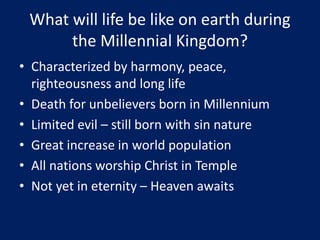
This will be a good start to the "age to come." All the practicing wicked will either have been destroyed during the tribulation period that precedes Christ's final leg of his coming (which is the time of the resurrection and translation of saints) or will be judged as being tares (weeds) and goat nations and sent away into endless punishment. What is left are people, mostly very young people, who had been kind towards Jews and Christians, and are humble and meek, and who believe instantly when they see Christ appear. These will enter the Millennial kingdom in their mortal bodies, but yet filled with the Spirit, and yet they are not confirmed in immortality, but enjoy a conditional immortality, as the texts in Isaiah's prophecy of the new heavens and earth describe. Among these, death will be rare.

Make no mistake about it, some people who witness the coming of Christ, especially the end of his coming, will be converted when they see Christ, and the aforementioned texts affirm it. Certainly, as we will show in the next chapters, many of the natural Jews will be so converted when they see Christ appear in addition to those sheep peoples from among the Gentiles.

Friday, December 22, 2023

Beliefs about the Afterlife (xxxx)


"Behold, the day of the LORD is coming, Cruel, with fury and burning anger, 
To make the land a desolation; And 
He will exterminate its sinners from it."
(Isaiah 13: 9 nasb)

Earlier, we stated that not all the individuals of the nations are smitten so that no one is left alive, following the tribulation and wrath, for Christ and his people begin their rule on earth over the nations, but this can only be so if some are left alive to become the seed for the new peoples of the Millennial age, just as Noah's three sons and their wives became the seed of a new world. There are many reasons for believing in a remnant of the race who survive the day of judgment, or day of the Lord (corresponding to chapters six through 19 of the Apocalypse). First, in talking about the tribulation of the days of the second coming, the Lord Jesus Christ said this in confirmation of that fact:  

"And except those days should be shortened, there should no flesh be saved: but for the elect's sake those days shall be shortened." (Matt. 24: 22)

Lots of people are killed by the divine judgments (wrath and tribulation) connected with the return of Christ as King of kings and Lord of lords. Under the first four judgments of the Apocalypse, we have the four horsemen of the Apocalypse, and by these four and their judgments one fourth of the world's population is killed. (Rev. 6: 8) We also read of more killed after this:

"It said to the sixth angel who had the trumpet, "Release the four angels who are bound at the great river Euphrates." And the four angels who had been kept ready for this very hour and day and month and year were released to kill a third of mankind." (Rev. 9: 14-15)

But, even with such devastation and death on such a large scale there are still a few, a remnant, who survive. The days of that awful destruction will stop short of universal death of all human beings so that a few flesh are "saved," i.e. preserved from physical death. This is also what is confirmed by other passages. Wrote Solomon:

"For the upright shall dwell in the land, and the perfect shall remain in it. But the wicked shall be cut off from the earth, and the transgressors shall be rooted out of it." (Pro 2: 21-22) 

It is also what is foreshown by Isaiah. Chapters 24-27 describe the end times that are connected with the second coming of the Lord and "that day," also known in scripture as "the day of the Lord," and "the day of wrath," and "the day of vengeance," and "the day of tribulation," and "the day of judgment," and "the day of redemption," and "the day that shall burn as an oven," etc. Notice the whole of chapter 24 and then compare it with what unfolds in Revelation chapters 6-20.

"Behold, the LORD makes the earth empty and makes it wasteDistorts its surface And scatters abroad its inhabitants. And it shall be: As with the people, so with the priest; As with the servant, so with his master; As with the maid, so with her mistress; As with the buyer, so with the seller; As with the lender, so with the borrower; As with the creditor, so with the debtor. The land shall be entirely emptied and utterly plundered, For the LORD has spoken this word. The earth mourns and fades awayThe world languishes and fades away; The haughty people of the earth languish. The earth is also defiled under its inhabitants, Because they have transgressed the laws, Changed the ordinance, Broken the everlasting covenant. Therefore the curse has devoured the earth, And those who dwell in it are desolate. Therefore the inhabitants of the earth are burned, And few men are left. The new wine fails, the vine languishes, All the merry-hearted sigh. The mirth of the tambourine ceases, The noise of the jubilant ends, The joy of the harp ceases. They shall not drink wine with a song; Strong drink is bitter to those who drink it. The city of confusion is broken down; Every house is shut up, so that none may go in. There is a cry for wine in the streets, All joy is darkened, The mirth of the land is gone. In the city desolation is left, And the gate is stricken with destruction. When it shall be thus in the midst of the land among the people, It shall be like the shaking of an olive tree, Like the gleaning of grapes when the vintage is done. They shall lift up their voice, they shall sing; For the majesty of the LORD They shall cry aloud from the sea. Therefore glorify the LORD in the dawning light, The name of the LORD God of Israel in the coastlands of the sea. From the ends of the earth we have heard songs: “Glory to the righteous!” But I said, “I am ruined, ruined! Woe to me! The treacherous dealers have dealt treacherously, Indeed, the treacherous dealers have dealt very treacherously.” Fear and the pit and the snare Are upon you, O inhabitant of the earth. And it shall be That he who flees from the noise of the fear Shall fall into the pit, And he who comes up from the midst of the pit Shall be caught in the snare; For the windows from on high are open, And the foundations of the earth are shaken. The earth is violently broken, The earth is split open, The earth is shaken exceedingly. The earth shall reel to and fro like a drunkard, And shall totter like a hut; Its transgression shall be heavy upon it, And it will fall, and not rise again. It shall come to pass in that day That the LORD will punish on high the host of exalted ones, And on the earth the kings of the earth. They will be gathered together, As prisoners are gathered in the pit, And will be shut up in the prisonAfter many days they will be punished. Then the moon will be disgraced And the sun ashamed; For the LORD of hosts will reign On Mount Zion and in Jerusalem And before His elders, gloriously."  (Isaiah chapter 24)

Though the word for "earth" may simply mean "land," and cannot in itself denote what is true of the whole planet, yet the context of this chapter, along with the other three in this prophecy, show that it means the whole earth or planet. In fact, if one reads this chapter and then reads chapters six through twenty of the book of Revelation, he will see the fulfillment of Isaiah's prophecy.

The great tribulation is alluded to in the words denoting one trouble after another, such as the pit and snare, the pit, and when the heavens rain down evils. This is what we see in the book of the Revelation, the book foretelling what will occur in the day of the Lord's return to earth. It occurs in that day when the Lord comes to "punish" the wicked and begin his reign on earth "on Mount Zion and in Jerusalem." So we read in the prophecy these words of the prophet:

"For when Your judgments are in the earth, The inhabitants of the world will learn righteousness." (26: 9)

That is what we see described in chapter twenty four, where this four chapter prophecy began, for we saw tribulation and death sent to the inhabitants of the earth so that few are left alive. It is the time when Christ comes to reign in Mt. Zion. It is through these judgments, associated as they are with the apocalypse of Christ (which is his coming, appearing, or revelation), and the day of the Lord, that men will receive the vengeance of the Lord so that they will be condemned to sufferings and death, except for a small remnant. This end time destruction kills nearly everyone except for a "few men" who are left. This is what the Lord himself stated, as we have seen. 

Though most during this time fail to repent and turn to the Lord (See Rev. 9: 20-21; 16: 8-11), or to "learn righteousness" by God's end time wrathful judgments, the few remaining mostly do learn righteousness, and that very learning is necessary for them to be given opportunity to enter the Millennium and live, as mortal men on probation, and not follow Adam's and Eve's example.  

That we might further see how the prophecy of Isaiah 24-27 involves the time of the second coming (or the time period between Revelation chapter six through twenty), notice these words from chapter twenty six:

"Come, my people, enter your chambers, And shut your doors behind you; Hide yourself, as it were, for a little moment, Until the indignation is past. For behold, the Lord comes out of His place To punish the inhabitants of the earth for their iniquity; The earth will also disclose her blood, And will no more cover her slain." (26: 20-21)

Again, that is fulfilled at the time of Christ's return when he comes bringing wrath, vengeance, judgment, tribulation, etc., on the wicked inhabitants of the earth, the very thing we see in the judgments of Revelation chapters six through twenty. Notice also this verse from chapter twenty seven:

"In that day the Lord with His severe sword, great and strong, Will punish Leviathan the fleeing serpent, Leviathan that twisted serpent; And He will slay the reptile that is in the sea." (27: 1)

So, who is Leviathan the fleeing and twisted (or crooked) "serpent"? And, what does it mean for him to be punished? And, if he is the same one designated as "the reptile that is in the sea," what does it mean for such sea monster to be slain? And, when and how will the Lord punish and kill this sea monster? 

In the book of Christ's return, or of his glorious Apocalypse, and of his executing upon the world the judgments written against its last generation, Satan is described as a sea monster and there is every reason to believe that he is the Leviathan of the above passage

The whole forty first chapter of Job is a discourse of God himself upon this creature. He ends that chapter with these words:

"He beholds every high thing; He is king over all the children of pride.” (verse 34 nkjv)

A "serpent" is a superior creature of the sea as "Behemoth" (chapter 40) is a superior creature of the land. But, "serpent" is also a label or fitting symbol of Satan (or he who was once known as Lucifer). So many scriptures refer to him by that name. In was by inhabiting a serpent (who could it seems go on land as well as sea, as most snakes can) that he first appeared to Adam and Eve and quickly enticed them to disobey God's prime directive even though God had warned them of the consequences. So Paul says "as the serpent beguiled Eve" (II Cor. 11 3); And, he is referred to as "the great dragon," and "that old serpent, called the Devil, and Satan." (Rev. 12: 9; See also 12: 14-15, 20: 2) Just as the Lord Jesus referred to Herod as "that fox" (Luke 12 : 32) so he refers to Satan, or the Devil, as "that old serpent," i.e. the serpent that seduced Eve, as Leviathan. The sea monster is a fitting symbol of Satan

Further, when Paul says to the Philippians "Beware of dogs, beware of evil workers, beware of the concision" (Phil. 3: 2), he was not warning against animals which are literal "dogs," but against people who are like dogs (thus being a symbol or metaphor). In fact, people use the word "dog" in the same way today, as when they say "he is a dog." It is thus used to speak of some negative quality of dogs which is seen in human beings. So Peter compares apostates from the Christian faith to a dog who returns to eat its own vomit. (II Peter 2: 22) 

Also, Paul says that he "fought with beasts at Ephesus." (I Cor. 15: 32) Though some think that he fought with real animals, being thrown to the lions, so to speak, as was Daniel and many early Christian martyrs who died in the Roman coliseum, I rather think that he is referring to men who denied the resurrection (as did the Sadducees and some of the Greeks on Mars Hill when hearing Paul preach about it). They are labeled by Paul as "beasts" or "animals" or even "monsters." 

The evil governments are viewed as monsters and beasts in the books of Daniel and Revelation, and in both the Antichrist is styled "the beast" or "the monster." 

Further, Job also speaks of Leviathan by the title "the fleeing serpent." Says he: "By His Spirit He adorned the heavens; His hand pierced the fleeing serpent." (Job 26: 13 nkjv)

This reference to "the fleeing serpent" or "the crooked serpent" (KJV), has a dual reference or application. First, to the constellation that goes by that name and secondly to Leviathan, to that "old serpent the Devil," to "the Satan." The constellation Cetus, the sea monster, is one of the largest constellations in the heavens, and no doubt pictures him. But, other constellations also allude to Leviathan or to the Dragon or Serpent. Said one source:

"The term bariach, rendered "crooked" but better as in the Revised Version, margin as "fleeing," is applied by Isaiah to "Leviathan" (liwyathan: Isa 27:1), properly a "wreathed" or writhing animal, twisted in folds, and hence also called by the prophet `aqallathon, "crooked," "twisted," or "winding"; a very appropriate designation for Draco, the great polar Dragon. But the latter was not the only "crooked serpent" in the constellations; there were three others, two of which were placed with an astronomical significance not less precise than the coiling of Draco round the poles. Hydra, the Watersnake, marked out the original celestial equator for about one-third of its circumference, and Serpens, the Adder, lay partly along the celestial equator and then was twisted up the autumnal colure, and reached the zenith with its head." (See here)

So, the point elaborately made is this: the context of Isaiah chapters 24-27 show that it has not yet been fulfilled but will be fulfilled at the second coming of Christ and that his execution of the judgments of the book of Revelation are accompaniments of his future coming (parousia), revelation (apocalupsis), or appearing (ephiphania). 

Further, Isaiah 24 says that all the inhabitants of the earth will be killed in the fiery judgments of the great tribulation and day of wrath except for a remnant. Only few people will be left and it is these living peoples who will be assembled in order to divide them in the manner described by Christ in Matthew 25. The nations who were helpful to the "brothers" of the Lord will be granted right to enter the Millennial kingdom while those who were not helpful will be sent away into everlasting fire. This shows that both the sheep and the goats are distinct and separate from the "brothers." 

If "the nations" designates Christians or believers in Christ, then we would have to read the text in this manner - "inasmuch as you (sheep nations) have done it unto the least of these OUR brethren" (or "your brethren") instead of "these MY brethren." In this prophetic scene we have several participants (individuals or groups) mentioned. They are Christ, the brothers of the Lord, the sheep nations, the goat nations. 

When Christ refers to his "brethren," most think he refers to the Jews, for Christ does call them his own people and the apostles also addressed their fellow Jews as "brothers" even though they were not saved. But, I rather think he has reference also to Christians. That being so, those few who remain alive among the nations, following the destruction attending Christ's return, are judged on how they were related to 1) the government of the beast or Antichrist, and 2) the treatment of Jews and Christians. 

In the days of Isaiah chapter 24 and Revelation chapters 6-20 a person will be forced to take sides in the six thousand year old war between the seed of the woman and the seed of the serpent. But, there will be a few who will refuse to become followers of the beast and to take his mark, though they are not yet believers in Jesus. And, these will no doubt help Jews and Christians survive end time persecution by the Antichrist and his henchmen in much the same way Schindler, the German, helped Jews survive Hitler's genocide of Jews or as others who helped Jews and Christians in some manner. 

So, we have shown I think that there will be some few humans left after the judgments of the Apocalypse, and that these will be divided as sheep from goats. The sheep nations will be those who enter the Millennial kingdom as mortal humans, most of them being believers in Christ on some level. After all, it is written:

"For it is written: “As I live, says the LORD, Every knee shall bow to Me, And every tongue shall confess to God.” (Rom. 14: 11 nkjv) (See also Phil. 3: 10; Heb. 6: 13)

The living nations who stand before God at the end of the present age and at the inauguration of the age to come will bow the knee to Christ and confess his Lordship and gladly enter into his kingdom. But, if this is the case, then what can we make of the fact that at the end of the thousand years, when Satan is loosed from his prison, he is able to deceive many nations, as Gog and Magog, to rebel against the Lord? How could only believers enter the Millennium but by its end there are many who are not confirmed believers? Surely it is so because 1) many of the believers who entered the Millennial kingdom were like the Israelites who, after crossing the Red Sea miraculously, believed in Jehovah,* and 2) their children, born in the Millennium, did not become true lovers of Christ, but only feigned obedience.

*9 He rebuked the Red sea also, and it was dried up: so he led them through the depths, as through the wilderness. 10 And he saved them from the hand of him that hated them, and redeemed them from the hand of the enemy. 11 And the waters covered their enemies: there was not one of them left. 12 Then believed they his words; they sang his praise. 13 They soon forgat his works; they waited not for his counsel." (Psa. 106: 9-13 kjv)

It will be the job of the Millennium's rulers, all under Christ, to govern the world, to run its cities and towns, to enforce its laws, and to manage its prosperity. This is in part how believers, after their resurrection, will spend their days. They will not be the only ones who govern the age to come, as we have seen. It will, however, be a monarchy under the King of kings and Lord of lords, in a pyramidal structure of government.

In the next chapters we will look further into how life will be for believers in the Millennium, and how life will be on earth during the reign of Christ and his kingdom.

Thursday, December 21, 2023

Beliefs about the Afterlife (xxxix)


"Blessed and holy is he who has part in the first resurrection. 
Over such the second death has no power
but they shall be priests of God and of Christ, 
and shall reign with Him a thousand years." 
(Revelation 20: 6 nkjv)

"And the armies which were in heaven followed him upon white horses, clothed in fine linen, white and clean. And out of his mouth goeth a sharp sword, that with it he should smite the nations: and he shall rule them with a rod of iron: and he treadeth the winepress of the fierceness and wrath of Almighty God." (Rev. 19: 14-15 kjv) 

According to this text (which I have called attention to in previous chapters), the rule of Christ over the nations is yet future, and follows after his first "smiting the nations," which smiting occurs throughout the events of the Apocalypse (via the seven seals, trumpets, and vials) and culminates in the final battle of Revelation chapter nineteen. Following the smiting of the nations of that chapter is when he shall rule over the nations with a rod of iron. Several facts are deducible from the text and its several affirmations.

First, the smiting of the nations occurs at the same time as the treading of the winepress of the fierceness and wrath of God. Throughout the judgments of Revelation chapters 6-19 God is in wrath smiting the nations

Second, not all the individuals of the nations are smitten with death, agonizing death, for how can Christ rule on earth over the nations if none are left? 

Third, the smiting of the nations precedes the ruling of the nations, and neither has yet been fulfilled or come to pass. 

Fourth, the ruling of the text is what we see occurring after chapter nineteen (which chapter pictures the final stage of his coming again). It occurs in chapter twenty when Christ is enthroned along with the church (body of believers), the apostles, the Israelites who will be converted when Christ appears (then joined to resurrected believing Israelites of the old testament who have been resurrected, such as king David), and they all begin to rule. Recall the text we have cited previously:

“The one who conquers, I will grant him to sit with me on my throne as I also conquered and sat down with my Father on his throne.” (Rev. 3:21)

It seems that Christ, in this text, says that he was enthroned when he ascended bodily into heaven forty days after his resurrection. So, is Christ already seated on his throne and ruling with a rod of iron? In addressing that question let us read into the record these words of Christ:

31“When the Son of Man comes in His glory, and all the holy angels with Him, then He will sit on the throne of His glory. 32All the nations will be gathered before Him, and He will separate them one from another, as a shepherd divides his sheep from the goats. 33And He will set the sheep on His right hand, but the goats on the left. 34Then the King will say to those on His right hand, ‘Come, you blessed of My Father, inherit the kingdom prepared for you from the foundation of the world: 35for I was hungry and you gave Me food; I was thirsty and you gave Me drink; I was a stranger and you took Me in; 36I was naked and you clothed Me; I was sick and you visited Me; I was in prison and you came to Me.’ 37“Then the righteous will answer Him, saying, ‘Lord, when did we see You hungry and feed You, or thirsty and give You drink? 38When did we see You a stranger and take You in, or naked and clothe You? 39Or when did we see You sick, or in prison, and come to You?’ 40And the King will answer and say to them, ‘Assuredly, I say to you, inasmuch as you did it to one of the least of these My brethren, you did it to Me.’ 41“Then He will also say to those on the left hand, ‘Depart from Me, you cursed, into the everlasting fire prepared for the devil and his angels: 42for I was hungry and you gave Me no food; I was thirsty and you gave Me no drink; 43I was a stranger and you did not take Me in, naked and you did not clothe Me, sick and in prison and you did not visit Me.’ 44“Then they also will answer Him, saying, ‘Lord, when did we see You hungry or thirsty or a stranger or naked or sick or in prison, and did not minister to You?’ 45Then He will answer them, saying, ‘Assuredly, I say to you, inasmuch as you did not do it to one of the least of these, you did not do it to Me.’ 46And these will go away into everlasting punishment, but the righteous into eternal life.” (Matt. 25: 31-46 nkjv)

Here, the text says that Christ sitting on the "throne of his glory" is yet future, coming to pass when he comes the second time, when "he comes in his glory" to reign from the "throne of glory." Notice the two adverbs of time in the passage ("when" and "then"). It is "when" he comes again that he "then" sits upon "the throne of his glory," the one also promised to the overcomers. Yet, Rev. 3: 21 says that after Christ conquered (via his death and resurrection, or his first coming) that he then "sat down" on "his Father's throne." Obviously, the "Father's throne" is not the same thing as "the throne of the glory of the Son of man." In the text there is a distinction Christ makes between "my throne" and "my Father's throne." 

Though Christ is now, since his bodily ascension into heaven, seated "at the right hand of God" (Heb. 1: 3; Eph. 1: 20-21; Rom. 8: 34; Col. 3: 1; I Peter 3: 22; etc.), or at the right hand of the throne of God, he is not yet seated on the "throne of his glory" in the Millennial kingdom. The present session of the risen and glorified Christ, as the son of man, occurred when Christ ascended bodily into heaven. So we read in Mark 16:19: “So then the Lord Jesus, after he had spoken to them, was taken up into heaven and sat down at the right hand of God.” But, that is not when Christ sat on the throne of his glory as the text in Matthew 25: 31 speaks of, for that occurs when Christ comes the second time from heaven to earth. 

Notice how carefully worded are the statements about Christ's present session on the throne of the Father, and at his right hand. 

“Now the point in what we are saying is this: we have such a high priest, one who is seated at the right hand of the throne of the Majesty in heaven.” (Heb. 8: 1)

“Looking to Jesus, the founder and perfecter of our faith, who for the joy that was set before him endured the cross, despising the shame, and is seated at the right hand of the throne of God.” (Heb. 12: 2)

These two verses speak of the present session of Christ on the throne of his Father, on his right hand, as the Son of God who is now and forever joined to his human body and soul. But again, it is the throne of deity and divinity, as well as the throne of the Father. Notice how Christ is viewed in his post incarnation state, where he is both Son of God (divinity) and Son of man (humanity) in what theologians call "hypostatic union" of the two natures of Christ, in this famous text: 

“But he, full of the Holy Spirit, gazed into heaven and saw the glory of God, and Jesus standing at the right hand of God. And he said, “Behold, I see the heavens opened, and the Son of Man standing at the right hand of God.” (Acts 7: 55-56)

Notice it is "Son of Man" and not "Son of God" who sits on the right side of the Father's throne. He has a glorified body and even "stands" to welcome the martyr Stephen into heaven. But, again, it is the Father's throne, or the throne of Deity, and not the throne of Christ nor the throne of David. In the text from Matthew 25: 31 we saw where Christ, when he returns, will sit on "the throne of his glory," a throne distinct from the Father's throne. Jesus referred to his enthronement at the second coming in other verses, such as this:

"Jesus said to them, “Truly I tell you, at the renewal of all things, when the Son of Man sits on his glorious throne, you who have followed me will also sit on twelve thrones, judging the twelve tribes of Israel." (Matt. 19: 28)

This text cannot be made to be a description of what has already been fulfilled. Dr. Gill, in his commentary, tries to do so, however, writing as follows:

"when the Son of man shall sit in the throne of his glory in the regeneration; not in the resurrection of the dead, or at the last judgment, but in this new state of things, which now began to appear with another face: for the apostles having a new commission to preach the Gospel to all the world; and being endued with power from on high for such service, in a short time went every where preaching the word, with great success." 

No, "the regeneration" is not what took place in the past by the preaching of the gospel and the institution of the new covenant or of the church. That is a misinterpretation of the text. Though Gill is a Premillennialist, he nevertheless does not adhere to the practice of interpreting prophecy literally, or being always fulfilled literally. This is what is called "spiritualizing" texts which are meant to be taken literally, and instead give them a symbolic or figurative application. I have found other Premillennialists who do the same, especially those who claim to be "Reformed" or "Calvinistic." But, as with the "duck test" (a form of abductive reasoning), so in this regard. The duck test is usually expressed as "If it looks like a duck, swims like a duck, and quacks like a duck, then it probably is a duck." 

Some Premillennialist look and act like Amillennialists in the way they spiritualize literal texts, and in how they interpret the bible's prophetic scriptures, especially the book of Revelation. Amillennialists are often heard saying of the prophetic portions of scripture (especially of unfulfilled prophecies and the book of Revelation) -- "it is 'apocalyptic' or symbolic" (meaning it is not literal, but esoteric). When they say such things they are talking like Amillennialists and leave prophecy to be some enigma or code that only a few can interpret or make sense of. So, Gill, in his interpretation of the above passage, is acting like an Amillennialist. He does not take the prophecy of Christ literally. 

But, the passage makes no sense unless it is interpreted literally, and not to see the "regeneration" as the time when the earth is renewed at the second coming of Christ, a thing talked about elsewhere in scripture, in both testaments (as we have seen in previous chapters). Further, it is highly likely that the session of the twelve apostles on twelve thrones, ruling over the twelve tribes, occurs at the beginning of the Millennium when the righteous all are enthroned (per Rev. chapter twenty). No, rather, as many commentators agree, by "the regeneration" is meant the change that will come to the world when Christ comes and inaugurates the "age to come," or the Millennium. 

Gill says further:

"When the Son of man shall sit in the throne of his glory, or glorious throne; as he did when he ascended into heaven, and sat down at the right hand of God; and was then exalted as a prince, and made, or declared to be Lord and Christ; and was crowned in human nature, with honour, and glory, and angels, principalities, and powers, made subject to him:

But, as we have seen, the right hand of the throne of God, or throne of the Father, is not the same as the glorious throne of the risen Christ, for as we have seen, it is not till Christ comes again that he then sits on the throne of "HIS" glory (as distinct from the throne of the Father or God). 

Gill says further:
 
"ye also shall sit upon twelve thrones: for though Judas fell from his apostleship, yet Matthias was chosen in his room, and took his place, and made up the number twelve; a metaphorical phrase, setting forth the honour, dignity, and authority of their office and ministry, by which they should be judging the twelve tribes of Israel; doctrinally and practically..." 

Why is the language of Christ a "metaphorical phrase"? Is "twelve tribes" literal or figurative? Is it a reference to spiritual Jews (which would include believing Gentiles) as Amillennialists and figurative interpreters think? Then, which tribe am I a member of as a Gentile who is a Jew inwardly? If "twelve tribes" is literal, then why not "thrones"? Further, if the ruling of the twelve is done through their writings, then how is the ruling limited to Jews only? Would it not be that the apostles rule over both Jews and Gentiles in this manner? If "thrones" in this text is metaphorical, then why does Gill think it not metaphorical in Revelation chapter twenty? Further, if we believe that the apostle Paul is not one of the twelve (the common view), then he is not ruling over the twelve tribes by his writings? What about the inspired writings of Mark, Luke, Jude and James, the Lord's brothers? Do they not rule by their writings too? You see how untenable is Gill's interpretation and of the perils of not taking scripture literally.

Not only is Christ not now seated on his own glorious throne, nor is he now seated on "the throne of David." Recall these words of the angel Gabriel to Mary: 

"He will be great and will be called the Son of the Most High. And the Lord God will give to him the throne of his father David, and he will reign over the house of Jacob forever, and of his kingdom there will be no end.” (Luke 1: 32-33)

This has not yet been fulfilled. Certainly not literally, and literally is the only way we are to interpret it. Let us again note what Dr. Gill said on the passage. Wrote Gill:

"...here it intends not his throne, in a literal, but in a figurative sense; for as David was a type of the Messiah in his kingly office, hence the Messiah is called "David their king", (Hosea 3:5) so his throne was typical of the Messiah's throne and kingdom; which is not of this world, but is in his church, and is set up in the hearts of his people, where he reigns by his Spirit and grace; and this is a throne and kingdom "given" by the Lord God." 

What is a figurative throne? The throne of David was literal when David occupied it, but it is not literal when Christ occupies it? That is just not tenable. Further, why is David excluded from ruling over the twelve tribes along with the twelve apostles and all under Christ, the super David? The prophecies about David's future rule should be interpreted to refer to David himself. If not, why not? Is that not the plain reading of the text, prima facie? The passage in Hosea that Gill cites reads as follows:

"For the children of Israel shall abide many days without a king, and without a prince, and without a sacrifice, and without an image, and without an ephod, and without teraphim: Afterward shall the children of Israel return, and seek the Lord their God, and David their king; and shall fear the Lord and his goodness in the latter days." (Hosea 3: 4-5)

I see no reason to think that "David" in the passage denotes Christ, son of David, nor Solomon, nor any other son of David. All the other terms in the prophecy are literally interpreted, so why make David a figurative term for the Messiah? Further, surely "Lord their God" and "the Lord" in the text includes the Son of God, even in his incarnate state, so this would exclude him from being the David of the text. The other prophecies of the future reign of king David are found in Jeremiah 30: 9, where the prophecy says "instead, they will serve the Lord their God and David their king, whom I will raise up for them.” Speaking of the same, God says through the prophet Ezekiel, My servant David will be king over them, and they will all have one shepherd. They will follow my laws and be careful to keep my decrees.” (Ezekiel 37:24) 

Judgment of the Living Nations

The judgment of the sheep and goat nations (peoples) of Matthew chapter twenty five, cited above, is not a judgment of the dead, but of the living at the time when Christ returns and judges those who are left alive following the destruction of the apocalypse of Christ or day of judgment. There is to be both a judgment of the dead and of the living. The judgment of the wicked dead occurs at the great white throne judgment after the Millennium as the latter part of Revelation chapter twenty informs us. But, the judgment of the wicked who are alive at the return of Christ is distinct from it, preceding the Millennium. 

Wrote Pentecost in "Things To Come" (pg. 344) under "The place of the judgment" in regard to the judgment of the nations:

"Inasmuch as this judgment follows the second advent, it must be an event that takes place on the earth. It can not be said to take place in the eternal state. Peters says: 

As there is no statement that any of these nations arose from the dead, so there is none that any part of them descended from heaven to be judged; the language, provided no previous theory is made to influence it, simply describing nations here on the earth, in some way, gathered together at the Second Advent."

Wrote Pentecost under "The subjects of the judgment":

"It is to be observed that those brought into this judgment are living individuals, not the dead that have been resurrected and brought to judgment. Peters says: 

The question before us is this: Does the “all nations” include “the dead,” or only living nations? In deciding this point we have the following: (1) Nothing is said of “the dead.” To say that they are denoted is inferred from the fact that this passage is made—wrongfully—to synchronize with Rev. 20:11-15. (2) The word translated “nations” is never, according to the uniform testimony of critics and scholars, used to designate “the dead,” unless this be a solitary exception.…(3) The word is employed to denote living, existing nations, and almost exclusively “Gentile” nations. (4) The Spirit gives us abundant testimony that precisely such a gathering of living nations shall take place just before the Mill. age commences, and that there shall be both an Advent and judging.…(6) National judgments are only poured out upon living, existing nations, and not upon the dead who are devoid of any organization belonging to the idea of nation or state.…(7) As there is no statement that any of these nations arose from the dead, so there is none that any part of them descended from heaven to be judged." (pgs. 344-345)

I believe that is correct. It also should be viewed in the same way as Paul's words to Timothy. He said:

"I charge you therefore before God and the Lord Jesus Christ, who will judge the living and the dead at His appearing and His kingdom." (II Tim. 4: 1 nkjv)

Wrote J. A. Seiss in his famous work "The Apocalypse" on Christ judging the living and the dead:

"There is an important distinction, noted in the Scriptures, and in all the creeds, between the judgment of "the quick" and the judgment of "the dead.'' The common idea is, that all men, those that have died, and those who are found living at the time, shall be judged alike, and in one and the same great congregation."
 
The bible does not teach that all, wicked and righteous, will be resurrected simultaneously in one general or universal resurrection. I was taught that as a young minister in the "Primitive Baptist" church, who are mostly Amillennial and believe in one general resurrection. But, it did not take long in my beginning years of bible study to begin to see that it was an error and that the bible teaches that the resurrection of the righteous will occur one thousand years before the resurrection of the unrighteous. One of the texts those who believe in a general resurrection use is the text about the judgment of the nations, or of the sheep and goats. 

Wrote J. A. Seiss further:

"It is conceived that the dead will all be simultaneously resurrected, and all the living simultaneously changed, and that only then the judgment will sit for the adjudication of the eternal destiny of each. Painters and poets have outdone themselves in their efforts to portray the overwhelming majesty and terror of so grand and universal an assize. But it is not according to the plain letter of the Scriptures, or of the creed of the Church. If the day of judgment is ever to come, it must find people living upon the earth, who are described as "the quick." They must, therefore, either be judged in the flesh, while still living in their natural life, or they must meet with some miraculous transformation equivalent to the resurrection, by which they lose the distinctive character of "quick." Such a change before the judgment, has also been accepted and affirmed concerning all who shall be living when the day of judgment comes. Thus, Bellarmin teaches, that the breaking in of that day will instantaneously end the natural life of all the living; that they will all be suddenly struck dead, and by the same stroke transformed into precisely the same state in which the resurrected shall be; and that then all distinction between "quick and dead" will have entirely and forever disappeared. And, if we take the doctrine of the simultaneous judgment of all men, we are necessitated to accept some such explanation. But then what becomes of the judgment of "the quick," as distinguished from the judgment of "the dead"? There is, in that case, no such judgment. All natural life in the flesh being ended and overpast before any judicial awards are made, the judgment becomes only a judgment of the dead, or rather of immortals; for there are no subjects of it except those who have ceased from the natural life, and passed into the post-resurrection state. The distinction made by the Scriptures and the creeds, between the judgment of "the quick" and the judgment of '' the dead," is thus turned into a distinction without a difference — a mere matter of words, signifying nothing in particular. But the phraseology of Jesus and his inspired apostles, so uniformly employed wherever the subject is touched, is not thus to be slurred over, and stripped of its proper and natural signification. If words have any meaning, "quick" does not mean "dead," and "dead" does not mean "quick;" and the judgment of the one cannot, therefore, be the judgment of the other." 

Agreed, though so many miss seeing this.

Wrote J. A. Seiss further:

"Two distinct classes are unmistakably intended, not only as to that state in which the day of judgment finds them, but also as to that state in which the day of judgment deals with them. If the natural life of "the quick" ends before they are judged, then theirs is not a judgment of the quick any more than of the dead, and one part of the sacred description utterly falls away. We must, therefore, allow a judgment which respects men still living their natural life in the flesh, the awards of which they receive, and have visited upon them in their distinctive character as "quick." (pgs 322-324)

Agreed, though so many miss seeing this also.

Wrote J. A. Seiss further:

"And even as respects the judgment of "the dead," there lurks in the popular idea a mischievous and confusing error. People take the resurrection as a mere preliminary of the judgment, and view the judgment itself as something distinct from the resurrection, and coming after it. The language of the last trump they conceive to be: "Awake, ye dead, and come to judgment." They consider that the dead are to be awakened for the purpose of being judged. It is also true, that not all the awards of the judgment are made or go into effect till after the resurrection; but the resurrection is itself a part of the judgment. The resurrection of the wicked is certainly something different from the resurrection of the saints. It is different both in character and in time. The one is a resurrection "in glory," and the other is a resurrection of "shame and everlasting contempt." The one is "adoption, the redemption of the body" and the other is "the resurrection of condemnation.'' The one is a "change of our vile body, that it may be fashioned like unto Christ's glorious body," and the other is a mere reversal of the state of death, with all the corrupt fruits of the sowing to the flesh still clinging to him who is the subject of it. (Gal. 6 : 7, 8.) The one is the peculiar privilege of the elect, of those who are Christ's, who rise at Christ's coming, and live and reign with him the thousand years; the other is subsequent — eito — afterwards — and embraces "the rest of the dead " who live not again until the thousand years are finished. (1 Cor. 15 : 23, 24 ; Rev. 20 : 4, 6.) These distinctions are very plainly drawn, and embrace the very highest things of our faith. Nothing that comes after the realization of them can add anything not already substantially included. The estate and destiny on both sides is thus effectually and irreversibly settled in advance. We accordingly would have the anomaly of the chief work and result of the judgment accomplished and concluded, before the judgment itself sits! The truth is, that the resurrection, and the changes which pass "in the twinkling of an eye" upon the living, are themselves the fruits and embodiments of antecedent judgment. They are the consequences of adjudications then already made. Strictly speaking, men are neither raised nor translated, in order to come to judgment. Resurrections and translations are products of judgment previously passed, upon the dead as dead, and upon the quick as quick. "The dead in Christ shall rise first," because they are already adjudged to be in Christ; and the living saints are caught up together with them to the clouds, because they are already adjudged to be saints, and worthy to attain that world. And the rest of the dead live not again until the thousand years are finished, and the rest of "the quick" are "left," by virtue of judicial decisions already had, and of which these things are the results. Whatever, in the line of increased blessedness or enhanced damnation, may come after, is only the further carrying into effect of what was already predecided, before there could be either resurrection or translation. And what so irreversibly fixes the estates of the persons concerned, must necessarily, in the very nature of things, be their judgment. The judgment is not a sham formality, or a solemn farce; it is something real; and the substance of it is the award to every man according to his works. And when we see these awards in potent effect in the very life which the dead live again, it is absurd to be thinking of the judgment as only a grand assize to which resurrection and cessation of natural life are only preliminary. And if the true judgment thus precedes, or is already embodied in, the resurrection and translation, it must necessarily take hold of the dead as dead, and the living as living. The language which the Scriptures and the creeds so carefully preserve, is thus found to possess a literal accuracy and depth too generally overlooked. We profess to believe that Christ "shall come to judge the quick and the dead." He does not come first to raise "the dead" and then to judge them, but he judges them as dead, that they may rise in their appointed lot, and share the resurrection of the just. He does not first come to change "the quick" in order to judge them; but to judge and discriminate between them while yet living, in order that those accounted worthy may be "changed," and caught up together with the resurrected ones, and that those adjudged unworthy of so high a portion may be cut off from it, and made to suffer still other inflictions in this world. And it is to these judicial dealings with people "left," and living in the flesh, that the action under these horses refers." (324-327) 
 
So, we sum up. The Millennial age will see the living nations (the remnant few who remain after the judgments of the Apocalypse) judged as to whether they will be cast away from the land of the living and denied entrance into the Millennial new heavens and earth or be allowed to continue to live and to enter the Millennial kingdom and be the seed of a new human race. 

Establishing that the Millennial new heavens and earth will find people who are mortal, and who are living lives as mortals, marrying and giving in marriage, having children and families, etc., and being "the nations" who have been thus purged, we see something about what it will mean for 1) Christ to rule on earth over the nations, and 2) Converted Israelis to reign on earth over their own land and over the Gentile nations, and 3) for king David to reign over Israel and the nations under Christ, the super David, and 4) the twelve apostles, who will likewise rule on earth, and 5) the church, or body of believers (the elect) to rule on earth over the nations (and its cities and towns). 

Knowing these various occupants of the coming new age of a thousand years helps us to understand what our first thousand years of our "eternal life" as believers, as saved and redeemed people, will be like. In the next chapter we will continue our look at how we will spend the first thousand years of our life in the ages of the ages yet to come. 

Friday, December 15, 2023

Beliefs about the Afterlife (xxxviii)


In this chapter we continue our examination of the prophecies of Isaiah about the new heavens and earth, showing how they apply primarily to the millennial reign of Christ and only secondarily to the new heavens and earth that follow the Millennium and described by the apostle John in Revelation's final two chapters. 

There are other prophecies of the old testament, including Isaiah (who speaks of the new heavens and earth), that speak of life in what is called the "Messianic Age," which as we now know, is the description of the Millennial rule of Christ as described in Revelation chapter twenty. In many texts in Isaiah, as well as in other texts of Hebrew prophets, the Messianic age was referred to by the terms "kingdom of God" and "kingdom of heaven," which terms were used by John the Baptist and the Messiah himself. The new heavens and earth of the Millennium will be the kingdom of God

That does not mean, however, that the term "kingdom of God" (or heaven) excludes its existence in other periods of time other than in the coming Millennium. The context and sense of texts must be the thing that helps us to discern what aspect, phase, or manifestation of the kingdom of God is under consideration. There was a period of time when the kingdom of God was visible on earth, though still in a limited way, and this was under the theocracy in the time of the Judges, and in the times of David and Solomon. This is not generally doubted. He was the king before Israel had her first king and every king from Saul onward were kings under Yahweh or Jehovah. 

That the kingdom of God was on earth when Christ was here is also not generally doubted, for it is expressly affirmed in scripture, as we will see. That the kingdom of God is also manifested by the rule that God through Christ exercises in the hearts of believers individually and in the assemblies of believers collectively is also not doubted. But, the kingdom of God that is described as coextensive with the Millennial new heavens and earth has not yet been realized. That is quite undeniable if we take the prophecies literally and at face value. 

As an example of other texts in Isaiah that speak of the same time period as that of the new heavens and earth of Isaiah 65-66 we will look at a text in Isaiah chapter eleven.

Millennial New Heavens and Earth

"There shall come forth a [a]Rod from the [b]stem of Jesse, And a Branch shall [c]grow out of his roots. 2 The Spirit of the Lord shall rest upon Him, The Spirit of wisdom and understanding, The Spirit of counsel and might, The Spirit of knowledge and of the fear of the Lord. 3 His delight is in the fear of the Lord, And He shall not judge by the sight of His eyes, Nor decide by the hearing of His ears; 4 But with righteousness He shall judge the poor, And decide with equity for the meek of the earth; He shall strike the earth with the rod of His mouth, And with the breath of His lips He shall slay the wicked. 5 Righteousness shall be the belt of His loins, And faithfulness the belt of His waist. 6 “The wolf also shall dwell with the lamb, The leopard shall lie down with the young goat, The calf and the young lion and the fatling together; And a little child shall lead them. 7 The cow and the bear shall graze; Their young ones shall lie down together; And the lion shall eat straw like the ox. 8 The nursing child shall play by the cobra’s hole, And the weaned child shall put his hand in the viper’s den. 9 They shall not hurt nor destroy in all My holy mountain, For the earth shall be full of the knowledge of the Lord As the waters cover the sea." (Isa. 11: 1-9 nkjv

Here again we see how the prophet describes what Messiah would do when he would come into the world and how we can see that part was fulfilled in his first coming while the other part is yet to be fulfilled at Messiah's second coming.

Further, the part that deals with the reign of Christ, and with the slaying of the wicked, and with ruling the earth with a rod of iron, and with the taming of the animal kingdom, etc., waits fulfillment in the Millennium. It is at that time when "the earth" will be "full of the knowledge of the Lord as the waters cover the sea." The description of the time period envisioned by Isaiah for the reign of Christ on earth shows that it is the same period that he later describes in Isaiah's closing chapters (65-66) as being the new heavens and earth.

Taking these three lengthy citations from the prophecies of Isaiah together (Isaiah 11: 1-9; 65: 17-26; 66: 22-24) gives us a fairly clear picture of life in the Millennium. To look at all such prophecies in Isaiah and in the other prophets would take more chapters than we have contemplated. But, they mostly give similar descriptions, but do add some things about the Millennial age not seen in those citations about new heavens and earth.

As a young minister I read "Things to Come: A Study in Biblical Eschatology" by J. Dwight Pentecost (available here) and highly recommend it. In fact, in those early days, I studied a lot by writers who are called "Dispensationalists," such as Pentecost, Clarence Larkin, John Walvoord, etc. As a Premillennialist, I agree with Dispensational Premillennialism to a large degree. But, I chiefly disagree with them how they explain "the rapture," affirming that it is 1) distinct from the second coming proper, and 2) occurs before the time of "the great tribulation" or "hour of global trial." 

I also disagree with some of them who go too far in affirming that parts of the bible were only intended to be applicable to people of a certain age, so that they say, for instance, that the lengthy sermon on the mount (Matt. 5-7) was only for the Jews and for the time period of the Millennium. 

In agreement with Dispensationalism I also do not believe in what is called "replacement theory," wherein the church is supposed to be the new Israel and seed of Abraham. Every Gentile who is joined to Christ by faith is indeed a spiritual Israelite, and literally so too, though not a physical descendant of Abraham. God has a special position in the Millennium for those who are both Jews via physical descent from Abraham and Jews in heart and spirit through the circumcision of the heart. So Paul wrote:

"For he is not a Jew who is one outwardly, nor is circumcision that which is outward in the flesh; but he is a Jew who is one inwardly; and circumcision is that of the heart, in the Spirit, not in the letter; whose praise is not from men but from God." (Rom. 2: 28-29 nkjv)

Some affirm that God has no more plans for those who are Jews both outwardly and inwardly. But, that is simply not the case according to the scriptures. These bible teachers will cite Paul's words in Galatians 3: 26-28 where he affirms that there is "in Christ Jesus...neither Jew nor Gentile, neither slave nor free, nor is there male nor female." But, that is true when it comes to being saved, for God has not restricted his offer of salvation to such various distinctions of people. But, to say that salvation removes our identity as male and female, or as Jew or Gentile, or as black or white, etc., is not Paul's intended meaning. Saved people do not become without gender when they are resurrected and glorified. Christ was as much a man after his resurrection as he was before. If I become without gender after this life, how is it me and not someone else?

Further, we actually see in the days preceding the Millennium, and in the Millennium, that God still recognizes those who are the physical descendants of Abraham and gives them those things that were promised to those who are both physical and spiritual Jews.

Though it is not my purpose to go into detail on the debate over the errors of that system of eschatology called "Dispensationalism," I will mention a few things. In an article titled "What are the core beliefs of dispensationalism?" (From study.com; See here)

"There are three essential beliefs of dispensationalism. The first is that there is a distinction between the church and Israel. The second is that all scripture in the Old Testament should be interpreted literally. The third is that the purpose of God in history is for the sake of the glory of God."

Well, if that is all there is to it, then count me a Dispensationalist. Of course, there is a little more to it than that, as others would list other beliefs.

I would consider myself what is called a "classical premillennialist." Those who believe this way believe in a post tribulation (and perhaps a pre-wrath) coming of Christ and rapture/resurrection of saints. They are also of those who take prophecy literally. Some do go too far, perhaps, in creating their various dispensations, but that certainly is no great error. There are dispensations in the bible.

I do agree with the emphasis Dispensationalists put on the literal interpretation of scripture, including the literal interpretation of prophecy. If one looks at the three texts in Isaiah mentioned above and in the preceding and present chapter, then one will see how impossible it is to interpret the things foretold in anything but a literal way. The same is true with the book of Revelation

Years ago I also read a good book by Baptist J.R. Graves, leader of the Landmark Baptists of the 19th century, titled "The Seven Dispensations." I found very little in that book to disagree with, except what he says about Christ not being the eternal Son of God, denying the Trinity it seems. 

The Kingdom of God

In chapter XXV titled "THE KINGDOM CONCEPT IN THE OLD TESTAMENT" Dr. Pentecost wrote (emphasis mine):

"God’s kingdom program occupies a large body of Scripture. But, in spite of all that the Scripture has to say on this subject, one is faced with a great variety of interpretations and explanations as to the nature and purpose of the kingdom program of God...Through this maze of interpretations it is almost impossible to make one’s way. The truths related to the kingdom will not be derived by an examination of the writings of men, but rather only by an inductive study of the teaching of the Word of God on this great subject."

Agreed. However, my main purpose now is to show how the promised coming of the "kingdom of God," or kingdom of Messiah, finds its fulfillment in coming in several ways, not the least of which is that time when Christ reigns on earth for a thousand years with the saints who have gotten the victory, and then becomes the new heavens and earth Isaiah described. 

Pentecost says further:

"It is a well established fact that the Jews at the time of Christ were anticipating a literal fulfillment of the Old Testament theocratic kingdom promises. It has been stated: It has been universally admitted by writers of prominence (e.g. Neander, Hagenbach, Schaff, Kurtz, etc.) whatever their respective views concerning the Kingdom itself, that the Jews, including the pious, held to a personal coming of the Messiah, the literal restoration of the Davidic throne and kingdom, the personal reign of Messiah on David’s throne, the resultant exaltation of Jerusalem and the Jewish nation, and the fulfilment of the Millennial descriptions of that reign. It is also acknowledged that the utterances of Luke 1:71; Acts 1:6; Luke 2:26, 30, etc., include the above belief, and that down, at least to the day of Pentecost, the Jews, the disciples, and even the apostles held to such a view.…they regarded the prophecies and covenanted promises as literal (i.e. in their naked grammatical sense); and, believing in the fulfilment, looked for such a restoration of the Davidic Kingdom under the Messiah, with an increased power and glory befitting the majesty of the predicted King; and also that the pious of former ages would be raised up from the dead to enjoy the same."

Again, I repeat. No prophecy of the scripture has been fulfilled in any other way than literally. A spiritual fulfillment is a fiction. If all the terms in the three prophecies of Isaiah mentioned are not to be taken literally, then what do the words new heavens, new earth, lion lying down with the lamb, a child playing near a snake, life spans being greatly expanded, etc. symbolize or represent? Thus, spiritualizers of the literal word of God follow their own private interpretations and whims when explaining the so called "figurative language" of the prophecies. 

Pentecost says further in the same section:

"The signs given by Christ were evidences of the power that would reside in the theocratic king and manifestations of the blessings that would exist in the kingdom. Peters well states: 

[The miracles of Christ] are so related to the kingdom that they cannot be separated from it without mutual defacement. Thus it is represented by Jesus Himself (Matt. 12:28), “But if I cast out devils by the Spirit of God, then the kingdom of God is come unto (or as some, upon) you”. Here we have, 1. The relationship existing between the kingdom and miracles; that without the latter the former cannot be revealed. 2. That miracles are a manifestation of possessed power, which Jesus will exert when He establishes His kingdom. 3. That the miraculous casting out of devils, or Satan, is an event connected with the kingdom, and its accomplishment through Jesus is thus verified as predicted, e.g., Rev. 20:1- 6. 4. That the miraculous casting out of devils by Jesus is a premonition, anticipating, foreshowing, or foreshadowing…like the transfiguration, of the kingdom itself. The miracles then are assurances vouchsafed that the kingdom will come as it is predicted. The miracles of Jesus are so varied and significant in the light of the kingdom that it can be readily perceived how they give us the needed confidence in its several requirements and aspects. The resurrection of dead ones is connected with the kingdom; that the keys of death hang at Christ’s girdle is shown in the miracles of [raising the dead].…Sickness and death are banished from the inheritors of the kingdom; the numerous miracles of healing various sicknesses and of restoring the dying, establish the power existing that can perform it. The utmost perfection of body is to be enjoyed in the kingdom; this is foreshadowed by the removal of blindness, lameness, deafness, and dumbness. Hunger, thirst, famine, etc., give place to plenty in the kingdom; the miracles of feeding thousands attest to the predicted power that will accomplish it. The natural world is to be completely under the Messiah’s control in that kingdom; the miracles of the draught of fishes, the tempest stilled, the ship at its destination, the walking on the sea, the fish bringing the tribute money, the barren fig tree destroyed, and the much-ridiculed one of water changed into wine, indicate that He who sets up this kingdom has indeed power over nature. The spiritual, unseen, invisible world is to be, as foretold, in contact and communication with this kingdom; and this Jesus verifies by the miracles of the transfiguration, the demoniac cured, the legion of devils cast out, passing unseen through the multitude, and by those of His own death, resurrection and ascension. Indeed there is scarcely a feature of this kingdom foretold which is to be formed by the special work of the Divine, that is not also confirmed to us by some glimpses of the Power that shall bring them forth. The kingdom—the end—is designed to remove the curse from man and nature, and to impart the most extraordinary blessings to renewed man and nature, but all this is to be done through One who, it is said, shall exert supernatural power to perform it. It is reasonable therefore to expect that as part of the developing of the plan itself, that when He first comes, through whom man and nature are to be regenerated, a manifestation of power—more abundant and superior to everything preceding—over man and nature should be exhibited, to confirm our faith in Him and His kingdom."  (pgs. 371-372)

Peters is spot on in his remarks. If the kingdom of God was now established on earth (as described by Isaiah in those sections and elsewhere too), healing would be the norm, miracles would be the norm and the natural and the supernatural would be the norm.

Wrote Pentecost in comment upon the above:

"Every miracle which the Lord performed, then, may be understood to be not only a demonstration of the theocratic power of the Messiah, but also that which depicts the conditions which will exist in the theocratic kingdom when it is established."

I believe that for sure. I think it is what is taught by Christ in these words:

"Now when John had heard in the prison the works of Christ, he sent two of his disciples, 3 And said unto him, Art thou he that should come, or do we look for another? 4 Jesus answered and said unto them, Go and shew John again those things which ye do hear and see: 5 The blind receive their sight, and the lame walk, the lepers are cleansed, and the deaf hear, the dead are raised up, and the poor have the gospel preached to them." (Matt. 11: 2-5 KJV)

John could be assured that indeed the kingdom of God had come in the person of the king, Jesus the Christ, because people were all made healthy and were entering into a happy state of getting good news. By these words he tells us what the presence of the king and the kingdom will mean for the world. Had Christ not been crucified, and had the Jews not rejected him, Christ would have continued to heal all, to raise the dead, and to cast out all evil spirits from the present heavens and earth so that a Millennial utopia is the result. We see Christ affirming the same truth on another occasion when he said: "But if I cast out demons by the Spirit of God, surely the kingdom of God has come upon you." (Matt. 12: 28 nkjv) You could substitute several words in the place of "cast out demons," such as in saying "if I perform miracles, heal, and raise the dead, then surely the kingdom of God has come." Again, this is what the kingdom of God being among men will bring to the world.

John Walvoord, well known author of books on eschatology, and Dispensationalist teacher, wrote the following about some characteristics of life in the coming Millennium (See here at bible.org) under the sub heading "Social and Economic Aspects of the Millennium" (emphasis mine):

"The reign of Christ on earth during the millennium, featuring as it does His righteous and universal government over all nations and characterized by spiritual blessing, obviously will affect all phases of life on the earth. Though the principal effects of the reign of Christ will be manifested in righteous government and in the spiritual realm, the rule of Christ will have extensive impact on the economic and social aspects of life on the earth."

"The fact that wars will cease during the millennium will have a beneficial effect upon both the social and economic life of the world. Instead of large expenditure for armaments, attention no doubt will be directed to improving the world in many various ways. Even under present world conditions, a relief from taxation due to military expenditure would have a great effect upon the economy. This coupled with absolute justice, resulting in greatly reduced crime and assuring minority people of government protection, will establish a social and economic order far different from anything the world had ever experienced prior to the millennium. Many of the prophetic Scriptures such as Psalm 72 and Isaiah 11 testify to these unusual millennial conditions. (Isa 35:1-2). The rest of the thirty-fifth chapter of Isaiah continues in the same theme. Plentiful rainfall characterizes the period (Isa 30:23; 35:7 ) and abundance of food and cattle are pictured (Isa 30:23-24). Though the curse on the earth is only partly lifted as indicated by the continuance of death, and will remain in some measure until the new heaven and the new earth are brought in (Rev 22:3), the land of Palestine will once again be a garden. The world in general will be delivered from the unproductiveness which characterized great portions of the globe in prior dispensations."

I have mused much on what orders Christ and his ruling saints will give to the nations that remain after the destruction of the day of the Lord. Will supernatural power be used to rid the world of nuclear reactors? Since this is the time when all the nations "beat their swords into plowshares" and "learn war no more" (Isa. 2: 4), one of the first tasks given to the nations will be to turn weapons into useful instruments for farming (which shows farming will continue during the Millennium). It will be, as Walvoord says, a time to begin improving the world. Surely this will include cleaning up all the pollution. 

Walvoord sees the curse placed upon the creation in the beginning, after the transgression of the race through Adam, as being partially lifted in the Millennium. I think that is so. The curse isn't completely removed because people still die and are healed of illnesses. But, it is lifted to a great extent, for as we have seen, it is in the Millennium that we see greatly increased productivity and fertility of plants and animals. It is not till the Millennium is over and the world enters into the first age following the Millennial that we find the oracle of God that announces "there should be no more curse" (Rev. 22: 3) that all curses are no more on earth.

Wrote Walvoord:

"Widespread peace and justice, spiritual blessing, and a bountiful supply of food in every land will result in a general era of prosperity such as the world has never known (Jer 31:12; Ezek 34:25-27; Amos 9:13-14). The many factors which produce poverty, distress, and unequal distribution of goods will to a great extent be nonexistent in the millennium. Labor problems which now beset all nations will be solved, and everyone will receive just compensation for his labors (Isa 65:21-25; Jer 31:5). Thus the curse which creation has endured since Adam’s sin (Gen 3:17-19) will be in part suspended as even the animal creation will be changed (Isa 11:6-9; 66:23)." 
 
There are several problems in envisioning life in the Millennium. For instance, how will waste be dealt with? Do the resurrected saints eat and drink and produce waste or need to use the bathroom? Surely the nations of people who enter the Millennium as mortals will certainly still need bathrooms. How will the government of Christ handle garbage? Will mortals still have shopping centers and grocery stores? How will overpopulation be handled? How will babies be born? In hospitals? Will there be midwives? Will there still be sports, games, and competitions? What happens at sports events when a player or fan sins at those events? When they let anger move them to curse? What about the sociology and economic conditions of people? Will there be classes and social stratification as now? Will there be prisons, courts, lawyers, etc.? 

Needless to say, changes galore are coming when we enter the Millennium. Many have looked at what the bible says about this glorious age to come. We will try to address many of these questions as we go along.

Wrote Walvoord:

"One of the predictions regarding the coming of the Messiah was that healing from sickness would characterize His reign. Though Christ healed many in His first advent, most of the prophecies seem to point to the millennial situation. Thus Isaiah writes: “And the inhabitant shall not say, I am sick: the people that dwell therein shall be forgiven their iniquity” (Isa 33:24). Those who have physical disability shall be healed of blindness and deafness (Isa 29:18) and healing will be experienced in a similar way by others. Again Isaiah states: “Then the eyes of the blind shall be opened, and the ears of the deaf shall be unstopped. Then shall the lame man leap as a hart, and the tongue of the dumb shall sing; for in the wilderness shall waters break out, and streams in the desert” (Isa 35:5-6). The brokenhearted will be comforted and joy will replace mourning (Isa 61:1-3). Longevity will apparently characterize the human race for Isaiah speaks of the death of a person one hundred years old as the death of a child (Isa 65:20). The freedom from these human ills so common in the present world is in keeping with the lifting of many other aspects of the curse upon nature. Not only will people live much longer, but there will be also a tremendous increase in birth rate as children are born to those who survive the tribulation. Of this Jeremiah says: “I will multiply them, and they shall not be a few; I will also glorify them, and they shall not be small. Their children also shall be as aforetime, and their congregation shall be established before me” (30:19-20 ). This blessing will not only characterize Israel, but also the Gentile in the millennial kingdom (Ezek 47:22)."
 
The healings and miracles done when Christ was here was the effect of the presence of the kingdom of God being present on earth in the person of King Jesus. Had Christ not been rejected by the Jewish nation, the kingdom of God would have been fully set up on earth. I agree with Dispensationalists who affirm that Christ did offer the kingdom to the Israelite people, but they rejected it saying "we will not have this man to rule over us." (Luke 19: 14) And, for this reason, he says to the Jewish leaders and the overwhelming majority of the nation's citizens: “Therefore I say to you, the kingdom of God will be taken from you and given to a nation bearing the fruits of it." (Matt. 21: 43 nkjv) And, during the forty days from the day of his resurrection we read of Christ still talking about the kingdom of God and the apostles asking him questions about the restoration of the kingdom to Israel.

"1The former account I made, O Theophilus, of all that Jesus began both to do and teach, 2until the day in which He was taken up, after He through the Holy Spirit had given commandments to the apostles whom He had chosen, 3to whom He also presented Himself alive after His suffering by many infallible proofs, being seen by them during forty days and speaking of the things pertaining to the kingdom of God. 4And being assembled together with them, He commanded them not to depart from Jerusalem, but to wait for the Promise of the Father, “which,” He said, “you have heard from Me; 5for John truly baptized with water, but you shall be baptized with the Holy Spirit not many days from now.” 6Therefore, when they had come together, they asked Him, saying, “Lord, will You at this time restore the kingdom to Israel?” 7And He said to them, “It is not for you to know times or seasons which the Father has put in His own authority. 8But you shall receive power when the Holy Spirit has come upon you; and you shall be witnesses to Me in Jerusalem, and in all Judea and Samaria, and to the end of the earth.” (Acts 1: 1-8 nkjv) 

The time when the kingdom of God is fully realized on earth is viewed as future by Christ and the apostles and is the time described by Isaiah as new heavens and earth, and when the earth is full of the knowledge of the Lord. It is in the Millennium when both Israel as a nation will rule on earth along with the church over the nations. 

Wrote Walvoord:

"Taken as a whole, the social and economic conditions of the millennium indicate a golden age in which the dreams of social reformists through the centuries will be realized, not through human effort but by the immediate presence and power of God and the righteous government of Christ. That mankind should again fail under such ideal circumstances and be ready to rebel against Christ at the close of the millennium is the final answer to those who would put faith in the inherent goodness of man."

This is what we have previously affirmed in the preceding chapters. It is also that wherein we are now beginning to discover and will speak more of in upcoming chapters. God has a purpose in the coming Millennial Age just as he has in every age. Every age has a revelatory and instructive purpose to it.

Under the sub heading "Physical Changes in the Millennium" Walvoord wrote:

"According to millennial prophesies, many topographical changes will take place in the land of Palestine in connection with the establishment of the millennial reign of Christ. While some of these may be due to the lifting of the curse upon the earth, the alterations seem to be more extensive than this."

There are many scriptures that show this to be so, and Walvoord cites them. For instance, read Zechariah chapter fourteen.

Walvoord wrote:
 
"In connection with the return of Christ to the earth, Zechariah 14 pictures the battle for the possession of Jerusalem which in its early stages seems to be in favor of the Gentiles. This is reversed, however, by the return of Christ described in the following words: “Then shall Jehovah go forth, and fight against those nations, as when he fought in the day of battle. And his feet shall stand in that day upon the mount of Olives, which is before Jerusalem on the east; and the mount of Olives shall be cleft in the midst thereof toward the east and toward the west, and there shall be a very great valley; and half of the mountain shall remove toward the north, and half of it toward the south” (Zech 14:3-4). In view of the fact that the Mount of Olives nowhere in Scripture is given a spiritualized interpretation, it seems clear that this refers to the physical Mount of Olives to the east of Jerusalem. When Christ returns, there will be where the Mount of Olives now stands a great valley extending toward the east with the Mount of Olives split in two."

Why would anyone not take Zechariah's prophecy literally? How can one make sense of it if it is not taken literally? When and how was it fulfilled if it has already been fulfilled in a non literal way?

Walvoord wrote:

"Other phenomenal things will occur at the same time. In the succeeding context a long day is described when “at evening time there shall be light” (Zech 14:7). Subsequent description pictures the “living waters” which “shall go out from Jerusalem; half of them toward the eastern sea, and half of them toward the western sea: in summer and in winter shall it be” (Zech 14:8). It should be clear from this description that the character of the land to the east of Jerusalem shall be much different than it is now and that the changes mentioned will be a preparation for other features of the millennial kingdom. Ezekiel adds more details concerning the river with special attention to the eastward flow of the river into the Dead Sea (cf. Ezek 47:1-12). The river like the cleavage is miraculous as to its source and brings life and fruitfulness to the land through which it goes (cf. Ezek 47:7-12). The effect on the Dead Sea is to bring healing to it and not only cause fruitfulness of trees and vegetation, but also to permit fish to thrive in its waters."

This prophecy has never yet been fulfilled. It will be literally fulfilled, however, in the Millennial reign of Christ and his saints and of Israel.

Walvoord wrote:

"One of the theological problems in relation to the doctrine of the millennium is the Scriptural teaching concerning the heavenly Jerusalem. This has not only confused opponents of premillennialism, but often has not been understood by those who hold to a millennial reign of Christ. Bound up in the problem also is the question of the relation of resurrected saints to the inhabitants of the millennial kingdom who are still in their natural bodies. Opponents of premillennialism have frequently heaped ridicule upon the teaching on the ground that it is impossible for resurrected beings and nonresurrected beings to mingle freely in the millennial scene. George L. Murray, for instance, refers to this when he states “…premillennialism makes no provision for the reconciliation of such irreconcilables as resurrected saints and mortal sinners in the same society” (Millennial Studies, p. 91)." 

But, it is not irreconcilable to think that resurrected beings can "mingle freely in the millennial scene." In fact, we have something very similar to that occurring when Christ was resurrected. Notice the gospel record of the event:

"50 And Jesus cried out again with a loud voice, and yielded up His spirit. 51 Then, behold, the veil of the temple was torn in two from top to bottom; and the earth quaked, and the rocks were split, 52 and the graves were opened; and many bodies of the saints who had fallen asleep were raised; 53 and coming out of the graves after His resurrection, they went into the holy city and appeared to many." (Matt. 27: 51-52 nkjv)

Further, we know that angels, who are also immortal beings, were able to take physical bodies and mingle with mortal men. They did this in Genesis chapter six when they mated with "the daughters of men" and produced the "Nephilim," or "giants," the monstrous offspring of such union. 

Consider also the fact that Jesus mingled at times with mortal men between his resurrection and ascension for forty days. 

Walvoord wrote the following under the sub heading "Relation of resurrected saints to the millennial earth"

"Though the major difficulty of the relationship of resurrected saints to those who are still in their natural bodies in the millennium is explained by the residence of the resurrected saints in the heavenly Jerusalem, Scriptures afford several instances in which there will be some relation of resurrected saints to those in the millennial earth. Christ promised His followers that they would participate with Him in His judgment upon the twelve tribes of Israel in His kingdom. Christ declared: “Verily I say unto you, that ye who have followed me, in the regeneration when the Son of man shall sit on the throne of his glory, ye also shall sit upon twelve thrones, judging the twelve tribes of Israel” (Matt 19:28). A larger promise is given by reminder to the Corinthians when Paul wrote them: “Know ye not that the saints shall judge the world? and if the world is judged by you, are ye unworthy to judge the smallest matters?” (1 Cor 6:2). It is further promised believers who participate in the first resurrection that they “shall reign with him a thousand years” (Rev 20:6). Further reference to reigning on the earth is found in Revelation 5:10 and 2 Timothy 2:12. It may be observed, however, that all of these references are not necessarily references to the millennial scene though some of them obviously are (Rev 5:10; 20:4, 6 ). If resurrected saints are to reign with Christ over the millennial earth, it would seem evident that there must be at least a limited amount of communication and association between resurrected saints and those in their natural bodies. If the reference in Ezekiel 37:24 to David as king over Israel is a reference to resurrected David as ruler over the Promised Land in the role of a subruler of Christ, then further evidence is given for this comingling. As far as Scripture revelation is concerned, however, it seems to be limited to a few specific functions, and the primary activity of the resurrected saints will be in the new and heavenly city."

I believe that is what the scriptures reveal to us. Walvoord wrote further in proving this point under the subheading "Scriptural ground for comingling of resurrected and nonresurrected saints." 

"The objection frequently raised that any comingling of resurrected with nonresurrected beings is impossible is of course denied by the simple fact that our Lord in His resurrection body was able to mingle freely with His disciples. Though there evidently was some change in their relationship, he could still talk with them, eat with them, and be subject to physical contact with them. Further, it is clear that even at the present time there is a ministry of angels to human beings even though angels are of an entirely different order of beings than men and are invisible in their earthly activities under ordinary circumstances. Though the free mingling of resurrected and nonresurrected beings is contrary to our present experience, there is no valid reason why there should not be a limited amount of such association in the millennial earth."

Thus far we have shown, or will yet show, from the scriptures, these things:

1. The second coming of Christ will usher in the next "age" (aion or eon) and it will last one thousand years.
2. It will follow the end of the previous age and world (cosmos), and the resurrection of the righteous dead, and the destruction of the wicked through the day of wrath, and the imprisonment of Satan and his agents, Antichrist (or beast, or man of sin) and the False Prophet.
3. The judgment of the nations will separate the sheep nations from the goat nations and the sheep nations will be the small remnant of humanity (the meek and the children) who survived the day of wrath, and who will enter the Millennium in their mortal bodies and be subject to death by any transgression of the law.
4. Believers will stand before the judgment seat of Christ to receive their rewards and demerits and given their specific occupations as enthroned kings and priests.
5. There will be extensive changes to the earth and heavens, to the cosmos, at the beginning of the Millennium and be the "new heavens and earth" that Isaiah foretold and described. 
6. The new heavens and earth of the Millennium are not the new heavens and earth described by John in the last two chapters of the Apocalypse. 
7. In the Millennium there will be Christ, immortal saints in new spiritual bodies, angels, and "the nations," who are made up of mortal human beings.

In the next chapters we will look further at life in the Millennium, and in the first age following the Millennial, when the saints and the human race  enter eternity, or "the generations of the ages of the ages." We will also look at how the saints will become truly "super" men and women, and how power over the natural world will be possessed by all the saints. The supernatural and the natural will be the regular order of things in the ages to come.