Monday, December 9, 2024
Male and Female Forever?
In a blog I read put out by desiringgod.org and well known pastor and author John Piper, I read an article today titled "Male and Female Forever?
Complementarity in the New Creation" (See here) and written by Colin Smothers, a guest writer. I read with interest this brother's arguments for the fact that resurrected saints will continue to be male and female, with male and female body parts, and I must say that his arguments for resurrected bodies retaining such parts were very weak, especially when compared to arguments against that view. Further, he never told us why we would have body parts that we no longer needed. Any way you can read and decide for yourself. In my long series on the afterlife, I wrote on this issue in several chapters. (See here, here, here, here) After reading Colin's arguments, I see no reason to change my views.


Sunday, December 8, 2024
Bible Hermeneutics (iv)
"Those opposed to a literal hermeneutic contend that since many biblical prophecies use symbols and figures of speech they must be allegorical in nature. In response to this argument it must be pointed out that literal interpreters have always taken into account figures of speech and symbols. Dr. Charles Ryrie explains: “Symbols, figures of speech and types are all interpreted plainly in this method [literal hermeneutic] and they are in no way contrary to literal interpretation.”[4] The meaning of any figure of speech is dependent on a literal meaning. Figures are used to make a literal meaning clearer."
This is so true and needs to be emphasized when in dispute with those who allegorize the prophetic portions of the word of God. As we will see, in Daniel's prophecy, and in the prophecy of John in the Apocalypse, "beast" is a term used to represent a nation, empire, or kingdom. In such a case, "beast" is symbolic but what it symbolizes (i.e. kingdom, etc.) is literal.
The same article says:
Under the sub-heading "The Importance of Fulfilled Old Testament Prophecies" the same source writes:
"The Old Testament is rife with literally fulfilled prophecies. For example, prophecies concerning the nations (such as Babylon, Nineveh, Tyre, and Edom) were all fulfilled literally. Furthermore, the Old Testament prophecies concerning Christ’s first coming were fulfilled literally. In Psalm 22 alone there are many specific prophecies concerning Christ’s death that we can see were literally fulfilled. Looking back at the Old Testament it is clear that the Bible has always been fulfilled literally. Most church historians believe that the early church interpreted these and all prophecies literally.[7] As I see God’s Word in the Old Testament fulfilled literally it is reasonable for me to conclude that unfulfilled prophecies will likewise be literally effectuated."
This is what we contend is an important truth, one which most Amillennialists do not accept.
Now, let us look at the times in the Gospels (Matthew, Mark, Luke, and John) where some old testament prophecies were said to have been fulfilled, in whole or in part, and see if they were literally fulfilled.
In "Matthew’s Use of the Term “Fulfilled” by Wayne Jackson (Christian Courier) (here) we have these excellent notes on this subject (emphasis mine).
"The general thrust of Matthew’s Gospel record is to establish, on behalf of the Hebrews, that Jesus of Nazareth is the promised Messiah of Old Testament Scripture. The Greek New Testament (Aland et al. 1983) lists approximately sixty-eight Old Testament references cited in the Gospel of Matthew.
In addition, the technical expression, “it is written,” in the perfect tense (gegraptai), is found nine times (2:5; 4:4, 6, 7, 10; 11:10; 21:13; 26:24, 31). It is employed in the sense of “it stands written,” and is used to express the authority and present validity of what was written (Balz 1990, 1.261).
Twelve times Matthew cites Old Testament prophecy in conjunction with the term “fulfilled,” together with such phrases as “that it might be fulfilled” or “was fulfilled,” “is fulfilled,” “should be fulfilled.” The following represents a sketch of these texts.
Matthew 1:22 – The apostle cited Isaiah 7:14 and declared that the supernatural conception of Mary, as a virgin with whom Joseph had not been intimate, was that which fulfilled what the Lord had spoken “through the prophet” in foretelling the nature of Jesus’ birth.
Matthew 2:15 – When Herod had ambitions to murder baby Jesus, Joseph was warned to take the child and his mother and flee to Egypt until such a time as it was safe to return to Canaan. Joseph followed the instruction. He remained there until Herod’s death “that it might be fulfilled which was spoken by the Lord through his prophet, saying, ‘Out of Egypt did I call my son.’” The quotation was from Hosea 11:1.
Matthew 2:17 – When the vicious Herod murdered the male babies two years old and under in Bethlehem, a cry of anguish went up from from the hearts of the inhabitants of the region. Matthew says: “Then was fulfilled that which was spoken through Jeremiah the prophet.” Jeremiah 31:15 was cited.
Matthew 2:23 – Herod died. When Joseph heard that Archelaus was reigning in his father’s place, he was fearful. Being warned of God, he traveled into northern Palestine and settled in Galilee, in a city called Nazareth, “that it might be fulfilled which was spoken through the prophets, that he should be called a Nazarene.”
Matthew 4:14 – After Jesus heard that John the Baptist had been delivered up, he left Nazareth and went to Capernaum, near the region of Zebulun and Naphtali in order that a prophecy “might be fulfilled which was spoken through Isaiah the prophet,” namely that Galilee of the Gentiles might see a great light (Isaiah 9:1-2).
Matthew 8:17 – While Jesus was in the vicinity of Capernaum, many who were possessed of demons were brought to him. He cast out the evil spirits and healed the sick, “that it might be fulfilled which was spoken through Isaiah the prophet, saying, ‘Himself took our infirmities, and bare our diseases’” (53:4).
Matthew 12:17 – In one of the Jewish synagogues in which Jesus was visiting, the Jews taunted him by asking whether or not it was lawful for him to heal a certain man with a withered hand on the Sabbath. The Savior did heal the man and the Pharisees plotted as to how they might destroy him. Perceiving such, the Lord moved on, but continued to heal many, although urging the crowds not to publicize him. This was done “that it might be fulfilled which was spoken through Isaiah the prophet” (Isaiah 42:1ff).
Matthew 13:14 – As the antagonism against Jesus began to intensify, the Master began to teach in a more obscure manner by the use of parables. The disciples were mystified about the shift in teaching procedure, hence asked why he was teaching by means of these illustrations. Christ explained that such was due to the hardened nature of the people’s hearts, and that Isaiah’s prophecy of this stubbornness was being “fulfilled” (Isaiah 6:9-10).
Matthew 13:35 – In a subsequent context the Lord again emphasized that his parabolic teaching was that “it might be fulfilled which was spoken through the prophet, saying, ‘I will open my mouth in parables. I will utter things hidden from the foundation of the world’” (cf. Psalm 78:2).
Matthew 21:4 – On Sunday morning of the Passion week, Jesus rode into Jerusalem on the back of a donkey, thus demonstrating his humble station as a soon-to-be-inaugrated king over his spiritual kingdom. Matthew states that this happened “that it might be fulfilled which was spoken through the prophet” (Zechariah 9:9).
Matthew 26:54, 56 – When Judas led Jewish officials to the garden in order to apprehend Christ, Peter attempted to defend the Lord with a sword, even cutting off the ear of the high priest’s servant. Jesus admonished his disciple to put up his sword. These events must transpire in order that the plan of redemption be consummated. In so doing, the Scriptures “should” and “must” be “fulfilled.” No specific Old Testament passages are cited; rather, the references are to general Messianic texts pertaining to his death.
Matthew 27:9 – Finally, Matthew alludes to a passage that depicts Christ’s betrayal for the price of thirty pieces of silver, which “fulfilled” an Old Testament prophecy (see Zechariah 11:12-13).
After this we have these comments by Jackson:
"We have surveyed the twelve instances in which Matthew referenced the Old Testament, asserting, both generally and specifically, that various events in the ministry of Jesus were previewed in the Old Testament and fulfilled during the lifetime of the Savior. The question now is: how should these affirmations of fulfilled prophecy be viewed?
Conservative Bible students take Matthew’s affirmations of “fulfilled” prophecy literally, recognizing the common principle that a word is to be viewed literally unless there is compelling evidence to interpret it figuratively. And the compelling evidence must be clear."
To me this argumentation is irrefutable. All these prophecies were literally fulfilled. When the prophet said Jesus would come to Jerusalem riding on the donkey, it was all literally true. Jerusalem was not interpreted allegorically so as to refer him coming to the church, nor the donkey a figure of a stubborn sinner (or a sinner who is like a "wild ass's colt" - Job 11: 12).
Jackson wrote further:
"The Greek term for “fulfilled” is pleroo. The verb was used in the sense of “to fill” something, or “to be filled” (Acts 2:2; Romans 15:13). “Fulfill” was employed of bringing to completion something that had been pledged earlier (cf. Jeremiah 44:25). This is the sense of Old Testament prophecy. In the New Testament certain events are said to have occurred in order to fulfill prophecy. The thought is that the thing spoken in prophecy has now been accomplished, and in such passages the word “fulfill” is the practical equivalent of “accomplish,” “complete” (Young 1960, 232)."
Jackson wrote further:
"J. H. Thayer identified the “fulfilled” texts in Matthew’s Gospel (as listed above) as “sayings, promises, prophecies, to bring to pass, ratify, accomplish” (1958, 518). Danker states it means “to bring to a designed end, fulfill a prophecy, an obligation, a promise . . . of the fulfillment of divine predictions or promises” (2000, 828-829), with the twelve Matthew passages listed. Donald Guthrie states that “fulfillment presupposes previous prediction” (1975, 611)."
"Bengel, who aptly declared that the Gospel writers: frequently quote prophecies, the context of which must, at the time they were first delivered, have been interpreted of things then present, and that, too, according to the Divine intention. But the same Divine intention, looking forward to remote futurity, so framed the language of prophecy, that it should apply with still greater specialty to the times of the Messiah (1877, 114-115)."
Keep in mind, however, as we have affirmed along with others we have cited, that there are some prophecies that have a double fulfillment, or which were fulfilled partially at one time and completely at a subsequent time. We gave one clear example of this when we referred to old testament prophecies of the coming (singular) of the Messiah which had some of the prophecies predictions fulfilled in Christ second coming but other things fulfilled in his second coming.
In the "Puritan Board Discussion" (see here) I noticed these comments by a brother named Scott (emphasis mine):
"I thought it might be helpful to look at a specific New Testament example as well. Let's look at Matthew 2:15, which reads: "So [Joseph] got up, took the child [Jesus] and his mother during the night and left for Egypt, where he stayed until the death of Herod. And so was fulfilled what the Lord had said through the prophet: 'Out of Egypt I called my son .'" On the surface, it could appear that Matthew was quoting a prophecy of the Messiah. He is not.
Matthew's quote refers to Hosea 11:1. Hosea 11:1-2 reads: "When Israel was a child, I loved him, and out of Egypt I called my son. But the more I called Israel, the further they went from me." Notice that in Hosea 11:1 the "son" being called out of Egypt is the nation of Israel, not the Messiah. Further, Hosea 11:1 is not a prophecy or prediction. It refers to something that happened in Israel's past (before the time of Hosea). It describes God's great and mighty work of delivering Israel from the bondage and slavery to Egypt. This mighty deed was called the Exodus. Matthew applies Hosea's comment on the Exodus to Jesus, who "fulfills" it.
If you examine Matthew closely you will see that he draws an extensive parallel between the life of Israel as a nation and the life of Christ. The very action and events of Israel prefigured Christ - a prophecy by deed so to speak. The calling out of Egypt is just one aspect of that. Other aspects seen in Matthew are:
· Israel experienced the loss of her infant children due the order of wicked Pharaoh that male infants be executed. Trying to kill Jesus, Herod ordered the death of all male infants.
· Israel crossed the Red Sea. Ex. 14. Jesus is baptized. Mat. 3:1ff. (see also 1 Cor. 10:1-2,which expressly connects the crossing of the Red Sea with baptism).
· After crossing the Red Sea, Israel enters the wilderness for 40 years of temptation. After his baptism, Jesus immediately retreats to the wilderness for 40 days and is tempted by Satan.
· Israel's first temptation involves Israel grumbling against God for food. Exodus 16. Jesus' first temptation involves Satan's challenge to have the fasting Jesus change stones into bread to satisfy His hunger. Jesus quotes Deut. 8:3, an Old Testament passage involving Israel's first temptation: "Remember how the Lord your God led you all the way in the desert these forty years, to humble you and to test you in order to know what was in your heart, whether or not you would keep his commands. He humbled you, causing you to hunger and then feeding you with manna, which neither you nor your fathers had known, to teach you that man does not live on bread alone but on every word that comes from the mouth of the Lord." Deut. 8:2-3.
· Israel's second temptation involves Israel putting the Lord to the test during their wilderness journey, at Massah, where Israel grumbled for water which God later gave them out of a stone. Exodus 17. Jesus quotes Deut. 6:16, which involves Israel's temptation at Massah: "Do not test the Lord your God as you did at Massah."
· Israel's third temptation involves idolatry, the golden calf. Exodus 32. Jesus' third temptation involves idolatry: worship of Satan. Jesus quotes an Old Testament passage referencing Israel's wilderness temptations.
· Israel fails every test. As a consequence God's curse fell on Israel: ". . . God was not pleased with most of them; their bodies were scattered over the desert." 1 Cor.10:5. Jesus succeeded at every test. As a consequence, God blessed Him and angels came and ministered to Him. Matt. 4:11."
I include these comments regarding the words of Hosea 11:1 because I had a bible teacher use this case to prove to me that all prophecies were not literally fulfilled. However, some affirm that Hosea's words about God's Son and Egypt was no prophecy at all. However, the new testament says that it was. And the way Christ is the superior Son as compared to the Israelite people in general being God's son is spelled out by Scott.
In the next chapter we will look at some old testament prophecies where symbolic or figurative language was used and see whether that was proof that prophecies may not be literally fulfilled.
Friday, December 6, 2024
Bible Hermeneutics (iii)
In this chapter we will first begin by finishing our citations from Dr. Pentecost, whom I have been citing from in the previous two chapters. After this we will look at new testament texts which affirm that an old testament prophecy has been fulfilled and see whether it was fulfilled literally. After that I will show that some prophecies are given in symbols and figures and yet the fulfillment was literal.
Pentecost in Chapter 4 of "Things To Come" (from which we have been citing) wrote:
"The problem that is of particular concern to the student of Eschatology is the problem of interpreting the prophetic portions of Scripture. Before considering the specific rules governing the interpretation of prophecy, it would be well to draw certain general observations concerning the nature of prophetic language."
Much of what is said in these words have been said in the previous citations from Pentecost in the preceding chapters. Indeed "the student of Eschatology," which all Christians should be, faces the problem of how to interpret "the prophetic portions" of the holy scriptures. He speaks of "specific rules governing the interpretation of prophecy." We have already stressed a few of these rules, such as the rule that says "if the literal (or 'plain') sense makes sense, seek no other sense." Another said that prophetic language should be understood literally unless the context or common sense dictates otherwise.
Also, several propositions have been proposed about the nature of divine prophecies. First, that though the prophecies often used metaphors, similes, figures and types, etc., it was in order to foretell of literal events. Evidence of this we will give in the next chapters. An illustration of this is when I say "it is going to rain cats and dogs tomorrow." Though I am using a figurative expression (or 'idiom'), i.e. "cats and dogs," I do not mean that it will literally rain cats and dogs and common sense tells us this. It is understood by those who are familiar with the idiom that what is meant is that the predicted rain is going to be a heavy rain and not a light shower. So, though figures of speech may be used in a prophecy, it is only a means to convey information about a coming literal rain of water. The words of the prediction cannot be made to mean something other than a heavy rain. Nor can it denote a figurative or non literal raining.
Pentecost writes:
"The law of double reference. Few laws are more important to observe in the interpretation of prophetic Scriptures than the law of double reference. Two events, widely separated as to the time of their fulfillment, may be brought together into the scope of one prophecy. This was done because the prophet had a message for his own day as well as for a future time. By bringing two widely separated events into the scope of the prophecy both purposes could be fulfilled."
I have written on "the law of double (or 'dual') fulfillment" several times over the years. It is a truth that is almost universally accepted among bible teachers that many prophecies of the coming of the Messiah in the old testament had things occurring in conjunction with it that were fulfilled in Christ's first coming and some that will not be fulfilled till his second coming, the idea of two comings of Messiah not being clearly revealed to them. (For instance see this posting here) We see this double fulfillment in the prophecy about both the rise and destruction of Babylon, which has both a past and a future fulfillment. We also see it in the prophecy of the coming of Elijah the prophet before the coming of the Lord, who came first in the person of John the Baptist but more fully in the person of one of the two witness prophets of Revelation chapter eleven, which is the actual coming again of Elijah. Many more examples could be given.
Pentecost writes further:
"In addition to the straightforward prophetic utterance, future events are revealed through types, symbols, parables, dreams, and prophetic ecstasy. Since there are attendant problems concerning the interpretation of such prophetic revelations, consideration must be given to each of these before considering the problem of the interpretation of prophecy as a whole, for there will be no understanding of prophecy apart from understanding its channels. The student must therefore familiarize himself with the language of prophecy—its figures and symbols as well as its method of communication."
This is such an important point for bible students to understand and to keep in mind. In the chapters following the present we will give examples of these affirmations by Pentecost and speak of the fact that symbols and figures are used in some prophecies, yet this does not mean that the literal events and things that the symbols stand for become non literal.
Pentecost writes further:
"The interpretation of the prophecies given through dreams or prophetic ecstasy will present no special problems of interpretation. Although the method of giving the prophecy may have been unique that which was given did not differ from a prophecy stated in clear language. In such a revelation the method differed, not the words, and so they may be interpreted without added problems."
This will be evident when we look at some of the prophecies in the old testament, especially those prophecies that came to the Babylonian king and to Daniel in the book of Daniel.
Pentecost writes under the sub heading "IIl. Rules for the Interpretation of Prophecy":
"The interpretation of prophecy requires attention to the same considerations in regard to words, context, grammar, and historical situations that are the accepted principles in respect to any field of interpretation."
True. The prophetic portions of scripture are to be interpreted in the same way the non prophetic portions are interpreted.
Pentecost writes further:
"Perhaps the primary consideration in relation to the interpretation of prophecy is that, like all other areas of Biblical interpretation, it must be interpreted literally. Regardless of the form through which the prophetic revelation is made, through that form some literal truth is revealed. It is the problem of the interpreter to discover that truth. Davidson affirms:
This I consider the first principle in prophetic interpretation—to read the prophet literally—to assume that the literal meaning is his meaning—that he is moving among realities, not symbols, among concrete things like peoples, not among abstractions like our Church, world, etc."
That is my view exactly. The words highlighted above in red are especially important. As we will see, though some prophecies are given in figures and symbols, they are used to predict literal events.
Pentecost writes further:
"Regardless of the form through which the prophetic revelation is made, through that form some literal truth is revealed."
So, though some figurative language is used in prophecies, yet they were intended to foretell a literal event. This will become evident as we give examples of it in the next few chapters.
Pentecost writes:
"The reason a non-literal method of interpretation is adopted is, almost without exception, because of a desire to avoid the obvious interpretation of the passage. The desire to bring the teaching of Scripture into harmony with some predetermined system of doctrine instead of bringing doctrine into harmony with the Scriptures has kept the method alive."
This needs little comment. It is absolutely true and needs to be said over and over again. What good would a prediction of a future event be if we could not understand its use of figures and symbols?
Pentecost writes:
"Without doubt the greatest confirmation of the literal method of interpreting prophecies comes from an observation of the method God has employed to fulfill the prophecies that have already been fulfilled, Masselink says:
We can therefore derive our method of interpretation for the unfulfilled prophecy from the fulfilled, because we may safely deduce the guiding principles for the unfulfilled prophecy from the fulfilled predictions which are recorded in the New Testament."
This argument has been emphasized by Pentecost, other scholars, and by me many times. I challenge any of the spiritual or allegorical interpreters to show us where a prophecy was fulfilled in a non literal way.
Pentecost writes
"From our vantage point in time prophecy is divided into that which has been fulfilled and that which is unfulfilled. From God's viewpoint prophecy is a unit, indivisible on the time basis. Since it is a unit, and therefore indivisible, that method used in those prophecies that are now fulfilled will also be the method used to fulfill those prophecies that await future fulfillment. In the field of fulfilled prophecy it is not possible to point to any prophecy that has been fulfilled in any way other than literally. The New Testament knows of no other method of fulfilling the Old. God has thus established His divine principle. Feinberg says:
"...in the interpretation of prophecy that has not yet been fulfilled, those prophecies which have been fulfilled are to form the pattern. The only way to know how God will fulfill prophecy in the future is to ascertain how He has done it in the past. All the prophecies of the suffering Messiah were literally fulfilled in the first advent of Christ. We have no reason to believe that the predictions of a glorified and reigning Messiah will be brought to pass in any other manner."
These words are so well stated, containing powerful arguments for the literal method, that they need little comment. Again, the challenge for the allegorical interpreter is to show where a prophecy was not literally fulfilled. We are to learn how to interpret prophecies by seeing how Christ and the new testament writers interpreted them.
Pentecost writes
"The conclusion must be that the New Testament literal method of fulfillment establishes the literal method as God's method in regard to unfilled prophecy."
Very true and anyone who wants to test this proposition or conclusion can do so by looking at every fulfilled prophecy and seeing whether it was literally fulfilled. And, if all was literally fulfilled, then there is no ground for failing to interpret unfulfilled prophecy in a non literal way.
Pentecost writes
"Observe the perspective of prophecy. Events which bear some relationship to one another and are parts of one program, or an event typical of another so that there is a double reference, may be brought together into one prophecy even though separated widely in fulfillment. Feinberg states:
"...in the interpretation of prophecy...due attention must be paid to perspective. Certain events of the future are seen grouped together in one circumscribed area of vision, although they are really at different distances. This is particularly true of the predictions of the so-called major prophets where many times prophecies concerning the Babylonian captivity, the events of the day of the Lord, the return from Babylon, the world wide dispersion of Israel, and their future regathering from all the corners of the earth, are grouped together seemingly almost indiscriminately."
Pentecost and I have already emphasized this point. But it needs to be repeated and stressed.
Pentecost writes:
"Observe the time relationships. As has previously been pointed out, events that are widely separated as to the time of their fulfillment may be treated within one prophecy. This is particularly true in the prophecies concerning Christ, where events of the first and second advents are spoken of together as though taking place at the same time. In like manner the second and third dispersions of the Jews are viewed in prophecy as taking place without interruption."
Again, I have emphasized this point many times in writings on eschatology. The old testament prophecies of the coming of Christ blended together both his comings, the prophets not seeing that there would be two comings of the Messiah and did not clearly see the valley between the mountain of his first coming and the mountain of his second coming. In other words, the church age was not clearly seen. The same thing is true of many prophecies where there are partial fulfillments and later complete fulfillments of prophecies.
Pentecost writes:
"Interpret according to the law of double reference. This has likewise been dealt with previously. It is sufficient to be reminded that oftentimes in a prophecy there may be a near view and far view. Of these the near view may have been fulfilled and the far view await fulfillment, or both may be in the realm of fulfilled prophecy. Again there may have been a double reference to two events of similar character, both of which were in the distant future. The fact that part of the prophecy has been fulfilled without the fulfillment of the rest of it does not argue for a figurative or non-literal method of fulfillment of that unfulfilled portion, but such a partial fulfillment does promise a complete, literal, future fulfillment of the whole."
Again, another repetition of what is needed to keep always in mind.
Monday, December 2, 2024
Bible Hermeneutics (ii)
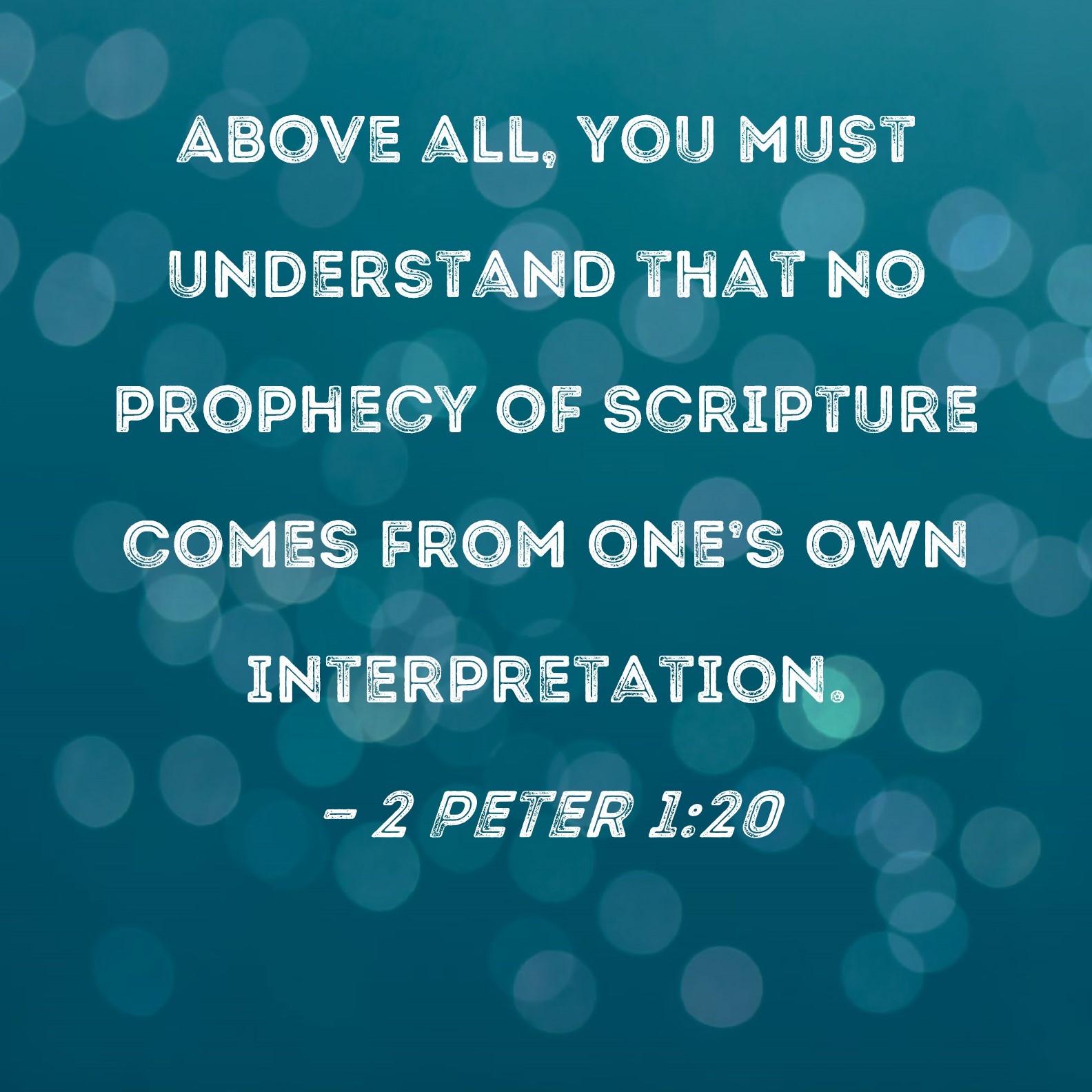
In a former article on bible interpretation titled "A Short Study on Interpretation" (See here) I quoted the above text and wrote the following. (The other previous article "Thoughts On How To Interpret Prophecy" can be read here).
"Knowing this first, that no prophecy of the scripture is of any private interpretation." (II Peter 1: 20)
The Greek word for "interpretation" in this passage is "epilysis," and means 1) a loosening, unloosing, 2) metaph. interpretation. The truth is "tied up," as it were, in the forms of words.
"Trust in the LORD with all thine heart; and lean not unto thine own understanding." (Prov. 3: 5)
1. Catholic misuse (false interpretation) of this passage (or word interpretation)
2. The proper interpretation of the passage and the word
a) Scripture is in harmony with scripture
i) No prophet or apostle said anything contrary to Christ or another inspired writer.
ii) No Christian should interpret scripture in a unique or solitary way.
"How is it then, brethren? when ye come together, every one of you hath a psalm, hath a doctrine, hath a tongue, hath a revelation, hath an interpretation ("hermēneia"). Let all things be done unto edifying." (I Cor. 14: 26)"
This prohibition of the apostle Peter certainly is a destructive blow against all the fanciful interpretations given by those who will not interpret prophecy literally. We gave an example of this in the previous chapter from the writings of C.H. Cayce (Hardshell Baptist pastor, editor, debater, and leader). His interpretation had no grounds for it, violating sound principles of biblical exegeses and interpretation. His interpretation was unique to himself, was of his own making. He did not interpret the text by comparing scripture with scripture and he violated the rule that says "if the literal sense makes sense, seek no other sense."
With these introductory remarks, we will now continue with important citations from professor J. Dwight Pentecost and from his famous book "Things To Come." In that book he writes (first chapter; emphasis mine):
"II. The Literal Method - In direct opposition to the allegorical method of interpretation stands the literal or grammatical-historical method."
"A. The definition of the literal method. The literal method of interpretation is that method that gives to each word the same exact basic meaning it would have in normal, ordinary, customary usage, whether employed in writing, speaking or thinking.— It is called the grammatical-historical method to emphasize the fact that the meaning is to be determined by both grammatical and historical considerations.— Ramm defines the method thus:
The customary, socially-acknowledged designation of a word is the literal meaning of that word."
"The "literal" meaning of a word is the basic, customary, social designation of that word. The spiritual, or mystical meaning of a word or expression is one that arises after the literal designation and is dependent upon it for its existence."
"To interpret literally means nothing more or less than to interpret in terms of normal, usual, designation. When the manuscript alters its designation the interpreter immediately shifts his method of interpreting."
When we say that we interpret the bible literally, this is what we mean. However, the spiritualizer of scripture gives to words and phrases meanings which have no foundation for doing so.
Pentecost writes further:
"B. The evidence for the literal method. Strong evidence can be presented to support the literal method of interpretation. Ramm gives a comprehensive summary. He says:
In defence of the literal approach it may be argued:
(a) That the literal meaning of sentences is the normal approach in all languages...
(b) That all secondary meanings of documents, parables, types, allegories, and symbols, depend for their very existence on the previous literal meaning of the terms...
(c) That the greater part of the Bible makes adequate sense when interpreted literally.
(d) That the literalistic approach does not blindly rule out figures of speech, symbols, allegories, and types; but if the nature of the sentence so demands, it readily yields to the second sense.
(e) That this method is the only sane and safe check on the imaginations of man.
(f) That this method is the only one consonant with the nature of inspiration. The plenary inspiration of the Bible teaches that the Holy Spirit guided men into truth and away from error. In this process the Spirit of God used language, and the units of language (as meaning, not as sound) are words and thoughts. The thought is the thread that strings the words together. Therefore, our very exegesis must commence with a study of words and grammar, the two fundamentals of all meaningful speech."
These are excellent points for all bible students to keep in mind. They are a great defense for the literal meaning of texts as a rule. Further, that is exactly how we speak to each other in every day language. Yes, we do use metaphors and similes, and of these there is often little misunderstanding. But still, the general rule is to take what someone says literally unless context or common sense dictates otherwise.
Pentecost writes further:
"Inasmuch as God gave the Word of God as a revelation to men, it would be expected that His revelation would be given in such exact and specific terms that His thoughts would be accurately conveyed and understood when interpreted according to the laws of grammar and speech. Such presumptive evidence favors the literal interpretation, for an allegorical method of interpretation would cloud the meaning of the message delivered by God to men. The fact that the Scriptures continually point to literal interpretations of what was formerly written adds evidence as to the method to be employed in interpreting the Word. Perhaps one of the strongest evidences for the literal method is the use the New Testament makes of the Old Testament. When the Old Testament is used in the New it is used only in a literal sense. One need only study the prophecies which were fulfilled in the first coming of Christ, in His life, His ministry, and His death, to establish that fact. No prophecy which has been completely fulfilled has been fulfilled any way but literally.— Though a prophecy may be cited in the New Testament to show that a certain event is a partial fulfillment of that prophecy (as was done in Matthew 2:17-18), or to show that an event is in harmony with God's established program (as was done in Acts 15), it does not necessitate a non-literal fulfillment or deny a future complete fulfillment, for such applications of prophecy do not exhaust the fulfillment of it. Therefore such references to prophecy do not argue for a non-literal method."
Again, this is so important for us as bible students to accept and see as true. The words of Pentecost are very eloquent and forceful in the defense of the literal, normal, or plain reading and interpretation of the bible. At the end of this short series we will see how it is true that "no prophecy which has been completely fulfilled has been fulfilled any way but literally." Further, that being true, the Amillennialist or others who spiritualize prophecies and give them a strange non literal interpretation are violating that self evident proposition. Let them come forward and give us an example where a fulfilled prophecy was NOT literally fulfilled. Will they meet that challenge?
Pentecost writes further:
"C. The advantages of the literal method. There are certain advantages to this method in preference to the allegorical method. Ramm summarizes some of these by saying:
(a) It grounds interpretation in fact. It seeks to establish itself in objective data —grammar, logic, etymology, history, geography, archaeology, theology...
(b) It exercises a control over interpretation that experimentation does for the scientific method...justification is the control on interpretations. All that do not measure up to the canons of the literal-cultural-critical method are to be rejected or placed under suspect. In addition to this the method offers the only reliable check on the constant threat to place double-sense interpretation upon the Scripture...
(c) It has had the greatest success in opening up the Word of God. Exegesis did not start in earnest till the church was a millennium and a half old. With the literalism of Luther and Calvin the light of Scripture literally flamed up...This method is the honored method of the highest scholastic tradition in conservative Protestantism. It is the method of Bruce, Lightfoot, Zahn, A. T. Robertson, Ellicott, Machen, Cremer, Terry, Farrar, Lange, Green, Oehler, Schaff, Sampey, Wilson, Moule, Perowne, Henderson Broadus, Stuart—to name but a few typical exegetes."
Again, this is so well stated that it needs little or no comment from me. I have, however, seen these principles neglected in those who say that much of biblical prophecy is not only given in figurative or symbolic language but is fulfilled in a non literal manner. But, I would challenge any who affirm this to give us examples where this is so in the bible's many prophecies.
I also would challenge the idea of many who say that "apocalyptic" scripture is by its nature figurative and does not denote literal fulfillment. But, apocalyptic or eschatological scripture may use figures or symbols to foretell coming literal events, but their fulfillment is literal. We will give examples of this later.
Pentecost writes further:
"D. The literal method and figurative language. It is recognized by all that the Bible abounds in figurative language. On this basis it is often argued that the use of figurative language demands a figurative interpretation. However, figures of speech are used as means of revealing literal truth. What is literally true in one realm, with which we are familiar, is brought over, literally, into another realm, with which we may not be familiar, in order to teach us truths in that unfamiliar realm. This relation between literal truth and the figurative language is well illustrated by Gigot:
It will thus be observed that the literalist does not deny the existence of figurative language. The literalist does, however, deny that such figures must be interpreted so as to destroy the literal truth intended through the employment of the figures. Literal truth is to be learned through the symbols."
Very good commentary. When the figurative interpreter shows how the bible uses figures and metaphors, etc., and then attempts to use this fact to support his interpreting scripture figuratively, he is proving what needs no proof, but he is jumping to conclusions when he says that the use of figures show that there are figurative fulfillments of prophecy, he is then way off base.
Pentecost writes further in chapter two:
"The prevailing method of interpretation among the Jews at the time of Christ was certainly the literal method of interpretation."
This is generally conceded by all, even by the spiritualizers. Christ himself interpreted the old testament prophecies literally, as did the apostles and those in the early church.
Pentecost writes further:
"Case, an ardent advocate of amillennialism, concedes:
"Ever since Origen's day certain interpreters of Scripture have sought to refute millennial expectations by affirming that even the most striking statements about Jesus' return are to be understood figuratively. It has also been said that Daniel and Revelation are highly mystical and allegorical works not intended to refer to actual events, whether past, present, or future, but have a purely spiritual significance like that of Milton's Paradise Lost or Bunyan's Pilgrim's Progress."
"This literal method was the method of the apostles."
Frankly, I do not understand the incentive for Amillennialists and others of their ilk having problems accepting the prophetic scriptures literally. Again, if the literal sense makes sense, why seek another sense? It must be because of some built in bias against prophetic studies, being like those in the early church who were warned to not despise prophesyings by the apostle. (See I Thess. 5: 20) Or, like those today who scoff at those who preach on end time events and point to things happening in the world as fulfillments of bible prophecies.
Pentecost writes further in Chapter 3:
"When is language literal or figurative? The first problem facing the interpreter is that of determining when the language is literal and when it is figurative. The implications of this problem are stated by Horne:
In order, then, to understand fully the figurative language of the Scriptures, it is requisite, first, to ascertain and determine what is really figurative, lest we take that to be literal which is figurative, as the disciples of our Lord and the Jews frequently did, or lest we pervert the literal meaning of words by a figurative interpretation; and, secondly, when we have ascertained what is really figurative, to interpret it correctly, and deliver its true sense."
"A simple rule to follow in determining what is literal and figurative is given by Lockhart, who says: If the literal meaning of any word or expression makes good sense in its connections, it is literal; but if the literal meaning does not make good sense, it is figurative."
I believe that this rule should be kept always in mind. Continued Pentecost, saying:
"Later the same author adds:
Since the literal is the most usual signification of a word, and therefore occurs much more frequently than the figurative, any term will be regarded as literal until there is good reason for a different understanding...The literal or most usual meaning of a word, if consistent, should be preferred to a figurative or less usual signification."
Pentecost then adds this thought:
"Thus, the interpreter will proceed on the presupposition that the word is literal unless there is a good reason for deciding otherwise."
That "good reason" would be the context, common sense, common usage and meaning in the day in which the words were spoken. If it is NOT true that we should interpret the bible's words literally, then how do the spiritualizers decide when to interpret literally and when not to do so?
Pentecost continued:
"Fairbairn goes on to give us some principles by which one may determine whether a passage is literal or figurative. He says:
"The first of these is that, when anything is said which if taken according to the letter would be at variance with the essential nature of the subject spoken of, the language must be tropical. A second principle applicable to such cases is that, if the language taken literally would involve something incongruous or morally improper, the figurative and not the literal sense must be the right one. A third direction may be added, viz., that where we have still reason to doubt whether the language is literal or figurative we should endeavor to have the doubt resolved by referring to parallel passages (if there be any such) which treat of the same subject in more explicit terms or at greater length."
As I stated in the first article in this series, the bible is its own best interpreter. If you want to know the meaning of a word used in the bible, then you should not only see what the definition of it is by scholars of the language (either Hebrew or Greek), but see how it is used in the scriptures. This is what it means to have doubt about the meaning of a word or text removed, as Pentecost says - "have the doubt resolved by referring to parallel passages."
Pentecost continued:
"This whole problem of when language is figurative and when literal has been well summarized by Terry, who comments:
It is scarcely necessary, and, indeed, quite impracticable, to lay down specific rules for determining when language is used figuratively and when literal. It is an old and oft-repeated hermeneutical principle that words should be understood in their literal sense unless such literal interpretation involves a manifest contradiction or absurdity. It should be observed, however, that this principle, when reduced to practice, becomes simply an appeal to every man's rational judgment. And what to one seems very absurd and improbable may be to another altogether simple and self-consistent...Reference must be had to the general character and style of the particular book, to the plan and purpose of the author, and to the context and scope of the particular passage in question. Especially should strict regard be had to the usage of the sacred writers, as determined by a thorough collation and comparison of all parallel passages. The same general principles, by which we ascertain the grammatico-historical sense, apply also to the interpretation of figurative language, and it should never be forgotten that the figurative portions of the Bible are as certain and truthful as the most prosaic chapters. Metaphors, allegories, parables, and symbols are divinely chosen forms of setting forth the oracles of God, and we must not suppose their meaning to be so vague and uncertain as to be past finding out. In the main, we believe the figurative parts of the Scriptures are not so difficult to understand as many have imagined. By a careful and judicious discrimination the interpreter should aim to determine the character and purport of each particular trope, and explain it in harmony with the common laws of language, and the author's context, scope, and plan."
Excellent words of instruction to all who are serious bible students!
Pentecost continued:
"A rule to guide us as to when to interpret literally and when figuratively has been carefully stated by Cooper. He says:
When the plain sense of Scripture makes common sense, seek no other sense; therefore, take every word at its primary, ordinary, usual, literal meaning unless the facts of the immediate context, studied in the light of related passages and axiomatic and fundamental truths, indicate clearly otherwise."
Again, this cannot be emphasized enough.
Pentecost continued:
"It should be observed at the very outset that the purpose of figurative language is to impart some literal truth, which may more clearly be conveyed by the use of figures than in any other way. The literal meaning is of greater importance than the literal words."
Again, well stated counsel to all who study the bible.
Pentecost continued:
"Horne has given an extensive set of rules in order to determine properly the sense implied in any figure: 1. The literal meaning of words must be retained, more in the historical books of Scripture than in those which are poetical."
I certainly do agree with Horne and Pentecost in their defense of the literal method. I would encourage all who are interested in this subject to read all Pentecost writes in the chapters of "Things To Come" that deal with interpretation of the bible and of prophecy.
Friday, November 29, 2024
Bible Hermeneutics

There is a rule in bible interpretation, or hermeneutics, which says "If the Literal Sense Makes Sense Seek No Other Sense." This is the rule I believe the bible writers themselves seemed clearly to adhere to. Does that mean that everything in the bible is literal? That there are no figures, types, parables, metaphors, similes, and such like? No; The literal interpretation of the bible accepts all these. So, how do bible students determine what is literal and what is non-literal (or what is figurative or symbolic)?
We get our word "hermeneutics" from the Greek word that is translated into English bibles as "interpret," "interpreted," or "interpretation." The verb form of the Greek word is "hermēneuō" and may mean either to translate or to interpret.
I believe that the bible is to be interpreted literally. I also believe that this is true in regard to bible prophecies. That is my thesis for this short series.
I have previously written on this in my posting "Thoughts On How To Interpret Prophecy" (here) and I would encourage all to read it in conjunction with what I now write. In that previous posting I wrote, citing Bernard Ramm:
"To treat figurative language as if it were literal, and to treat literal language as if it were figurative, constitute two of the greatest hindrances to understanding the meaning of the Bible."
One example to consider in regard to this issue has to do with the Communion Supper, often called the Eucharist, and whether the words of Christ are to be interpreted literally or figuratively, the words "take eat for this is my body (or flesh)" and "drink, for this is my blood." Though I take the bible literally, that does not mean that there are no figures or figurative language in the bible, for the bible is full of figures, types, likenesses, similes, metaphors, etc.
We should take the bible literally unless there are reasons in the context or in reason to not do so. It is possible that the words of Jesus about the bread and wine being his body and blood are literally true, context however and common sense leads us not to do so. If I hand a photograph of my daughter to a friend and say "this is my daughter" it is well understood that the photograph is not my literal daughter, but is rather a figure of her. This is how the words of Christ are to be interpreted. They all understood that Jesus meant "this is a symbol or figure of my body and blood." The same thing may be said about the washing, or salvation, that is connected with the rite of Christian baptism (Acts 22: 16; I Peter 3: 21). This ritual, like the rite of the Eucharist, is a picture, a figure, a type, a symbol. In Romans 6: 5 it is called a "likeness" which is from the Greek word "homoiōma" and means likeness, figure, or symbol. Peter says that baptism in water is a "like figure" of salvation. So, when the bible tells us something is a figure, we ought not to take it literally.
Another example are seen in these words of the apostle Paul:
"Moreover, brethren, I do not want you to be unaware that all our fathers were under the cloud, all passed through the sea, all were baptized into Moses in the cloud and in the sea, 3 all ate the same spiritual food, and all drank the same spiritual drink. For they drank of that spiritual Rock that followed them, and that Rock was Christ." (I Cor. 10: 1-4 nkjv)
It is generally conceded by bible teachers that the words "that Rock was Christ" are not to be taken literally but figuratively. In other words, "that Rock" was a picture or type of Christ. Many scriptures refer to God as "the Rock." Wrote the Psalmist for instance:
"The LORD is my rock, my fortress and my deliverer; my God is my rock, in whom I take refuge, my shield and the horn of my salvation, my stronghold." (Psa. 18: 2 niv)
However, figurative language is used to convey literal truth. God is literally all the things we attribute to being rock. A rock is solid strength, hardness, and endurance. God is literally these things. In the above Psalm God is literally a fortress and deliverer, a refuge, a shield, a stronghold, and all this is connected with rock.
Next I want to cite from J. Dwight Pentecost and his famous book "Things To Come: A Study in Biblical Eschatology." This classic book can be read online (here). In Chapter One - "Methods of Interpretation" Pentecost writes (emphasis mine):
"No question facing the student of Eschatology is more important than the question of the method to be employed in the interpretation of the prophetic Scriptures. The adoption of different methods of interpretation has produced the variant eschatological positions and accounts for the divergent views within a system that confront the student of prophecy. The basic differences between the premillennial and amillennial schools and between the pretribulation and posttribulation rapturists are hermeneutical, arising from the adoption of divergent and irreconcilable methods of interpretation."
I believe it is true that those who take the prophetic scriptures literally become Premillennial and that the chief tenets of Premillennialism are a result of taking the prophecies literally. Most scholars acknowledge that this is the case. If so, then we should be very concerned on the question of the mode of interpreting both scripture and the prophecies thereof. However, I disagree with Pentecost when he affirms that the pretribulation and/or posttribulation views are a result of one side not taking the prophecies literally. I am a classical Premillennialist, and as such believe the rapture and resurrection of saints follows the time of "the great tribulation" and yet I take the prophecies literally.
Pentecost continued:
"The basic issue between premillennialists and amillennialists is clearly drawn by Allis, who writes:
One of the most marked features of Premillennialism in all its forms is the emphasis which it places on the literal interpretation of Scripture. It is the insistent claim of its advocates that only when interpreted literally is the Bible interpreted truly; and they denounce as "spiritualizers" or "allegorizers" those who do not interpret the Bible with the same degree of literalness as they do. None have made this charge more pointedly than the Dispensationalists. The question of literal versus figurative interpretation is, therefore, one which has to be faced at the very outset [italics mine]."
"When Allis acknowledges that "Literal interpretation has always been a marked feature of Premillennialism" - he is in agreement with Feinberg, who writes:
...it can be shown that the reason the early Church was premillennial was traceable to its interpretation of the Word in a literal manner, whereas the cause of the departure from this view in later centuries of the history of the Church is directly attributable to a change in method of interpretation beginning with Origen in particular."
I hope to show in this short series how the new testament writers interpreted the old testament prophecies literally and that this is our guide in doing the same. One of my other theses in this series affirms that "all fulfilled prophecy has been fulfilled literally." If I can demonstrate that truth, then there is no validity for any to show that prophecy has been or will be fulfilled in a figurative sense, i.e. non literally. Whether it be true that some Dispensational Premillennialists go too far in interpreting prophecy literally, being overly literal, is a matter of opinion. We have already seen where some take things literally that were not intended to be taken literally.
Pentecost cites Hamilton who says:
"Now we must frankly admit that a literal interpretation of the Old Testament prophecies gives us just such a picture of an earthly reign of the Messiah as the premillennialist pictures. That was the kind of a Messianic kingdom that the Jews of the time of Christ were looking for, on the basis of a literal interpretation of the Old Testament promises. That was the kind of a kingdom that the Sadducees were talking about when they ridiculed the idea of the resurrection of the body, drawing from our Lord the clearest statement of the characteristics of the future age that we have in the New Testament, when He told them that they erred "not knowing the Scriptures nor the power of God" (Matt. 22:29)...the Jews were looking for just such a kingdom as that expected by those premillennialists who speak of the Jews holding a preeminent place in an earthly Jewish kingdom to be set up by the Messiah in Jerusalem."
Again, there is no question that the Jews in the time of Christ interpreted the old testament prophecies literally. There is no question that the apostles continued to do so after the ascension of Christ. None of the new testament inspired writers interpreted old testament prophecies any other way than literally.
Wrote Pentecost:
"Therefore, the antecedent to any discussion of the prophetic Scriptures and the doctrines of Eschatology is the establishment of the basic method of interpretation to be employed throughout. This is well observed by Pieters, who writes:
The question whether the Old Testament prophecies concerning the people of God must be interpreted in their ordinary sense, as other Scriptures are interpreted, or can properly be applied to the Christian Church, is called the question of the spiritualization of prophecy. This is one of the major problems of biblical interpretation, and confronts everyone who makes a serious study of the Word of God. It is one of the chief keys to the difference of opinion between Premillenarians and the mass of Christian scholars. The former reject such spiritualization, the latter employ it; and as long as there is no agreement on this point the debate is interminable and fruitless [italics mine]."
When I was with the Hardshell (or "Primitive") Baptists I saw them spiritualize most prophecies in the old testament. Being Amillennial, they would apply nearly all old testament prophecies to the present age, to life in the church, rather than to the age to come, or to the future millennium. The prophecy of the lion lying down with the lamb (Isa. 11: 6) was figurative language to describe the peace within the church family. The prophecy of the desert blossoming as a rose (Isa. 35: 1) was also figurative of the prosperity of the church. I always had a reluctance to follow them in this kind of hermeneutics.
Wrote Pentecost:
"Since the interpreter is not handling a book of human origin, but the Word of God, he must be equipped with an accurate method of interpretation or error will be the necessary result of his study. The fact that the Word of God cannot be correctly interpreted apart from a correct method of and sound rules for interpretation gives the study its supreme importance."
This is so true. Just ask people the simple question "do you take the bible literally" and see the answers you will get. Again, to take the bible literally does not mean that everything said in the word of God is to be taken literally. There are figures and similes and metaphors galore in scripture. I expect people to take what I say literally as a rule, but there are exceptions to the rule, and yet people do not generally take me literally when I speak in a metaphor or simile. Jesus told some to go to Herod with these words - "go and tell that fox" (Luke 12: 32). Clearly Herod was not a literal fox. Common sense tells us that. We take words literally unless context or common sense dictate otherwise.
Sarcasm in the bible is another problem with interpreters of the bible. As all know, when we speak sarcastically, we don't want to be understood literally or as stating a truth, for it is understood that what we are saying is not literally true, the truth being the opposite of the literal. I could say sarcastically to a fool - "you are such a genius" when I really mean that you are not a genius at all.
Wrote Pentecost:
"While many diverse methods of interpreting the Scriptures have been propounded during the course of the history of interpretation, today there are but two methods of interpretation which have a vital effect on Eschatology: the allegorical and the grammatical-historical methods. The literal method is generally held to be synonymous with the grammatical-historical method and will be so used throughout this discussion. These two methods will be considered in detail."
The method of interpretation employed by Christ and the new testament writers was clearly the grammatical or historical method.
Wrote Pentecost:
"It would seem that the purpose of the allegorical method is not to interpret Scripture, but to pervert the true meaning of Scripture, albeit under the guise of seeking a deeper or more spiritual meaning."
This is so true. When we throw away the literal method of bible interpretation, then we leave it up to each person's whim to interpret the figurative meaning. The prophecy of the lion lying down with the lamb could be made to fit any experience or state the interpreter wishes.
Wrote Pentecost:
"The allegorical method is fraught with dangers which render it unacceptable to the interpreter of the Word."
Amen.
Wrote Pentecost:
"The first great danger of the allegorical method is that it does not interpret Scripture. Terry says:
...it will be noticed at once that its habit is to disregard the common signification of words and give wing to all manner of fanciful speculation. It does not draw out the legitimate meaning of an author's language, but foists into it whatever the whim or fancy of an interpreter may desire. As a system, therefore, it puts itself beyond all well-defined principles and laws."
Excellent counsel! In Amillennial circles we see all kinds of examples where such whims and fanciful interpretation are common.
Wrote Pentecost:
"Angus-Green express the same danger when they write:
There is...unlimited scope for fancy, if once the principle be admitted, and the only basis of the exposition is found in the mind of the expositor. The scheme can yield no interpretation, properly so called, although possibly some valuable truths may be illustrated."
Again, all I can say is "amen."
Wrote Pentecost:
"The above quotation suggests, also, a second great danger in the allegorical method: the basic authority in interpretation ceases to be the Scriptures, but the mind of the interpreter. The interpretation may then be twisted by the interpreter's doctrinal positions, the authority of the church to which the interpreter adheres, his social or educational background, or a host of other factors."
This is so true, especially when it comes to interpreting bible prophecy and the book of Revelation. God is his own interpreter. The scriptures interpret themselves, i.e. we see how later inspired writers interpreted prophecy.
Citing Farrar Pentecost writes:
"...When once the principle of allegory is admitted, when once we start with the rule that whole passages and books of Scripture say one thing when they mean another, the reader is delivered bound hand and foot to the caprice of the interpreter."
Agreed. Prophecy cannot be interpreted to mean anything that comes into the mind of the interpreter. Even the symbols used in prophetic utterances are common symbols used elsewhere in the bible and have a clear usage and meaning.
I find it interesting that those Amillennialist commentators who read of the plagues sent by God upon the land of Egypt in the Exodus will interpret them literally but when they read of similar plagues in the book of Revelation they are often interpreted non literally. The plague of locusts in the Exodus or in the prophecies of Joel are literal locusts, but not the locusts of the Apocalypse?
Wrote Pentecost:
"A third great danger in the allegorical method is that one is left without any means by which the conclusions of the interpreter may be tested."
Again, this is another point to remember. It is also an unanswerable objection to the allegorical method of interpretation.
Citing Ramm Pentecost adds:
" ...to state that the principal meaning of the Bible is a second-sense meaning, and that the principal method of interpreting is "spiritualizing," is to open the door to almost uncontrolled speculation and imagination. For this reason we have insisted that the control in interpretation is the literal method."
I heard many sermons among the Hardshell Baptists that fit this description. They spiritualized many literal prophecies. For instance, Elder C.H. Cayce, one of the foremost leaders of the "Primitive Baptist" church, and who edited the paper "The Primitive Baptist" (the second one by that name) in the end of the 19th century and well into the 20th century, wrote the following in his editorial writings (see here) for March 5th, 1918 (emphasis mine):
"Brother Enoch Bledsoe, of Blackwater, Va., requests our views of (Revelation
16:13), which reads: "And I saw three unclean spirits like frogs come out of the
mouth of the dragon, and out of the mouth of the beast, and out of the mouth of
the false prophet." We do not feel an inclination, or desire to offer more than a few
remarks in connection with the text.
The unclean spirits were like frogs; they were not frogs, but they were like them.
Frogs usually make more noise as spring approaches. As you travel along, and
come near a low, swampy place, in spring time, you can usually hear a great noise.
So, there are some spirits which make a great noise as spring approaches. As the
weather turns warm, and there are signs of approaching spring, the noise of the "big meetings" begin (an allusion to Spring revival meetings by Missionary Baptists).
Frogs are amphibious-they live in water or on land. Yet they are usually more often
found in low, marshy places; that is, some of them are. Others (as toads) usually
hide during the day and come out to feed at night.
Some species of them are hatched in the water-perhaps most of them. At first they
are tadpoles. They change from tadpoles to frogs when the tail disappears. As
tadpoles they live in the water. As frogs they live in water or on land.
Some spirits say you can't have Christians without water (an allusion to Campbellites who say you must be baptized in water to be Christian). They have to gather
'round the water to make Christians, or rather, to make children of God. That's like
the frog.
There is another kind of frog called the tree frog. It turns the same color as the
article it is on. If it is on a gray bark it will turn gray. Put it on a brown leaf, and it
will turn brown. Put it on a white article, and it will turn white. Put it on a black
stump, and it will turn black. Put it on a green leaf, and it will turn green.
There is a spirit like that. Some folks are always of your opinion when they are with
you. Put them with others whose opinion is different, and their opinion will be
different. They always agree with those they are with. They can shift in opinion as
quickly and as conveniently as the tree frog can change in color.
Some frogs will hide under bushes and leaves, and will come out readily when it
rains. The sprinkle suits them all right; but they seldom get in the water. So, there
are some who like sprinkling all right; they seldom get in the water.
Comparisons might be made still farther. Study the nature of frogs, and compare
the same with the spirits, and you will find that these are only a few that may be
correctly made."
That is a perfect example of interpreting bible prophecy by a whim, of fanciful interpretation. If the literal is not true, then its anyone's guess as to what the prophecy says.
Wrote Pentecost:
"That these dangers exist and that the method of interpretation is used to pervert Scripture is admitted by Allis, who is himself an advocate of the allegorical method in the field of Eschatology, when he says:
Whether the figurative or "spiritual" interpretation of a given passage is justified or not depends solely upon whether it gives the true meaning. If it is used to empty words of their plain and obvious meaning, to read out of them what is clearly intended by them, then allegorizing or spiritualizing is a term of reproach which is well merited."
Amen. The example given by Cayce is case in point.
Wrote Pentecost:
"Thus, the great dangers inherent in this system are that it takes away the authority of Scripture, leaves us without any basis on which interpretations may be tested, reduced Scripture to what seems reasonable to the interpreter, and, as a result, makes true interpretation of Scripture impossible."
Exactly! So, how could anyone check the interpretation of Cayce?
Wrote Pentecost:
"It must be carefully observed that in Galatians 4:21-31 Paul is not using an allegorical method of interpreting the Old Testament, but was explaining an allegory. These are two entirely different things. Scripture abounds in allegories, whether types, symbols, or parables. These are accepted and legitimate media of communication of thought. They do not call for an allegorical method of interpretation, which would deny the literal or historical antecedent and use the allegory simply as a springboard for the interpreter's imagination. They do call for a special type of hermeneutics, which will be considered later. But the use of allegories is not a justification for the allegorical method of interpretation. It would be concluded that the usage in Galatians of the Old Testament would be an example of interpretation of an allegory and would not justify the universal application of the allegorical method to all Scripture."
Again, we see this to be true in the allegorical, figurative, or spiritualized manner that many Amillennialists are seen putting into practice.
Wrote Pentecost:
"In reply to the accusation that because one interprets types he is using the allegorical method, it must be emphasized that the interpretation of types is not the same as allegorical interpretation. The efficacy of the type depends on the literal interpretation of the literal antecedent. In order to convey truth concerning the spiritual realm, with which realm we are not familiar, there must be instruction in a realm with which we are familiar, so that, by a transference of what is literally true in the one realm, we may learn what is true in the other realm. There must be a literal parallelism between the type and the antitype for the type to be of any value. The individual who allegorizes a type will never arrive at a true interpretation. The only way to discern the meaning of the type is through a transference of literal ideas from the natural to the spiritual realm."
Amen. Brothers, these are important observations to keep in mind as we study the bible, and especially study prophetic oracles. In the next chapter we will continue to look at further things Pentecost and others had to say about the interpretation of prophecy in eschatology.
Wednesday, November 27, 2024
By Faith = By Works?
A common argument by Hardshell Baptists says that "if salvation is by faith then it is by works." And, since salvation is said to be "not of works," then it is also not by faith. However, the following verse shows this argument is invalid.
"But to him who does not work but believes on Him who justifies the ungodly, his faith is accounted for righteousness." (Rom. 4: 5 nkjv)
That shows us that a person is saved by faith and not saved by works. Ergo, faith is not a work. In the same chapter the apostle Paul also says:
"Therefore it is of faith that it might be according to grace" (vs. 16).
When I was a Hardshell this verse caused me all kinds of problems. I wanted the text to say "therefore it is of grace that it might be according to faith." But, it did not read that way. The same apostle wrote "for by grace are you saved through faith" (Eph. 2: 8).
These verses uproot all the argumentation of the Hardshells about how faith is a work and destroys their contention that salvation cannot be "by faith."
See my posting "Hardshell Anti Faith Preaching" (See here) for more on this denial of the role of faith in salvation.
Monday, November 25, 2024
Satan's Usurpation of the Political World
“The ten horns which you saw are ten kings who have received no kingdom as yet, but they receive authority for one hour as kings with the beast." (Rev. 17: 12 nkjv)
"And I saw three unclean spirits like frogs coming out of the mouth of the dragon, out of the mouth of the beast, and out of the mouth of the false prophet. For they are spirits of demons, performing signs, which go out to the kings of the earth and of the whole world, to gather them to the battle of that great day of God Almighty." (Rev. 16: 13-14 nkjv)
Notice how Satan through his demons are able to "go out to" the kings and rulers of the world and to control what they do, even to gather them together for "the battle of that great day of God Almighty."
Satan's influence in world politics is also alluded to in several other bible texts. The apostle John testified:
"We know that we are children of God, and that the whole world is under the control of the evil one." (I John 5: 19 niv)
"So the great dragon was cast out, that serpent of old, called the Devil and Satan, who deceives the whole world; he was cast to the earth, and his angels were cast out with him." (Rev. 12: 9 nkjv)
The fight for political power is seen in the book of Daniel in these words:
"Then he said to me, “Do not fear, Daniel, for from the first day that you set your heart to understand, and to humble yourself before your God, your words were heard; and I have come because of your words. “But the prince of the kingdom of Persia withstood me twenty-one days; and behold, Michael, one of the chief princes, came to help me, for I had been left alone there with the kings of Persia...Then he said, “Do you know why I have come to you? And now I must return to fight with the prince of Persia; and when I have gone forth, indeed the prince of Greece will come." (Dan. 10: 12-13, 20 nkjv)
Bible scholars agree that by "prince of the kingdom of Persia" is a spiritual or demonic being. This text shows that Satan, through his demons, exercises political power.
Bible prophecy tells us that there is a coming "Antichrist," who is "the son of perdition," or son of the Devil, and who will be ruler over a one world government or as described in the Books of Daniel and Revelation where he and his empire are called "the beast."
How much influence does Satan have in our government? How much in other governments today? If we are to keep an eye on Satan's workings, we will certainly be keeping an eye on global politics in the very last days. Of course, God will also be at work among the nations as he has always been.
United To Christ by Faith (Spurgeon)

From Charles Spurgeon's "Morning and Evening" on "fellowship with him." (for November 23rd)
What do these words tell us about the "ordo salutis" of Spurgeon? He put faith in the first place, for he believed as did John Calvin, that faith is the means for being united to Christ and that all spiritual blessings come as a result of such union.
What think ye?
Subscribe to:
Posts (Atom)