Tuesday, August 5, 2025

Two Seed Baptist Ideology (V)


"And the angels which kept not their first estate, but left their own habitation

he hath reserved in everlasting chains under darkness unto the judgment of the great day." 

(Jude 1: 6 kjv)

The above text speaks of the "estate" and special "habitation" of angels. What is the original dwelling place of angels? Is it heaven? The third heaven? Or, is their dwelling place outer space or in earth's sky and atmosphere? Other translations give us these translations:

"but abandoned their proper dwelling" (NIV);

"but left their proper dwelling" (ESV);

"did not keep their proper domain, but left their own abode" (NKJV).

"Their first estate" literally means their first rank or position in the hierarchy of creatures. On "their own habitation" Albert Barnes in his commentary rightly says:

"But left their own habitation - To wit, according to the common interpretation, in heaven. The word rendered "habitation" (οἰκητήριον oikētērion) occurs nowhere else in the New Testament. It means here that heaven was their native abode or dwelling-place."

John Gill in his commentary writes:

"...for they were drove out of their native habitation, heaven; they were turned out of it, and cast down to hell; see 2 Peter 2:4. And this their habitation, which they left, or fell from, or they were cast out of..."

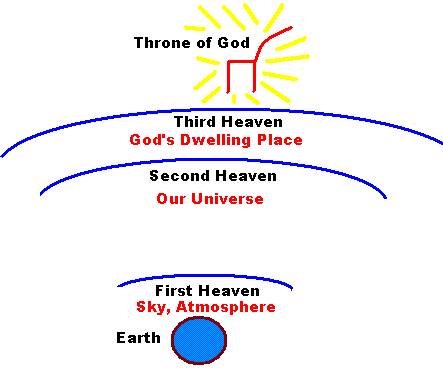
I dare say that this is the view of the vast majority of bible teachers. The view of semi Two Seeders, who we cited in the previous chapter and who said that the "heaven" out of which Satan and the non-elect angels were cast when they sinned was not the third heaven, but some other heaven, gave to heaven other meanings. Many of these meanings were not in accordance with the image at the head of this chapter. Rather than seeing the first and second heavens as described in that image, they come up with strange and novel meanings for heaven. John Robbins who debated father on the point said that maybe the heaven out of which Satan and the angels were cast was "the old Jewish heaven" or "the church heaven." But, this is farcical and a gross mishandling of scripture. It is nonsensical and leads to gross absurdities, reduction ad absurdum.

The bible is very clear on what is the natural abode of angels. This we will demonstrate shortly. The first heaven of earth's atmosphere was not the original home of angels. If that is the heaven from which Satan and the sinning angels were cast out of, then why do the scriptures show them as still occupying the aerial region? The second heaven of outer space cannot be the original home of angels, for again the fallen angels still occupy those regions. The church of either the old covenant or the new cannot be the original abode of angels because angels existed before there was a church, and trying to explain what that could possibly mean leads to further absurdities. We will enlarge upon these points but first let us show the absurdity in saying that angels are human beings.

Angels Are Not Humans

"What is man that You are mindful of him, And the son of man that You visit him? For You have made him a little lower than the angels, And You have crowned him with glory and honor." (Psa. 8: 4-5 nkjv)

This text is very clear in showing that humans are not angels. Man was made a little lower than the angels, which statement shows that human beings are a lower order of creatures than are angels, and that the Two Seed notion of angels being humans is false. Wrote Peter:

"They are not afraid to speak evil of dignitaries, whereas angels, who are greater in power and might, do not bring a reviling accusation against them before the Lord." (II Peter 2: 10-11 nkjv)

This is similar to these words of the Psalmist:

"The Lord has established His throne in heaven, And His kingdom rules over all. Bless the Lord, you His angels, Who excel in strength, who do His word, Heeding the voice of His word." (Psa. 103: 19-20 nkjv)

These verses again show that human beings are inferior to angels as a species. To say that angels in these verses are human beings make the verses nonsensical. Who are the angels superior to? Answer: human beings. Therefore, angels are not human beings. Wrote the writer of Hebrews:

"And of the angels He says: “Who makes His angels spirits And His ministers a flame of fire.”...But to which of the angels has He ever said: “Sit at My right hand, Till I make Your enemies Your footstool”? Are they not all ministering spirits sent forth to minister for those who will inherit salvation?" (Heb. 1: 7; 13-14 nkjv)

Angels are "ministering spirits." Spirits are incorporeal. Jesus said this about being "spirit":

"Behold My hands and My feet, that it is I Myself. Handle Me and see, for a spirit does not have flesh and bones as you see I have.” (Luke 24: 39 nkjv)

On Hebrews 1: 7 John Gill wrote the following in his commentary, giving the nigh universally understood meaning:

"...the design of the apostle in citing them, which is to show the superiority of Christ to angels, of whom it is said, that they are made spirits: they are "spirits", created ones, and so differ from God the Creator: they are incorporeal ones, and so differ from men; they are immaterial, and so die not; they are spiritual substances subsisting in themselves..." 

It is against such clear statements about who are the angels, and what is their nature, that Two Seeders oppose when they say that angels are human beings. Shortly after Hebrews chapter one, the writer of Hebrews says the following in the second chapter:

“For verily [Christ] took not on him the nature of angels; but he took on him the seed of Abraham.” (Hebrews 2:16). 

This verse indicates clearly that the "nature of angels" is not the same as the nature of human beings. On this verse Dr. Gill writes:

"...but of a non-assumption of their nature; there was no need of it with respect to good angels, and there was no salvation designed for evil ones; and to have assumed the nature of angels, would have been of no service to fallen man; an angelic nature is not capable of death, which was necessary to atone for sin, save men, and destroy Satan..."

These verses, along with many more we could cite, show that angels are not human beings. It is a ridiculous idea for Parker, Beebe, and the Two Seeders to affirm that angels are human beings and that Satan is uncreated, possibly even was originally a snake of the animal kingdom. Such a view denies that angels are superior to humans and rather says that humans are superior to angels.

The writer of Hebrews also speaks of an “innumerable company of angels and distinguishes them from “the spirits of just men made perfect” (Hebrews 12:22-23). 

Now let us return to showing that the third heaven is the proper abode of angels.

Angels of Heaven

"And He said to him, “Most assuredly, I say to you, hereafter you shall see heaven open, and the angels of God ascending and descending upon the Son of Man.” (John 1: 51 nkjv)

We cited this verse in the previous chapter when we cited Hassell's mentioning the dream of Jacob wherein he saw a ladder extending from earth to heaven and found it ironic because Hassell did not believe that the proper abode of angels was the third heaven. Clearly the above text indicates that the heaven from which angels descended and ascended into is the highest heaven where God's presence is fully manifested and where he sits on the throne.

Jesus in speaking of those little ones who come to him said:

"...in heaven their angels do always behold the face of my Father which is in heaven." (Matt. 18: 10 kjv)

Notice how the word "heaven" is twice used. Only those who come to the text with man-made biases and presuppositions as do the Two Seeders will fail to see that angels are from the third heaven. Jesus also spake of resurrection saints becoming immortal "as the angels of God in heaven." (Matt. 22: 30 kjv) To give to the word "heaven" in these texts the meaning of first or second heaven, or the heaven of the church, is totally untenable. Jesus more than once spoke of "the angels of heaven." (See also Matt. 24: 36)

We have also already mentioned this text from the Book of Job:

"Now there was a day when the sons of God came to present themselves before the LORD, and Satan also came among them." (Job 1: 6)

This is obviously heaven, for it is in the presence of the LORD.

Recall these words of the angel Gabriel:

"And the angel answered and said to him (Zacharias), “I am Gabriel, who stands in the presence of God, and was sent to speak to you and bring you glad tidings." (Luke 1: 19 nkjv)

Can anything be more clear that angels are in the third heaven? Does not that fact disprove the premise of Beebe and the Two Seeders who say 1) that angels are humans, and 2) that if they fell from heaven, it could not have been the third heaven? Though Gabriel probably appeared to Mary in a human form, as they have often done, he was not human. Now let us notice these words from the Book of Daniel:

"All the inhabitants of the earth are reputed as nothing; He does according to His will in the army of heaven And among the inhabitants of the earth. No one can restrain His hand Or say to Him, “What have You done?” (Dan. 4: 35 nkjv)

It is universally acknowledged by all that by "army of heaven" is meant the "heavenly host" of angels. They are distinguished from "the inhabitants of the earth." Next, let us notice these words of the apostle Paul:

"For we wrestle not against flesh and blood, but against principalities, against powers, against the rulers of the darkness of this world, against spiritual wickedness in high places." (Eph. 6: 12 kjv)

On this Dr. Gill comments:

"...against spiritual wickedness in high places; or wicked spirits, as the devils are, unclean, proud, lying, deceitful, and malicious; who may be said to be in "high" or "heavenly places"; not in places super celestial, or in the highest heavens, in the third heaven, where God, angels, and saints are; but in the aerial heavens, where the power or posse of devils reside, and where they are above us, over our heads, overlooking us, and watching every advantage against us; and therefore we should have on our armour, and be in a readiness to engage them; and so the Syriac and Ethiopic versions render it, "under", or "beneath heaven"; and the Arabic version, "in the air"."

These "rulers" and "principalites" and "wicked spirits" are NOT "flesh and blood" beings, i.e. not human beings. Further, they occupy the first and second heavens, and therefore these heavens cannot be the heaven out of which they were cast.

Therefore we see how absurd is this idea of the Two Seed Baptists which denies the creation of angels and of the fall of some of them and which attempts to say that angels are human beings. Though Watson, Hassell, and Daniels, who we cited in the previous chapter, don't accept those Two Seed ideas, yet they show remnants of that ideology when they deny that the proper habitation of angels is the third heaven.

In the next chapter we will look at another false idea of the Two Seeders, which says that Christ being the begotten Son of God has nothing to do with his divinity, but with his humanity, and that his humanity preexisted his birth of the virgin Mary. We will then deal with their belief that the souls or spirits of the elect were created when Christ was begotten before the world began, being then in Christ, being a case of the preexistence of their souls. 

Monday, August 4, 2025

Two Seed Baptist Ideology (IV)


In this chapter we will continue to trace the beliefs of the Primitive Hardshell Baptists since their genesis in the early nineteenth century. We began with a look at the views of Daniel Parker, the first Two Seed Baptist, who denied the creation and fall of the angels. We then introduced Gilbert Beebe who promoted the basic propositions of Two Seedism, although he did not believe Satan was an uncreated being. So, we will pick up where we left off and continue with citations from Beebe taken from his paper "The Signs of the Times," for the years 1840-1842. 

Beebe wrote his first article on the angels who sinned and on the elect angels in 1840. Sometime later Elder John Clark of Virginia, another first generation leader of the newly formed "Primitive" or "Old School" or "Hardshell" sect, who often found himself at odds with Beebe and his followers over elements of Two Seedism, and who later started his own paper in 1854 titled "Zion's Advocate," objected in writing to the views of Beebe and the Two Seeders on the creation of angels and of the fall of some of them. Beebe wrote a response in the Signs, beginning with these words:

"We designed only to defend our former views upon the subject of fallen angels, which we had published some three years ago by request: of a brother in Kentucky..."

He is (in 1842) referring to his previous article from 1840, from which we cited extensively in the previous chapter. From the above remarks by Beebe we learn that he had not changed in his views at all, even though he received kickback from Clark and no doubt from some others who were part of the newly formed sect. 

Beebe wrote further:

"Brother Clark proceeds to congratulate us upon what he calls our retreat from views which we had formerly published; but let him check his exultation one moment, and lay his finger on the passage in any thing we have ever written, contradictory to the sentence which he calls our “retreat.” Perhaps, however, his idea that we had at some previous time advanced the sentiment that Satan had come a sinful being from the hand of his Creator, and that he had not apostatized, was based, as in the other case, on prima facie evidence, and not on any thing we had ever said or written: for we do most positively and unequivocally deny that we have ever published any sentiment contradictory of that which he hails with affected triumph and exultation."

Clark apparently objected to the Two Seed view of an eternal Devil and though Beebe accepted the basic premises of Two Seedism, did not go so far as to affirm that the Devil was an uncreated being. That part of Two Seedism which affirmed an uncreated Devil being was rather quickly objected to by some Two Seeders and by all those who opposed Two Seedism. Also, Beebe says that he rejects the idea that God made the Devil a Devil. But, he still rejects the idea of angels (incorporeal beings not of the human race) falling from heaven, especially from the "third heaven." Clark's opposition to Beebe on his Two Seedism forced Beebe to come out more clearly on those two points.

Wrote Beebe:

“From these considerations,” he continued, after the above declaration, “it is clear that the apostles in the use of the term ‘angels,’ &c., did not mean men or human beings.” Very clear, truly. If it be, as he has asserted, a wresting of the scriptures to assert that the apostles meant men or human beings, why, it must be as clear as daylight itself that the apostles meant no such thing."

Clearly Clark was right to assert that "angels" generally, though not universally, is a reference to heavenly spiritual beings. Beebe and the Two Seed view says that angels are not a higher order of beings but are human beings. That is, of course, ridiculous. But, more on that in the next chapter.

Wrote Beebe in further reply to the objection of Clark:

"With the place occupied by the fallen angels before their apostacy, brother C. says he has but little to do. He seems in this expression to treat that matter with a degree of independence, but in his subsequent remarks he evidently inclines to the notion that they existed in that heaven of unfading glory where the saints are destined ultimately to dwell; and the argument, if argument it may be called, is that they “kept not their first estate,” that they “left their own habitation, and that they sinned,” &c.: also that of the devil our Lord said, “He abode not in the truth.” Therefore, to admit that the fallen angels were once associated with the elect angels would not frighten him! Neither do we see anything frightful in the admission, for we have already so understood the subject; but neither the elect nor the reprobate angels as mentioned in the scriptures mean those heavenly spirits which have only existed in the world of gloryThe elect angels mentioned by Paul were the messengers or presbytery in whose presence Paul gave the ordination ministerial charge to Timothy."

Here Beebe says that Clark's view was the traditional orthodox view (that says the heaven from which some angels fell is the place of God's throne), the view my beloved father believed and defended against his fellow Hardshells who took the Two Seed view, and my firm view. Beebe says it is frightening to him to think that fallen angels were once "associated with" the "elect angels." He does not seem to be frightened however by fallen men associating with elect men. This argument is without strength. Many will find it stunning that a leading minister of any sect of Christians would say that "the elect angels" was an allusion to "the messengers or presbytery" that assembled to ordain Timothy. That is indeed a stretch of the imagination and a gross mishandling of the scriptures. 

Wrote Beebe:

"Brother Clark discovers no more difficulty in conceiving of the entrance of sin among the angelic hosts, than in the introduction of sin into the human family. Neither have we the least difficulty on that subject, for we are perfectly satisfied that there never was, nor ever will be, any sin or impurity in that world of ineffable glory where the holy angels are. If sin has originated in that world, and the theory at whose fountain brother Clark has drank so copiously be true, then is earth indebted to heaven for the origin of corruption and all that is opposite to God and holiness, and the remaining angels are liable also to fall at every moment."

It is astounding and bewildering that Beebe and the Two Seeders found it easy to believe that sin could occur among men in an earthly paradise (Eden) but impossible to believe that sin could occur among angels in the heavenly paradise. This reminds me of father's debate with John Robbins (see the previous chapter) on this point. Father told him that the security of anyone's standing with God, whether men or angels, is not based upon his physical location. The believer's security is owing to the blood of Christ and the keeping power of God. Beebe takes his idea about how being in heaven makes it impossible for sin to occur TO the Bible and makes the bible to square with it, and he does this by saying heaven doesn't mean heaven and angels don't mean angels. He ought however to see how the bible does teach that sin originated with Satan when he was lifted up with pride and sought to exalt himself above the throne of God in heaven, and other angels also fell from heaven, and therefore his idea is false. Though Beebe and the Two Seeders had mental problems with believing sin originated in heaven before sin on earth, his problems should not force them to deny what the scriptures say but to rather throw away their presuppositions. 

Wrote Beebe:

"And if there be any testimony in the scriptures of truth to prove that sin existed anywhere, among any order of beings, in heaven, earth or hell, before the six days in which God created the heavens and the earth and all the hosts of them, we have never found the passage. It must be clear, from bible testimony, that if the children of God are stained with sin that originated in heaven, the mediatorial work of Jesus does not purge it away from them, as his work was to take away the sins of the world."

However, the scriptures do assert that sin originated with Satan's sin, and later by the fall of some of the angels. Satan appeared in the form of the serpent as a fallen angel before the sin of Adam and Eve. Further, the "mediatorial work of Jesus" was not needed before sin entered into the world nor does it pertain to angels.

Wrote Beebe:

"Brother C. says that we have left our readers in the dark as to the whereabouts or locality of the devil before his fall. This we did not design, for we intended to be understood to represent him among the other creatures which the Lord our God had made, and to give brother C. and all other men and brethren all the hight on that subject which the sacred scriptures furnish. The precise locality assigned him in the divine record, is among those beings which were presented to Adam to receive such names as he should give them. Of this assemblage of all the people of God belonging to the six days’ creation, a particular description is given of Satan, thus: “Now the serpent was more subtle than any beast of the field which the Lord God had made.” – Gen. iii. 1. This text, compared with Rev. xii. 9, will show that this very old serpent, the oldest of which the sacred pages furnish any account, is the devil and Satan."

Beebe says that Satan was a reptile! Rather than viewing him as an angel who fell from heaven as the bible describes (Isaiah 14: 12-15; Luke 10: 18; Rev. 12: 4-9), and as merely possessing the serpent reptile, he instead says Satan is a lowly beast of the earth. That is indeed absurd. In the gospels we read where demons, when cast out of a man by the Lord Jesus, went into a herd of swine. If we use Beebe's reasoning we would have to say that the demons are pigs and not rational spirits!

Returning to what Watson wrote in "The Old Baptist Test" book, we note that he said this:

"From all of which we learn that angels were created somewhere in the heavens, but we know not whether in the first or second heaven; not in the third, we presume. 2 Co 12:2. They, however, had a habitation, somewhere in the created heavens. Further we read in the word of God that those who kept not their first estate and left their own habitation, were cast down out of it, after they had sinned, to hell; though, for certain reasons, and at certain times, they are suffered to come forth, and rove, about in this earth, and in the air." (pg. 202)

Why did Watson say that he did not know if the "heaven" where the angels were first created, and was their proper habitation, was not the "third heaven"? Why have the overwhelming majority of "Primitive Baptists" since have likewise shown an unwillingness to believe that the proper abode of angels is the third or highest heaven? He possibly took that position because he believed that it was repugnant to think anyone could fall from heaven, as did Beebe. Perhaps he did believe, as did Elder Clark, that it was the third heaven, but did not want to do battle on that point, choosing to restrict his debate with the Two Seeders to whether Satan was uncreated or that he was created wicked. He says he "presumes" that it is not the third heaven, which means he is not sure. As we will see in the next chapter, the first and second heavens have not been cleansed of the presence of Satan or the fallen angels, so those heavens cannot be the proper abode of angels.

Watson wrote:

"In this way, we presume, the elect angels were confirmed in a holy and happy state, by the Lord working in them "both to will and to do" his commandments, and thus keeping them, by his divine power, from sinning; wherein we see the grace of internal guidance and safe keeping, but not the grace of redemption, as they never sinned, through which grace, however, they become united and associated with saints here on earth, and will hereafter be associated and united with them in the saints' third heaven, or heaven of heavens; while, on the contrary, the angels who sinned and kept not their first estate had, by sin and a change of state, become fit associates for wicked persons here, and hereafter." (pg. 205)

Watson does not believe that the "elect angels" are human beings and objects to that view. He believes that they are incorporeal beings with wings and who dwell in the highest heaven with God. It is interesting that Watson allows that one day the "elect angels" will dwell in the third heaven with redeemed and glorified saints. 

In Hassell's History we read:

"God is the only eternal Being revealed to us in the Scriptures. — Gen. i. 1; Deut. xxxiii. 27; Isa. lvii. 15; Romans i. 20; 1 Timothy i. 17 ; vi. 16. Angels, as well as men and animals, are His creatures (Psalm civ. 4; Heb. i. 6, 7; Rev. xxii. 8, 9); and all God's creatures were "very good" when He made them. — Gen. i. 31. When and where angels were created, has not been revealed to us. Some of them, the non-elect (1 Tim. v. 21), kept not their first estate, but sinned, and left their own habitation, and are now reserved by God in everlasting chains under darkness unto the judgment of the great day. — 2 Peter ii. 4; Jude 6. There is, therefore, no redemption or salvation for them. Our Lord speaks of them as "the devil and his angels." — Matt. xxv. 41. We learn from Paul that pride was the condemnation of the devil. — 1 Timothy iii. 6. Left to his own free will, instead of worshiping, he rebelled against the Son of God." (pg. 32)

We know that earth was created to be the habitation of human beings. We also know that heaven was created to be the habitation of angels. Hassell says that the bible does not tell us "when and where angels were created." But, he surely must have known better. As we will see, the bible is very plain in telling us that heaven was the home of angels when created. We have also seen how the Bible tells us that the angels were witnesses to the creation of the world and so they must have been created before God created the world. Hassell does not know what the bible says is the proper "habitation" of angels? Hassell, like Watson, does not want to believe what Beebe and other Two Seeders believed about the creation and fall of angels, but they don't want to affirm that they were created to dwell in the third heaven. That is quite bewildering.

Hassell also writes:

"I will put enmity between thee and the woman, and between thy seed and her seed; it shall bruise thy head, and thou shalt bruise his heel." Here is a promise of Christ, a Savior, "the seed of the woman," who was to bruise the head of Satan, while Satan could only bruise the heel of Christ. Christ is the seed of the woman, and his elect children are his seed. The seed of the devil are his angels and wicked men who die without repentance; the term seed here being understood, not in a physical, but in a spiritual sense. He is a fallen angel, and led his comrades in rebellion, and through the medium of the serpent seduced man also from his allegiance to God. The contest is to be between Satan and Christ; so that while Satan is to bruise the heel or the church of Christ, Christ is to bruise the head or the power of Satan. Satan may annoy, but Christ overcomes, by destroying him that had the power of death. — Heb. ii. 14 ; Rom. xvi. 20; I John 3: 8." (pg. 53)

Here Hassell says that Satan is "a fallen angel." But, he does not want to say that Satan fell from the third heaven. This reluctance is hard to understand. What damage does a belief in Satan's fall from heaven (Luke 10: 18) do to other bible doctrines? The only answer the Two Seeders give, and one which both Watson and Hassell are willing to grant to the Two Seeders, is that if any creature in heaven can sin and fall from that place, then so too may the saints once they take up their abode there. But, that, as we have seen, is not a sound objection. 

Hassell also writes:

"Though a poor, selfish sinner and an outcast, in a "waste, howling wilderness" (Deut. xxxii. 9, 10), a covenant-keeping God graciously visited him in a, dream, showed him a ladder reaching from earth to Heaven, upon which the angels of God were ascending and descending, and he heard the voice of God renewing His promises of protection. Jacob concluded that place to be the house of God and the gate of Heaven." (pg. 73)

Why should anyone think that "Heaven" in the above text means some lower heaven than the highest, or "third heaven"? Most bible scholars believe that the three heavens Paul references (II Cor. 12: 2) are as follows: the first heaven is the place where the birds fly, heaven being their natural habitation; the second heaven is the place where the planets, stars, etc. are located, or outer space; the third heaven is the place where God dwells in the fullness of his glory and sits upon his throne, the habitation or estate of spiritual beings and angels. Paul calls this third heaven "paradise." Compare the above text about Jacob's dream of a ladder reaching from earth to heaven with these words of the Savior:

"And He said to him, “Most assuredly, I say to you, hereafter you shall see heaven open, and the angels of God ascending and descending upon the Son of Man.” (John 1: 51 nkjv)

Again, why is this heaven not the third heaven? If it is, then the angels are found there. But, Watson and Hassell, because they deny that angels fell from the third heaven, could not see these texts as referencing the third heaven. Though angels exist in all three heavens, the third heaven is their proper habitation just as earth is the proper habitation of humans. 

In "Questions and Answers" Sylvester Hassell answered a number of questions from readers. Later, a protege of Hassell, Elder R.H. Pitman, published them. At the head of that publication are these words: "The answers given to the questions appearing in this book are mainly the work of that Authoritative Historian, Scholar and Editor: Elder Sylvester Hassell." Pittman says that they were copied from the "Gospel Messenger" and from the "Advocate and Messenger" and compiled by R.H. Pittman (April, 1935) (See here). Notice this question and answer:

"Q. Revelation chapter 12:7,8,9 - does this mean that the Devil or Satan, was up in God's heaven and was cast down from there? 

A. Not in the third heaven, the habitation of God. There is no discord or fighting there, but peace, love and joy. The church here on this earth is sometimes called heaven. Paul, speaking of the Ephesians, says, "hath raised us up together, and made us sit together in heavenly places in Christ Jesus." Chapter 2, v. 6. I think the war between Michael and his angels and the dragon and his angels was in this world, and that the Devil was cast out of heaven, or heavenly places, into the earth."

Recall that Elder Watson, even though believing that Satan is a fallen angel as did Sylvester, yet said he "presumed" that the heaven out of which Satan was cast was not the third heaven. Hassell, in the above answer, is more dogmatic. Where is the church ever called "heaven"? Yes, it can be a "heavenly place" but that is not the same as saying it is heaven. If one looks at the places in the bible where the words "heavenly places" or "heavenly realms" are used, he will see that it does not refer to the church. The text Hassell cites from (Ephesians 2: 6) says that it is that place "where Christ sits at the right hand of God." That is the third or highest heaven. Keep in mind that Watson and Hassell believed that angels were not human beings as Beebe and the Two Seeders taught. The text in Revelation chapter twelves reads as follows:

"And war broke out in heaven: Michael and his angels fought with the dragon; and the dragon and his angels fought, but they did not prevail, nor was a place found for them in heaven any longer. So the great dragon was cast out, that serpent of old, called the Devil and Satan, who deceives the whole world; he was cast to the earth, and his angels were cast out with him." (12: 7-9 nkjv)

This text says that Satan was "cast out" of heaven or "cast to the earth," but if this was a casting out of the church, then he was already on earth for the church is on earth. Therefore, the "heaven" cannot be the church. Secondly, how and when was Satan cast out of the church? If Satan has been cast out of the church, never to be present there again, then why does the church still battle with him? What is meant by the angels? Would Watson and Hassell be forced to agree with Beebe and the Two Seeders to say they are human beings who are members of the church? When did angels fight Satan and his angels in the earthly church? 

These brethren had a proposition that said that it was impossible for sin to take place in heaven and they work hard to make scriptures like the above to agree with it by giving secondary meanings to heaven and angels, and making them nonsensical thereby. They ought to see by such texts that their proposition is false and should be discarded. 

Hassell, in the late nineteenth century spoke of the damage that Two Seedism had caused among the "Primitive Baptist Church" and yet he shows remnants of their teaching on the origin of Satan and the creation and fall of angels in what he says about the impossibility of angels falling from the third heaven.

Having seen what were the views of Daniel Parker (1820s onward), Gilbert Beebe (1830s onward), John Watson (1830s onward), John Clark (1840s onward), Sylvester Hassell (1880s onward), we now look to this day and time. I have already referred to the controversy with my father, Eddie K. Garrett Sr., a Hardshell Baptist minister for over fifty years, and the Powell Valley Association over the origin and fall of Satan. But, let us look at one writing on the fall of Satan by another present day Elder.

In an Internet article titled "Origin of the Devil" by Elder Allen Daniels from Bethlehem Primitive Baptist Church of Oklahoma City, Oklahoma (2016; See here) wrote the following things (emphasis mine except where noted otherwise): 

"Now look at Isaiah 14:12: “How art thou fallen from heaven, O Lucifer, son of the morning! how art thou cut down to the ground, which didst weaken the nations!” The point I want to make here is that he fell from heaven. What caused his fall? The next few verses tell us." (emphasis by Allen)

One might think based upon this introductory comment that Daniels believed what the scriptures say about the fall of Satan and of the non-elect angels. But, as we will see, he likewise does not believe this is the third heaven.

He writes further:

"The main objection to this view of Satan’s Origin, seems to be that he was cast out of heaven. Paul speaks of the third heaven in 2Cor 12:2, “I knew a man in Christ above fourteen years ago, (whether in the body, I cannot tell; or whether out of the body, I cannot tell: God knoweth;) such an one caught up to the third heaven.” In accordance with this verse, we see that there are at least three heavens; therefore, we must concede that he was cast out of one of these heavens. I think we can all agree that there is no sin in eternal heaven (the abode of God). If there is sin there, then we really don’t have much in which to look forward. Are we going to have to battle the same lusts and temptations there as we do here on earth? I don’t think so. All is perfect in Heaven’s glory world. If there is no sin in heaven, how can we say that Satan lusted after the throne of God? I do not argue that Satan wants the glory that only belongs unto God; but, I do not believe that Satan ever occupied a place in eternal heaven."

No, we can't all agree that there has never been any sin in heaven. The overwhelming consensus of Bible commentaries don't agree with that proposition. Again, where is that premise stated in scripture? Where does the bible say that it is impossible for sin to take place in heaven? Ironically, we see where the scriptures say just the opposite! Daniels says he does not "believe that Satan ever occupied a place in eternal heaven." But, why does he believe that? Is there a text that says so? Daniels got that proposition outside of the bible and took it to the bible and tried to make the bible, by twisting texts, to agree with his man-made proposition. 

He writes further:

"As for the word heaven, we must ask, “Which heaven is under consideration?” (How art thou fallen from heaven, O Lucifer, son of the morning!) Jesus said in Luke 10:18, “I beheld Satan as lightning fall from heaven.” Jude 1:6 speaks of some angels which kept not their first estate, but left their habitation. 2 Peter 2:4 speaks of some angels that sinned and were cast down to hell. John writes (Rev 12:9) of Satan (the great dragon) was cast out (of heaven),” …that old serpent, called the devil, and Satan, which deceived the whole world: he was cast out into the earth, and his angels were cast out with him.” The scriptures do not say which heaven, so let us for the moment deal with what we know."

Is it true that "the scriptures do not say which heaven" where the angels dwell and out of which some were cast when sinning? If that is so, how does he know that it is not the third heaven? As we will see in the next chapter, the context of the verses on the subject show that it is indeed the third heaven.

He writes further:

"Now concerning the statement, “there is no sin in heaven“; it must be qualified. Which heaven? The Scriptures are very clear, there was sin in one of them at one time; however, I agree, there is no sin in the “third heaven”: the eternal abode of God, where Jesus sits at the right hand of the Father."

It is quite clear that the above named elders, from the nineteenth and twentieth centuries, had "cognitive dissonance" on the subject of Satan's origin, and of his sin and the fall of angels. They simply cannot handle the truth on this subject. That is because they think their eternal security rests upon the place where they exist. 

Wrote Daniels:

"Let’s look at a couple more verses in Job 1:6-7 “Now there was a day when the sons of God came to present themselves before the LORD, and Satan came also among them. And the LORD said unto Satan, Whence camest thou? Then Satan answered the LORD, and said, From going to and fro in the earth, and from walking up and down in it.” My point here is this: Satan is not in Heaven any more, but he was cast down to the earth.

I find this citation quite puzzling. Obviously by "sons of God" are meant angels, and this is the nigh universal belief of ancient Jews and Christians. Further, this place where the angels came was the very presence of God and was not on earth. Daniels seems to recognize this fact, and says in response "Satan is not in Heaven any more" but was "cast down to the earth." In this comment he seems to contradict what he has previously said. Satan, as a fallen angel, was allowed by God to come once again into his presence, and so this disproves the man-made propositions of the Two Seeders and even of those who fighting Two Seedism still retained remnants of their beliefs on the creation and fall of angels.
Friday, August 1, 2025

Two Seed Baptist Ideology (III)


"And the angels who did not keep their proper domain, but left their own abode, He has reserved in everlasting chains under darkness for the judgment of the great day." (Jude 1: 6)

"God did not spare the angels who sinned, but cast them down to hell and delivered them into chains of darkness, to be reserved for judgment." (II Peter 2: 4)

"How are you fallen from heaven, O Lucifer, son of the morning!" (Isaiah 14: 12 nkjv)

"And He said to them, “I saw Satan fall like lightning from heaven." (Luke 10: 18 nkjv)

The above texts speak of the fall of Satan and some angels "from heaven." There then ought to be no disagreement about it. So, why do the Two Seeders and many Primitive Baptists deny it? In this and the next chapter we will address the Two Seed views on the creation and fall of angels.

John Watson had this to say about the Two Seed views on angels and their falling from heaven in his book we cited from extensively in the previous chapters:

"As the Parkerite denies the creation of angels, we will have to premise a little." (pg. 202)

Sylvester Hassell in his history, from which we cited also in the previous chapters, says:

"Elder Daniel Parker, who had some following in the West and Southwest, denied the creation and fall of the angels..." (pg. 636)

Hassell mentions some other Christian teachers who likewise denied the creation and fall of angels, including Satan, naming these men:

"Origen (born A. D. 185, died 254), who also taught that men are fallen angels, and that all men, and all the wicked angels, even Satan himself, will be finally saved." (pg. 328)

"Friedrich Daniel Ernst Schleiermacher, of Germany (1768-1834), the modern reviver of Clement's or the Greek Theology, and "the typical theologian of the nineteenth century," as he is called, also rejected the fall of the angels, the personality of the Devil, the personality of God, and the doctrine of the Trinity; he was a Pantheist, holding that God dwells in every man forever— like Spinoza, identifying God and the universe." (pg. 590-591)

We should also mention the fact that though the Pharisees believed in angels, the Sadducees did not. (See Acts 23: 8)

In light of the scriptures cited above, how could anyone deny that the scriptures teach a creation and fall of angels? Obviously those who do deny it take their views on angels TO the Bible rather than deriving them FROM the Bible, a case of eisegesis rather than exegesis. Today's Primitive Hardshell Baptists generally reject Parker's view and believe in the creation and fall of angels (though it took decades for them to rid themselves of it), but they still show the remnants of the Two Seed view on angels in other ways, as I began to show in the previous chapter. They still want to deny that the angels that sinned fell from heaven, the third heaven, and generally want to avoid talking about where the Devil came from, still claiming it is a mystery. I have heard some of them say "we have better things to preach than the Devil."

What was it that led Parker and the Two Seeders to deny the fall of the angels? Answer: It is because it contradicted some of their premises. It is because they sought to exonerate God in the creation of evil and because they thought that if angels could fall from heaven so too could redeemed men.

In writing upon the views of the Hardshells on the creation and fall of the angels, we will look first at what Daniel Parker believed (1820s) followed by what Gilbert Beebe believed (1840s) followed by what John Watson believed (1840s-1850s) followed by what Sylvester Hassell believed (end of the 19th century), and finally by what Hardshell Allen Daniels believes (in our time). We will also mention that Elder John Clark of Virginia objected to the views of Beebe and the Two Seeders (1842). 

Wrote Watson:

"We have been thus particular, in order to show the different sources of evil, as they exist in the finite state of all created things, as many of our good brethren have turned Parkerites, because they could not trace evil to any other source than Satan, and then, that they might disconnect the source of evil from God, and His works, have created in their fancy an eternal evil spirit or devil, without a single solitary text of scripture to sustain such a notion." (pg. 206-207)

However, this Parkerite explanation described by Watson is not the way to deal with the problem of evil, being a totally untenable theodicy. Notice how Watson says that in the middle nineteenth century that "many good brethren have turned Parkerites." Today's "Primitive" Hardshell Baptists do not want to admit that many of their forefathers in the church held such heretical views. Even their most highly respected leaders such as Elder Lemuel Potter who confessed in his early days that he was a believer in Two Seedism. In Potter's book "Life And Travels Of A Poor Sinner" (See here) he will find Potter saying this:

"When I first joined the church and began to preach, there was a great deal said about the Two Seed doctrine, and the most of our preachers of southern Illinois believed it...For several years after I commenced preaching, I rather favored it..." (pg. 262)

I cited this in previous writings on Two Seedism. (See my blog on Two Seedism - here)

Watson writes further:

"But, after all, we must forestall the Parkerite here, as he will say that all we have quoted from the word of God, in relation to angels, has reference to Adam and Eve, and their posterity. But this he cannot do, with any kind of consistency, according to another tenet of his - that souls cannot be lost - cannot go to hell. As he is bound to admit that they had souls - Adam, at least, according to his own notion - these scriptures, of course, will not apply to them, as the angels who sinned and were cast down to hell; nor to the elect, as they likewise have souls. And, as he says, that the non-elect never fell in Adam, but have kept their first estate, these scriptures do not embrace them either, as the angels who fell kept not their first estate." (pg. 203)

The Parkerite Two Seeder says that none of the elect or non-elect, men or angels, fell from Heaven and were cast down to Hell because the non-elect have no souls and no elect angel can fall from heaven. The non-elect angels have always been in a fallen condition because they originated in Satan himself, being his seed and have always been evil. Anyone should see the contradiction in the Parkerite view of the fall of angels, the non-elect angels. If the non-elect never fell in Adam, and if angels are but human beings, then it must have been elect angelic humans who fell from heaven, and who kept not their first estate, and were cast down into Hell. What absurdities, reductio ad absurdum. 

Wrote Watson:

"The scriptures assure us that "sin is the transgression of the law," also that the angels sinned." (Ibid)

He also wrote:

"Man fell very soon after his creation, and may we not also infer that Satan did likewise?" (pg. 206)

This is the scriptural orthodox position. Angels are not corporeal beings, but spirit beings, although on some occasions the word angel is used of human messengers, the Greek word for angel meaning such. But, this is a secondary usage, and not the primary usage in scripture. To overthrow the view of the Two Seeders all one has to do is to first show that angels are not humans, though they have the ability to appear in human bodies. Secondly, to show that the third heaven is the proper abode of angels.

Wrote Watson:

"Moreover: May we not recognise (sic) Satan at their head as one who abode not in his first estate, in the truth, as Christ stated; for we have no idea that Satan was created in his present state, but was created an upright, intelligent spirit, in the light of truth of some kind, in which state he, however, abode not. John 8:44. Being lifted up with pride, he sinned, and was cast down and cursed with a change of state. After he sinned, we may safely infer that he involved other angels in the same sin, curse and change of state; for he is said to be a murderer from the beginning of this state, when he ceased to abide in the truth. His involving other angels, and soon afterwards Adam and Eve, in disobedience, sin and death, show his murderous course very plainly." (pg. 202-203)

"The angels who sinned were cast down to hell, and delivered into chains of darkness; who like Adam and Eve, KEPT NOT THEIR FIRST ESTATE, but were changed into devils. They, however, according to an unresolvable Providence, which however, must, all the while be predicated of infinite wisdom, goodness and power, are permitted by the lengthening of their prison chains, to come into this world; and Satan was suffered to enter the Garden of Eden, and to tempt and seduce our First Parents; Satan as the chief devils, then became the Prince of the power of the air, and the Chief Ruler of the powers of darkness, and often took up his abode with other spirits in the hearts of sinful men, as in a palace, where he was, and is yet kindly entertained with his associate spirits, until ejected from thence by the Lord." (Ibid)

"We have proved that man's state at first admitted of disobedience, and his present fallen state is a sad consequence of his disobedience. May we not then infer, in the light of analogy, that the origin of the Satanic state is the same, or analogous to that man. But we will look at it under a clearer and surer light. Not a novice, lest being lifted up with pride he fall into the condemnation of the devil. 1 Tim. 3:6. Satan was lifted up with pride, and was therefore condemned, and became Satan, devil, etc. Man disobeyed, and was condemned, and became a sinner, etc. However exalted the state of Satan may have been before he fell, there was in it a liability to pride; and if it be asked how this liability to pride was brought into sinful action, we answer, one of the very elements of his state or nature, inferiority to God might originate it, in violation of a precept to the contrary." (pg. 205-206)

Watson has the correct orthodox view on the fall of angels and on the origin and fall of Satan. However, as we will see, he did not want to say that it was from the "third heaven" that he fell. 

Wrote Watson:

"We think we have, in some respects, indicated the origin of the Satanic state satisfactorily; but we freely confess that there are many unresolvable problems connected with it which we shall not presumptuously attempt to explain: our design is rather to direct the candid enquirer in a way which will not lead to hurtful heresies, than to remove all its difficulties. Let us, however, present one more view of it." (pg. 205)

Watson does not tell us what are those "many unresolvable problems" that are connected with believing the scriptures and confessing that God created the angel Lucifer who sinned in heaven and was cast out and became forevermore Satan, the arch enemy of God and his people. He does not tell us the "hurtful heresies" and "difficulties" that some are led into on this subject. They no doubt have to do with the reluctance to believe that any creature in heaven can sin and fall from that blessed place.

Elder Gilbert Beebe, one of the chief founders of the "Old School" or "Primitive Baptists," and editor of the first periodical of that new sect, "The Signs of the Times," and who was himself a Two Seed Baptist, and its best defender, writes the following in that periodical under the title of "FALLEN ANGELS," January 15, 1840 (Read online here - emphasis mine):

"Our attention has been called to the subject of the “angels which kept not their first estate,” &c., by brother Gaines, of Kentucky, who desires our views on Jude 6, and 2 Peter ii. 4. It is rather a thankless undertaking to set forth our views upon a subject on which we must necessarily come in collision with the long established opinions and deep-rooted traditions of others..."

Beebe acknowledges that the traditional orthodox view affirms the creation and fall of angels from heaven, their original state. His view will be abnormal. So, why did Beebe, following Parker, deny the creation and fall of angels from heaven?

Beebe continued:

"We have not been able to see, with Milton and others, either beauty or scriptural authority for the notion that the angels here spoken of were ever residents of that heaven above, where the saints are ultimately to rest, nor that they had an existence prior to that date in which God created the heavens and the earth, and all the hosts of them – to believe that they were once associated with those holy angels that sang the joyful anthems to the shepherds in Judea; nor to believe that in their creation they were created for or capacitated to enjoy the immediate presence of their Maker, or that he designed them for any other purpose than that which is and shall be fully accomplished in their case, to us seems to conflict seriously with divine revelation."

No scriptural authority for the creation of angels as incorporeal beings who are superior to humans and who dwell in heaven where God especially dwells? Beebe loses much credibility when he says such things. Though the Two Seeders often said, as we have seen, that the Bible does not tell us when and where Lucifer and the angels, both elect and non-elect, were created, a sentiment Beebe at times would agree with, nevertheless says that he can tell you when they were not created and when they did not fall. The angels that fell were humans? That is astounding and bewildering! The angels who fell from heaven were human beings who fell from some other place called heaven? Again, that is shocking. He says that angels did not exist before the six days of creation. But, that is false. Recall that God asked Job:

“Where were you when I laid the foundations of the earth? Tell Me, if you have understanding. Who determined its measurements? Surely you know! Or who stretched the line upon it? To what were its foundations fastened? Or who laid its cornerstone, When the morning stars sang together, And all the sons of God shouted for joy?" (Job 38: 4-7 nkjv)

Laying the foundations of the earth takes one back to the very start of the creation, to day one of the six days of creation. Angels were there to witness God's work from its start. Ergo, they had to have been created before the creation of the earth and heavens. 

In the above words of Beebe he gives the impression that though he believes the fallen angels were never in the heaven of God's presence he believes that the holy elect angels were there. Yet, as we will shortly see, Beebe not only said that the non-elect angels were human beings, but he will also say that "the elect angels" were likewise human beings. 

Beebe continued:

"Can we rationally suppose that the place originally provided for one description of beings shall ultimately be occupied by another so essentially different, without relinquishing the doctrine of the immutability of God. Or, if the saints are finally to occupy a place originally designed for the devil and his angels, how can it be said in truth that the heavenly kingdom was prepared for the saints before the foundation of the world, when, according to Milton, it was not known that the place would be vacated until the world was founded, and the decree of bringing his Only Begotten into the world, and that all the angels should worship him?" 

It is ironic that Beebe would use the words "rationally suppose" for there is nothing rational or reasonable about what he says in the above words. How does Beebe deduce that a belief in the fall of angels from his presence in heaven denies the immutability of God? That is a non-sequitur. How does the traditional orthodox view lead to a belief that heaven was therefore designed for the Devil and his angels? God cast Lucifer and the fallen angels out of Heaven the very moment they sinned. Besides, when we say that the angels and Satan fell from heaven, we mean that they lost heaven as their proper dwelling place. Their sin might have occurred somewhere outside of the immediate presence of God but their sin now kept them from ever occupying heaven, their proper abode, once again. But, we will say more on these things in the next chapter. 

Beebe continued:

"Again, would not the saints feel sad in prospect of being placed where angels could not stay? If a higher order of beings, holy, happy, and in a place where temptation and sin could not enter, and such beings as could have no predisposition to sin, did fall from that estate, and were cast over the battlements of glory, would not the poor lambs of Jesus, who have all their lifetime been tormented with temptation and struggling against inbred corruptions, have great cause to fear that they also might fall from the height of glory and sink at last among the damned? But lest we be tedious, we will leave the negative part of our subject, and give our opinion of the angels." (Editorials of Elder Gilbert Beebe – Volume 1, page 311)

This has been the reasoning of Hardshells throughout their history. Though some, like Watson and Hassell, believe that angels are not human beings, and that they fell from their sinless state, and from some heaven, they all would not, with few exceptions, say that they fell from "the third heaven," for they surmise that no one can fall from heaven, it being an impossibility. The two propositions highlighted above in red were not either induced or deduced from scripture, but were obtained outside of scripture and taken to the scriptures. If we prove that the angels that sinned did in fact fall from the third heaven, this will nullify those propositions. But, again we will have more to say on this later. 

Beebe continued:

"By the angels that kept not their first estate, we understand the children of the devil. Satan is called an angel, and sometimes transforms himself into an angel of light; and as far as we have been able to discover from revelation all the names by which he is known in the scriptures are applicable to his seed. Hence Satan is called “The old serpent, which is the devil and Satan,” (Rev. xx. 2;) his children are also called “a generation of vipers,” – Matt. iii. 7; also xxii. 33. So also is Satan called an angel, and in Rev. xii. 7, his children are also thus denominated: “There was war in heaven; Michael and his angels fought against the dragon; and the dragon fought, and his angels.”

Notice the theory of Beebe. The angels that sinned, the non-elect angels, are human beings who are "children of the devil." Every lost sinner of Adam's race is a fallen angel! Incredible! Is Satan then a human being? He is after all a fallen angel, as Jesus said. But, shortly we will see how Beebe takes an even more incredible position on the kind of being is Satan. He will also say that "Michael" in the text is Jesus, and "his angels" are redeemed children of God of Adam's race. 

Beebe continued:

"The term angel also signifies messenger, and hence every emissary of Satan employed to disseminate heresy, to oppose the gospel of Christ; to afflict and persecute the children of God, are properly denominated his angels. It can be by no means difficult to perceive that the dragon and his angels, mentioned in Rev. xii., are designed to show the powers of darkness in array against the cause and church of Christ. Michael, the only archangel spoken of in the bible, is none other than Christ; his angels are those who are denominated “The remnant of her (the church’s) seed, which keep the commandments of God, and have the testimony of Jesus Christ.” – Rev. xii. 17. Admitting then, as we are compelled to do, that the disciples of Christ, in this case, are his angels, it is perfectly plain that the opposite angels are those unto whom Christ said, “Ye are of your father, the devil.” – John viii. 44. These two descriptions of angels, in our opinion, include the whole human family; the chosen generation, or that seed which Jesus saw when he poured out his soul unto death; a seed that should serve him, and that should be counted to him for a generation; these constitute the one family, and are all in time born of a spiritual birth, by the Holy Ghost, and when discipled in the ranks of the followers of the Lamb, are known as his angels, keeping the commandments of God, and having the testimony of Jesus Christ."

So, Jesus, being Michael, is an archangel? I guess Beebe would be forced to say this of the humanity of Christ and not of his divinity. Every human false teacher is a fallen angel? Every human being is an angel? What absurdities are these! Today's Hardshell Baptists have Two Seeders as their ancestors and must accept what they said about angels or denounce their views.

Apparently not all agreed with Beebe when he published his views on angels in the Signs of the Times, for Elder John Clark (who I have cited much form in my blog writings) wrote to the Signs on April 1, 1842 about the matter which provoked Beebe to write the following (See here) under the title "REPLY TO BROTHER J. CLARK."

We will take up Clark's reply in the next chapter and also continue to look at what other Hardshells have said on the creation and fall of angels.

Sunday, July 27, 2025

Two Seed Baptist Ideology (II)


As stated in the first chapter of this series, Two Seedism borrowed several of its leading ideas from other sources, one of them being Manichaeism (Dualism or Zoroastrianism). This is because the Two Seeders believed in an eternal Devil, that God never created the being who became Satan. Their idea was that God could never create anything or anyone that was evil (orthodox view says God did not make the angel Lucifer evil but became such by his rebellion). Like the Dualists of old, they believed that the Devil was uncreated and therefore eternal like God, though they would perhaps confess that the Devil was not as powerful as God. This seems to be their answer to the age old "problem of evil." Often, when Two Seeders were cornered by those who rejected their teachings about the eternity of the Devil, they would often simply state their main reasons for their belief but would often say it is all a mystery and ought not to be investigated. 

This attitude on the question - "where did the Devil come from" is one which I have written about before. The reason this question is taboo among the Hardshells is due to the remnants of Two Seedism still present among them. Valdosta State professor and a Primitive Baptist John G. Crowley, says one may still find Two Seed doctrines preached by Primitive Baptists “if one knows where to go and what to listen for.” (Primitive Baptists of the Wiregrass South: 1815 to Present, Gainesville, FL: University Press of Florida, 1998) This is especially true on the origin of Satan and the fall of the angels. But, we will have more to say on this later in this series.

My father, a primitive Baptist minister for over fifty years, and a leader among the Hardshells (having several debates with Arminians in defense of Hardshell doctrine, and being a contributing editor of "The Christian Baptist" periodical for many years, and being in demand to "fill appointments" in churches) wrote an article on "The Origin of Satan" in that periodical (1972 or 1973). From that time on he was declared in disorder by many Hardshell churches. Father believed as do most bible scholars that Satan is a fallen angel, having fallen from heaven (Luke 10: 18). This was strongly rejected by many Hardshells. Many, however, though not agreeing with father, nevertheless did not think such a disagreement should be made a "test of fellowship." A few ministers agreed with Father on the doctrine but were not declared in disorder, such as Elder S. T. Tolley, founder and editor of "The Christian Baptist" periodical, which in its day was the leading Hardshell periodical and had other leading ministers on the editorial staff besides father, although he and Tolley were the chief writers. As a young Hardshell minister I also wrote some articles for it. I also spent time in Tolley's home in Atwood, Tennessee. I wrote about my father's ministry and the controversy over his views on the origin of Satan in chapter two of "The Hardshell Baptist Cult" (See here).

So, what is Manichaeism? According to Britannica we have this short statement (emphasis mine):

"Teachings similar to Manichaeism resurfaced during the Middle Ages in Europe in the so-called neo-Manichaean sects. Groups such as the Paulicians (Armenia, 7th century), the Bogomilists (Bulgaria, 10th century), and the Cathari or Albigensians (southern France, 12th century) bore strong resemblances to Manichaeism and probably were influenced by it. However, their direct historical links to the religion of Mani are difficult to establish." (See here)

In the early centuries there also was some incorporation of the views of Manichaeism into some Christian sects. So, it is nothing new for Parker and his followers to do the same in the 19th century. It is similar to Zoroastrianism, though many say Zoroastrianism is monotheistic whereas Manichaeism is dualistic. But, that is not completely true. AI Overview says "Zoroastrianism is often perceived as having two main divine entities, but it is more accurately described as a monotheistic religion with a dualistic framework. While Ahura Mazda is the supreme, uncreated God and creator, the faith also acknowledges the existence of Angra Mainyu (or Ahriman), a destructive spirit who embodies evil. This framework creates a cosmic battle between good and evil." Zoroastrianism is older than Manichaeism and the latter borrowed several ideas from the former. Both began in ancient Persia or modern day Iran.

"Mani sought to found a truly ecumenical and universal religion that would integrate into itself all the partial truths of previous revelations, especially those of Zoroaster, Buddha, and Jesus. However, beyond mere syncretism, it sought the proclamation of a truth that could be translated into diverse forms in accordance with the different cultures into which it spread. Thus, Manichaeism, depending on the context, resembles Iranian and Indian religions, Christianity, Buddhism, and Taoism." (Ibid; Britannica)

Not only did Mani syncretize elements of other religions, but so does the Two Seed religious philosophy of Parker and the Two Seeders. In the previous chapter we listed those other sources for Two Seedism's main ideas.

"At its core, Manichaeism was a type of gnosticism—a dualistic religion that offered salvation through special knowledge (gnosis) of spiritual truths. Like all forms of gnosticism, Manichaeism taught that life in this world is unbearably painful and radically evil. In Manichaeism inner illumination reveals that the soul, which shares in the nature of God, has fallen into the evil world of matter and must be saved by means of the spirit or intelligence (nous)." (Ibid)

As we said in the previous chapter, Two Seedism borrows from both Manichaeism and Gnosticism and much of what is said above applies to Two Seed ideology.

"At death the soul of the righteous person returns to Paradise. The soul of the person who persisted in things of the flesh—fornication, procreation, possessions, cultivation, harvesting, eating of meat, drinking of wine—is condemned to rebirth in a succession of bodies." (Ibid)

Notice the word "returns." Manichaeism taught that the human soul is essentially a pre-existing spark of divine light much like Two Seedism. Likewise Zoroastrianism posits that a component of the human being, the fravashi, has a pre-existent spiritual form. The belief in the preexistence of souls is also a central tenet of Gnosticism. In Hinduism, the concept of the soul (Atman) says that it is eternal and has pre-existed before birth into its current body. Further, as we will see, some Christian teachers in the Hyper Calvinistic tradition taught that the human soul of Christ was begotten before the world began, before his body was begotten in time via the virgin Mary. Some of them even suggested that the souls of the elect were also created in Christ at the time Christ's soul was begotten. So, this part of Two Seedism is not a new idea. Daniel Parker said he learned of the doctrine from some brother in east Tennessee, but really it goes back farther than that. 

I will begin now to cite sources who were the first opponents of Two Seedism and Daniel Parker when he first began to teach Two Seedism. First we will cite from Elder (Dr.) John M. Watson of middle Tennessee who was a Hardshell leader who was on the front lines of battle with the Two Seeders. We referred to his book, "The Old Baptist Test," in the previous chapter. This book is available to read online for free. I have cited from it much, along with brother Fralick, in several articles in this blog and in the Baptist Gadfly blog, mostly in regard to his defense of the gospel means view, and his attack on those Two Seeder Hardshells who began to deny that one must hear the gospel and believe it to be saved. This blog chose the name "Old Baptist Test" mostly as a way to speak to present day Hardshells and to show them that they are really not "primitive" Baptists at all, it now being a misnomer, for they are really new school and not old school as they claim. 

In Elder Watson's "Old Baptist Test" we will cite from the book section titled - "A REFUTATION OF THE MANICHEO PARKERITE HERESY THE IMPERFECTION OF ALL CREATED THINGS THE SOURCE OF EVIL." (pg. 190 See here) dealing with Two Seedism's belief in an uncreated Devil, what he calls "the Parkerite heresy." (pg. 191) Watson writes (all emphasis mine):

"As the Parkerite does not deduce the least proof from the Word of God, in confirmation of his untenable notion of the existence of an eternal evil spirit, we cannot meet him on scripture ground, in the discussion of that point, but will reason the case a little with him, and a few words must suffice." (pg. 195)

I remember father and the members of our church in Ohio going to Oak Ridge, Tennessee for a church council of the churches of the Powell's Valley Association to discuss father's view on the origin and fall of Satan and I remember one Hardshell pointed to father and said, "I'll tell where the Devil came from, he's over there." I also recall father the year before (1973) debating with Elder John Robbins at the association in Middlesboro, Kentucky (where I was baptized the year before) in the cafeteria of the High School wherein the association was held. It began after the morning service on Friday when John said to father - "come on in here and lets talk about this 'devil doctrine' of yours." I recall that father could not get John and those siding with him to deny that the Devil was eternal. John focused on the fact that Satan could not have fallen from the third heaven, that if he did fall, it must have been from the first or second heaven. He said that he believed in a "pure heaven" and that it was impossible for anyone to fall from the third heaven. I say all this simply to show that this is evidence of how Two Seedism was once in full swing in that association and that the remnants of it still remained. I wrote about this fact in a post titled "Powell's Valley Originally Espoused Gospel Means" (See here). In that posting I cited from the "The History of the Baptists of Tennessee" by an historian of the Powell Valley Association, Lawrence Edwards (August, 1940), University of Tennessee, Knoxville. In that book he had a section (chapter V) titled "THE TWO-SEED HERESY AND ABSOLUTE PREDESTINATION," where Lawrence wrote: 

"The Two-Seed doctrine, which was beginning to occupy the attention of the churches in the early 1870's, continued to plague the Primitive Baptists, especially those of the Powell Valley association, until 1889, when a split occurred in the association. The Nolachucky association, too, felt the impact of this conflict, but no complete rift, such as the Powell Valley experienced, occurred in any of the other East Tennessee associations. 

At the 1879 meeting of the Powell Valley association the tenth item of business said: Committee appointed to draft advice to the churches in regard to the Two-Seed doctrine, who reported as follows:

"We as an association advise our sister churches to have no fellowship with what is generally known as the two-Seed Heresy or those who teach the doctrine of an Eternally damned or Eternally Justified outside of the preaching of the gospel of the Kingdom of God and teach that the unbeliever is no subject of gospel address. We believe that God makes use of the Gospel as a means of calling his Elect and this means is the work of the Spirit in the church."  

But the Powell Valley seems to feed on division and dissension, for in the early years of the twentieth century it was again torn asunder." (pg. 89)

Notice how Two Seed ideology was denounced by the side who rejected Two Seedism, calling it "heresy." Notice too how they associated that heresy with the belief of those who believe the non-elect were condemned before they existed in time and the elect were justified from sin in eternity past. They also say, in agreement with Elder Hosea Preslar, that Two Seedism denies that gospel preaching is a means of salvation and that salvation ought not to be offered to lost sinners. Notice also that Edwards says that the history of the Powell Valley Primitive Baptist "seems to feed on division and dissension," a phenomenon that is also true of most Hardshell Baptist churches. That was shown to be true in 1973 in the Oak Ridge council and in the wrangling of Elder John Robbins and his followers. The issue of the origin of Satan is a bugaboo to these descendants of the first Two Seeders and has become taboo to speak about it. Perhaps we should call it a theological hot potato.

Wrote Watson further:

"...our course will be to discuss such things as are producing distress and divorcement among us; for it is both well known and painfully felt by the Baptists of this Association, and the Old Order generally, that many hurtful and untenable notions, unsustained by the word of God, with nothing for their support, but mere Parkerite perversions, have been, for a long time, gaining strength and consideration among us, against which we now protest plainly, yet charitably." (pg. 191-192)

Watson's first edition of "The Old Baptist Test" was published about 1858, so when he says "for a long time" he means since Daniel Parker first began to promulgate his Two Seed heresy. He says the same thing that other later elders testified to about how much harm Two Seed doctrine has done to the Hardshells, especially in the 19th century, such as what Elders Sylvester Hassell, Hosea Preslar, Lemuel Potter, and other Hardshells have said. (See our earlier writings on this in this blog and in the blog titled "Two Seed Baptists"; see link on this Old Baptist Test blog)

Wrote Watson further:

"Let us see: for instance, all that we shall write on the origin of evil, will go to show the great truism of ONE GOD, THE GREAT FIRST CAUSE of all things. Then will follow the truth of the fall of all the human family in Adam; sin, a consequence of disobedience; a Scriptural account of the union between Christ and His people; the relation of Satan to the wicked; and the resurrection of our bodies." (pg. 192)

These are some of the issues Watson addressed in his denunciation and refutation of the foundational premises of Two Seedism. He denies that Satan is uncreated, affirming the orthodox scriptural view that Satan was first created as a holy angel and sinned through pride and became the Devil and Satan. He also mentions the Two Seed idea of how the elect existed in Christ before the world began, and the kind of union that existed between the elect and the eternal Son of God before the world began, and of how actual vital union does not occur until a soul is united to Christ in time by faith.

Wrote Watson further:

"As we have to shape our address according to the subjects of controversy among us, we will proceed according to the following order: to show, 

1. That the imperfection of all created things is the source or origin of evil, and not an eternal principle of evil, or an eternal Devil

2. Prove that all the human family, elect and non-elect, fell in Adam, in opposition to the Parkerite notion, that only the elect, or Church, fell in him! and give an exposition of the two texts of Scripture which they quote in confirmation of that error. 

3. Set forth the Scriptural account of the different kinds of Union between Christ and His people, contradistinct to the Parkerite view of the subject

4. Offer an exposition of the revealed doctrine of the change and resurrection of our natural or mortal bodies, in opposition to the fallacy of the non-resurrectionists

5. Conclusion. We will now consider our first proposition-that the imperfection of all created things is the source or origin of evil, and not an eternal principle of evil, or an eternal Devil!" (pg. 192-193)

Dr. Watson spent much time refuting these erroneous opinions of the Two Seed "Parkerites." 

Wrote Watson further:

"...the Parkerite Pagan Philosophy lead to a Minotaur of heresy, more to be dreaded than the Cretan monster of old-likewise indicate the true source of evil, and in the light of analogy, show the origin of Satan himself..." (pg. 193)

Watson shows that the origin of Satan was no mystery, and that he was not uncreated. He rejected this Manichean idea because the scriptures are clearly opposed to it.

Wrote Watson further:

"As the Parkerite does not deduce the least proof from the Word of God, in confirmation of his untenable notion of the existence of an eternal evil spirit, we cannot meet him on scripture ground, in the discussion of that point, but will reason the case a little with him, and a few words must suffice." (pg. 195)

It is strange indeed that a bible believer or bible teacher should affirm that the Devil is uncreated. Parker thought it was a way to explain the origin of evil and thus exonerate God for evil's presence. But, he created more theological problems with his view than the ones he sought to solve. 

Wrote Watson further:

"We will offer a few additional suggestions on the origin of Satan, as Satan, or as a Devil, and bring this subject to a close." (pg. 203)

In the ten years or so I was with the Hardshell Baptists, I never heard a sermon on the origin of Satan or fall of the angels except by father in our home church and in the article he wrote in the The Christian Baptist periodical. I also listened to thousands of sermons by cassette tapes. This was a subject that preachers wanted to avoid, especially if they wanted not to be shunned or rebuked.

Wrote Watson further:

"We have just seen that creation necessarily involved finite creatureship, which contained in itself an innate source of evil; but, in order to indicate the origin of Satan as Satan, it will be proper to set forth the fact that this finite condition of all creatures, whether of human beings or angels, involved the necessity of a law being given by the Creator to the creature, in a state, which admitted of a violation of such a law, or rule of conduct." (pg. 204)

Watson upholds the orthodox view that sin entered into the angelic and human worlds because God made them mutable, with a free will, and with a liability to sin and death. 

In Hassell's History, a "Primitive Baptist" history (1885), Sylvester writes the following on page 636 (See here - emphasis mine):

"Elder Daniel Parker, who had some following in the West and Southwest, denied the creation and fall of the angels, and the resurrection of the body; and he affirmed the actual existence from eternity to eternity of Satan, and of all the wicked as his seed in him, and of the righteous as the seed of Christ in Him. This doctrine is known as Two-Seedism, or Dualism; and it is an attempt to incorporate into Christianity the essence of Parsism, the ancient Pagan religion of Persia, which affirmed that there were two eternal Beings, Ormuzd, the God of light, the cause of everything good, and Ahriman, the God of darkness, the cause of all evil. It was a characteristic of Gnosticism and Manichseism, and has more or less troubled the church in all countries and ages. In utter demolition of this doctrine, the Bible declares that there is but one Eternal Being, Jehovah, and that He is the Creator of all things. The most thoughtful minds admit that sin is not a creature of God, but originated in the abuse of the free-will that God first gave to His responsible creatures."

It is true that mixing Dualism with Christian truth was not newly invented by Parker. It is doubtful that Parker could invent anything philosophically, for he was not very literate. Hassell in the late 19th and early 20th centuries was still, like his brethren, battling the errors of Two Seedism.

In a footnote on page 32 of Hassell's History Sylvester puts the following in a footnote to what his father C.B Hassell had written:

"The word "heaven" in Luke 10: 18 and Revelation 12: 7, is believed by the best scholars not to the glorified state, but to the church militant." 

I don't see how the learned Sylvester Hassell could say "the best scholars" deny that the heaven of Luke 10: 18 is the heaven where God dwells. He says that often when defending his view on certain doctrines. I suppose that "the best scholars" are those who agree with him. Satan fell from a position in the militant church? Absurd. 

In published questions submitted to Sylvester Hassell and answered by him or his fellow minister and publisher, R. H. Pitman (See here) we have this question and answer by Hassell (emphasis mine):

"Q. Revelation chapter 12:7,8,9 - does this mean that the Devil or Satan, was up in God's heaven and was cast down from there?

A. Not in the third heaven, the habitation of God. There is no discord or fighting there, but peace, love and joy. The church here on this earth is sometimes called heaven. Paul, speaking of the Ephesians, says, "hath raised us up together, and made us sit together in heavenly places in Christ Jesus." Chapter 2, v. 6. I think the war between Michael and his angels and the dragon and his angels was in this world, and that the Devil was cast out of heaven, or heavenly places, into the earth."

I believe that Hassell took this view out of fear of being persecuted by the Two Seeders among the Hardshells. He attacks their rejection of the fall of the angels and their belief in an eternal Devil, yet he did not want to say that Satan fell from the third heaven. Several years ago Elder Sonny Pyles was at a church where they had a session for members to ask Pyles Bible questions. A young boy asked him - "where did the Devil come from?" Sonny at first reacted by basically saying "woo hoo." Further, he danced all around the question and basically would not say that Satan fell from heaven, i.e. from the third heaven but wanted to say that he fell from the Garden of Eden. I don't think he wanted to take the standard view for it would hurt him and his being so popular among the Hardshells in holding appointments all over the country. Again, I say all these things to let the reader know the truth of what Crowley said when he testified that one could hear remnants of Two Seedism if he knew what to listen for. This attitude towards the question of where the Devil came from is a remnant of the battle with the Two Seeders.

Friday, July 25, 2025

Two Seed Baptist Ideology (I)

In preceding years I have written several articles on what is called "Two Seedism," reflecting the views of those who came to be called "Two Seed Primitive Baptists" and then distinguished between those who were "Two Seed in the Spirit" or "Two Seed in the Flesh." I have had a desire to complete those previous writings. I have read much literature through the years written by Two Seeders themselves, and I wish I had kept notes on those readings so I could incorporate citations from those writings into the articles I now write to elaborate more fully on this sect. I now have a blog that will have all my articles on the Two Seeders (see link on this blog or here). 

The first thing to do is to describe the belief system of Two Seedism. The next thing will be to trace the causes that gave birth to this system and to observe the history of its advocates and that sect. 

Maxims & Premises of Two Seeders

There are some maxims of the Two Seeders that give in a nutshell their views. Here are two of them:

1. "If the head of the body existed before the world began, then so too did his body (the elect), for it would be absurd to think the head existed without a body."

2. "Nothing goes up to heaven but what first came down from heaven."

Some of the leading premises or propositions of Two Seeders are these:

1. The man Christ Jesus had a human existence before the world began, being created a man with a human soul when he was "begotten" by the Father, his being begotten having to do with his humanity and not with his divinity.

2. When the man Christ was begotten or created before the world was created, the souls of the elect were also then created in Christ, so that both the human Christ and the elect preexisted the creation of the world.

3. The elect had thus a vital living and actual union with the man Christ Jesus before the world began.

4. Regeneration or Rebirth is simply a coming down from heaven of the souls of the elect in order to enter into their human bodies when conceived in the womb. 

5. Regeneration thus does not change a man. The preexistent soul is not changed from sin's impurity for it was already pure by being in Christ from before creation, nor is the sinful body changed when it becomes possessed by the eternal spirit of the elect. The holy nature of the descended spirit was not changed and the depraved nature of the flesh was not changed when possessed. It is like when a rabbit runs into a hollow log. The log is not changed as a result. Hence we have the "hollow log" doctrine or no change in regeneration. 

6. All the non-elect were united to their father the Devil also before the world began. Thus the "two seeds," one of God and the other of Satan. 

7. God did not create the Devil. Thus, both God and the Devil are uncreated beings. The Devil never was in heaven as a pure angel, thus he never fell from heaven. Nor has any angel fallen from heaven.

8. The non elect never fell in Adam.

9. The Christian warfare of flesh (body) with the inner renewed spirit is the result or evidence of the preexistent spirit entering the depraved body.

10. There is no need for a resurrected body, for a return to being a pure spirit is preferred.

11. The seed of the Devil cannot be saved and they should not be preached unto and offered salvation.

12. Being "chosen in Christ before the foundation of the world" (Eph. 1: 4) and "given grace in Christ Jesus before the world began" (II Tim. 1: 9) necessarily imply that the elect actually existed before the world began, and not merely existed in God's mind.

13. In the beginning God had appointed that Eve should bring forth only a certain number of offspring; the same provision applied to each of her daughters. But when the particles of evil essence had been diffused by Satan, the conception of Eve and her daughters was increased. They were now required to bear the original number, who were styled the seed of God; and an additional number who were called the seed of the serpent. (See B.H. Carroll's "The Genesis of American Anti-Missionism")

14. The elect were justified from sin from eternity. T. P. Simmons, author of a good systematic theology, said the following about Two Seedism's embrace of the doctrine of eternal justification: "As commonly used, this is a logical corollary of the two-seed doctrine." He also said: "We utterly reject this doctrine. It is wholly anti-scriptural, and is the absurdest nonsense. It is aptly described as "a curious revival, with some modifications, of the ancient speculative philosophy of Manichaeus" and "a very disgusting form of Gnostic heresy." ("Two-Seed Doctrine and Eternal Justification" by T. P. Simmons, 1931; See here)

15. The non elect have no souls.

We could also possibly add the doctrine known as "the absolute predestination of all things," but it seems that Daniel Parker may not have believed this doctrine, though some later advocates of Two Seedism did.

Two Seedism borrows, as we will see, elements of its system from the following religious systems:

1. Manichaeism (Dualism or Zoroastrianism)
2. Gnosticism or Mysticism
3. Arianism or Semi Arianism
4. Hyper Calvinism

We could possibly add Mormonism, but really it seems that Mormonism borrowed from Two Seedism rather than the other way around. 

Elder Hosea Preslar was a Primitive Baptist minister who lived in both North Carolina and Tennessee in the early to mid 19th century and I cited him in an article (See here) where he listed eight beliefs of the Two Seeders that he battled in those states, especially in middle Tennessee. He was an associate of Elder (Dr.) John M. Watson who likewise contended against the Two Seeders and wrote a book called "The Old Baptist Test" wherein the first half of the book attacks the heretical ideas of the Two Seed Baptists. We will refer to both these men in upcoming chapters. Preslar wrote a book titled "Thoughts on Divine Providence," a book I have in my library from which I cited several times. 

He lists many of the items in the list I have above, but adds that it was the Two Seeders who began to teach that God does not use his word in the regeneration of sinners. He said:

"Sixthly: That the gospel never was designed for anything else, but for the edification of the body of Christ, and that believers are the only subjects of gospel address."

That citation was taken from his book, mentioned above, and from page 87 (See my other post here)

In a previous article I cited the following words from Hardshell leader and historian, Elder Sylvester Hassell, about Two Seedism:

"...the heathenish perversions of Scriptural truth set forth by Eld. Daniel Parker, of Tennessee, about 1835, in his pamphlet called "My Views on the Two Seeds," have corrupted Primitive Baptist doctrine more, and rent off more members and churches from our fellowship, than any and all other causes combined." (The Two Seed Heresy The Gospel Messenger--March 1894) 

Other Hardshell Baptists have said the same. See all my previous articles on this, especially what Elders Grigg Thompson and Hosea Preslar (who lived during the time of Parker) have testified to the same fact Elder Hassell states. 

On pages 179-180 of Preslar's book he writes (emphasis mine):

"From that time forth I was persecuted by some of those people (Two Seeders), but I thought, perhaps that Divine Providence had sent me to Tennessee to defend the truths of the gospel, with others of like calling; and that we should suffer together for His sake. To speak of all the distress this doctrine caused, within my knowledge, would be too tedious. But for the satisfaction of those that are not acquainted with it, I will endeavor to give the reader a short, but plain sketch of their doctrine, though they, among themselves, seem at times to have it almost every way, any way, and as it were, no way at last. Some call them the "Sadducees," some "Non-Resurrectionists," but mostly the "Two-Seeders." Now if there is any system to their doctrine, or if they preach any system, I understand it to be about as follows..." (He then lists a number of the beliefs of the Two Seeders; see my two postings mentioned above with links)

In writing on the "Two Seed" Baptists, of which Elder Daniel Parker was the first leader and promulgator of "Two Seedism," one must first define it. What are the leading ideas inherent in that system? Simply put, it is the belief that there are two seeds in scripture, the seed of Satan and the seed of the Lord. The seed of Satan stands for the "children of the Devil" that Jesus spoke about. The seed of the Lord stands for the "children of God." That basic proposition finds little opposition from the Christian world. What does find opposition, however, is what Parker and others following him taught relative to these two seeds. 

Parker and the first promoters of Two Seedism believed in the preexistence of the souls of both seed groups. The seed of the Devil existed in the Devil before the world began. The seed of the Lord likewise existed in the Lord Jesus Christ before the world began. These views arose out of several ancient heretical ideas. One is Manichaeism, also known as Dualism or Zoroastrianism. Another one of these ideas is the belief in the preexistence of souls. Another is the heresy known as Arianism. Another idea inherent in Two Seedism is borrowed from some aspects of Gnosticism. Finally, another heretical idea involved is the idea that Christ in his human nature existed in some form before the world began. Two Seedism is the result of blending these ideas together.

We should also mention what is called "eternal vital union" which says that the elect had a literal existence in Christ the Son of God before the world began. Just as Eve was in Adam before she was made from his rib, so the elect, as the bride of Christ, existed in him before they were born into the physical world. This idea denied that "vital union" with Christ is begun in time when the sinner unites himself with Christ by faith. 

Following Parker there were those who took the lead in promoting Two Seed ideology. Elder Gilbert Beebe took that lead along with Elder Samuel Trott and other leading writers of the periodical "Signs of the Times." Immediately after helping to write "The Black Rock Address" in 1832 (a document where the Hardshells declared non-fellowship with all other Baptists who did not agree with them) he began to publish the first Hardshell periodical called "The Signs of the Times."