Friday, August 15, 2025

Losing What You Do Not Have?


Recently I wrote a short article on a question that comes up in the debate over apostasy and eternal security, on whether the biblical warnings addressed to believers about falling away from Christ and the faith become meaningless if it is true that no believer can lose his salvation. See Why The Warnings? In this article I will address another argument by advocates of the possibility of believers losing salvation. This other argument says that the warnings about "falling away from" Christ or "losing" salvation imply that a person has salvation, for how can a person fall from a place he never occupied and lose what he never had?

My reply to this line of argument when in debates with those who believe that genuine salvation can be lost has been to say that many of the warnings about losing salvation are directed towards all who are professors of Christ, towards both genuine and false professors. In the case of true believers the warnings are effectual means Lord God uses to insure their perseverance. In the case of hypocrites, the warnings may serve to wake them up to their lost condition and help them to become true believers. In other cases the warnings are not heeded and the false professor falls away seemingly or apparently, that is, it looks like they have lost what they had, even though they never really possessed Christ and his salvation. I often cited Luke 8: 18 in support of this counter argument. So, let us notice that text. However, let me give an account of the same saying of the Lord given in Mark and Matthew.

"Therefore take heed how you hear. For whoever has, to him more will be given; and whoever does not have, even what he seems to have will be taken from him.” (Luke 8: 18 nkjv)

"For whoever has, to him more will be given, and he will have abundance; but whoever does not have, even what he has will be taken away from him." (Matt. 13: 12 nkjv)

"Then He said to them, “Take heed what you hear. With the same measure you use, it will be measured to you; and to you who hear, more will be given. For whoever has, to him more will be given; but whoever does not have, even what he has will be taken away from him.” (Mark 4: 24-25 nkjv)

In the case of those who fall away and never return we say that they lose only what they "seemed" to have, not what they really had. It only "appears" from outward circumstances that there has been a loss of possessed salvation.

Another verse that is similar to the above warnings is the following:

"For I say to you, that to everyone who has will be given; and from him who does not have, even what he has will be taken away from him." (Luke 19: 26)

In an Internet article titled "How can Jesus take something away from someone who has nothing (Luke 8:18)" by Dr. Bill Mounce (See here), Greek scholar and professor, we have these comments (emphasis mine):

"I found an interesting little example of the synoptic problem and harmonization. In Luke 8:18, Jesus says, "Therefore consider carefully how you listen. Whoever has will be given more; whoever does not have ((ὃς ἂν μὴ ἔχῃ)), even what they think they have (ὃ δοκεῖ ἔχειν) will be taken from them" (NIV).

When I first read this, it felt strange. I spend more time in Mark than in Luke, so I checked out Mark 4:25 (also Matt 13:12; 25:29). "Whoever has will be given more; whoever does not have, even what they have (καὶ ὃ ἔχει) will be taken from them" (NIV).

The Markan version at one level is non-sensical. If a person has nothing, then there is nothing to be taken away. And so at one level, what appears to be a Lukan clarification saves the passage from absurdity: "even what they think they have." The δοκεῖ is the key...Most see Luke as clarifying its meaning."

"While Luke's version is more obvious in meaning, the Markan/Matthean version has more rhetorical punch to it and is the kind of thing Jesus would say given his tendencies toward metaphor and obfuscation. His images have punch and cause one to think. The absurdity of the Markan version, I would guess, is original, and Luke is making explicit the implicit meaning."

I agree with these comments. Luke 8: 18 destroys the argument of those who believe that "those who fall away" must denote those who actually possess salvation. Therefore, when we read of those who have "fallen from grace" (Gal. 5: 4) we may well understand this to be true of those who were mere professors and not real possessors. Also, it may simply denote a moving away from a belief in grace. Also, when we read the following text, we are confronted with this same scenario.

"For if we sin willfully after we have received the knowledge of the truth, there no longer remains a sacrifice for sins, but a certain fearful expectation of judgment, and fiery indignation which will devour the adversaries. Anyone who has rejected Moses’ law dies without mercy on the testimony of two or three witnesses. Of how much worse punishment, do you suppose, will he be thought worthy who has trampled the Son of God underfoot, counted the blood of the covenant by which he was sanctified a common thing, and insulted the Spirit of grace?" (Heb. 10: 26-29 nkjv)

First of all, "after we have received the knowledge of the truth" may refer 1) to those who have heard the truth and embraced it and become a professed believer or 2) to those who have heard the truth but rejected it outright without believing it. If to the latter, it becomes a warning given to all who hear the word of God and warns of eternal damnation for rejecting the gospel. The word "rejected" is used in the above text about those who rejected the law of Moses, and its parallel is in those who reject the gospel upon hearing it. It does not seem to refer to those who hear the word, receive it in faith, and then reject it. 

However, it may indeed describe not only those who have heard and rejected the gospel (never believing it) but those who believed the message. The arguments for that view lies in what is said of these apostates, such as having been "sanctified" by the "blood of the covenant." I have argued that it could well mean "counted the blood of the covenant by which he was SEEMINGLY sanctified." In this case it refers to those hypocritical believers who lose what they thought they had, or what they seemed to have, looking at external appearances. 

With those Arminians who believe that Christ died for every man and who also believe in losing salvation, I have argued that the words "by which he was sanctified" does not necessarily, even by their own system, denote possessed salvation, for they believe that when Christ is said to have sanctified all for whom he died at the time he died, they do not say that it means actual salvation. In other words, Christ sanctified all for whom he died even though many will never be saved. So verse 10 of this same chapter says: "sanctified through the offering of the body of Jesus Christ once for all." 

It seems impossible that anyone who has truly been sanctified by the blood of Christ would esteem that blood of no account, and would "insult" the Holy Spirit. It seems absurd that any true believer would see the blood of Christ as a common thing or trample the Son of God! Such persons in doing this reveal that they never truly possessed what they had only professed to have.

I could give other examples where the new testament writers addressed people based upon their professions, knowing that many of them were not genuine possessors but mere hypocritical professors.

Tuesday, August 12, 2025

Elder Samuel Trott on Nature & Sin of Angels


Elder Samuel Trott
(1783 - 1866)

Elder Samuel Trott was one of the preachers who helped to begin the "anti-mission movement" of the early nineteenth century and to spawn the new sect called "Old School" or "Primitive" or "Hardshell" Baptist church. He was a frequent writer to the "Signs of the Times" periodical edited by his ministerial friend Elder Gilbert Beebe. He held to certain "Two Seed" beliefs as did Beebe, although he did not embrace several of the foundational principles of Two Seed doctrine. He did believe in "eternal vital union" and therefore of the preexistence of the man Christ Jesus and of the elect in him. He also denied the doctrine known as "eternal sonship of Christ," and he did not believe in the Trinity. However, he rejected "eternal justification" and did not reject God's use of means in the eternal salvation of sinners. I posted Trott's views on the Trinity in a post a few years ago (See here). In that posting I cite where he says that some of his brethren accused him of being both Sabellian and Arian. In those citations he takes the view of Beebe that the Son of God had three natures, not two as the orthodox view has traditionally affirmed. He said

In John 1st, as already noticed, we have the three natures, "The Word was God;" again, "In Him was life;" again, "The Word was made flesh," verse 1,4 & 14. In Isa. 9:6, we have A child born and a Son given, are not these distinct?

 They hold that there are three persons in the Godhead. I deny that, but say that the Son is a proper and distinct person from the Father and the Holy Ghost, in relation to His sonship; but that He does not exist in His sonship separate from His Godhead, any more than He does as man, so that in His distinct personality He is God, Son of God, and Man. They hold that His sonship relates to His Godhead, so that He is no otherwise God than as He is begotten of the Father; I deny this as contradictory to His being equal with the Father, and to His being the independent and self-existent God; and in distinction, I hold that His sonship consists in His being begotten of the Father as the Head of His church and life of His people and that they thus, in their spiritual life, were begotten in Him and proceed from Him, and that He is the "first born among many brethren" Rom.8:29."

Trott is also said to have been the person who wrote the "Black Rock Address" in 1832 wherein the Hyper Calvinists declared non-fellowship with all other Baptists who supported mission societies, theological education, etc. 

In my recent chapter on the creation and fall of the angels, I showed how many of the first Two Seed Baptists did not believe in the creation and fall of the angels, such as Daniel Parker and Gilbert Beebe. (See here) Not all those who believed in some of the foundational beliefs of the Two Seeders agreed with Parker and Beebe on this issue. Just like in the anti-mission movement as a whole, not every element within Two Seedism was accepted by all Two Seeders. Many, for instance, did not believe in an eternal Devil, but did believe in the preexistence of the human soul of Christ and the souls of the elect. In that chapter on angels I showed that Elder John Clark, one of the founders of the "Primitive Baptist Church," took issue with Beebe on his views and seemed, according to Beebe, to believe the angels that fell were cast out of the third heaven. Samuel Trott also did not agree with Beebe and seems, from the following citations, to have agreed with Clark and with my departed father in some statements he made, both of whom I referred to in that chapter. Trott writes the following under the title "The Being And Nature Of Angels" (See here). Many of Trott's and Beebe's writings are available on the Internet, although very little of Elder Clark's writings have yet appeared on the Internet. Hopefully one day his writings in "Zion's Advocate," the paper he began in 1854. I have cited from some of the issues of that periodical in the past. I spent a whole day at Duke University looking at some old volumes of that periodical. Trott wrote (emphasis mine):

"I will now come to the subject proposed. My first position in describing the being, &c., of angels, is, That in the Scriptures, the term angels, when not used in the figurative language of prophecy or parable, is descriptive of a distinct order of Beings. This I prove from Heb.2:16. “For verily he took not on him the nature of angels, but he took on him the seed of Abraham.” Not to insist on the term nature in the least, as it is in italics, yet the expression that he took on him angels, in distinction from the seed of Abraham; that is, the promised seed, must exclude everything human to which the term has been applied, and we must therefore understand the Apostle as meaning a distinct order of beings distinguished by the term angels; and the term angel must therefore mean such a distinct order of beings in its proper Scriptural import. For he certainly took on him human nature, he took on him the office of Messenger, of Servant, of Apostle, Prophet and Priest; the apostle could not therefore mean human nature, nor any of these offices by the term angels, neither anything connected with the seed of Abraham, either natural or spiritual, because according to the flesh he was a Jew." (pg. 203)

So, Trott disagrees with Beebe when the latter says that angels are human beings. 

Trott also wrote:

"My second position is, that the angels are spirits and so made of God, therefore that they are the creatures of God. This I prove from Ps.104:4 & Heb.1:7. “Who maketh his angels spirits and his ministers a flame of fire.” In reference to this passage as found in the 104th Psalm, could the order be changed without doing violence to the established usage of the Hebrew, so as to read, Who maketh spirits his angels, &c., or as some would construe the passage, winds his angels, then there might be a propriety in supposing the term angel to mean merely a messenger. But not only does the usage of the Hebrew require us to preserve the order in which it stands, but the quotation of the passages, Heb.1:7, in an argument showing the superiority of Christ as a Son, requires us to understand by angels here the highest order of created beings." (pg. 203)

Trott also wrote:

"But if God maketh his angels spirits; angels must be his workmanship, and therefore his creatures. What then becomes of the challenge of our western brother to me; to prove that angels are created beings?" (pg. 204) 

By "our western brother" might be one who is a Two Seeder and wanted to deny that angels are created beings. Isn't that a strange phenomenon? I suspect that this brother took this view because he believes like Beebe that angels are human beings, and also believes in the doctrine of "eternal children," and "eternal vital union," and so believes that the elect have always existed in God and the Son of God, and that this is what he means by his belief that angels, being the elect, were never created.

Trott also wrote:

"My third position is, That angels are heavenly, not earthly beings. This I show from such texts as the following, in reference to the holy angels. “For I say unto you, that in heaven their angels do always behold the face of my Father which is in heaven.” Matt.13:10. “But of that day and hour knoweth no man, no, not the angels of heaven.” Matt.24:26. “But are as the angels, which are in heaven.” Mark 12:25." (pg. 204)

Trott also wrote:

"But, secondly, this position is proved from I Tim. 5:21, “I charge thee before God, and the Lord Jesus Christ, and the elect angels.” Here a regular gradation is observed in the order of invisible beings, in whose sight Timothy is thus reminded, that he acts, whether seen of men or not. By the Apostle here, the purpose of God, by which these angels are set apart to holiness, is showed to be according to election by which they were chosen whilst others were passed by. But in reference to this text, we are met by an assertion, and a bare assertion it is, not having a particle of Scripture proof to sustain it, that the elect angels here mean men; namely, the presbytery who ordained Timothy...But further we have nothing in the New Testament sanctioning the idea of electing particular elders to officiate in ordaining any individual." (pg. 205) 

This is a direct denial of the position of Beebe who believe the "elect angels" were human elders in the church.

Trott also wrote:

"My fifth and last position is, That some of those spiritual beings designated by the term angels, kept not their standing in uprightness, but sinned. My proof for this is found in II Pet.2:4, “For God spared not the angels that sinned, but cast them down to hell and delivered them into chains of darkness,” &c., and in Jude 6, “And the angels, which kept not their first estate, but left their own habitation, he hath reserved in everlasting chains, under darkness, unto the judgment of the great day.” Attempts have been made, in order to get rid of the proof these texts afford of a future judgment, to make us believe, that these angels were Jews, or national Israelites. But where is the proof for such an idea?" (pg. 206)

Trott also wrote:

"These Apostles speak of angels, and what right have we to say they do not mean what they say; especially when, by representing them to mean something else, we turn the beauty and harmony of the order observed by Peter, into confusion? We are therefore warranted by these texts, taken in connection with I Tim.5:21, in the belief that whilst some angels were elected to holiness, others being passed by and left to themselves, sinned, and in sinning left their first estate, or that uprightness in which they were created. We are not directly informed that these sinning angels are the devils spoken of in Scriptures; but we know that like the devils they are wicked spirits, and are reserved in chains of everlasting darkness, or in everlasting opposition to God who dwells in light; and like the devils have hell for their habitation. What particular occasion occurred to lead them to sin, we are not informed, unless it be found in Heb.1:6. But we know, that they transgressed the law, under which they were placed; for “sin is the transgression of the law,” and they sinned. Hence they cannot have been created with a wicked nature, because no law would require them to act contrary to their nature; neither could they have been self-existent, for then they would have been without law, and where no law is, there is no transgression." (pg. 206-207)

As a side comment, I want to say something about these words of Trott: "We are not directly informed that these sinning angels are the devils spoken of in Scriptures; but we know that like the devils they are wicked spirits." I hold to the view that the fallen angels are not the same order of beings called "demons" (often translated as "devils" in the KJV). See my posting on this (here). In spite of Trott's errors on other things, I think he is right to question the traditional view that says the fallen angels are the same as the demons.

Trott also wrote:

"The five positions, which I have laid down relative to the being, &c., of angels, are showed to be supported by the Scriptures I have quoted, if we will allow them their plain and natural import, and by others to which I might refer. Why not then let them stand as revealed truths? And why not be satisfied with the plain declarations of God’s inspiration? What is gained by launching out, without compass, into the ocean of speculation? What by torturing and wresting the Scriptures from their natural import to establish the belief of no future judgment? Or that of the Sadducees, that there are neither angels or spirits? I cannot believe that anything would be gained, but much lost." (pg. 207)

This is the view of many of the non Two Seed Baptists who were part of the original "Primitive Baptist Church" in the nineteenth century.

Trott also wrote:

"Although no Scripture has been or can be brought to prove the contrary to these positions, yet certain ideas have been advanced against the possibility of spiritual beings having sinned, which in conclusion, I will notice." (pg. 207)

Trott is correct to affirm that those who denied the creation and fall of angels from the highest heaven do not have any scripture to support their view but rely upon their reasonings. He is right to say that the scriptures are very clear on this subject, a fact I showed in that chapter on angels and Two Seedism.

Trott also wrote the following in answer to those who argued that angels cannot fall from heaven because that would mean that redeemed men may likewise fall from heaven:

"The first is, That angels in heaven could not be subject to temptation and therefore would have nothing to lead them to sin. Whilst it is admitted that there is no account of their being tempted; yet the idea that angels could not sin without being tempted, wants proof both from reason and Scripture. We are informed that they sinned, they were of course as before noticed, under a prohibitory law; this is proof positive that they were liable to depart from the rectitude in which they were created, else why prohibited by law? And as a law only commands, without providing the principle of obedience in the subject, it would not remove their liability to disobey, if left to their own choice. And whilst God’s having created them, involved them in an obligation to obey him, it involved on him no obligation to constrain them to obey. So that this argument evidently has nothing to stand on. A second idea which has been presented as an argument, is, That the angels existed in heaven, they must have been in the presence of God, where sin could not enter. In one sense I admit, that neither sin, nor sinful creatures can be in the presence of God. That is, as such can never receive his smiles or approbation. In another sense they can be, and are in his presence, for God fills immensity with his presence. “Whither shall I go from thy Spirit; or whither shall I flee from thy presence? If I ascend up into heaven, thou art there, if I make my bed in hell, behold, thou art there, &c.” Psal. 139:7- 12. And we are told, “There was a day when the sons of God came to present themselves before the Lord and Satan came also among them;” in another text it is added, “To present himself before the Lord.” Job 1:6, 2:1. If those who use the above argument mean thereby to prove that angels could not sin with God’s approbation, or that they would not be beholding the face of Christ’s Father which is in heaven, as do the holy angels, they are attempting to prove what will not be denied. On the contrary Peter as quoted shows that God disapprobated the sin of the angels. But if they mean to deny, that the angels would have sinned, where God was present in his being, and under his notice, they cannot sustain their position; it would go to deny the possibility of Adam’s having sinned, as well as that of the angels." (pg. 208) has evidently nothing to stand upon." (pg. 207-208)

Trott here completely overthrows the reasoning of many of the Two Seeders. 

Trott also wrote:

"A third idea advanced, is, That if angels could sin and fall from heaven, saints might do so too when they get there. If those angels which have been established in holiness by God’s electing purpose were to fall it might afford some plausibility to this argument. But even this would not establish the truth of their position. Nothing short of proof, that Christ is liable to fall, can prove the liability of the saints falling from heaven. This argument therefore shrinks away at the first touch. Nevertheless, as so much stress is laid on the idea of the angels being in Heaven, in these arguments, we will notice that idea a little. But no candid person would infer, that the terms heaven or heavens as found in the Scriptures, always denote the place of heavenly glory, where Christ in his glorified body is enthroned at the right hand of the Father. Paul speaks of a man whom he knew being taken up to the third heavens; {II Cor.12: 2,} and Solomon says, that the heaven and heaven of heavens cannot contain God. I Kings 8:27. According to these texts there are more heavens than one; so that these angels might have been in heaven, without being where the glorified body of Jesus is. As to Milton’s poetic phantasma, I have never quoted him as authority, and therefore no one has a right to charge his visions upon me. In speaking of the angels which sinned as being in their creation heavenly beings, I consider myself sustained by the fact that they were made spirits, and therefore not earthly, not serpents, nor any other beasts of the field, and as the Scriptures speak of but two regions or spheres which God created, the heaven and the earth, they must of course been heavenly. Thus much I infer without assigning them a place in the third heavens, or heaven of heavens." (pg. 208-209)

Here one wonders why Trott ended his argumentation by not willing to say that he cannot be sure if the angels fell from the third heavens. In saying this he has contradicted all he has previously said, for he has said that the third heaven is the proper habitation of angels. I suspect he says this in order not to be totally rejected by the Two Seeders. 

Trott also wrote:

"If the view I have thus given of the being and nature of angels is sustained by the plainest and most natural construction of Scripture, it must be the best view we can have of them. I know of nothing which can be produced from the Scriptures according to the literal import of them, to forbid the idea of its being the correct view. And until it be clearly shown, that the Scriptures require a different view, I would entreat our brethren not to reject it for speculations." 

S.TROTT. Centreville, Va., Nov. 23, 1842. (pg. 209)

What think ye?

Monday, August 11, 2025

Two Seed Baptist Ideology (VII)


In this chapter we will continue to cite from Peter Toon who shows that some Hyper Calvinists of the past, such as Joseph Hussey and Isaac Watts, who were Calvinists (Hussey being a Hyper Calvinist), believed in the preexistence of the human soul and nature of Christ before his coming into the world by birth of Mary. The above image also speaks of other theologians who believed this doctrine, such as Karl Barth and Donald B. Bloesch. According to a Google search, AI gives us this information about Karl Barth's belief in the preexistence of the human nature of Christ:

"Here's how Barth approached the preexistence of Christ's humanity: Rejection of a Logos asarkos: Barth rejected the notion of a logos asarkos, which refers to the Word of God existing without human nature before the incarnation. Instead, Barth argued that the "he" in John 1:2 ("He was in the beginning with God") refers to the incarnate Jesus of Nazareth, thereby including his human nature in his preexistence with God. In other words, Jesus of Nazareth, the Logos who would become incarnate, is the Word of God existing eternally with God."

This reminds us of Mormon ideology about God being a man with a physical body. According to Mormon ideology, specifically within the theology of "The Church of Jesus Christ of Latter-day Saints," Jesus Christ and Satan are considered spiritual brothers in a pre-mortal existence. They also, like the Two Seeders, believe in what they call "Spirit Children of God" believing that before this life, everyone, including Jesus and Satan, lived with God the Father as his spirit children.

Now let us return to Peter Toon, who is giving us those who believed in the preexistent man Christ Jesus. Wrote Toon in his book "THE EMERGENCE OF HYPER-CALVINISM IN ENGLISH NONCONFORMITY 1689–1765" (from which we began citing in the previous chapters):

"In the strange book, The Redeemer’s Glory Unveil’d (1733), by Samuel Stockell, who was once a member of Hussey’s Church, we find a combination of Hyper-Calvinism and the doctrine of the pre-existence of the human soul of Christ. Since several writers, apart from Watts, advocated the doctrine of the pre-existence of Christ’s human soul it is possible that Stockell was influenced by one or other of these.  He believed that it was only correct to speak of the human soul of the God-Man as begotten of the Father. “I cannot understand,” he wrote, “the terms in vogue amongst us namely, eternal Generation and essential Filiation. Because I am positive that Christ, as the eternal God, was never begotten, since it is impossible for me to conceive the Begetter and the Begotten to be of equal date.” (pg. 48)

The idea of a preexistent human Christ is a foundational part of the Two Seed ideology. As we see, it did not begin with Daniel Parker and Gilbert Beebe, just as the dualism of Parker did not begin with him but was borrowed from Manichaeism. Toon says Stockwell, like the Two Seed Primitive Baptists who would pop up in the early nineteenth century, blended together "a combination of Hyper-Calvinism and the doctrine of the pre-existence of the human soul of Christ." Notice how he also believed that the creation of the human soul of Christ occurred when he was "begotten" by the Father. It is no wonder, as we will see, that "Primitive Baptists" Elders John Clark and Grigg Thompson accused the Two Seeders of embracing Arianism

Concerning Stockwell, another writer, Ruth Macritchie, in "A theological study of hyper-Calvinism in the writings of Joseph Hussey (1660-1726), John Skepp (1675-1721), John Gill (1697-1771), and John Brine (1703-1765)," written for her Phd. degree (2025) wrote the following concerning Stockwell (See here emphasis mine):

"He was an attentive disciple of Hussey and embraced his theology, the title of his influential book The Redeemer’s Glory Unveil’d mirroring Hussey’s. He openly confessed the ‘despised, but powerful, Antinomian Gospel’ and ‘everlasting Love’. He shared Hussey’s view of eternal justification or ‘conscience-justification’, which does not require the assistance of ‘sinful Faith’ to ‘give it an additional Value’. He taught that properly God does not forgive sins, for he cannot pardon debts which are already paid, reflecting the antinomian belief that the elect were never guilty. He further developed Hussey’s doctrine of the pre-existence of Christ’s human soul, or preexisterianism, a theory in turn adopted by the Particular Baptist minister John Stevens (1776-1847), himself a hyper-Calvinist. This controversy over eternal generation or sonship resulted in a painful split in the Particular Baptists in the nineteenth century, the scars of which remain to this day. This led to the formation of the Gospel Standard Strict Baptists who strongly adhered to Christ’s eternal sonship against both Hussey and Stockell, but ‘ironically became, and still are, the chief defenders of Hussey’s “no-offer” doctrine in England’." (pg. 110)

Wrote Toon:

"Perhaps it should be added that the doctrine of the God-Man which (Thomas) Goodwin gave in his Exposition of Ephesians I is developed into a rather more logical form in the treatise, and it was probably from the former not the latter that Hussey received inspiration. At least he denied that the latter actually influenced him. Thomas Goodwin set the Augustinian and Calvinist doctrine of the Mediator, the God-Man, in the context of the Ramist and Puritan doctrine of technologia. As we noted in Chapter I, the foundation of this doctrine was the belief that in the mind of God there existed and exists a coherent and rational scheme of ideas upon which He modelled the world."

It is biblical to say that the man Christ Jesus and every creature was in the mind of God as an idea long before they came into existence. But, to go further than this and claim that there was an actual existence in eternity past is heterodox and far removed from what the scriptures teach. Goodwin may have laid the foundation for others to go further than he did, but Goodwin did not believe that Christ as a man actually existed from eternity or from before his birth in the womb of Mary.

Wrote Toon:

"Apart from the verses in the first chapter of Ephesians which speak of predestination and Christ, Goodwin found the basis for his doctrine in Colossians 1. 15–19; John 17. 5, 24; and Proverbs 8. 22–9. All these passages make some reference, he believed, to the Second Person as He existed in heaven before the creation of the universe and after the agreement of the covenant of grace. He thought that these verses describe the Second Person as the God-Man (that is possessing the human nature) in the mind of God as an archetype, a real, preexistent idea. Christ was thus “set up from everlasting”; when God “marked out the foundation of the earth” the God-Man was by Him. He was “the image of the invisible God, the first-born of every creature” as He existed in God’s decrees." (pg. 74-75) 

One can see how Goodwin's view was one step short of actually affirming the eternity of the human nature of the Son of God. Yes, the man Christ Jesus was foreseen by God but that does not mean that the man Jesus actually existed from eternity. To exist in God's mind and decrees does not mean actual existence. If that were true, then everything is without beginning, even earth and animals, for they were surely in God's mind before their actual creation.

Wrote Toon:

"The Son of God was extant and with God at the instant when he was chosen to this glory of being God-Man; …the glory of it was immediately given to him at the very act of predestinating him to it." (pg. 75)

This is what Beebe asserted as the leading apologist for Two Seedism.

Wrote Toon:

"Goodwin also believed that when God created the human race He modelled it on the idea He already had of the God-Man. Indeed, not only was Adam formed in the image of the God Man (Genesis 1. 26), but his marriage to Eve was a type of the union of Christ to God’s elect already ratified in heaven. The elect in heaven had already been given as “meet companions, children, and spouses unto him” since in God’s thoughts He was already set up as an “everlasting father and … an everlasting husband to them”. It must be emphasised that Goodwin was not saying that Christ’s human nature actually existed in heaven. Rather, as he explained: Whatever God predestinates, persons, or things concerning persons He hath the idea thereof and all that appertains thereto in the divine mind."

Goodwin may not have gone so far as to say that Christ's human nature actually existed in heaven before the creation of the world, but others later did go that far. The Two Seed Primitive Baptists did go that far. Recall that I cited from the Bear Creek Association's articles of faith (1832) that said:

"Article 2. We believe in the man Jesus being the first of all God's creation and the pattern of all Gods perfection in nature, providence, grace and glory, and in relative union with the Divine Word, and thus united with the whole Trinity."

What Goodwin said above seems to be what this article of faith says.

Wrote Toon:

"Goodwin was simply trying to explain what thoughts of God were contained in the decrees of predestination." (pg. 75)

This belief of Goodwin and others is similar to Plato's theory of two realms, one being the physical world we experience and the other being a separate, higher realm of perfect, eternal Forms (or Ideas).

Wrote Toon:

"Like Goodwin, Hussey accepted the orthodox doctrine of the eternal generation of the Son of God, but he went one step further than Goodwin by making a distinction between the words “eternal” and “everlasting”." (pg. 76)

A person may say that he believes in the eternal sonship of Christ, and yet not believe that Christ has always been the only or uniquely begotten divine Son of God, for whatever takes place before the world began is said to be eternal or without beginning. 

Wrote Toon:

"In days when the doctrine of the Trinity was being abused by some and misunderstood by others, Hussey felt that he had found the key to a perfect appreciation of the doctrine. Rather than seeking to understand a “few hard School Terms” (e.g. “consubstantial”) Hussey felt that: The Trinity is not to be studied or known but as we mingle the Doctrine of Christ with that High or Glorious study, and bring along with us the Wisdom-Mediator, as the human nature had a secret way to stand in God, and so was the Glory-Man from the Days of Everlasting. Therefore to know the doctrine of the “Glory-Man” was to possess the secret of the mystery of the Trinity. Concerning the relation of the God-Man and the Church in the decrees of God, Hussey explained: As the Eternal Son of God in the Everlasting Covenant and Counsel of Settlements did assume or take on him the Covenant-Man (or first Human Nature from which our Natures flow) into union with Himself, the Second Person; so did he take the Church presented of God unto him in a Marriage-Deed of Settlement and Covenant-Contract, at the Donation of the Father, and before the Holy Ghost: consequently Christ and the Church were both mystically One Person in God’s covenant, long before Adam...This was the Secret Glory of the Church in her Marriage Settlements between God and Christ." (pg. 76-77)

This is one step short of Two Seedism, and so this heresy did not begin with Daniel Parker nor Gilbert Beebe.

Wrote Toon:

"It is very difficult to know whether or not Hussey did believe that the human nature of Christ mysteriously existed “standing in God” before the Incarnation." (pg. 77)

Some of these folks who believed in the preexistence of the human nature of Christ believed that the human soul of Christ was part of God's divinity, very similar to the Mormon teaching that God in his divinity was a man.

Wrote Toon:

"By his doctrine of the God-Man, Hussey believed that he preserved the doctrines of the Person of Christ and the Trinity from all possibility of Socinian and Arian errors. He felt that his vision of the eternal Son of God, Who, in the everlasting covenant of grace assumed humanity, was such a Bible-based, God-given, picture of salvation, that it ruled out all human schemes whatever their origin." (pg. 81)

I doubt that Daniel Parker had read Hussey's books, nor the books of others who promoted this "doctrine of the God-Man." Parker was simply parroting what he had been taught by a brother from Tennessee (we don't know who this brother was) so that his book on the two seeds was not the result of having read books on Manichaeism, Gnosticism, Arianism, etc. That is not true with Gilbert Beebe however, the man who did far more than Parker to promote Two Seedism. Beebe was a far better apologist for the fundamental ideas of Two Seedism than Daniel Parker. One of those ideas was this God-Man idea, for once a man accepts it he is on the road to believing that when Christ was begotten as a man in eternity past so too were all those chosen to salvation.

Wrote Toon:

"The three doctrines of Hussey which he (John Beart) chose to attack were the God-Man Christology, the doctrine of eternal justification and the denial of the free offer of grace." (pg. 82)

Beebe embraced the idea that Christ was made human when he was begotten as the Son of God sometime in eternity past. He also taught that the elect were also then begotten. These "three doctrines of Hussey" made their way into Two Seed ideology.

Wrote Toon:

"With regard to Hussey’s view of the God-Man, Beart believed that it was a perversion of Goodwin’s doctrine in that it tended to make the humanity of the Mediator exist in heaven before the actual Incarnation. In opposition to the doctrine of eternal justification and its corollary that justification by faith is merely a persuasion that one is already justified, Beart advocated the doctrine of virtual justification in the resurrection of Christ and a valid justification of the sinner through grace and by faith. Of the latter he wrote that “there is, at, or upon believing, some true and real act of God toward the soul, which is not merely a manifestation of what was done before, but is truly justification”. Beart also held that “the Free Tender of Christ is the soul’s warrant for receiving him”. He felt that “ there must be a Warrant in the Word as well as in the heart”. In his doctrines of justification and the free tender of Christ, Beart was repeating what men like Ames, Owen and Goodwin had often said in the previous century." (pg. 82)

Again, Hussey, Watts, and Stockwell and others who taught the preexistence of the human Christ, and who affirmed that "the humanity of the Mediator" did "exist in heaven before the actual Incarnation" became a foundational principle of Two Seedism in the early nineteenth century.

Wrote Toon:

"And also he (Hussey) deduced from the part which he believed that Christ played in the covenant of grace the doctrine that Christ’s humanity was “standing in God” before the creation of the world. One of Hussey’s followers, Samuel Stockeil, abandoned the doctrine of eternal generation because he could not conceive how “the Begetter and the Begotten” could be of equal date." (pg. 145)

What was true of Stockeil was also true of many of the founders of today's "Primitive" or Hardshell Baptists, for they too denied eternal generation and believed that Christ was not the divine Son of God by his being begotten of the Father. Some were semi Arians in regard to this novel idea, and some, like Wilson Thompson, were Modalists or Sabellians. But, of course, the Begetter and the Begotten can be of equal date, as the orthodox view affirms. If God has always been "Father," then Christ the Word has always been "Son."

Wrote Toon:

"Yet another person, to whom we have only made brief reference, who helped to spread the doctrine of Hyper Calvinism was Samuel Stockell. His views on the God-Man gained acceptance amongst many Particular Baptists so that John Brine in 1754, and Andrew Fuller thirty years later, had to make reference to them. John Macgowan (1726–1780), minister of Devonshire Square Particular Baptist Church from 1767 to 1780, likewise taught that the human soul of Christ was joined to His divine nature in heaven before the creation of the world and so also did John Allen, a Baptist minister, and author of Royal Spiritual Magazine (1752). In the first part of the nineteenth century, Stockell’s views were adopted by John Stevens (1776–1847), another Particular Baptist minister. Stevens also shared the views of Wayman, Gill and Brine in regard to the duty of sinners and opposed Andrew Fuller on this point. But through the writings of Stevens on the question of Christology, there was a serious controversy about the doctrine of eternal generation amongst Strict and Particular Baptists in the 1830s and 1840s which resulted in the formation of a group of Baptists who are now called the Gospel Standard Strict Baptists." (pg. 147-148)

In our next chapter we will begin to see how this doctrine of the preexistence of the human nature of the divine Son of God was a step towards the doctrine of the preexistence of souls.

Saturday, August 9, 2025

Why The Warnings?


"And you, who once were alienated and enemies in your mind by wicked works, yet now He has reconciled in the body of His flesh through death, to present you holy, and blameless, and above reproach in His sight—if indeed you continue in the faith, grounded and steadfast, and are not moved away from the hope of the gospel which you heard, which was preached to every creature under heaven, of which I, Paul, became a minister." (Col. 1: 21-23 nkjv)

The above text, like so many others similar to it, say that if a believer does not persevere or continue in the faith, or abiding in Christ, etc., that he was never saved in the beginning and that he will not be saved in the end. However, the bible affirms that perseverance is a gift of God and that true believers will be kept from falling from salvation. 

In the several public oral debates I have had on the question of whether true believers could lose their salvation I was often challenged by my opponents who said that my view on eternal security made the numerous warnings about falling from grace, or not abiding in Christ and so being cut off, not enduring, etc., meaningless.

Arminian Argument on Losing Salvation

Proposition: The biblical warnings to believers about persevering are meaningless if they do not imply that a believer may not persevere and thus lose salvation.

Does the bible warn believers of being lost if they apostatize?

In my rebuttal to this line of argument I have often brought up the case of the apostle Paul and his being ship wrecked at sea. I pointed out 1) how God predetermined that in the shipwreck that was sure to come that none would be lost, and 2) how this did not prevent Paul from both warning those on the ship and commanding them to do something in order to keep them and those on board from being destroyed by the shipwreck. Notice the story as given in the Book of Acts.

"9 Now when much time had been spent, and sailing was now dangerous because the Fast was already over, Paul advised them, 10 saying, "Men, I perceive that this voyage will end with disaster and much loss, not only of the cargo and ship, but also our lives." 11 Nevertheless the centurion was more persuaded by the helmsman and the owner of the ship than by the things spoken by Paul. 12 And because the harbor was not suitable to winter in, the majority advised to set sail from there also, if by any means they could reach Phoenix, a harbor of Crete opening toward the southwest and northwest, and winter there. 13 When the south wind blew softly, supposing that they had obtained their desire, putting out to sea, they sailed close by Crete. 14 But not long after, a tempestuous head wind arose, called Euroclydon. 15 So when the ship was caught, and could not head into the wind, we let her drive. 16 And running under the shelter of an island called Clauda, we secured the skiff with difficulty. 17 When they had taken it on board, they used cables to undergird the ship; and fearing lest they should run aground on the Syrtis Sands, they struck sail and so were driven. 18 And because we were exceedingly tempest-tossed, the next day they lightened the ship. 19 On the third day we threw the ship's tackle overboard with our own hands. 20 Now when neither sun nor stars appeared for many days, and no small tempest beat on us, all hope that we would be saved was finally given up. 21 But after long abstinence from food, then Paul stood in the midst of them and said, "Men, you should have listened to me, and not have sailed from Crete and incurred this disaster and loss. 22 And now I urge you to take heart, for there will be no loss of life among you, but only of the ship. 23 For there stood by me this night an angel of the God to whom I belong and whom I serve, 24 saying, 'Do not be afraid, Paul; you must be brought before Caesar; and indeed God has granted you all those who sail with you.' 25 Therefore take heart, men, for I believe God that it will be just as it was told me. 26 However, we must run aground on a certain island." 27 Now when the fourteenth night had come, as we were driven up and down in the Adriatic Sea, about midnight the sailors sensed that they were drawing near some land. 28 And they took soundings and found it to be twenty fathoms; and when they had gone a little farther, they took soundings again and found it to be fifteen fathoms. 29 Then, fearing lest we should run aground on the rocks, they dropped four anchors from the stern, and prayed for day to come. 30 And as the sailors were seeking to escape from the ship, when they had let down the skiff into the sea, under pretense of putting out anchors from the prow, 31 Paul said to the centurion and the soldiers, "Unless these men stay in the ship, you cannot be saved." 32 Then the soldiers cut away the ropes of the skiff and let it fall off. 33 And as day was about to dawn, Paul implored them all to take food, saying, "Today is the fourteenth day you have waited and continued without food, and eaten nothing. 34 Therefore I urge you to take nourishment, for this is for your survival, since not a hair will fall from the head of any of you." 35 And when he had said these things, he took bread and gave thanks to God in the presence of them all; and when he had broken it he began to eat. 36 Then they were all encouraged, and also took food themselves. 37 And in all we were two hundred and seventy-six persons on the ship. 38 So when they had eaten enough, they lightened the ship and threw out the wheat into the sea. 39 When it was day, they did not recognize the land; but they observed a bay with a beach, onto which they planned to run the ship if possible. 40 And they let go the anchors and left them in the sea, meanwhile loosing the rudder ropes; and they hoisted the mainsail to the wind and made for shore. 41 But striking a place where two seas met, they ran the ship aground; and the prow stuck fast and remained immovable, but the stern was being broken up by the violence of the waves. 42 And the soldiers' plan was to kill the prisoners, lest any of them should swim away and escape. 43 But the centurion, wanting to save Paul, kept them from their purpose, and commanded that those who could swim should jump overboard first and get to land, 44 and the rest, some on boards and some on parts of the ship. And so it was that they all escaped safely to land." (Acts 27: 9-44 nkjv)

These verses show that God had predestined that the 276 persons on board that ship should survive the tempest and shipwreck. Yet, that fact (which Paul knew and was persuaded of) did not keep Paul from giving warnings and telling the ship's crew to do certain things to survive. Conclusion? The warnings and the commands of Paul were means God used to bring about the end God had decreed. So, the same is true with salvation from sin and death. God has predestined that believers will be saved and yet God, through his messengers, did not let knowledge of this fact keep them from warning believers to do or not do certain things in order for their final salvation. Was it possible that any be lost in the shipwreck? No.

The warnings in Scripture, such as those found in the book of Hebrews, are not necessarily meant to suggest that salvation can be lost, but rather to motivate believers to actively pursue a life of faith and obedience, and because predestination does not exclude God's use of human means and making the things predestined conditional upon some act or choice of men. 

Keep in mind that the warnings are also directed towards those who profess faith but do not truly believe, and are intended to show that their falling away reveals their lack of genuine salvation. The warnings serve as a safeguard against taking salvation for granted and becoming complacent in one's faith. They encourage believers to remain vigilant and actively pursue a life that reflects their commitment to Christ. 

The Bible’s warnings against apostasy exist because there are two types of religious people: believers and unbelievers. The warnings are means to bring about the perseverance of true believers and to manifest that those who fall away were never saved to begin with. Wrote the apostle John in confirmation of this truth:

"They went out from us, but they were not of us; for if they had been of us, they would have continued with us; but they went out that they might be made manifest, that none of them were of us." (I John 2: 19 nkjv)

Thursday, August 7, 2025

Two Seed Baptist Ideology (VI)


In the next few chapters we will once again look at the Two Seed doctrine of the preexistence of both the human soul of Christ and of the souls of the elect and how Two Seeders believe that the "begetting" of the Son of God occurred before the foundation of the world and had nothing to do with his being divine but with him being human, and when Christ' human soul was begotten so too were his elect people (or bride) likewise begotten or created in him. This is why this Two Seed belief is called "the eternal children doctrine." It involves the idea of the preexistence of souls, an idea that did not originate with the Two Seeders, as many religions believe in it. 

In beginning this section we will first give citations from Two Seeders to show what is their belief about the preexistence of the human nature of Christ and of the preexistence of the souls of the elect. We have already given extensive citations from Two Seeders in years gone by and in this series I will give some of those citations as a prelude to a further elaboration on that point. I will show how two major ideas from earlier times helped to produce Two Seedism. The first was the heresy of Arianism and the second was the idea that Christ's human soul was created when he was "begotten" of the Father before the world began

For my previous writings on Two Seedism's belief in "eternal vital union" see (here) and (here) together with others that I will mention as we go along. I have three postings on this heresy of the Two Seed Baptists and you can read them in the blog that contains all my previous writings on Two Seedism. There is a link to that blog on this page in the list of links titled "Two Seed Baptists." In beginning this section of our present series we will cite from those previous postings to give the reader a synopsis of what is involved in this Two Seed idea

What Is Eternal Vital Union?

In the debate that Lemuel Potter (a leader in the "Primitive Baptist Church" in the latter half of the nineteenth century and former Two Seeder) had with W.P. Throgmorton, Dr. Throgmorton said (See here ):

"Is Brother Potter responsible for the two-seeders among his people? or is Dr. Watson? He admits that they have a considerable party of two-seeders among them, in their denomination; and so does Dr. Watson. I will read some about them. This will not be so funny to the old brethren. O, no! They will not like to hear this. What do those two-seeders among the Hardshells believe? Dr. Watson's Old Baptist Test, page 292:

2. They believe there is an uncreated-self existent, eternal evil spirit, or devil, intelligent, wicked, cunning and antagonistic to God.

3. They say that the soul of Christ is uncreated and eternal.

4. They fancy that the souls of the children of God, or the elect, are uncreated and eternal and were always in actual union with God."

Now, Brother Potter talks pretty hard against that doctrine in his book. But I think they have quite a respectable portion who believe it.

8. "They deny the resurrection of the bodies of the just and unjust."

These two-seeders do, and there is a considerable party of them, among Mr. Potter's people, mark you. And what does Potter say about those that deny the resurrection? He says that they virtually deny the whole Gospel of Christ; they do not only say that Christ did not rise, but that we are yet in our sins." (166)

I wrote the following in a post titled "Eternal Vital Union" (See here), citing Gilbert Beebe's comments on James 1: 18 which says "Of His own will He brought us forth by the word of truth, that we might be a kind of firstfruits of His creatures." 

Testifies Elder Gilbert Beebe

"Perhaps the means renders will try to make some capital of the words “with the word of his power,” construing the word of his power to imply instrumentality. One of two things must be intended by these words: “With the word,” they were begotten by the Father of lights, spoken of in the context. Christ is the only begotten of the Father; but as a begotten emanation from the Godhead, he is the life of his people, head of his body, the church, mediator, &c.; as God he is self-existent, equally with the Father; but as the life and immortality of his spiritual body, he is the beginning of the creation of God, and the first born of every creature; and in this sense he only hath immortality, dwelling in the light which no man can approach unto, [not even by the magic Power of means,] whom no man hath seen nor can see; to whom be honor and power everlasting’. Amen. Now the one production of spiritual life was what we understand to be the begetting of both the head and the body, so that if Christ as the Word is intended by James, the saints have a common origin with Christ their head, and both be that sanctifieth and they that are sanctified are all of one, for which cause he is not ashamed to call them brethren." 

Gilbert Beebe and Samuel Trott, the two leading writers for the "Signs of the Times," here promote their own version of Daniel Parker's "Two Seedism." Who would have ever interpreted James 1: 18 in the absurd fashion of these Two Seed Hardshells? (See here) From the expressed belief of Beebe in the above words we can see why his view was identified as being "Arianism" by other Hardshells who rejected these ideas. In the above citation, however, Beebe does not deny the deity or divinity of Christ, but denies that his being begotten as the Son of God was designed to demonstrate it. This reminds me of my early days as a Hardshell Baptist elder when a leading minister, Conrad Jarrell, and a few other younger elders, such as Jackie Mott, taught that Jesus being begotten referred to his being born a human being. Their idea was that the second person of the Trinity was God and as such was called the "Word of God," and denied that the second person was God because of being begotten. It caused a stir among the Hardshells and both Jarrell and Mott were forced to form their own sub cult. These brethren argued as do the Arians and Beebe that a son who is begotten cannot be equal with his father. They denied the traditional orthodox view called "eternal generation," the belief that Christ being the begotten Son cannot be an event that took place in time, nor be in every respect like human begetting.

In an article titled "ROMANS 8: 38.39 Eternal Vital Union and Its Blessings," Gilbert Beebe wrote:

"Consequently if there ever was a period in time or eternity when any of the members of His church were NOT IN HIM, then there has been a period when His body was not full. But to imagine the existence of a Head without a body, or a body without a Head, or a perfect and complete Head, and an imperfect and deficient body, does not suit our understanding of the declaration that it pleased the Father that in Him all fulness should dwell. (Col. 1:19)" 

"All the members of Christ are IN HIM, even as the eternal Father is in Him. He is the dwelling place (not of one-third part of the Godhead, as some seem to understand it,) but of ALL the fullness of the Godhead. “That they all may be one, as thou Father art in Me and I in Thee, that they also may be one IN US.” “I in them, and Thou in Me, that they may be made perfect IN ONE,’ &c. (John 17:21-23)."

"If the church is in Christ as the eternal Father is in Him, must they not have been in Him from everlasting?"

“Forasmuch then as the children are partakers of flesh and blood, He [Christ] also Himself likewise [or in like manner} took part of the same.” (Heb. 2:14) His children partaking of flesh and blood, shows that their relationship to God as children was perfect before they partook of flesh and blood; and that participation of flesh and blood no more constituted them children, than Christ’s coming into the world, and “also Himself likewise partaking of the same,” constituted Him the Son of God, or the Head of Immortality to His body, the church."

Beebe believed that "Christ" was eternally begotten by the Father (and this is not to say that he is God by this begetting), or produced (created) in the manner believed by the Arians. As a caveat, however, what he meant by "eternally begotten" was that he was begotten before the world began, not that he has always been the Son of God. The term "Son of God" does not denote Christ's divinity, but his composite nature, as part divine, part human, and a third part, a hybrid mixture of the two (thus three natures). 

Many held, as I will show, to the belief that this created (begotten) Christ involved the preexistence of the human soul and/or body of Christ, and some went further and believed that all the elect were created or begotten in Christ when he was created and begotten before the world began. So, not only did Christ preexist before his incarnation (being made flesh) but so too did the elect preexist in Christ, and had a vital or seminal union with him.

In "ETERNAL VITAL UNION," Beebe wrote the following things on the subject. [Republished by request of brother Isaac N. Moon in The 1880 volume of The Signs of The Times, page 81-82] (See here)

"But the question still may arise, how, or in what sense, we the saints in Christ Jesus before the world began?"

"As the seed of Abraham existed in him before any of them we born; and being thus in him, unto them God gave the land of Canaan, before any of them were manifested by generation. God made Abraham the father of many nations, long before any of these nations were developed. Adam called his wife’s name Eve, because she was the mother of all living; and that too, before any of her children were born. But the life of all the posterity of which Abraham was the father was in him, and though not manifested to men, they were personally identified by God; for Levi paid tithes unto Melchisedec, when he was yet in the loins of his great-grandfather Abraham. If the life of all the human family had not been in Adam, how could their development by generation and birth been regarded as a multiplication of Adam? God blessed Adam and bade him be fruitful, and multiply and replenish the earth. And in this, Adam is the “figure of Him that was to come,” which is Christ. And in covenant with Abraham, God said, “Surely blessing I will bless thee; and multiplying I will multiply thee.”"

"Our being born into the natural world did not make us the sons and daughters of Adam; but our original creation in him as his posterity, is that which constitutes the relationship, and our birth is but the manifestation of it. Our generation is the manifestation of that life which was given us in Christ, and makes us manifest as the children of God."

"Thus to be IN Jesus Christ seminally, as the spiritual embodiment and progenitor of “a seed that shall serve Him, and be counted to the Lord for a generation,” according to Psalms 22:30; Isaiah 53:10-12; I Peter 2:9, involves the Bible doctrine of eternal Union. A union of life, love and immortality. One with Christ even as Christ is one with the Father." 

"A birth is not the creation or origination of life, but the manifestation of life by what is called procreation. Our earthly nature which in Christians is called the old, or outward man, was created in Adam, but pro-created by natural generation. But that immortality which is in the Christian, and which is denominated the new, or the inward man, was given us in Jesus Christ, and is manifested by spiritual generation when born of God."

Of course, as the opponents of eternal vital union showed, no one has an actual existence prior to his creation and birth in the womb. Yes, they were foreknown, loved, and chosen, but only because God foresaw them before they existed. Yes, all men were "in" Adam not only by representation, but seminally (physically), as containing or contributing the seed of later generations. However, the teaching that all souls or spirits were created in Adam is not an indisputable fact. Were the souls or spirits of the elect created in Adam or in Christ before the world began? It seems the Two Seeders cannot logically have it both ways. Many of them said that only the souls of the non-elect were "in" Adam when he was created, for the souls of the elect were "in" Christ when he was begotten sometime in eternity past.

It is not appropriate to say that the elect were "in" Christ seminally when he was begotten (either in eternity past or in the womb of the virgin). The way one is joined to Christ vitally, according to the new testament, is to be born again by faith. So Jesus taught that one must eat his flesh and drink his blood in order to have him enter into the heart, mind, and spirit. (John 6: 53-57) This partaking of Christ is done in the mind when it receives the message of the gospel of Christ. 

Also, the begetting of the Son of God was not a creation of the man Christ. Christ, as man, did not exist till he was conceived in the womb of the virgin Mary. Two of the oft cited scriptures of the Two Seeders were those which speak of Christ as being the "beginning of the creation of God." (Rev. 3: 14; Col. 1: 15). They interpret such verses in an Arian fashion, except that they say they involve him being a mediator, and having both a God nature and a human from the time he was created or begotten. The doctrine of eternal vital union, and the preexistence of souls, is interwoven with serious errors on the doctrine of the Trinity.

One of the verses that has been cited to disprove that the elect preexisted with Christ in eternity past, or were "in him" before the world began, is the one from Paul who said of two named Christians that "they were in Christ before me" (Rom. 16: 7). If all the elect were literally in Christ from eternity, then how can one be in Christ before another? 

In my writings in "The Hardshell Baptist Cult" and copied for this blog (and the "Two Seed Baptists" blog) I had two chapters titled "Eternal Children Doctrine" and I want to cite from those two chapters. In the first (See here) I wrote:

Elder Gilbert Beebe - "INCARNATION OF THE CHILDREN OF GOD"

"...the participation of the children of God of flesh and blood, and the incarnation of the Son of God, are placed on the same ground, and based upon the same principle, by the inspired apostle in his epistle to the Hebrews: "Forasmuch, then, as the children are partakers of flesh and blood, he also himself likewise took part of the same." [2:14] To our mind, this text is a key to the subject..."

Beebe interpreted Hebrews 2: 14 as saying that the children of God became incarnate just as Jesus. As Jesus existed before his being made flesh, so too did the children of God. However, that is not what the text is saying. 

Now I want to go back in history to the late 17th and early 19th century and cite from some "high" or "hyper" Calvinists, some of whom were Baptists, who believed that the human soul of Christ was conceived when he was begotten by the Father and that this idea, like the idea of Manichaeistic dualism, and the idea of the preexistence of souls, came from other sources and were blended together in Two Seedism.

In "THE EMERGENCE OF HYPER-CALVINISM IN ENGLISH NONCONFORMITY 1689–1765" (here) well known author Peter Toon writes the following in chapter one titled "CALVIN AND CALVINISM" and under the sub-title "Modifications in the doctrine of the Trinity." Wrote Toon (all emphasis mine):

"Not a few “Calvinists” found the doctrine of the Trinity as explained in the traditional Creeds and Confessions difficult to accept. In his lectures on the Larger Catechism, Thomas Ridgley, minister of the Congregational Church which met at the Three Cranes, Thames Street, London, revealed that he found two orthodox positions untenable. He believed that the expressions “the eternal generation of the Son” and “the procession of the Holy Ghost” were absurd and unscriptural phrases. He thought of the Second Person of the Trinity as Son of God by virtue of His office as Mediator and not through eternal generation by the Father. Yet he did not deny the equality of the Son with the Father and His proper eternity." (pg. 47)

This was the view of Beebe. Beebe actually believed that Christ had three natures, a human, a divine, and a mediatorial. He also connected Christ's being begotten by the Father with his becoming a mediator, and his becoming a mediator necessitated that he be human. Thus, if one believes that Christ functioned as a mediator before the world began, or in the old testament before his birth of Mary, then Christ must have been human before his incarnation.

Wrote Toon:

"In his The Glory of Christ Unveil’d (1706), Joseph Hussey set out his belief that the human nature of Jesus Christ existed in heaven from the agreement of the covenant of grace by the Trinity. He believed that the verses in Proverbs 8. 22 ff. referred to the Second Person as God-Man possessing the human nature before the creation of the world." (pg. 47)

Joseph Hussey was a Hyper Calvinist. He wrote several books, but the one that promotes one of the foundational beliefs of Hyper Calvinism is the book titled "God's Operations of Grace but No Offers of His Grace" (1707). Hyper Calvinism began with the denial that salvation was to be offered to lost sinners in Gospel preaching. It seems to me that Beebe, the leading apologist for Two Seed propositions, at times parroted things that Hussey taught. One was the no offers of salvation proposition, and the other was the proposition that the human soul of Christ came into being when he was "begotten" sometime in eternity past. So, Two Seed views on this are not new. However, as we will see, they also added the idea that all the souls of the elect were also begotten or created when Christ was begotten, and thus came their tenet known as the "eternal children doctrine." I have written on this proposition in chapters 37-39 in "The Hardshell Baptist Cult" book (See here). This belief in the preexistence of souls is a belief borrowed from other religions, such as Gnosticism and several Oriental religions. 

Wrote Toon:

"Isaac Watts, who had maintained a neutral position in the subscription controversy at Salters’ Hall, found himself confused by the doctrine of the Trinity for most of his life. It was in 1725 that he first gave a clear statement of his view that a human soul was joined to the Second Person of the Trinity in heaven before the creation of the world. He believed that the human race, in its creation, was modelled by God on this archetype, the God-Man, the Mediator, Who became “the first born of all creation” (Col. 1. 15). Then from Mary, the God-Man received His human flesh and form. This Christology also appeared in his "The Glory of Christ as God-Man (1746)." (pg. 48)

I have mentioned this view of the great hymn writer in the past. I strongly believe that Beebe and his fellow Two Seed Baptists not only had been influenced by reading Hussey on the preexistence of the human soul and nature of Christ, but also in reading Watts also.

When Toon says that Watts, following Hussey, affirmed that "the human race was modelled by God as the archetype," or "God-man," that he was stating the view of Primitive Baptist Two Seeders who a century later read his writings. One Hardshell article of faith affirms this teaching of Watts. In my posting titled "Bear Creek Association & Two Seedism" (See here) I wrote about how Elder Hosea Preslar (who I have cited already in this series on Two Seedism) wrote about how Two Seed ideas had been embraced by the Bear Creek Association of Primitive Baptists, an association I was part of when I was a young Hardshell preacher. I cited from that association's articles of faith that affirmed belief in what Hussey and Watts taught. In that posting I wrote the following:

"Here is what Elder Preslar wrote about the Bear Creek Association in the days just preceding the Civil War. 

 "But in the midst of all this confusion, my desire and prayer to God was that the Bear Creek Association might be saved,--saved from the many errors by which she was surrounded, (her well known enemies) And also from some erroneous things or principles, that are now in her midst, or in her ranks, going under the name of "Old Baptist;" but when named by those who are better acquainted with its signs and marks, is the old Two Seed Parkerite heresy." 

(This citation was taken from the periodical "The Primitive Baptist" after Preslar had moved back from Tennessee to his home state of North Carolina, and mingled among the Bear Creek churches)

In that posting I then cited from the articles of faith of the Bear Creek Association which read as follows:

"Article 2. We believe in the man Jesus being the first of all God's creation and the pattern of all Gods perfection in nature, providence, grace and glory, and in relative union with the Divine Word, and thus united with the whole Trinity."

This is exactly what Joseph Hussey and Isaac Watts had taught, and others too as we will see.

In the next chapter we will continue with an investigation into these Two Seed ideas about the preexistence of both the human soul of Christ and of the human souls of the elect, and the doctrine of "eternal children" and of the effects of this teaching on other areas of theology.

Tuesday, August 5, 2025

Two Seed Baptist Ideology (V)


"And the angels which kept not their first estate, but left their own habitation

he hath reserved in everlasting chains under darkness unto the judgment of the great day." 

(Jude 1: 6 kjv)

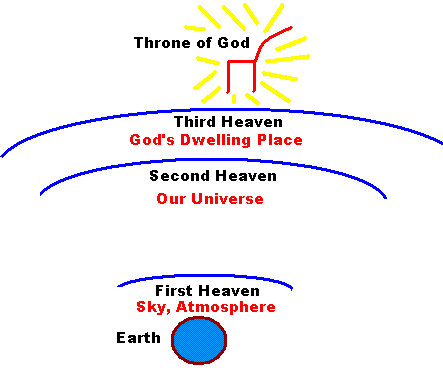
The above text speaks of the "estate" and special "habitation" of angels. What is the original dwelling place of angels? Is it heaven? The third heaven? Or, is their dwelling place outer space or in earth's sky and atmosphere? Other translations give us these translations:

"but abandoned their proper dwelling" (NIV);

"but left their proper dwelling" (ESV);

"did not keep their proper domain, but left their own abode" (NKJV).

"Their first estate" literally means their first rank or position in the hierarchy of creatures. On "their own habitation" Albert Barnes in his commentary rightly says:

"But left their own habitation - To wit, according to the common interpretation, in heaven. The word rendered "habitation" (οἰκητήριον oikētērion) occurs nowhere else in the New Testament. It means here that heaven was their native abode or dwelling-place."

John Gill in his commentary writes:

"...for they were drove out of their native habitation, heaven; they were turned out of it, and cast down to hell; see 2 Peter 2:4. And this their habitation, which they left, or fell from, or they were cast out of..."

I dare say that this is the view of the vast majority of bible teachers. The view of semi Two Seeders, who we cited in the previous chapter and who said that the "heaven" out of which Satan and the non-elect angels were cast when they sinned was not the third heaven, but some other heaven, gave to heaven other meanings. Many of these meanings were not in accordance with the image at the head of this chapter. Rather than seeing the first and second heavens as described in that image, they come up with strange and novel meanings for heaven. John Robbins who debated father on the point said that maybe the heaven out of which Satan and the angels were cast was "the old Jewish heaven" or "the church heaven." But, this is farcical and a gross mishandling of scripture. It is nonsensical and leads to gross absurdities, reduction ad absurdum.

The bible is very clear on what is the natural abode of angels. This we will demonstrate shortly. The first heaven of earth's atmosphere was not the original home of angels. If that is the heaven from which Satan and the sinning angels were cast out of, then why do the scriptures show them as still occupying the aerial region? The second heaven of outer space cannot be the original home of angels, for again the fallen angels still occupy those regions. The church of either the old covenant or the new cannot be the original abode of angels because angels existed before there was a church, and trying to explain what that could possibly mean leads to further absurdities. We will enlarge upon these points but first let us show the absurdity in saying that angels are human beings.

Angels Are Not Humans

"What is man that You are mindful of him, And the son of man that You visit him? For You have made him a little lower than the angels, And You have crowned him with glory and honor." (Psa. 8: 4-5 nkjv)

This text is very clear in showing that humans are not angels. Man was made a little lower than the angels, which statement shows that human beings are a lower order of creatures than are angels, and that the Two Seed notion of angels being humans is false. Wrote Peter:

"They are not afraid to speak evil of dignitaries, whereas angels, who are greater in power and might, do not bring a reviling accusation against them before the Lord." (II Peter 2: 10-11 nkjv)

This is similar to these words of the Psalmist:

"The Lord has established His throne in heaven, And His kingdom rules over all. Bless the Lord, you His angels, Who excel in strength, who do His word, Heeding the voice of His word." (Psa. 103: 19-20 nkjv)

These verses again show that human beings are inferior to angels as a species. To say that angels in these verses are human beings make the verses nonsensical. Who are the angels superior to? Answer: human beings. Therefore, angels are not human beings. Wrote the writer of Hebrews:

"And of the angels He says: “Who makes His angels spirits And His ministers a flame of fire.”...But to which of the angels has He ever said: “Sit at My right hand, Till I make Your enemies Your footstool”? Are they not all ministering spirits sent forth to minister for those who will inherit salvation?" (Heb. 1: 7; 13-14 nkjv)

Angels are "ministering spirits." Spirits are incorporeal. Jesus said this about being "spirit":

"Behold My hands and My feet, that it is I Myself. Handle Me and see, for a spirit does not have flesh and bones as you see I have.” (Luke 24: 39 nkjv)

On Hebrews 1: 7 John Gill wrote the following in his commentary, giving the nigh universally understood meaning:

"...the design of the apostle in citing them, which is to show the superiority of Christ to angels, of whom it is said, that they are made spirits: they are "spirits", created ones, and so differ from God the Creator: they are incorporeal ones, and so differ from men; they are immaterial, and so die not; they are spiritual substances subsisting in themselves..." 

It is against such clear statements about who are the angels, and what is their nature, that Two Seeders oppose when they say that angels are human beings. Shortly after Hebrews chapter one, the writer of Hebrews says the following in the second chapter:

“For verily [Christ] took not on him the nature of angels; but he took on him the seed of Abraham.” (Hebrews 2:16). 

This verse indicates clearly that the "nature of angels" is not the same as the nature of human beings. On this verse Dr. Gill writes:

"...but of a non-assumption of their nature; there was no need of it with respect to good angels, and there was no salvation designed for evil ones; and to have assumed the nature of angels, would have been of no service to fallen man; an angelic nature is not capable of death, which was necessary to atone for sin, save men, and destroy Satan..."

These verses, along with many more we could cite, show that angels are not human beings. It is a ridiculous idea for Parker, Beebe, and the Two Seeders to affirm that angels are human beings and that Satan is uncreated, possibly even was originally a snake of the animal kingdom. Such a view denies that angels are superior to humans and rather says that humans are superior to angels.

The writer of Hebrews also speaks of an “innumerable company of angels and distinguishes them from “the spirits of just men made perfect” (Hebrews 12:22-23). 

Now let us return to showing that the third heaven is the proper abode of angels.

Angels of Heaven

"And He said to him, “Most assuredly, I say to you, hereafter you shall see heaven open, and the angels of God ascending and descending upon the Son of Man.” (John 1: 51 nkjv)

We cited this verse in the previous chapter when we cited Hassell's mentioning the dream of Jacob wherein he saw a ladder extending from earth to heaven and found it ironic because Hassell did not believe that the proper abode of angels was the third heaven. Clearly the above text indicates that the heaven from which angels descended and ascended into is the highest heaven where God's presence is fully manifested and where he sits on the throne.

Jesus in speaking of those little ones who come to him said:

"...in heaven their angels do always behold the face of my Father which is in heaven." (Matt. 18: 10 kjv)

Notice how the word "heaven" is twice used. Only those who come to the text with man-made biases and presuppositions as do the Two Seeders will fail to see that angels are from the third heaven. Jesus also spake of resurrection saints becoming immortal "as the angels of God in heaven." (Matt. 22: 30 kjv) To give to the word "heaven" in these texts the meaning of first or second heaven, or the heaven of the church, is totally untenable. Jesus more than once spoke of "the angels of heaven." (See also Matt. 24: 36)

We have also already mentioned this text from the Book of Job:

"Now there was a day when the sons of God came to present themselves before the LORD, and Satan also came among them." (Job 1: 6)

This is obviously heaven, for it is in the presence of the LORD.

Recall these words of the angel Gabriel:

"And the angel answered and said to him (Zacharias), “I am Gabriel, who stands in the presence of God, and was sent to speak to you and bring you glad tidings." (Luke 1: 19 nkjv)

Can anything be more clear that angels are in the third heaven? Does not that fact disprove the premise of Beebe and the Two Seeders who say 1) that angels are humans, and 2) that if they fell from heaven, it could not have been the third heaven? Though Gabriel probably appeared to Mary in a human form, as they have often done, he was not human. Now let us notice these words from the Book of Daniel:

"All the inhabitants of the earth are reputed as nothing; He does according to His will in the army of heaven And among the inhabitants of the earth. No one can restrain His hand Or say to Him, “What have You done?” (Dan. 4: 35 nkjv)

It is universally acknowledged by all that by "army of heaven" is meant the "heavenly host" of angels. They are distinguished from "the inhabitants of the earth." Next, let us notice these words of the apostle Paul:

"For we wrestle not against flesh and blood, but against principalities, against powers, against the rulers of the darkness of this world, against spiritual wickedness in high places." (Eph. 6: 12 kjv)

On this Dr. Gill comments:

"...against spiritual wickedness in high places; or wicked spirits, as the devils are, unclean, proud, lying, deceitful, and malicious; who may be said to be in "high" or "heavenly places"; not in places super celestial, or in the highest heavens, in the third heaven, where God, angels, and saints are; but in the aerial heavens, where the power or posse of devils reside, and where they are above us, over our heads, overlooking us, and watching every advantage against us; and therefore we should have on our armour, and be in a readiness to engage them; and so the Syriac and Ethiopic versions render it, "under", or "beneath heaven"; and the Arabic version, "in the air"."

These "rulers" and "principalites" and "wicked spirits" are NOT "flesh and blood" beings, i.e. not human beings. Further, they occupy the first and second heavens, and therefore these heavens cannot be the heaven out of which they were cast.

Therefore we see how absurd is this idea of the Two Seed Baptists which denies the creation of angels and of the fall of some of them and which attempts to say that angels are human beings. Though Watson, Hassell, and Daniels, who we cited in the previous chapter, don't accept those Two Seed ideas, yet they show remnants of that ideology when they deny that the proper habitation of angels is the third heaven.

In the next chapter we will look at another false idea of the Two Seeders, which says that Christ being the begotten Son of God has nothing to do with his divinity, but with his humanity, and that his humanity preexisted his birth of the virgin Mary. We will then deal with their belief that the souls or spirits of the elect were created when Christ was begotten before the world began, being then in Christ, being a case of the preexistence of their souls.