"My times are in thy hand: deliver me from the hand of mine enemies, and from them that persecute me." (Psalm 31:15)
"Man's goings are of the LORD; how can a man then understand his own way?" (Proverbs 20:24)
How one can read and accept these propositional statements of divine truth and yet still believe in creature free will and human sovereignty and self determination is almost a mystery.
These verses tell us that all our goings and all our times are in the sovereign control of God and happens only as he wills it, that he is the only one who determines each one's destiny, both in time and eternity. All our experiences, fortunes, common occurrences, occasions, are all of the Lord.
My time to be born and born again are both predetermined. Did not Paul say, "But when it pleased God...I was saved"? (Galatians 1: 15)
It was not "WHEN IT PLEASED PAUL."
My time to die too is predetermined as the Scriptures state in numerous places.
(The above was originally published by me in 2006 here)
Saturday, July 11, 2020


Friday, July 10, 2020
Red Horse Of The Apocalypse III

"my sword shall be bathed in heaven"
"the sword of the LORD is filled with blood"
"Come near, ye nations, to hear; and hearken, ye people: let the earth hear, and all that is therein; the world, and all things that come forth of it. For the indignation of the LORD is upon all nations, and his fury upon all their armies: he hath utterly destroyed them, he hath delivered them to the slaughter. Their slain also shall be cast out, and their stink shall come up out of their carcases, and the mountains shall be melted with their blood. And all the host of heaven shall be dissolved, and the heavens shall be rolled together as a scroll: and all their host shall fall down, as the leaf falleth off from the vine, and as a falling fig from the fig tree. For my sword shall be bathed in heaven: behold, it shall come down upon Idumea, and upon the people of my curse, to judgment. The sword of the LORD is filled with blood, it is made fat with fatness, and with the blood of lambs and goats, with the fat of the kidneys of rams: for the LORD hath a sacrifice in Bozrah, and a great slaughter in the land of Idumea. And the unicorns shall come down with them, and the bullocks with the bulls; and their land shall be soaked with blood, and their dust made fat with fatness. For it is the day of the LORD'S vengeance, and the year of recompences for the controversy of Zion." (Isa. 34: 1-8)
This prophecy yet awaits fulfillment. The Apocalypse is a description or adumbration of the time here foretold by the prophet. Slaughter begins the day of judgment when the red horse rider comes forth and takes peace from the earth and brings widespread murder and mayhem throughout the world.
Many believe that the fulfillment of the prophecy is to be found in Revelation 19, at the end of the tribulation. I too believe this. However, I also believe that the prophecy begins to be fulfilled at the start of the tribulation and day of wrath (Rev. 6), particularly with the coming of the rider on the red horse. Bloody slaughter not only marks the end scene of the day of judgment but also marks it commencement. The sword is filled with blood under the red horse rider, but he keeps right on riding all through the whole Apocalypse. There is death and bloodshed in nearly every scene of the Apocalypse.
God Is The One Riding The Horses
"Were you angry with the rivers, LORD? Was your wrath against the streams? Did you rage against the sea when you rode your horses and your chariots to victory?" (Hab. 3: 8)
As we noted in our series on the white horse rider, we should view these horses with the coming day of judgment being images of the Lord's coming in varied judgments. Each rider is not to be viewed as necessarily a person, though the first rider is definitely a picture of Christ. I do not discount that particular angels may be the riders. They will after all play a great role in the judgment executions of the last days, just as they have in previous judgments since the fall of man.
We already observed (in our series on the white horse) how each of the first four seals of judgment may be viewed as particular arrows shot from the mighty conqueror's bow. In another sense too the four faces of the living creatures (Rev. 4) may correspond to the four horses and riders. Each one seems to give the announcement "go" (or "come" forth) to each horse.
Angelic Horses & Chariots
In both passages, from Isaiah and Habakkuk, the horses upon which Jehovah rides are celestial and his horses and chariots are connected with angels.
"The chariots of God are twenty thousand, even thousands of angels: the Lord is among them, as in Sinai, in the holy place." (Psa. 68: 17)
"He lays the beams of His upper chambers in the waters; He makes the clouds His chariot; He walks upon the wings of the wind." (Psa. 104: 3)
"For behold, the Lord will come in fire And His chariots like the whirlwind, To render His anger with fury, And His rebuke with flames of fire." (Isa. 66: 15)
"As they were going along and talking, behold, there appeared a chariot of fire and horses of fire which separated the two of them. And Elijah went up by a whirlwind to heaven. Elisha saw it and cried out, “My father, my father, the chariots of Israel and its horsemen!” And he saw Elijah no more. Then he took hold of his own clothes and tore them in two pieces." (2 Kings 2:11-12)
"Then Elisha prayed and said, “O Lord, I pray, open his eyes that he may see.” And the Lord opened the servant’s eyes and he saw; and behold, the mountain was full of horses and chariots of fire all around Elisha." (II Kings 6: 17)
"That night the angel of the LORD went out and put to death a hundred and eighty-five thousand in the Assyrian camp. When the people got up the next morning--there were all the dead bodies!" (II Kings 19: 35)
In Ezekiel the "wheels" are angels, or cherubim, who are employed by the Lord when he "moves" in judgment.
Thus, it is very likely that the red, black, and livid horses are angels and angelic powers that are executing judgments upon the wicked world. These are angels of destruction.
In both passages (Isaiah and Habakkuk) the angels are clearly judgment angels who are employed in the execution of God's anger, wrath, and vengeance.
Destroying Angels
"For the LORD will pass through to smite the Egyptians; and when he seeth the blood upon the lintel, and on the two side posts, the LORD will pass over the door, and will not suffer the destroyer to come in unto your houses to smite you." (Exo. 12: 23)
"And God sent an angel to Jerusalem to destroy it: and as he was destroying, the LORD beheld, and he repented him of the evil, and said to the angel that destroyed, It is enough, stay now thine hand. And the angel of the LORD stood by the threshingfloor of Ornan the Jebusite." (1 Chronicles 21:15)
"He sent upon them His burning anger, Fury and indignation and trouble, A band of destroying angels." (Psa. 78: 49 NASB)
We may very well view the red, black, and livid horse riders as a kind of "(calvary) band of destroying angels (or agents)." Each angel (horse) executes a particular judgment.
Angels are employed throughout the Apocalypse. This is what we should expect since
1) the Apocalypse deals with the second coming, and
2) Jesus spoke of the angels being associated with his second coming.
The red horse rider is a messenger of death. He executes God's anger and wrath upon the guilty and unrepentant world.
Wednesday, July 8, 2020
Red Horse Of The Apocalypse II

Reign Of Terror
When the Lord threatened and brought vengeful judgment in the past upon the nation of Israel, with whom he had made covenant, the prophet bore this witness -
"The sinners in Zion are afraid; fearfulness hath surprised the hypocrites. Who among us shall dwell with the devouring fire? who among us shall dwell with everlasting burnings?" (Isa. 33:14)
Not only sinners and hypocrites within the holy community of Israel, or in the church, but sinners outside will also be gripped by fear caused by the "terrors" of the last days. The whole world will be controlled by fear arising from a total loss of civil peace, and the sad consequences of such loss. Not only the prophets of the old testament, but Jesus himself foretold of those days.
Universal Civil Strife
"And there shall be signs in the sun, and in the moon, and in the stars; and upon the earth distress of nations, with perplexity; the sea and the waves roaring; Men's hearts failing them for fear, and for looking after those things which are coming on the earth: for the powers of heaven shall be shaken." (Luke 21: 25-26)
A time of general mayhem. A time of violence which recalls the days before the first great world judgment of the flood, when all but the chosen few were destroyed. The Genesis record is -
"And God saw that the wickedness of man was great in the earth, and that every imagination of the thoughts of his heart was only evil continually...The earth also was corrupt before God, and the earth was filled with violence. And God looked upon the earth, and, behold, it was corrupt; for all flesh had corrupted his way upon the earth." (6: 5, 11-12)
The Lord comes with his "toxon," with his "instruments of death" and "arrows of victory and salvation." When he shoots those celestial arrows and the long anticipated vengeance begins, it will produce great fear and alarm among the inhabitants of the earth. This is because the world is at war with God in its heart, being a "rebel" to his rule and government. In the four horsemen of the Apocalypse we see how the Lord "comes with vengeance." (Isa. 35: 4; II Thess. 1:8; etc.)
Though history is from the standpoint of the purpose of God "linear," yet this does not negate the idea of "cycles" within that linear framework. We see the cycle of cataclysmic judgments in several instances in holy scripture. Thus we hear Christ saying "as it was in the days of Noah so shall it be in the day of the coming of the Son of man." In those cycles the Lord suffered the wickedness of man to increase till it reached a climax or zenith, and then God brought devastation. The world is now as it was before the judgment of the Deluge.
The Lord in the long ago warned of the time when "the sword of the LORD shall devour from one end of the land to the other end of the land; no flesh shall have peace." (Jeremiah 12:12) Such is the time that the whole world will experience at the time the Lord returns in vengeance, typified in the coming of the red horse and rider. It is also described by the prophet in this oracle: "For thus saith the LORD; We have heard a voice of trembling, of fear, and not of peace." (Jer. 30: 5) Such times have been experienced many times throughout history on a national level, affecting but one nation, or a few, but never on a global scale as will occur under the happenings of the red horse rider. One of those times was described by the prophet Zechariah: "For before these days there was no hire for man, nor any hire for beast; neither was there any peace to him that went out or came in because of the affliction: for I set all men every one against his neighbour." (Zech. 8: 10)
Notice those important words "for I set all men every one against his neighbour." God did something in the psychology of these men to cause them to war with each other. God says "I set" or cause this. It is a judgment in execution. The God who gives peace can take it away, and he does take it away from those who fail to thank God for whatever peace they enjoy. How is peace lost and destroyed? One way is by the removing of divine restraints.
The Lord Gives & Takes Away
"The LORD gave, and the LORD has taken away; blessed be the name of the LORD." (Job 1:21)
God is to be thanked for whatever peace is enjoyed on earth. Peace is his gift. He is "the God of peace" (Rom. 15: 33) because all peace, of whatever kind, is from him. Though man has lost, because of sin and alienation from God, his internal peace with God, yet he still enjoys much external peace while in that condition due to the mercy and compassion of God.
When Christ came the first time it was announced by angels a message of peace toward man and earth: "Glory to God in the highest, and on earth peace, good will toward men." (Luke 2: 14) But, at the second coming of Christ, the angelic message will be different. Rather than extending peace to men he will suffer it to be taken from them. He is the one who gives peace, when and to whom he pleases, and he is the one who takes away the peace given, and that is what we see in the coming of the rider of the red horse and the opening of the second seal of the scroll.
In the long ago the LORD said:
"I form the light, and create darkness: I make peace, and create evil: I the LORD do all these things." (Isa. 45: 7)
Just as the "light" and the "darkness" are opposites, so too is "peace" and "evil." Thus, evil in this case primarily signifies the absence of peace. We may thus say that peace is "the absence of conflict" and "conflict" is the absence of peace. The word "peace" like other words such as "life," is hard to define, being mostly defined by its negation or absence. What is "life"? It is not being dead. But, try to define it positively. It is difficult. So too with the word "peace." Under the time of the rider of the red horse the Lord will be "creating" darkness and the evil of no peace and safety. Antonyms for peace include disagreement, discord, disharmony, distress, conflict.
Loosening Of Providential Restraints
The coming of the four horsemen of the Apocalypse is a time when restraints previously in place in God's providence over the world are removed. It is a "loosening" of forces, from heaven, earth, and under the earth. Paul refers to this coming phenomenon when he speaks of "the one who restrains" the coming of the "man of sin," of those divine energies which "withhold" those days till the appointed time.
"And now you know what is holding him back, so that he may be revealed at the proper time. For the secret power of lawlessness is already at work; but the one who now holds it back (or 'restrains') will continue to do so till he is taken out of the way." (II Thess. 2: 6-7 NIV)
I do not believe that the one restraining is the Holy Spirit, though it is a popular view. In the first instance above the words "what is holding" (in red) in neuter gender and may be translated as "it." In other words, "what it is that is holding." But, in the second instance above the words "the one who now holds" (in red) is masculine and so it is correct to say "he" or "the one who." But, it is not integral to us to know for sure what the precise entity is that is doing the restraining. Clearly it is God who is doing the restraining, though he often uses angels in such restraining work. So, the text basically says "until the one who is restraining stops restraining."
The Psalmist inspired wrote these words about divine restraints upon the world:
"Surely the wrath of man shall praise thee: the remainder of wrath shalt thou restrain." (Psa. 76: 10)
Surely the time of opening of the second seal, with its global violence and murder, will be a time when God is not "restraining" the wrath and doings of men and nations as he has done regularly since the fall of man.
Divine Letting Loose
"But the day of the Lord will come as a thief in the night; in the which the heavens shall pass away with a great noise, and the elements shall melt with fervent heat, the earth also and the works that are therein shall be burned up. Seeing then that all these things shall be dissolved, what manner of persons ought ye to be in all holy conversation and godliness, Looking for and hasting unto the coming of the day of God, wherein the heavens being on fire shall be dissolved, and the elements shall melt with fervent heat?" (II Peter 3: 11-12)
The words "melt" and "dissolved" are from the Greek "lyō" and the KJV translates it in the following manner: loose (27x), break (5x), unloose (3x), destroy (2x), dissolve (2x), put off (1x), melt (1x), break up (1x), break down (1x).
From this it can be seen how the word "dissolved" is not the best translation, not being commonly used by the KJV, the most common word being "loose"; And, if one studies all the places where "lyō" is used, he will see that the word means to break things apart (often destroying them). It is the breaking of bonds and attachments.
The idea in "lyō" seems to me to be the opposite idea conveyed in the word "consist" as used by Paul concerning the importance of the Son of God to this world. Of him he said - "and by him all things consist." (Col. 1: 17) The word "consist" is from the Greek "synistēmi" and means "to put together," or to "unite parts into one whole." Everything in the physical and spiritual realms are "put" and "held together" by the power of the Son of God who is "upholding all things by the word of his power" (Heb. 1: 3), keeping things held in their place till he dissolves or loosens them. Dr. Gill in commentary on Col. 1: 17 said that if not for Christ's power in holding all things together "the whole frame of nature would burst asunder and break in pieces." So true indeed.
The word "lyō" is translated as "loose" in the Apocalypse in these verses:
"Saying to the sixth angel which had the trumpet, Loose the four angels which are bound in the great river Euphrates. And the four angels were loosed, which were prepared for an hour, and a day, and a month, and a year, for to slay the third part of men." (9: 14-15)
What a "letting loose" that will be!
This same word is also used in the Apocalypse of the "loosing" of the seals and of the loosing of Satan after the Millenium.
Other loosings are to be seen in the Apocalypse though the word is not used. The idea is there all through the scenes of the Apocalypse.
Tuesday, July 7, 2020
Red Horse Of The Apocalypse I
"Destruction cometh
and
they shall seek peace, and there shall be none"
(Ezekiel 7: 25)
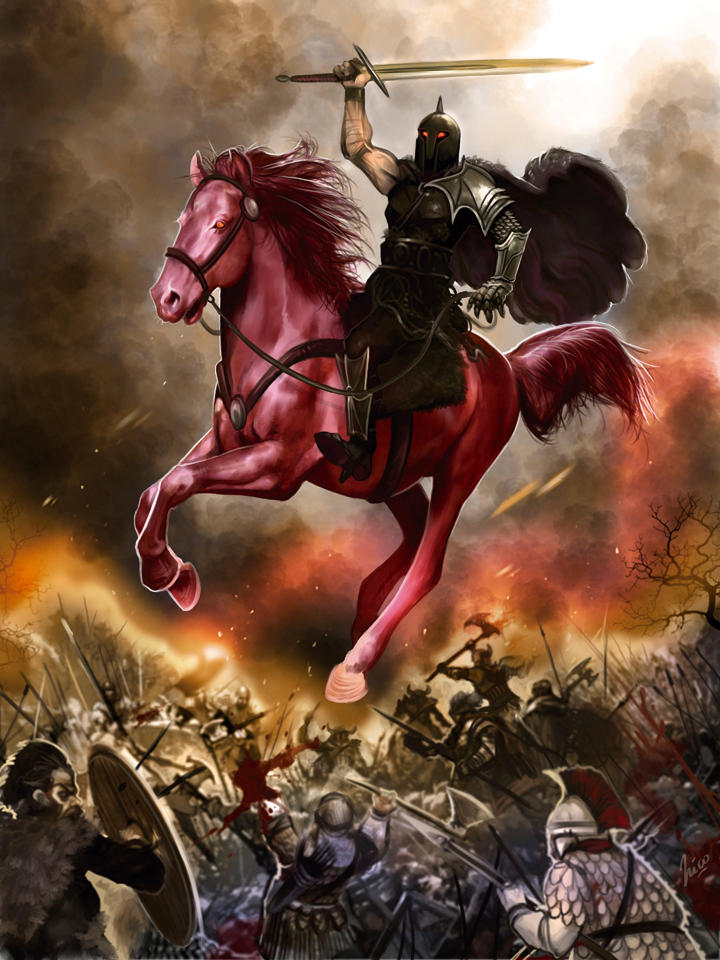
"And when he had opened the second seal, I heard the second beast say, Come and see. And there went out another horse that was red: and power was given to him that sat thereon to take peace from the earth, and that they should kill one another: and there was given unto him a great sword." (Rev. 6: 3-4)
Having considered the white horse rider and its significance, we now look at the next rider, the fiery red horse and its rider. The red horse is certainly a "horse of a different color"!
"The horse is prepared against the day of battle: but safety is of the LORD." (Prov. 21: 31)
"...as the horse rushes into the battle." (Jer. 8: 6)
"The sword is without, and the pestilence and the famine within: he that is in the field shall die with the sword; and he that is in the city, famine and pestilence shall devour him." (Eze. 7: 15)
Questions (to be studied)
1. What is meant by the taking of peace from the earth?
2. Is the removal of peace in politics alone, or in other areas?
3. Is the removal of peace worldwide?
4. What is the nature of the mutual slaughter of people against people?
5. What will be the impetus for this mutual killing?
6. What will be the means of this widespread murder?
7. What will be the effects of this murderous and violent state?
8. What is the significance of the great sword?
9. For what purpose is the sword given?
10. Is it to stop the killing or to promote it?
I will begin this initial overview look at the verses informing of the coming of the fiery red horse and its sword wielding rider by citing from the great J. A. Seiss and his famous work "The Apocalypse."
Seiss said this about this red horse:
"IT must be borne in mind, in dealing with these seal openings, that we are dealing with the scenes of the judgment. They relate to “the day of the Lord.” Anticipatory fulfilments have occurred, but the proper breaking of these seals, and whatever is connected with their opening, belongs to the future, and to that momentous period, now at hand, which is to close up the entire order of things now existing. The whole scene presents the action of the judgment throne in heaven, toward those then living upon the earth."
This is what must be kept in mind throughout the opening of the seals.
The rider on this horse comes when the second seal of the book of redemption is opened and its contents disclosed.
The coming of the red horse and his rider signifies the coming of a particular kind of awful judgment that will come from heaven upon an unbelieving and wicked world. There is reason and purpose behind the calamities associated with the coming of this Apocalyptic judgment. The Lord intends to "kill" the wicked, to "uproot" them from the earth. Notice these texts that speak of this:
"And the LORD rooted them out of their land in anger, and in wrath, and in great indignation, and cast them into another land, as it is this day." (Deut. 29: 28)
"For the upright shall dwell in the land, and the perfect shall remain in it. But the wicked shall be cut off from the earth, and the transgressors shall be rooted out of it." (Pro 2: 21-22)
"But he answered and said, Every plant, which my heavenly Father hath not planted, shall be rooted up." (Matt. 15: 13)
The killing done by the Lord in the Apocalyptic judgments are intended for removing of the wicked from the earth so that only the righteous are left.
Seiss continued:
"I have shown that horses, in prophetic vision, are images of God’s swift, invisible, resistless power for the defence of his people, especially in its going forth upon the proud, guilty, and unbelieving world. It was so in the case of those seen by Elisha’s servant, and in the case of those mentioned by Zechariah.
In the case of the red horse rider we see the power of God exercised in terrible judgments that are intended to bring retribution to those who have hated God and his people. Paul writes of this in II Thessalonians 1, referring to how "the churches of God" were enduring "persecutions and tribulations" and that at the return of the Lord Jesus Christ God will "recompense tribulation to them that trouble you." The death and destruction that comes with the riders on the four horses are nothing but tribulation sent as repayment for the tribulation brought against the saints.
Seiss continued:
"In these four different horses and horsemen, we are to see four different forms of the coming forth of the judicial power of God upon the inhabitants of the earth, looking to the breaking up of the dominion of wickedness, the punishment and casting out of transgression, and the consummation of that long-pending revolution whose accomplishment is at once the fulfilment of all prophecy and all prayer."
This is what we should see and understand as Christians in regard to the purpose of these awful judgments. They are not intended for Christians, for God's own people, but for the wicked world.
Seiss continued:
"We are not to suppose, however, that the action of one ceases entirely, before the other comes into play. They are consecutive in their incoming, in the main stress of them, and in some of their more marked circumstances, but they are all, in a measure, contemporaneous. The action of the first horseman certainly is continuous; for he goes forth in conquest unto conquest, which terminates only in the complete victory in which the opening of the seals ends. His career, therefore, runs on through that of his three successors, and through all the remaining seals. No such intense continuity is expressed with reference to the action of the other horsemen; and the nature of their work is such as not likely to extend itself so far. But there is an inner and natural relationship between the things adumbrated, which renders it quite evident that their several careers overlap each other, and that the doings of the one run side by side with the doings of the other."
I believe that this should be kept in mind as one studies the opening of the first four seals of the scroll.
Seiss continued:
"The colour of this horse is red — fiery — the hue of blood. This itself is indicative of vengeance and slaughter. The great dragon is “red,” and he is “a murderer from the beginning.” The mighty Hero of Salvation, travailing in the greatness of his strength, and crushing his enemies beneath his feet, is “red” in his apparel, emblematic of his work of violent destruction. Nor can we be mistaken in regarding this horse and his rider as significant of bloody times. His work is specifically described to be the taking of peace out of the earth. A great and terrible weapon is also put into his hand; not the ordinary sword of war (romyai>a), but (macaira megalh) a great sword of one having the power of life and death. And the result of his presence is war, much taking of life by public executions, and mutual killing among men."
The time under the red horse will indeed be a "reign of terror" that will make the French Revolution pale in comparison. But, we will discuss more on this in the next several postings.
Seiss continued:
"The picture is particularly terrific. It presents not only disturbance of the relation of nations, the rising of nation against nation, and kingdom against kingdom; but internecine collisions, civil wars, the murderous hate of one portion of citizens exercised against another portion, and bloody commotions all over the face of society, having no issue but wretchedness and depopulation. It is the rampage of human passion raging to all forms of bloodshed, and the authorities of state in vain drawing the sword to put it down."
I have read many commentaries on the significance of the events connected with the coming of the red horse rider, and none of them really capture the fullness of the calamitous state of things on earth during that time. But, more on that later.
Seiss continued:
"A small specimen of this state of things was enacted in the days of Asa, when Israel had been “a long season without the true God, and without a teaching priest, and without law;” in which times “there was no peace to him that went out, nor to him that came in, but great vexations were upon all the inhabitants of the countries. And nation was destroyed of nation, and city of city; for God did vex them with all adversity.” (2 Chronicles 15:3, 5.)
There have been lots of prior "specimens" and examples of such a chaotic state of things civilly. Times when peace and safety were hardly known at all. But, under the coming Tribulation, it will exceed all previous examples.
Seiss continued:
"Fancy a world which has no peace in it — no concord but that of lawless and selfish passion — no regard for life when it stands in the way of covetousness or ambition — no amity between its nationalities, or internal harmony and toleration between citizens of the same city or state — but every man’s sword is against his fellow, and every one’s hand rises up against the hand of his neighbour, and international slaughter, civil butchery, and private revenge and murder are the order of the day, — and you have what the earth will be under the judgment power of this red horse and his rider. Of old, already, Jehovah threatened to bring a sword to avenge the quarrel of the covenant; and to “call for a sword upon all the inhabitants of the earth.” (Jeremiah 25:29.) And in this horseman, with his great sword taking peace from the earth, and desolating the world with violence and bloodshed, we have the final fulfilment of that threat. Nor need any one be at a loss to see how everything is already tending to just such a condition of society and the world."
Clearly, the purpose of the great sword given to the rider of the red horse is to inflict violent death on masses of people in divine judgment. This second seal plainly represents conflict, war, destruction, and bloody death.
The word for slay is really the word "slaughter." It is a reference to civil war or civil anarchy where mobs of people group together to attack and destroy other peoples whom they do not like. When peace is taken from the earth, people will slay one another. The verb (σφάζω) is associated with violence and murder; it is a vivid word meaning “to slaughter, either animals or persons; in contexts referring to persons, the implication is of violence and mercilessness”. In Revelation 5:6 the same verb is used to describe the Lamb standing “as though it had been slain.”
Who is causing these terrible calamities? Some will say God. Some will say Satan or extraterrestrials. Those who say God will either ascribe to God his honor and fear him, or else curse him.
In the next posting we will begin to answer our questions on this prophetic passage.
Friday, July 3, 2020
White Horse Of The Apocalypse XVIII
In this chapter we will end our series on the the opening of the first seal of the Apocalypse and on the rider on the white horse. First, let us note some things that have been said by others relative to Daniel 9: 24-27.
From preceptaustin.com, a cite that gives commentaries on the scriptures, says this about Daniel 9: 24-27 (emphasis mine):
"Daniel 9:24-27 is one of the key Scriptures regarding "end times" prophecy. Daniel 9:24-27 holds the key to all prophetic interpretation and as such is the backbone of biblical prophecy."
"Well known pastor and author Ray Pritchard writes that
If you understand what these verses mean, you will have a good framework for understanding all that the Bible says about the future.
Miss this, and Revelation
will be a mystery to you
I think that those who say such things are of the Dispensational school. I deny that Daniel 9: 24-27, especially of the interpretation given of it by Dispensationalists, is the "key" to understanding "biblical prophecy," and deny that one must understand the Dispensational view of that text in order for the Book of Revelation, and unfulfilled prophecy, to be understood. How is the prophecy about the seventy weeks a "good framework for understanding all that the Bible says about the future"?
The seventy weeks have been fulfilled, as we have seen, yet the Apocalypse is future. It cannot therefore be a framework for the Book of Revelation. There is nothing in Daniel's prophecy about the second coming of Christ. It is rather all about the first coming. Of course, though the 490 years of the prophecy have come and gone, yet the effects of the events of that 70th week are with us today, yea, some even being eternal, such as the bringing in of "everlasting righteousness."
The Book of Revelation, and all new testament teaching on the second coming, may be understood apart from knowing the prophecy of the seventy weeks. The only reason why I can surmise for why so many teachers make the 70 weeks prophecy the framework for their system of eschatology is that it somehow is judged to support their views on a pre-tribulation rapture and of their extremism against what is called "replacement" theology (where the church fulfills many, if not all, of the promises made to Israel in the old testament). I cannot conceive however why it is so important, so integral, to their system of hyper literal interpretation.
Another writer said:
"If you have wondered where certain popular writers get the concept of a future seven-year Tribulation period, you will find the answer in this passage. Jesus refers to it in Mt 24:15 as does Paul in 2 Th 2:1, 2, 3, 4. And the amazing events of Rev 6-19 are simply an expansion of Daniel 9:27. What is presented here in a condensed form is greatly expanded in the New Testament. This passage is the key that unlocks many other biblical prophecies. (A Peek into God's Calendar)" (ibid)
But, the "tribulation period" of the Apocalypse lasts much longer than seven years. See my posting Tribulation Period - 7-yrs-Or More? for the evidence for this.
There is no mention of "seven years" in the Book of Revelation, nor in all the new testament. If the 70th week is not fulfilled, and is yet future, and is the key to understanding all new testament teaching on the second coming with its time of great tribulation, one would expect there to be mention of that "framework," would they not? This is not a faulty argument from silence because the silence is not what one would expect if the 70th week prophecy is the key to all prophetic understanding. Don't you see?
Daniel's 'Abomination of Desolation'
In my mind the "abomination of desolation" was fulfilled in A.D. 70 when the Roman soldiers entered into the Temple. This does not exclude a dual fulfillment however. We may indeed yet see another Jewish Temple and see Antichrist sit in it "demonstrating that he is God." That indeed would be another time when an abominable image was set up in the House of God. In fact, we may say that "the abomination that causes desolation" has been fulfilled twice already and Antichrist would be a third time.
Said Dr. Gill in his commentary:
"...but the Roman army is designed; see ( Luke 21:20 ) which was the (Mmvm Myuwqv Pnk) , "the wing", or "army of abominations making desolate", ( Daniel 9:27 ). Armies are called wings, (Isaiah 8:8 ) and the Roman armies were desolating ones to the Jews...Now our Lord observes, that when they should see the Roman armies encompassing Jerusalem, with their ensigns flying, and these abominations on them, they might conclude its desolation was near at hand; and he does not so much mean his apostles, who would be most of them dead, or in other countries, when this would come to pass; but any of his disciples and followers, or any persons whatever, by whom should be seen this desolating abomination, spoken of by Daniel the prophet:
not in (Daniel 11:31) which is spoken of the abomination in the times of Antiochus; but either in (Daniel 12:11) or rather in (Daniel 9:27) since this desolating abomination is that, which should follow the cutting off of the Messiah, and the ceasing of the daily sacrifice."
There is more than one prophecy in Daniel about "the abomination of desolation."
Dispensational teacher John Walvoord wrote:
"The interpretation of the revelation given to Daniel concerning the seventy weeks (Daniel 9:24–27) constitutes one of the determining factors in the whole system of prophecy. The attention given to it by all schools of interpretation, and the attacks upon the authenticity of the book itself combine to focus the white light of investigation upon it. The interpretation of this passage inevitably colors all other prophetic views, and a proper understanding of it is the sine qua non of any student of prophecy. The importance of the revelation of Daniel nine lies first of all in the chronology which it establishes."
But this is blatantly false. I do not doubt that what he says is true of his Dispensational "interpretation" of the prophecy, though not of the prophecy itself.
Walvoord continued:
"Properly understood, we have here the major outline of the period from Daniel to Christ and from the rapture of the Church to the second coming of Christ in glory. Certainly, no other Old Testament passage does as much for ordering events future from Daniel’s point of view as does the passage under consideration." (As cited here)
So, instead of the prophecy lasting 490 years, Walvoord makes the time period to be some 2500 years! (from Daniel till the second coming) How is that for interpreting the word of God? Ironically it is Walvoord who thinks that only he and his ilk take the prophesies literally!
Popular teacher David Jeremiah speaks on "Decoding Daniel's Seventy Weeks Prophecy" and of "the suspension of the prophecy." (here) The prophecy needs to be "decoded"? Are you kidding me? To me the prophecy is very clear and lacks all the stuff that those of the Dispensational school read into the passage.
Six Things
The six things that were to occur by the "cutting off" of the Messiah the Prince do not yet wait a future fulfillment but, praise God, have already come to pass!
"...to finish the transgression, and to make an end of sins, and to make reconciliation for iniquity, and to bring in everlasting righteousness, and to seal up the vision and prophecy, and to anoint the most Holy..."
How anyone can read the new testament and say that the death and sacrifice of Christ did not fulfill the above things, but yet await fulfillment, is incredible to me.
Jews Only?
One of the other errors of the Dispensational school on the 70 weeks prophecy is that they insist that only Israel or Israelites (according to the flesh) are involved in the prophecy. Dispensationalism insists that "the church," or Gentile believers of this age, are not at all involved in the prophecy. They insist that the words "upon your people," and "upon your city," and the reference to the destruction of the Temple, etc., prove this.
Though the prophecy chiefly concerns the earthly nation, or ethnic people, of the Jews, it does not exclude Gentile involvement. Certainly "the prince that shall come," the one who destroys the city and temple, is Gentile, being the Roman prince Titus. But how can bringing in everlasting righteousness, making an end of sins, and making reconciliation for iniquity, exclude Gentile believers and involve the Jews only?
At the commentary at preceptaustin, we have the Dispensational view upheld. In regard to Daniel's 70 weeks prophecy, they say (emphasis mine):
"5) A clear understanding of the history of Israel is the key to unlocking prophecy
From Genesis to Revelation, the Word of God centers on Israel and the Jew. (I don't think that is exactly correct. Many hundreds of years passed before the calling of Abraham and the birth of Jacob and the birth of the nation Israel. The focus "from Genesis to Revelation" is on the promised "seed" of Genesis 3 and the protoevangelium) If you want to accurately interpret prophecy you must understand how God deals with Israel in both Testaments. Israel is God's timepiece and is the key to unlocking the prophetic Scriptures. If you "replace" the Jew with the church in your interpretative scheme, you will fail to understand God's prophetic timetable for His chosen people, and thus fail to understand much of prophecy, especially that relating to Israel. You must receive the word of God in its literal, natural sense, allowing scripture to interpret scripture and refraining from interpreting a passage with based on a brand of theology you have been taught (be it dispensationalist, reformed, etc), and then you will see clearly that God is not yet finished with Israel or the Jew."
But, how can you exclude Gentiles from being recipients of the blessings of Messiah's making an end of sins, bringing in everlasting righteousness, and making reconciliation? Literal interpretation? Well, yes, I accept the literal interpretation of prophecy, but it is ironic that the Dispensational view of Daniel's 70 weeks does not take the 490 years literally! They can condemn Amillennialists for making "thousand yours" (Rev. 20) into some other time period, it being a figurative rather than a literal number (and rightly so), yet they do the same thing by turning 490 years into more than 2500 years. Further, how is putting a gap between the 69th and 70th week interpreting literally?
But, to see believing Gentiles as included in the prophecy is not "replacing" the Jew but an adding of him to the class to be benefited by Messiah's being cut off. "Interpretative scheme" of those who do not limit the prophecy of the 70 weeks to Jews only? What about the Dispensational "interpretative scheme"? "Interpreting in a literal natural sense" is what the Dispensational school does? I trow not.
The commentary continues with a citation from teacher Ray Pritchard:
"If you understand what these verses mean, you will have a good framework for understanding all that the Bible says about the future. Miss this, and Revelation will be a mystery to you...What is presented here in a condensed form is greatly expanded in the New Testament. This passage is the key that unlocks many other biblical prophecies." Pritchard goes on to add that "If you have wondered where certain popular writers get the concept of a future seven-year Tribulation period, you will find the answer in this passage. Jesus refers to it in Mt 24:15 as does Paul in 2 Th 2:1-4. And the amazing events of Rev 6-19 are simply an expansion of Da 9: 27 (note). What is presented here in a condensed form is greatly expanded in the New Testament. This passage is the key that unlocks many other biblical prophecies."
But, again, the absence of any passage in the new testament or in the book of Revelation of "seven years," or "seven year tribulation," or "seven year peace treaty," etc. is striking and surprising, is it not? If the Dispensational interpretation is the "key" that unlocks all the mysteries of unfulfilled prophecy, it is certainly curious why the new testament writers never spoke of it as such.
The commentary at precept Austin says:
"2) Daniel 9:24-27 - Outlines the future history of Israel
As will be discussed below, Daniel 9:24-27 lays out in summary form a timetable of the events that will impact Israel. There is no reference whatsoever to "the church" in this passage, although some commentators still imagine some reference to "the church.""
Just as nearly all bible commentators, including some Dispensationalists, will not restrict the promises of a new heart and a new covenant to ethnic Israelites (after the flesh genealogically), even though the promises are addressed to Israel, so we should do likewise with Daniel 9. Such passages as these:
"For finding fault with them, he saith, Behold, the days come, saith the Lord, when I will make a new covenant with the house of Israel and with the house of Judah." (Heb. 8: 8)
"A new heart also will I give you, and a new spirit will I put within you: and I will take away the stony heart out of your flesh, and I will give you an heart of flesh." (Ezekiel 36:26)
If these promises are made to natural Jews alone, then I have no hope, and neither does any other Gentile.
Fake Righteousness?
Those who insist that the rider on the white horse is a fake, a false Messiah, or Antichrist, will focus almost entirely upon the idea of peace being the chief thing to see as a result of the going forth of that rider. They rarely mention the idea of righteousness and justice and purity as being the main thing alluded to by the color white. Does the Antichrist bring a false righteousness also when he comes?
7 Year Peace Treaty?
Where is there in Daniel 9: 24-27 a "seven year treaty between the Jews and Antichrist?" That surely is read into the passage.
In conclusion I say that the main lesson of the vision of the rider on the white horse in the Apocalypse is to picture the coming of the Lord in final judgment upon this wicked world. In this picture of Christ we see him "riding prosperously" as the Victor of victors. His heroic character and work as coming judge and king is set before us in the vision.
Recall too how the judgments of the end times are "arrows of victory" shot by the rider who "in justice and righteousness makes war."
From preceptaustin.com, a cite that gives commentaries on the scriptures, says this about Daniel 9: 24-27 (emphasis mine):
"Daniel 9:24-27 is one of the key Scriptures regarding "end times" prophecy. Daniel 9:24-27 holds the key to all prophetic interpretation and as such is the backbone of biblical prophecy."
"Well known pastor and author Ray Pritchard writes that
If you understand what these verses mean, you will have a good framework for understanding all that the Bible says about the future.
Miss this, and Revelation
will be a mystery to you
I think that those who say such things are of the Dispensational school. I deny that Daniel 9: 24-27, especially of the interpretation given of it by Dispensationalists, is the "key" to understanding "biblical prophecy," and deny that one must understand the Dispensational view of that text in order for the Book of Revelation, and unfulfilled prophecy, to be understood. How is the prophecy about the seventy weeks a "good framework for understanding all that the Bible says about the future"?
The seventy weeks have been fulfilled, as we have seen, yet the Apocalypse is future. It cannot therefore be a framework for the Book of Revelation. There is nothing in Daniel's prophecy about the second coming of Christ. It is rather all about the first coming. Of course, though the 490 years of the prophecy have come and gone, yet the effects of the events of that 70th week are with us today, yea, some even being eternal, such as the bringing in of "everlasting righteousness."
The Book of Revelation, and all new testament teaching on the second coming, may be understood apart from knowing the prophecy of the seventy weeks. The only reason why I can surmise for why so many teachers make the 70 weeks prophecy the framework for their system of eschatology is that it somehow is judged to support their views on a pre-tribulation rapture and of their extremism against what is called "replacement" theology (where the church fulfills many, if not all, of the promises made to Israel in the old testament). I cannot conceive however why it is so important, so integral, to their system of hyper literal interpretation.
Another writer said:
"If you have wondered where certain popular writers get the concept of a future seven-year Tribulation period, you will find the answer in this passage. Jesus refers to it in Mt 24:15 as does Paul in 2 Th 2:1, 2, 3, 4. And the amazing events of Rev 6-19 are simply an expansion of Daniel 9:27. What is presented here in a condensed form is greatly expanded in the New Testament. This passage is the key that unlocks many other biblical prophecies. (A Peek into God's Calendar)" (ibid)
But, the "tribulation period" of the Apocalypse lasts much longer than seven years. See my posting Tribulation Period - 7-yrs-Or More? for the evidence for this.
There is no mention of "seven years" in the Book of Revelation, nor in all the new testament. If the 70th week is not fulfilled, and is yet future, and is the key to understanding all new testament teaching on the second coming with its time of great tribulation, one would expect there to be mention of that "framework," would they not? This is not a faulty argument from silence because the silence is not what one would expect if the 70th week prophecy is the key to all prophetic understanding. Don't you see?
Daniel's 'Abomination of Desolation'
In my mind the "abomination of desolation" was fulfilled in A.D. 70 when the Roman soldiers entered into the Temple. This does not exclude a dual fulfillment however. We may indeed yet see another Jewish Temple and see Antichrist sit in it "demonstrating that he is God." That indeed would be another time when an abominable image was set up in the House of God. In fact, we may say that "the abomination that causes desolation" has been fulfilled twice already and Antichrist would be a third time.
Said Dr. Gill in his commentary:
"...but the Roman army is designed; see ( Luke 21:20 ) which was the (Mmvm Myuwqv Pnk) , "the wing", or "army of abominations making desolate", ( Daniel 9:27 ). Armies are called wings, (Isaiah 8:8 ) and the Roman armies were desolating ones to the Jews...Now our Lord observes, that when they should see the Roman armies encompassing Jerusalem, with their ensigns flying, and these abominations on them, they might conclude its desolation was near at hand; and he does not so much mean his apostles, who would be most of them dead, or in other countries, when this would come to pass; but any of his disciples and followers, or any persons whatever, by whom should be seen this desolating abomination, spoken of by Daniel the prophet:
not in (Daniel 11:31) which is spoken of the abomination in the times of Antiochus; but either in (Daniel 12:11) or rather in (Daniel 9:27) since this desolating abomination is that, which should follow the cutting off of the Messiah, and the ceasing of the daily sacrifice."
There is more than one prophecy in Daniel about "the abomination of desolation."
Dispensational teacher John Walvoord wrote:
"The interpretation of the revelation given to Daniel concerning the seventy weeks (Daniel 9:24–27) constitutes one of the determining factors in the whole system of prophecy. The attention given to it by all schools of interpretation, and the attacks upon the authenticity of the book itself combine to focus the white light of investigation upon it. The interpretation of this passage inevitably colors all other prophetic views, and a proper understanding of it is the sine qua non of any student of prophecy. The importance of the revelation of Daniel nine lies first of all in the chronology which it establishes."
But this is blatantly false. I do not doubt that what he says is true of his Dispensational "interpretation" of the prophecy, though not of the prophecy itself.
Walvoord continued:
"Properly understood, we have here the major outline of the period from Daniel to Christ and from the rapture of the Church to the second coming of Christ in glory. Certainly, no other Old Testament passage does as much for ordering events future from Daniel’s point of view as does the passage under consideration." (As cited here)
So, instead of the prophecy lasting 490 years, Walvoord makes the time period to be some 2500 years! (from Daniel till the second coming) How is that for interpreting the word of God? Ironically it is Walvoord who thinks that only he and his ilk take the prophesies literally!
Popular teacher David Jeremiah speaks on "Decoding Daniel's Seventy Weeks Prophecy" and of "the suspension of the prophecy." (here) The prophecy needs to be "decoded"? Are you kidding me? To me the prophecy is very clear and lacks all the stuff that those of the Dispensational school read into the passage.
Six Things
The six things that were to occur by the "cutting off" of the Messiah the Prince do not yet wait a future fulfillment but, praise God, have already come to pass!
"...to finish the transgression, and to make an end of sins, and to make reconciliation for iniquity, and to bring in everlasting righteousness, and to seal up the vision and prophecy, and to anoint the most Holy..."
How anyone can read the new testament and say that the death and sacrifice of Christ did not fulfill the above things, but yet await fulfillment, is incredible to me.
Jews Only?
One of the other errors of the Dispensational school on the 70 weeks prophecy is that they insist that only Israel or Israelites (according to the flesh) are involved in the prophecy. Dispensationalism insists that "the church," or Gentile believers of this age, are not at all involved in the prophecy. They insist that the words "upon your people," and "upon your city," and the reference to the destruction of the Temple, etc., prove this.
Though the prophecy chiefly concerns the earthly nation, or ethnic people, of the Jews, it does not exclude Gentile involvement. Certainly "the prince that shall come," the one who destroys the city and temple, is Gentile, being the Roman prince Titus. But how can bringing in everlasting righteousness, making an end of sins, and making reconciliation for iniquity, exclude Gentile believers and involve the Jews only?
At the commentary at preceptaustin, we have the Dispensational view upheld. In regard to Daniel's 70 weeks prophecy, they say (emphasis mine):
"5) A clear understanding of the history of Israel is the key to unlocking prophecy
From Genesis to Revelation, the Word of God centers on Israel and the Jew. (I don't think that is exactly correct. Many hundreds of years passed before the calling of Abraham and the birth of Jacob and the birth of the nation Israel. The focus "from Genesis to Revelation" is on the promised "seed" of Genesis 3 and the protoevangelium) If you want to accurately interpret prophecy you must understand how God deals with Israel in both Testaments. Israel is God's timepiece and is the key to unlocking the prophetic Scriptures. If you "replace" the Jew with the church in your interpretative scheme, you will fail to understand God's prophetic timetable for His chosen people, and thus fail to understand much of prophecy, especially that relating to Israel. You must receive the word of God in its literal, natural sense, allowing scripture to interpret scripture and refraining from interpreting a passage with based on a brand of theology you have been taught (be it dispensationalist, reformed, etc), and then you will see clearly that God is not yet finished with Israel or the Jew."
But, how can you exclude Gentiles from being recipients of the blessings of Messiah's making an end of sins, bringing in everlasting righteousness, and making reconciliation? Literal interpretation? Well, yes, I accept the literal interpretation of prophecy, but it is ironic that the Dispensational view of Daniel's 70 weeks does not take the 490 years literally! They can condemn Amillennialists for making "thousand yours" (Rev. 20) into some other time period, it being a figurative rather than a literal number (and rightly so), yet they do the same thing by turning 490 years into more than 2500 years. Further, how is putting a gap between the 69th and 70th week interpreting literally?
But, to see believing Gentiles as included in the prophecy is not "replacing" the Jew but an adding of him to the class to be benefited by Messiah's being cut off. "Interpretative scheme" of those who do not limit the prophecy of the 70 weeks to Jews only? What about the Dispensational "interpretative scheme"? "Interpreting in a literal natural sense" is what the Dispensational school does? I trow not.
The commentary continues with a citation from teacher Ray Pritchard:
"If you understand what these verses mean, you will have a good framework for understanding all that the Bible says about the future. Miss this, and Revelation will be a mystery to you...What is presented here in a condensed form is greatly expanded in the New Testament. This passage is the key that unlocks many other biblical prophecies." Pritchard goes on to add that "If you have wondered where certain popular writers get the concept of a future seven-year Tribulation period, you will find the answer in this passage. Jesus refers to it in Mt 24:15 as does Paul in 2 Th 2:1-4. And the amazing events of Rev 6-19 are simply an expansion of Da 9: 27 (note). What is presented here in a condensed form is greatly expanded in the New Testament. This passage is the key that unlocks many other biblical prophecies."
But, again, the absence of any passage in the new testament or in the book of Revelation of "seven years," or "seven year tribulation," or "seven year peace treaty," etc. is striking and surprising, is it not? If the Dispensational interpretation is the "key" that unlocks all the mysteries of unfulfilled prophecy, it is certainly curious why the new testament writers never spoke of it as such.
The commentary at precept Austin says:
"2) Daniel 9:24-27 - Outlines the future history of Israel
As will be discussed below, Daniel 9:24-27 lays out in summary form a timetable of the events that will impact Israel. There is no reference whatsoever to "the church" in this passage, although some commentators still imagine some reference to "the church.""
Just as nearly all bible commentators, including some Dispensationalists, will not restrict the promises of a new heart and a new covenant to ethnic Israelites (after the flesh genealogically), even though the promises are addressed to Israel, so we should do likewise with Daniel 9. Such passages as these:
"For finding fault with them, he saith, Behold, the days come, saith the Lord, when I will make a new covenant with the house of Israel and with the house of Judah." (Heb. 8: 8)
"A new heart also will I give you, and a new spirit will I put within you: and I will take away the stony heart out of your flesh, and I will give you an heart of flesh." (Ezekiel 36:26)
If these promises are made to natural Jews alone, then I have no hope, and neither does any other Gentile.
Fake Righteousness?
Those who insist that the rider on the white horse is a fake, a false Messiah, or Antichrist, will focus almost entirely upon the idea of peace being the chief thing to see as a result of the going forth of that rider. They rarely mention the idea of righteousness and justice and purity as being the main thing alluded to by the color white. Does the Antichrist bring a false righteousness also when he comes?
7 Year Peace Treaty?
Where is there in Daniel 9: 24-27 a "seven year treaty between the Jews and Antichrist?" That surely is read into the passage.
In conclusion I say that the main lesson of the vision of the rider on the white horse in the Apocalypse is to picture the coming of the Lord in final judgment upon this wicked world. In this picture of Christ we see him "riding prosperously" as the Victor of victors. His heroic character and work as coming judge and king is set before us in the vision.
Recall too how the judgments of the end times are "arrows of victory" shot by the rider who "in justice and righteousness makes war."
Wednesday, July 1, 2020
Potter-Throgmorton Debate Review VI
Throgmorton's fifth speech (page 146)"
"Is Brother Potter responsible for the two-seeders among his people? or is Dr. Watson? He admits that they have a considerable party of two-seeders among them, in their denomination; and so does Dr. Watson. I will read some about them. This will not be so funny to the old brethren. O, no! They will not like to hear this. What do those two-seeders among the Hardshells believe? Dr. Watson's Old Baptist Test, page 292:
2. They believe there is an uncreated-self existent, eternal evil spirit, or devil, intelligent, wicked, cunning and antagonistic to God.
3. They say that the soul of Christ is uncreated and eternal.
4. They fancy that the souls of the children of God, or the elect, are uncreated and eternal and were always in actual union with God."
Now, Brother Potter talks pretty hard against that doctrine in his book. But I think they have quite a respectable portion who believe it.
8. "They deny the resurrection of the bodies of the just and unjust."
These two-seeders do, and there is a considerable party of them, among Mr. Potter's people, mark you. And what does Potter say about those that deny the resurrection? He says that they virtually deny the whole Gospel of Christ; they do not only say that Christ did not rise, but that we are yet in our sins." (166)
Throgmorton won this point throughout the debate. Potter had criticized Missionary Baptists for their broad "test of fellowship," indicating that the Hardshell "test of fellowship" was more narrow and restricted, and therefore were right for that reason. Besides the illogicalness of that argument, Throgmorton ably showed that the Hardshells in their formative years from 1832 up till 1887 (time of the debate) had a large, probably majority, of those who adhered to one or more of the doctrinal distinctions of the "two-seeders." It showed the hypocrisy of Potter and the Hardshells in such a line of thought.
Further, since Hardshells are "Landmarkers" on church succession and "baptismal authority," they must admit that their church and baptismal "genealogy" is corrupted by the presence of such heretics as the "two-seeders."
Notice that one of the tenets of "two-seedism" was that "they say that the soul of Christ is uncreated and eternal." Some not only argued that the "soul" of Christ was "uncreated and eternal" but so was his body or flesh! (This was the view of Isaac Watts the famous hymn writer) I wrote an article a few years back on how this item of "two-seedism" can be seen in at least one article of faith of one leading Hardshell Association, one that I used to be part of when I was a Hardshell. That article is titled "Bear Creek Two Seedism." There I wrote:
In the Bear Creek PB Association articles of faith, we have these words:
Art. 2. We believe in the man Jesus being the first of all God's creation and the pattern of all God's perfection in nature, providence, grace and glory, and in relative union with the divine word, and thus united with the whole Trinity. (see here)
Notice it is "the man" Jesus, with a body and soul, that "was the first of all God's creation."
Throgmorton's sixth speech (page 164-165)
"Now I began this discussion, my friends, to show you that the New Testament Baptists were missionary. I have shown that at the time of the division in 1832, among American Baptists, the Hardshells were the seceding party. I have shown you that prior to 1832 back to the origin of the American Baptists, the American Baptists were missionaries. I have crossed over the waters and have shown you that from the time persecution ceased, which was about 1689, the English Baptists were missionary. I have gone over to Wales in 1653, and have shown you that the Baptists there were missionary in character. I have called your attention to the fact that as soon as persecution allowed, they came together in an association and made it a missionary body. They resolved to return to the ancient custom, which they understood to be missionism.
Then I have shown you in this speech the character of the Waldensians relative to this question.
My friends, there never was a separate and distinct people such as the Hardshells of this country are until 1832. Never! They then took a new stand. They then took a new name. They then took a new position. They then adopted new tests of fellowship. They are the innovators; not we. Our people are Apostolic."
"Then he speaks of the broadness of the fellowship of the missionaries. Now what do Hardshells fellowship? "Two-seedism," non-resurrectionism, the idea that the dust man is born again, the idea that the Gospel must not be preached to every creature, the idea that the non-elect are not subjects of Gospel address. Your fellowship is rather broad in that direction, Brother Potter. If you cannot stand missionary societies and boards, which are for the purpose of of sending the Gospel to the heathen, you can fellowship a man that visits saloons. He says he did not mention visiting saloons. I wonder if they discipline them for visiting saloons! They can manage to look over all these things, but when it comes to a gathering on Sunday to teach the Bible, called a Sunday-school, or to sending the Gospel to those who have it not, they cannot stand that. That is unscriptural, this missionary effort--"away with it!" Yet he talks about the broadness of our fellowship!" (pg. 166)
Again, Throgmorton showed the glaring hypocrisy of the Hardshells in their "tests of fellowship" (which are nothing but an expression of "come not near to me for I am holier (more orthodox) than thou")
Throgmorton continued:
"I refer to Orchard, page 328, where he speaks of the English Baptists in 1693: --
"Easter week was appointed for the Western Association at Bristol. On April 19, 1693, divers brethren of the Baptist churches met at Bristol. The epistle from this body expresses considerable satisfaction at the union, communion and peace prevailing in their communities. They desire the co-operation of all the churches to further the great work of preaching the Gospel. Their epistle is signed by nineteen ministers."
Notice that "they desire the co-operation of all the churches to further the great work of preaching the Gospel." What was this great association engaged in? In the great work of preaching the Gospel. Remember that I have continually urged upon Potter that every principle that warrants the organization of an association, warrants the organization of a missionary society. He has not tried to meet this because he knows that he cannot meet it. Here was a missionary organization in 1693 desiring the co-operation of the churches to further the great work of preaching the Gospel. And yet he says there were no missionary organization up to 1792, in England!" (pg. 168)
Quoting Orchard
"On the 16th day of April, 1694, the brethren met at Bristol. The epistle expressed the prosperity of the Western churches, but evinces real grief for the jealousies which had subdivided the London churches, and the low state of zeal among these communities. A request was made of the city brethren for many thousands of printed catechisms, as the country churches were in much want of them. Signed by fifteen ministers." (168)
When will the Hardshells quit lying about their history and of the history of the Baptists in general? When will they stop charging Mission Baptists with innovations in Baptist life when historical facts prove otherwise? The evidence clearly shows that the Hardshells were the party to bring in things new into the Baptist family.
"Is Brother Potter responsible for the two-seeders among his people? or is Dr. Watson? He admits that they have a considerable party of two-seeders among them, in their denomination; and so does Dr. Watson. I will read some about them. This will not be so funny to the old brethren. O, no! They will not like to hear this. What do those two-seeders among the Hardshells believe? Dr. Watson's Old Baptist Test, page 292:
2. They believe there is an uncreated-self existent, eternal evil spirit, or devil, intelligent, wicked, cunning and antagonistic to God.
3. They say that the soul of Christ is uncreated and eternal.
4. They fancy that the souls of the children of God, or the elect, are uncreated and eternal and were always in actual union with God."
Now, Brother Potter talks pretty hard against that doctrine in his book. But I think they have quite a respectable portion who believe it.
8. "They deny the resurrection of the bodies of the just and unjust."
These two-seeders do, and there is a considerable party of them, among Mr. Potter's people, mark you. And what does Potter say about those that deny the resurrection? He says that they virtually deny the whole Gospel of Christ; they do not only say that Christ did not rise, but that we are yet in our sins." (166)
Throgmorton won this point throughout the debate. Potter had criticized Missionary Baptists for their broad "test of fellowship," indicating that the Hardshell "test of fellowship" was more narrow and restricted, and therefore were right for that reason. Besides the illogicalness of that argument, Throgmorton ably showed that the Hardshells in their formative years from 1832 up till 1887 (time of the debate) had a large, probably majority, of those who adhered to one or more of the doctrinal distinctions of the "two-seeders." It showed the hypocrisy of Potter and the Hardshells in such a line of thought.
Further, since Hardshells are "Landmarkers" on church succession and "baptismal authority," they must admit that their church and baptismal "genealogy" is corrupted by the presence of such heretics as the "two-seeders."
Notice that one of the tenets of "two-seedism" was that "they say that the soul of Christ is uncreated and eternal." Some not only argued that the "soul" of Christ was "uncreated and eternal" but so was his body or flesh! (This was the view of Isaac Watts the famous hymn writer) I wrote an article a few years back on how this item of "two-seedism" can be seen in at least one article of faith of one leading Hardshell Association, one that I used to be part of when I was a Hardshell. That article is titled "Bear Creek Two Seedism." There I wrote:
In the Bear Creek PB Association articles of faith, we have these words:
Art. 2. We believe in the man Jesus being the first of all God's creation and the pattern of all God's perfection in nature, providence, grace and glory, and in relative union with the divine word, and thus united with the whole Trinity. (see here)
Notice it is "the man" Jesus, with a body and soul, that "was the first of all God's creation."
Throgmorton's sixth speech (page 164-165)
"Now I began this discussion, my friends, to show you that the New Testament Baptists were missionary. I have shown that at the time of the division in 1832, among American Baptists, the Hardshells were the seceding party. I have shown you that prior to 1832 back to the origin of the American Baptists, the American Baptists were missionaries. I have crossed over the waters and have shown you that from the time persecution ceased, which was about 1689, the English Baptists were missionary. I have gone over to Wales in 1653, and have shown you that the Baptists there were missionary in character. I have called your attention to the fact that as soon as persecution allowed, they came together in an association and made it a missionary body. They resolved to return to the ancient custom, which they understood to be missionism.
Then I have shown you in this speech the character of the Waldensians relative to this question.
My friends, there never was a separate and distinct people such as the Hardshells of this country are until 1832. Never! They then took a new stand. They then took a new name. They then took a new position. They then adopted new tests of fellowship. They are the innovators; not we. Our people are Apostolic."
"Then he speaks of the broadness of the fellowship of the missionaries. Now what do Hardshells fellowship? "Two-seedism," non-resurrectionism, the idea that the dust man is born again, the idea that the Gospel must not be preached to every creature, the idea that the non-elect are not subjects of Gospel address. Your fellowship is rather broad in that direction, Brother Potter. If you cannot stand missionary societies and boards, which are for the purpose of of sending the Gospel to the heathen, you can fellowship a man that visits saloons. He says he did not mention visiting saloons. I wonder if they discipline them for visiting saloons! They can manage to look over all these things, but when it comes to a gathering on Sunday to teach the Bible, called a Sunday-school, or to sending the Gospel to those who have it not, they cannot stand that. That is unscriptural, this missionary effort--"away with it!" Yet he talks about the broadness of our fellowship!" (pg. 166)
Again, Throgmorton showed the glaring hypocrisy of the Hardshells in their "tests of fellowship" (which are nothing but an expression of "come not near to me for I am holier (more orthodox) than thou")
Throgmorton continued:
"I refer to Orchard, page 328, where he speaks of the English Baptists in 1693: --
"Easter week was appointed for the Western Association at Bristol. On April 19, 1693, divers brethren of the Baptist churches met at Bristol. The epistle from this body expresses considerable satisfaction at the union, communion and peace prevailing in their communities. They desire the co-operation of all the churches to further the great work of preaching the Gospel. Their epistle is signed by nineteen ministers."
Notice that "they desire the co-operation of all the churches to further the great work of preaching the Gospel." What was this great association engaged in? In the great work of preaching the Gospel. Remember that I have continually urged upon Potter that every principle that warrants the organization of an association, warrants the organization of a missionary society. He has not tried to meet this because he knows that he cannot meet it. Here was a missionary organization in 1693 desiring the co-operation of the churches to further the great work of preaching the Gospel. And yet he says there were no missionary organization up to 1792, in England!" (pg. 168)
Quoting Orchard
"On the 16th day of April, 1694, the brethren met at Bristol. The epistle expressed the prosperity of the Western churches, but evinces real grief for the jealousies which had subdivided the London churches, and the low state of zeal among these communities. A request was made of the city brethren for many thousands of printed catechisms, as the country churches were in much want of them. Signed by fifteen ministers." (168)
When will the Hardshells quit lying about their history and of the history of the Baptists in general? When will they stop charging Mission Baptists with innovations in Baptist life when historical facts prove otherwise? The evidence clearly shows that the Hardshells were the party to bring in things new into the Baptist family.
Thursday, June 25, 2020
Did God Rest When He Saved You?
We know that when God created the world in six days that he rested on the seventh day. In other words, his work ended, or was finished, at the end of the sixth day.
Those who are saved are they who are a "new creation" as Paul said:
"Therefore, if anyone is in Christ, he is a new creation." (II Cor. 5: 17)
Question - did the Lord finish his work on me when he saved me? Or, is he still working on me? (As the hymn says "he's still working on me")
What answer would our Hardshell brothers give to this question? How important is a right answer?
I am sure that today's Hardshells (the bulk of them anyway) will deny that God is still working in creation upon them, and this is because they forsook the historic view of their forefathers in denying the sure and certain perseverance (which includes continuous sanctification, renewal, transformation, etc.) of the elect, and which doctrine necessitates that one believe that the work of conversion did not end, though it began, God's creative work in us.
"And I am sure of this, that he who began a good work in you will bring it to completion at the day of Jesus Christ." (Philippians 1: 6)
The Lord did not rest from his saving labors when he saved me almost 50 years ago, but, praise him, he is still recreating me into the image of Jesus. How about you? Is God still working on you? If he is, you will be found working on yourself too.
Those who are saved are they who are a "new creation" as Paul said:
"Therefore, if anyone is in Christ, he is a new creation." (II Cor. 5: 17)
Question - did the Lord finish his work on me when he saved me? Or, is he still working on me? (As the hymn says "he's still working on me")
What answer would our Hardshell brothers give to this question? How important is a right answer?
I am sure that today's Hardshells (the bulk of them anyway) will deny that God is still working in creation upon them, and this is because they forsook the historic view of their forefathers in denying the sure and certain perseverance (which includes continuous sanctification, renewal, transformation, etc.) of the elect, and which doctrine necessitates that one believe that the work of conversion did not end, though it began, God's creative work in us.
"And I am sure of this, that he who began a good work in you will bring it to completion at the day of Jesus Christ." (Philippians 1: 6)
The Lord did not rest from his saving labors when he saved me almost 50 years ago, but, praise him, he is still recreating me into the image of Jesus. How about you? Is God still working on you? If he is, you will be found working on yourself too.
Wednesday, June 24, 2020
Potter-Throgmorton Debate Review V
For the previous postings in this series see
(here)
(here)
(here)
(here)
Elder Potter's 4th speech (pg. 137-38)
"He reads a lengthy history of the union of the churches that finally became the Kehukee Association. The general and regular Baptists were united together, and some of them, the regular Baptists at least, were taken in with their doctrine and Baptism; but then he goes on to state that when among them, their labor produced a reformation in those things. That churches were organized anew and adopted the doctrine of grace; and that a renovation finally took place in all the churches among them, until they were ready to adopt the Philadelphia confession of faith, and did do it. That is his own witness. Hence they were established on the same doctrine they believe to day. They were established upon the same confession of faith they have now, the Philadelphia confession of faith. He says they are Hardshells now. Now I just challenge him to tell when they became Hardshells. Give us the date when they turned that somersault. If they were not always Hardshells, he admits that they are Hardshells now. Again, on the subject of conviction and conversion, he says that I denied that the Spirit ever did use means in the conversion of a sinner. I did not say it. I said the Spirit operated or worked independently of means. I did not say, "without means." But I deny that it is limited to them. I want that distinctly understood; that I deny the doctrine that the Spirit never operates only where the Gospel is preached. The missionaries preach that doctrine. No one else does. But if it is not dependent on means, then it is not dependent on the preaching of the Gospel, or the influence of the church, or the Bible. If it is, then salvation is limited to where the Gospel is preached, or the Bible is known. That is his doctrine."
This is an important citation from this famous 1887 debate and anyone who is a student of the history of the "Primitive" or "Old School" (aka "Hardshells") Baptist denomination will recognize its importance, especially as it relates to the change in doctrine that was occurring among the Hardshells in the second half of the 19th century.
The Transition View
Potter in this debate does not deny that the Spirit may sometimes, though not always, convert the sinner by means. Today's Hardshells will deny that God ever uses the means of the Gospel or word of God in converting the sinner.
Potter condemned the view of the Missionaries that the Spirit never converted apart from the means of the Gospel, calling it an extreme. But, he seems clearly to deny the view of today's Hardshells who go to the other extreme in saying that God never uses those means in conversion. (And in this debate Potter is using the term "conversion" and "salvation" in the sense of new birth and eternal salvation) Potter says that he takes the middle ground which says God may sometimes use those means and sometimes not. That seems to me to be a clear "transition view" between the views of Potter's forefathers and associates (who espoused means, men like Watson and Fain) and those of the 20th century.
Taking this view would give support to the anti means wing of the denomination (growing in size in 1887) and yet not completely alienate those who still retained a belief in means. Consider also this supposition. If Potter had taken the extreme view (that God never converts by means) he would have no support from those PBs who still believed in means and would show that he was clearly at odds with Watson, Fain, Clark, etc., men who preceded him by a few years.
This transition view accomplished its purpose of creating a bridge from the PBs of the first half of the 19th century till the beginning of the 20th.
Following the above words of Potter he added these words:
"I quoted his own confession of faith of the Franklin Association yesterday. In that they say that the influence of the Spirit of God is co-extensive with the proclamation of the Gospel. Does he find such sentiments as that among the Philadelphia Association, the Kehukee, Charleston, or any of these associations that he has been reading to us about? Nothing of that sort. Did any of these old brethren believe that the salvation of God was limited to where the Bible was known? The Missionary Baptists preach it, and they preach eternal damnation of all that portion of mankind that never hear the Gospel, or have any knowledge of the Bible."
Why would Potter bring up what those old Associations believed about means? They all taught that the heathen were lost without the gospel.
(here)
(here)
(here)
(here)
Elder Potter's 4th speech (pg. 137-38)
"He reads a lengthy history of the union of the churches that finally became the Kehukee Association. The general and regular Baptists were united together, and some of them, the regular Baptists at least, were taken in with their doctrine and Baptism; but then he goes on to state that when among them, their labor produced a reformation in those things. That churches were organized anew and adopted the doctrine of grace; and that a renovation finally took place in all the churches among them, until they were ready to adopt the Philadelphia confession of faith, and did do it. That is his own witness. Hence they were established on the same doctrine they believe to day. They were established upon the same confession of faith they have now, the Philadelphia confession of faith. He says they are Hardshells now. Now I just challenge him to tell when they became Hardshells. Give us the date when they turned that somersault. If they were not always Hardshells, he admits that they are Hardshells now. Again, on the subject of conviction and conversion, he says that I denied that the Spirit ever did use means in the conversion of a sinner. I did not say it. I said the Spirit operated or worked independently of means. I did not say, "without means." But I deny that it is limited to them. I want that distinctly understood; that I deny the doctrine that the Spirit never operates only where the Gospel is preached. The missionaries preach that doctrine. No one else does. But if it is not dependent on means, then it is not dependent on the preaching of the Gospel, or the influence of the church, or the Bible. If it is, then salvation is limited to where the Gospel is preached, or the Bible is known. That is his doctrine."
This is an important citation from this famous 1887 debate and anyone who is a student of the history of the "Primitive" or "Old School" (aka "Hardshells") Baptist denomination will recognize its importance, especially as it relates to the change in doctrine that was occurring among the Hardshells in the second half of the 19th century.
The Transition View
Potter in this debate does not deny that the Spirit may sometimes, though not always, convert the sinner by means. Today's Hardshells will deny that God ever uses the means of the Gospel or word of God in converting the sinner.
Potter condemned the view of the Missionaries that the Spirit never converted apart from the means of the Gospel, calling it an extreme. But, he seems clearly to deny the view of today's Hardshells who go to the other extreme in saying that God never uses those means in conversion. (And in this debate Potter is using the term "conversion" and "salvation" in the sense of new birth and eternal salvation) Potter says that he takes the middle ground which says God may sometimes use those means and sometimes not. That seems to me to be a clear "transition view" between the views of Potter's forefathers and associates (who espoused means, men like Watson and Fain) and those of the 20th century.
Taking this view would give support to the anti means wing of the denomination (growing in size in 1887) and yet not completely alienate those who still retained a belief in means. Consider also this supposition. If Potter had taken the extreme view (that God never converts by means) he would have no support from those PBs who still believed in means and would show that he was clearly at odds with Watson, Fain, Clark, etc., men who preceded him by a few years.
This transition view accomplished its purpose of creating a bridge from the PBs of the first half of the 19th century till the beginning of the 20th.
Following the above words of Potter he added these words:
"I quoted his own confession of faith of the Franklin Association yesterday. In that they say that the influence of the Spirit of God is co-extensive with the proclamation of the Gospel. Does he find such sentiments as that among the Philadelphia Association, the Kehukee, Charleston, or any of these associations that he has been reading to us about? Nothing of that sort. Did any of these old brethren believe that the salvation of God was limited to where the Bible was known? The Missionary Baptists preach it, and they preach eternal damnation of all that portion of mankind that never hear the Gospel, or have any knowledge of the Bible."
Why would Potter bring up what those old Associations believed about means? They all taught that the heathen were lost without the gospel.
Subscribe to:
Posts (Atom)