Just got home today from the hospital. Had a heart attack and a stent put in one of my coronary arteries. It has been an ordeal. Will try to write about it later. God is good. Keep my wife and me in your prayers (she is on oxygen 24 hours). So, in addition to having pulmonary fibrosis I also have heart problems along with other things.
Tuesday, May 24, 2022


Thursday, May 19, 2022
A Utopian Society?
I'm currently reading a book by C. Gregg Singer entitled 'A Theological Interpretation of American History'. I highly recommend it, though it is very challenging, especially if you're like myself and have a very limited understanding of our nation's history.
In this work are traced the various ideologies (e.g. puritanism, deism, transcendentalism, social darwinism) which have arisen from colonial times to the present, and have helped shape our society to what it is today. Yet as I'm reading it one thought keeps coming to mind. I'm having a tremendous problem trying to reconcile today's radicals/liberals with those from centuries past. Singer presents the latter as honestly thinking that a golden age of mankind can be achieved in this life via secularism, and that every humanistic ideology which has arisen since our country's inception was working towards this end. Yet when I consider their supposed descendants today, it's hard for me to envision them as similarly well-intentioned. They do not want a utopian society, but simply want money, power, and control. Am I wrong, or are today's globalists, the left, etc. really trying to usher in their own version of a golden age? Or could it be that this is in fact the desired end, and the destruction of our country is simply the means towards that end?
I really would appreciate any thoughts on this matter.
Wise Words About The Devil
We have all likely heard the maxim "Idle hands are the devil's workshop."
Here are two more worth remembering.
"When the Devil reminds you of your past, remind him of his future!"
"If you marry a child of the Devil you will have trouble with your father in law."
Wednesday, May 18, 2022
The Prophet Job a Type of Christ (ii)
For the first post in this series see here.
Job The Persecuted
"Job" is a Hebrew name meaning "persecuted" or "object of scorn." Is that not interesting and pregnant in meaning? Situational irony? The persecution of Job is a figure of the persecution that Messiah experienced.
Notice these passages from the dialogues of Job.
“Have pity on me, have pity on me, O you my friends, For the hand of God has struck me! Why do you persecute me as God does, And are not satisfied with my flesh?" (Job 19: 21-22)
“I am one mocked by his friends,
Who called on God, and He answered him,
The just and blameless who is ridiculed." (12: 4)
"But you forgers of lies,
You are all worthless physicians. Oh, that you would be silent,
And it would be your wisdom!" (13: 4-5)
“Suffer me that I may speak; and after that I have spoken, mock on.” (21: 3)
“My spirit is broken, My days are extinguished, The grave is ready for me. Are not mockers with me? And does not my eye dwell on their provocation?" (17: 1-2)
"Then Job answered and said: “I have heard many such things;
Miserable comforters are you all! Shall words of wind have an end?
Or what provokes you that you answer? I also could speak as you do,
If your soul were in my soul’s place.
I could heap up words against you,
And shake my head at you." (16: 1-4)
"He tears me in His wrath, and hates me;
He gnashes at me with His teeth;
My adversary sharpens His gaze on me. They gape at me with their mouth,
They strike me reproachfully on the cheek,
They gather together against me. God has delivered me to the ungodly,
And turned me over to the hands of the wicked." (16: 9-11)
“But He has made me a byword of the people,
And I have become one in whose face men spit." (17: 6)
“My kinsfolk have failed, and my familiar friends have forgotten me. They that dwell in mine house count me for a stranger.” (Job 19:14–15)
"My friends scorn me: but mine eye pours out tears unto God." (Job 16: 20)
Jesus too, like Job, was persecuted. (John 5: 16) Both Job and Christ, like some of the righteous men and women of faith, had "trial of cruel mockings and scourgings." (Heb. 11: 36; Matt. 20: 19)
Both Job and Christ were hated men. Both were mocked, scoffed, ridiculed, persecuted, scorned, falsely accused, reviled, provoked, and had all manner of evil said against them.
Notice the word "trial" in regard to such cruel mocking and scourging. Job's trials, like those of Christ, consisted, to a large degree, in such abuses. In the previous post we showed how Christ was the "tried stone," the tested one (and for this reason can be fully trusted and relied upon). Job too was a "tried stone" and was therefore a type of Christ (as we observed in the previous posting - "when he has tried me I shall come forth as gold").
The writer of Hebrews calls upon all to “Consider him who endured such opposition from sinful men, so that you will not grow weary and lose heart.” (Heb. 12: 3)
The opposition that Job faced from his wife, neighbors, extended family, and his senior friends were a type of that opposition that Christ would face. Focus is upon the fact of Christ endurance, patience, fortitude, perseverance, in the face of such great trials and sufferings. So too is Job known for his patient endurance in suffering and adversity and is therefore a type of Christ.
Many people even "laughed him (Christ) to scorn." (Matt. 9: 24; Mark 5: 40; Luke 8: 53) What insolence against God and the Son of God. Rather than scorning and deriding the Lord they should have "kissed the Son." (Psa. 2: 12) In the well known Messianic Psalm, the Psalmist says: "All who see me mock me; they hurl insults, shaking their heads." (Psa. 22: 7) This happened to Job and to Christ.
As previously stated, Job suffered opposition and alienation from his kin and his friends. So too did Christ. Notice this text:
"And when his family heard it, they went out to seize him, for people were saying, “He is beside himself”. And the scribes who came down from Jerusalem said, “He is possessed by Be-el′zebul, and by the prince of demons he casts out the demons”. (Mark 3:21–22)
Both Job and Christ suffered scorn and ridicule by friends, neighbors, and family. Jesus too was a stranger among his own people, of the Jewish nation, and of his own immediate family. So it is written in the gospel of John - “neither did his brethren believe in him.” (John 7:5) John also records: "He came to His own, and His own did not receive Him." (John 1: 11)
Judas fulfilled the prophetic words of the Psalmist who wrote: "Even my own familiar friend in whom I trusted, Who ate my bread, Has lifted up his heel against me." (Psa. 41: 9) So too could Job say this about his friends. Wrote Zechariah these words applicable to Christ:
“And one will say to him, ‘What are these wounds between your arms?’ Then he will answer, ‘Those with which I was wounded in the house of my friends.’" (Zech. 13: 6)
Job, as we have seen, was spit in the face by his friends. So too Christ. "Then they spit in his face and struck him with their fists. Others slapped him." (Matt. 26: 67)
Jesus was hated by the world and loved by only a few. He said to his disciples: “If the world hates you, know that it has hated me before it hated you." (John 15: 18) He also said: "it hates me because I testify about it that its works are evil." (John 7: 7)
Job was in great pain as a result of his varied trials (Job 2: 13). So too was Christ. The bodily sufferings of Christ suffered during his trials (before the Sanhedrin and Pilate) were immense. His death by crucifixion was "excruciating." He was bruised and beaten and bleeding like a lamb in slaughter. In the next posting we will conclude this series dealing with how Job and Christ are both innocent men, falsely accused and condemned, and both suffering servants of Yahweh.
Monday, May 16, 2022
Hardshell Description Of Regenerated People
Hardshell Baptists believe that these words of Christ - "You are wretched, and miserable, and poor, and blind, and naked" (Rev. 3: 20) describe regenerated people. How much more absurd can one be, theologically speaking? That is a description of lost people and the church of Laodicea had such as members. There are lots of unregenerate people who are members of churches. Do our Hardshell brothers deny this?
See my previous posts on Rev. 3: 20
"Hardshells Affirm That They Are Saved!" (here)
"Further Thoughts On Rev. 3:17-22" (here)
"On The Right Track on Rev. 3:20" (here)
To look at the adjectives describing these people (wretched, miserable, poor, blind, naked) and say that they describe regenerate people is pure nonsense. It is about as bad as those commentators who say that the six descriptive words of Hebrews 6: 4-5 refer to lost people! Lost people may be "once enlightened, and have tasted of the heavenly gift, and were made partakers of the Holy Ghost, And have tasted the good word of God, and the powers of the world to come."
What think ye?
Friday, May 13, 2022
Don't Know What Exegesis and Eisegesis Means?

Recently in a text communication with a Hardshell preacher (who has been preaching for years) that preacher said he did not know what those two words mean and would have to look them up. I responded by saying "you have been teaching the bible for years and don't know those terms?"
Here is what Got Questions web page says in answer to the question - "What is the difference between exegesis and eisegesis?" (here):
"Exegesis and eisegesis are two conflicting approaches in Bible study. Exegesis is the exposition or explanation of a text based on a careful, objective analysis. The word exegesis literally means “to lead out of.” That means that the interpreter is led to his conclusions by following the text.
The opposite approach to Scripture is eisegesis, which is the interpretation of a passage based on a subjective, non-analytical reading. The word eisegesis literally means “to lead into,” which means the interpreter injects his own ideas into the text, making it mean whatever he wants.
Obviously, only exegesis does justice to the text. Eisegesis is a mishandling of the text and often leads to a misinterpretation. Exegesis is concerned with discovering the true meaning of the text, respecting its grammar, syntax, and setting. Eisegesis is concerned only with making a point, even at the expense of the meaning of words."
Warnings Against Falsely Interpreting
"...as also our beloved brother Paul, according to the wisdom given to him, has written to you, as also in all his epistles, speaking in them of these things, in which are some things hard to understand, which untaught and unstable people twist to their own destruction, as they do also the rest of the Scriptures." (II Peter 3: 15-16)
I exercise great care in interpreting the scripture. That is my goal. On some things I am sure that I am interpreting honestly and correctly and can be dogmatic and defend them. On some things I am not so sure and do not speak so dogmatically but offer opinions (some strong). I do not want to suffer destruction and so I try to interpret correctly. I check the commentaries, the views of others, and weigh the arguments. So should we all. It is better to hold no opinion than a false one.
Paul spoke of those who are "handling the word of God deceitfully." (II Cor. 4: 2) There are now, as there have been in the past, many who practice this black art. Paul also said:
"For we are not, as so many, peddling the word of God; but as of sincerity, but as from God, we speak in the sight of God in Christ." (II Cor. 2: 17)
See my post "Honesty in Bible Interpretation" (here)
The Hardshells have been very good at eisegesis as regards many texts of scripture. It saddens me to see it. Even the Hardshell historian and leader, Sylvester Hassell, recognized this fact. See my posting "Hassell On Interpretation" (here).
We see this same type of issue on interpretation of the USA constitution. Liberal justices tend to read things into the Constitution that are not there while others are "strict constructionists."
Thursday, May 12, 2022
1689 Confession Teaches Rebirth Before Faith?

Bob L. Ross
2/25/1935 to 12/13/2020
The following was written by the late Bob. L. Ross, author of several books, in regard to whether the 1689 London Baptist Confession taught the regeneration before faith error. (See here) He attacks Dr. James White on this issue. Ross was the nemesis of White on this issue. White never wanted to debate brother Ross on this question.
James White & the Baptist Confession
DOES JAMES WHITE BELIEVE THE
1689 LONDON BAPTIST CONFESSION?
In James White's recent video, he claims to believe the 1689 London Baptist Confession of Faith on "Effectual Calling." Unfortunately, he does not give credible evidence that this is the case, nor does he even accurately read what the Confession actually says.
Where, for instance, does the Confession ever affirm that "regeneration must take place first," as James teaches in his writings such as "The Potter's Freedom" (page 84) and in his debate book with Dave Hunt where he defends the heresy that we must be "born again before we can exercise true, saving faith" (Debating Calvinism, page 198)?
While James misunderstands, misapplies, and misinterprets 1 John 5:1 to teach his heresy, where in the Baptist Confession does it teach that 1 John 5:1 is understood to teach that "regeneration" precedes faith? While James claims to "exegete" Scripture, he is more adept at eisegesis -- reading his own ideas into the text.
When and where did James White ever demonstrate that my charge -- that he does not affirm the teaching of the 1689 LBCF -- is false and has been refuted?
Has James repudiated what he presented in the debate with Dave Hunt -- wherein James presented the non-creedal, unscriptural "born again before faith" balderash? Has he repudiated his "exegeet'n" on John's writings wherein he claims that regeneration precedes faith, or as we like to express it, that one is "born again before he believes in Christ"?
Those phantasmagorical ideas, borrowed from the likes of Sproul, Shedd, and Berkhof, and other Pedobaptist (baby baptizer) sources, will as likely be found in the 1689 LBCF as readily as one will find the baptism of babies!
All of that sort of stuff is PEDO-REGENERATIONIST doctrine, not Baptist.
It was hatched by the Pedos and you will find it in their hatcheries. Even pedo-regenerationists Shedd and Berkhof admit that the same vanities which James presents on regeneration are not even in the Westminster Confession (aka LBCF for Baptists). The "Ordo Paludal" had not even been fully fermented to its more "developed" level in 1689, according to the Pedo theologians, Berkhof, Shedd, and Packer.
What James teaches on "regeneration" is about as CLOSE to the teaching of the 1689 London Baptist Confession as the HARDSHELL BAPTIST CHURCH where James was invited to preach this type of doctrine awhile back.
We would be delighted to meet James in an "exegesis" debate on either the Scriptures or the 1689 London Confession of Faith, or both, but the prospects for such a debate are about as prospective as a debate with any of the advocates of the "regeneration precedes faith" delusion.
James prefers much more "easy pickins," like Muslims, Catholics, Mormons, Gays, etc. I understand some of these types even get paid and go on free cruises to debate with James, he is so eager to "make a name" for himself as a debater.
1689 LONDON BAPTIST CONFESSION?
In James White's recent video, he claims to believe the 1689 London Baptist Confession of Faith on "Effectual Calling." Unfortunately, he does not give credible evidence that this is the case, nor does he even accurately read what the Confession actually says.
Where, for instance, does the Confession ever affirm that "regeneration must take place first," as James teaches in his writings such as "The Potter's Freedom" (page 84) and in his debate book with Dave Hunt where he defends the heresy that we must be "born again before we can exercise true, saving faith" (Debating Calvinism, page 198)?
While James misunderstands, misapplies, and misinterprets 1 John 5:1 to teach his heresy, where in the Baptist Confession does it teach that 1 John 5:1 is understood to teach that "regeneration" precedes faith? While James claims to "exegete" Scripture, he is more adept at eisegesis -- reading his own ideas into the text.
When and where did James White ever demonstrate that my charge -- that he does not affirm the teaching of the 1689 LBCF -- is false and has been refuted?
Has James repudiated what he presented in the debate with Dave Hunt -- wherein James presented the non-creedal, unscriptural "born again before faith" balderash? Has he repudiated his "exegeet'n" on John's writings wherein he claims that regeneration precedes faith, or as we like to express it, that one is "born again before he believes in Christ"?
Those phantasmagorical ideas, borrowed from the likes of Sproul, Shedd, and Berkhof, and other Pedobaptist (baby baptizer) sources, will as likely be found in the 1689 LBCF as readily as one will find the baptism of babies!
All of that sort of stuff is PEDO-REGENERATIONIST doctrine, not Baptist.
It was hatched by the Pedos and you will find it in their hatcheries. Even pedo-regenerationists Shedd and Berkhof admit that the same vanities which James presents on regeneration are not even in the Westminster Confession (aka LBCF for Baptists). The "Ordo Paludal" had not even been fully fermented to its more "developed" level in 1689, according to the Pedo theologians, Berkhof, Shedd, and Packer.
What James teaches on "regeneration" is about as CLOSE to the teaching of the 1689 London Baptist Confession as the HARDSHELL BAPTIST CHURCH where James was invited to preach this type of doctrine awhile back.
We would be delighted to meet James in an "exegesis" debate on either the Scriptures or the 1689 London Confession of Faith, or both, but the prospects for such a debate are about as prospective as a debate with any of the advocates of the "regeneration precedes faith" delusion.
James prefers much more "easy pickins," like Muslims, Catholics, Mormons, Gays, etc. I understand some of these types even get paid and go on free cruises to debate with James, he is so eager to "make a name" for himself as a debater.
I agree that neither the scriptures nor the 1689 confession teaches the born again before faith view.
I also offered to debate with White on this issue but he refused.
I appreciate much of what Dr. White teaches, being a five point Calvinist as he, and an opponent of KJV Onlyism as he. But, I cannot accept his regeneration before faith idea.
Wednesday, May 11, 2022
Frightened By The Apocalypse
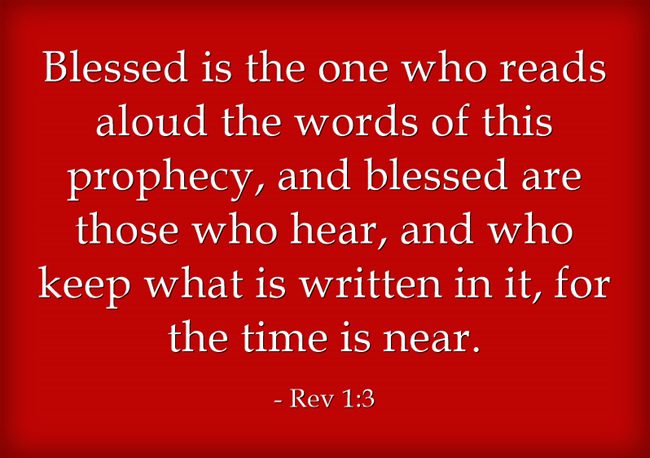
Many bible readers and believers do not like to read, study, and meditate upon the Book of Revelation. The reason they give is that it is too disturbing, foreboding, and fear producing. Yet, the book begins with a special blessing to those who read and follow its teachings.
It was the Lord's intention that the Apocalypse prophecy should instill fear. In the midst of the Apocalyptic judgments an angel speaks to the whole world and says -
“Fear God and give glory to Him, for the hour of His judgment has come; and worship Him who made heaven and earth, the sea and springs of water.” (Rev. 14: 7)
The letters to the seven churches in Asia Minor each have a promise of salvation and protection to those who overcome so that what is fearful to the world becomes a comfort to the faithful.
Also, there is much hope for believers in the Book of Revelation. Its message is that Christ wins and we win, the wicked lose. It ends with a picture of the New Jerusalem and the new heavens and earth so it is not all bad. Again, I refer to that great question of Amos concerning the coming of Christ's Apocalypse.
"Woe unto you that desire the day of the Lord! to what end is it for you? the day of the Lord is darkness, and not light. As if a man did flee from a lion, and a bear met him; or went into the house, and leaned his hand on the wall, and a serpent bit him. Shall not the day of the Lord be darkness, and not light? even very dark, and no brightness in it?"
Subscribe to:
Posts (Atom)