Tuesday, December 12, 2023

A CATHOLIC BISHOP RECOGNIZES A BAPTIST HERO

  There are two reasons I am posting this story. The first, is because I think the Christian world needs to know what it means to really follow Jesus. It means laying down our lives, sometimes literally, in order to see the Kingdom cause advanced. It means loving people enough to tell them the truth, even if it cost us our own life. It means understanding that no matter how horrible things may seem, God will bring good from it.

  The second reason I am posting this, is because it was sent to me by a Roman Catholic bishop. This story was written by Monsignor Richard Lopez. It stands out to me, because he evidently regards these Baptists as true Christians, valid in their authenticity, and true martyrs of the faith. I don't think I have ever read anything by a prelate in the Catholic Church where it is clear that non Catholic Christians are the real deal. I guess when you are so devoted to Jesus and His Gospel, that you are willing to lay down your life, then to have your daughter forgive the killers and return to tell them about Jesus, you simply cannot deny that it is genuine Christianity.  Read the following true story, written by Monsignor Lopez as part of his "Heroes of the Faith" series, and praise God for these Baptists who laid it all down, and showed the love of God so clearly, that even a Catholic bishop cannot deny its validity. 

 Hero of the Week: Peggy Covell (1923-1995)

"Conversion is one of the most mysterious and surprising of all miracles. Peggy Covell might be called a "miracle maker" in terms of conversion. Peggy's parents were American Baptist missionaries. They labored initially in Japan, but as things became more unsettled they moved to the Philippines. Peggy and her siblings were sent back to the States for school just before the horror of the Japanese invasion.

Peggy's parents and several other missionaries fled into hiding, deep in the mountains, to avoid Japanese imprisonment. For many months they maintained an almost idyllic existence, praying and preaching deep in the jungles. Tragically, their refuge, nicknamed "Hopevale,” was betrayed to the Japanese. Captured, they pleaded for the release of their Filipino friends and for an hour of prayer before their execution. Their requests were granted. They sang hymns and prayed and then told their captors they were ready. The adults were beheaded and the children were bayoneted to death!

After the war, when Peggy discovered what had happened to her parents and the other families, she burned with hatred. Contemplating her parents' final hours, she began to realize they must have been praying for the soldiers who were about to execute them. Gradually the Holy Spirit washed away her hatred and filled her with His love. To put that love into action, she volunteered to work tirelessly for Japanese POWs, held captive in Colorado. Even the hardest among them was deeply moved by her compassion and service.

When one of them returned to Japan, he told the story of the girl whose parents had been murdered by their troops, yet served them out of love. Listening to his words, one friend was shocked beyond belief. Her actions made no sense according to the Bushido code he was reared with. Picking up a copy of the New Testament in a train station, he read the words: "Forgive them, Father, for they know not what they do." He was converted to Christ on the spot.

This former Japanese air force pilot spent the rest of his life preaching healing and reconciliation in Japan and the United States. His name was Mitsuo Fuchida, his fame was that he was the pilot who led the attack on Pearl Harbor! Someone stated that conversion has three parts: a. disillusionment, b. encounter, and c. transformation. Often a faith-filled person precipitates the first stage by living, forgiving, and loving in such a way that another person becomes disillusioned with their life and hungry for more. Peggy Covell's mercy brought peace and Christ to a man who started the war that killed her parents. One saint said: "God almighty would in no way allow evil, were He not so good and all-powerful that from that evil He would work good." The horror experienced by the Hopevale martyrs leads credence to that" 

NOTE: Mitsuo Fuchida, became a Baptist preacher and served the Lord the rest of his life. This is the man who actually started WW2 for the United States, by leading the attack on Pearl Harbor.


Sunday, December 10, 2023

Equal Provision?


"20 Then He began to rebuke the cities in which most of His mighty works had been done, because they did not repent: 21 “Woe to you, Chorazin! Woe to you, Bethsaida! For if the mighty works which were done in you had been done in Tyre and Sidon, they would have repented long ago in sackcloth and ashes. 22 But I say to you, it will be more tolerable for Tyre and Sidon in the day of judgment than for you. 23 And you, Capernaum, who[e] are exalted to heaven, will be brought down to Hades; for if the mighty works which were done in you had been done in Sodom, it would have remained until this day. 24 But I say to you that it shall be more tolerable for the land of Sodom in the day of judgment than for you.” (Matt. 11: 20-24 nkjv)

There are many Christians who believe that God has provided each person with all he or she needs to be saved from sin and death. Many of them also think that God would be unjust, not good and benevolent, were he not to provide every man an opportunity to be saved, or stated another way, did not provide every man the means of salvation. Here is where the debate between "Arminians" and "Calvinists" becomes particularly focused. 

There are several questions related to this debate on the extent of provision as respects providing each with "what it takes" (or requires) to be saved. One thing that is not disputed is whether the substitutionary or sacrificial death of Christ, and his resurrection and ascension, are necessary means for anyone's salvation. Arminian soteriology says that God has provided this sacrifice for all men, that every man was represented by Christ when he died for other's sins.  Further, all agree that Christ dying for a man's sins, though required, is not the only thing required, for the atonement or propitiation must be applied in time to sinners when they believe and are regenerated or born again. Further, nearly all, except the Hardshells and some other Hyper Calvinists, say that it is applied when one by faith "receives the atonement." (Rom. 5: 11) Further, it is also nigh universally agreed that one must hear about Christ and the good news in order to believe in him and in it, per what Paul taught in Romans 10: 14-17. 

So, have all heard the gospel? Do not many die not ever having heard about Christ? Or, know nothing of the bible? Yes they do. So, what do those who advocate that every sinner is given all necessary means and provisions for being saved do? They will say God provided all an opportunity to be saved by dying for each and every person. But, why does he not also give everyone the gospel message? 

The above text is difficult for those who say that 1) God has provided to all what is needed for salvation, and 2) faith and gospel knowledge is necessary for salvation. The text says that the inhabitants of Tyre, Sidon, and Sodom, et. als., would have repented had they seen the miracles. This is what is called a "counter factual" in the Molinist debate. Not only does God foresee everything that actually happens, he also sees what may have happened had a thing or things been altered. 

Now the question that arises in view of this text is this: "if God wanted those peoples to be saved more than anything, why did he not have those miracles performed?" That is a difficult question for Arminians, in my opinion. They may respond by saying - "well they still had the word of God as a means and could have been saved by their repentance." And, in response, I would agree. However, it does show that God knows what means will be effective to make penitent believers in any given case. And, it shows that God does not give all equal means of salvation. It shows that God, on some level, desired the salvation of the Sodomites, et al., and provided some means for it, but not as much means as he could have. And, I think all would acknowledge that not all sinners have equal opportunities and means for salvation. So, God made a choice not to give those added means to the Sodomites and others, knowing that it would secure their damnation.

In an article at Bible Tools web page (see here), Dan Elmore is cited as saying, under the heading "What the Bible says about Equal Opportunity for Salvation"

"It is clear that God is not a respecter of persons, giving everyone an equal opportunity for salvation and judging all by the same standards."  (emphasis mine)

This would be a good proposition for debate among Calvinists and Arminians. Does God in fact give everyone an equal opportunity for salvation? 

Chorazin, Capernaum, and Bethsaida, had "A" (the means of the word of God) and "B" (the miracles performed as confirmation of the word) and were not brought to repentance and faith (or saved). Tyre, Sidon, and Sodom had "A" but not "B"

Christ says that those who had only "A" are lost, but had they had both "A" and "B", then they would have been saved. So, it is proven then that 1) all are not given equal means and opportunities to be saved, and 2) Christ knows, as omniscient being, what is required in any individual case to change a person's heart and mind. 

The doctrine of election is God's choice to make certain that some are saved, and in that choice he gives each chosen sinner what he needs to come to faith and repentance. Though it is not the only reason, yet we can say that one reason why the citizens of Sodom, Tyre, and Sidon did not repent is because they did not have miracles "provided" for them. That is all that my understanding of Calvinism affirms. God applies more force, more power, more means, more of this and that, in the case of the elect than he does with the non elect and this difference in the degree of power exerted is the determining factor.  

Further, it is with this understanding that most Christians pray, including those like Elmore and other Arminians. When they pray "God save Jack and Mary," they thereby confess that God can save them at any time he chooses. When they pray "God, bring him to his senses," or "God, influence him even more," etc., they are acknowledging that God does not operate equally upon all. Did God not use more means in the conversion of Paul than other Christians? 

Many who hold the view of Elmore operate under the assumption that, in every individual case, God has the same degree of desire for their salvation and operates to the same level of influence towards their salvation. But, that is simply not what the scriptures show us. 

God does discriminate, if you want to call it that. He does "make a difference" based upon his own sovereign choice.  

"And of some have compassion, making a difference: and others save with fear, pulling them out of the fire." (Jude 1: 22-23 kjv)

This is what Christians are to do. They should not treat everyone equally. So, if it is right for Christians to choose in this manner, why not God? Do Christians or God become respecter of persons when they make such a difference in how they treat others? Wrote Paul along this line:

"For who makes you differ from another? And what do you have that you did not receive? Now if you did indeed receive it, why do you boast as if you had not received it?" (I Cor. 4: 7 kjv)

God is not a respecter of persons because his choice or making a difference is not based upon any natural distinction between people or based upon how one was superior in some way to another. It seems to me that those who say that God chooses those who make a certain "free will" decision are saying God chose them because they made themselves different from others. 

Further, the bible says that God "had respect" to Abel and to his offering. (Gen. 4: 4) So, God does respect persons in some sense and in some sense he does not. The question is this - "why does he respect anyone?" Is it not that he respects those who he himself made to differ?

Who can say that the heathen who died without any knowledge of the one true God or of his way of salvation through Christ (such as the American Indians before the Pilgrims came with the word of God) had the same opportunities as Sodom, Tyre, Sidon, Capernaum, etc.? Or as a person born into a Christian home where the bible was read every day and prayer offered to God daily?

Does God Discriminate?

The word "discriminate" or "discrimination" may mean one of two things. It may mean to "make an unjust or prejudicial distinction in the treatment of different categories of people, especially on the grounds of ethnicity, sex, age, or disability." Or it may simply mean to "recognize a distinction," or to "differentiate." So, we say "he has discriminating taste." So, God does not discriminate per the first definition, but he does per the secondary definition. If he makes you to differ from another, then he does "make a distinction" or "differentiate" among men. The big question is not whether he made you to differ, but why does he make you different? That can only be answered by saying "for so it seemed good in your sight, holy Father." (See Matt. 11: 26)

On April 9, 1907 Elder C.H. Cayce, Primitive Baptist debater, met Missionary Baptist Elder, I.N. Penick in Martin, Tennessee and one of the four propositions was this (see here):

"The scriptures teach that in the death of Christ sufficient provision was made for the salvation of all the race of mankind." 

Now, I can both affirm and deny that proposition. I have always believed the expression about the atoning death of Christ which says it is "sufficient for all, efficient for the elect." The sufferings and death of Christ are sufficient to save every single sinner. But, it does not save all. Universal salvation is a grievous error and one taught against in scripture. On the other hand, "sufficient provision" is not true if it means that nothing other than the atonement itself is necessary for salvation, for certainly hearing the gospel and believing and obeying it are necessary, and this has not been provided to all, as we have observed. 

Many have died who did not have the means of salvation, the gospel or word that is necessary for faith (Rom. 10), which faith is necessary for salvation.

Some Arminians deal with this conundrum on how atonement is provided for all but the gospel has not been provided for all by denying that the word of God or gospel message has been denied to all or that it is necessary to have the word of God to be saved (affirming that if one lives up to the light of natural revelation, then he is saved). But, that is not tenable according to the plain declarations of scripture. 

So, to me, the doctrine of election simply tells us that God chose to so work or influence someone to a greater degree than he does in common with all, that he exerts not little power (or influence) in the cases of the elect, but that he exerts compelling power. (See Eph. 1: 19-20) It also means that he provides a person who is chosen with the gospel message and providential influences sufficient to ensure their repentance.

Saturday, December 9, 2023

If I Were Still A Hardshell

"4 As concerning therefore the eating of those things that are offered in sacrifice unto idols, we know that an idol is nothing in the world, and that there is none other God but one. 5 For though there be that are called gods, whether in heaven or in earth, (as there be gods many, and lords many,) 6 But to us there is but one God, the Father, of whom are all things, and we in him; and one Lord Jesus Christ, by whom are all things, and we by him. 7 Howbeit there is not in every man that knowledge: for some with conscience of the idol unto this hour eat it as a thing offered unto an idol; and their conscience being weak is defiled. 8 But meat commendeth us not to God: for neither, if we eat, are we the better; neither, if we eat not, are we the worse. 9 But take heed lest by any means this liberty of yours become a stumblingblock to them that are weak." (I Cor. 8: 4-9 kjv)

Several years ago I wrote a series on the weak and strong brothers whom Paul talks about in I Corinthians chapters eight and nine and in Romans chapter fourteen. (They are in the archives of The Baptist Gadfly blog with the first in the series here; and the last in that series here) I showed how the common view that affirms that the weak brothers are born again Christians who have "scruples" about certain beliefs and practices is false and showed rather how they were not Christians at all and Paul's calling the weak "brothers" did not mean that they were Christian.  I showed that this was the term Paul used to refer to his religious brothers among the Pagans, much like the Communists used the term "comrade" which means "brother." My view is proven by these words of the apostle in the context:

"To the weak became I as weak, that I might gain the weak: I am made all things to all men, that I might by all means save some." (I Cor. 9: 22)

If weak brothers are already Christian, already gained and saved, then why does Paul say he wants to save and gain them? 

My view is upheld by some, whom I cite in my series. I found out later that Dr. W. P. Throgmorton held to the view I hold. 

Not only does I Cor. 9: 22 show that the weak (impotent) brothers are not saved, but the text above in chapter eight also shows it. It says that weak brothers do not possess or believe the stated creed of Christians which says that there is only one God and one Lord and Savior, Jesus Christ, etc. How can the weak brothers be saved if they do not believe Paul's creedal statement? 

If these weak brothers are saved, as most commentators affirm, then I would argue, if I were still a Hardshell Baptist, that it shows that one can be wrong on who are God and Christ and still be "brothers" and go to heaven. And, I would argue that the "gaining" and "saving" of the weak brother was a "time salvation" that was not determinant of eternal destiny.

Of course, one must also deal with these comments of Paul on the weak brothers:

"And through thy knowledge shall the weak brother perish, for whom Christ died?" (8: 11)

After I got my opponent to affirm that the weak brothers were born again children of God, I would as a Hardshell apologist then ask what salvation was effected by gaining and saving the weak. He could not say initial salvation but say it was some kind of temporal salvation post initial salvation. And, I would have him affirming that the weak brother "perishing" was a temporal perishing. 

Thankfully, however, I am not a Hardshell. 

The text rather shows that no one is saved who does not believe the several creedal statements Paul mentions. In other words, if you do not believe in one God, the Father, and in his Son Jesus Christ, and that of the Father and through the Son are all things, then you are lost and need to be gained or saved. 

Can one be saved without believing these things about God? Hardshells say yes. They say many Pagans and Polytheists are born again and saved. They say one does not have to believe the truth of these things to be saved. But, many commentators affirm the same, inadvertently and unintentionally, when they affirm that the weak brothers are saved people who are not yet convinced that there is one God and one Savior Jesus Christ. 

Friday, December 8, 2023

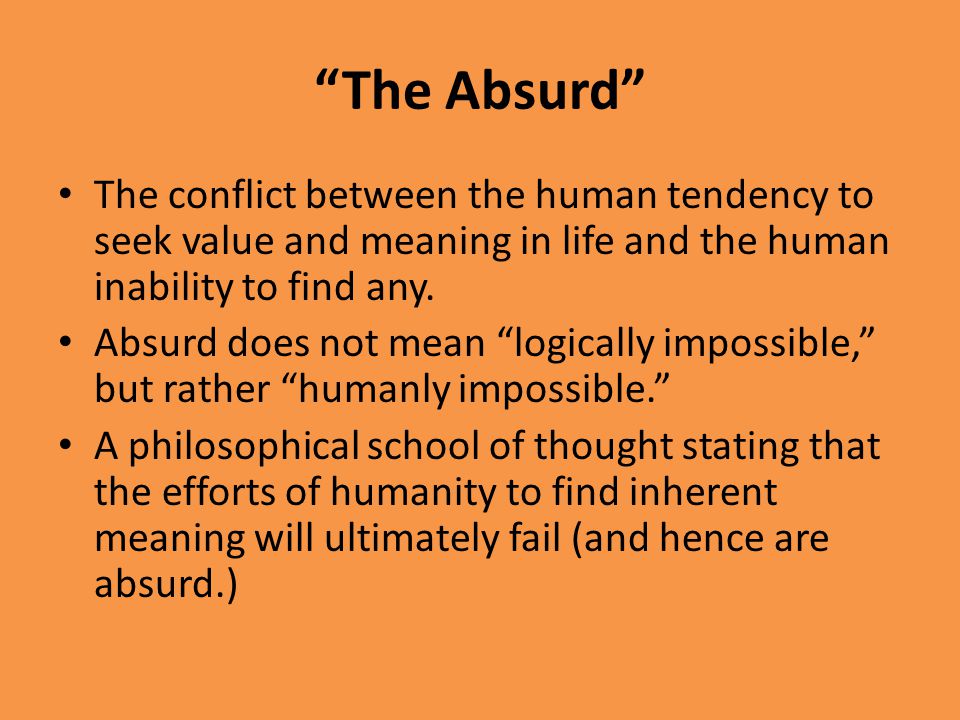
Absurdism


Absurdism as a philosophy is an extension of, or divergence from, Existentialism, in that it focuses on the pointlessness of mankind, the meaninglessness of life and existence, and on the emotional angst and anxiety, and other psychological phenomena, that results from this realization. It deals with the question "is life worth living?" There are many scenes in movies where this philosophy is expressed. 

For instance, in "John Wick," John the assassin is at the cemetery for the burial of his soul mate who had died of disease, and another assassin, "Marcus," who is a friend of John, has a very short dialogue with him in the rain while Marcus is holding an umbrella. Marcus says - 

"There's no rhyme or reason to this life. It's days like today scattered among the rest."

In another popular movie, “The Legend of Bagger Vance,” Walter Hagen says to fellow golfer "Junuh," -

The meaning of it all is that there is no meaning.” 

In the movie Hagen is pictured as a worldly man who indulges in pleasures of sin, and yet he has a "swami" as his caddie. I am sure that line came from the Swami's teachings. 

This absurdism philosophy is seen in the Book of Ecclesiastes and in its theme which is "all is vanity" or "all is meaningless." 

A bible believer "knows everything" (or "all things" - I John 2: 20) as a result of experiencing the "anointing" ("unction" kjv) that John speaks of. Of course, that does not mean that believers are omniscient as God, but means, I rather think, that believers see the big picture, the reason for all things, the meaning of life and existence.  

Don't give in to the pessimism of others who believe in the meaninglessness of life. Meaning can only be found in the Creator. Is our life without meaning and purpose? I urge you to find meaning and purpose in doing the will of God and getting to know him through Christ Jesus, the Son of God. You will then be able to say with the apostle Paul: "For to me to live is Christ, and to die is gain." (Phil 1: 21 kjv)

"Therefore let those who suffer according to the will of God 
commit their souls to Him in doing good, as to a faithful Creator." 
(I Peter 4: 19 nkjv)

Wednesday, December 6, 2023

Beliefs about the Afterlife (xxxvii)


Figuring Out The Chronology

Anyone who has studied eschatology (study of last things or unfulfilled prophecy and an aspect of our study on the afterlife or hereafter) will confess that the greatest difficulty in understanding and interpreting prophecies is in regard to discerning the order of events of things, particularly as it relates to the second coming of Christ, and in regard to all yet unfulfilled prophecy. 

Just as bible believers discuss and disagree on the "ordo salutis" (which deals with the sequence or order of things within the doctrine of salvation), so too do they also disagree on the chronology of prophetic events yet to occur. However, it was also that way in the days when Christ was born. It was also that way among the prophets of Israel. They too tried to figure out what things would happen first. Notice first this text:

"And His disciples asked Him, saying, “Why then do the scribes say that Elijah must come first?” Jesus answered and said to them, “Indeed, Elijah is coming first and will restore all things."  (Matt. 17: 9-11 nkjv)

Notice the words "coming first." Further, the people understood the order as to who would come first, Elijah or the Messiah. They no doubt were confused on some of the other order of things predetermined to come to pass. 

"Concerning this salvation, the prophets, who spoke of the grace that was to come to you, searched intently and with the greatest care, trying to find out the time and circumstances to which the Spirit of Christ in them was pointing when he predicted the sufferings of the Messiah and the glories that would follow." (I Peter 1: 10-11 NIV)

"Forasmuch as many have taken in hand to set forth in order (Greek word anatassomai) a declaration of those things which are most surely believed among us..." (Luke 1: 1 kjv)

The Greek word means to "set in order" or "arrange" or "compose." It does deal with sequence. It is important that narrators and historians in teaching and conveying stories to get things in their right order. To get the order mixed up can ruin a story or narrative. Getting historical events wrong also creates enigmas and contradictions. It is also important in giving directions, as when you say "you go this way till you come to this sign, then you turn right when you see another sign..." If you get the sign order wrong in the directions you will get lost. 

The old testament prophets did not always understand things in the right order as we will see as we proceed with this study. 

One of the things I have liked about Luke's gospel is the fact that he wants to get the events in the story of the life of Christ in the right order and when there is a seeming conflict between his narrative and that of Matthew, Mark, or John, I go with Luke. I also believe that he wrote in the right order in the Book of Acts, written by him.  

So, it has always been an area of intense investigation by dedicated bible students to discern, when it comes to unfilled prophecies, which comes first. That is quite apparent when it comes to answering the question - "which comes first, the great tribulation or the rapture and second coming?" It also shows up when someone asks "who comes first, Christ or Antichrist?" So, not only is the order of the various aspects of salvation important, but so too is the order of the various things yet to occur in the future per all unfulfilled prophecy. Like the old testament prophets we today as late new testament believers are also "trying to find out the time and circumstances" of things yet to occur at the end of this age and in the ages to come. 

Isaiah's New Heavens and Earth

17“For behold, I create new heavens and a new earth; And the former shall not be remembered or come to mind. 18But be glad and rejoice forever in what I create; For behold, I create Jerusalem as a rejoicing, And her people a joy. 19I will rejoice in Jerusalem, And joy in My people; The voice of weeping shall no longer be heard in her, Nor the voice of crying. 20“No more shall an infant from there live but a few days, Nor an old man who has not fulfilled his days; For the child shall die one hundred years old, But the sinner being one hundred years old shall be accursed. 21They shall build houses and inhabit them; They shall plant vineyards and eat their fruit. 22They shall not build and another inhabit; They shall not plant and another eat; For as the days of a tree, so shall be the days of My people, And My elect shall long enjoy the work of their hands. 23They shall not labor in vain, Nor bring forth children for trouble; For they shall be the descendants of the blessed of the Lord, And their offspring with them. 24“It shall come to pass That before they call, I will answer; And while they are still speaking, I will hear. 25The wolf and the lamb shall feed together, The lion shall eat straw like the ox, And dust shall be the serpent’s food. They shall not hurt nor destroy in all My holy mountain,” Says the Lord." (Isa. 65: 17-25 nkjv)

“For as the new heavens and the new earth Which I will make shall remain before Me,” says the Lord, “So shall your descendants and your name remain. 23And it shall come to pass That from one New Moon to another, And from one Sabbath to another, All flesh shall come to worship before Me,” says the Lord. 24“And they shall go forth and look Upon the corpses of the men Who have transgressed against Me. For their worm does not die, And their fire is not quenched. They shall be an abhorrence to all flesh.” (Isa. 66: 22-24 nkjv)

When is this fulfilled? During the Millennium? Or, in the beginning age of the ages of the ages? Is this description of new heavens and earth the same as the description by Peter, John, and other new testament writers? 

It seems clear to me and to others that the new heavens and earth of Isaiah have their fulfillment in the Millennium while the descriptions given by Peter and John have their fulfillment in the ages following the Millennium. We should begin by showing how Isaiah's description differs from that of John in the Apocalypse. 

Isaiah’s vision for the new heavens and earth includes physical death (although human life-spans are substantially lengthened) and a greatly transformed quality of natural life, yet it still falls short of eternal life in the new heavens and earth described by John in the Apocalypse. In the new heaven and earth of John we are told, for one thing, that there is "no more death." (Rev. 21: 4) Isaiah’s vision must therefore, for this reason alone, be pointing to the Millennium (which, in many ways, as we will see, anticipates the eternal state).  

My Thesis

The prophecies of the old testament concerning the coming of Christ the Messiah did not reveal that there would be two comings of Christ (they assuming that all that Christ would accomplish would involve only one coming). It is the new testament revelation, first given by Christ himself while here on earth, that speaks of his going away and coming again, and telling us that both comings would be different in their purpose and effect. (See for instance Colossians 1: 26-27) 

The new testament inspired authors speak of several "mysteries" that saints of the old testament did not have revealed to them to the extent that they are now revealed in the new testament. The idea that Christ would come to earth two times and separated by thousands of years was not revealed to them, although hints of it were present to them. Because of this, when we read old testament texts describing things that are to occur when the Messiah would come, we see where some of them were fulfilled in his first coming but others in his second coming. Notice this text from the gospels as an example:

"16And he came to Nazareth, where he had been brought up: and, as his custom was, he went into the synagogue on the sabbath day, and stood up for to read. 17And there was delivered unto him the book of the prophet Esaias. And when he had opened the book, he found the place where it was written, 18 The Spirit of the Lord is upon me, Because he hath anointed me to preach the gospel to the poor; He hath sent me to heal the brokenhearted, to preach deliverance to the captives, And recovering of sight to the blind, To set at liberty them that are bruised, 19 To preach the acceptable year of the Lord. 20And he closed the book, and he gave it again to the minister, and sat down. And the eyes of all them that were in the synagogue were fastened on him. 21And he began to say unto them, This day is this scripture fulfilled in your ears." (Luke 4: 16-20) 

Here is the text in Isaiah that Christ read from:

"61 The Spirit of the Lord God is upon me; because the Lord hath anointed me to preach good tidings unto the meek; he hath sent me to bind up the brokenhearted, to proclaim liberty to the captives, and the opening of the prison to them that are bound; 2 To proclaim the acceptable year of the Lord, and the day of vengeance of our God; to comfort all that mourn; 3 To appoint unto them that mourn in Zion, to give unto them beauty for ashes, the oil of joy for mourning, the garment of praise for the spirit of heaviness; that they might be called trees of righteousness, the planting of the Lord, that he might be glorified. 4 And they shall build the old wastes, they shall raise up the former desolations, and they shall repair the waste cities, the desolations of many generations."

Why did Christ abruptly quit reading the Isaiah text when he did? Why did he not say "this day is this scripture fulfilled" in relation to the words following, such as "to proclaim the day of vengeance" or "they shall build the old wastes" and "raise up the former desolations" and "repair waste cities" and "the desolations of many generations"? Is it not because the first part of the Isaiah passage, that part which was read by Christ, was fulfilled in the first coming of Christ, but the rest, the part he did not read nor pronounce as fulfilled, awaits fulfillment at his second coming?

The Scofield Reference Bible expresses this view, saying: 

“Observe that Jesus suspended the reading of this passage in the synagogue at Nazareth Lu 4:16-21 at the comma in the middle of Isa 61:2. The first advent, therefore, opened the day of grace, “the acceptable year of Jehovah,” but does not fulfil the day of vengeance. That will be taken up when Messiah returns 2Th 1:7-10 Cf. Isa 34:8; 35:4-10. The last verse, taken with the 4th, gives the historic connection: the vengeance precedes the regathering of Israel, and synchronizes with the day of the Lord. Isa 2:10-22; Re 19:11-21; Isa 63:1-6.”

Some think that it is reading too much into this fact that Christ stopped reading just where he did with the closing words "this scripture is fulfilled today." In fact, he could not rightly say of the "day of vengeance"  that it had also been fulfilled and is the reason he stopped where he did in his citation. 

The brothers at Got Questions web page (See here) say what others also say along this line, writing (emphasis mine):

"The Old Testament clearly teaches that the Messiah would come, but it does not explicitly say that He would come twice." 

They also write:

"In short, there were many things in the Old Testament about the coming of the Messiah that were not fully explained, and sometimes seemingly contradictory things were presented in the same book or even the same chapter. Some of the Jewish rabbis even suggested that there would be two Messiahs, a humble, suffering one and a conquering, reigning one; but no one was suggesting that the same Messiah would come twice, once to suffer and once to reign."

I firmly believe what these brethren write in the above two citations. They also write:

"The Old Testament had several mysteries regarding the Messiah: would He be a divine figure or a human descendant of David? The New Testament gives the answer—both, because of the Incarnation. Would the Messiah be cut off or reign forever? The New Testament gives the answer—both, because of the Resurrection. Would the Messiah come to suffer or to reign? The New Testament once again gives the answer—both, because He would come twice."
 
They also write:

"The idea that the Messiah would come once to suffer and again to reign is not clearly taught in the Old Testament, although the doctrine is completely consistent with Old Testament teaching. Further, the second coming resolves some of the apparently contradictory teachings about the Messiah in the Old Testament."

We could give many examples of how many old testament prophecies of the Messiah have parts of the prophecy finding fulfillment in Christ's first coming, while the rest find fulfillment in Christ's second coming. Also, some things are fulfilled in both comings. There are instances of what theologians call a "dual fulfillment." 

Clarence Larkin, Dispensationalist teacher and architect of many charts that have been widely used by bible teachers, in the chart at the heading of this chapter, shows how the prophets often did not see the chronology of events so clearly. Their prophecies of the coming of Christ and of the kingdom of God and of  the new heavens and earth are often envisioned as occurring in one single coming or in one single age or period of time. 

In a discussion board at "Quora" one writer, Chavoux Luyt, expressed my view very well and copy and paste it here. He wrote (See here - emphasis mine):

"Why then does Isaiah explicitly mention the new heavens and earth? I believe that this is typical of prophecy (most clearly seen in the Old Testament, but also for example, in Matt.24 — referring to both the coming fall of Jerusalem, within that same generation, and the far future return of the Son of Man, the Messiah, within what appears like a single prophecy). Some theologians use the word “telescopy”. It is the idea that similar to a mountain range seen at a distance, where the mountains often seem to be on the same level, once you get closer, you can see that there are actually two mountain ranges that are separated quite far from each other. The same pattern is seen in the Messianic prophecies where the prophets often made no distinction between the first coming of the Messiah and his final triumphant return (e.g. Mic.5, Is.7–9). It is not only seen in the Messianic prophecies, it is sometimes also seen in shorter term, more literal prophecies, e.g. that of Ezekiel on Tyre, where part of the prophecy was fulfilled by Nebuchadnezzar (victory over the mainland part of Tyre) and the last part of the prophecy (the walls been thrown into the sea and the city totally destroyed, including the island portion) only being fulfilled much later in the time of Alexander the Great. Yet, both events are found in the same prophecy as if it is single event. (this is what is also called a "dual fulfillment" of prophecy) For this reason I believe that a similar pattern is at play in Isaiah 65. Both the eventual new heavens and earth (where there is no death at all) and the “millennial” reign of Messiah on earth, are described within a single prophecy as part of the same plan of God and in language that would make much more sense to the Israelites at the time, before Messiah had been raised from the dead and eternal life has become a reality. But it is a misunderstanding of that prophecy (like many have misinterpreted other old Testament prophecies) to insist that the whole prophecy refers to the same time period."

Wrote Dr. John Piper in commenting upon the prophecy of Malachi (4: 1-3, 5) about the coming of the Lord and the day of the Lord (see here - emphasis mine):

"There was no clear prophecy in the Old Testament that this day of the Lord, with its blazing judgment against evil, and its healing and leaping for joy for those who fear God, would come in two stages separated by 2,000 years. The Old Testament prophetic perspective looked at the nearer and farther mountains in the mountain range of God’s future and saw them as temporally indistinct."

The very first announcement of a Messiah by God himself in the Garden of Eden speaks of a singular coming, and yet we now know that Messiah was predetermined to come twice, and each for its own ends and purposes. That promise, called the protoevangelium, is given in these words of God to the Serpent: 

"And I will put enmity Between you and the woman, And between your seed and her Seed; He shall bruise your head, And you shall bruise His heel.” (Gen. 3: 15 nkjv)

All recognize this as a prophecy of the coming of that one called "her seed," and the "desired one," i.e. the Messiah or Christ. However, in the fulfillment of this prophecy, the bruising of the heel of the virgin's seed was fulfilled in Christ's first coming when the Serpent (Satan) via his seed put Christ to death, literally wounding him in his feet and heels via the nails. But, the crushing of the serpent's head did not occur during the first coming, but will occur during the second coming. Christ obtained victory over the Serpent and his seed when he lived a life without sin and in obedience to the will of his Father died as an innocent sacrifice for the sins of believers. But, the complete overthrow of Satan awaits the second coming. So Paul testifies: "The God of peace will soon crush Satan under your feet." (Rom. 16: 20) In Isaiah's prophecy of new heavens and earth, cited already, he says:

"The wolf and the lamb shall graze together; the lion shall eat straw like the ox, and dust shall be the serpent’s food. They shall not hurt or destroy in all my holy mountain,” says the LORD." (Isa. 65: 25)

Here the prophecy of the fate of the Serpent and his seed about eating dust and being crushed by the seed of the woman is viewed as what is yet to be fully realized. Yes, in some sense, Satan has been defeated, but his complete destruction awaits the time Christ has chosen. Perhaps we can say that there is a dual fulfillment of these prophecies. Yet, who can deny that the prophecy has things that were fulfilled in the first coming and things that await fulfillment in the second coming?

Here is another example:

"For to us a child is born, to us a son is given, and the government will be on his shoulders. And he will be called Wonderful Counselor, Mighty God, Everlasting Father, Prince of Peace. Of the greatness of his government and peace there will be no end." (Isaiah 9: 6-7) 
 
This passage combines a prophecy of a child being born (the first coming) and the prophecy of the Davidic kingdom being revived, bringing peace and righteousness from then and forever more (the second coming). Isaiah combines the two events as though they were one

We see the same thing in the prophecies of Zechariah. 
 
“Rejoice greatly, O daughter of Zion! Shout, O daughter of Jerusalem! Behold, your King is coming to you; He is just and having salvation, Lowly and riding on a donkey, A colt, the foal of a donkey. 10 I will cut off the chariot from Ephraim And the horse from Jerusalem; The battle bow shall be cut off. He shall speak peace to the nations; His dominion shall be ‘from sea to sea, And from the River to the ends of the earth.’(Zech 9: 9-10)

The first part of this prophecy was fulfilled by Jesus at His first coming. (Matt 21: 1-11) But, the second part will be fulfilled by Christ at his second coming.

Conclusion

The description that Isaiah gives of the new heavens and earth in chapters 65 and 66 of his book of prophecies mix together two scenes, like a "double exposure" in photographs, for he mixes the Millennial Age with the ages following, i.e. the ages of the ages. Since we now have the additional revelation of the Messiah himself, and of the new testament inspired writers, we can separate the events foretold into what is fulfilled in his first coming and what is fulfilled in his second coming. 

In the next chapter we will look at Isaiah's description further and see how it describes things which are to be fulfilled in the Millennium alone, which are to be fulfilled in the ages following, and which are fulfilled in both the Millennium and the ages following.

Tuesday, December 5, 2023

Reformed Arminians?

In the ABSTRACT of an article at desiringgod web page (begun by Dr. John Piper) written by Stephen M. Davis (See here) we find these words (emphasis mine): 

"The Reformation disrupted the religious status quo of early sixteenth-century Europe when multitudes embraced the teachings of Martin Luther (1483–1546) and John Calvin (1509–1564). Their followers were respectively called Lutherans and the Reformed, the latter known also as Calvinists and Huguenots."

So many times I read similar statements by others who falsely equate the noun or adjective "Reformed" and "Calvinist." The fact is, many "Reformed" folks have been Arminian, yea, even Arminius himself! Those terms are not to be equated even though some Calvinists, especially those with Hyper Calvinistic leanings and beliefs, want all to believe. Here again we may say "the devil is in the definition."

In an article titled "Meet A Reformed Arminian" (See here) Dr. Jeff Robinson says (emphasis mine):

"The first time I heard Matt Pinson speak, he repeatedly dropped a term that rolled around in my mind for several days: “Reformed Arminian.” Such a phrase seems an oxymoron along the lines of jumbo shrimp, heated ice, or left-wing conservative."

Well, lots of folks do not know that there are "Reformed Arminians." But, we will inform them.

Robinson says further:

"As a trained church historian, I was fairly certain that by “Reformed Arminian” he meant one who affirms the teaching of Jacob Arminius, a figure who arose out of the Protestant Reformation, a figure whose theology departs at numerous key points from much popular Arminian theology today. Was I correct? I had to know more, and the interview below is a product of my query." 

Yes, the fact that Arminius is considered both "Reformed" and "Arminian" shows that "Reformed" is not a synonym for "Calvinist." 

Wrote Dr. Robinson:

"A growing number of Arminians are embracing a non-Wesleyan variety of Arminianism that’s coming to be known as “Reformed Arminianism.” The mainstream of this movement in the United States is found in the Free Will Baptist denomination, the origins of which date back to the English General Baptist movement of the 17th century. Early proponents of this approach include 17th-century English figures such as Thomas Helwys and Thomas Grantham. Twentieth-century proponents include Free Will Baptist scholars Leroy Forlines and Robert Picirilli, who see themselves as representing a type of Arminianism more like the theology of Arminius than most modern Arminianism. Forlines and Picirilli have also found much in common with scholars from outside the General/Free Will Baptist tradition like Thomas Oden."

Thus, "Reformed Arminianism" to me is equated with what theologians also call "classical Arminianism." For my own self, I can say as a Calvinist that I have much in common with classical or reformed Arminians. 

Wrote Dr. Robinson:

"A growing number of evangelicals fit a unique profile in the Calvinist-Arminian conversation: They see Scripture as not supporting a traditional Calvinistic view of predestination, grace, and human freedom. Yet they disagree with most Arminians’ rejection of the Reformed doctrines of total depravity, penal substitutionary atonement, the imputation of Christ’s righteousness of Christ in justification, and progressive (as opposed to entire) sanctification. For these individuals, and for the entire Calvinist-Arminian conversation, this Reformed Arminian stream of thought offers fruitful possibilities."

This is also why I have, along with others, referred to "Hyper Arminianism" as well as "Hyper Calvinism." 

Wrote Dr. Robinson:

"It’s funny that Arminians (or Calvinists) can work together with fellow Arminians (or Calvinists) who differ with them on whether infants should be baptized, the timing of Christ’s return, and charismatic gifts, and yet Calvinism and Arminianism has become a litmus test for evangelical fellowship in those same circles. This situation is precisely what keeps people from understanding and reading authors from the other side, which is unhealthy."

Yes, it is "funny" or odd, but it is sad too. Thankfully, we will all understand it better by and by, for there will be no disagreement about these things by departed saints in heaven.

Wrote Dr. Robinson:

"Reformed Arminian soteriology diverges from Wesleyan and Holiness models of Arminianism by embracing the more Reformed categories of Arminius. Unlike Wesleyan-Arminian theology as it developed in the Holiness movement, Reformed Arminianism holds the traditional Reformed notion of original sin and radical depravity that only the grace of God via the convicting and drawing power of the Holy Spirit can counteract. It puts forward a thoroughgoing Reformed, penal-satisfaction view of atonement. This entails that Christ’s active and passive obedience are imputed to the believer in justification."

Wrote Dr. Robinson further:

"I believe Reformed Arminianism can reinvigorate the current Arminian-Calvinist dialogue (or lack of dialogue). It’s a more grace-oriented appropriation of Reformed teaching on the nature of atonement, justification, sanctification, and spirituality, combined with its Arminian stance on predestination and freedom (before and after conversion) to resist divine salvific grace...Unfortunately, most popular Arminianism is semi-Pelagian, closer to Finney than Wesley."

Wrote Dr. Robinson further:

"The fact so many Calvinists love to sing the gospel-rich hymns of Charles Wesley, which John loved and printed and commended and sang, shows what Wesley meant when he said he was within a “hair’s breadth” of Calvinism."

Amen to that!

What think ye?

Saturday, December 2, 2023

Neglect in Reading the Apocalypse?


Through the years when I have tried to talk about the Book of Revelation with lay church members I have often found a large majority of them say "oh it frightens me to read it" (or something similar) or perhaps say "I have read it once, but it is way over my head" (so they quit reading and studying it). 

In an article at Crossway by Nancy Guthrie titled "4 Reasons We Avoid the Book of Revelation" (See here) she lists these four reasons for neglect of reading the final book of the bible:

1. We’re afraid we won’t be able to understand it.

2. We know there is lots of disagreement about Revelation.

3. We think Revelation is mostly or completely about the future with nothing practical for us today.

4. We know that there is a lot about persecution of believers in Revelation, and that makes us uncomfortable.

Others add more to this list of reasons for neglect of reading and musing upon the book of Revelation which is called "the words of this prophecy." 

It is highly ironic and significant that the inspired book is neglected when it begins with this word of introduction by the risen Lord Jesus Christ himself:

"Blessed is he who reads and those who hear the words of this prophecy, and keep those things which are written in it; for the time is near." (Rev. 1: 3 nkjv)

No other book of the bible has such a stated introduction to it. Of course it is true that every book of the inspired canon of scripture contains a blessing for those who read it and heed its teachings but none offer such a direct and emphasized promise as this. That makes the scrolls of the Apocalypse special and in some ways superior. Has it not been called "the capstone of revelation"

That it is mostly prophetic of future events is most undeniable. However, it nevertheless also deals with first century times, and even of things between then and "the time of the end." 

It ought to be interpreted in light of the old testament's language, including its figures, symbols, idioms, etc., as well as in light of what Christ and the apostles taught about what lies ahead for the church and for the world, both for the aion and for the cosmos. It tells us of God's program for the future, for only God has foreknowledge of it, and has ordained it, saying "so let it be." It tells us of his providence, yea, his meticulous providence of all things that are occurring. It tells us that things will get worse before they get better, that the saints "must through much tribulation enter the kingdom" (Acts 14: 22)

Guthrie also commented, saying (emphasis mine):

"Revelation presents a past, present, ongoing, and future reality that servants of Jesus living in between his ascension and return need to see. It sheds light on history as it has unfolded in the past and is unfolding right now. It serves as a corrective to any assumptions we might have that the status quo will continue, and that resistance to the world’s system is futile."

She also said in the same article:

"Revelation is actually less about when Jesus will return and more about what we are to do, who we are to be, and what we can expect to endure as we wait for Jesus to return to establish his kingdom."

I think that is true. It reminds me of Peter's words when talking about the second coming of Christ and of his Apocalypse and judgment of the world. Wrote the apostle:

"11 Since everything will be destroyed in this way, what kind of people ought you to be? You ought to live holy and godly lives 12 as you look forward to the day of God and speed its coming.[b] That day will bring about the destruction of the heavens by fire, and the elements will melt in the heat. 13 But in keeping with his promise we are looking forward to a new heaven and a new earth, where righteousness dwells. 14 So then, dear friends, since you are looking forward to this, make every effort to be found spotless, blameless and at peace with him. 15 Bear in mind that our Lord’s patience means salvation, just as our dear brother Paul also wrote you with the wisdom that God gave him." (II Peter 3: 11-15 NIV) 

Reading and meditating upon the Book of Revelation (or "Apocalypse"), as in reading all the prophetic oracles of God concerning unfulfilled prophecy of things to come, should stir us who believe it to strive for greater holiness, a closer walk with God, less sin and disobedience, etc. The doctrine of the second coming and of the coming day of divine judgement, wrath, and vengeance ought to provoke us to reverential fear and awe and see more clearly our need of God's salvation, to patiently endure any and all crosses for his name's sake.  

Guthrie also said:

"Revelation has everything to do with how we invest the capital of our lives, what is worth getting excited about, or being afraid of. Revelation speaks to our big and little compromises with the world around us, how we view political and governmental systems, and what we expect our money can provide for us."

She also said:

"Enduring in our allegiance to King Jesus even when it costs us, and living as if we do not expect this world to applaud us, approve of us, or satisfy us, is subversive. It’s shocking. And at the same time, it is the ordinary Christian life. It is what is expected of a citizen of the kingdom of heaven living in the kingdom of the world."

Agreed.

The book of Revelation, though having parts of it that are symbolic, has much of it that is very literal. Scholars often debate on which parts are literal and which parts are symbolic. But, the same is true of all other books of the bible. Many don't take the story of Jonah and the mega whale literally. Many other such things in the bible are believed to not be literal by some. Revelation is not unique in that sense. I myself believe that there is a right way to approach this important issue. It involves "hermeneutics" which deals with ways to interpret the bible (or as in other texts, such as the USA constitution). But, even symbolic language, or similes and metaphors, are used to present a literal truth fact or proposition. 

I believe that every prophecy given in the bible, and which has clearly already been fulfilled, was fulfilled literally. Christ was prophesied to come into Jerusalem as God's anointed king in the old testament riding upon a colt (Zech. 9: 9), and how was that fulfilled? Literally or spiritually? (Matt. 21: 1-5)

Amillennialists will say to Premillennialists - "you take things too literally in the book of Revelation."
Premillennialists will say to Amillennialists - "you take very few things literally in the book of Revelation."

Don't let the devil distract you or encourage you not to read the book of Revelation. He is keeping you from a blessing and keeping you from oracles God delivered for the salvation of your soul.

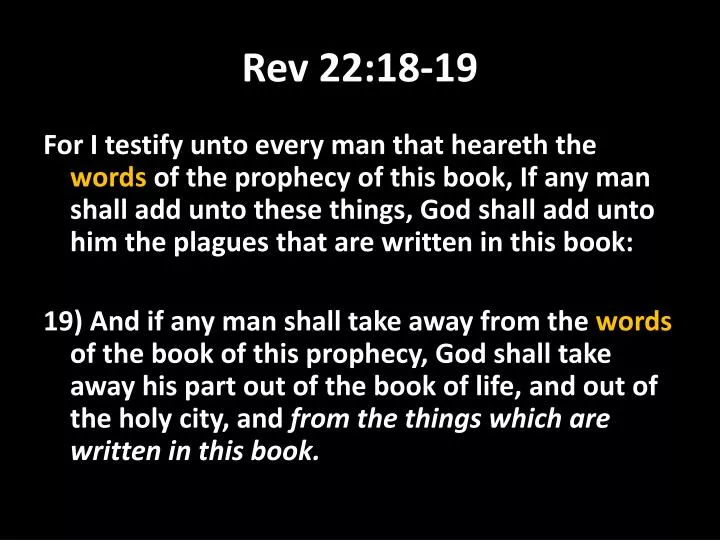
The text at the head of this posting gives the warning to those who add to this final revelation and who take away from it. Fellow Christian, do you not realize that your failure to read and meditate upon this last capstone of inspired scripture and to teach it to others is one way to "take away" from that revelation? Do you also know that to belittle its importance is to take away from it? 

Not only is it wrong to neglect reading and heeding the book of the Apocalypse of Christ but it is wrong to interpret it incorrectly, especially so as to turn people away from properly understanding it. If the devil cannot keep you from reading this capstone of revelation he will lead you to say as the Masons say to initiates about their Masonic symbols and their meaning - "interpret them as you want." But, the book of Revelation is not a code book of symbols, enigmas, coded messages, esoteric language, and the like. No one is at liberty to make the symbols to mean whatever he wants them to mean; And, that is true of the symbols in the other books of the bible. 

For myself, I have always been blessed by my studies of this book and by my musings upon it. I also can say that just as I find much pleasure in studying theology, soteriology, ecclesiology, etc., I find as much or more in studying eschatology. Further, I find myself being irritable at errors in eschatology as much as in other branches of biblical science. 

I also get irritated (and must exercise self control) when I hear or read Amillennialists and Postmillennialists say about the Book of Revelation - "it is written in apocalyptic genre, and that means it is written in symbolic terms." That is simply a falsehood. There is so much in "apocalyptic" literature that is literal! In fact, the theme of the Book of Revelation is what its divinely chosen title says it is, that is, the book of the second coming of Christ, and of the day of the Lord, or day of judgment, or day of wrath and vengeance, etc., that is connected with it. That being so, does Jesus come back literally or not? 

Further, as previously stated, all prophecy has been literally fulfilled and I challenge anyone to deny it. It is true that the prophecies may make use of symbolism (as Daniel did in referring kings and kingdoms to wild beasts or to various metallic body parts) and yet the message of what would happen to these kings and their kingdoms was fulfilled literally. 

Friday, December 1, 2023

Beliefs about the Afterlife (xxxvi)


"Then I saw an angel coming down from heaven, having the key to the bottomless pit and a great chain in his hand. 2 He laid hold of the dragon, that serpent of old, who is the Devil and Satan, and bound him for a thousand years; 3 and he cast him into the bottomless pit, and shut him up, and set a seal on him, so that he should deceive the nations no more till the thousand years were finished. But after these things he must be released for a little while. 4 And I saw thrones, and they sat on them, and judgment was committed to them. Then I saw the souls of those who had been beheaded for their witness to Jesus and for the word of God, who had not worshiped the beast or his image, and had not received his mark on their foreheads or on their hands. And they lived and reigned with Christ for a thousand years. 5 But the rest of the dead did not live again until the thousand years were finishedThis is the first resurrection. 6 Blessed and holy is he who has part in the first resurrection. Over such the second death has no power, but they shall be priests of God and of Christ, and shall reign with Him a thousand years. 7 Now when the thousand years have expired, Satan will be released from his prison 8 and will go out to deceive the nations which are in the four corners of the earth, Gog and Magog, to gather them together to battle, whose number is as the sand of the sea. 9 They went up on the breadth of the earth and surrounded the camp of the saints and the beloved city. And fire came down from God out of heaven and devoured them. 10 The devil, who deceived them, was cast into the lake of fire and brimstone where the beast and the false prophet are. And they will be tormented day and night forever and ever. 11 Then I saw a great white throne and Him who sat on it, from whose face the earth and the heaven fled away. And there was found no place for them. 12 And I saw the dead, small and great, standing before God, and books were opened. And another book was opened, which is the Book of Life. And the dead were judged according to their works, by the things which were written in the books. 13 The sea gave up the dead who were in it, and Death and Hades delivered up the dead who were in them. And they were judged, each one according to his works. 14 Then Death and Hades were cast into the lake of fire. This is the second death. 15 And anyone not found written in the Book of Life was cast into the lake of fire. Now I saw a new heaven and a new earth, for the first heaven and the first earth had passed away. Also there was no more sea. 2 Then I, John, saw the holy city, New Jerusalem, coming down out of heaven from God, prepared as a bride adorned for her husband." (Rev. 20-21: 2 nkjv) 

This text speaks of what occurs following 1) the culmination of Christ's parousia, and 2) the resurrection and ascension into the air to greet Christ, and 3) Christ and his people smiting the nations and defeating the Antichrist and his followers, effecting their imprisonment, and 4) the ending of "this present evil age." Then the thousand year reign of Christ and his people begins. That is the chronology given to us in the text and context

From the above text, we see the various people who will be part of this Millennial age. They are Christ, the resurrected and enthroned saints, "the nations," including "Gog and Magog." No doubt angels will mix and mingle with the occupants of "the age to come." 

There are also cities, and one named in particular is "the beloved city" and "camp of the saints." Further, as Jesus taught, in this time of Christ's reign on earth, or in "the kingdom of God," he will have one saint to rule over five cities and another saint to rule over ten cities, which shows that cities will continue to exist in the Millennium. (See Luke 19: 17-19) The chief city, of course, will be Jerusalem where Christ, and the resurrected king David, will rule, it being the capital of the government of Christ, of "the kingdom of God" and "kingdom of heaven."  

We also observe how the resurrection of those who died unsaved, those in the second resurrection, occurs after the thousand years, but the righteous dead are raised prior to the start of the thousand years. Following the second resurrection, the unsaved dead are finally judged before the great white throne by their works and sentenced to spend eternity in "the lake of fire and brimstone," their permanent prison. Following that final or last resurrection, and white throne judgment of the wicked, both living and dead, comes the new heavens and earth. Notice the words again from our opening text:

"Now I saw a new heaven and a new earth, for the first heaven and the first earth had passed away. Also there was no more sea. 2 Then I, John, saw the holy city, New Jerusalem, coming down out of heaven from God. (Rev. 21: 1-2)

A difficulty with bible students who begin to study this aspect of our subject (life in the ages to come) is to ascertain when the earth and the heavens become "new heavens and earth." Is it at the beginning of the Millennium or at the age following the Millennium (and the "little season" which is sandwiched between the Millennial age and the first post Millennial "age")? 

It seems to me from the above words that the Millennium age is part of the "first heaven" and "the first earth." They do not "pass away" until after the Millennium and the little season. Revelation chapter twenty tells us about life in the Millennial age and in the little season, but Revelation chapter twenty one and twenty two tell us about life in the ages of the ages. 

From the text of Revelation twenty we see the saints take their seats on their promised thrones (Rev. 3: 21), and begin to rule over the nations (Rev. 2: 26-27). Their enthronement occurs after the final battle of Armageddon, after their resurrection and glorification, and after Satan has been removed from the heavens and the earth, bound with chains in the bottomless pit. Satan is not bound now, thus saints are not now ruling over the nations or sitting on their thrones. Rather, Satan like a lion on the hunt of prey "walks about seeking whom he may devour." (I Peter 5: 8) 

So, in studying what the bible says about the "new heavens and earth" we must first address the question of when they come to be. At the start of the Millennium? Or, after the Millennium and the little season of apostasy? Most take the view that it begins after the little season and at the start of "the ages of the ages." That is my view but it is not a view without difficulty, as we will see.

Of course, the first scriptures to look at on the subject of the new heavens and earth are from the old testament, especially the last two chapters of the prophet Isaiah. We will begin to do that in the next chapter. We will also look into this text and see if it applies to life in the Millennial age or in the ages following it:

"I tell you the truth, at the renewal (regeneration kjv) of all things, when the Son of Man sits on His glorious throne, you who have followed Me will also sit on twelve thrones, judging the twelve tribes of Israel." (Matthew 19:28)

So, when is this fulfilled in the future? At the end of this age and the beginning of the next Millennial age? Or, now in the present age? Or, in the age following the Millennium, in the new heavens and earth of Revelation chapter 21-22? I believe as others that it has its first and primary fulfillment in the Millennium and yet also in the ages to come, though not in every way the same way. 

The above "renewal" or "regeneration" is connected with that time when Christ returns and "sits on his glorious throne" and the twelve apostles of Christ "sit on twelve thrones judging the twelve tribes of Israel." And we have seen when this rule of Christ and the saints begin, which per Revelation twenty, is at the start of the Millennium when the martyrs and saints wear crowns and rule on earth as kings on their thrones. 

If this regeneration begins at the start of the Millennium and the new heavens and the new earth follow the Millennium, then they cannot be the same, so it seems. But, we will address that further in the next chapters of our study. 

Is the regeneration or renewal the same phenomenon as that described in these verses about the deliverance of earth and "the whole creation"?

"18 For I consider that the sufferings of this present time are not worthy to be compared with the glory that is to be revealed to us. 19 For the eagerly awaiting creation waits for the revealing of the sons and daughters of God. 20 For the creation was subjected to futility, not willingly, but because of Him who subjected it, [n]in hope 21 that the creation itself also will be set free from its slavery to corruption into the freedom of the glory of the children of God. 22 For we know that the whole creation groans and suffers the pains of childbirth together until now." (Rom. 8: 18-22 nasb) 

So, when does this take place in the future? When in relation to other future events? Is the whole creation set free from decay and bondage at the start of the Millennium and at the same time as the prophesied regeneration and renewal mentioned previously? 

Like the passage about the renewal, this passage seems clearly to apply to what takes place at the second coming of Christ and the start of the Millennium. Notice the various words and adverbs used in the above text dealing with various times (highlighted in bold letters). The reason I believe this is because this deliverance of the whole creation from the curse placed upon it by the transgression of our race through our parents, Adam and Eve, occurs at the time when the sons of God are revealed, and that occurs, as the context shows, in the day of redemption of the body, the day when Christ comes to resurrect and glorify the saints with their new bodies and new state. 

But, affirming this does not alleviate all the problems. The question arises in my mind about why the need to create new heavens and earth after the Millennium when it was delivered from the curse and regenerated at the start of the Millennium? Why burn up a regenerated cosmos and world? I don't have all the answers to these mysteries, but we will explore them further as we study the Millennial Age and the ages of eternity to follow, discovering the purpose of the Millennial age and those which follow (more than we already have).