Before going forward with this chapter and discovering new things to know about the resurrected and glorified bodies of the saints, including those who are transformed in body without dying, let us sum up what we have thus far discovered. We have seen that three major adjectives describe the changed bodies of the saints; those words are glorious, spiritual, and heavenly. We have seen how these words describe a body that has been drastically changed so that the new body does not look exactly like the old body. We have seen that saints in glory will nevertheless know those saved loved ones who they knew on earth, though they will not be recognized by mere bodily appearance alone. This aspect of our subject deals with the whole idea of "identity." Will saints in glory still have their individual identities? The answer is a yes and no. They will still be in some ways the same persons, but in some ways they will be new persons. Is the butterfly the same creature as the caterpillar from whence it came? Or a totally new creature? Or both?
So, with these introductory remarks to this chapter, let us now return to that great resurrection chapter and see what more the inspired apostle had to say about the resurrected bodies of the saints.
There are different kinds of "flesh" and "bodies" in the cosmos. That is Paul's central affirmation. There are celestial bodies and there are terrestrial bodies and each is different in "glory." That being true, what kind of flesh and what kind of body will the transformed bodies of the saints be?
When Paul speaks of "celestial bodies" does he mean the sun, moon, and stars? Or, does he refer to angels? Theologians disagree on that. Some even think that the heavenly bodies of the stars, planets, and moons, actually are bodies of angels. If Paul refers to the celestial bodies of sun, moon, planets, and stars, then he is referring to bodies that are not houses for living beings, in the same way we refer to the body of a car.
Regardless of this disagreement as to who or what is intended by "celestial bodies" the point of the apostle is that there are different kinds of bodies just as there are different kinds of flesh. Notice that Paul does not refer to aliens on other planets, which he may have done had he believed in beings who live on other planets and who differ much from humans and from each other (which we see in many science fiction movies about aliens on other planets).
Also, the argument of the apostle affirms that the resurrection and transformed body, being glorious, spiritual, and heavenly, will not be the same body as the earthly body. Does that mean that the new bodies will not have genitals (as we discussed earlier)? Does it mean that the new bodies will not have all the organs that the earthly body has? Will the new bodies still have hair to grow, nails to grow, or that sweat, etc.? Will the new bodies have blood so that if the flesh is cut will bleed? Will the new bodies have a digestive or excretory system? We have mentioned these things before and will discuss them further as we proceed.
Of course, when it is affirmed that the glorified bodies of the saints will not be the same, we do not mean in every respect. For the same apostle affirms that the body that is raised and transformed is the same body. It is a body that has been "changed," and not exchanged. So Paul will say that the same "it" that dies and is buried is the same it that will be transformed. Again, as argued previously, I am the same person that came forth from my mother's womb almost sixty nine years ago, but I am not the same for I have changed so much that you could not put a picture of me as a baby beside a present picture of me and know that it was the same person in each picture. The butterfly is in some respects the same as the caterpillar but in some respects not. Later, as we will shortly see, the apostle Paul in this chapter we are examining will tell us in what precise ways the body will not be the same body that died, i.e. that body of humiliation.
Of course, some of the answers I give may be speculative theology, but I do believe that some things are deducible from propositions clearly stated in scripture. For instance, if we accept the proposition that the heavenly life in eternity will be nothing but joy, then it seems that things we do regularly, with regard to our earthly bodies, such as brush teeth, shave, get a haircut, trim nails, etc., will not be necessary for these would take away from that bliss. Will they need to sleep?
In the previous chapter we showed how Paul compares, in this chapter, the glorified body of Christ and the saints with the body Adam had before he sinned, or as originally created, as well as after he sinned. The glorious body will be superior to the original body Adam had before he sinned, and certainly far greater than the body he had after he sinned. That is what Paul means when he calls Adam's original body "earthly" and "natural" and the transformed body as "heavenly" and "spiritual." Just as the renewed soul or spirit is called a "new creation" (II Cor. 5: 17), so too will the glorified bodies of saints also be a new creation.
Clearly Paul in the above words indicates that the transformed bodies of the saints will be different in two ways, in appearance and in substance. We have already spoken some about the change in appearance, noting how Christ did not look exactly like his earthly low body of his humiliation, but was much more like the way his body appeared on the holy mount of transfiguration or as he appeared to John on the isle of Patmos in Revelation chapter one.
Will there be midgets among the resurrected and glorified saints? Will saints who suffered from gigantism still be giants? Will those who died in infancy still be infants? This might be speculative theology, however, I think nearly all Christians and bible believers will agree that there will be no infants after the resurrection.
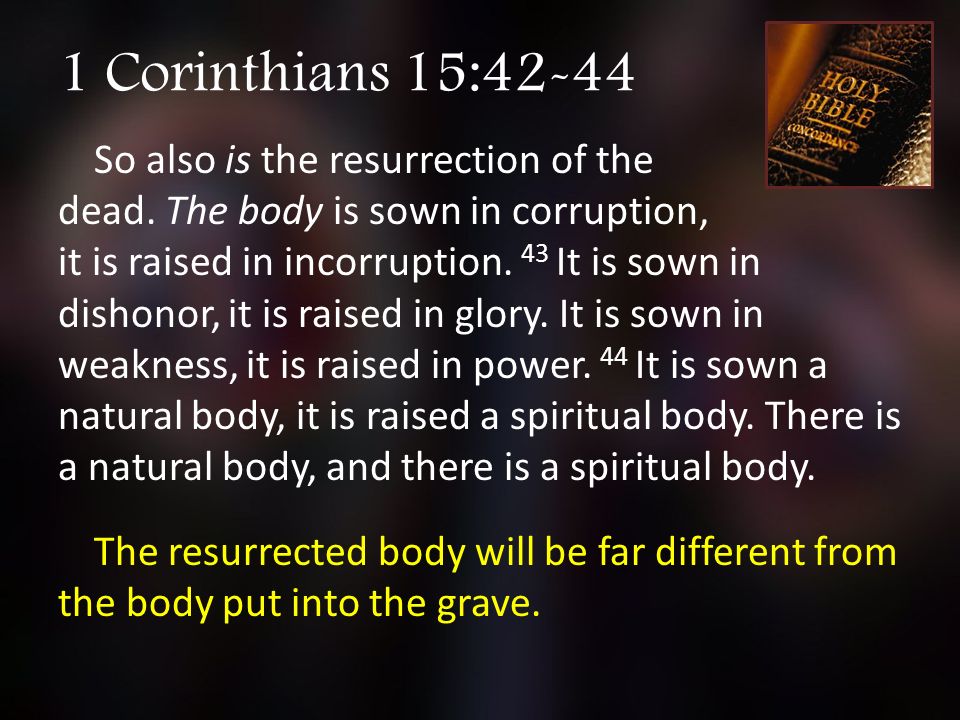
42b"The body is sown in corruption, it is raised in incorruption. 43 It is sown in dishonor, it is raised in glory. It is sown in weakness, it is raised in power. 44 It is sown a natural body, it is raised a spiritual body. There is a natural body, and there is a spiritual body."
First, notice that the same body, the same "it" that dies is resurrected. The new body will be a transformation of the old body and not a giving of a new body that does not come from the old body. Second, even though it is the same body in this sense, it is nevertheless not the same body. Why? Because the old body was dying, growing old and feeble, being corruptible and the new body is incorruptible, not dying or growing old, and not weak and frail; Also because the old body was a body of humiliation, a dishonorable body, lacking glory. The Greek word for "dishonor" means disgraceful, undignified, vile, humiliated, lowly, degrading, shameful, etc. However, the new body will be glorious, the opposite of being dishonorable. We have in previous chapters already seen all that is involved in something being glorious.
The new body is not the same as the old body also because the old body was "weak" while the new body is full of power. The weakness of the old body is seen in its frailty, its susceptibility to sickness and disease, to its feebleness. On the other hand, the new body will be strong in every way. The extent of the power of the risen saints, in body and spirit, will be enlarged upon in upcoming chapters. Finally, the bodies are not the same because the old body was a "natural" body. The Greek word is psychikon and means what is animalistic, sensuous, sensitive, what pertains to the "soul" (psyche) and not to the inner "spirit" (pneuma). On what it means for the body to be spiritual rather than natural we have more to say as we proceed.
Further, the new body is not wholly new, for if it was, it would not be "changed" but "exchanged." If nothing in the new is like the old, or from the old, then it cannot be the same body. If I have an old pocket knife and I replace every part of it with a new part, is it still the old knife? No, it is a new knife, though of the same kind as the old one. The new glorious body of saints will have new and enhanced faculties but it will still have the same external body parts, such as head, torso, arms, hands, feet, etc., although it will not likely have the same internal organs or the same kind of flesh and blood.
To be raised a powerful body involves having increased abilities for the five senses. It also likely includes acquiring new faculties. Barnes, a highly respected commentator, has the following to say about the bodies of the saints becoming full of power (emphasis mine):
"It is raised in power - This does not denote power like that of God, nor like the angels. It does not affirm that it shall be endued with remarkable and enormous physical strength, or that it shall have the power of performing what would now be regarded as miraculous. It is to be regarded as the opposite of the word "weakness," and means that it shall be no longer liable to disease; no more overcome by the attacks of sickness; no more subject to the infirmities and weaknesses which it here experiences. It shall not be prostrate by sickness, nor overcome by fatigue. It shall be capable of the service of God without weariness and languor; it shall need no rest as it does here (see Revelation 7:15; compare Revelation 22:5); but it shall be in a world where there shall be no fatigue, lassitude, disease; but where there shall be ample power to engage in the service of God forever. There is, however, no improbability in supposing that the physical powers of man, as well as his intellectual, may be greatly augmented in heaven. But on this point there is no revelation."
I do not agree with these words of the learned commentator. Not only that, he seems to contradict himself in the latter part of the above citation from what he said at the start of the citation. He says "This does not denote power like that of God, nor like the angels" but then says "however, no improbability in supposing that the physical powers of man, as well as his intellectual, may be greatly augmented in heaven."
Of course Paul does not mean that resurrection bodies become omnipotent, but he does affirm that the bodies and persons of the transformed and glorified saints will become powerful. Just as the spirit within a person "partakes of the divine nature" in being "born again" (II Peter 1: 4), in part, he will fully partake of it in every way, in body, soul, and spirit in the day of his glorification and transformation. And as far as the assertion of Barnes that says "on this point there is no revelation," that is also not true. The verse we are analyzing says the body is "raised in power" and that means the powers of the resurrected saints will become fitting as "sons of God." So, in support of this, let us notice a few texts, beginning with this text from the prophet Zechariah:
"In that day shall the LORD defend the inhabitants of Jerusalem; and he that is feeble among them at that day shall be as David; and the house of David shall be as God, as the angel of the LORD before them." (Zech. 12: 8)
Some commentators suggest that "God" in the text, being from the Hebrew word "Elohim," denotes angels, but that is a mistake. However, the KJV only translates Elohim once as angels (Psa. 8: 5). The predominant person(s) denominated by the word however is God, or the Godhead, Father, Son, and Spirit. However, in the above text we not only have "as God (elohim)" but "as the angel of the LORD" which is a reference clearly to the Son of God. This is the angel who appeared to Moses in the burning bush and is called both "Yahweh" and "Elohim" (Exo. 3: 1-4). So, being "as God" means the same thing as "as the angel of the LORD," denoting having divine powers.
Even if we say that the "sons of the resurrection," the perfected "sons of God," are "as the angels" in power, that is still great power, far superior to that of earthly human beings. This text overthrows the remarks of Barnes who says the power that will characterize the resurrected bodies of the saints will not be like that of God or angels. Now, I know that the context of the prophecy has to do with the "house of David" but it surely is not to be limited to them. Also, the time of fulfillment of the prophecy is when Christ returns and the Jews repent as a nation for having rejecting Christ and embrace him. This the context shows to be true. Notice verse 10:
"And I will pour upon the house of David, and upon the inhabitants of Jerusalem, the spirit of grace and of supplications: and they shall look upon me whom they have pierced, and they shall mourn for him, as one mourneth for his only son, and shall be in bitterness for him, as one that is in bitterness for his firstborn." (kjv)
That the glorified saints (who will forever be earth's kings, priests, lords, and governors of the new human race) will be full of power in both body and spirit is implied, I believe, in the affirmation that they will be raised in power. They will have power over the physical world, as did Christ, so that they may walk on water, run and not be weary, defy gravity, etc. All this is further implied, I believe, when Paul speaks of "
the powers of the world (age) to come." (Heb. 6: 5) On this Barnes makes this comment:
"The word "powers" here implies that in that time there would be some extraordinary manifestation of the "power" of God." The commentators at Precept-Austin (See
here) say:
"Powers of the age to come - refers to miracles which they had witnessed or experienced and which will be seen in the age to come (What age? The age that follows the church age is the Millennium)."
In that text Paul says that believers even now in their present lives on earth have "tasted" of the powers of the coming age. That must include the powers of working miracles, or we might say power over the physical elements. Of course, it also includes powers of mind, of soul and spirit, in addition to bodily powers. These powers are listed by the apostle Paul in his first letter to the Corinthian believers. There he wrote:
"...for to one is given the word of wisdom through the Spirit, to another the word of knowledge through the same Spirit, to another faith by the same Spirit, to another gifts of healings by the same Spirit, to another the working of miracles, to another prophecy, to another discerning of spirits, to another different kinds of tongues, to another the interpretation of tongues. But one and the same Spirit works all these things, distributing to each one individually as He wills." (I Cor. 12: 8-11 nkjv)
Why would not all the resurrected sons of God not have such gifts and faculties? Perhaps it is by having these gifts that they will be able to communicate with each other when separated by long distances, particularly as it relates to having the the gift called "the word of knowledge" or "the word of wisdom." Those gifts certainly would be a great asset as they spend eternity acting as priests and kings, and as lords and governors over the new heavens and earth, and over the new humanity. Working of miracles also might come in handy at times in this rule over the nations. Further, if the sons of the resurrection are all filled with the Holy Spirit to the highest degree, why could they not do miracles? Does not Paul say that those who work miracles do it by the Spirit? (Gal. 3: 5) Having the gift of healing may not be necessary in the millennial kingdom age for the water or river of life, along with the fruit from the tree of life, will be for the healing of the nations (as we have previously written about), nor necessary in the endless ages that follow, for then there will be no more death, neither sickness nor sorrow.
Certainly speaking in tongues may be necessary if "the nations" in the millennial age all keep their native tongues. If resurrected saints rule over the nations and over the cities, then to speak in each of the many nations would be needed. However, I do believe that among those who reside in the New Jerusalem will speak a new language. So the prophet Zephania writes:
"Therefore wait ye upon me, saith the LORD, until the day that I rise up to the prey: for my determination is to gather the nations, that I may assemble the kingdoms, to pour upon them mine indignation, even all my fierce anger: for all the earth shall be devoured with the fire of my jealousy. For then will I turn to the people a pure language, that they may all call upon the name of the LORD, to serve him with one consent." (3: 8-9 kjv)
Notice the promise of a "pure language" and how it will come into being following the end time day of wrath. Whether this will apply to all "the nations" or only to the inhabitants of the city of God, is something I cannot say for sure. In identifying who is "the people" it may be "the nations" mentioned in the text, or it may be those who "call upon the name of the LORD" and who serve him. If all speak the same language, then of course the gift of tongues would not be needed, at least among the nations of the new earth. But, what about "the tongues of angels" that Paul speaks of? (See I Cor. 13: 1)
It seems to me that the gift of "discerning of spirits" will be part of the abilities of saints. As they rule over the nations as its judges, priests, and kings, they will be called upon to judge things, and surely this gift would prove most beneficial.
So, what I am saying is that being raised in power includes the idea of being gifted and endowed with supernatural abilities. However, it could be argued that such powers or supernatural gifts will not be part of "the powers of the age to come" based upon these words of the apostle Paul:
"8 Love never fails. But whether there are prophecies, they will fail; whether there are tongues, they will cease; whether there is knowledge, it will vanish away. 9 For we know in part and we prophesy in part. 10 But when that which is perfect has come, then that which is in part will be done away. 11 When I was a child, I spoke as a child, I understood as a child, I thought as a child; but when I became a man, I put away childish things. 12 For now we see in a mirror, dimly, but then face to face. Now I know in part, but then I shall know just as I also am known." (I Cor. 13: 8-12 nkjv)
If the gift of prophesying ends prior to the age to come ("when that which is perfect is come"), then prophesying via having the harps of God (as we wrote about in earlier chapters) cannot be. But, it is certain that prophesying by those harps will be the case. That fact will be the fulfillment of the words of the prophet Moses who said: "Oh, that all the Lord’s people were prophets and that the Lord would put His Spirit upon them!” (Numb. 11: 29 nkjv)
So, how do we explain Paul's assertion that the three gifts mentioned, prophecies, tongues, and knowledge, will "fail," "cease," "vanish away," "done away," or "put away" when the day of perfection comes?
Before answering, let us first say a few things about the time of perfection. The perfection of the text is to be connected with the time when the family of God are no longer children, but when they become adults, that is, when they are fully matured. That occurs in the resurrection day when all the members of the family of God are glorified and reach a state of perfection in the perfect age of the thousand year reign of Christ and his people. Prior to this time they are children who speak, understand, and think like a child. That is the condition of saints in their lives on earth. These are the "childish things" that will be put away in the day of glorification. While being immature children of God, while in this earthly life, they "know in part" and "prophesy in part" and only see things dimly, but when perfected and glorified, when transformed into powerful super humans, they will know fully, see things face to face.
So, I think that the idea is that what is partial and limited now will become much greater. So, prophesying itself will not cease, but prophesying in part will cease. Supernatural knowledge and revelation will not cease in the day of perfection, but knowing in part will cease. Limited speaking miraculously in other tongues will not be limited in the day of perfection as it is in the church age. If Paul has in mind the other miraculous gifts besides the three mentioned, such as the gift of working miracles, then are we to believe that the glorified sons of God will not have any of those nine charismatic gifts? Further, if Paul calls such supernatural gifts "childish things," then surely the adult things will be far greater. A childish thing is to know in part but the adult thing is to know fully, even as known by God. If it was a childish thing for the apostles, for Stephen the martyr, to work miracles among the people, then how much greater power will the saints have when glorified and empowered by their transformation?
Commented Barnes in his commentary on I Corinthians 13: 8:
"Whether there be knowledge - See the note at 1 Corinthians 14:8. This refers, I think, to knowledge as "we now possess it." It cannot mean that there will be no knowledge in heaven; for there must be a vast increase of knowledge in that world among all its inhabitants. The idea in the passage here, I think, is, "All the knowledge which we now possess, valuable as it is, will be obscured and lost, and rendered comparatively valueless, in the fuller splendors of the eternal world; as the feeble light of the stars, beautiful and valuable as it is, "vanishes," or is lost in the splendors of the rising sun. The knowledge which we now have is valuable, as the gift of prophecy and the power of speaking foreign languages is valuable, but it will be lost in the brighter visions of the world above." That this is the sense is evident from what Paul says in illustration of the sentiment in 1 Corinthians 13:9-10. "Now" we know in part. What we deem ourselves acquainted with, we imperfectly understand. There are many obscurities and many difficulties. But in that future world we shall know distinctly and clearly 1 Corinthians 13:12; and then the knowledge which we now possess will appear so dim and obscure, that it will seem to have vanished away and disappeared..."
In summing up we can say that all the saints, when perfected and when raised in power, will have those same miraculous gifts in a far greater measure. So, not only will the glorified saints be as the angels of heaven as respects not marrying and not procreating, but also as respects their mental powers and power over the physical world, or power to do things beyond the ability of natural men. Recall these words of the Lord Jesus while here on earth:
"Then came the disciples to Jesus apart, and said, Why could not we cast him out? And Jesus said unto them, Because of your unbelief: for verily I say unto you, If ye have faith as a grain of mustard seed, ye shall say unto this mountain, Remove hence to yonder place; and it shall remove; and nothing shall be impossible unto you." (Matt. 17: 19-20 kjv)
If saints on earth, who are yet in a state of imperfection, may have such faith so as to have power over the physical world, then much more in that day when they are perfected and put into their place as fully matured sons of God. That is when they will become super men and on that point we will have more to say in the next chapter.


:max_bytes(150000):strip_icc()/conflict-theory-Final-66da57019fd84b9e906d0a6114cb79a8.png)