Monday, May 5, 2025

Essentials of Religion


"If any man among you seem to be religious, and bridleth not his tongue, but deceiveth his own heart, this man's religion is vain. Pure religion and undefiled before God and the Father is this, To visit the fatherless and widows in their affliction, and to keep himself unspotted from the world." (James 1: 26-27 kjv)

In this series we will speak of the essentials of religion, especially as spoken of in the holy scriptures. Years ago I preached a message to the church I pastored titled "Five Things Necessary For Religion." After about fifty years later I want to return to that theme, with however some additions so that it is now far more than five essential things. 

I have heard some sermons through the years where I heard a preacher say "religion cannot save you sinner; only Jesus can save you." Ironically I would hear some of these same preachers sing "give me that ole time religion, give me that ole time religion..." Of course, what they meant to say was this: just being involved in religious activities or being members of a religious group or performing some religious exercises, does not guarantee salvation or acceptance with God. We see this from these words of Christ:

"Many will say to me in that day, Lord, Lord, have we not prophesied in thy name? and in thy name have cast out devils? and in thy name done many wonderful works? And then will I profess unto them, I never knew you: depart from me, ye that work iniquity." (Matt. 7: 22-24 kjv)

Here are people who had religion but were never known by the Lord and who go to Hell. Jesus also often spoke against the religious leaders of his day, be they Sadducees or Pharisees, declaring that they were lost in sin in spite of all their religiosity. See for instance his rebuke of them in Matthew chapter twenty three. 

But, we must not go to extremes or "throw the baby out with the bathwater" when we speak against "religion." For the fact is, we are saved by truly and sincerely embracing the Christian religion as defined in the new testament scriptures. The text above from James, the Lord's brother, shows us that there is both a "vain religion" and a "pure and undefiled religion," and "that before God." False religions will not be of any use to anyone, and can actually be a means of sealing one's doom. 

The 1689 London Baptist Confession of Faith in chapter ten of "Effectual Calling" write this in section 4:

"4. Others not elected, although they may be called by the ministry of the Word, and may have some common operations of the Spirit, yet not being effectually drawn by the Father, they neither will nor can truly come to Christ, and therefore cannot be saved: much less can men that receive not the Christian religion be saved, be they never so diligent to frame their lives according to the light of nature and the law of that religion they do profess." (Mt 22:14; 13:20-21; Heb 6:4-5;  Jn 6:44-45,65; 1Jn 2:24-25; Ac 4:12; Jn 4:22; 17:3)

If this is true (and it is), then 1) accepting the Christian religion (which is to accept the gospel) is necessary to be eternally saved, and 2) following any other religion saves no one.

Excluding God, the object of worship in religion, what are the essentials or component elements of "religion." In fact, how does the dictionary define "religion"? The above image gives the most simple definition, which is a sociological one. Other sources give much longer definitions. Essentially it is the worship of a deity and involves doing the bidding of that deity, or being engaged in service to him or her.

However, we cannot exclude the deity being religiously served. True religion only exists where the true deity is worshiped. All vain and false religion that does not worship only "the one true and living God" (Jer. 10: 10; I Thess. 1: 9; etc.) saves no one. 

Word Study

The sociological definition in the above heading is good simple concise definition of "religion." However, it does not detail the essential elements of religion, which is what we will do in this series. Many other social scientists also are concerned about studying the world's religions, as are theologians, and so in many colleges you can find classes in "the sociology of religion," and in the role of religion in psychology, and in "the philosophy of religion" (a class I took in college), etc. But, how do the scriptures speak of the idea of religion? As we will see, some texts give the word "religion" (or its cognates, such as worship, serve, etc.) a negative connotation, and others give a positive connotation. In the text above from James we have both kinds of religion referred to. Notice these texts about what Paul said about his native religion.

"My manner of life from my youth, which was at the first among mine own nation at Jerusalem, know all the Jews; Which knew me from the beginning, if they would testify, that after the most straitest sect of our religion I lived a Pharisee." (Acts 26: 4-5 kjv)

"For ye have heard of my conversation in time past in the Jews' religion, how that beyond measure I persecuted the church of God, and wasted it: And profited in the Jews' religion above many my equals in mine own nation, being more exceedingly zealous of the traditions of my fathers." (Gal. 1: 13-14 kjv)

Vine's NT Words says this about the Greek words translated "religion":

"Religion (threseia) signifies religion in its external aspect (akin to threskos), "religious worship," especially the ceremonial service of "religion;" it is used of the "religion" of the Jews, Acts 26:5; of the "worshiping" of angels, Colossians 2:18, which they themselves repudiate (Revelation 22:8-Revelation 22:9)...in James 1:26-James 1:27 the writer purposely uses the word to set in contrast that which is unreal and deceptive, and the "pure religion" which consists in visiting "the fatherless and widows in their affliction," and in keeping oneself "unspotted from the world." He is "not herein affirming...these offices to be the sum total, nor yet the great essentials, of true religion, but declares them to be the body, the threskeia, of which godliness, or the love of God, is the informing soul" (Trench)."

In the Galatians passage the Greek word is "ioudaismos" and means religion of the Jews and on this word Vine says that it "denotes "the Jews' religion," and stands, not for their religious beliefs, but for their religious practices, not as instituted by God, but as developed and extended from these by the traditions of the Pharisees and scribes. In the Apocrypha it denotes comprehensively "the Government, laws, institutions and religion of the Jews." 

Essentials of Religion

1. Temple or place of worship

2. Priests

3. Worshipers

4. Prayer

5. Praise and Adoration

6. Altars

7. Religious Rules 

8. Sacrifices

9. Rites and Ceremonies

10. Oracles and Sacred Writings.

11. Holy or Feast Days

12. Religious Duties (religious life)

13. Creed or Confession of Faith

14. Belief and religious feelings (psychological)

Some might include other things, things that are not essential, but accompaniments, such as:

1. Relics and holy objects
2. Anointings
3. Ordinations
4. Etc.

As we will see, there are both internal and external elements of religion, what corresponds to the thoughts and emotions of the worshipers, and what corresponds to the physical activities of the worshiper. In our next chapter we will begin examining each of these listed essentials one by one. We will show how in all these essentials that the Christian religion far excels that of all other religions.

Sunday, May 4, 2025

Divine Justice Issues (XXXI)


Is eternal punishment fair?


“Then he will say to those on his left, ‘Depart from me, you cursed, into the eternal fire prepared for the devil and his angels...And these will go away into eternal punishment, but the righteous into eternal life.” (Mattt. 25: 41, 46 esv) 

"when the Lord Jesus is revealed from heaven with his mighty angels in flaming fire, inflicting vengeance on those who do not know God and on those who do not obey the gospel of our Lord Jesus.  They will suffer the punishment of eternal destruction, away from the presence of the Lord and from the glory of his might, when he comes on that day to be glorified in his saints, and to be marveled at among all who have believed, because our testimony to you was believed." (II Thess. 1: 7-10 esv)

These are two of the many texts of scripture which uphold the teaching of eternal punishment. Some who deny eternal punishment will sometimes argue that the word "eternal" (Greek "aiōnios") does not mean unending but simply means for a long time. But this is totally untenable. The same word is used for "eternal life" that is used for "eternal punishment." So, if we say that the punishment comes to an end then we will also have to affirm that the life will also come to an end. Also, the same Greek word is used when it speaks of God as being eternal. 

Some also want to say that "eternal punishment" denotes annihilation or extermination. But, again, this is not tenable. Dr. Robert Peterson at Ligonier (See here or here) writes under the heading "Annihilation or Eternal Punishment" that there are "six main arguments" that annihilationists use to prove their proposition. He gives those arguments in these words (emphasis mine):

"First is an argument based on the Bible's use of fire imagery to describe hell. We are told that fire consumes what is thrown into it, and so it will be for the lake of fire (Rev. 19:20; 20:10, 14, 15; 21:8)—it will burn up the wicked so that they no longer exist.

Second is an argument based on texts that speak of the lost perishing or being destroyed. Examples include unbelievers perishing (John 3:16) and suffering "the punishment of eternal destruction" (2 Thess. 1:8).

Third is an argument based on the meaning of the word eternal. In hell passages, it is claimed, eternal means only pertaining to "the age to come" and not "everlasting."

Fourth is an argument based on a distinction between time and eternity. Annihilationists ask: how is it just of God to punish sinners for eternity when their crimes were committed in time?

Fifth is an emotional argument that God Himself and His saints would never enjoy heaven if they knew some human beings (let alone loved ones and friends) were perpetually in hell.

Sixth is an argument that an eternal hell would tarnish God's victory over evil. Scripture declares that God will be victorious in the end; He will "be all in all" (1 Cor. 15:28). We are told that this idea seems hard to reconcile with human beings suffering endlessly in hell."

Dr. Peterson responds to these arguments and shows how they are not valid. He cites texts which speak of people being "tormented forever." (Rev. 14: 10-11; 20: 10) You cannot torment a person who no longer exists. Nor can you separate torment from consciousness. A person who has no cognition cannot suffer torment. We see this fact verified in the story of the rich man and Lazarus and of their conscious experience and condition in the afterlife (Luke 16) where we find the rich man in the fires of Hell (Hades) saying that he is "tormented in this flame." (Luke 16: 24) 

I like these words of Dr. Peterson:

"Fourth is the argument that it is unjust of God to punish sinners eternally for temporal sins. It strikes me as presumptuous for human beings to tell God what is just and unjust. We would do better to determine from His Holy Word what He deems just and unjust."

In answer to the question in the heading above, Google AI gives this Overview:

"Whether eternal punishment is fair is a complex theological and philosophical question with no universally agreed-upon answer. Some argue that it is a just punishment for sin, reflecting the gravity of offending a holy and infinite God. Others argue that it is an unfair disproportionate punishment, as a finite sin does not warrant an eternal penalty." 

In answering this question we must resort to the syllogism I offered in chapter three.

1. All that God wills and does is just. 
2. God willed and did A. 
3. A is just

This is essentially the same thing that Dr. Peterson stated in the above citation which I particularly liked. 

Transgression of God's law must be punished. That is a foundational principle of God's government and of his law and order. Forgiveness of sin cannot be given apart from satisfaction to law and justice. The question then becomes whether eternal torment in the fires of Hell is a just recompense. The scriptures teach that "every transgression and disobedience" receives from God "a just recompence of reward." (Heb. 2: 2 kjv) God is the lawgiver and the judge of all and therefore it is his right to dictate what is criminal and what is the punishment for crimes committed. So the scripture says:

"For the LORD is our judge, the LORD is our lawgiver, the LORD is our king; he will save us." (Isa. 33: 22 kjv)

"There is one lawgiver, who is able to save and to destroy: who art thou that judgest another?" (James 4: 12 kjv)

Since God is the Creator of all, he has the sovereign right to make law and to command all to keep it. He also has the right to decree what the punishment will be for any violations of his law. Most believers in God will acknowledge this much. But some will object that God is being too harsh and cruel in sentencing sinners to unending punishment and torments. Some even criticize God by saying that he should be more lenient, perhaps only giving a slap for violations or put sinners on probation. 

The doctrine of eternal (or endless) punishment will rarely be accepted by those who are condemned by God. To them it will always appear to be a case of "cruel and unusual punishment" and which makes God to be cruel, harsh, severe, and tyrannical. This reminds me of that old hymn by hymnist Isaac Watts wrote titled "Show Pity Lord" where he writes these lyrics:

Should sudden vengeance seize my breath, 
I must pronounce thee just in death; 
And if my soul were sent to hell, 
Thy righteous law approves it well.

Like the penitent thief on the cross on the right side of Christ who said to the other impenitent thief "we are suffering justly for our crimes" (Luke 23: 41), so all those who go into Hell's eternal prison should confess the same as Isaac Watts says in league with the words of the penitent thief. 

The denial of eternal punishment gives the wicked hope; For even if he goes to the prison of Hell for his crimes, he will eventually "serve his time" and be able to leave Hell and enter Paradise. Or, if the wicked believes in annihilation at death, he will have no fear of judgment in the afterlife to deter him from sin. The denial of eternal punishment is the actual belief of all those who believe in universal salvation. It is also the belief of most Muslims and of other religions. One Muslim web page says this (See here):

"If the Qur’an and Hadith taught eternal hell, I wanted to know. So I dove into a study of both. I arrived at an undeniable conclusion: Islam does not teach eternal damnation for anyone. Here are seven reasons why Islam rejects the concept of eternal hell — for Muslims and everyone else." (emphasis mine)

Interesting is the fact that this Muslim is arguing against other Muslims who affirm that the Koran teaches endless punishment. Therefore it seems that Muslims are divided on the question as are Christians, except that eternal punishment in Islam seems to be a minority view whereas in Christianity it is the major view.

If everyone who goes to Hell will eventually serve his or her time and then be given release and right to enter Heaven, then it seems that the atoning sacrificial death of Christ becomes unnecessary. This is in fact the view of Muslims who reject the idea of Christ's sacrificial death, arguing that Allah has provided no substitute for any and that Allah is able to forgive sin apart from any satisfying of justice for those sins. They believe that it is unjust for a person to be punished for another persons' crimes, a question we have already addressed.

Matt Slick at CARM writes (See here - emphasis mine) under the heading "How just is the God of Islam?":  

"If a person commits a sin such as murder or theft, should that person be punished? The obvious answer is yes. But why should he be punished?

There are two primary reasons we can offer why someone who commits a sin should be punished. First, he has broken the law of God; and if God does not exercise punishment, then what is the purpose of the law? To not exercise punishment for sin is to permit the sin to exist without consequence. Second, he has harmed others; and if he is not punished, others will be encouraged to do the same.

Therefore, we can conclude that it is proper to exercise judgment/punishment for the crimes committed by individuals.

If the same person who has committed a sin, such as murder or theft, says that he is sincerely sorry for what he has done and that he would never do it again, should society excuse him from punishment? Maybe, maybe not.

God is holy and righteous; and if he didn’t carry (out) a punishment for sins, he would be allowing evil to exist without consequence. The result would be, essentially, to condone evil; and since God cannot do that, His justice requires that a proper punishment be incurred for each sin.

Likewise, if God did not punish someone because that person said he was sorry and would not do it again, then is God being just? After all, if he did not exercise the punishment for breaking his law, he is then permitting evil to exist without proclaiming its error or dealing with its consequence."

This is a good summation of the biblical teaching on forgiveness and on punishment for sin (or crime). 

Slick writes further:

"In Islam, a Muslim who commits murder and thievery can ask Allah for forgiveness and receive that forgiveness without Allah exercising any punishment whatsoever. According to Islam, Allah may forgive that person–if he so chooses. But doesn’t that mean the righteous judgment of Allah is not satisfied? Doesn’t it mean that the sin has essentially been ignored by forgiving it; and that the Law of God, though broken, has resulted in no punishment? Is this just–not to exercise punishment for the sins committed? It is not. No, for we have already established that punishment is the proper and righteous response to sin. Declining to punish is to avoid satisfying the law of God."

This is the teaching of the Christian scriptures. God is not only a God of love, mercy, grace, compassion, longsuffering and forbearance, but he is a God of justice and wrath against sin, one who hates iniquity and who will in no instance "clear the guilty." (Exo. 34: 7) Habakkuk says "Your eyes are too pure to look on evil; you cannot tolerate wrongdoing." (1: 13 niv) God cannot simply overlook sin, for it would be against his holy and righteous character and would encourage people to break his laws and to have no fear of divine retribution. And, as we will see, the "punishment will fit the crime" in God's sentencing sinners to eternal punishment. 

There are really only two options. Either God is 1) overreacting and "flying off the handle," or "making a mountain out of a molehill," for breaking God's law or 2) sin is extremely heinous and deserves eternal punishment. God is viewed by many as either too severe or too lax.

He writes further:

"In Christianity, every sin is dealt with by God in one of two ways. Either God satisfies the law by exercising his punishment upon the sinner by sending him to eternal damnation, or he places the sins of the person on Jesus Christ who suffers the punishment in place of the person. Either way, the justice of God is never ignored. It is proper that sin be dealt with by a punishment relative to the sin. To neglect to do so is to avoid being just. Therefore, we see that the God of Christianity is just because no sin goes unpunished."
 
Every religion that has the Creator forgiving sin without any satisfaction to divine justice has the adverse consequences that Slick points out. If there is no such satisfaction, and every criminal is forgiven and given no punishment every time he repents or says that he is sorry, then there will not be any respect for God's law, and people will be encouraged to sin for they will say to themselves "I will sin and then say 'I repent' and go on and do it again and again." There will be no fear of God. The same is true in regard to human government as Paul said.

"For rulers are not a terror to good works, but to evil. Do you want to be unafraid of the authority? Do what is good, and you will have praise from the same. For he is God's minister to you for good. But if you do evil, be afraid; for he does not bear the sword in vain; for he is God's minister, an avenger to execute wrath on him who practices evil." (Rom. 13: 3-4 nkjv)

But this is also superlatively true when it comes to fearing God and his authority. God is also "an avenger to execute wrath on him who practices evil." People who have no fear of God or punishment in the afterlife lack restraints upon their evil ways. Fear of punishment by citizens for breaking the laws of the nation is a restraint upon criminal activity, and the easier it is for crimes to be committed without being caught and without severe judgment the easier it is to choose to commit crime. 

Saved Without Satisfying Justice

Unlike Islam and other religions that show the Deity forgiving sins apart from any punishment for sin or satisfaction to justice, Christianity does not. God justifies sinners on the basis of the law being satisfied by the substitutionary sacrifice of Christ. Notice how this is what Paul affirms in these words:

"For there is no difference; 23 for all have sinned and fall short of the glory of God, 24 being justified freely by His grace through the redemption that is in Christ Jesus, 25 whom God set forth as a propitiation by His blood, through faith, to demonstrate His righteousness, because in His forbearance God had passed over the sins that were previously committed, 26 to demonstrate at the present time His righteousness, that He might be just and the justifier of the one who has faith in Jesus." (Rom. 3: 22-26 nkjv)

Barnes Commentary says:

"That he might be just...refers to the fact that God had retained the integrity of his character as a moral governor; that he had shown a due regard to his Law, and to the penalty of the Law by his plan of salvation. Should he forgive sinners without an atonement, justice would be sacrificed and abandoned. The Law would cease to have any terrors for the guilty, and its penalty would be a nullity. In the plan of salvation, therefore, he has shown a regard to the Law by appointing his Son to be a substitute in the place of sinners; not to endure its precise penalty, for his sufferings were not eternal, nor were they attended with remorse of conscience, or by despair, which are the proper penalty of the Law; but he endured so much as to accomplish the same ends as if those who shall be saved by him had been doomed to eternal death." 

Under "Arguments Against Eternal Punishment as Fair" we have these points given by AI:
 
"Disproportionality: Some argue that a finite sin should not warrant an eternal punishment.

Lack of Opportunity for Redemption: The concept of eternal punishment may be seen as eliminating the possibility of redemption for those who repent later.

God's Love and Mercy: The concept of eternal punishment may be seen as contradicting God's love and mercy.

Unnecessary Cruelty: Some argue that eternal suffering is cruel and unnecessary, even if it is a consequence of sin." 

The only way to prove that eternal punishment is too severe is to lesson the heinousness of sin. But, it is the other way around for eternal punishment demonstrates the greatness of rebellion against God, which all transgression of God' law is.
 
Some want to know why Jesus needs not to suffer eternally to save from eternal punishment. Dr. John Piper responds to this we these words (See here):

"Now, the Bible does not say explicitly how this works. But just as we learned the demerit of sin by looking at God’s appointed penalty for it — namely, eternal punishment — so also we learn the merit, or the worth, of Christ and his suffering by looking at the achievement of it — namely, salvation for millions of hell-deserving sinners. So, the question becomes, What is it about the worth of Jesus and his suffering that makes it sufficient to remove the punishment of millions of sinners?" (Emphasis mine)

Though we may not fully grasp how it is so, nevertheless we are assured by the scriptures that Christ suffered the equivalent of eternal torment in his sufferings as a substitute for the sins of others.

Next he writes the following and cites from the learned Jonathan Edwards.

"Let me read you the answer given by Jonathan Edwards and then say a word about it. This comes from a sermon he preached in 1729 entitled “The Sacrifice of Christ Acceptable.” Here’s what he says: 
 
'Though Christ’s sufferings were but temporal [that is, not eternal], yet they were equivalent to our eternal sufferings by reason of the infinite dignity of his person. Though it was not infinite suffering, yet it was equivalent to infinite suffering, for it was infinite expense. His blood which he spilled, his life which he laid down, was an infinite price because it was the blood of God, as it is expressly called. Acts 20:28, “The church of God, which he hath purchased with his own blood.” His life was the life of that person that was the eternal Son of God, though it was the life of the human nature. Now, upon this account, the price offered was equivalent to the demerit of the sins of all mankind, [and] his sufferings equivalent to the eternal sufferings of the whole world. (Works of Jonathan Edwards, 14:452)'"

That is the way Christian apologists answer the objection.

With this chapter we end our series on issues that people have with God's acts and judgments. Though there are several ways where many think God is being unfair, they are wrong to think that way. God is just and whatever he does is right and just even if we cannot fully grasp it completely.

Friday, May 2, 2025

Divine Justice Issues (XXX)


In this chapter we will look at question number nine given in our opening chapter. It asked: "Was it right for God to create beings who he foreknew would rebel and be punished forever for it?" 

To some extent we have already made several observations as the question is connected with several of the other questions in the list, especially with the problem of evil. To answer this question one must first show that God does have absolute foreknowledge of all future events and things. Then we may proceed to consider whether having this ability to foresee the future makes God responsible for everything that comes into existence or occurs, and why God chooses to prevent some possible occurrences but not others. If we had the power to see into the future (a theme or plot in many books and movies such as in the movie "Paycheck" or movies involving the concept of a "time machine"), what burden or responsibility would that put on us? 

The claim that divine foreknowledge makes God culpable for human actions is a complex theological issue rooted in the tension between God's omniscience (all-knowing) and human free will. It arises from the argument that if God knows everything that will happen, including human choices, then those choices are predetermined, and God, not the individual, is ultimately responsible. If God knows and therefore determines every action, including evil, does that make God the author of evil and thus culpable for human actions? 

By the same reasoning we may ask whether God is responsible for the sins of his creatures because he made them capable of sinning by giving them free will. We have already asked whether it would be viewed as just for God to bring into existence people such as Hitler, Stalin, or Judas since he knows what evils that they would do and whether it would be better if God had not brought into existence all who he foreknew would reject his offers of mercy? We spoke of this difficulty when we applied "product liability" laws to God. God made a product (angels and humans) who he knew would cause harm. We also looked at it from the legal reasoning that uses the "but for" argument. But for God making creatures with the ability to sin, with free will, there would have been no sin and no sorrow and death.

We might ask everyone who studies this subject - "what would you do if you had foreknowledge of the future?" Some no doubt would try to make money from the stock market or by betting on games (as was a theme in the movie "Back To The Future"). Would you use it to prevent any and all crimes? Or, would you use that ability to commit crime, the perfect crime? 

If you did know the future, does that mean you can change it? Most movies on this theme suggest yes. In the movie "Terminator" a man and a android go back in time for the purpose of changing the future. In fact, the man who comes back from the future ends up becoming his own father! Another similar question asks whether God's foreknowledge is causative. Or, does God foresee only what he has first determined shall come to be? Or, does he see some things that he does not cause or predetermine to be? Or, does God foresee things that might have been but are not? This is called "middle knowledge" by theologians. 

"Perhaps the strongest scriptural support for middle knowledge, and therefore for Molinism, comes from the use of counterfactuals in the Bible. Counterfactuals are “if-then” statements about situations or choices. For example, Jesus explicitly says, twice, that under different circumstances certain people would have made a different free choice of whether or not to repent (Matthew 11:21–23; Luke 10:13). Jesus also refers to different outcomes under different circumstances (Matthew 26:24; John 14:2). God also references different choices leading to different results in the Old Testament (Exodus 9:15; Isaiah 48:17–19). Further, the Bible clearly states that God allows us to make choices contrary to His preferences (Matthew 23:37; 2 Peter 3:9; Psalm 5:10; Isaiah 30:1)." (From Got Questions - See here - emphasis mine)

In other words, God not only sees what shall be but what could have been. He sees all possibilities. Notice this passage:

"Then He said to me: “Son of man, go to the house of Israel and speak with My words to them. For you are not sent to a people of unfamiliar speech and of hard language, but to the house of Israel, not to many people of unfamiliar speech and of hard language, whose words you cannot understand. Surely, had I sent you to them, they would have listened to you." (Eze. 3: 4-6 nkjv)

This passage is an instance that supports the theological concept of middle knowledge. God knows what creatures would do in various circumstances, even if those circumstances never actually occur (counter factuals). 

This text also is important to keep in mind in regard to several other questions we have already addressed in regard to God's justice. Why did God not send Ezekiel to those other peoples? If he wanted them to have listened to Ezekiel's message from God, then why did he not send Ezekiel to them? Obviously God did not want them to hear the message, which message is a means of salvation. God could just as well have said the same thing to other peoples, such as to the American Indians in the centuries before the white man brought the word of God to them. So, it could be said of them "surely, had I sent you to them sooner, they would have listened to you." 

In another case we see something similar. Said God to Jeremiah the prophet: "So you shall speak all these words to them, but they will not listen to you. You shall call to them, but they will not answer you." (Jer. 7: 27 esv)

In the Ezekiel case, God does not send Ezekiel to other nations even though he knew that they would listen to his message and heed it, but in the case with the Jeremiah passage, God sends Jeremiah to preach to those who he knows in advance will reject his message. Also, we see another instance where God does foresee the free choices of his creatures, although some deny that God foresees the free choices and acts of his creatures. But more on that shortly.

We see another instance of the same in this text (referenced in the above citation from Got Questions):

21 "Woe to you, Chorazin! Woe to you, Bethsaida! For if the mighty works which were done in you had been done in Tyre and Sidon, they would have repented long ago in sackcloth and ashes. 22 But I say to you, it will be more tolerable for Tyre and Sidon in the day of judgment than for you. 23 And you, Capernaum, who are exalted to heaven, will be brought down to Hades; for if the mighty works which were done in you had been done in Sodom, it would have remained until this day. 24 But I say to you that it shall be more tolerable for the land of Sodom in the day of judgment than for you." (Matt. 11: 21-24 nkjv)

This is another instance of middle knowledge and of counter factuals. This text, along with the previous one from Ezekiel, show that God does not equally desire the salvation of all, for he does not give all equal opportunities to be saved, or have equal means. It is obvious that God did not sufficiently desire the repentance or salvation of Tyre, Sidon, and Sodom, and that he did not give them the same means as he did to Chorazin, Bethsaida, and Capernaum. 

These texts reveal the fact that God knows what it will take in any given case to bring a person to repentance and faith and hence salvation. He can engineer events and circumstances in the lives of people to get their attention and to make them believers. I have previously affirmed that God desires that all men be saved and to come to a knowledge of the truth (as Paul stated), but also affirmed that such a fact does not mean that he desires this end to the same degree in every case. All are not given equal means towards salvation. 

We must also affirm that what God foresees as actually coming to pass in the future must come to pass for God cannot be wrong about anything. If that is not true, then no God given prophecy can be relied upon. The bible is full of examples where God revealed to his rational creatures what was sure to come to pass in the future. Many of these prophecies have been fulfilled, while others await fulfillment. Sometimes these prophecies are contingent. In other words, God says A will come to pass if B happens, but if B does not happen, then A will not come to pass. We see this type of foreknowledge in God's numerous warnings in scripture. God says "if you do A, then B will occur." These are the counter factuals that the above citation calls attention to.

Got Questions web page also has these comments (see here - emphasis mine):

"It may be hard to see how Adam and Eve’s falling into sin could bring glory to God. In fact, some might even wonder why, if God knew ahead of time all the trouble they would cause, He made them in the first place.

God is omniscient (Psalm 139:1–6), and He knows the future (Isaiah 46:10). So He definitely knew that Adam and Eve would sin. But He created them anyway and gave them a free will with which they chose to sin.

We must carefully note that Adam and Eve’s falling into sin does not mean that God is the author of sin or that He tempted them to sin (James 1:13). But the fall does serve the purpose of God’s overall plan for creation and mankind."

The traditional belief in God's omniscience (all-knowing) suggests that he has perfect knowledge of the past, present, and future. All scripture that asserts God's omniscience asserts his foreknowledge of all things. Also, omniscience cannot be divorced from God's immutability. God is therefore not adding to his knowledge nor is his knowledge ever decreasing.

God's rational creatures also have some limited ability to see the future. This is due to knowing cause and effect, and something of the laws of nature. So, we have weather forecasters, economic forecasters, etc. So Solomon wrote: "A prudent man foresees evil and hides himself, But the simple pass on and are punished." (Prov. 22: 3; 27: 12 nkjv)

Jesus spoke of those who could foresee (or predict or forecast) the weather of the future, saying:

"He answered and said to them, “When it is evening you say, ‘It will be fair weather, for the sky is red’; “and in the morning, ‘It will be foul weather today, for the sky is red and threatening.’ Hypocrites! You know how to discern the face of the sky, but you cannot discern the signs of the times." (Matt. 16: 2-3 nkjv)

Interesting is the fact that the Greek word translated "foreknowledge" (kjv) is "prognosis," the thing we want doctors to give us regarding symptoms of an illness. In medicine, it's the prediction of the probable course and termination of a disease. It's also used more broadly for predicting the outcome of any situation. 

What responsibility comes with such foreknowledge? And, if you had foreknowledge, could you change it? Or, would you? And, if you could change it, then is it not the case that you really did not see the future in the first place but only one possible version of it? 

Jesus foretold the thrice denial of knowing Jesus by Peter during the trial of Christ. 

"31 Then Jesus said to them, "All of you will be made to stumble because of Me this night, for it is written: 'I will strike the Shepherd, And the sheep of the flock will be scattered.' 32 But after I have been raised, I will go before you to Galilee." 33 Peter answered and said to Him, "Even if all are made to stumble because of You, I will never be made to stumble." 34 Jesus said to him, "Assuredly, I say to you that this night, before the rooster crows, you will deny Me three times." 35 Peter said to Him, "Even if I have to die with You, I will not deny You!" And so said all the disciples." (Matt. 26: 31-35 nkjv)

Here Peter and the other apostles were told what was going to come to pass and yet that foreknowledge did not keep it from coming to pass. One could argue that this was because they did not believe Jesus' prophecy. However, even if some of them believed it, none of them prevented it from coming to pass just as Jesus said.

Open Theism

"Open Theism is a theological view that suggests God knows everything but doesn't know everything in the future with certainty, especially regarding free choices made by humans. It's a perspective that attempts to reconcile God's omniscience with human free will. Open Theism is a relatively recent development within Christian theology, gaining prominence in the 1990s, and is often debated in relation to classical theism." (AI Overview)

The same survey of the literature on this subject has AI adding these comments:

"The future, according to Open Theism, is not fully settled or predetermined by God. It's a realm of possibilities that is still open to the choices of individuals." 

"God knows the range of possibilities in the future, but He doesn't know with certainty which of those possibilities will actually occur because they depend on human free will choices." 

"While Open Theists believe God is fully involved in the world, they also emphasize that God's actions are influenced by and adapt to human free choices." 

The bible does not picture God as having uncertain knowledge of future events as the open theist affirms. Further, the bible affirms that God foreknows the free choices of his creatures and so the proposition is false that says God cannot certainly and absolutely know what choices a creature will make. Peter made a choice to deny Christ and yet Christ foreknew it. Many examples are in the bible of this truth fact.

Under "Points of Debate and Controversy" AI also gives the following further overview.

"Omniscience: Open Theism challenges the traditional understanding of God's omniscience, which often implies a complete and pre-determined knowledge of the future." 

But the scriptures do assert that God has "a complete and predetermined knowledge of the future." So God says by the prophet:

"Declaring the end from the beginning, And from ancient times things that are not yet done, Saying, ‘My counsel shall stand, And I will do all My pleasure." (Isa. 46: 10 nkjv)

"Divine Providence: Critics argue that Open Theism weakens the traditional doctrine of divine providence, which suggests God governs all events, even those that seem to be a result of human free will."

Open theism does in fact deny what the scriptures say about God's omniscience. Also, God is able to control a world where his rational creatures are given choices or a degree of free will.  

"God's Power and Sovereignty: Some argue that Open Theism diminishes God's power and sovereignty by suggesting He is not fully in control of the future."

If God is not able to control the choices and activities of his creatures, then his power and sovereignty would be limited. But, we have already seen in this series where God did cause people to choose a certain way. He hardened Pharaoh's heart and this was behind his choice to go back on his word. We could fill pages with examples where both good and bad choices were made by God's influence, or lack thereof, on the will. God did not give up any of his control over his creatures by giving them free choice.

"The Problem of Evil: Open Theism is sometimes seen as offering a potential solution to the problem of evil by suggesting that God, while omnibenevolent, does not have complete control over events."

But open theism is no solution at all to the problem of evil, a subject we covered in the opening chapters of this series in discussing various theodicies.  

"Biblical Interpretation: Open Theists often rely on specific biblical passages to support their view, while critics counter that such passages are often misinterpreted." 

In my dialogues and debates with those from the "Church of Christ" and with a local group of Baptist churches I argued against their belief that God did not know everything. The former group would say to me "God knows all that he wants to know," implying that some things God does not know because he does not want to know those things. The latter group would cite passages that say that God came to know something as a result of what a creature chose to do or passages that say that God does not remember the sins of those he has forgiven. 

"And He said, “Do not lay your hand on the lad, or do anything to him; for now I know that you fear God, since you have not withheld your son, your only son, from Me.” (Gen. 22: 12 nkjv)

"For now I knew - literally, have known; not caused thee to know (Augustine), but caused others to know (Lange); or the words are used anthropomorphically (Calvin) - that thou fearest God" (Pulpit commentary).

This represents a formal recognition of Abraham's fear of God, such as a trier of facts or judge might utter in a formal hearing. It is another example of God speaking anthropomorphically or after the manner of men and is not implied that God did not know beforehand what Abraham would choose to do.

Gill's commentary says:

"...this is said after the manner of men...or this may be understood of a knowledge of approbation, that the Lord now knew, and approved of the faith, fear, love, and obedience of Abraham, which were so conspicuous in this affair, see Psalm 1:6."

The local Baptist churches referenced above, through their leading elder, use to argue with me that when God says that he will "remember your sins no more" (Jer. 31: 34; Heb. 8: 12) that this literally meant that God had no more knowledge of those sins. I found this a gross interpretation and showed how foolish it was. God does not forget, willingly or unwillingly. I affirmed that the statement means that God will never go back on his word or promise of forgiveness, that he will never formally "charge" those forgiven, as Paul said "who shall lay anything to the charge of God's elect? It is God who justifies." (Rom. 8: 33) 

I also pointed out how Paul, while writing by the inspiration of God the Holy Spirit, enumerated his past sins (all which God had forgiven) in First Timothy 1: 13. So, though God did not know (remember) in a legal sense (Paul's record had been cleaned), he still knew that Paul had committed those sins. If that is not true, then we must say that Paul knew things that God did not know, reductio ad absurdum. 

So, in conclusion we say that God created man in spite of the fact that he knew how evil he would become and that he had good reasons for so doing, even though we may not fully grasp the reasons. As we pointed out in our discussion of the problem of evil, God creates or suffers evil to exist because he intends to use that evil to bring about some greater good, whether that greater good is creature free will or to manifest his mercy, grace, goodness, etc., on the one hand, and his just wrath against that evil on the other hand.

Thursday, April 24, 2025

Divine Justice Issues (XXIX)


Was it right for God to punish the animal creation for the sin of man? That is our next question to address in this series. In "Animal Death – God’s Fault or Man’s Fault?" Dr. Jason Lisle (See here), a well known Christian apologist for young earth creationists, wrote (emphasis mine): 

"There is something wonderful about having a pet, these cute wiggly little balls of fur that give us unconditional love. They just want to be near their human, often to the point that they practically jump out of their skin to greet us as we return home from time away. But we only have them for a while. Our animal friends come with an unknown yet unavoidable expiration date. And when you lose your little buddy, it is a sad day. Though they are not made in God’s image as people are, nonetheless, losing an animal friend is painful. How do we account for such a sad thing as animal suffering and death? Why does God permit such an awful thing? And ultimately, whose fault is it that animals suffer and die?"

I recently wrote on the death of my little dog Kirby in "Do Our Pets Go To Heaven?" (See here). Since his death I have often said several things to myself about it, such as "thanks Adam." I am saddened when I see animals suffering. Those commercials by the society for the prevention of cruelty to animals (SPCA) that show animals suffering because of neglect or mistreatment make me feel very sad. When I see nature films showing animals preying on other animals, violently killing and eating them, I feel the horror of it. All nature is fading and dying because of the sin of Adam. Why did God bring such awful consequences to nature because of the one man's sin? Is that just and right for God to do? Why did he do it?

Lisle continued:

"Since Adam was given dominion over the animals, his sin affected the animal world as well. We understand this principle all too well; when our government officials act wickedly, all of us suffer because we are under their authority. A straightforward reading of Scripture indicates that animal death is man’s fault."

I agree with this and make the same arguments when discussing the justice of God imputing the sin of Adam to his descendants, or his "visiting the iniquity upon the fathers upon the children." We showed how this paradigm of things was also what made salvation possible, for unless God had allowed a substitute and the imputation of people's sins to Christ, or of his righteousness to people, no one would be saved. If every man only stood for his own sin and could only be saved by himself, no one would be saved. But, such justification for the imputation of Adam's sin does not justify God in setting up an order of things that makes all creation to suffer for the sin of Adam. Why curse the ground or the heavens and earth because of the sin of Adam? Why allow Adam's sin to bring suffering to the animals? 

Lisle continued:

"Likewise, many professing Christians subtly (or perhaps not so subtly) blame God for animal death. Old earth creationists and theistic evolutionists generally claim that animals had been living and dying for hundreds of millions of years before human beings were even created. So obviously, death cannot be man’s fault if man did not exist at the time. Belief in millions of years requires us to blame God rather than man for animal death. But is such a position Scripturally defensible?"

All that is true. However, a skeptic might easily ask "did not God decree that the sin of man bring suffering to the whole creation?" Could he not have set it up differently?

Lisle continued:

"We must admit that taking Scripture at face value, we have every indication that animal death was a result of Adam’s sin, and absolutely no evidence of animal death before sin."

Again, that is true. But it still does not address the chief question which asks "why did God ordain that the animal world suffer death and adverse things because of Adam's sin?" And, "was it just for God to do that?"

Lisle continued:

"That death in general (human death and animal death) entered the world as the result of Adam’s sin is the collective teaching of the entire Bible. Genesis specifically mentions animal death as part of the curse. Recall that God sacrificed an animal or animals and used their skins as garments of clothing to cover the shame associated with Adam’s sin (Genesis 3:21)."  

Every lamb or goat or pigeon that was sacrificed for atonement of man's sin is a picture of how innocent animals suffer for the sins of man.

Lisle continued:

"Furthermore, we are supposed to emulate God’s character (Ephesians 5:1, Isaiah 55:7-8). So, if God enjoys the suffering and death of animals, then so should we. Yet this is contrary to the Scriptures. The Bible teaches that a righteous man cares for the life of the animals under his authority, but the wicked are cruel (Proverbs 12:10). A good shepherd cares about the life of his sheep (John 10:11). So, if God does not care about His animals, then wouldn’t that make man more righteous than God? And we know that isn’t biblical."

But again, the infidel or skeptic might respond by saying "if God cares about his animals, then why did he punish them for the sin of Adam?" 

In a Google search of the question "was it just for God to punish all of creation for man's sin" we get this AI Overview answer:

"Whether it was just for God to punish all of creation for man's sin is a theological question with various interpretations. Some argue it was just, as God's judgment is always righteous, while others find it unjust, especially regarding the concept of "original sin" and the potential for a just God to punish innocent individuals for another's actions." 

We have already seen how God imputed the one sin of Adam to all his posterity and that this was just and right for God to do. But, the original sin of Adam also brought a curse to all of creation. If it was just for God to punish Adam's descendants for Adam's sin, then it is also likewise just for him to curse man's habitation, and "the whole creation," including the earth, animals, and plants. Just as original sin is based upon a union between Adam and his descendants, so too is it based upon a union of man with the cosmos, with the animal world. 

The Cursing of Creation

"So the Lord God said to the serpent: "Because you have done this, You are cursed more than all cattle, And more than every beast of the field; On your belly you shall go, And you shall eat dust All the days of your life." (Gen. 3: 14 nkjv)

"Then to Adam He said, "Because you have heeded the voice of your wife, and have eaten from the tree of which I commanded you, saying, 'You shall not eat of it': "Cursed is the ground for your sake; In toil you shall eat of it All the days of your life. Both thorns and thistles it shall bring forth for you, And you shall eat the herb of the field. In the sweat of your face you shall eat bread Till you return to the ground, For out of it you were taken; For dust you are, And to dust you shall return." (Gen. 3: 14-19 nkjv)

The apostle John speaks of a time coming when in the new heavens and new earth “there will no longer be any curse” (Revelation 22:3). The curse of sin will be lifted, and all creation will be restored to the Eden-like reflection of God’s glory (Isaiah 65:17; 66:22; 2 Peter 3:13). “There will be no more death or mourning or crying or pain, for the old order of things has passed away” (Revelation 21:4). The full realization of redemption includes the reversal of the curse on the present heavens and earth, and on the animal and plant kingdoms. The Genesis curse on the earth and on the animals will be removed at the return of the Messiah, resulting in the lifting of the current conditions of animal hostility. When that occurs, there will once again no longer be any evil consequences for the animal world for the sin of man. So we read of these prophecies: 

"(6) The wolf also shall dwell with the lamb, and the leopard shall lie down with the kid; and the calf and the young lion and the fatling together; and a little child shall lead them. (7) And the cow and the bear shall feed; their young ones shall lie down together: and the lion shall eat straw like the ox. (8) And the sucking child shall play on the hole of the asp, and the weaned child shall put his hand on the cockatrice' den. (9) They shall not hurt nor destroy in all my holy mountain: for the earth shall be full of the knowledge of the Lord, as the waters cover the sea." (Isaiah 11:6-9 KJV)

"I will make a covenant of peace with them and rid the land of wild beasts so that they may live in the desert and sleep in the forests in safety." (Ezekiel 34: 25 NIV) 

"In that day I will make a covenant for them with the beasts of the field and the birds of the air and the creatures that move along the ground." (Hosea 2:18a NIV)

Is this literal or figurative language? Surely it is literal. These verses tell us that originally Adam and Eve were at peace with the animals. They feared not the animals and the animals feared not man. Further, it appears that both man and animal were strictly vegetarian. God allowed Adam and Eve to eat plants and herbs, a privilege he granted also to the animals (Gen. 1:29-30). Humans and animals enjoyed a peaceful and friendly relationship in the Garden of Eden (Gen. 2:19-20). 

It was only after the Flood that permission was granted to eat animal flesh, and only then under the condition that the blood be drained out of the meat (Gen. 9:3-4). We may take this as indication that meat eating was not ideal, although God certainly blessed the eating of meat in other times and places (Lev. 6:24-29; Acts 10:9-16).

Notice these verses that tell us of God's oracle to Noah and his sons relative to their being allowed to kill animals and to eat their flesh.

"And God blessed Noah and his sons, and said unto them, Be fruitful, and multiply, and replenish the earth. And the fear of you and the dread of you shall be upon every beast of the earth, and upon every fowl of the air, upon all that moveth upon the earth, and upon all the fishes of the sea; into your hand are they delivered. Every moving thing that liveth shall be meat for you; even as the green herb have I given you all things. But flesh with the life thereof, which is the blood thereof, shall ye not eat. And surely your blood of your lives will I require; at the hand of every beast will I require it, and at the hand of man; at the hand of every man's brother will I require the life of man." (Gen. 9: 1-5 kjv)

On this text John Gill comments in his commentary:

"And the fear or you, and the dread of you, shall be upon every beast of the earth,....This is a renewal, at least in part, of the grant of dominion to Adam over all the creatures; these obeyed him cheerfully, and from love, but sinning, he in a good measure lost his power over them, they rebelled against him; but now though the charter of power over them is renewed, they do not serve man freely, but are in dread of him, and flee from him; some are more easily brought into subjection to him, and even the fiercest and wildest of them may be tamed by him; and this power over them was the more easily retrieved in all probability by Noah and his sons, from the inhabitation of the creatures with them for so long a time in the ark: 

and upon every fowl of the air, and upon all that moveth upon the earth, and upon all the fishes of the sea; as appears by fowls flying away, by beasts and creeping things getting off as fast as they can, and by fishes swimming away at the sight of men

into your hand are they delivered; as the lords and proprietors of them, for their use and service, and particularly for what follows, see Psalm 8:6 where there is an enumeration of the creatures subject to men."

Animals were preserved with Noah in the ark. They will also be preserved through the day of judgment, wrath, and tribulation. But, after the "regeneration" of the world (Matt. 19: 28) there will be no more savagery among the animal kingdom. Animals will no longer be killed for food or for clothing. There will be no more fear and dread between humans and animals. 

Paul's Revelation

God's curse on the creation is announced by God in Genesis chapter three, but Paul's commentary on it is seen in Romans 8:19-22 and is the key to our understanding of this event.

"For the earnest expectation of the creation eagerly waits for the revealing of the sons of God. For the creation was subjected to futility, not willingly, but because of Him who subjected it in hope; because the creation itself also will be delivered from the bondage of corruption into the glorious liberty of the children of God. For we know that the whole creation groans and labors with birth pangs together until now." (Rom. 8: 19-22 nkjv)

There has not been unanimity among bible commentators on who is meant by "the creation" or "the whole creation." Some think that the reference is to the children of God who are styled a "new creation" or "new creature" in scripture. (II Cor. 5: 17) Others, as I do, believe this is wrong, believing rather that by the whole creation is intended all of nature, the present heavens and earth, and the animal and vegetable kingdoms. This is clear I think in the text because "the children of God" are viewed as distinct from "the whole creation." It is but a summation of what was promised in the old testament in connection with new heavens and earth, as the scriptures cited above foretell about peace in the animal creation. The Greek word for creation (ktisis – κτίσις) in verse 19 has been the subject of some debate, but in context it clearly refers to the non-human creation; the creation is distinguished from redeemed humanity in verse 21.

John Calvin in his commentary writes:

"Because the creation itself, etc. He shows how the creation has in hope been made subject to vanity; that is, inasmuch as it shall some time be made free, according to what Isaiah testifies, and what Peter confirms still more clearly. It is then indeed meet for us to consider what a dreadful curse we have deserved, since all created things in themselves blameless, both on earth and in the visible heaven, undergo punishment for our sins; for it has not happened through their own fault, that they are liable to corruption. Thus the condemnation of mankind is imprinted on the heavens, and on the earth, and on all creatures. It hence also appears to what excelling glory the sons of God shall be exalted; for all creatures shall be renewed in order to amplify it, and to render it illustrious."

This is what is shown us in the Book of Genesis and the texts I have cited from it. God cursed the ground, the animals, and all nature as a result of Adam's sin. 

Calvin continues:

"But he means not that all creatures shall be partakers of the same glory with the sons of God; but that they, according to their nature, shall be participators of a better condition; for God will restore to a perfect state the world, now fallen, together with mankind. But what that perfection will be, as to beasts as well as plants and metals, it is not meet nor right in us to inquire more curiously; for the chief effect of corruption is decay. Some subtle men, but hardly sober-minded, inquire whether all kinds of animals will be immortal; but if reins be given to speculations where will they at length lead us? Let us then be content with this simple doctrine, — that such will be the constitution and the complete order of things, that nothing will be deformed or fading."

Of course I think Calvin is too censorious in his denunciation of those who seek to know about the kind of conditions that will exist in the world, human, animal, plant, heavens and earth, etc.

So, in conclusion we say that it is true that God brought all of nature, including the animals, into their present wild and savage state as a punishment for the sin of man. But, we also see where man's redemption includes a restoration of Edenic conditions for the animals. In my series on the afterlife and eternal state, I go into greater detail about the peace that will exist between animals and humans. 

It is just for God to have done this for several reasons. First of all he is God, the Creator, and can so order and constitute things as he sees fit. Second, it is not against his will to prevent adverse consequences to nature as a result of man's fall into sin. Third, his subjecting of the whole creation to death and suffering was never meant to be permanent for he has promised to deliver the whole creation from the effects of sin.

Sunday, April 20, 2025

Divine Justice Issues (XXVIII)


One of the leading objections to the doctrine of unconditional election is that it makes God to be a "respecter of persons," that he is guilty of showing partiality and discrimination. We have replied to some of this line of reasoning already but want to elaborate on it. We have shown how it is not unjust or unfair for God to favor one person over another, that God is not obligated to give all his creatures equal abilities and gifts. Because creatures are clay and the result of God's work as a potter, no creature has any right to complain to God that he is unjust because he did not make him better than he is. Paul, citing God's word in the old testament, asks rhetorically - "Shall the thing formed say to him that formed it, Why hast thou made me thus?" (Rom. 9: 20) Isaiah wrote this oracle:

"Woe to him who strives with his Maker! Let the potsherd strive with the potsherds of the earth! Shall the clay say to him who forms it, 'What are you making?' Or shall your handiwork say, 'He has no hands'? Woe to him who says to his father, 'What are you begetting?' Or to the woman, 'What have you brought forth?'" (Isa. 45: 9-10 nkjv)

God has made many kinds of creatures, from the highest angel, seraphim, cherubim, down to human beings and further down to animals. God has a right to determine the kind of creature to make and creatures are wrong to insult their Creator by murmuring against him for not making them different. It is ironically unjust for rational creatures to charge God with injustice for exercising his own sovereign rights. This is the sin of those who are called "trans" today, people who don't like the fact that they were born male or female and seek to make themselves into the opposite sex (or "transcend"). 

The doctrine of election, particularly in its Calvinistic form, teaches that God chooses individuals for salvation independently of their merit or actions, being in this sense "unconditional." This raises the question of whether this choice by God makes him guilty of showing partiality or favoritism. While the doctrine is sometimes seen as a form of preferential treatment or discrimination, and therefore an unrighteous thing for God to do, it is really not as it seems, as we will show. Rather, those who say God chose A because A had quality B, and rejected those who did not have that quality (or didn't perform a certain action) are the ones who really make God a respecter of persons and to show partiality. That is truly ironic. It is ironic because they are saying that God's choice is based on some difference, some betterment, in the ones chosen. However, as we have seen, God's election is not based upon any inherent quality or merit or good of the individual, but rather on his own sovereign will and purpose. 

Respecting Persons is not Righteous

"These things also belong to the wise. It is not good to have respect of persons in judgment." (Prov. 24: 23 KJV) 
 
"To have respect of persons is not good: for for a piece of bread that man will transgress." (Prov. 28: 21 KJV) 

"Ye shall do no unrighteousness in judgment: thou shalt not respect the person of the poor, nor honor the person of the mighty: but in righteousness shalt thou judge thy neighbour." (Leviticus 19: 15 KJV) 

"Thou shalt not wrest judgment; thou shalt not respect persons, neither take a gift: for a gift doth blind the eyes of the wise, and pervert the words of the righteous." (Deuteronomy 16: 19 KJV)

These texts denounce showing partiality or respect of persons in judgment. It also gives some things that define what it means to show respect of person. Clearly to show respect of persons is "wrong" and a case of doing what is "unrighteous." God does not want people being partial or showing respect of persons. Further, he does not do this himself and his choice of people, such as Isaac and Jacob to be his children, is not a case of showing respect of persons. 

One example of showing respect of persons in judgment is seen in cases where one's decision to show favor is based upon whether a person is "poor" or "mighty." We have "person of the poor" and "person of the mighty." No one should be favored or declared innocent or guilty, judged to be right or wrong, based upon his financial statement. A person should not be declared innocent because he is poor, or rich, though this is often done in courts. 

In God's choice of Isaac and Jacob, as we have seen (or of everyone of the vessels of mercy), it was not based upon whether they were rich or poor. Paul plainly affirms that God's choice could not be based upon something in Isaac and Jacob, or something they did, for God chose them before they were ever born, and who had "not yet done either good or evil," concluding that God's election of sinners to salvation "is not of him who wills nor of him who runs, but of God who shows mercy." 

It is therefore an error for Arminians, and others who deny unconditional election, to say that for God to choose some unconditionally to salvation (and not choosing others) is a scenario where God is being unfair and unrighteous, for he is guilty of partiality and showing respect of persons. However, that is fallacious reasoning. If it was valid reasoning we would then have to conclude that God was partial and a respecter of persons when he chose Isaac and rejected Ishmael, and when he chose and loved Jacob and did not choose nor love Esau. The Arminian argument therefore forces him to say for God's election of either angels or men is God's decision to choose those persons who have or do XY, and Z. That is, God's election must be based upon conditions or it is not just and right. That is, God chooses those who believe and obey and rejects those who do not believe and obey. In the Arminian mind, this is the only way God can rightly base his election of sinners to salvation. 

Is God A Respecter of Persons?

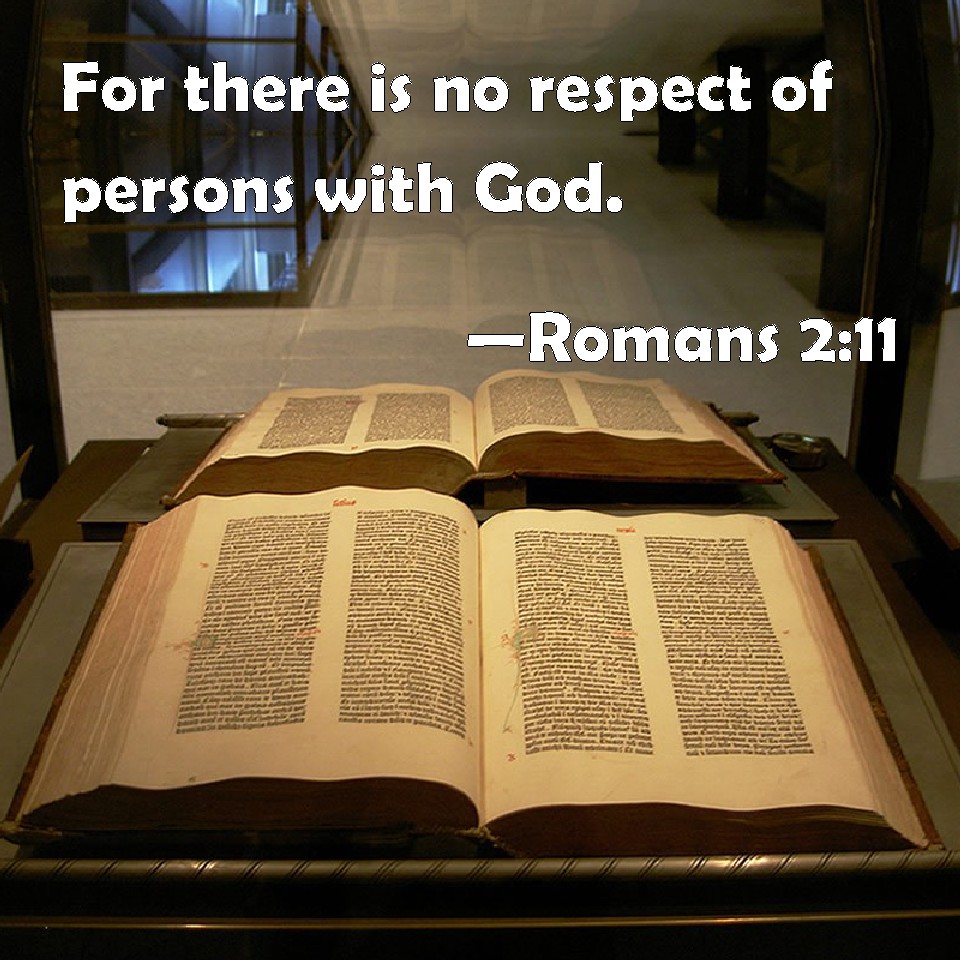
In the text at the head (Romans 2: 11), it is clearly said that "God is no respecter of persons." (kjv) Other translations say "God does not show favoritism" (niv) "God shows no partiality" (esv). 

Weymouth's translations says: "God pays no attention to this world's distinctions." (which is more a paraphrase) "For God judges everyone by the same standard." (Good News translation)

However, I favor "respect of persons" as the older versions. The reasons for that will become apparent when we look more closely at how the bible defines and describes what it means to show such respect of persons.

"Wherefore now let the fear of the LORD be upon you; take heed and do it: for there is no iniquity with the LORD our God, nor respect of persons, nor taking of gifts." (II Chronicles 19: 7 KJV)

"And if ye call on the Father, who without respect of persons judgeth according to every man's work, pass the time of your sojourning here in fear." (I Peter 1: 17 KJV)

"God is no respecter of persons." (Acts 10: 34)

We must be careful in proclaiming that God is no respecter or persons, and that he is impartial, and that he judges all by the same equal standard. For instance, do these verses say that people should not be respected? No. Why? Because it teaches us to "give honor (respect) to whom honor is due" (Rom. 13: 7) as in respecting one's elders and parents. God also shows respect to those who please him. So we read:

"And Abel, he also brought of the firstlings of his flock and of the fat thereof. And the LORD had respect unto Abel and to his offering: But unto Cain and to his offering he had not respect. And Cain was very wroth, and his countenance fell." (Gen. 4: 4-5 kjv)

Here Lord God respected both the person and religious acts of Abel but did not respect the person and religious acts of Cain. So, as previously stated, when God is said to not be a respecter of persons, this is not to be understood to be true in every respect. God respected Abel because he was a man of faith and brought the proper sacrifice and did not respect Cain because he was not a man of faith nor brought the right gift. We also learn from the scriptures that the reason Abel had faith was because he was given faith by God. 

As regards God showing partiality or favoritism, we have also already addressed that question. We looked at passages that speak of being good to some "especially," or more than others. Are persons to be faulted because they love their spouses or children more than others? Is it wrong for God to give more grace to one than to another? It it wrong for God to naturally endow some people with greater abilities? God is partial in ways that are right. He is not partial in deciding who has done right or wrong. His partiality or favoritism is not based upon merit or any natural difference between men. This is the chief meaning of "grace." 

Definition

"My brethren, have not the faith of our Lord Jesus Christ, the Lord of glory, with respect of persons. For if there come unto your assembly a man with a gold ring, in goodly apparel, and there come in also a poor man in vile raiment; And ye have respect to him that weareth the gay clothing, and say unto him, Sit thou here in a good place; and say to the poor, Stand thou there, or sit here under my footstool: Are ye not then partial in yourselves, and are become judges of evil thoughts? Hearken, my beloved brethren, Hath not God chosen the poor of this world rich in faith, and heirs of the kingdom which he hath promised to them that love him? But ye have despised the poor. Do not rich men oppress you, and draw you before the judgment seats? Do not they blaspheme that worthy name by the which ye are called? If ye fulfil the royal law according to the scripture, Thou shalt love thy neighbour as thyself, ye do well: But if ye have respect to persons, ye commit sin, and are convinced of the law as transgressors." (James 2: 1-9 KJV)

This text shines light on what it means to show respect of persons. It also reiterates the fact that to "have respect of persons" is to "commit sin" and be designated "as transgressors." It is to base one's treatment and judgement of others on their "faces," or "persons" (personas), whether they are rich or poor, learned or unlearned, high society or low life, famous or unknown, etc. 

God does not choose any to salvation because he or she is in any way superior to others. It is not a choice of those who have differentiated themselves from others by having made better choices and had better successes. However, it is the Arminian idea that God chooses those who first choose him, who chooses to love those who first loved him, to choose those who made themselves to differ from another. The apostle said that God "out of the same lump" makes one vessel unto honor and another unto dishonor. The clay that was made for honor was not any different from the clay made for dishonor prior to God beginning his work on it. The difference came after the Potter's making each piece of clay different. Recall Paul's question - "who makes you different from another and what do you have that you did not receive from God?" 

Abel was different from Cain. Isaac was different from Ishmael. Jacob was different from Esau. The chosen seed in Egypt was different than the Egyptians. So we read:

"But against any of the children of Israel shall not a dog move his tongue, against man or beast: that ye may know how that the LORD doth put a difference between the Egyptians and Israel." (Exo. 11: 7 kjv)

Recall that in a previous chapter we showed how God instructed Gideon to choose those soldiers who showed they were superior in wisdom and military skills, or who merited being chosen, and denied that God's choice of sinners to salvation was likewise a choice of the most deserving, a choice of those who were wise enough to have made the right decision to believe God or to obey him. God's choice is what makes the difference and so any such difference cannot be the reason for God's choice. So, we cannot say that "God chose me because I chose him" but rather say "God chose me before I chose him." Therefore the doctrine of unconditional, or unmerited, election is not a case of God showing partiality or respecting persons.

Friday, April 18, 2025

Divine Justice Issues (XXVII)


Many theologians answer this question by using an analogy. They say that the same sun will melt ice but harden clay. The same thing that softens the hearts of some is the same thing that hardens the hearts of others. So, by this analogy God is justified in his hardening of the clay (or the heart). God sends fires of trial in his providential crucible and in one case the fire purifies some people so that they become vessels for honor and glory, and in other cases some people are destroyed by the fire and become vessels for wrath and dishonor. So, in this way we see how God, by means of fire or the sun (contributing causes), makes one vessel into a good or better vessel and makes another vessel into a bad or worse vessel. There is much truth in these analogies. 

We might ask in response to those who would criticize how God punishes transgressors or his "judicial hardening" of heart: "is society morally responsible if criminals become more criminal by being sent to prison by them?" Is their criminal justice system better than God's?

Many who write on the philosophy of crime and punishment will often say that criminals are really victims, and therefore not responsible, at least to some degree. This was what the famous lawyer Clarence Darrow argued in one of his famous cases. (See my posting on this here) It is also the philosophy of many liberal democrats in this country. It is the view of most sociologists. My college major was in sociology and I was taught it and read it in the writings of the leading sociologists. Their idea is that a person is born with a good nature, or at least a "Tabula rasa." It is a Latin phrase meaning "blank slate" or "clean slate." It's a philosophical concept that refers to the idea that the human mind, soul, or spirit at birth is a blank slate, without any pre-existing or intuitive knowledge, or no law written in their nature. This concept suggests that all knowledge and belief are acquired through sensory experiences and interactions with the world, or from the environment. Therefore the liberal sociologist will argue that a person who becomes a criminal becomes so by external factors alone and thus becomes an innocent victim. Of course, the bible is against this philosophy. It rather teaches that man is born depraved, as we have already seen. (Psa. 51: 5; Eph. 2: 3; etc.) It teaches that every man is responsible for his crimes and has no excuses. (Rom. 1: 20)

That is not to deny, however, that some criminals may be shown leniency due to what are called "mitigating" circumstances. In legal terms, a mitigating circumstance is a factor that lessens the severity of a criminal offense or the punishment for it. It's not an excuse or justification for the crime, but rather a reason to consider the defendant's actions as less blameworthy. These circumstances can lead to reduced charges or a lighter sentence. The bible acknowledges the rightness of this way of thinking. Solomon said: "People do not despise a thief if he steals to satisfy his appetite when he is hungry." (Prov. 6: 30 kjv) The bible also  recognizes how external factors may be contributing causes for a person becoming criminal and that these should be considered in deciding the level and kind of punishment in a sentence.

Further, who can doubt that when a sinner enters into his eternal prison (Hell) that his time there makes him infinitely more hardened against God and right? If men do not condemn themselves for making criminals more hardened by their imprisonments, then they cannot condemn God. 

Judicial Hardening

"But although He had done so many signs before them, they did not believe in Him, that the word of Isaiah the prophet might be fulfilled, which he spoke: “Lord, who has believed our report? And to whom has the arm of the LORD been revealed?” Therefore they could not believe, because Isaiah said again: “He has blinded their eyes and hardened their hearts, Lest they should see with their eyes, Lest they should understand with their hearts and turn, So that I should heal them.” These things Isaiah said when he saw His glory and spoke of Him." (John 12: 37-41 nkjv)

Barnes in his commentary says: "There is, indeed, a judicial blinding and a judicial hardening." It is not a case where God is preventing the salvation of anyone who is seeking salvation. For, as we have seen, "God desires that all men be saved and come to a knowledge of the truth." (I Tim. 2: 4) God does not want any of his creatures to believe falsehood, especially about him and his ways. It is rather a case where God has "given up," as it were, in his efforts to turn a man from his wicked ways. In Romans chapter one Paul speaks of this when he speaks of how “God gave them over” (or "up") in three things: 

1) “God gave them over in the lusts of their hearts to impurity, so that their bodies would be dishonored among them” (verse 24, NASB). 
2) “God gave them over to degrading passions” (verse 26, NASB). 
3) “God gave them over to a depraved mind, to do those things which are not proper” (verse 28, NASB).

"The Greek word translated “gave over” or “gave up” means “surrendered, yielded up, entrusted, or transmitted.” In this context, it refers to the act of God completely abandoning the unrighteous. As the wicked deserted God, God in turn deserted them, no longer giving them divine direction or restraint, but allowing them to corrupt themselves as they wished. Because they would not honor Him, He let them do what they pleased to dishonor themselves. Being given over or yielded up to one’s sinful desires is a judgment from God." (Got Questions - See here - emphasis mine)

So, it must be acknowledged that God's judicial hardening and blinding, his giving them up, makes sinners more sinful, and this is one way in which they are being further fitted or prepared, as vessels of wrath, for destruction. Is God just to render this kind of punishment knowing that it will increase a person's sin and level of punishment? Can he not send punishments that rather reform the sinner and turn him around, or make him sin less? Answer: yes, some of God's punishments do act as means to turn a sinner around. But, in some cases, they rather harden the wicked man even more. If a man is "getting away with" his crimes, with little punishment, will this not encourage him to keep on committing crimes? We see this to be the case with some criminals.

The same source article also says:

"What’s the result of God’s having given them over?They have become filled with every kind of wickedness, evil, greed and depravity. They are full of envy, murder, strife, deceit and malice. They are gossips, slanderers, God-haters, insolent, arrogant and boastful; they invent ways of doing evil; they disobey their parents; they have no understanding, no fidelity, no love, no mercy. Although they know God’s righteous decree that those who do such things deserve death, they not only continue to do these very things but also approve of those who practice them” (Romans 1:29–32)."

Some God haters who are ever looking for ways they can condemn God may argue that God is the cause of some people becoming more sinful because of his judicial hardening. Obviously, however, God does not agree with this, i.e. that he is being unjust to give the sinner up because it leads him to commit greater sins. Further, God can and often does lesson the amount of sin being committed by his creatures. The bible is filled with proof texts that uphold this truth. For instance, the bible teaches that God is hindering or preventing, for the time being, the coming of the Antichrist. (II Thess. 2: 6-7) But, one day he will suffer Antichrist to enter into the scene and then what follows will be greater wickedness on earth. So, we cannot go beyond scripture and affirm that God never does anything in his providence and government of men that brings about more wickedness. If the cynic thinks he could do better than God in his control of the world, let him tell us how he would govern the wicked or criminal.

When God gives persons up or over because they have long spurned his truth, he gives them over to a "reprobate mind." Wrote Paul in that same chapter:

"And even as they did not like to retain God in their knowledge, God gave them over to a reprobate mind, to do those things which are not convenient; Being filled with all unrighteousness..." (Rom. 1: 29-30 kjv)

"A reprobate mind is void of all sense and judgment to discern things that differ, so that they could not distinguish their right hand from their left in spiritual things." (Matthew Henry commentary) 

Said the same source:

"The sad fact is that sometimes God gives us what we want. God allowed the Israelites who rebelled to reap the natural consequences of their choice: “But my people would not listen to me; Israel would not submit to me. So I gave them over to their stubborn hearts to follow their own devices” (Psalm 81:11–12). In Romans 1, Paul shows how the wicked made a choice to reject God, and that choice set them on a downward spiral of increasing darkness and decreasing hope. As the godless run farther and farther from God, God intervenes less and less. The Spirit’s restraint of sin is a blessing, and if that restraint is removed, all wickedness follows." 

The God hater, by sophistry, will act like a prosecutor and put God on trial and say that because God removed his restraints, he caused more wickedness, and he shows thereby that he is not just. After all, why does God not do more restraining? Cannot criminals say that it is God's fault that they committed a crime since he did not keep them from doing the crime? However, God is not obligated to intervene to stop every crime, nor to show mercy to all without exception. 

Yes, as the Got Questions article says, God does sadly sometimes give people what they want, even though he knows that it would be better if he didn't. So the Psalmist wrote: "And He gave them their request, But sent leanness into their soul." (Psa. 106: 15 nkjv) God, like many parents, replies to their begging children - "okay, I am going to give you what you want, but you will regret it, but I do it so that you might thereby learn a few things." A case where this is seen is in the story of "the prodigal son" who pestered his father and demanded that he give him his inheritance early in life. The father granted his request and it led to the ruination of the son, loss of all his inheritance by squandering all in sinful pursuits, living is squalor, to starving to death.

Barnes says further:

"He hath blinded their eyes - The expression in Isaiah is, "Go, make the heart of this people fat, and shut their eyes." That is, go and proclaim truth to them truth that will result in blinding their eyes. Go and proclaim the law and the will of God, and the effect will be, owing to the hardness of their heart, that their eyes will be blinded and their hearts hardened. As God knew that this would be the result - as it was to be the effect of the message, his commanding Isaiah to go and proclaim it was the same in effect, or in the result, as if he had commanded him to blind their eyes and harden their hearts. It is this effect or result to which the evangelist refers in this place. He states that God did it, that is, he did it in the manner mentioned in Isaiah, for we are limited to that in our interpretation of the passage. In that case it is clear that the mode specified is not a direct agency on the part of God in blinding the mind - which we cannot reconcile with any just notions of the divine character - but "in suffering the truth to produce a regular effect on sinful minds, without putting forth any positive supernatural influence to prevent it." The effect of truth on such minds is to irritate, to enrage, and to harden, unless counteracted by the grace of God. See Romans 7:8-9, Romans 7:11; 2 Corinthians 2:15-16. And as God knew this, and, knowing it, still sent the message, and suffered it to produce the regular effect, the Evangelist says "he hath blinded their minds," thus retaining the substance of the passage in Isaiah without quoting the precise language; but in proclaiming the truth there was nothing wrong on the part of God or of Isaiah, nor is there any indication that God was unwilling that they should believe and be saved."

We might view the command of God to Isaiah as sarcasm. In other words he says "Preach to them Isaiah and give them more opportunities to refuse, scorn, deride, and harden themselves against me." 

The very same ones who believed not and had hardened their hearts is not because they cannot be healed (saved), but simply means that as long as they remain in this state their healing is not possible.

In other places in the gospels we read where people are also said to have hardened their own hearts when they refused to believe in Jesus. (Mark 6: 52, 8: 17) So again we see where both God and people themselves may be seen as doing the same hardening in some cases. 

Further, it is not only the unbeliever who is often hardened in his heart towards God and his word, but even the believer sometimes is likewise hardened. So we read: "For they considered not the miracle of the loaves: for their heart was hardened." (Mark 6: 52 kjv) The "they" of the text are the apostles, God's disciples. Notice also these words of the Lord Jesus to his apostles and disciples:

"And he charged them, saying, Take heed, beware of the leaven of the Pharisees, and of the leaven of Herod. And they reasoned among themselves, saying, It is because we have no bread. And when Jesus knew it, he saith unto them, Why reason ye, because ye have no bread? perceive ye not yet, neither understand? have ye your heart yet hardened? Having eyes, see ye not? and having ears, hear ye not? and do ye not remember?"(Mark 8: 15-18 kjv)

Here again the "they" are the apostles. Believers must always be on guard against becoming hardened in heart and spirit against any truth of God. We see this hardening of heart against truth in the many cults within the professing Christian community. Each of these cults holds to some gross heresy and become hardened against all other groups and against certain bible doctrines. One group I have focused much of my outreach ministry towards are those known as "Primitive" "Old School" or "Hardshell" Baptists. The term hardshell was applied to them because of their stubborn adherence to their ideas and for them withdrawing into a cocoon. These folks are hardened against all other churches, being especially antagonistic towards those they call "Missionary Baptists," or "Arminians." It is also seen to a large degree in some Calvinists being hardened against Arminians and vise versa, or between Unitarians and Trinitarians. 

A hardened heart is intimately linked with a lack of understanding, with ignorance, and blindness to truth. Our lack of understanding God's word, even as believers, can sometimes be the result of having a hard heart, or being hard-headed. Another verse that shows that even believers are to ever be on guard against having a hard heart is this:

"Beware, brethren, lest there be in any of you an evil heart of unbelief in departing from the living God; but exhort one another daily, while it is called “Today,” lest any of you be hardened through the deceitfulness of sin. For we have become partakers of Christ if we hold the beginning of our confidence steadfast to the end, while it is said: “Today, if you will hear His voice, Do not harden your hearts as in the rebellion.” (Heb. 3: 12-15 nkjv)

This text tells us much about what it means for the heart to be hardened and the causes of it. The Christian has no need to worry that God is going to harden his heart as he did Pharaoh, Sihon, and others. That is because the believer is not a vessel of wrath, or vessel unto dishonor, and doomed to destruction, but is rather a vessel of mercy, a vessel unto honor, who is being prepared by God for glory. God will never "give them up" as he does the reprobate. They may harden their hearts to some degree, but never to the extent or for the same reason, that many unbelievers are hardened in heart. The thing that causes hardness of heart is "the deceitfulness of sin." 

"13 This is why I speak to them in parables, because seeing they do not see, and hearing they do not hear, nor do they understand. 14 Indeed, in their case the prophecy of Isaiah is fulfilled that says: ‘“You will indeed hear but never understand, and you will indeed see but never perceive.” 15 For this people’s heart has grown dull, and with their ears they can barely hear, and their eyes they have closed, lest they should see with their eyes and hear with their ears and understand with their heart and turn, and I would heal them.’" (Matt. 13: 13-15)

These are the effects of a hardened heart, a stubborn will, and perverseness of spirit. It is a heart that is in opposition to God, or to one or more of his truths. When people get into the condition described above by Jesus and Isaiah it is much more difficult to bring them to repentance. If God saves any of them it will require greater power to be exercised by him. With them God may have to use extraordinary means, even a pry bar, to pry them away from their sins. But again, God will never harden the hearts of his own children in the same way he did to his enemies, such as Pharaoh and Sihon. God will soften the hearts of believers so that their hardness of heart is limited and restrained as a result of mercy shown. The hardening of the hearts of the reprobate brings an end to God's positive influence towards them. Further, God only hardens the hearts of the vessels of wrath, in conjunction with their own efforts towards that end, but he never hardens the hearts of his own children. They do that themselves within the limits he circumscribes. 

Some of the other ways that the vessels of wrath are being prepared or fitted for destruction may be learned from such texts as this:

"But in accordance with your hardness and your impenitent heart you are treasuring up for yourself wrath in the day of wrath and revelation of the righteous judgment of God."(Rom. 2: 5 nkjv)

This "treasuring up" is linked with "prepared (fitted) for destruction." Both texts show that this preparation is continuous and progressive. Every sinner who is spurning God and his offers of mercy and chooses a life of sin is being steadily prepared for destruction. In fact, that are on "the broad way that leads to destruction." (Matt. 7: 13) 

"But in the fourth generation they shall return here, for the iniquity of the Amorites is not yet complete.” 
(Gen. 15: 16 nkjv)

We might say that the Amorites, as vessels of wrath, were not yet fully "fitted" for destruction until they had reached a certain level in their sinful course. When hard hearted people die, we may say that they die "ready" for Hell, in contradistinction to the vessels of mercy who will die ready or "fit for" Heaven.