
Saturday, November 30, 2019

The Sign Of The Virgin


I firmly believe that the Zodiac sign or constellation of Virgo was named and drawn by the first prophets of Lord God, based upon the protoevangelium,* and details the basic facts of the gospel of redemption. In Job "Mazzaroth" (the Zodiac or twelve constellations of the circular heavens) is spoken of as being of God and having messages and a story connected with them. (See Job 38:31-32)

*or the first good news promise of a savior and redeemer found in the words of God to the Serpent - “I will put enmity between you and the woman; and between your offspring and her offspring; he shall bruise your head, and you shall bruise his heel” - Gen. 3:15

The following citations are from my former posting on this subject (here). Under "The Sign Of Virgo" J. A. Seiss wrote:

"I begin with Virgo, which I take to be the first sign in the Zodiac, according to its original intent and reading. The Zodiac of Esne begins with this sign. The story has no right starting-point, continuity, or end except as we commence with this constellation. I also have the statement from the best authorities that the custom was universal among the ancients to reckon from Virgo round to Leo. And in this sign of Virgo, if anywhere among the starry groups, we find the primary idea in the evangelic presentations."

"The initiative sign of the Zodiac is called Virgo, The Virgin. All the traditions, names, and mytholgies connected with it recognize and emphasize the virginity of this woman. Astrea and Athene of Greek story identify with her. 


In Hebrew and Syriac she is Bethulah, the maiden. In Arabic she is Adarah, the pure virgin. In Greek she is Parthenos, the maid of virgin pureness. Nor is there any authority in the world for regarding her as anything but a virgin."

"But the greater wonder is, that motherhood attends this virginity, in the sign the same as in the text..."

"And this maiden in the sign is the holder and bringer of an illustrious Seed; In her hand is the spica, the ear of wheat, the best of seed, and that spica indicated by the brightest star in the whole constellation. He who was to bruise the Serpent's head was to be peculiarly "the Seed of the woman," involving virgin-motherhood, and hence one born of miracle, one begotten of divine power, the Son of God. And such is the exhibit in this first sign of the Zodiac. She is a virgin, and yet she produces and holds forth a Seed contemplated as far greater than herself. That seed of wheat Christ appropriates as a symbol of himself. When certain Greeks came to Philip wishing to see Jesus, He referred to himself as the corn, or seed, of wheat, which needed to fall and die in order to its proper fruitfulness (John 12: 21—24).



Verily, verily, I say unto you, Except a corn of wheat fall into the ground and die, it abideth alone: but if it die, it bringeth forth much fruit."

"Thus, according to the starry sign, as according to the Gospel, out of the seed of wheat, the good seed of the Virgin, the blessed harvest of salvation comes."

"A very significant figure of Christ, much employed by the prophets, was the branch, bough, or sprout of a plant or root. Hence He is described as the Rod from the stem of Jesse and the Branch out of his roots (Isa. 11 : i), the Branch of Righteousness, the Branch 'of the Lord, God's servant The Branch (Isa. 4:2; Jer. 23 : 5 ; Zech. 3:8; 6:12). And so this sign holds forth the Virgin's Seed as The Branch. In addition to the spica in one hand, she bears a branch in the other. The ancient names of the stars in this constellation emphasize this showing, along with that of the Seed. Al Zimach, Al Azal, and Subilon mean the shoot, the branch, the ear of wheat. The language of the prophecies is thus identical with the symbols in this sign."

"It is a doctrine of our religion that without Christ, and the redemption wrought by Him, all humanity is fallen and helpless in sin. There is none other name given among men whereby we can be saved.


Even Mary herself needed the mediatorial achievements of her more glorious Son to lift her up to hope and standing before God. And this, too, is here signified. This woman of the Zodiac lies prostrate. She is fallen, and cannot of herself stand upright. Christ alone can lift up to spiritual life and standing. This woman accordingly holds forth the goodly Seed, the illustrious Branch, as the great embodiment of her hope and trust, the only adequate hope and trust of prostrate and fallen humanity.

And what is thus vividly signified in this constellation is still further expressed and defined by the Decans, or side-pieces, which go along with it."


The great and learned Bullinger wrote:

"The name of this sign in the Hebrew is Bethulah, which means a virgin, and in the Arabic a branch. The two words are connected, as in Latin--Virgo, which means a virgin; and virga, which means a branch (Vulg. Isa 11:1). Another name is Sunbul, Arabic, an ear of corn.

In Genesis 3: 15 she is presented only as a woman; but in later prophecies her nationality is defined as being of the stock of Israel, the seed of Abraham, the line of David; and, further, she is to be a virgin. There are two prominent prophecies of her and her seed..."


"Behold, a virgin shall conceive and bear a son,
And shall call his name Immanuel."
 (Isa. 7: 14)

"For unto us a child is born, Unto us a son is given; And the government shall be upon His shoulder; And His name shall be called Wonderful, Counsellor, The Mighty God, The Everlasting Father, The Prince of Peace. Of the increase of His government there shall be no end. Upon the throne of David, and upon His kingdom, To order it, and to establish it With judgment and with justice From henceforth even for ever. The zeal of the LORD of hosts will perform this." (Isa. 9: 60)

"...the brightest star in VIRGO (a) has an ancient name, handed down to us in all the star-maps, in which the Hebrew word Tsemech is preserved. It is called in Arabic - Al Zimach, which means the branch. This star is in the ear of corn which she holds in her left hand. Hence the star has a modern Latin name, which has almost superseded the ancient one, Spica, which means, an ear of corn. But this hides the great truth revealed by its name Al Zimach. It foretold the coming of Him who should bear this name. The same Divine inspiration has, in the written Word, four times connected it with Him. There are twenty Hebrew words translated "Branch," but only one of them (Tsemech) is used exclusively of the Messiah, and this word only four times (Jer 33:15 being only a repetition of Jer 23:5). Each of these further connects Him with one special account of Him, given in the Gospels."

"The star b is called Zavijaveh, which means the gloriously beautiful, as in Isaiah 4: 2. The star e, in the arm bearing the branch, is called Al Mureddin, which means who shall come down (as in Psa 72:8), or who shall have dominion. It is also known as Vindemiatrix, a Chaldee word which means the son, or branch, who cometh."

"The Hebrew word ‘Zerah’ (the alpha star) is the word used to describe Messiah to Adam and Eve in Genesis 3:15 and to Abraham in Genesis 15:5...the seed, “zerah” was a direct reference to the coming Messiah."

Other names of stars in the sign, are--

Subilah, who carries. (Isa 46:4)
Al Azal, the Branch. (As in Isa 18:5)
Subilon, a spike of corn. (As in Isa 17:5)


Under "The Desired One (Coma)" Seiss wrote:

"The Gospel in the Stars: Or, Prímeval Astronomy" By Joseph Augustus Seiss (here)

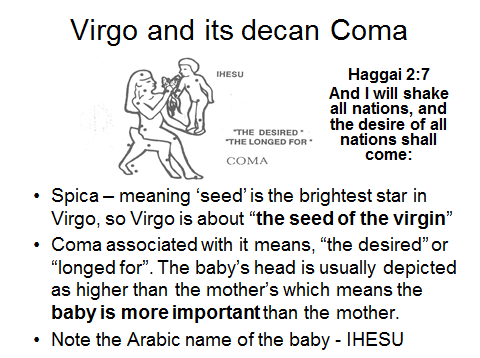
"The prophets are also very emphatic in describing the promised Saviour as the Desired One, "the Desire of women," "the Desire of all nations." So the name of this first Decan of Virgo is Coma, which in Hebrew and Oriental dialects means the desired, the longed-for —the very word which Haggai uses where he speaks of Christ as "the Desire of all nations.-' The ancient Egyptians called it Shes-nu, the desired son. The Greeks knew not how to translate it, and hence took Coma in the sense of their own language, and called it hair— Berenice's Hair. The story is, that that princess gave her hair, the color of gold, as a votive offering for the safety of her brother; which hair disappeared. The matter was explained by the assurance that it was taken to heaven to shine in the constellation of Coma. Hence we have a bundle of woman's hair in the place of " the Desire of all nations." (pg. 77)

So, how old is the gospel message about Jesus the Messiah? Does it not go back to the beginning?

Sunday, November 24, 2019

On Topical/Textual Preaching

I have not been one to "jump on the bandwagon" in regards to what is called "expository preaching," calling for this type of preaching to be the exclusive manner of teaching the bible. Of course, I first object (like others) to how "expository preaching" is defined. I have in previous writings already objected to some false definitions.

(see herehereherehere)

Actually, what I have written, together with other possible additions, could make a small introductory book on the subject.

First, let me say that I like textual and topical preaching. I think also that this type of preaching has been the most loved by the saints, has produced the greatest results, and has much to commend it. The greatest preachers have been primarily textual and topical preachers. Think of Spurgeon, the great "prince of preachers." Among my PB brothers, their greatest preachers have been textual and topical, such as Lasserre Bradley and Sonny Pyles. My beloved father was a textual preacher.

Further, topical and textual preaching involves exegeses or exposition.

From gotquestions.org (here) there is a  good writing on this subject.

Question: "What is topical preaching? Should a pastor preach topically?"

Answer: 
As the name suggests, topical preaching is centered on a topic. Most pastors will preach at least some topical sermons, while some focus almost exclusively on them. Whether this model is good or bad probably has more to do with how it is used than anything else. Topical preaching can be quite effective, but there are inherent limitations that must be understood if it is to be used properly.


Sermons can be generally grouped in four types: textual, topical, textual-topical, and expository. A.W. Blackwood observed, “Needless to say, these labels fit poorly. Sometimes these overlap and cause confusion.” A textual sermon follows the structure of the text of Scripture, allowing the word flow to provide the sermon points. A topical sermon is organized around a thought, with the sermon points developed by the speaker and supported by proof texts. A topical-textual sermon merges the two, allowing the sermon points to flow either from the text or the thoughts of the speaker. An expository sermon follows the text of Scripture, and then seeks to draw out the full meaning of it. The goal of each type of sermon is to apply the Word of God to the lives of the hearers.

In topical preaching, the speaker has the freedom to address issues being faced by his hearers. If the need is a better understanding of sin, a series can be presented to address various aspects and results of sin. When done well, this type of preaching will give a broad-spectrum view of what the Bible says on a given topic. By focusing on issues in this way, people can develop a biblical understanding of any subject matter. Another benefit of topical preaching is unity of thought. People are able to follow the logical progression of thought, which often helps them remember what they have heard. This method lends itself well to the natural talents of a speaker, because the thoughts come from his own heart.

While topical preaching allows the speaker to develop quality sermons, it also has a number of dangers. If it is the only method used, the speaker can easily get trapped in the rut of only preaching on those topics that are of interest to him or those which are easily developed in a message. Likewise, the audience can become acclimated to “comfortable” or “exciting” messages, turning away from teaching that doesn't fit that model. A strict adherence to topical preaching will result in a stunted understanding of the whole counsel of God, even though certain subjects will be well understood. In some cases, a speaker may be tempted to think more of his own ideas than “rightly dividing the word of truth” (2 Timothy 2:15).

For these reasons, many pastors alternate between topical and textual or expository messages. The topical messages allow them to address current issues in society or the life of the church, while the textual and expository messages build on the “big picture” of whole books in the Bible. Both are essential in encouraging balanced growth in the Christian life. How a sermon is organized isn't nearly as important as making it biblical and applicable. A topical message can be just as scriptural as an expository one, and an expository message can be just as interesting as a topical one. Warren Wiersbe, in his book Preaching and Teaching with Imagination, relates the exasperation of a pastor who said, “My preaching sounds like a commentary! I'm dull! I have all the biblical facts but there's no life! What should I do?” This pastor, who had the biblical information right, needed help learning how to communicate it to people. According to Wiersbe, “People think in pictures and respond with their hearts as well as their heads.”

Regardless of the type of message, if it is firmly grounded in Scripture and applied to life with vivid word pictures, it will accomplish the goal and draw people to follow Christ more closely.

These are some remarks on this subject that I endorse. Textual and topical preaching have their place in the ministries of preachers and good textual preaching will include exegeses. Let us not "throw the baby out with the bath water" in promoting "expository preaching." Exposition may just as well be done in topical preaching as in verse by verse, book by book, preaching. I think topically. I like to read books on topics. I also certainly like topical sermons. Topical sermons will include lots of texts, and lots of exegeses.

Saturday, November 23, 2019

Elder Newell Helms


JANUARY 28, 1932 – NOVEMBER 21, 2019

The obituary for Elder Helms has been posted here and gives funeral details.

As I stated in my announcement of Newell's passing, Newell and I were good friends. In my twenties, while married to his oldest daughter, he was a second father to me. We spent a lot of time together talking scripture. He counseled me much in those days about religious matters.

I was glad to hear brother Helms tell me in one of our visits at the Bear Creek Association (last decade) that he did not believe that unbelievers were saved and that he said this recently in a sermon. I said to him - "I am happy to hear you say this."

Newell loved Spurgeon and was regularly reading his sermons. I was happy about that fact also.

Newell was a good father, husband, and brother. He was gentle, patient, and was always ready to visit the sick in the hospital. Many times I went to Charlotte with him to visit them. Pastoring churches was more than just preaching to him.

He is happy now. Let us celebrate the Lord who gave this man such a rich full life.

Will All The Elect Believe?

"If Jesus himself reveals himself, and preaches the Gospel to his elect, then how can it be affirmed that many will be in Heaven who did not hear and know?"

A question I asked of my Hardshell brothers in the posting "Redford's Hardshell Apology" (here) and which is one worth repeating, don't you think?

I plan to write more on this in the future, the Lord willing. I already have a draft posting or two in the works on it.

Friday, November 22, 2019

Elder Newell Helms Has Passed

Elder Newell Helms, my ex father in law, has passed away at his home on last evening, here in Monroe, NC.

The Lord blessed him with long life and good days. Let us celebrate his life and keep the family in prayers.

I have not heard any of the funeral arrangements as yet.

Elder Helms and I were good friends. I use to visit him in his retirement years by going to the Bear Creek Association a few times. Those visits and conversations are etched in my memory.

A good sermon by Elder Helms preached in 1990 can been seen and heard here.

Tuesday, November 19, 2019

Baptist Watchman Citations (III)

Dr. R. W. Fain in an article titled "Faith," for the Dec. 5th, 1871 issue of the Baptist Watchman, wrote (highlighting mine, caps not):

"So then faith cometh by hearing, and hearing by the word of God." (Rom. 10:17)

"To effect this great object, "GOD HAS PROVIDED MEANS THAT HIS BANISHED BE NOT EXPELLED FROM HIM." Christ has been crucified, the Holy Spirit has come, and the gospel in the name of Christ has been preached. All these are means by and through which God's purpose in our behalf are carried out. It is said that "whosoever shall call on the name of the Lord, shall be saved." But again, it is said that "no man can say that Jesus is Lord but by the Holy Ghost." 

"His word whispered by the Holy Spirit into the ear of the understanding is heard. His word preached and extended by divine power to the same is heard, and God calls His ministers who proclaim pardon through Christ, and when the spirit makes the application, the sinner hears and believes, and "so faith comes by hearing, and hearing by the word of God." 

That is Old Baptist doctrine!

Dr. Piper On Job

I found the following posting by Dr. John Piper disheartening, especially in view of the fact that I find Dr. Piper "spot on" on most of his bible interpretations. His posting is a transcript of a sermon titled "How Should I Read the Book of Job?" (here) Some may know that years ago I wrote a series of chapters on the Theology of Job, primarily for the purpose of defending this righteous prophet from the character assassination that he has received from many biblical commentators. Piper clearly does not see Job as innocent and righteous as does the Lord. 

Let me cite the portions of Piper's remarks that I intend to dispute, giving enough context to prevent misinterpretation. (highlighting mine)

"Job has about 29 chapters of misapplied theology in the middle. It's very hard to navigate your way through those chapters and determine what is true and what is not, because these guys are mixing up truth and falsehood all over the place. (True! - SG) I think you're supposed to get the big picture that God was not happy with these three friends, Eliphaz, Bildad, and Zophar. (Yes, but was he happy with Job and Elihu? - SG)

And when Elihu shows up, he, I believe, begins to set it right. (But, was not Job already setting things right? - SG) Finally God speaks and he sets it completely right.

Then there is the last chapter that puts the closure on the whole thing. There it says that God brought all of this upon Job; and Job proves in the end to be a better man than these other men, even though Job himself sinned and had to repent in dust and ashes.

How important is it for us to note that Job's calamities had absolutely no connection with his character?

I don't think that's exactly right to say. I think "absolutely" is an overstatement, because when you get to the end, it says,

Then Job answered the LORD and said:

“I know that you can do all things, and that no purpose of yours can be thwarted.

‘Who is this that hides counsel without knowledge?’ Therefore I have uttered what I did not understand,things too wonderful for me, which I did not know.'

‘Hear, and I will speak... (Job 42:1-4)

And then Job repents in dust and ashes, verse 6:

"Therefore I despise myself, and repent in dust and ashes."

In other words, here's the way I would say it: He was called an upright and blameless man, and yet that doesn't mean that he was a sinlessly perfect man.

I picture Job as a beaker of water. Job had been so worked upon by the grace of God that his life was pure. You could see right through the water. People looked at him and they saw a pure man. (Did not God see him as a pure man?! - SG) But there was a sediment of self-reliance and pride at the bottom. (Really? Where is the proof of that? - SG) It wasn't huge and it wasn't damning, but it was there.

When God shook Job, the sediment colored the water, and you find Job saying some terrible things about God in this book. (This is an incredible statement to say of one whom God said was righteous and spoke of him correctly! - SG) God knew that it was there, and he knew that in shaking this godly, blameless man there would arise some imperfection into his life, and that it would need to be purged. So the last thing is, therefore, "I despise myself, and repent in dust and ashes."

God is so pleased with Job (I thought he wasn't? - SG) that he makes the three friends go and ask Job to pray for them instead of them praying for themselves. God loves this man Job.

So, we may rephrase the question, "How important is it that we see that Job's suffering was not directly connected to any evil deed?" That is true.

We should be able to say to people, "I'm not looking for a specific sin in your life that God is punishing you for or chastising you for. God may be permitting this calamity to come into your life just to refine very beautiful faith. Your faith is like gold, but it does have straw in it, and God loves you so much that he is now going to burn out a little more straw."

All I can do at this time in response is to refer the reader to my writings titled "Theology of Job" (here).

Here are the chapters written thus far (I may add to it in the future):

Job's Righteous Character - Chapter One
Job The Prophet - Chapter Two
Job The Accused - Chapter Three
Job's Apology - Chapter Four
Job's Character Assassination - Chapter Five
Job's Repentance - Chapter Six

Here are some excerpts from those chapters:

Chapter One

"Our view of him ought to be the same as that of God."

Chapter Two

"... these words of James prove that Job was a prophet of God, one who spoke in the name of the Lord."

"These words should settle all debate about the correctness of Job's theology, about the truthfulness of what he said about the nature and workings of God in his dialogues with his "friends."" 

Chapter Three

"Strikingly, however, Job is never accused of any evil by God. He only blesses and approves of Job's character and teachings."

"In fact, many commentators on the Book of Job invariably end up being just as accusatory and critical against Job's character and theology as were Job's "friends," the very ones God condemned in the Epilogue for sin and heresy!" 

 Chapter Four

"Job Maintains his Righteousness and Integrity." "Here Job again maintains his righteousness and innocence. Job does not believe he has erred theologically or morally. He also claims that his friends have failed to demonstrate his error." 

Chapter Five

"Job being "righteous" did not beget pride, presumption, or arrogance in him. Though righteous, he was nevertheless humble, dependent, and unworthy."

"Job confesses that he does not "have all the answers." He confesses his "confusion" regarding the "why" of his circumstances." "Is it not a great sin to speak evil of the prophet Job? As much so as to speak evil of Moses, David, Isaiah, or one of the apostles?"

"It thus appears that the early Christians did not share the same view of Job as later commentators and interpreters."

"Elihu is not immune, as some have wrongly imagined, to errors concerning the character and theology of Job. He too thinks Job is self-righteous and given to self-justification. But, Elihu is wrong. Job did not trust in his own righteousness for salvation, but in his "Redeemer" and in his God. He did believe that he was innocent of the sins charged against him." 

Chapter Six

"Therefore, the passage can be as legitimately translated “I reject and regret dust and ashes” as it can be translated “I despise myself and repent in dust and ashes”."

""Naham" can be translated "repent" but only in the loosest possible sense and a potentially misleading sense in this context."

""Repent, a verb that is often used to indicate a change of mind on the Lord's part (Exodus 32: 14; Jeremiah 18: 8, 10). Here it does not mean repentance for sin (see vv. 7-8, where Job is said to have spoken what is right)."

Sins of Job (supposed)

1. Pride and arrogance (presumption)
2. Self righteousness (self justification)
3. Hypocrisy and idolatry
4. Cowardness (too much complaining)
5. Selfishness and greed
6. Impenitence (refusal to confess sin)
7. Impatience (complains too much)
8. Unbelief (refusal to trust God)
9. Unfaithfulness and disloyalty
10. False Teacher (bad theology)
11. Respecter of persons (envious)
12. Murderer (for being suicidal)

I experience "righteous indignation" when I hear Job's character maligned. If you are interested in the Book of Job (the oldest in the bible), then I recommend you take some time and read the chapters I have written on this important subject.

Monday, November 18, 2019

Buffalo Association of Primitive Baptists

The 1897 minutes of the Buffalo Association of Primitive Baptists (download here) of Arkansas has these notes, which show that even up till the end of the 19th century there were still PBs who believed in means.

8. On motion the Association appointed a committee to meet in a convention at Crooked Creek Church Saturday before the third Sunday in Nov. 1897, to see whether there can be a union effected between the Buffalo Association of Regular Primitive Baptists and the Buffalo Association of Regular United Baptists and chose from the different churches..."

"On motion the Association adds to her abstract of principles an article declaring "that we believe the preaching of the Gospel of the Son of God to be one of God's ordained means of doing good to humanity."