Thursday, April 28, 2022

How Is That Possible?

How do Hyper Calvinists explain the fact that one may "die daily" (I Cor. 15: 31)? We might also ask - how can a person be "half dead"? (Luke 10: 30) How is that possible?

Those who teach the born again (regenerated) before faith view argue that going from death to life, and from life to death, is instantaneous. A man is either dead or alive, they argue, and there is no in between. But, it seems to me that the above texts (and others like them) show that this is not the case. Necrosis (Greek word used to describe dying) does not always denote an instantaneous action but may be a process. One is dying, that is, he is losing life (strength or life force). The fact is, we can be both more dead than we are, and we can be more alive than we are. If this is so, then the Hyper Calvinist' argument about being dead or alive, and not being linear, is false. 

What think ye?  

Will Technology Save or Destroy Us?


That is a much discussed question in our day when knowledge is increasing at faster and faster velocity and technological innovation and invention is changing dramatically. I wrote on this recently in "Observations on "The New World Order"" (here). 

“But you, Daniel, shut up the words, and seal the book until the time of the end; many shall run to and fro, and knowledge shall increase.” Dan. 12: 4)

Great advancement in knowledge, leading to improvements in technologies such as travel and dissemination of knowledge (science), is foreseen by the oracle given to Daniel the prophet. 

There is no question that many of the prophecies of the end time, to the time of judgment, could not have been fulfilled in any preceding time, but only in an age in which such advances in technology have taken place. For example, we read that the Antichrist will do as follows.

"He causes all, both small and great, rich and poor, free and slave, to receive a mark on their right hand or on their foreheads, and that no one may buy or sell except one who has the mark or the name of the beast, or the number of his name." (Rev. 13: 16-17)

Such control over the buying and selling of every person on the planet was not possible in previous times. Only now is such technology able to regulate commerce to such a degree.

It seems to me that this was the same thing that occurred before the Noahic flood. The scientific knowledge of the antediluvian world may have been as great as now in some respects. Even today we find evidences of a previous world that was highly advanced. That world certainly was advanced in astronomy and mathematics and geometry. They were also advanced in stone cutting technology. 

Our Lord said that the world, at the time of his returning, would be like that world that was destroyed by the great flood. (Matt. 24: 37-39)

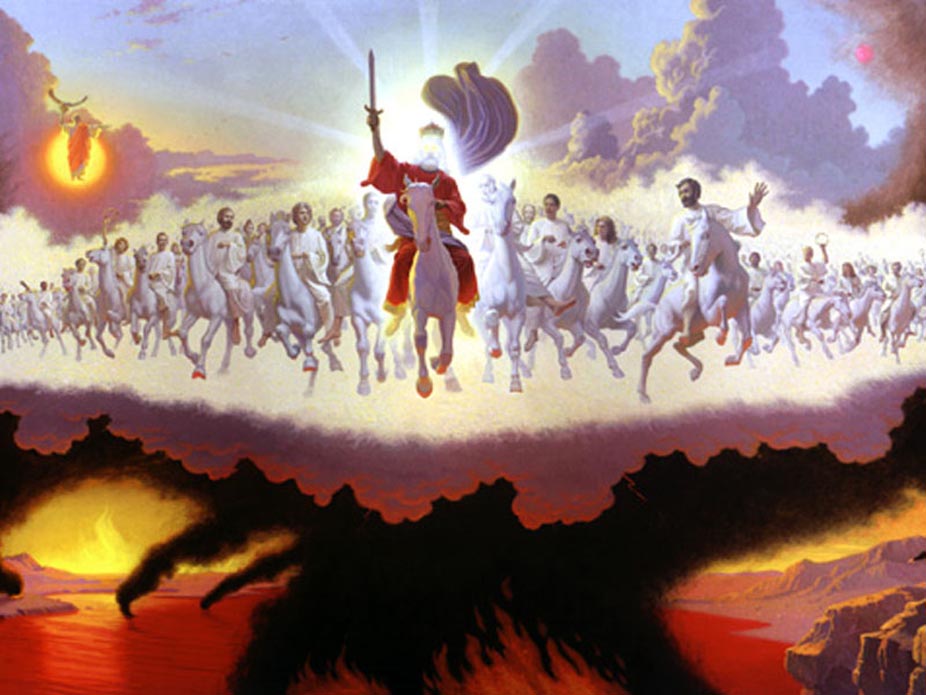
So, the answer to the question is "yes, technology will destroy us." To escape this destruction, you must get into Christ, the ark of safety and deliverance. If you live in the time of Antichrist, you must refuse his mark, even if it means you cannot buy or sell, and may mean your death. Let us be among those who are described in this way:

“And they overcame him by the blood of the Lamb and by the word of their testimony, and they did not love their lives to the death." (Rev. 12: 11)

They loved Christ even though it meant their martyrdom. 

Wednesday, April 27, 2022

Called To Die


The apostle Paul prayed -

"That I may know him, and the power of his resurrection, and the fellowship of his sufferings, being made conformable unto his death." (Phil. 3: 10)

Experiencing the power of Christ's resurrection follows experiencing his death. "Being made" is linear in tense and means "being continually made to conform." It also precedes "that I may know...the power of his resurrection." In other words, if you would know the power of his resurrection and to participate in his sufferings, you must be experiencing his death.

But, what does it mean, practically, to be made "conformable unto his death"? We know what it means to be conformed to Christ (to obtain his character). Paul said: "For whom he did foreknow, he also did predestinate to be conformed to the image of his Son" (Rom. 8: 28). 

To be conformed to the image and likeness of Christ is opposed to being "conformed to this world" (Rom. 12: 2). The work of "being conformed" is also called a being transformed, being a spiritual and moral metamorphosis, involving being "renewed" in "mind." (ibid)  It is a "coming to be" more and more like Christ in character so that one has "the mind of Christ" (I Cor. 2: 16), and "the spirit of Christ" (Rom. 8: 9), and "the heart of Christ." Such a person thinks like Christ, feels as Christ felt, and behaves as Christ. 

Being conformed to his death is a "being made like him in his death." So, how are we like Christ in death? Does that mean we must die by Crucifixion as he? Though many Christians have so imitated Christ by dying as a martyr, even by crucifixion, many have not. Yet, they nevertheless imitate Christ in other ways by experiencing death. Wrote Paul:

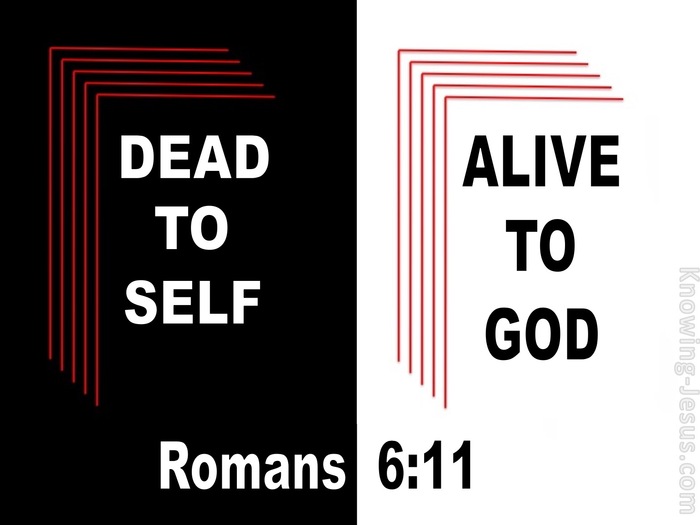
"For if we have been united with him in a death like his, we shall certainly be united with him in a resurrection like his. We know that our old self was crucified with him in order that the body of sin might be brought to nothing, so that we would no longer be enslaved to sin. For he that is dead is freed from sin. Now if we be dead with Christ, we believe that we shall also live with him: Knowing that Christ being raised from the dead dies no more; death has no more dominion over him. For in that he died, he died unto sin once: but in that he lives, he lives unto God. Likewise reckon you also yourselves to be dead indeed unto sin, but alive unto God through Jesus Christ our Lord." (Rom. 6: 5-11)

To be in union with the resurrection life of Christ one must also experience union with his death. In regeneration or new birth the believer dies in one sense and revives in another sense. Paul says that one of the things put to death (mortified or crucified) is the "self," what he calls the "old self." When the self has been put to death by apprehending the death of Christ (in conversion) the person is "alive to God." Where there has been no death of the old self (or "old man") there is no new man, no new self. When the self is alive to itself and to sin and the world, it is dead to God. When the old self rules the heart the sinner is enslaved to sin. When Christ and his resurrection life and power kill the old self, the self no longer has dominion, but Christ has the dominion. Believers are dead to self, dead to sin and the "body of sin", but they are alive to God. This is what it means to be "united with him in a death like his."

Death of Ego (self)

"For I (ego) through the law died to the law that I might live to God. I have been crucified with Christ; it is no longer I (ego) who live, but Christ lives in me; and the life which I now live in the flesh I live by faith in the Son of God, who loved me and gave Himself for me." (Gal. 2: 20)

Of the six times the pronoun "I" is used by Paul in the above words, only two of them are translations of the Greek word "ego." The other times the pronoun is part of the verb. 

Says Vine's NT Words

"I: is the nominative case of the first personal pronoun. The pronoun, "I," however, generally forms a part of the verb itself in Greek; thus luo itself means "I loose," the pronoun being incorporated in the verb form. Where the pronoun ego is added to the verb, it is almost invariably, if not entirely, emphatic. The emphasis may not be so apparent in some instances, as e.g., Mat 10:16, but even here it may be taken that something more of stress is present than if the pronoun were omitted. By far the greater number of instances are found in the Gospel of John, and there in the utterances of the Lord concerning Himself, e.g., Jhn 4:14, 26, 32, 38; 5:34, 36, 43, 45; 6:35, 40, 41, 48, 51 (twice), 63, 70; instances in the Epistles are Rom 7:9, 14, 17, 20 (twice), 24, 25; there are more in that chapter than in any other outside the Gospel of John."

Simply put, when a sinner turns to the Lord in faith, he both dies and is resurrected to life. He dies to self, to the world, to sin. When Paul was converted he says that his "ego," his self, died. Before that time his ego or self was sitting as king of his heart but afterward Christ took that place. In Paul's Roman epistle he wrote:

"I was alive once without the law, but when the commandment came, sin revived and I (ego) died." (Rom. 7: 9) 

The pronoun "I" is from the Greek word "ego." As previously noticed, it is rarely used because Greek verbs included the pronoun in their forms. The exceptions, as in this case, are pregnant with meaning. When a sinner is converted and made to believe the gospel and trust in Christ, his ego is dethroned in his heart and Christ takes the ruling place. Ego dies. The self becomes the "old self," and the self becomes a new self, a new man. A converted sinner becomes what he was not before. 

Taking Up The Cross

"And he said to all, “If anyone would come after me, let him deny himself and take up his cross daily and follow me." (Luke 9: 23)

"For whoever would save his life will lose it, but whoever loses his life for my sake and the gospel's will save it." (Mark 8: 35)

Involved in taking up the cross is the idea of dying to self, of losing one's life, of denying self. This death is a prerequisite for coming to new life. You lose life in order to find life. In this you may then refer to your "old life" and of your "new life." Where there has been no real dying to self, real denial of self, there is no new self or new life. To take up the cross daily is to "die daily." (I Cor. 15: 31) But, as we die daily we are invigorated in our new life.

Things to Crucify

"I have been crucified with Christ. It is no longer I who live, but Christ who lives in me. And the life I now live in the flesh I live by faith in the Son of God, who loved me and gave himself for me." (Gal. 2: 20)

"And they that are Christ's have crucified the flesh with the affections and lusts." (Gal. 5: 24)

What I wrote earlier about the word "ego" (I) applies to the former verse. Ego has been crucified with Christ when the sinner believes in Christ. Ego no longer lives, no longer has sway and dominion, but Christ rules.

Not only is the self, the ego, continuously being put to death (mortified and crucified), but so too "the flesh," especially "with the affections and lusts" of it. Thus, "being conformed to his death" involves such death to the flesh, to the carnal nature.

Christ died to sin. The believer also has died to sin. (Rom. 6: 10) Not in exactly the same sense, however, for Christ dying to sin does not imply any sin of his own (he took on the sins of others). Recall that Paul said:

"Knowing that Christ being raised from the dead dies no more; death has no more dominion over him. For in that he died, he died unto sin once..." (Rom. 6: 10)

Christ did not die to self, to ego, for he had no need in that regard. But, he did die to sin, meaning that the sins he bore were taken away and cast into the sea of forgetfulness. Notice these words of the apostle Peter:

"Therefore, since Christ suffered for us in the flesh, arm yourselves also with the same mind, for he who has suffered in the flesh has ceased from sin, that he no longer should live the rest of his time in the flesh for the lusts of men, but for the will of God." (I Peter 4: 1-2)

Notice how Peter shows how believers are being made conformable to Christ's death. He also wrote, in the same context, these words:

"Beloved, do not think it strange concerning the fiery trial which is to try you, as though some strange thing happened to you; but rejoice to the extent that you partake of Christ’s sufferings, that when His glory is revealed, you may also be glad with exceeding joy." (12-13)

In these words we see how persecution for Christ is a way in which believers partake of the sufferings of Christ. Recall too that Paul said - "Yes, and all who desire to live godly in Christ Jesus will suffer persecution." (II Tim. 3: 12)

Always Dying Yet Always Living

"Persecuted, but not forsaken; cast down, but not destroyed; Always bearing about in the body the dying of the Lord Jesus, that the life also of Jesus might be made manifest in our body. For we which live are alway delivered unto death for Jesus' sake, that the life also of Jesus might be made manifest in our mortal flesh. So then death worketh in us, but life in you." (II Cor. 4: 9-12)

Expositor's Greek Testament gives this excellent commentary on these words (emphasis mine).

"The climax of the preceding antithesis is now reached: “Dying, yet living” (cf. 2 Corinthians 6:9). πάντοτε τὴν νέκρωσιν κ.τ.λ.: always bearing about in the body the dying of Jesus, that the Life also of Jesus may be manifested in our body; for we which live are ever being delivered over to death (cf. 2 Corinthians 11:23 below) for Jesus’ sake, that the Life also of Jesus may be manifested in our mortal flesh. The key to the interpretation of 2 Corinthians 4:10 is to observe that 2 Corinthians 4:11 is the explanation of it (ἀεὶ γὰρ κ.τ.λ.); the two verses are strictly parallel: “our mortal flesh” of 2 Corinthians 4:11 is only a more emphatic and literal way of describing “our body” of 2 Corinthians 4:10. Hence the bearing about of the νέκρωσις (nekrosis - SG) of Jesus must be identical with the continual deliverance to death for His sake. Now the form νέκρωσις (see reff.) is descriptive of the process of “mortification”; and the νέκρωσις τοῦ Ἰησοῦ must mean the νέκρωσις to which He was subject while on earth (gen. subjecti). The phrase περιφέρειν τὴν νέκρωσιν τοῦ Ἰησοῦ conveys, then, an idea comparable to that involved in other Pauline phrases, e.g., “to die daily” (1 Corinthians 15:31), “to be killed all the day long” (Romans 8:36, a quotation from Ps. 43:22), “to know the fellowship of His sufferings, becoming conformed unto His death” (Php 3:10), “to fill up that which is lacking of the afflictions of Christ in my flesh” (Colossians 1:24), the conception of the intimate union in suffering between Christ and the Christian having been already touched on in 2 Corinthians 1:5. And such union in suffering involves a present manifestation in us of the Life of Christ, as well as ultimate union with Him in glory (Romans 8:17, cf. John 14:19). The phrases “if we have become united with Him by the likeness of His death, we shall be also by the likeness of His resurrection,” and “if we died with Christ, we believe that we shall also live with Him” (Romans 6:5; Romans 6:8), though verbally similar, are not really parallel to the verse before us, for they speak of a death to sin in baptism, while this has reference to actual bodily suffering in the flesh. And the inspiring thought of 2 Corinthians 4:10-11 of the present chapter is that Union with Christ, unto death, in life, has as its joyful consequence Union with Christ, unto life, in death. It is the paradox of the Gospel over again, ὁ ἀπολέσας τὴν ψυχὴν αὐτοῦ ἕνεκεν ἐμοῦ εὑρήσει αὐτήν (Matthew 10:39)."

Tuesday, April 26, 2022

What Will Christ's Appearing Mean For You?


"he shall appear to your joy, and they shall be ashamed" 
(Isa. 66: 5)

"Woe to you who desire the day of the Lord! For what good is the day of the Lord to you? It will be darkness, and not light. It will be as though a man fled from a lion, And a bear met him! Or as though he went into the house, Leaned his hand on the wall, And a serpent bit him! Is not the day of the Lord darkness, and not light? Is it not very dark, with no brightness in it?" (Amos 5: 18-20)

To true believers the second coming of Christ will be a time of great thrill and exuberant joy. "He shall appear to your joy." But, to the unbeliever (including pretenders), "he shall appear" to his shame and disgrace, and bring woe and tribulation. 

Let us therefore be diligent to make our calling and election sure. (II Peter 1: 10)

"And now, little children, abide in him; that, when he shall appear, we may have confidence, and not be ashamed before him at his coming." (I John 2: 28)

The appearing of Christ will find two kinds of people and produce different effects upon the two. There will be those who will "have confidence" and those who have none. The former are they who did abide in Christ, and who held firm to a genuine faith and allegiance to him. The latter are they who did not abide, being like the five foolish virgins (Matt. 25) who, having no oil in their lamps, and asleep (when they should have been watching alertly), missed out on experiencing the joy of the coming of the Lord.

Monday, April 25, 2022

Does Faith Cause Regeneration?

The above is the title for Dr. John Piper's remarks on the ordo salutis as respects faith and regeneration. In it Piper argues that the new birth precedes faith. (See here)

I have previously said that Dr. Piper has been wishy washy on this topic but in this posting he comes out very plainly. 

He did a poor job defending the born again before faith view in this posting. The scripture asked about by the inquirer (Col. 2: 12) does in fact teach that we are raised through faith. 

Read the article by Piper and then read what I have written on the subject. See my series (back in December and before) titled "Regeneration Before Faith Proof Texts" and before that (November) on "Justification To Life and Regeneration". The entries on I John 5: 1 should also be looked at. Use the search engine to find postings where I have referred to Dr. Piper in regard to this subject.

Tuesday, April 19, 2022

Urim and Thummim?


I believe the Urim and Thummim were a means of divination, a way to discern the will of God, a means of receiving oracles. There is so much mystery on these stones and how they worked. We do not even know how many stones there were (although many assume two). In a video titled "What is Urim and Thummim?" Dr. Michael Heiser (video here), Old Testament and Hebrew scholar, addresses this subject. It is well worth listening to.

In my mind I have wondered whether "the white stone" promised to believers (Rev. 2: 17) is similar to the Urim and Thummim stones. What think ye? 

Monday, April 18, 2022

Kept Through Great Tribulation


I do not believe in a rapture of Christ before the tribulation, but after it. I believe the rapture of believers occurs at the same time as the resurrection of their bodies. I believe it occurs "at the last trump" (I Cor. 15: 52), after the seven trumpets of the Apocalypse have sounded. I believe that the rapture and resurrection of the just takes place "on the last day," and not seven years before the last day. (John 6: 40) I believe that there is but one additional coming of Christ, a second, and this second coming is singular. There is not a third coming of Christ. Neither can I affirm that the second coming of Christ has two stages, each being called the coming of the Lord. However, I do believe that the coming of Christ a second time, like his first coming, takes in more time than a single twenty four day. 

I believe that the bible gives us signs of his coming, and which would include signs of the coming rapture and resurrection. I believe, as Paul taught, that two things in particular that must occur before the coming again of Christ are "the falling away" and the "revelation or coming of the man of lawlessness," the "son of perdition" (elsewhere called "Antichrist," and "the beast," and "the little horn"). I believe, as Christ taught in his Olivet discourse, that it is "after the tribulation" that Christ gathers together his elect. (II Thess. 2; Matt. 24)

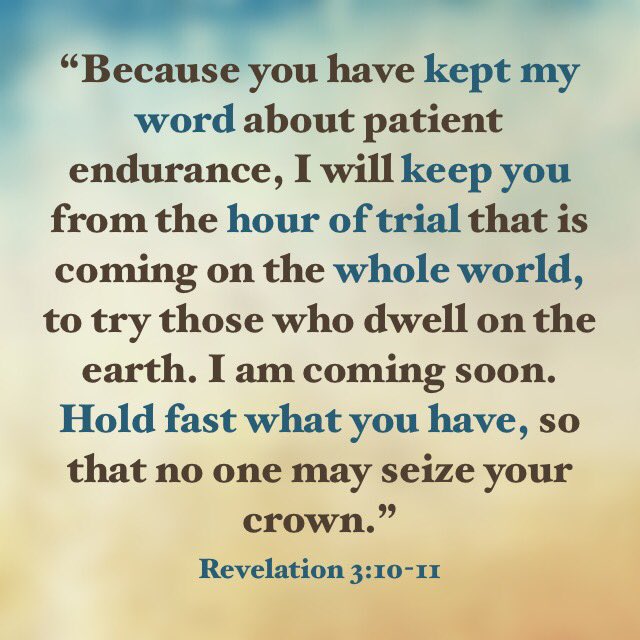
The above words of Revelation 3: 10 speak of "time of great tribulation" that Christ spoke about. This time of great tribulation is alluded to in many prophetic texts. (Dan. 12: 1; Matt. 24: 21; Rev. 2: 22, 7: 14; Amos 5: 18-20) It will come upon all the world and particularly upon the nation of Israel, called the "time of Jacob's trouble." (Jer. 30: 7) It is also called a day of destruction, a day of vengeance and wrath, an evil day. (See my posting on this here) 

This time of testing and trial is for the purpose of revealing who is judged to be wicked and who judged to be righteous. However, in the coming global tribulation the Lord promises that he will "keep from" it those who have persevered as the Lord commanded. To those who believe in a resurrection and rapture of the righteous before the day of great tribulation the words "keep from" means to be removed from the place where those troubles occur. I rather believe that it alludes to being preserved in the midst of those troubles. I believe we have an example of this in the Exodus of the chosen people out of Egyptian bondage. 

The Exodus of the chosen people from slavery in Egypt is a type of the coming Exodus of the elect (from both Jews and Gentiles) from this world (age and condition) to the world to come. Who can deny that the "catching up" (rapture) of believers (in connection with their resurrection) will be a great Exodus? In the story of the Exodus from Egypt God brought a day of evil, a day of wrath and vengeance, a day of great tribulation and judgment, upon the Egyptian people and nation. When did he do this, before or after the departure from Egypt through the Red Sea? Before. The tribulation or day of testing and trial, for both the Egyptians and the Israelites, occurred in the land before Israel's departure. And, what happened? Were the Israelites "kept from" those troubles? Let us see. 

"But I am sure that the king of Egypt will not let you go, no, not even by a mighty hand. So I will stretch out My hand and strike Egypt with all My wonders which I will do in its midst; and after that he will let you go. And I will give this people favor in the sight of the Egyptians; and it shall be, when you go, that you shall not go empty-handed. But every woman shall ask of her neighbor, namely, of her who dwells near her house, articles of silver, articles of gold, and clothing; and you shall put them on your sons and on your daughters. So you shall plunder the Egyptians.” (Exo. 3: 19-22)

Notice that the snatching away of the elect from Egypt (the Exodus) occurred in the midst of the land while still occupied by Israelites. It is only "after" the various judgments (tribulations) have come upon the land of Egypt that Israel exits.

"And I will harden Pharaoh’s heart, and multiply My signs and My wonders in the land of Egypt. But Pharaoh will not heed you, so that I may lay My hand on Egypt and bring My armies and My people, the children of Israel, out of the land of Egypt by great judgments. And the Egyptians shall know that I am the Lord, when I stretch out My hand on Egypt and bring out the children of Israel from among them.” (7: 3-5)

The bringing out of the chosen race was preceded by the judgments upon the land. The judgments were against "the land of Egypt," against the Egyptians, and not against Israel. So too in the coming global tribulation, the great tribulation, the evils sent will be against the wicked inhabitants of the world and not against the Lord's people (although many of them will tested and tried too). Said the prophet:

"And he said, Go thy way, Daniel: for the words are closed up and sealed till the time of the end. Many shall be purified, and made white, and tried; but the wicked shall do wickedly: and none of the wicked shall understand; but the wise shall understand." (Dan. 12: 9-10)

The coming time of tribulation that will come upon all the world will serve to purge the visible professing church of all hypocrites and pretenders. 

"And the Lord said to Moses, “Rise early in the morning and stand before Pharaoh as he comes out to the water. Then say to him, ‘Thus says the Lord: “Let My people go, that they may serve Me. Or else, if you will not let My people go, behold, I will send swarms of flies on you and your servants, on your people and into your houses. The houses of the Egyptians shall be full of swarms of flies, and also the ground on which they stand. And in that day I will set apart the land of Goshen, in which My people dwell, that no swarms of flies shall be there, in order that you may know that I am the Lord in the midst of the land. I will make a difference between My people and your people." (8: 20-23)

I expect this to be the same way it will be in the days of the coming tribulation. God will sever the places where his people live and are gathered together so that they are "kept from" such evils. Notice that the evil of the swarms of flies was intended for the wicked Egyptians, the non elect. 

"Then the Lord said to Moses, “Go in to Pharaoh and tell him, ‘Thus says the Lord God of the Hebrews: “Let My people go, that they may serve Me. For if you refuse to let them go, and still hold them, behold, the hand of the Lord will be on your cattle in the field, on the horses, on the donkeys, on the camels, on the oxen, and on the sheep—a very severe pestilence. And the Lord will make a difference between the livestock of Israel and the livestock of Egypt. So nothing shall die of all that belongs to the children of Israel.” (9: 1-4)

I expect this to be the norm in the tribulation for the genuine believer, although some will be chosen to become martyrs for Christ at that time.

"And the hail struck throughout the whole land of Egypt, all that was in the field, both man and beast; and the hail struck every herb of the field and broke every tree of the field. Only in the land of Goshen, where the children of Israel were, there was no hail." (9: 25-26)

"But against none of the children of Israel shall a dog move its tongue, against man or beast, that you may know that the Lord does make a difference between the Egyptians and Israel." (11: 7)

May the Lord make the same difference with regard to us who will live to see the great tribulation!

When the death angel passed through the land of Egypt, he "passed over" the houses of the chosen people, who were in their houses which they had marked with the blood of the Passover lamb. Let us be "holed up" in our houses (booths or tabernacles) when the day of testing comes and let us make sure that we have had the blood of Christ applied to us. 


"Come, my people, enter your chambers, And shut your doors behind you; 

Hide yourself, as it were, for a little moment, Until the indignation is past. 

For behold, the LORD comes out of His place 

To punish the inhabitants of the earth for their iniquity; 

The earth will also disclose her blood, And will no more cover her slain." 

(Isa. 26: 20-21)


The Exodus

 "The Exodus" refers first and foremost to the "exiting" of the chosen people, Israel, the true "seed of Abraham," from their four hundred years in Egyptian bondage by God through the hand of Moses. This Exodus was both a redemption and a deliverance. It also involved the idea of entering into something else. After all, when one exits one place, he moves to another (enter). Israel exited Egypt, then entered the wilderness, and then finally entered the land of promise. The Exodus is referred to in the new testament in this verse:

"By faith Joseph, when he died, made mention of the departing (the Exodus in Greek) of the children of Israel; and gave commandment concerning his bones." (Heb 11:22) 

The Exodus of Israel was a type of other superior exits. 

First, of the exit of Christ from this world after his death and resurrection.

"Who appeared in glory, and spake of his decease (Exodus) which he should accomplish at Jerusalem." (Luke 9:31) 

Moses and Elijah appeared in glory on the mount of transfiguration and the topic of their conversation with the glorified Christ pertained to Christ's Exodus, the one "he should accomplish at Jerusalem." It was not merely a statement about his death, the departure of his soul into Sheol, or of his body into the tomb, but also of that deliverance which he should accomplish at Jerusalem by his sacrificial death and resurrection. It would also include his Ascension into heaven. Our exit out of a state of bondage to sin and death is accomplished by the Exodus of Christ. His Exodus is our Exodus. 

Second, of the exit of believers from this world by death or by the translation and resurrection (rapture) of believers at the coming again of Christ the Lord.

"Moreover I will endeavour that ye may be able after my decease (Exodus) to have these things always in remembrance." (2 Pet. 1: 15) 

In this passage the apostle Peter calls his "decease" an "Exodus." In death the believer exits this world and enters into the heavenly land of promise. He crosses the Jordan river, which, in Christian jargon symbolizes "crossing over" in death. Death is a "departure." So Paul wrote: "For I am now ready to be offered, and the time of my departure is at hand." (II Tim. 4: 6)

The Greek word for "departure" is "analysis" and means "an unloosing (as of things woven); a dissolving (into separate parts); departure; a metaphor drawn from loosing from moorings preparatory to setting sail." In this respect death, for the righteous, is also a "passing away." 

The Exodus of the children of Israel from Egyptian bondage is also used by the new testament writers to refer to both initial conversion and to an eschatological entering into the new heavens and new earth, the antitype of Eden and the land of Canaan. (See Jude 1, Hebrews 4, I Cor. 10, etc.)

When a sinner is saved, when he believes in Christ, he exits the world (of which Egypt is a type), exits his slave state to sin, and enters into the community of believers. Many Christian hymns sing about this typology. "I have left the land of bondage" they sing. They now "come to mount Zion, to the church of the living God." (Heb. 12: 22) But, it is only after having first "come out," exited, the fellowship of the world. So says the text:

“Come out from among them And be separate, says the Lord. Do not touch what is unclean, And I will receive you.” 18 “I will be a Father to you, And you shall be My sons and daughters, Says the Lord Almighty.” (II Cor. 6: 17-18)

If you are on the road to destruction, the road that leads to death, there is an "exit" provided for you, so that you can get on the road to life, eternal life. (Matt. 7: 13)

Not only is Christ our Passover (I Cor. 5: 7), but he is our Exodus, our means of escape.