Friday, June 10, 2022

WHO ARE THE SEVENTH DAY BAPTISTS?

    Just when I think I've pretty much covered most kinds of Baptists in my studies, I have stumbled upon another kind. This week I spoke with a pastor from the Seventh Day Baptists in Rhode Island. His church is over 300 years old, meeting in the same location as their founding. The church is First Seventh Day Baptist Church of Hopkinton, Rhode Island.

   As I have stated in other articles, it never ceases to amaze me at how many kinds of Baptists there are. The Seventh Day Baptists (hereafter referred to as SDB) are not particularly unique or strange, as they are very orthodox Baptists in all areas. The only major variance is their habit of observing the Saturday Sabbath. This is because they believe the ten commandments should be followed by Christians as part of the moral Law. (As Christians we all believe this, with most believing the "Lord's Day" which is the first day of the week, has now superceded Saturday.) They are quick to point out that sabbath-keeping has NOTHING to do with salvation, and they happily cooperate with other Baptists for missions and fellowship. They are not even legalistic, like the Seventh Day Adventists, about HOW to observe the Sabbath, and do not require individuals to observe any particular standard other than attending public worship. So some may adhere to a strict observance with no tv, games, movies etc. Others may do all of those things with no judgement or exclusion. You will find the same variance among those who worship on Sunday. The Sabbath begins at sundown on Friday, in which most churches will have an evening service, followed by morning service on Saturday morning. 

   Their articles of faith state the things most Baptist confessions state, but they do not mention either predestination or free will. Most are neither Calvinist nor Arminian, much like the Eastern District Primitive Baptists, but some are calvinistic. Their tradition allows for varying views in the atonement, but they believe such thoughts should be held privately, and they abstain from preaching any kind of "ism" from the pulpit. One of their pastors wrote so eloquently by saying "Calvinism is not the Gospel. Arminianism is not the Gospel. The Gospel is the Gospel. And the Gospel says "Christ died for sinners, and all who turn to Him in repentance and faith shall escape condemnation and be saved." They simply leave their soteriology at that.

   Some of their early leaders were James Ockford, William Saller, Peter Chamberlain, Francis Bampfield, and Edward and Joseph Stennett. The first historical documentation of an SDB church is in the year 1650, at the founding of Mill Yard Church in London. Shortly after this time, the first London Baptist Confession was written, and the first time the SDB churches broke fellowship with other Baptists. This was not however due to the fact that the London Confession was calvinistic, but because the churches who adopted it required all individuals in their association to adhere to it.  They never went as far as some other Baptists in declaring non fellowship though, as they accept any Baptist baptism and all baptized by immersion are welcome at the Lord's Table. They observe two ordinances, with feet washing being optional and not considered an ordinance. In December 1671, Stephen Mumford and his wife were joined with five others to establish the first Seventh Day Baptist church in America. SDB's have been prominent in American history. One such man is Samuel Ward (1725-1776) who served as governor of Rhode Island, Chief Justice, member of the Continental Congress  and was supposed to be a signer of the Declaration of Independence, but passed away before he could do so. He was married to the granddaughter of Roger Williams, who founded the first Baptist church in America. Samuel Stennett, a prominent SDB pastor and theologian, had a Doctorate of Divinity from King's College in England, and wrote many hymns, one of which is "On Jordan's Stormy Banks I stand". Just another example of early Baptists who valued higher education and biblical studies.

   The SDB's were missions minded from the outset, sending their first missionaries in the 1760's, but their first united mission society for the promulgation of the Gospel was started in 1843. So much for the notion of the hardshells that no Baptists were involved in missions before the 1830's. Since their history goes back to 1650 at least, there can be no claim that ALL Baptists were like the Old Line Primitive Baptists are now, as many of them claim.

   Another interesting fact, is that musical instruments have always been welcome in their midst. While many of their churches were acapella in the beginning, others were not. Those churches that were, did so because they simply had no instruments. As soon as a church had the funds to buy instruments like organs or pianos, they did so. Even in Colonial America they used stringed instruments in worship. SDB's love music and it is one of their hallmarks, in that they have accepted many styles of music in their history, when many other Baptists did not. Some Separate Baptists joined their churches, before moving further south in the colonies. I believe those Separate Baptists retained this love of music when they left the SDB's and became "Sunday" Baptists. There is some evidence that Shubal Stearns was influenced by the SDB love of music and allowed instruments in his churches, which I will write about at a later date. The modern contemporary Christian music group "Citizen Way" are Seventh Day Baptists.

   In closing let me say that these Seventh Day Baptist brethren are joyful, easy, open and loving. They have a lively faith and wish for nothing more than reaching the lost. The song written by Samuel Stennett, has come to  be of great meaning to me. We sang this many times in my church growing up, and it's lyrics have greater meaning now as I get older. Read these lyrics with me, and see how they convey both a longing for that heavenly home, assurance of salvation, an asking for others to come and join the journey and be saved,and a future home where sickness and death shall be no more. I can't help but shout for joy as I sing this song now! Do you know if you have a home in heaven? Are you sure? Oh who will come and go with me?!!!!!!

1 On Jordan's stormy banks I stand,
and cast a wishful eye
to Canaan's fair and happy land,
where my possessions lie. 

 Refrain:
I am bound for the promised land,
I am bound for the promised land;
oh, who will come and go with me?
I am bound for the promised land.

2 O'er all those wide extended plains
shines one eternal day;
there God the Son forever reigns,
and scatters night away. [Refrain]

 3 No chilling winds or poisonous breath
can reach that healthful shore;
sickness and sorrow, pain and death,
are felt and feared no more. [Refrain]

4 When I shall reach that happy place,
I'll be forever blest,
for I shall see my Father's face,
and in his bosom rest. [Refrain]

Wednesday, June 8, 2022

How old is the gospel?


In all ages the gospel has been preached or disseminated and faith in it has been the means of realizing the salvation which it announces. Though the gospel message has increased in details since it was first announced, its basic elements have remained the same. The importance of understanding this is important in answering the question about the fate of those who die without hearing the gospel. The first persons to find salvation found it through faith in the gospel (Adam, Eve, Abel, etc.), as we will see. 

The gospel is as old as the garden of Eden into which the first man and woman were placed. The promise or prophecy of a savior or deliverer was made by God after the fall of Adam and Eve. In the words spoken to the serpent (who we know to be Satan) there is revealed the essence of the gospel message. That revelation is called by theologians the "protoevangelium." That word simply means "first gospel." 

"And the Lord God said to the woman, “What is this you have done?” The woman said, “The serpent deceived me, and I ate.” So the Lord God said to the serpent: “Because you have done this, You are cursed more than all cattle, And more than every beast of the field; On your belly you shall go, And you shall eat dust All the days of your life. And I will put enmity Between you and the woman, And between your seed and her Seed; He shall bruise your head, And you shall bruise His heel.” (Genesis 3: 13-15)

From this oracle we see a promised savior, one who would defeat the serpent and his seed, who would undo or remedy the damage done by the serpent. It was not merely a prophecy of the serpent's destruction and defeat, but of undoing what he had done, which is the essence of redemption. That is the way Adam and Eve and their children understood the oracle, as we will see. 

The constellation of Virgo, the first sign in the ancient Zodiac (or Mazzaroth - Job 38: 32), elaborates on the protoevangelium as understood by the first family and their immediate descendants. (See my posting here) In that sign a virgin is seen giving birth to the promised deliverer. 

A Promised Savior and Redeemer

The one who would destroy the serpent, and his work and seed, is presented as a savior and redeemer. A redeemer in old testament understanding was a near kinsman. (See our series on Redemption) So in this case, the protoevangelium presents the Redeemer as "the seed of the woman." That fact is pregnant with meaning and significance. One thing that jumps out of that expression is the idea of a person being of the seed (sperma) of a woman. In the bible a child is always the seed of the man. So, "seed of the woman" is highly unusual and therefore significant. It no doubt signifies that the Redeemer would be born miraculously of a virgin. It also gives the promised Redeemer the significant title of "the seed." Until the time of Abraham the promised Redeemer and Deliverer was known as "the virgin's seed," and "the desired one," and "the coming one." From the revelation given later to Abraham by Lord God the woman's illustrious seed became also known at "the seed of Abraham." (Gen. 22: 18)  Wrote the apostle Paul:

"Now to Abraham and his Seed were the promises made. He does not say, “And to seeds,” as of many, but as of one, “And to your Seed,” who is Christ...What purpose then does the law serve? It was added because of transgressions, till the Seed should come to whom the promise was made..." ( Gal. 3: 16, 19)

Jesus said: "Abraham rejoiced to see my day, and he saw it and was glad." (John 8: 56) Also, in Galatians Paul also wrote:

"And the Scripture, foreseeing that God would justify the Gentiles by faith, preached the gospel to Abraham beforehand, saying, “In you all the nations shall be blessed.” So then those who are of faith are blessed with believing Abraham." (3: 8-9)

Not only was the gospel announced in the garden of Eden but was also announced to others after that, such as Seth, Enoch, Noah, and Abraham. Adam no doubt was a prophet and received additional revelation about the gospel and true worship. So too with Abel and Seth. Whatever gospel knowledge they had would have been disseminated by their offspring so that it would have been known by the antediluvian peoples.  

Adam and Eve and their descendants had a basic understanding of the gospel. They believed in a promised Savior and Redeemer. Those who were saved in the days preceding the flood, up to the time of Noah, were saved by hearing of the promised Redeemer and by placing faith in him for salvation. All their hope of redemption from the curse of sin, from the work of the serpent, was in that promised seed, that "one who is to come," or "the coming one." If Adam, Seth, and Enoch (the seventh from Adam) were the ones who drew the constellations, and gave names to them and to their leading stars, then we see that their knowledge of the gospel was quite extensive. But, more on this shortly. First, let us talk about Abel.

The Faith of Abel

"By faith Abel offered to God a more excellent sacrifice than Cain, through which he obtained witness that he was righteous, God testifying of his gifts; and through it he being dead still speaks." (Heb. 11: 4)

We are told by the apostle Paul that "faith comes by hearing and hearing by the word of God." (Rom. 10: 17) He also asked:

"How then shall they call on him in whom they have not believed? and how shall they believe in him of whom they have not heard? and how shall they hear without a preacher? And how shall they preach, except they be sent? as it is written, How beautiful are the feet of them that preach the gospel of peace, and bring glad tidings of good things!" (vs. 14-15)

Since Abel had faith he must have heard the word of God. What word was that? Surely it was the word of the protoevangelium. It no doubt included faith in other oracles that Lord God gave to the first family. Who taught Abel about sacrifices and worship? Abel believed in the promised Redeemer, the one who would be born of a woman, and yet who would be the Lord himself, and who would be wounded in his heel by the Serpent and his seed, and yet thereby crush the head of the Serpent. By offering an animal sacrifice he showed that he understood how the promised Redeemer would save from the fall by himself suffering the penalty announced, which was death. 

The good news concerning the Lord Jesus Christ has been published since the foundation of the world. The ancient first sign of "Mazzaroth" (Job 38: 32), or the Zodiac, tells of the coming of the "seed of the woman" (the Virgin Maiden of Virgo). Virgo has in her right hand the Spica of Wheat or the Seed, and the name of the brightest star in Virgo means "the seed." Jesus, when referring to his coming death, said to the Greeks - "except a corn of wheat fall into the ground and die, it abides alone, but if it die, it brings forth much fruit." (John 12: 24) 

The Virgin in the constellation of Virgo also has in her left hand a "branch" and this is one of the most ancient names of the Messiah or "seed of the woman." (See Isa. 4: 2; 11: 1; Jer. 23: 5; 33: 15) The first Decan of the Virgo constellation is the sign of "Coma" and this word means "the Desired One," and which is also a title of Christ "the seed" in scripture. (See Haggai 2: 7; Dan. 11: 37) The other two Decans also testify of Christ, the divine seed who would be Redeemer, Judge, Shepherd, and be both God and man. So, the gospel revelation is as old as the garden of Eden. 

Prophets Since The World Began

From the following texts we see how the prophets of God have been in existence since the world began, extending back to the first family, and that their prophetic message included information about the coming of the promised Deliverer.

“Blessed is the Lord God of Israel, For He has visited and redeemed His people, And has raised up a horn of salvation for us In the house of His servant David, As He spoke by the mouth of His holy prophets, Who have been since the world began, That we should be saved from our enemies And from the hand of all who hate us, To perform the mercy promised to our fathers And to remember His holy covenant, The oath which He swore to our father Abraham: To grant us that we, Being delivered from the hand of our enemies, Might serve Him without fear." (Luke 1: 68-74)

From this passage of scripture we see how the prophets of God have existed "since the world began" and that they spoke concerning salvation through the promised Savior. 

“Therefore the wisdom of God also said, ‘I will send them prophets and apostles, and some of them they will kill and persecute,’ “that the blood of all the prophets which was shed from the foundation of the world may be required of this generation, “from the blood of Abel to the blood of Zechariah who perished between the altar and the temple. Yes, I say to you, it shall be required of this generation." (Luke 11: 49-51)

Notice how Abel is put in the category of prophets. It was he, along with others, who drew the constellations, and gave them and their leading stars their names. Of course, it was God who gave names to the stars (Psa. 147: 4; Isa. 40: 26), but these were revealed to Adam, Seth, and Enoch who all together gave us the names of the stars and constellations. If one studies the twelve constellations and their associated Decans (minor constellations), beginning with Virgo and ending with Leo, he will see the story of the gospel, and see that those first prophets had great understanding of the gospel. And, all the nations who studied the Zodiac would be instructed in the gospel. See J. A. Seiss's book "Gospel in the Stars."

“Repent therefore and be converted, that your sins may be blotted out, so that times of refreshing may come from the presence of the Lord, “and that He may send Jesus Christ, who was preached to you before, “whom heaven must receive until the times of restoration of all things, which God has spoken by the mouth of all His holy prophets since the world began. “For Moses truly said to the fathers, ‘The LORD your God will raise up for you a Prophet like me from your brethren. Him you shall hear in all things, whatever He says to you. ‘And it shall be that every soul who will not hear that Prophet shall be utterly destroyed from among the people.’ “Yes, and all the prophets, from Samuel and those who follow, as many as have spoken, have also foretold these days." (Acts 3: 19-24)

Again, another statement that the prophets have been since the world began and that all the prophets foretold of the days of Christ.

In the next chapter we will see how this gospel knowledge was disseminated in the antediluvian world and in the world after the flood. 

Sunday, June 5, 2022

The Prophet Job a Type of Christ (iv)


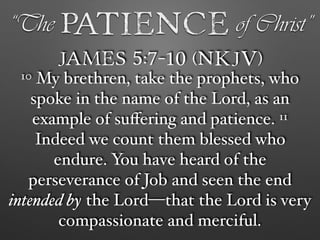
"The Patience Of Jesus Christ"

Revelation 1: 9

Job's Patient Endurance

The patience of Job points to the patience of Christ. James said to the believers "you have heard of the patience of Job." Well may we also say, based upon the words of the apostle John in the Apocalypse,"you have heard of the patience of Christ."

In the above verses from James the word "patience" is twice used (kjv) but come from two different Greek words. The first is from "makrothymia." The Greek word for "patience" in the second instance is from "hypomonē."

Both words include, besides patience, the ideas of steadfastness, constancy, endurance, perseverance. In the NT hypomene is "characteristic of a man who is not swerved from his deliberate purpose and his loyalty to faith and piety by even the greatest trials and sufferings." Strong also says it denotes a "cheerful (or hopeful) endurance, constancy:—enduring, patience, patient continuance (waiting)." 

Makrothymia includes the idea of forbearance (putting up with, or tolerating), longsuffering, and also the idea of fortitude. The New KJV uses the word "perseverance" for hypomene, which is probably the best single word equivalent for it. We may also use the word "endurance." 

Patience is defined as "the capacity to accept or tolerate delay, trouble, or suffering without getting angry or upset." That certainly was exemplified in both Job and Christ. It is also true that patience is consequential from hope and expectation, from faith and belief. So the apostle Paul says "if we hope for that we see not, then do we with patience wait for it." (Rom. 8: 25) He also puts faith before patience when he says it is "through faith and patience" that the promises are realized. (Heb. 6: 12) The patience of Job was great because his faith and hope were great.

Job is famous for his sufferings, yes, but more rather for his patiently enduring those sufferings with grit, perseverance, and fortitude. But, the fortitude of Christ is greater, as the antitype is greater than the type. 

The Fortitude of Christ

"Therefore, since we are surrounded by so great a cloud of witnesses, let us also lay aside every weight, and sin which clings so closely, and let us run with endurance (patience kjv) the race that is set before us, looking to Jesus, the founder and perfecter of our faith, who for the joy that was set before him endured the cross, despising the shame, and is seated at the right hand of the throne of God. For consider Him who endured such hostility from sinners against Himself, lest you become weary and discouraged in your souls." (Heb. 12: 1-3)

Christ Jesus is set forth as an example in patience, in enduring trials and hardships, even as an innocent victim. Job too is an example, but here Christ is set forth as the greater example, a greater than Job. The fortitude of Christ and Job are our examples in patience and perseverance. 

Fortitude is defined as "strength of mind that enables a person to encounter danger or bear pain or adversity with courage." 

This is certainly true of both Job and Christ. Both showed great courage in pain and adversity. There was strength of mind, will, and character in both. They were men of focus and purpose. Think of an athlete who finishes a race in spite of an injury or severe pain. In a good article from Got Questions, in answer to the question "What does the Bible say about fortitude?" (here), the author writes:

"Although the word fortitude is rarely used in the most popular versions of the Bible, the concept is addressed often. Instead of fortitude, the word endurance, strength, or perseverance is used more often in our Bibles. Not only is fortitude a great quality, but we are commanded to pursue it (1 Timothy 6:11; 2 Timothy 2:3; 1 Peter 1:5–6)."

I agree. Fortitude is a good word to include in our list of words to define biblical patience. The same article continues:

"We are also instructed to have fortitude when being disciplined by the Lord (Hebrews 12:7). Rather than become bitter and turn away from God when He takes us through fiery trials (1 Peter 4:12), we are to endure, develop fortitude, and grow in our faith and character to be more like Christ (Romans 8:29). Fortitude is not needed on sunny days at the beach; it’s needed in the storms of life."

In this respect we should consider Christ Jesus as the greatest example of fortitude, to "consider Him who endured such hostility" from his trials and persecutions. He endured the agony of his scourgings, beatings, and death by crucifixion without the least murmur or complaint. These words of Isaiah are applicable to Christ in his agony. 

"I gave my back to the smiters, and my cheeks to them that plucked off the hair: I hid not my face from shame and spitting. For the Lord GOD will help me; therefore shall I not be confounded: therefore have I set my face like a flint, and I know that I shall not be ashamed." (Isaiah 50: 6-7)

The "grit" and fortitude of Christ are affirmed in the above words when it expresses Christ's state of mind as the setting of his face like flint. Dr. John Gill explained the meaning of this, writing:

"hardened against all opposition; resolute and undaunted; constant and unmoved by the words and blows of men; not to be browbeaten, or put out of countenance, by anything they can say or do. He was not dismayed at his enemies who came to apprehend him, though they came to him as a thief, with swords and staves; nor in the high priest's palace, nor in Pilate's hall, in both which places he was roughly used; nor at Satan, and his principalities and powers; nor at death itself, with all its terrors." (Gill's Commentary)

We see this prophesy fulfilled in the life of Christ when Luke writes these words:

"And it came to pass, when the time was come that he should be received up, he stedfastly set his face to go to Jerusalem, And sent messengers before his face: and they went, and entered into a village of the Samaritans, to make ready for him. And they did not receive him, because his face was as though he would go to Jerusalem." (Luke 9: 51-53)

Again, let us cite from Dr. Gill on this.

"or "strengthened his face", as the Vulgate Latin and Ethiopic versions; set his face like a flint, as in (Isaiah 50:7) denoting not impudence, as hardening of the face is used in (Proverbs 21:29) but boldness, courage, constancy and firmness of mind: or "he prepared his face", as the Syriac; or "turned his face", as the Arabic, he looked that way, and set forward; or as the Persic version renders it, "he made a firm purpose", he resolved upon it, and was determined to go to Jerusalem, his time being up in Galilee; and though he knew what he was to meet with and endure; that he should bear the sins of his people, the curse of the law, and wrath of God; that he should have many enemies, men and devils to grapple with, and undergo a painful, shameful, and accursed death; yet none of these things moved him, he was resolutely bent on going thither, and accordingly prepared for his journey." (Gill)

In the new testament the apostle Paul exhorts Christians, "as good soldiers of Christ," to "endure hardness" (II Tim. 2: 3). Certainly Christ, the captain or commanding general, is the great example to his soldiers in regard to such endurance of hardship and trial. He exemplifies that fortitude, courage, and endurance that soldiers need in warring. 

In the OT we see where the Lord many times said to his servants "be strong and of a good courage." (Num. 13: 20; Deut. 31: 6,7,23; Josh. 1 several times, etc.) Certainly the prophet Job showed great strength and good courage during his ordeal. So too did Christ. So should we as his servants. Wrote the apostle Peter:

"For this is commendable, if because of conscience toward God one endures grief, suffering wrongfully. For what credit is it if, when you are beaten for your faults, you take it patiently? But when you do good and suffer, if you take it patiently, this is commendable before God." (I Peter 2: 19-20)

Both Job and Christ are to be highly commended and given credit for they surely, because of conscience toward God, endured great grief, and suffered wrongfully. They took it patiently. 

In both cases, Job and Christ suffered their many ills through the agency of Satan. In both cases Satan was defeated. Neither Job nor Christ were overcome by their adversities. 

This concludes our look at how Job is a picture of Christ. 

Saturday, June 4, 2022

When I Survey

When I survey my writings (in the several blogs) I have come to some conclusions. 

First, I am fairly satisfied with what I have written. Having done lots of reading, especially in theology, I know what good writing is. It reminds me of that hard college course I took in "advanced composition." I compare my writings with those of others. I do not profess to be the best writer but I do not profess to being a novice either. I am satisfied with the content for the most part. I am also satisfied that I have generally written in correct grammar which is something that requires both knowledge and practice. 

Second, I am thankful for those who have read my writings and offered praise and criticism. 

Third, I wish I had acquired a larger audience. I have pondered on the reason for this, asking why some writings (books) have become popular while other good writings have not. Why did "A Purpose Driven Life" become popular? Why did Spurgeon's sermons and writings become popular? Why have other good writings not become popular? I am sure that some of the best writings by servants of God have become buried in oblivion, mostly because they were written by people who are not well known. Of these we may say that they are "unknown, and yet well known." (II Cor. 6:9)

Fourth, when I survey my writings against the Hardshell Baptists I have come to several conclusions. Let me enumerate some of them.

1. My writings on the history of the "Primitive" or "Old School" Baptists have shown that the overwhelming majority of such churches today are not "original" at all, and that what they now believe is not what their forefathers believed. I have shown historical proof for this conclusion. No Hardshell has come forward today with counter evidence to prove that I am wrong. I have shown how they have lied about their history, even distorting on purpose the writings of their forefathers. Elder Crouse did this in the early 20th century in regard to the beliefs of Elder John Clark and the Fulton Convention Hardshells did it in the year 1900 when they perverted the 1689 London Confession of faith. No Hardshell today has ventured to engage us on their history. Wonder why?

2. My writings against their errors on the question of means, from the scriptures, has also not been refuted. Wonder why none have come forward to defend their views and demonstrate where I have misinterpreted scripture? I have produced many texts of scripture that uproot their man made premises and propositions and yet none of them have come forward to refute them. Wonder why?

3. The only response I get from the Hardshells who do read my writings, with the exception of Jason Brown, is to make personal attacks against me. What does this say about them? Thankfully, however, there have been a few who have been helped by my writings and left the Hardshell cult and are happy about it. I only wish that more would come to see their errors.

4. I also conclude that I have done my duty to this cult by witnessing to them. When they stand before God they will be reminded of how they were warned by me and others. 

About my writings in general, when I survey them, I notice the variety of subjects I have written upon. If I published all these writings into books and pamphlets they would be many, very many. I am fairly well pleased with them and sometimes wonder why some have not been more popular. Some examples would be my series on Redemption, on the Weak Brothers, Predestination, Landmarkism, etc. They represent my legacy, my confession of faith. 

I know my remaining days are few, especially since I suffer from several maladies. But, I still feel a need to finish writing on several things. I have hundreds of draft writings. Will they ever get written? 

I thank God for brother Kevin Fralick who has been with me from the beginning of this "Old Baptist" blog and of the addition of brother Kenny Mann. I am also thankful for the support of others through the years, such as Elders Jeremy Sarber and Stephen Emmons. Sometimes when I have gotten discouraged these brothers have come forward with words of encouragement. 

Friday, June 3, 2022

The Prophet Job a Type of Christ (iii)


"He who justifies the wicked and he who condemns the righteous
Both of them alike are an abomination to the Lord." 
(Prov. 17: 15)

Job was falsely accused. So too was Christ. Both were condemned though righteous. Their accusers and condemners were therefore "an abomination to the Lord." Each condemned the innocent and the righteous, and indirectly justified the wicked.

First in the story of Job we find that "the Satan" was his chief accuser. In the Bible Satan is called "the accuser of the brethren." (Rev. 12: 10) "Satan" also denotes an adversary (which all accusers are). The apostle Peter speaks of "your adversary the Devil" (I Peter 5: 8). Peter also wrote:

"Having a good conscience; that, whereas they speak evil of you, as of evildoers, they may be ashamed that falsely accuse your good conversation in Christ." (I Peter 3: 16)

In the previous chapter (post) we saw how both Job and Christ were hated and ridiculed, mocked and persecuted. In this chapter we will focus on how both were innocent and righteous men who were falsely accused. Though Satan was the chief accuser against Job he was not the only one. All four of the men who accused Job were false accusers and were no doubt influenced by Satan. To those men Job was an evildoer, a sinner of the worst kind. So too was Christ accused, as we will see. He too was accused and tempted directly by Satan.

Job Falsely Accused

"Have I sinned? What have I done to You, O watcher of men? Why have You set me as Your target, So that I am a burden to myself?" (7: 20)

Though the word "accuse" is not used in the book of Job, yet the idea is there, as we see in the above words. Like any innocent person would do in the face of a false accusation, Job asks what are the charges against him. He asks his accusers to plainly state their charges and present the evidence to support them. So too did our Lord ask his accusers to do the same. 

"And when he had thus spoken, one of the officers which stood by struck Jesus with the palm of his hand, saying, Answerest thou the high priest so? Jesus answered him, If I have spoken evil, bear witness of the evil: but if well, why smitest thou me?" (John 18: 22-23) On another occasion he asks his accusers: Which of you convicts Me of sin? And if I tell the truth, why do you not believe Me?" (John 8: 46)

In both cases there was no evidence of guilt in either Job or Christ. The blasphemy against Job and Christ was wholly unjustified. In both cases we may say to their accusers - "You have condemned and killed the just; and he does not resist you." (James 5: 6) To his accusers Job said: "I am afraid of all my sufferings; I know that You will not hold me innocent." (9: 28)

Many commentators believe that Job is addressing God in these words. He is the "you" who will not hold Job innocent. In my view it is another example of how the majority view of commentators is not always right. Job believes that God will hold him innocent, will judge him as righteous, and will demonstrate that his sufferings were not the direct result of sin. It makes more sense to see the above words as addressed to those of his three friends who spoke previously to this time (Job chapters 4-8). Eliphaz and Bildad have rendered their judicial decisions about Job's case and they have accused Job of deserving his calamities, and that he was not innocent. The pronoun "you" is second person singular, but this does not necessarily mean the "you" is God. It could be that it is addressed to either Eliphaz or Bildad who both had just spoken. It also could be a reference to them as a single group. 

So too, many in Christ's time likewise had no intention of ever seeing Christ as an innocent sinless man. They thought he was a sinner because he ate and received sinners. They also thought he spoke blasphemy. 

To Job it was said - “There is no end to your iniquities.” (Job 22: 5). What a false accusation! So different too from the description God gives of his servant Job! Eliphaz also says:

“You have given no water to the weary to drink, and you have withheld bread from the hungry. You have sent widows away empty-handed, and the arms of the orphans you have crushed.” (Job 22: 7-8)

This was a false accusation. Job would later respond to it, and to other false accusations, in Job chapter 31. There he says:

"If I have withheld the poor from their desire, or have caused the eyes of the widow to fail; Or have eaten my morsel myself alone, and the fatherless hath not eaten thereof; (For from my youth he was brought up with me, as with a father, and I have guided her from my mother's womb;) If I have seen any perish for want of clothing, or any poor without covering; If his loins have not blessed me, and if he were not warmed with the fleece of my sheep; If I have lifted up my hand against the fatherless, when I saw my help in the gate: Then let mine arm fall from my shoulder blade, and mine arm be broken from the bone." (16-22)

Job did not fail to give water to the thirsty or bread to the hungry. He never failed to help widows and orphans! He denies the unjust accusation. Job's religion was pure religion, and which, as James said, consisted in such.

"Pure religion and undefiled before God and the Father is this, To visit the fatherless and widows in their affliction, and to keep himself unspotted from the world." (James 1: 27)

Job did remember the poor as did the apostles and all true believers. (Gal. 2: 10)

Bildad says to Job - "If you were pure and upright, Surely now He would awake for you, and make the habitation of thy righteousness prosperous." (8: 6) 

On this accusation the Pulpit commentary says:

"If thou wert pure and upright. Job had asserted this, not in so many words, but substantially (Job 6:29, 30). We have God's testimony that it was true (Job 1:8; Job 2:3); not, of course, in the sense that he was absolutely free from sin, but in that qualified sense in which "just," and "righteous," and "pure," and "holy" can be properly used of men. Bildad implies, without boldly asserting it, that he does not believe Job to deserve the epithets, either absolutely or in a qualified sense. If he were so, Surely now he (i.e. God) would awake for thee." 

Does God always come to the rescue of the innocent to save them from harm and false accusation? No, he does not. Does he always deliver the righteous from suffering unjustly and prosper him in this world? No, he does not. As I have pointed out in the series on Elihu's speeches, Elihu and the three senior friends of Job all taught what we call today the "prosperity gospel," teaching that if one is living in the will of God he will be blessed with wealth and health. 

Now let us notice how these same type of false accusations were made against Christ Jesus.

"There was again a division among the Jews because of these words. Many of them said, “He has a demon, and he is mad; why listen to him?” (John 10:19–20)

Jesus the perfectly righteous was accused of being a "demonic" person, full of evil. He was accused of being crazy or insane. Mark also records that "the chief priests accused him of many things" (Mark 15: 3).

"Now the chief priests and all the council sought testimony against Jesus to put Him to death, but found none. For many bore false witness against Him, but their testimonies did not agree. Then some rose up and bore false witness against Him, saying, “We heard Him say, ‘I will destroy this temple made with hands, and within three days I will build another made without hands.’ ” But not even then did their testimony agree." (Mark 14:  55-57)

"Many bore false witness against him." The false accusations made against Job foreshadowed those made against Christ. 

"Then the whole multitude of them arose and led Him to Pilate. And they began to accuse Him, saying, “We found this fellow perverting the nation, and forbidding to pay taxes to Caesar, saying that He Himself is Christ, a King.” (Luke 23: 1-2)

Just as Job was falsely accused and persecuted, so was Christ. So too have his followers been falsely accused and persecuted.

The Suffering Servant

Both Christ and Job may be called "suffering servants of Yahweh." Christ preeminently so, for he is the antitype and Job is the type. The sufferings of Job prefigured the sufferings of Christ. Job was a type of Christ in that he was a righteous innocent sufferer. 

Job underwent a humiliation and exaltation that finds it’s antitype in the suffering and glorious exaltation of the Redeemer. Just as God meant good for Job through his sufferings (Job 42:12), so He meant good for Christ through His sufferings. Jesus is the righteous sufferer who shows forth the righteousness of God. 

"Then the LORD said to Satan, “Have you considered My servant Job, that there is none like him on the earth, a blameless and upright man, one who fears God and shuns evil?” (Job 1: 8; 2: 3; 42: 7, 8)

Christ is greater than Job and of him it may be said in the highest sense "there is none like him on the earth." Of the righteousness, holiness, sinlessness, and moral purity of Christ, there is much testimony in scripture. Confessed Job:

“Oh, that my grief were fully weighed, And my calamity laid with it on the scales! For then it would be heavier than the sand of the sea— Therefore my words have been rash. For the arrows of the Almighty are within me; My spirit drinks in their poison; The terrors of God are arrayed against me." (Job 6: 2-4)

These words may well be applied to Christ. Oh that we would weigh fully the grief and sorrows of Christ, the suffering servant of the prophet Isaiah. Says Isaiah of the Messiah:

"By His knowledge My righteous Servant shall justify many, For He shall bear their iniquities." (Isa. 53: 11)

“Behold! My Servant whom I uphold, My Elect One in whom My soul delights! I have put My Spirit upon Him; He will bring forth justice to the Gentiles." (Isa. 42: 1)

Christ is "the Righteous One," and "the Holy One," and "the Just One" (Acts 3: 14; 7: 52; 22: 14). 

In the new testament there is constant reference to "the sufferings (or afflictions) of Christ" (II Cor. 1: 5; Col. 1: 24; I Peter 1: 11; 5: 1) In the case of Job and of the other suffering prophets there also was "suffering affliction." The time of his sufferings is called the time of "the captivity of Job." (42: 10) In like manner we may speak of "the captivity of Messiah." Turning the captivity of someone in the OT denoted a restoration of lost fortunes. Christ, after his suffering and death, was restored to the right hand of God and to all the joys and heaven. 

The sufferings of Job were in several respects. He had losses. He who was rich became poor even though righteous. So too Christ. Wrote the apostle Paul:

"For you know the grace of our Lord Jesus Christ, that though He was rich, yet for your sakes He became poor, that you through His poverty might become rich." (II Cor. 8: 9)

On the other hand, Christ is superior to Job. Job's losses and sufferings were not a result of his choice, but Christ's were by his choice. 

God treated Job as an enemy for a higher purpose. God the Father forsook Christ and treated him as an enemy in a moment of time when he was seen by God as bearing the sins of the people. So Christ prayed "My God, my God, why have you forsaken me?" (Matt. 27: 46) And so it is also written: "Yet it pleased the Lord to bruise him; he hath put him to grief" (Isa. 53: 10). 

Notice also these words of the prophet:

"I gave my back to those who strike, and my cheeks to those who pull out the beard; I hid not my face from disgrace and spitting. But the Lord GOD helps me; therefore I have not been disgraced; therefore I have set my face like a flint, and I know that I shall not be put to shame. He who vindicates me is near. Who will contend with me? Let us stand up together. Who is my adversary? Let him come near to me. Behold, the Lord GOD helps me; who will declare me guilty?" (Isa. 50: 6-9)

Job said: “God hath delivered me to the ungodly, and turned me over into the hands of the wicked.” (Job 16:11). This would be a fitting summary of what happened when the Savior was crucified, yet it was spoken by Job. Job also said:  “They have gaped upon me with their mouth; they have smitten me upon the cheek.” (Job 16:10) Again, this is another statement by Job that is very applicable to the Savior and to the above words of Isaiah.

We are told that “the Lord turned the captivity of Job, when he prayed for his friends” (Job 42:10), friends who had symbolically crucified him with words. Jesus also prayed for the soldiers who, by military order, had literally crucified him: “Father, forgive them; for they know not what they do.” (Luke 23:34)

In the next posting we will consider the patience of Job and Christ and finish this short series.

Monday, May 30, 2022

"Dia Pistin"


Dr. A.H. Strong wrote (as cited by me here)

because faith, and not repentance or love or hope is the medium or instrument by which we receive Christ and are united to himHence we are never said to be justified dia pistin, = on account of faith, but only dia pisteos, = through faith, or ek pisteos, = by faith. Or, to express the same truth in other words, while the grace of God is the efficient cause of justification and the obedience and sufferings of Christ are the meritorious or procuring cause, faith is the mediate or instrumental cause." 

We are not saved or justified by faith in the sense that faith is the ground or reason of it but because it is the means of receiving it.

Saturday, May 28, 2022

On My Heart Surgery

As I promised in the preceding post "Another Health Update" I will add these thoughts.

The coronary blocked was the main artery and was 99% blocked. This was the one the surgeons put in the stent. I am sure it is a wonder that I am still alive. I have had chest pains off and on for years. The first time I went to the ER was about ten years ago and was taken to Charlotte's main hospital by ambulance from the hospital here in Monroe. The heart doctors there went into my heart and said they saw no reason for my chest pains from my heart, saying it looked good. I was sent home without knowing the reason for the chest pains. 

Over the years I would have chest pains that would come and go, but they began to increase over the past 1-2 years. About a year ago I was having bad chest pains and went to the ER and again they took pictures of my heart, ran an EKG, etc., and concluded it was not my heart. They thought it was from my GERD and either esophagus or ulcers. They sent me home with medicine for that and without any relief from the pain. 

After that my family doctor and I have been trying to figure out what is causing the chest pains. Well, two weeks leading up to my visit to the ER last Sunday I was having chest pains every day, mostly when I did some light work. But I would take a nitro glycerin and put it in my mouth and it often relieved the pain. Sometimes I would have to wait five minutes, take another. If it didn't relieve the pain, I took a third (as prescribed). If this didn't work I would take a hydrocodone/acetaminophen pill. Most of the time this combination would relieve the pain. But, this past Sunday I was relaxed lying on the bed watching the PGA golf tournament when the pains came on and nothing would relieve it. I finally had my step son take me to the ER. I was in the midst of a heart attack. When the EKG showed this, the ER doctor said "your heart is very unhappy." 

They called for me to be air lifted by helicopter to the hospital in Pineville to the cath lab. I did not like that ride at all. Got to the lab and they began to work on me. They gave me morphine and decided to go into my heart through the major artery in my right wrist although they prepped me to go in through my groin. They put in the dye and the blockages showed up. I was awake the whole time and was told to stay still. I had several blockages and they stented the main blockage. The others they said could be treated with drugs and diet and if that didn't work they could put other stents in later. One place is blocked 70%, one blocked 50%, and one blocked 40%. 

After the surgery I was in ICU for a day and then in a private room for a day before being released to go home. The first night I slept little. The second night I slept well. This was because the nurses took out the IV in my right arm so that I could sleep on my right side (normal for me). During the second night I was feeling low and the nurse who cared for me asked "do you mind if I pray for you? I ask all my patients this." I said "oh yes, please do." Well, that was the best prayer I have ever heard from a sister! After the prayer I told her about my Christian faith and we talked about ten minutes about my writings, etc. She said she would check out my blog writings. I have since thanked God for her and asked God to bless her and her ministry. She was no novice and knew the scriptures, and attended a home church. We talked about Job and several other things.

I feel sad that I will not be able to eat food I used to eat. I have also been diagnosed with having diabetes insipidus, a rare disorder totally different from Diabetes Mellitus.* So, my diet now has to be such that I do not clog my arteries and do not eat food with too much sugar. All this is life changing for me. But, my father went through this and he far outlived the normal years people live after heart surgery. He had four bypasses (before the days when stent procedures became the norm). 

While on the operating table I was saying the Lord's Prayer and Psalm 23 over and over. I also breathed out slowly (Vegas nerve exercise to reduce stress).

I believe the Lord kept me alive because he is not finished with me. I have work to do, mainly to care for my wife, but hopefully to keep writing.

Keep me in your prayers if you have a mind.

*Diabetes insipidus (DI) is a rare condition in which the kidneys are unable to retain water, whereas diabetes mellitus is a condition characterized by the inability of the body to produce enough or respond normally to insulin, causing blood sugar (glucose) levels to be abnormally high.

Is Sovereignty Fatalism?

The above is the title of Dr. Richard Trader's post for today (he is a Southern Baptist pastor). In it he wrote (See here):

"Teaching the sovereignty of God without human responsibility leads to fatalism. On the other hand, teaching human responsibility while neglecting God's sovereignty leads to deism, where God is simply not ruling in our world. Then, God is nothing more than a spectator. Neither can ever be acceptable according to Holy Scripture."

Can I get an amen?