Wednesday, July 20, 2022

David Benedict's History (i)


David Benedict was a Baptist minister and historian who lived in the 19th century. He was an observer and chronicler of the Baptists in his day. He was well traveled and a collector of old records. He is the author of several books: 

"The History Of Baptism" 
"A General History Of The Baptist Denomination In America" (1813)
"History Of The Donatists: With Notes" (with Henry Clinton Graves) 
"Fifty Years Among The Baptists" (1847)
Several lessor works

I read both his general history and his fifty years when a young Hardshell minister (and as a Baptist historian since then) the two works for which he is most known. I was told, as a young "Primitive Baptist" minister, in talks about the history of the "primitive" or "old school" church and of the split with the "Missionary Baptists" in 1832 (via "the Black Rock Address"), that David Benedict's book "Fifty Years Among The Baptists" showed that the "Primitive," "Old School," or "Hardshells," were the original Baptists and that the Missionaries were the new party and cause of the schism. Ironically, you can read this book at a "Primitive Baptist" web site (See here). 

However, here is what I have discovered about "Fifty Years Among The Baptist" as it relates to today's Hardshells or "Primitive Baptists" (with some few exceptions, such as in the Eastern District PBs and other smaller groups): 

1. Benedict does affirm that the Baptists in America at the beginning of the 19th century were almost totally Calvinistic, and even Hyper Calvinistic. There are exceptions of course, but they represent the minority.

2. Though most Baptists were advocates for limited atonement (Gillite view), a growing number began to hold to the views of Calvinist preacher Andrew Fuller, who we might call a 4 and 1/2 point Calvinist. This is because he taught that the atonement was for all men, although redemption is particular because it deals with the application of the atonement. Election of certain people effected who would become regenerate but not who the Lord died for.

3. The Gillites were deniers of duty faith and repentance and did not believe in addressing the unregenerate directly. Those agreeing with Fuller espoused duty faith and believed in exhorting the spiritually dead about faith in Christ and repentance. 

4. Both groups, Fullerites and Gillites, were strong Calvinists. It was only in respect to the extent of the atonement and duty faith that there was disagreement.

5. Benedict did not say that the Gillite Baptists (the majority) denied gospel means, or the necessity of faith and repentance for salvation. Their leader, John Gill, believed in means and the necessity of faith and repentance for salvation. Their separation from the Missionary of Fullerite Baptists led them to further extremes, for in the latter half of the 19th century they began to declare the means view, and the duty faith view, to be heresy.

6. When Benedict affirms that most Baptists (outside of the General Baptists) were Calvinistic, even Hyper Calvinistic, he includes Separate, Regular, and United Baptists. He did affirm that as the 19th century progressed, Baptists became less Calvinistic and more Arminian (or less Calvinistic).

Here are some excerpts from his book Fifty Years Among the Baptists along with some observations of mine upon them. (highlighting mine)

"FORTY YEARS AGO large bodies of our people were in a state of ferment and agitation, in consequence of some modifications of their old Calvinistic creed, as displayed in the writings of the late Andrew Fuller, of Kettering, England. This famous man maintained that the atonement of Christ was general in its nature, but particular in its application, in opposition to our old divines, who held that Christ died for the elect only. He also made a distinction between the natural and moral inability of men."

Observations

"Forty years ago" would denote the start of the 19th century (since he published this in 1847). Also, count me a Fullerite in this respect. Though not believing in a general atonement in the same way as Fuller, yet I do believe in some aspects of the death of Christ that were general. I believe that he died "for" all men in some sense, and that he died only for the elect in some sense. I also agree with Fuller (and others who taught the same) that the inability of man, in his total depravity, is not "natural" or physical, but is moral or spiritual.

What Benedict shows, by these historical notes, is that the Baptists were mostly five point Calvinists. Today only a small minority of Baptists are five pointers, or even, like Fuller, a four and a half pointer.

Said Benedict:

"Dr. John Gill, of London, was, in his day, one of the most distinguished divines among the English Baptists, and as he was a noted advocate for the old system of a limited atonement, the terms “Gillites” and “Fullerites” were often applied to the parties in this discussion. Those who espoused the views of Mr. Fuller were denominated Arminians by the Gillite men, while they, in their turn, styled their opponents Hyper-Calvinists. Both parties claimed to be orthodox and evangelical, and differed but little on any other points except these which have been named. On Election, the Trinity, etc., they all agreed."

Observations:

Historians who today study Baptist history, and who find where early 19th century Baptists taught a general atonement like Fuller, should not infer that this must mean they rejected the other four points of the Calvinistic system, such as total depravity, unconditional personal election, and irresistible grace. Since most Baptists at that time soon came to believe like Fulller, we may say that they were four and a half pointers.

The Gillites were stating falsehoods when they accused the Fullerites of being "Arminian." It was a type of slander that has characterized the Hardshells in the 19th century and continues to this day. The Hardshells, once they rejected a belief in means, began to accuse other PBs who believed in means of being "Arminian," because of that one issue. They would also accuse those who supported missions, had Sunday Schools, or musical instruments in the church, also of being "Arminian." Such ignorance!

On the other hand, the Fullerites were right in charging their opponents as "Hyper-Calvinists." Keep in mind, at the start of the 19th century, Hyper Calvinism had not yet evolved to its extremist form of "hardshellism" where all human means, including the gospel, and faith, and repentance, were rejected. Though "Hyper Calvinism" did not originally involve a denial of a general atonement, yet because nearly all Hyper Calvinists believe in limited atonement, it has often been associated with it since. 

Said Benedict:

"In the age when this discussion arose among the American Baptists, as none of the modern subjects of agitation had been introduced into their churches, the speculative opinions thus briefly described, for a number of years were the occasion of unhappy debates and contentions in many locations. Our old Baptist divines, especially those of British descent, were generally strong Calvinists as to their doctrinal creed, and but few of them felt at liberty to call upon sinners in plain terms to repent and believe – the gospel, on account of their inability to do so without divine assistance. They could preach the gospel before the unconverted, but rousing appeals to their consciences on the subject of their conversion did not constitute a part of their public addresses."

Observations

This is a fact of history. Arminianism was repugnant to most Baptists in America at the beginning of the 19th century. Many were in fact Hyper Calvinistic. Again, nothing that Benedict said about the Baptists at that time, in their being Hyper Calvinistic, affirms that they were anti means. As I have shown in my writings here, the Baptists who produced the 1689 London Confession believed in means, in regeneration being by faith, and in supporting missionary and educational institutions. The same with John Gill. It was Andrew Fuller and his supporters who began to turn the Baptists away from Hyper Calvinism. 

Said Benedict:

"In expatiating on the strong points of their orthodox faith they sometimes ran Calvinism up to seed, and were accused by their opponents of Antinomian tendencies. In that age it was customary for many of our ministers to dwell much on the decrees and purposes of God, to dive deep, in their way, into the plans of Jehovah in eternity, and to bring to light, as they supposed, the hidden treasures of the gospel, which they, in an especial manner, were set to defend. In doing this they discoursed with as much confidence as if they were certain that they were not wise above what is written, but had given a true report of the secrets of the skies."

Observations

This still characterizes the Hardshells of today. However, many of the founding fathers of the "Primitive Baptist" church, such as Elder John M. Watson, John Clark, Grigg Thompson, etc., did believe in addressing the spiritually dead and that it was a means in regenerating the elect. Such men did warn their brethren against their Antinomianism.

Said Benedict:

"This extreme of orthodoxy has been followed by laxity and indifference."

Observations

Indeed the ill effects of the Hyper Calvinism of many Baptists, at the beginning of the 19th century, were manifested in the newly formed "Old School" or "Primitive" Baptist sect. One of those ill effects was to deny means in effecting the eternal salvation of the elect, and in refusing to address the lost in preaching, and in creating an "anti mission" and "anti effort" (Antinomian) state of mind. (See my series "Hardshell Antinomianism" in the archives for September 2014) They became lazy and indifferent, "do nothings." 

The twig had been bent towards Hardshellism in the early 19th century and the tree became fully inclined towards greater extremism in the history of the Hardshells for the remainder of the 19th century.

In the next chapter we will conclude our examination of Benedict's "Fifty Years Among The Baptists."

Rightly Reacting To Fearing God

“Then he who had received the one talent came and said, ‘Lord, I knew you to be a hard man, reaping where you have not sown, and gathering where you have not scattered seed. And I was afraid, and went and hid your talent in the ground. Look, there you have what is yours.’ “But his lord answered and said to him, ‘You wicked and lazy servant, you knew that I reap where I have not sown, and gather where I have not scattered seed. So you ought to have deposited my money with the bankers, and at my coming I would have received back my own with interest. So take the talent from him, and give it to him who has ten talents." (Matt. 25: 24-28 nkjv)

That servant who hid his talent in the ground wrongly reacted to the fear he had of his lord.

"By faith Noah, being warned of God of things not seen as yet, moved with fear, prepared an ark to the saving of his house; by the which he condemned the world, and became heir of the righteousness which is by faith." (Heb. 11: 7)

Noah properly reacted to the fear he had of God.

Lesson for us? Let the fear of God move us to obey and serve him with our everything and not move us to stand still and do nothing. How are you reacting to your fear of God? 

Saturday, July 16, 2022

Achilles' Heel of Calvinism?


The Achilles heel of Calvinism (or rather Hyper Calvinism) is the born again before faith teaching. Those who are skilled in their opposition to Calvinism attack the born again before faith view more often because it is viewed as the Achilles heel of that system. It is attacked more often than the system's ideas about sovereignty, predestination, and determinism. Of course, as I have shown, the regeneration before faith view is not the historic view of many leading Calvinists, such as Calvin himself. Still, it has become a commonly accepted belief that all Calvinists and "Reformed" folk believe in the born again before faith view. However, any debates I have had with Arminians do not have such Achilles' heel. I have always affirmed that faith and regeneration occur together and are so joined together that one does not exist without the other. 

Father was a debater and held many debates. When I was a young licentiate he used to give me advice on debating (I took four years of debate in college and was on the debate team). I have since had my own debates. He used to tell me to "go straight to the jugular" in a debate. In other words, attack the main weakness in the error you are opposing, their main argument(s), their jugular. I have tried to do that in debate. I also always had many arguments and proof texts to support my view, and ones to counter my opponent's view, but I generally tried to limit my arguments to a few of the most supporting texts. 

For instance, if the bible expressly says that all things come to pass by the will and decree of God, I will simply affirm what the text says. For instance, I might use this passage:

"Who is he who speaks and it comes to pass, "When the Lord has not commanded it? Is it not from the mouth of the Most High?" (Lam. 3: 37-38)

Or this passage:

"In Him also we have obtained an inheritance, being predestined according to the purpose of Him who works all things according to the counsel of His will, that we who first trusted in Christ should be to the praise of His glory." (Eph. 1: 11-12)

Or this passage:

"For of Him and through Him and to Him are all things, to whom be glory forever. Amen." (Rom. 11: 36)

The same would be true in defending limited atonement. I would select the clearest texts that support that view. It would also be true on the subject of "irresistible grace" or "effectual calling." KISS is not merely a rock group but an acronym for "keep it simple stupid." 

So, what would be the Achilles heel of Arminianism? Would it not be in that Arminians must in the end credit themselves for their salvation? Would it not be in how they say that God gives everyone a chance to be saved? Did he give those who died without ever hearing the word of God a chance to be saved? 

Another possible Achilles heel of predestination (Calvinism) is its supposed incompatibility with moral responsibility. It is at least the objection that is most often made and stressed. In this it is argued that there can be no responsibility where there is no ability. God would be unjust to hold accountable those who could not help doing what they are condemned for doing. 

Those who oppose "theistic determinism" say that it makes God the Devil, for it is the devil, and not God, they affirm, who causes the evil in the world. Therefore, Predestinarians worship the Devil. This is what Norman Geisler has said. But, on the other side, in rebuttal, it may well be said that non predestinarians believe in dualism, in two gods, one who causes all the good and one who causes all the evil.

Non Predestinarians will not accept the idea that God, in any sense, is a "cause" of any evil. They affirm that to believe God is a cause of evil is to indict God and make him responsible for sin, or the culprit. On this point I have written much in my series "Hardshells and Predestination." In those chapters I give my views on predestination and determinism. I am also presently working on a series on "Free Will & Determinism."

I believe in open dialogue and debate. Our Republic, our democracy, demands it. So too does the Christian community. I do not believe in censorship and cancel culture, but with some exceptions of course. Truth can only be generally known by debate, by hearing both pros and cons. 

Friday, July 15, 2022

The Speed Of Things in the Last Days


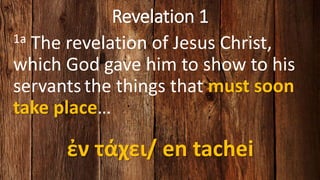
γενέσθαι ἐν τάχει (to take place with speed)

I believe, along with other believers, that there is an acceleration of end time events. Things are speeding up in terms of biblical prophecy. There is so much drastic change occurring in our world in anticipation of the coming Apocalypse of our Lord Jesus Christ. Everything seems to be on fast forward. In the above passage from Revelation chapter one, verse one, this end time speed of things is foretold. Before we look closely at this passage, let me cite from J.A. Seiss, author of that great work "The Apocalypse," about the prophecies of the Apocalypse and Second Coming of Christ. Seiss says in chapter one (See here):

"It is always important for us to be forwarned with regard to the future. It is our nature to be forecasting, and it is one of the necessities of our wellbeing to be able to anticipate with accuracy, at least with regard to the leading things that shall concern us. He who does not shape the conduct of today with reference to some end foreseen or calculated on for some other day, is a mere fool and madman, whether it be in the things of God, or in the things of the world. And in this book we are certified beforehand of what God hath determined concerning the future — what the devout may hope for, what the indifferent and unbelieving have to fear, wherein the true safety and consolation of man is to be found, what tribulations are to come upon the world, and what birth pangs are yet to be passed through to reach that Golden Age of which prophets and poets of all nations and times have spoken."

Amen. With that in mind, let us ask what is meant by "things that must shortly come to pass." (kjv)

"The Revelation of Jesus Christ, which God gave unto him, to shew unto his servants things which must shortly come to pass; and he sent and signified it by his angel unto his servant John." (Rev. 1: 1 kjv)

Soon, shortly, or quickly come to pass, means to happen with speed, haste, swiftness, etc. It is used adverbially in Luke 18: 8 ("en tachei" as in Rev. 1: 1) and means without delay, at once, speedily, rapidly, etc. Tachos is also used in the last chapter of Revelation (22: 6) where it is written "to show to His bond-servants the things which must soon take place." The idea of tachos is better understood as meaning swiftly, speedily, or rapidly. It means that once God begins to act he will move fast and accomplish his purposes in a relatively short time.

The commentators at preceptaustin web page say (See here):

"shortly take place - Shortly is ἐν τάχει [en tachei]. Considerable discussion attends the meaning of this phrase. Three alternatives are before us: 
 
1. The phrase requires all of the events set forth in the book to have transpired within the lifetimes of John’s initial readers (the preterist interpretation). 

2. The phrase denotes events which may be in the distant future, but which transpire in rapid sequence once they begin. 

3. The phrase denotes closeness in time, but from God’s perspective. 

The phrase ἐν τάχει [en tachei] (“shortly”) occurs in the following NT passages: 
 
“he will avenge them speedily” (Luke 18:8) God will avenge His elect who cry out day and night though he bears long with them. 
“Arise quickly” (Acts 12:7) 
“going there shortly” (Acts 25:4) 
“get out of Jerusalem quickly” (Acts 22:18) 
“And the God of peace will crush Satan under your feet shortly” (Rom. 16:20) 
“I hope to come to you shortly” (1Ti. 3:14) 
“things which must shortly take place” (Rev. 22:6+) (after which Jesus says “I am coming quickly” ἔρχομαι ταχύ [erchomai tachy])" 

The question then becomes one of whether it denotes the manner in which events will transpire (rapidly) or the certainty and imminency of the events? I take it to mean the former. If I thought the latter, I would be a "Preterist" and believe all prophecies of the Apocalypse were fulfilled in the first century. But, being a "Futurist," I believe "things which must take place speedily" means that once the prophesied events begin to happen, it will be like dominoes falling. There is a chronology of events given us in the Apocalypse and many err for not following that chronology. Things in the Apocalypse happen sequentially, and once the first event occurs (first domino falling), things happen rapidly, though spanning several years. Though "en tachei" may denote imminency in some contexts, it also sometimes denotes swiftness of action when once the action begins. The context of the Apocalypse shows that the latter is the meaning intended.

Said the same commentators (emphasis mine): 

"Some understand the primary meaning of en tachei in this passage as denoting the manner in which the events transpire: tachy does not mean soon but swiftly. It indicates rapidity of action, as is well seen in its accurate use in the medical compound tachycardia (tachy and kardia = the heart), which does not mean that the heart will beat soon, but that it is beating rapidly. Of course, the swift action may take place at the very same time, as in Mat. 28:7-8 . . .—G. H. Lang, The Revelation of Jesus Christ: Selected Studies (Miami Springs, FL: Conley & Schoettle Publishing Co., 1945, 1985), 387-88."

I agree.

Said the same writer:

"Not only is there a preponderance of lexical support for understanding the tachos family as including the notion of “quickly” or “suddenly,” there is also the further support that all the occurrences in Revelation are adverbs of manner. These terms are not descriptive of when the events will occur and our Lord will come, but rather, descriptive of the manner in which they will take place when they occur.

Both futurists and nonfuturists . . . agree that the idea of tachos here has to do with swiftness of execution when the prophetic events begin to take place. . . . Both certainty and rapidity of action are involved here. Whatever seeming delay there is, action is certain and it will be swift."

Again, I fully agree.

In "REVELATION: THE "DIVINE TACHOMETER" (See here) a writer wrote:
 
"A tachometer is an instrument for measuring speed, revolutions per minute (RPM) displayed on a dial. Tachometer comes from Greek táchos for "speed") and métron for "measure". In short a tachometer measures velocity, how fast a car is going. When the motor is off the tachometer is not moving. But once the motor is turned on the tachometer moves. By the same token, when the events of Revelation begin to take place, they will move speedily. The divine tachometer will be spinning fast. When the first Seal on the scroll is broken by Jesus, the events in the Revelation of Jesus Christ begin to move quickly and irrevocably toward the consummation of this present age in which we now live." 

Amen. My views exactly. Lehman Strauss, bible teacher, says - 

"When the things in this book come to pass, they will "speedily happen." God has borne along with men patiently, and while some ridicule the prophecies of this book, they fail to see that God is longsuffering (2 Peter 3:9+). But the end will come, and when it does it will be marked by suddenness and swiftness. The events will come to pass speedily. Thus the purpose of the Revelation is to show beforehand those things that will speedily happen." (Ibid)

"I tell you that he will avenge them speedily. Nevertheless when the Son of man cometh, shall he find faith on the earth?" (Luke 18: 8)

In closing I repeat the observation - things are happening fast. It can make your head spin and cause anxiety. Yet, they will get even faster. When the first seal of the Apocalyptic scroll is opened, and Christ comes upon his white horse, so too will come his wrath and judgment upon all who dwell upon the earth. What are the first events of the Apocalypse? The coming of the four horsemen of the Apocalypse. Are we beginning to see that now with civil conflicts and rampant murders, famine, and pandemics? If so, then it will get much worse quickly. Let us be prepared, be like the five wise virgins (Matt. 25). 

My series on the Four Horsemen of the Apocalypse are worth reading.

What Is Spiritual Life by Bob Ross


2/25/1935 to 12/13/2020

"The Killing Effects of Hyper Calvinism" 
By Author Bob L. Ross (here)

Here are some comments made by brother Ross in the above book. I agree 100%. When I was a Hardshell I also did not know how the scriptures defined spiritual life. I too saw it as some kind of a "deposit," or some vague thing. Now I see it as coming from the PBs historical roots in "Two Seedism," where the Two Seeders also saw the new birth (quickening) as depositing an eternal child within the "Adam man."

Wrote Ross (all emphasis mine):

"WHAT IS SPIRITUAL LIFE? The answer to this question is actually a refutation of the heresy of the Hyper-Calvinists. Spiritual life, according to the teaching of the Word of God, is a faith-union with God through Christ." (page 10)

Yes, amen. This is what I have constantly affirmed in my writings against Hardshellism. Spiritual life "is a faith union with God through Christ."

Ross wrote:

"But Hyper-Calvinists make spiritual life a sort of spiritual deposit (I prefer to call it “biological” since it has none of the fruits of the Spirit such as love for Christ) which the Spirit makes in men who perhaps have never even heard of Christ, much less have a knowledge of Him. Hyper-Calvinists teach that a heathen person, if he is elect, does not have to learn of Christ or know Christ, for he will be made alive by the Spirit." 

"You see, there is no such thing as spiritual life apart from a union with Christ, and there is no union with Christ, apart from a knowledge of Christ. “He that hath the Son hath life” (1 John 5:12); eternal life is to know God revealed in Christ (John 17:3). To think that a man could have the life of the Spirit of Christ and not know Christ is nothing but heresy. Life is union with Christ. The Bible says that those who know not God do not have life. In fact, the Bible teaches: “The Lord Jesus shall be revealed from heaven with his mighty angels, in flaming fire taking vengeance on them that know not God, and that obey not the gospel of our Lord Jesus Christ” —2 Thess. 1:7,8." (page 11) 

"Christ is referred to as the “Bread of Life.” Without eating of Him “ye have no life in you” (John 6:53). To eat of Christ is to partake of Him through a knowledge of Him, which of course involves faith. Notice, it is not eating of the Spirit that gives life, but eating of Christ. It is through Him that we have life." 

My writings are filled with such proofs from scriptures against Hardshellism.

Ross wrote:

"When the “eyes” of the spiritually “blind” are opened they immediately see Christ. “The people which sat in darkness saw great light,” and that Light was Christ the Light of the World. When men are given life God commands the light to shine out of darkness to give the knowledge of Christ (2 Cor. 4:6). It is every one that “seeth” the Son who has everlasting life (John 6:40). The one who believes on Christ does not abide in “darkness.” (John 12:46). So the life of the Hyper-Calvinist is wholly different from the life in Christ." (page 11)

"We could go on with the many Scriptures that bear upon this subject, but too many will simply make our article overloaded. So we leave these before the reader with the assurance that the error of the Hyper Calvinist as to spiritual life is clearly seen. Life is not a biological or even a spiritual deposit made by the Holy Spirit, but a spiritual union with Christ brought about by the Spirit of God shedding abroad the knowledge of Christ in the heart." (pg. 11) 

"As we have before said, the reason Hyper-Calvinists have a heretical position toward the Gospel is because of their idea of spiritual life. If life is some sort of biological or spiritual deposit from the Holy Spirit without, apart from, and before the use of any means, then of course it is wrong to think that a medium of revelation or a means of the knowledge of Christ is needed. But if eternal life is what we contend— knowing God as revealed in Christ —then a medium of revelation is necessary. In other words, God must give some kind of revelation to man whereby he can know Christ. The Gospel, or glad tidings, of redemption through Christ must be revealed to man some way." (page 12)

Amen. My view exactly. 

Thursday, July 14, 2022

Waldenses Were Not Hardshell


2/25/1935 to 12/13/2020

"The Killing Effects of Hyper Calvinism" 
By Author Bob L. Ross (here)

When I was with the Hardshells I heard them claim that their Landmarker genealogy included the Waldenses of the middle ages. That they believed in many things Hardshell Baptists believe, like other Baptists, is not denied. However, I have never seen a citation from those ancient brethren where they affirmed the basic peculiarities of Hardshellism. In fact, the following citations from brother Ross shows that they denied Hardshellism and their anti means view.

"Article ten of an old Waldensian Confession: “They believe moreover that no man can attain true faith, unless he hear the Word of God, according to that of Paul. Faith comes by hearing, and hearing by the Word of God.” 

Another Waldensian Confession says, “We are united with Christ, and made partakers of all His benefits by faith, trusting and confiding wholly to those promises of life which are given us in the Gospel.” (page 9)

Now, if our Hardshell brothers can show us where they said differently, we would like to see it.

Tuesday, July 12, 2022

Bob L. Ross on Hyper Calvinism


2/25/1935 to 12/13/2020

"The Killing Effects of Hyper Calvinism" 
By Author Bob L. Ross (here)

"THE Bible is a dangerous book! That may sound rather strange, yet Peter plainly says in our text that some wrest the Scriptures, to their own destruction. And human experience reveals this to be so: many go to hell, stumbling over verses of Scripture which have been perverted, twisted, distorted, misapplied, and misused. Sadly, yet to many, the Bible is only a means of heaping condemnation upon condemnation. As Paul said of the Gospel, it is the “savour of death unto death” (2 Cor. 2:16).

The doctrines taught in the Bible relating to the sovereignty of God, referred to in religious circles as “Calvinism,” also as “the doctrines of grace,” are doctrines of the Book that are the occasion for many people “choking” on the Word. The misuse and abuse of these doctrines will deaden and kill. Babes in Christ, unless taught properly, most likely will rebel against these truths, else be misled and their spiritual lives twisted. We know nothing so deadening to spirituality as to run into hyper-Calvinism as a result of a distorted faith regarding the sovereignty of God and related doctrines.

Hyper-Calvinism and the misuse of Calvinism will kill a number of things in the Christian, in the preacher, and in churches." 

I wish all Hyper Calvinists, and all Hardshell Baptists, would read this excellent booklet (which is available in pdf at the web page above).

C.H. Spurgeon on The 1689 Baptist Confession of Faith


On this old confession of faith Charles Spurgeon said:

“This ancient document is the most excellent epitome of the things most surely believed among us. It is not issued as an authoritative rule or code of faith, whereby you may be fettered, but as a means of edification in righteousness. It is an excellent, though not inspired, expression of the teaching of those Holy Scriptures by which all confessions are to be measured. We hold to the humbling truths of God’s sovereign grace in the salvation of lost sinners. Salvation is through Christ alone and by faith alone.” (As cited here)

I agree.