Thursday, August 1, 2024

Beliefs about the Afterlife (LXXIV)


Beginning with this chapter we will look at what the scriptures teach about the resurrection of the dead. Throughout the previous seventy eight chapters I have made some remarks on the subject by way of anticipation. In the immediate several chapters we looked at the question as to whether the resurrection bodies, especially of the saints, will be male or female, and I have taken the position that the bodies of the resurrected saints will not have any body parts that no longer serve any purpose or use. I also spoke of how saints not having male and female parts, such as genitalia, female breast, ovaries, and wombs, etc., is implied in the words of Christ about them not marrying, which implies that there is no sex and reproduction. I also argued that such reproductive parts would not only be unnecessary but would be a hindrance to the joy of Paradise and therefore would not exist. 

I argued against those who say that the genitals remain for beauty or adornment or for some other such reason and that such arguments were untenable. I failed to mention the question of whether those resurrected in the resurrection of the unjust or unrighteous would have genitalia and reproductive organs. Surely they will not either. If they did, what would keep them from using them in Hell and bringing some pleasure to their time in the prison of Gehenna?

I plan to establish the fact of the resurrection from the old testament scriptures first, followed by looking at what the new testament scriptures say about it. Once we have established the fact of the resurrection, we will then first look at the kind of bodies that the resurrected ones will have, both of the righteous and of the wicked.

Resurrection in the Old Testament

We begin by asserting that there is a difference between a temporary resurrection, or bringing back to life, and a permanent resurrection which involves a drastic change in the body. In the old testament there were several persons who were raised from the dead. Here is the short list of them:

1. Elijah raised the son of the Zarephath widow from the dead (1 Kings 17:17-22). 
2. Elisha raised the son of the Shunammite woman from the dead (2 Kings 4:32-35). 
3. A man was raised from the dead when his body touched Elisha’s bones (2 Kings 13:20, 21).

The writer of the Hebrews epistle speaks of them when he said that by faith "Women received their dead raised to life again." (Heb. 11: 35 nkjv)

These were indeed resurrections but not of the same kind as will be experienced by those who are resurrected in the end time resurrection of just and unjust. For one thing, they were not permanent as all the ones resurrected by Elijah and Elisha died again. Also, there was no change in the body; what was raised to life was still in every way the same body. There was no glorification of the body in those cases, and no transformation into the kind of body that will be had in the final resurrection, a change that becomes immutable and incapable of dying. In the same context the inspired writer says: "Others were tortured, not accepting deliverance, that they might obtain a better resurrection." (vs. 36) 

By a "better resurrection" is meant that resurrection of the righteous that will occur when Christ returns and translates the bodies of the righteous who are living and the bodies of the righteous who have died. This final glorious resurrection is far better than those temporary resurrections performed by the prophets named above, or of the several resurrections of individuals by Christ and his apostles in the new testament. How is it better? It is better for the reasons enumerated above. Of that better resurrection Christ says "neither can they die any more" (Luke 20: 36), a thing which is not true of those temporary resurrections of the prophets, apostles, and of Christ. Here are those resurrections in the new testament:

1. Jairus' daughter (Mark 5:21–24) 
2. The son of the widow of Nain (Luke 7:1–17) 
3. Lazarus of Bethany (John 11:17–44)
4. Resurrection of Tabitha/Dorcas (Acts 9:36–42) 
5. Resurrection of Eutychus (Acts 20:7–12)

We can also refer to two other resurrections, but a discussion of them will perhaps come later.

1. Resurrection of unknown saints during the crucifixion (Matt 27: 52–53) 
2. Resurrection of the Two Witnesses (Rev 11: 7–11) 

There is some debate about whether the resurrection of the bodies of the saints in Matthew (above) was a temporary restoration to life or a permanent resurrection of the nature and kind of the end time resurrection of the righteous. 

The Fact of the Resurrection

In the oldest book of the Bible, the prophet Job testified of his faith, saying:

"For I know that my Redeemer lives, And He shall stand at last on the earth; And after my skin is destroyed, this I know, That in my flesh I shall see God, Whom I shall see for myself, And my eyes shall behold, and not another. How my heart yearns within me!" (Job 19: 25-27 nkjv)

This cannot be spiritualized to mean a non physical spiritual resurrection. Job believes in a resurrection of his skin and flesh, that is, of his physical body. It is with his physical eyes that he will see God and his Redeemer who will "stand at last on the earth," which tells us when this resurrection of the righteous will occur. Were it a resurrection of the spirit, and not of the body, denoting rebirth, or a quickening, it would be a continuous resurrection, for people are being quickened into divine life every day when a person is converted. Further, Job was already in possession of a resurrected life in the spirit when he uttered those words and yet the resurrection he "yearns" for has not yet been experienced. Also, it is a resurrection that occurs after he has died and his flesh and skin have been destroyed. 

The prophet Daniel also testifies to the resurrection of the dead. He wrote:

"And many of those who sleep in the dust of the earth shall awake, Some to everlasting life, Some to shame and everlasting contempt." (Dan. 12: 2 nkjv)

Again, these words cannot be made to be allegorized so as to speak of spiritual resurrection. "Those who sleep in the dust of the earth" refers to dead physical bodies. Notice also how the text speaks of a two-fold resurrection, one of the righteous and one of the unrighteous. As we have before seen, in earlier chapters citing Revelation chapter twenty, these two resurrections do not occur together at the same time. A thousand years separate the two, with the resurrection of the righteous occurring first, and so we hear the words uttered "blessed and holy is he who has part in the first resurrection. Over such the second death has no power..." (20: 6); And, "but the rest of the dead did not live again until the thousand years were finished." (Vs. 5) 

There are other arguments to show this truth. For instance, the resurrection of the justified ones is said to be "out from among the dead," which language shows that some of the dead exit not the state of dead, these resurrected being the unjustified, who must wait another thousand years to be raised. 

By "resurrection unto everlasting life" is meant the full enjoyment or reception of eternal life in every respect, in body, soul, and spirit, and in state or place. It primarily refers to the body's becoming possessed of eternal life and immortality. On the other hand, by "resurrection to shame and everlasting contempt" denotes not becoming extinct, or annihilated, but to receiving punishment in body as well as in spirit and soul. On this we will have more to say later.

Other old testament texts which speak of the resurrection of the body will now be considered. Isaiah wrote:

"On this mountain the LORD of hosts will make for all peoples a feast of rich food, a feast of well-aged wine, of rich food full of marrow, of aged wine well refined. And he will swallow up son this mountain the covering that is cast over all peoples, the veil that is spread over all nations. He will swallow up death forever; and the Lord GOD will wipe away tears from all faces, and the reproach of his people he will take away from all the earth, for the LORD has spoken." (Isa. 25: 6-8 nkjv)

The apostle Paul alludes to this passage in his great discourse on bodily resurrection in the fifteenth chapter of his first letter to the Corinthians, which we will examine in detail in upcoming chapters. Isaiah also records these words of inspiration:

"Your dead shall live; Together with my dead body they shall arise. Awake and sing, you who dwell in dust; For your dew is like the dew of herbs, And the earth shall cast out the dead." (Isa. 26: 19 kjv)

What could be clearer about the fact of the resurrection of the dead? Again, this language cannot be accepted as figurative. No, it is literal and pertains to the physical body. "Dead body" of the dead "who dwell in the dust." So, why did many Jews in the time of Christ deny the resurrection of the body, as did the Sadducees? We will address that question shortly when we discuss these resurrection deniers.

Now let us notice some clear proof texts from the Psalms. Said king David, speaking as a prophet of God:

"I have set the Lord always before me: because he is at my right hand, I shall not be moved. Therefore my heart is glad, and my glory rejoiceth: my flesh also shall rest in hope. For thou wilt not leave my soul in hell; neither wilt thou suffer thine Holy One to see corruption." (Psa. 16: 8-10 kjv)

Again, we notice how this is a clear and easily understood affirmation of the resurrection of the body. "My flesh shall rest in hope." The resurrection of the body, in which it becomes an immortal spiritual body, without defect or possibility of disease or death, is a thing highly anticipated by believers in scripture.

"This their way is their folly: yet their posterity approve their sayings. Selah. Like sheep they are laid in the grave; death shall feed on them; and the upright shall have dominion over them in the morning; and their beauty shall consume in the grave from their dwelling. But God will redeem my soul from the power of the grave: for he shall receive me. Selah." (Psa. 49: 13-15 kjv)

By "in the morning" we are to understand the morning of the last day, the day wherein the righteous dead will be raised, and together with the translated living saints, made immortal and given eternal life in their new bodies. This is when the bodies of the saints will be "redeemed" from "the power of the grave." It will occur in the morning of that day when "the sun of righteousness arises with healing in its wings," the Lord Jesus Christ being that sun. (Mal. 4: 1)

"You, who have shown me great and severe troubles, Shall revive me again, And bring me up again from the depths of the earth. You shall increase my greatness, And comfort me on every side." (Psa. 71: 20-21 kjv)

This is another reference to the resurrection of the righteous dead in the old testament. It is also connected with that time when the Lord will "increase" the "greatness" of his people, a thing we will be writing about in upcoming chapters in this subsection. It will also occur in conjunction with the saints being "comforted on every side." 

We also see the resurrection of the dead in the story of Ezekiel and the valley of dry bones being brought back to life. (Chapter 37) Then there is also a picture of resurrection in Jonah's experience in the belly of the giant sea creature. It is also pictured in Aaron's rod (staff) that budded (Numb. 17). A dead piece of wood living again and bringing forth fruit!

In the next chapter we will begin a look at what the new testament testifies about the resurrection of the dead.

Tuesday, July 30, 2024

My Title Clear


"Now faith is the substance of things hoped for, the evidence of things not seen." (Heb. 11: 1 KJV)

Wuest translates as: "Now faith is the title deed of things hoped for, the proof of things which are not being seen." 

The commentators at Precept Austin (here) say:

"Hupostasis is a very common word from Aristotle on and was used in Greek to describe that which stands under anything such as a building, a contract, a promise. It is common in the papyri in business documents as the basis or guarantee of transactions or with the meaning of a title deed. Thus one translation renders it "Faith is the title-deed of things hoped for."

A T Robertson on hupostasis: "It is common in the papyri in business documents as the basis or guarantee of transactions." 

There is a thing in law called "Evidence of Title." One legal source defines it as:

"Evidence of title refers to the means by which the ownership of land is satisfactorily demonstrated within a given jurisdiction. It is a legal proof that shows who owns a piece of land or property. There are different types of evidence of title..." (here)

Another text that alludes to this title is this:

"He came to that which was his own, but his own did not receive him. Yet to all who did receive him, to those who believed in his name, he gave the right to become children of God— children born not of natural descent, nor of human decision or a husband’s will, but born of God." (John 1: 11-13 NIV)

By "right" we can also see "title deed." 

A song I heard for the first time a few years back has these lyrics:

1 My name is in the book of Life, Oh, bless the name of Jesus; I rise above all doubt and strife, And read my title clear. 

Refrain: I know, I know, My name is there; I know, I know, My name is written there.

2 My name once stood with sinners lost, And bore a painful record; But by His blood the Savior crossed, And placed it on His roll. [Refrain] 

3 Yet inward trouble often cast, A shadow o’er my title; But now with full salvation blest,1 When I can read my title clear To mansions in the skies, I'll bid farewell to every fear, And wipe my weeping eyes. Praise God! it’s ever clear. [Refrain]

Attorneys and title companies know what it means to have a "cloud" or "shadow" on a title. AI says this about clouds on titles:

"A cloud on title, also known as a title defect, is an irregularity in a property's title chain that could make a reasonable person hesitant to accept the title. These irregularities can be claims, encumbrances, documents, or unreleased liens that could impair or invalidate the title. Clouds on title can be caused by a number of things, including: 

Easements or mortgages on the land 
Deed or lien defects 
A dead person's name on the title 
Foreclosure 
Fraud, such as recording a forged deed."

The song may be heard (here).

Only a genuine faith and trust in the true and living God and in his Messiah, Jesus Christ the Son of God, is a clear title without any clouds on it. 

Another good song about this title deed of believers is titled "I hold a clear title." It's lyrics read as follows:

I've heard people talk about heaven and describe its beauty so rare 
So one day I purchased a title to a mansion in that land so fair 
It was given to me without money but it cost my dear Savior His life 
He died on the cross just to save me For me he paid a great price 
 
Now, I hold a clear title to mansion that Jesus has gone to prepare... 

My deed was both signed and recorded the day Jesus saved me from sin...

The Happy Goodmans sing it (here).

Another song is titled "When I Can Read My Title Clear" and is well sung by Michael Lining (here). It was written by Isaac Watts in 1707. 

Friend, do you have a clear title to what God has promised to those who believe? Faith is that title. Make sure your faith is rightly placed in God and in his word and that it is real.

Sunday, July 28, 2024

Beliefs about the Afterlife (LXXIII)


In this chapter we will conclude our sub series on the question of whether there will be male and female bodies in the resurrection of the saints. We will look further into the meaning and ramifications of Galatians 3: 28 in this chapter and observe what some other bible teachers have said on that verse and that question. Following this chapter we will begin a look at what the scriptures teach about the resurrection bodies of both the righteous and the unrighteous. 

Following that we will look at some other aspects of life in the eternal ages that follow the resurrection of saints at the second coming of Christ. We will look at how the millennial age will see the full realization of the new covenant and its effects on the ongoing race. We will also look at what is meant by "the powers of the world to come" (Heb. 6: 5) and look at the kinds of power and supernatural gifts that the resurrected and glorified saints will possess. We will also discuss the psychological changes and transformation of nature that must exist in order to insure that there will be no longer any possibility of sin or losing eternal life and salvation, and what is integral to that question, which is to what extent people will have "free will." We will then close this long book with an examination of some other questions that people have about life in eternity.

Wrote one commentator on Galatians 3: 28 (emphasis mine):

"Many interpreters have read 3:28 as if Paul had written “you are all equal in Christ.” Many have considered 3:28 a “Magna Carta” for a new humanity in which the differences between men and women, slave and free, and Jew and Greek are abolished. Paul the apocalyptic thinker envisions a new age in Christ and his Spirit which invades and abolishes the distinctions of “the present evil age” (1:4). Nevertheless, that change of the eras is not yet fully realized. An “already–not yet” tension characterizes Paul’s thought. Where exactly is the emphasis to be placed? On the “already” side of the equation or on the “not yet”? In 3:28 the apostle is stressing the state of affairs that exists now in Christ. Thus the verse closes “you are all one in Christ”—present tense. Baptized believers are already enjoying these benefits." (Dr. A. Andrew Das commentary - See here)

This commentary alludes to the view which I have been upholding. The elimination of distinctions between male and female, Jew and Greek, bond or free, is not yet fully realized. That equality is in some respects already begun in miniature, but the full realization of that "Magna Carta for a new humanity" is to be realized in the resurrection of the righteous and in the coming of the new heavens and earth.

We see this "already-not yet" thought in several instances in the writings of the Apostle Paul. We see it in the idea of oneness, as we have seen. We see it also in the work of perfection of believers. We see it also in enjoyment of the kingdom of God or Heaven, where some experience of that kingdom is a present reality for believers but yet the full experience of it is yet future. An example of this is in these words of the Apostle John:

"Beloved, now we are children of God; and it has not yet been revealed what we shall be, but we know that when He is revealed, we shall be like Him, for we shall see Him as He is." (I John 3: 2 nkjv)

When a person believes in Christ and is born of God, he at that time becomes made in the likeness of Christ or God likeness. Yet, this likeness is not yet complete, for that awaits the apocalypse (revelation) of Christ, his second coming. 

Also, children of God begin their glorification when they are born again, and it continues to increase as they are further sanctified and live the Christian life and yet full glorification comes when the saints are resurrected. (See II Cor. 3: 18) 

Wrote one writer (See here):

"...some early Christians described a resurrected flesh that lacks sexual desires and is incapable of sexual practices such as intercourse and reproduction.

The question about how resurrected bodies will differ from mortal bodies concerns sexuality. In brief, we will see how for early Christians, sexual acts and desires, and sexual reproduction did not have any place in the resurrection. This difference between the mortal and resurrected spheres produced a set of problems for thinking about and describing not only the relationship between resurrected bodies and sexuality, but also the place of sexuality in mortality. What does it mean to speak of a flesh that does not desire and is incapable of any sexuality? How are sexuality and sexual difference related, if at all, in resurrected bodies? If there is no sexuality, on what basis is sexual difference established?" (“Carnal Resurrection: Sexuality and Sexual Difference in Early Christianity” A dissertation presented by Taylor Grant Petrey; page 4)

So, the question we have been examining about whether resurrected saints will still be male and female or have genitalia is not a new or novel question but has been contemplated and discussed for centuries. I doubt, however, that the average Christian has spent much time investigating this question. Perhaps even many bible teachers, who are not novices, have studied the question. 

Petrey also writes:

"Chapter two discusses Ps. Justin Martyr, who was engaged in a dispute with another set of Christians who denied the resurrection of the flesh, specifically because such a resurrection entailed the resurrection of the genitals. As evidence, these rival Christians pointed to Jesus’ saying that “in the resurrection there shall be neither marrying nor giving in marriage” (Mark 12:18`23, and par.). Ps. Justin argues in favor of the resurrection of the flesh, including the genitals, but insists that these “parts” will be free from sexual desires. He points to the resurrected flesh, including the genitals, as the model proving that it is possible to live a virginal life. He defends morphological sexual difference as a key aspect to validating virginity." (pg. 31)

There is no evidence that the resurrected bodies (what Martyr called "flesh") will have male and female body parts. The only argument for it is to say that it is necessary to retain those distinctions in order for a saint to remain the same person. But, this argument has little weight, as we have previously shown.

Petrey also writes:

"As for the content of this text, we shall see that Ps. Justin argues for the resurrection of the flesh (τῆς σαρκὸς ἀνάστασιν) with all of its “parts,” specifically including the genitals, against some Christians who imagined a resurrection from the flesh, explicitly without the genitals. While all sides agreed that the resurrection would occur, they disagreed about the nature of the resurrection. In this dispute, rival Christian teachings about the resurrection posit different bodies, ones in which sexual difference, sexual desires, and reproduction were central points of debate. Sexual difference is not assumed to be a natural, biological given, but something that must be argued for as something that is essential to one’s identity in resurrected form. Every level of defining the resurrected body, including the substance, the morphology, and the physiology or functions of the body, was in dispute. We shall see that Ps. Justin’s defense of the resurrection of the genitals comes not in the service of a dyadic male female binary as self evident, but rather another alternative entirely of dimorphic bodies which lack (or are free from) reproductive capacities." (Pgs. 36-37)

That is a good summary of the early Christian debate on our question. Again, I lean strongly to the view that the resurrected body of a saint will not have all the parts and characteristics of the body he or she had while they lived on earth. We have already seen how they will not have stomachs, and in some sense not have flesh and blood as they did. 

Petrey also writes:

"The problem with the “parts” is central, so that Ps. Justin reports that the objection to the rising of the “whole” person is that it would entail the rising of the genitals as well." (pg. 40)

But, we have overthrown this reasoning by Justin Martyr. Identity does not entail that the resurrected body be in every respect the same as the natural body. But, of this we will have more to say in the next few chapters.

Petrey also writes:

"The term “parts” functions metonymically here to refer to the genitals, but this notion of the centrality of the “parts” is central to the other thinkers discussed in later chapters as well. Ps. Justin suggests that his opponents say that the resurrected body will not have “parts and portions,” and in this way would lack not only sexuality, but also any morphological markers of sexual difference. In this view, to be “like angels” is to transcend sexual differences marked on bodies." (pg. 41)

The debate over what "parts" of the natural body become part of the spiritual body is the crux of the matter. If we can show how one part is missing from the glorified body, then the whole thesis of Justin and those of his view is overthrown. A person can miss a body part and still be the same person. We have people today who are without certain limbs and organs but this does not mean that they are not the same person. A butterfly comes from a caterpillar but it does not look at all alike nor have the same body parts but it is the same creature, a connection between the two forms of butterfly and caterpillar existing. 

Petrey also writes:

"The connection between the lack of sexuality and the elimination of differences between males and females was one made by other early Christians too." (pg. 41)

So, this debate is not new. It may be new to many of our readers, but it is not a novel question. Further, it is one that many Christians have been curious about.

Petrey also writes:

"Ps. Justin stakes their entire argument for the resurrection of the flesh on the salvation of the genitals. In contrast, his opponents argue that if the genitals will be resurrected, then resurrected bodies would procreate, which is absurd in their view since they associate reproduction with sinful desire and death. For them, the “whole” resurrected body would be raised with its parts and their teleological functions, which seems unsuitable. Just as, for instance, an eye is for seeing, and a nose for smelling, the opponents insist that the genitals are for procreating. For this reason, they do not consider the genitals to take part in the future resurrection." (pg. 44)

So, why it is so important to Justin that the resurrection of the bodies, or the flesh, have the genitals? "The salvation of the genitals"? That is an usual way to express the view of Justin! Notice the argument that asks why are genitals preserved if they serve no purpose and are actually a hindrance to joy?

Petrey also writes:

"Ps. Justin characterizes his opponents as rejecting the resurrection of the flesh because the flesh is problematically bound up with sexuality, including desires and reproduction. Rather than defend desires and reproduction as part of God’s created order, or as ordained for mortality, Ps. Justin actually shares his opponents’ negative views of sexuality, but not their vision of the angelic body lacking sexual difference. He consistently praises models of those who are free from desires and reproduction, such as virgins. Virgins exemplify the highest values with respect to sexuality." (pg. 44)

Are genital parts essential to being "flesh"? As we will see, the apostle Paul says that there are all kinds of "flesh." (See I Cor. 15: 39-40) Both the caterpillar and the butterfly are flesh, or physical bodies, and yet they do not look anything alike.

Petrey also writes:

"Ps. Justin looks to mules, who like virgins, do not reproduce despite possessing genitals as examples of what resurrected bodies will be like." (pg. 46)

So, Justin thinks that resurrected saints will be like mules? That they will have genitalia that they cannot use? I don't see why this view is so attractive to Justin and others.

Under "Conclusion" Petrey wrote: 

"In both Ps. Justin and his representation of his opponents’ materializations of  the resurrected body, the human being is depicted as desexualized. For their views  of the non sexual resurrected body, they turn to the saying of Jesus that “in the  resurrection there shall be neither marrying nor giving in marriage.” What they disagree on is what “parts” constitute the human being who shall be raised. In his  emphasis on the resurrection the flesh as a resurrection of the “whole” person  including the genitals, Ps. Justin’s definition of the “whole” is necessarily selective  because it excludes sexuality. For Ps. Justin, the resurrected body consists of flesh, but a flesh that is quite different from the flesh that his opponents imagine. They  imagine a flesh that is full of weakness, imperfections, and desire. Such a substance  is not possibly worthy of the heavenly realm. Ps. Justin agrees with this evaluation  of sexuality, especially desire and reproduction, as a problem that impedes salvation. Yet, he is committed to the salvation of the flesh. As a solution, he  constructs a flesh without desire that is not only characteristic of the resurrection,  but also which can also be achieved “before the coming age.” (pg. 65-66)

It may be true that resurrected saints will have all their male and female parts, but I don't think so for the several reasons stated in this current section of chapters. I rather believe that the resurrected saints will be neither strictly male nor female. Some have pointed out that Adam had genitals surely before he had Eve as his wife. But, surely it was in anticipation of his having a wife. It could also be said that Adam also had Eve the female as part of him prior to her being taken from him. So we read:

"For the man is not of the woman: but the woman of the man. Neither was the man created for the woman; but the woman for the man. For this cause ought the woman to have power on her head because of the angels. Nevertheless neither is the man without the woman, neither the woman without the man, in the Lord. For as the woman is of the man, even so is the man also by the woman; but all things of God." (I Cor. 11: 8-12 kjv)

In the above text Paul uses two words that mean a male, being "aner" and "andros." He uses them interchangeably. The female was once part of the male and not vise versa. 

Besides Petrey, another writer who has examined the history of the debate on this question may be seen in the treatise "The Monastic Ideal and the Glorified/Spiritual Resurrection Body: An Exercise in Speculative Theology" by Aaron Raverty (See here). He writes (emphasis mine):

"The nature of glorified spiritual body that human beings will take on (according to Christian tradition) in their post resurrection existence remains a fascinating mystery. The meager biblical data suggest that our biological integrity will be maintained insofar as we will still be recognizable in terms of our previous earthly identity, but that we will also be changed. Jesus himself was mysteriously transformed after his resurrection, and he was not always immediately recognizable even to his closest followers (John 20:14; 21:4; Luke 24:16, 37). Can we speculate about the ultimate nature of glorified, spiritual, post resurrection bodies by extrapolating from our current human biological condition? I believe we can gain some insight into our post resurrection bodies by examining the gendered agency of the monastic life."

The celibate or monastic life does in some respects picture that condition of resurrected saints as I have previously observed. However, affirming this does not equate to retaining the male and female reproductive parts. 

Citing Luis Ladaria, the same writer says:

"According to Tertullian, “[genitals] will have no function in the resurrection, but they will survive for the sake of beauty.”

Again, I find that hard to believe for the reasons I have already mentioned. I do not believe, per scripture inference and deduction, that the resurrected saints will have body parts that serve no function.

Raverty says, citing Bynum:

"It is noteworthy that early Christian commentators provided little reflection on the gendered nature of the resurrection body. “With the partial exception of Jerome . . . the most materialistic of fourth and fifth century writers on bodily resurrection do not focus on maintaining distinctions owing to gender . . .” On the face of it, why should eschatological gender distinctions of masculinity and femininity divide monastic agents at all?"

In the next chapter we will begin a more detailed look at the nature of the resurrected and glorified bodies of the saints. 

Wednesday, July 24, 2024

Beliefs about the Afterlife (LXXII)


In the previous chapters we have seen how those resurrected in the resurrection of the just (or righteous) will not marry and not have sexual intercourse or procreate. We also observed how this was not true of the nations of the ongoing human race. We also gave our opinion that the bodies of the resurrected saints will no longer be strictly male or female, especially in body. They will not have male and female genitalia or body parts as they will no longer be needed. We observed how the arguments put forth by those who affirm the retention of genitalia by the resurrected saints are unconvincing, while the arguments against that view are much stronger. 

As promised, we will begin this chapter with a look at a highly controversial text that must be examined in the context of this debate on gender for resurrected believers.

Neither Male Nor Female

"For you are all sons of God through faith in Christ Jesus. For as many of you as were baptized into Christ have put on Christ. There is neither Jew nor Greek, there is neither slave nor free, there is neither male nor female; for you are all one in Christ Jesus."    (Gal. 3: 26-28 nkjv)

Needless to say, this passage has been a very difficult one to interpret or unpack its full meaning. Many who believe that women may preach and hold any office in the church that men do cite it as a proof text. 

I tend to believe, though not dogmatically, that by "in Christ there is neither Jew nor Greek, there is neither slave nor free, there is neither male nor female," is a futuristic present tense, denoting a truth that is not yet fully realized, but one that will surely be realized in the ages to come following the resurrection of the righteous dead. In other words, if we read the verse in the following manner it makes perfect sense to me: 

"For in the resurrection (or age to come) there is no male nor female, slave nor free, Jew nor Gentile." Or, we could paraphrase as follows:

"There is neither Jew nor Greek, there is neither slave nor free, there is neither male nor female; for you are all to become one in Christ Jesus at the second coming of Christ."

Let me give other examples where a futuristic present tense is used. 

"We enter into the rest" (Heb. 4: 3) is an example. Eiserchometha, the Greek word translated as "we enter" is a present tense verb. The context makes it clear however that entering the rest of God occurs when a saint dies or when he enters into the eternal glorified state following the resurrection of the righteous dead, and thus is a future event. So we read: "For he who has entered His rest has himself also ceased from his works as God did from His. Let us therefore be diligent to enter that rest..." (vs. 10, 11) Saints do not cease from their works until they die. This fact is confirmed in other passages such as the following: "Blessed are the dead who die in the Lord from now on. 'Blessed indeed,' says the Spirit, 'that they may rest from their labors, for their deeds follow them!'" (Rev. 14: 13) Entering the rest follows dying in the Lord and from life's labors. 

"So also is the resurrection of the dead. It is sown in corruption; it is raised in incorruption: It is sown in dishonour; it is raised in glory: it is sown in weakness; it is raised in power: It is sown a natural body; it is raised a spiritual body. There is a natural body, and there is a spiritual body." (42-44)

In the above passage "is raised" is used four times and in each case the verb is in the present tense as it also is in the words "it is sown." This is another clear instance of what is called the futuristic present tense. Paul could have said "it is being sown (linear present) and it will be raised (future)" but using the present tense "it is raised" nevertheless carries the futuristic idea because it is a futuristic present tense. Earlier in this chapter Paul wrote: "For as in Adam all die, even so in Christ shall all be made alive." (I Cor. 15: 22 kjv) Also, when all are made alive in Christ in the resurrection of the just they will then become one or equal.

Had the apostle Paul used the future tense in Galatians 3: 28 there would be more clarity to what Paul is saying and upholding my thesis. He could have said "There shall be (future tense instead of "is") neither Jew nor Greek, there shall be neither slave nor free, there shall be neither male nor female; for you are destined to become all one in Christ Jesus." The words in bold are what I have added or altered. I have put the future tense words "shall be" in place of the verb "is" and for the verb "are" and have added "destined to become." I believe that this is the apostle's meaning and the verbs "is" and "are" are futuristic present tense. 

Consider the fact that all saints becoming "one" is not realized in the present dispensation. This is clear from these words of Christ:

“I do not pray for these alone, but also for those who will believe in Me through their word; that they all may be one, as You, Father, are in Me, and I in You; that they also may be one in Us, that the world may believe that You sent Me. And the glory which You gave Me I have given them, that they may be one just as We are one: I in them, and You in Me; that they may be made perfect in one, and that the world may know that You have sent Me, and have loved them as You have loved Me." (John 17: 20-23 nkjv)

So, when we read Paul saying that there will be neither male nor female because they are "all one in Christ Jesus" we should not think that such is the case now nor designed to be so now in this present age nor in the church of this age. The oneness that Christ prayed for in the above words has not yet been realized and that is quite evident. All the saints, both living and dead, have not been made one nor "made perfect in one." That being true, the time when there will be no males or female, no slaves or freemen (slave masters), no Jew and Gentile distinctions, among the resurrected saints, will be when they become in fact one in Christ Jesus. Notice this verse on how oneness or unity among all believers is not yet fully realized, but is rather a work in progress:

"I appeal to you, brothers and sisters, in the name of our Lord Jesus Christ, that all of you agree with one another in what you say and that there be no divisions among you, but that you be perfectly united in mind and thought." (I Cor. 1: 10)

That believers in certain areas and certain churches do achieve an almost perfect unity is acknowledged. It is recorded by Luke in the Book of Acts: "All the believers were one in heart and mind. No one claimed that any of their possessions was their own, but they shared everything they had." (Acts 4: 32 kjv)

Again, another verse that shows that perfect unity is what is being sought after, yet not reached, in this life is this from the apostle Paul:

"So Christ himself gave the apostles, the prophets, the evangelists, the pastors and teachers, to equip his people for works of service, so that the body of Christ may be built up until we all reach unity in the faith and in the knowledge of the Son of God and become mature, attaining to the whole measure of the fullness of Christ." (Eph. 4: 11-13)

So, Paul's statement that "you are all one in Christ Jesus" does not denote what is a fact now but what will be realized at the resurrection and glorification of the saints. This being so, it is then that there will no longer be Jews and Gentiles, slaves and masters, male and female.

A similar verse to Galatians 3: 28 is this text, also from Paul:

"Lie not one to another, seeing that ye have put off the old man with his deeds; And have put on the new man, which is renewed in knowledge after the image of him that created him: Where there is neither Greek nor Jew, circumcision nor uncircumcision, Barbarian, Scythian, bond nor free: but Christ is all, and in all." (Col. 3: 9-11 kjv)

Again, I insist, that there being no ethnicity, or slaves and masters, among those who are in Christ is not yet fully realized. In the church age there have been lots of saved people who were slaves. Freedom from slavery however will be realized in the world to come following the resurrection and when saints enter into the new heavens and earth. It is divinely decreed now that all those who are in Christ will be equal, be one, but it is not now fully realized. Christ is not now actually "all and in all." That will not occur until Christ returns and the new heavens and earth and the New Jerusalem are realized. That is what is stated by the apostle elsewhere. Christ is all, but Christ is not recognized as "all" to everyone. Christ is in some men, in them who are believers in him, but he is not "in all" yet.

"That in the dispensation of the fulness of times he might gather together in one all things in Christ, both which are in heaven, and which are on earth; even in him: In whom also we have obtained an inheritance, being predestinated according to the purpose of him who worketh all things after the counsel of his own will." (Eph. 1: 10-11 kjv)

When will all things be gathered together "in Christ"? Is it not in the world to come? Is that not when Christ will be "all and in all"? Paul uses the present tense verb "is" when he says Christ "is in all." If this refers to the elect, then it is not true that Christ was in all the elect when Paul wrote those words. Many of the elect were not even born yet. It cannot denote all who are saved, for many did not even exist when Paul wrote the above words and therefore not yet saved. Christ could not be said to be in a person before he is born. It also cannot refer to every human being living on the earth at the time Paul speaks of when he uses the present tense verb "is." The only time it can be true that all the elect, all the saved, or all of the inhabitants of the earth have Christ in them is in the age to come in the new heavens and earth. 

The common view says that Paul is not saying that being saved via conversion eliminates social structures but only says that such social distinctions matter not in the matter of being saved from sin. God saves all and not on the basis of race, gender, social status, etc., and that is true but I doubt that is the only thing the apostle had in mind when he said what he did. Further, whoever affirmed that salvation was limited to males or females only? Or, to only masters or slaves? Or, to only Jews or Gentiles? I doubt that Paul is making such an affirmation that is not denied by anyone. God saves slaves, but that does not mean that the slaves will ever be delivered, even in the world to come, from their slavery? Will women not be delivered from the curse wherein the man would dominate and lord it over her? More on that in a moment. Will not the Jew Gentile distinction be eliminated among the sons of the resurrection since they will all be Jews inwardly? (See Romans 2: 28-29) 

People have a problem with this text because they see a seeming contradiction between Paul's words in Galatians 3: 28 and his words on the roles of women and men in the church and in social structures. Clearly Paul did make a distinction between males and females, between slaves and masters, and between Jews and Greeks (or Gentiles). Paul did not promote abolition, though he believed that it would be abolished at the second coming and not exist among the resurrected millions. Do those bible interpreters think that the text does not mean that God will never do away with slavery and ethnicity among the redeemed family? Nor with male and female distinctions and roles and of their present inequalities?

Will Gender Roles Still Be Binding?

If male and female genders continue forever by the resurrected saints, will the distinct roles of men and women also continue? Will the man still be the head of the woman? (I Cor. 11: 3) Will there still be patriarchy among the resurrected saints? Will women still be forbidden to teach and usurp authority over the men? (I Tim. 2: 12) Will women still be the "weaker vessel"? (I Peter 3: 7) In I Timothy 5: 14 Paul wrote:

"It is my will therefore that the younger women marry, bear children, guide the house, give no occasion to the adversary to speak reproachfully."

Surely, as we have seen, this will no longer be the role of women who are resurrected in the resurrection of the righteous. Neither, I think, will she still be under obligation to "learn in quietness and full submission" to men. (I Tim. 2: 11) Nor will the words of Genesis be applicable any longer that say: "Your desire shall be for your husband, And he shall rule over you.” (Gen. 3: 16)

If the resurrection does not eliminate male and female, then it can be argued that it also does not eliminate slavery or ethnicity. But, if it eliminates slavery and ethnicity among the sons of the resurrection, then it eliminates male and female distinctions too. I find this reasoning irrefutable. 

Further, I think the distinction to be done away with respects the body and not the soul or spirit, or the mind.  If the definition of "person" includes all the life experiences, thoughts and feelings, of a person, then there will still be male and female as respects the inner self. 

The woman shall not wear that which pertaineth unto a man, neither shall a man put on a woman's garment: for all that do so are abomination unto the LORD thy God.” (Deut. 22: 5 kjv)

Will this precept still be in force among the resurrected saints who are still male and female? 

"For if the woman be not covered, let her also be shorn: but if it be a shame for a woman to be shorn or shaven, let her be covered. For a man indeed ought not to cover his head, forasmuch as he is the image and glory of God: but the woman is the glory of the man." (I Cor. 11: 6-7)

"Judge in yourselves: is it comely that a woman pray unto God uncovered? Doth not even nature itself teach you, that, if a man have long hair, it is a shame unto him? But if a woman have long hair, it is a glory to her: for her hair is given her for a covering." (13-15)

Will women still have long hair and men short hair when they have their resurrected and glorified bodies? Is the man alone "the image and glory of God"? Is the female resurrected saint still "the glory of the man"? Will she wear a head covering in worship in the eternal ages to come? Will such distinctions between men and women continue forever? Will the present roles of women and men in the church still persist in the ages to come? Personally I don't think the hair on the heads of the resurrected saints will continue to grow for if they did then they would need to have barbers forever. But, more on that in later chapters.

In "Role Distinctions in the Church (Galatians 3:28)" Dr. S. Lewis Johnson Jr. writes (See here):

"Surprisingly, Augustine (354-430), the Bishop of Hippo, the greatest of the Latin fathers, rarely alluded to Galatians 3:28 in his writings. In his Second Discourse on Psalm Twenty-six there is one allusion. Speaking of waiting on the Lord, he writes, “He who has lost endurance has become weak and womanish. Let both men and women take heed of this, for man and woman are one in the one Man. He is no longer man or woman who lives in Christ.” The allusion is clear, and it is plain that he has in mind a oneness, a unity, of status in Christ. He says nothing of how this status relates to function in the church."

He also wrote:

"Martin Luther (1483-1546), the great German Reformer, in his important commentary on Galatians, devotes three pages to Galatians 3:28. He reminds the woman to “obey her husband,” and warns that, “if the woman would be the man,” that would be nothing but “confusion.” All the faithful have “the same Christ” that all the saints had. Clearly, Luther sees the text as meaning that all believers have the same status in Christ, but in other spheres, such as the family, a submission within the equality all have in Christ is Biblical."

But, how can "all believers have the same status in Christ" if some are forever in slavery? How can they be equal in Christ but not equal in actuality or in social relations? What Luther and others fail to see, I believe, is the fact that the equality or oneness of Galatians 3: 28 is not realized fully in the church age but in the age to come

Johnson also wrote:

"The human distinctions of race, social rank, and sex are in some sense nullified in Christ. The crucial question is: In what sense? Betz contends, “There can be no doubt that Paul’s statements have social and political implications of even a revolutionary dimension.”

"In a sense"? Indeed, "in what sense"? I agree with Betz that Galatians 3: 28 has "social and political implications" but do not see the ideal fulfilled in this age but in the age to come. You can tell a slave that by being a Christian he is no longer a slave, but it will be hard to convince him of that fact until he is delivered from his slavery. 

Johnson also wrote:

"The second antithesis touches the inferiority of slaves, so marked in the ancient world and in Israelitish society. For Paul a Christian slave, too, inherits the promises equally, being “the Lord’s freedman” (1 Corinthians 7:22). The Epistle to Philemon provides a vivid illustration of this (Philemon 8-20; cf. Colossians 4:9), and also in principle provides just grounds for the abolition of slavery itself. Yet here again, the distinction of slave and freedman still existed within the church (cf. 1 Corinthians 7:17-24). In fact, the vast majority of the New Testament commentators have taken the position that the apostle, while affirming the irrelevancy of the institution of slavery for status and relationship within the church, nevertheless did not feel it necessary to raise the issue of its retention in the society of the time (cf. 1 Corinthians 7:21-24; Colossians 3:22-25). It is difficult to see the “revolutionary dimension” of Paul’s statement here."

How could the distinction of slave and freedman still exist in the church if what Paul said about oneness and equality in Galatians 3: 28 is fulfilled in the present age? 

Johnson also wrote:

"Concerning this last antithesis, Bruce comments, “It is not their distinctiveness, but their inequality of religious role, that is abolished ‘in Christ Jesus.’" Professor Bruce complains that Paul’s other bans of discrimination on racial and social grounds have been accepted “au pied de la lettre” (literally), or litteratim ac verbatim, to use a Latin phrase, while this one has met with restrictions, since people have related it only to “the common access of men and women to baptism, with its introduction to their new existence ‘in Christ.’" He insists that the denial of discrimination holds good for the new existence “‘in Christ’  in its entirety,” although he admits that circumcision involved a form of discrimination against women that was removed in its demotion from the position of religious law. Other inequities among Jewish and particularly among Gentile women existed."

Again, the difficulty with many commentators is in thinking that the oneness of believers in Christ is designed to be fulfilled completely in the present age. 

Johnson also wrote:

"Bruce argues that, if leadership may be given to Gentiles and to slaves in the church fellowship, then why not to women? Can superiority and inferiority of status have place in the society of which our Lord said, “whoever wants to be first must be slave of all” (cf. Mark 10:44). Certainly Paul welcomed the service of women in the Gentile mission (cf. Philippians 4:3, etc.) and permitted, many believe, their exercise of prayer and prophecy in church gatherings. Does this mean that the apostle affirmed women in the church offices and permitted their teaching in the church meetings? Professor Bruce does appear to admit that other Pauline passages may provide restrictions on female activities, but he contends that such passages are to be understood in relation to Gal. 3:28, and not vice-versa. We are reserving a fuller discussion of the questions surrounding the third antithesis for the third division of this paper, but perhaps three points ought to be noted here. First, the antitheses are not parallel, for the distinction between male and female is a distinction arising out of creation, a distinction still maintained in family and church life in the New Testament. Second, it must also be remembered that in this context Paul is not speaking of relationships in the family and church, but of standing before God in righteousness by faith. And, third, the apostle in his later letters, such as 1 Corinthians and 1 Timothy, does set forth just such restrictions as Bruce mentions."

Yes, the context has Paul "not speaking of relationships in the family and church, but of standing before God," but that equal standing will in the ages to come be reflected in the elimination of the distinctions Paul mentioned in the passage. 

Johnson also wrote:

"Justified by faith in Christ, both male and female are “sons of God” (verse 26), both are “in Christ Jesus” (verse 26), united to Him in eternal union through the baptism of the Holy Spirit (verse 27), both have clothed themselves with Christ and are one in Him (verse 28)." 

This is what I have observed previously. It is one of the reasons why some bible teachers have affirmed that all believers will become male in the resurrection. There is some truth in this. However, the text says that there is neither male nor female. The "sons of the resurrection" will retain male and female qualities in their characters but not in their genitalia. It is true that by being saved by faith a believer becomes one with Christ, but this does not mean that this union is perfect or complete nor that the believer is in perfect agreement with every other believer. 

Johnson also wrote:

"Paul, however, did not implement his Christian insight thoroughly, which has left us with the problem of the man/woman question. The church must press on to the full implementation of his Galatians 3:28 insight, abandoning, of course, his shortcomings in his other epistles."

That is getting to the whole point of my thesis on the text in question. The mandate of Galatians 3: 28 has not yet been realized in full but will be in the age following the resurrection.

Wrote one commentator on the text:

"This verse continues the proof that all Christians are, in the fullest sense, “sons of God.” Galatians 3:27 showed why this was so; the present verse shows that there are no exceptions, no inequalities. All Christians alike, no matter what their race, status, or sex, stand on the same footing of sonship before God. There is a unity or solidarity in the Christian body. What is true of one is true of all." (Ellicott's commentary)

Ellicott also says:

"The word “one” is masculine—“one man,” “a single person”—as explained in the paraphrase above."

Yes, there are masculine pronouns in the context of Galatians 3: 28. In verse 26, cited above, he had said "you are all the sons of God by faith in Christ Jesus" (although the KJV wrongly translates the Greek as "children" rather than "sons"). Paul says that all the believers in the churches of Galatia, male and female, were "sons of God." Why did he not say "you are all the sons and daughters of God by faith"

Other texts also speak of the whole body of believers becoming one man, as we have already noticed.

In the next chapter we will conclude our discussion of this text and on its affirmation that there will not be male and female body types in the resurrection. 
Friday, July 19, 2024

Beliefs about the Afterlife (LXXI)


In an Internet search concerning the question as to whether the bodies of the resurrected saints will still be male and female or the same gender they had when they lived on earth, AI Overview gave this summation:

"The Bible doesn't explicitly teach what gender people will have after death, but some say it's likely that people will retain their gender. Gender is part of who people are, and it's more than physical, it's part of their nature and how they relate to God. Some say that gender will be perfected and glorified in eternity, and that Jesus retained his gender after his death and resurrection."

I think that is a good short summary of the debate pro and con. It seems to be a direct quote from Got Questions web page but the same page also adds this remark (here):

"Matthew 22:30 speaks of people after the resurrection not participating in marriage–they become "like the angels." However, this does not mean people are genderless. The masculine, not neuter, pronoun is used many times to describe angels (and HE was like...HIS appearance was like, etc.). So there is no real indication that the angels are genderless beings."

The question as to whether the sons of the resurrection will be genderless is not a settled question, although most Christians have historically believed that resurrected saints will retain their gender. Some few others, however, will affirm that saints will be neither male nor female. So, who is right? Most will admit that the bible does not give an explicit clear cut answer to the question, and lean upon inference from scripture for their view. I lean towards the view that the resurrected saints will not have male or female genitalia. Here are my reasons for believing this.

First, if I am correct in affirming that the resurrected saints will not need to urinate and will not procreate, then the genitalia becomes obsolete and even becomes a hindrance to enjoyment of life. Those therefore who affirm that genitalia will be part of the resurrected bodies will needs tell us why. Some say it is for some speculative reason, although the reasons suggested are quite untenable. For instance notice these words from C.S. Lewis:

“In denying the sexual life [in heaven] . . . it is not of course necessary to suppose that the distinction of sexes will disappear. What is no longer needed for biological purposes may be expected to survive for splendour” (Miracles, p. 166).

So, we retain genitalia "for splendour"? Who can believe it? Others may suggest other reasons but all are untenable. I find this answer by Lewis to be quite absurd. Our resurrected bodies will have body parts that serve no use, or that make life not quite as enjoyable as it could be? I find that quite untenable. Augustine believed that genitalia would be present, not for "splendour" as Lewis affirmed, but for ornamentation!

One source gives these citations from Augustine's work "City of God" (See here):

"Beauty is also valued prized by Augustine, and he mentions male bodies as possessing this beauty in a very ornamental way. Women’s bodies will be beautiful too, beautiful in a way that “excites praise” rather than lusts (22:17). Their breasts and vaginas and wombs will be aesthetically pleasing in a pure way, not desired for pleasure or function. Nevertheless, it seems that Augustine highlights even more strongly men’s bodies as those possessing beauty. In particular, men are raised with their nipples and beards and rough skin (22.24). Since these features do not serve any real function, thus unnecessary to the human constitution (as proved by the fact that women’s bodies are different), nipples and beards and rough skin are to be understood as ornamental, as beautiful adjuncts to the resurrection body
 
In short, the male body in Augustine’s vision of the resurrection holds onto key masculine features. Whether the basic size of the male body or its decorative aspects, it is to be raised powerful and beautiful, and celebrated as distinctly male."

I find this idea totally untenable. Genitalia is retained for ornamentation and as a thing of beauty? How could it be for pleasing the eyes if no one sees the genitalia of other resurrected saints? Will saints admire their own genitalia as Augustine imagines? I hardly think so. 

The above citation from Got Questions argues that men and women in the resurrection retain their genitalia for if they did not, then they would lose their identities. It is argued that if a saint was a male on earth, he must also be a male in the resurrection and throughout eternity. But, the fault with this reasoning lies in the unproven assumption that one cannot be male without the genitalia. However, the same citation says that angels are addressed as masculine, with masculine pronouns. But, if angels are spirits, then how can they have genitalia? That they are able to appear in bodies and do bodily things, such as eat, drink, and have sex with women, the scriptures do declare. But, this is not their normal state, it being non physical, i.e. spiritual. So, the retort says that if angels can be spoken of in the masculine gender without having male physical organs, then why cannot resurrected men still be masculine although they no longer have male genitalia? 

Wrote Ian Paul (See here - emphasis mine):

"But what is really fascinating in the patristic writers is the way that they frequently move from the question of resurrection life and virginal existence (encouraged not least by Rev 14.4) to the question of the bodily organs, including sexual organs. They often appear to be responding to a very similar kind of reductum ad absurdum argument to the one that the Sadducees presented to Jesus: if we are to be raised bodily, and if we are going to do without sex in the resurrection, what is the point in having sexed, differentiated, sexual organs? The answers given are unambiguous. Lehtipuu summarises the arguments of Pseudo-Justin and Tertullian in this way: ‘If having sexual organs does not unavoidably lead to sexual intercourse in this world, it will certainly not do so in the world to come.’"[11]

Indeed, what is the purpose of the male and female genitalia if it is still present in the resurrected bodies? The answer that says it is for splendour or ornamental beauty is ridiculous. That it is in order to remaining the same person the saints were on earth is also not cogent reasoning. The eunuch does not cease to be a man because he has been castrated. A women who has had both breasts removed does not cease to be female as a result.

Wrote Ian Paul further:

"If there is no marriage, procreation and sexual relations in the resurrection, but virginity demonstrates that sex difference need not lead to sexual relations, that allows for the possibility that our resurrected bodies will indeed be sex differentiated. But is this necessary? The answer of Jerome (also an ardent opponent of Origen) is unequivocal: bodily resurrection must of necessity imply the continuance of sex identity. ‘The apostle Paul will still be Paul, Mary will still be Mary.’[12] Since we only know ourselves as bodily persons with sex identity, then true continuity into the resurrection (whatever the discontinuities) must involve retaining this.

If the woman shall not rise again as a woman nor the man as a man, there will be no resurrection of the body for the body is made up of sex and members." [13]

Again, this argument that saints lose identity by being resurrected without genitalia is not cogent. A eunuch does not lose his identity by being castrated. Further, it is a begging of the question. The argument assumes a premise that has not been proven to be true, i.e. that the resurrected bodies must retain everything that made a person a person, or a unique person, or a male or female, and that identity necessitates that the resurrected body retain all the parts of the earthly body. Of course, we will have much more to say about these things when we focus on the nature of the resurrected and glorified bodies of the saints. 

Consider also the fact that in the intermediate state, the saints in heaven, dwelling as spirits in temporary spiritual bodies, are still male and female though they are disembodied spirits. Are we to suppose that those temporary bodies have male and female parts?

Writes Ian Paul:

"Jerome supports this by himself going back to Jesus’ saying and noting that the phrase ‘they will neither marry nor be given in marriage’  in fact presupposes sex difference."

This reasoning by Jerome is not cogent. One may just as well suppose that the words "neither marry nor given in marriage" presupposes no sex difference

Writes Ian Paul:

"...it is hard to envisage Jesus’ resurrection body not also being sexed."

Are we to believe that Christ Jesus, after his resurrection, still had male genitalia? Does he need to use the toilet in heaven? I don't think so. Yet, he was still a man after his resurrection. Men can still be men even though they do not have male genitalia. I rather find it "hard to envisage Jesus' resurrection body as being sexed." In the previous chapter we referred to those who had made themselves eunuchs for the kingdom of heaven's sake. Did they cease to be male because they were eunuchs? No, they did not. Do women today who have a double breast mastectomy cease to be fully women? No, they do not. Also, angels in their natural state are spirits without genitalia and yet are referred to by masculine pronouns.

Heaven would not be paradise if we must use the toilet throughout eternity. Also, will a resurrected man who runs need a jock strap? Will a resurrected female need a bra when she runs? 

Paul refers to the body's "comely parts" in contradistinction to its "uncomely parts" (I Cor. 12: 22-24). But, the bodies of the resurrected saints will have no uncomely parts. I understand genitalia to be uncomely parts and is one reason why they are concealed by clothing. But, nothing about the bodies of the risen saints will be ugly or uncomely. Further, in this text Paul says that all parts of the body exist because they are needed, or serve some purpose in the body. But, what purpose will the genitalia serve in the body of the sons of the resurrection?

Second, Galatians 3: 28 and Paul affirming that "in Christ there is neither male nor female" seems to deny that there will still be genders among the resurrected saints. But more on that text in the next chapter.

Third, the arguments used to support the idea that resurrected saints will still have male and female body parts are not convincing, and a begging of the question. Also, the arguments for there being no male and female body parts outweigh arguments against.

Fourth, in the text we have been examining where Christ says there is no marrying for the resurrected saints speaks of those resurrected as "sons of the resurrection," and not "sons and daughters of the resurrection." 

Also, we must ask these questions: Do the wicked, after their resurrection, retain their genitalia? If so, what will keep them from sexual intercourse in Hell?

Wrote Augustine (as cited by Schaff here):

"Jesus Himself also, when asked by the Sadducees, who denied the resurrection, which of the seven brothers should have to wife the woman whom all in succession had taken to raise up seed to their brother, as the law enjoined, says, “Ye do err, not knowing the Scriptures nor the power of God.” And though it was a fit opportunity for His saying, She about whom you make inquiries shall herself be a man, and not a woman, He said nothing of the kind; but “In the resurrection they neither marry nor are given in marriage, but are as the angels of God in heaven.” (Chapter 17.—Whether the Bodies of Women Shall Retain Their Own Sex in the Resurrection)

I do not see the argument of Augustine (in bold above) to be of any weight. I think that when Christ said that the "sons of the resurrection" do not marry includes the inference that they will no longer be strictly male or female as far as genitalia. If the resurrected saints are still male and female, having genitalia, then why could they not marry and have sex? 

In fact, in the bulk of new testament texts involving salvation, a sinner saved becomes a "son of God." Only a few texts speak of becoming both sons and daughters. Here are two:

"Wherefore come out from among them, and be ye separate, saith the Lord, and touch not the unclean thing; and I will receive you, And will be a Father unto you, and ye shall be my sons and daughters, saith the Lord Almighty." (II Cor. 6: 17-18 KJV)

"In bringing many sons and daughters to glory, it was fitting that God, for whom and through whom everything exists, should make the pioneer of their salvation perfect through what he suffered." (Heb. 2: 10 NIV)

But, again, these are the exceptions. The bulk of times the saints, male and female, are spoken of as becoming sons of God or grown men in Christ. Let us notice some of these texts.

"And because you are sons, God has sent forth the Spirit of His Son into your hearts, crying out, “Abba, Father!” (Gal. 4: 6 KJV)

Was Paul only addressing the male members of the churches of Galatia? Was he not addressing the female members too? Surely he was and yet he says they are sons of God. 

"Blessed are the peacemakers, For they shall be called sons of God." (Mattt. 5: 9 kjv)

Female peacemakers will be called "sons of God" in the eternal kingdom?

“nor can they die anymore, for they are equal to the angels and are sons of God, being sons of the resurrection." (Luke 20: 36)

Here Christ says even the resurrected females will be "sons of the resurrection." 

"For as many as are led by the Spirit of God, these are sons of God...For the earnest expectation of the creation eagerly waits for the revealing of the sons of God." (Rom. 8: 14, 19)

Female believers are led by the Spirit of God. So, they are sons of God.

"For you are all sons of God through faith in Christ Jesus." (Gal. 3: 26)

Again, this was said as much to the female members of the church as to the male members.

Further, the body of Christ, or his church, composed of male and female members, are to become one perfect man after the image of Christ. Wrote Paul:

"And he gave some, apostles; and some, prophets; and some, evangelists; and some, pastors and teachers; For the perfecting of the saints, for the work of the ministry, for the edifying of the body of Christ: Till we all come in the unity of the faith, and of the knowledge of the Son of God, unto a perfect man, unto the measure of the stature of the fulness of Christ." (Eph. 4: 11-13 kjv)

There are two Greek words for "man." "Anthropos" means a human, and may be either male or female. "Aner" on the other hand denotes a male. In the above passage "man" in the words "a perfect man" is aner.

There are other ways to be either male or female other than the genitalia or the breasts. Men have greater muscles and bones, greater strength, than women. This is why women are referred to as being "weaker vessels" by the apostle Peter. (I Peter 3: 7) But, there will be no weak vessels after the resurrection for all the bodies of the resurrected will be raised in power. (I Cor. 15: 43) 

Paul also exhorts all believers, male and female, to be "men." "Be watchful, stand firm in the faith, act like men, be strong." (I Cor. 16: 13 ESV)

The answer to our question about resurrected saints retaining male and female body parts is involved in the apostolic question raised by Paul in that great chapter dealing with the resurrection body of believers, i.e. "With what body do they come?" (I Cor. 15: 35) We will deal more in depth with that question in upcoming chapters, but will say this much now; the resurrection body is in some respects the same body that died, but in other respects is not the same body. Therefore, "identity" does not require that the body be in every respect the same body as it was while the believers lived on earth. 

Notice these words of the apostle Paul:

"Food is for the stomach and the stomach is for food, however God will do away with both of them. But the body is not for sexual immorality, but for the Lord, and the Lord is for the body." (I Cor. 6: 13 nasb)

If the resurrection body no longer has a stomach, does that mean the body is no longer human? No. Likewise, for the resurrection body to no longer have male and female genitalia and body parts does not mean that they cease to be male and female in every respect. Further, as we have seen, there will be food to eat for the resurrected saints. However, per the above text, the food will not be for the stomach for stomach food will be no longer. I cannot explain the physics of such a thing, but the power of God will bring it about that the saints will eat food and drink beverages and water without digestive organs. 

Paul also said that “Flesh and blood cannot inherit the Kingdom of God.” (1 Cor. 15: 50) So, this is further evidence that the resurrection bodies will not have every body part the same as it was when it lived a mortal life on earth. On this we will have more to say later in chapters on the resurrection bodies.

In the next chapter we will continue focus on this question, especially concerning Galatians 3: 28.

Monday, July 8, 2024

Beliefs about the Afterlife (LXX)


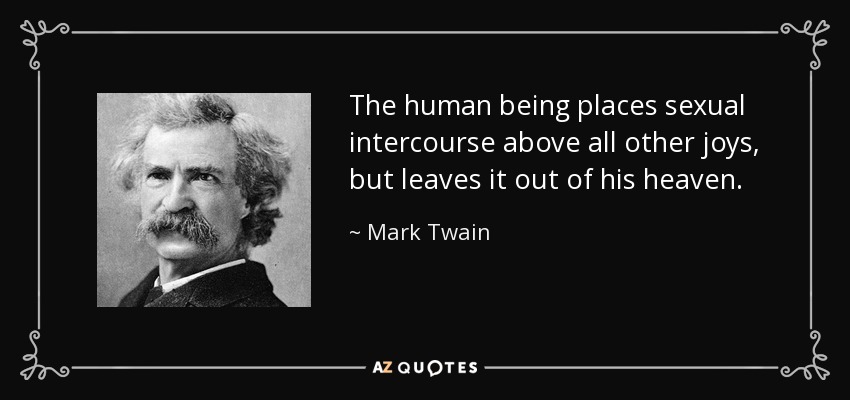
I can see why an unbeliever like Twain (Samuel Clemens) would utter the above words. Being guided by reason or emotion alone a person might well come to the same conclusion as Twain. This same kind of human reasoning might also question why God put restrictions on sexual pleasure, why there should be such sins as fornication or adultery, or bestiality, or pedophilia, or any other sexual immorality. This type of reasoning leads to there being no restrictions on sexual activity and is the kind of reasoning we see so prominent today where homosexuality and its concomitants are not only tolerated but promoted. Such reasoning questions or denies God's right to place such restrictions upon people. 

So, how would we respond to Twain? Why will resurrected saints, citizens of heavenly Jerusalem, no longer marry, have children and sexual pleasure? In the previous two chapters we saw how great pleasures and delights await those who will dwell there. So, why is sexual pleasure not one of them? After all, sexual pleasure between Adam and his wife Eve was part of their life experience in Eden or Paradise. 

This is in fact a primitive question debated and discussed. Christ, thankfully, gave us an answer as we will see. Further, as we also see, though the resurrected saints will no longer enjoy sexual pleasures, yet the still mortal nations who enter into the millennial new heavens and earth will be able to marry, have children, and enjoy sexual pleasures with their spouses. 

Resurrected Saints & Sexual Pleasure

"27 Then some of the Sadducees, who deny that there is a resurrection, came to Him and asked Him, 28 saying: “Teacher, Moses wrote to us that if a man’s brother dies, having a wife, and he dies without children, his brother should take his wife and raise up offspring for his brother. 29 Now there were seven brothers. And the first took a wife, and died without children. 30 And the second [g]took her as wife, and he died childless. 31 Then the third took her, and in like manner the seven [h]also; and they left no children, and died. 32 Last of all the woman died also. 33 Therefore, in the resurrection, whose wife does she become? For all seven had her as wife.” 34 Jesus answered and said to them, “The sons of this age marry and are given in marriage. 35 But those who are counted worthy to attain that age, and the resurrection from the dead, neither marry nor are given in marriage; 36 nor can they die anymore, for they are equal to the angels and are sons of God, being sons of the resurrection." (Luke 20: 27-36 nkjv)

Matthew's account ends the above reading like this:

"Jesus answered and said to them, “You are mistaken, not knowing the Scriptures nor the power of God. For in the resurrection they neither marry nor are given in marriage, but are like angels of God in heaven." (22: 29-30 nkjv) 

These verses are clear about whether the "sons of the resurrection" will marry. They will not. Further, since sex is only permitted in a marital relationship (Heb. 13: 4), then the fact of no marriage entails the idea of no sexual pleasure. 

However, I must disagree with some inferences that some bible believers see in the above passages. The first false inference states that the text proves that the angels cannot marry, have sex, or procreate. The second false inference says that the words of Christ deny that any occupant of the new heavens and earth, or of the millennial kingdom age, will marry and have children. 

It is my view, as well as many others, from ancient times, that "the sons of God" of Genesis chapter six who lusted after "the daughters of men" were angels and that this is what Peter and Jude are referring to when they speak of the fall of the angels. 

"And the angels who did not keep their proper domain, but left their own abode, He has reserved in everlasting chains under darkness for the judgment of the great day; as Sodom and Gomorrah, and the cities around them in a similar manner to these, having given themselves over to sexual immorality and gone after strange flesh, are set forth as an example, suffering the vengeance of eternal fire." (Jude 1: 6-7 nkjv)

"For if God did not spare the angels who sinned, but cast them down to hell and delivered them into chains of darkness, to be reserved for judgment;" (II Peter 2: 4 nkjv)

The passage in Jude seems to indicate that the sin of the angels was similar to the sin of Sodom and Gomorrah, to sexual immorality. Angels often appeared in physical bodies and were able to eat and drink. So, if they can do this, they could procreate. But, doing so was their fall from heaven, from the condition in which they were originally made and constituted. What Jesus said about angels not marrying is true of the angels who did not abandon their "proper domain," being the "elect angels" (I Tim. 5: 21), to "the angels of heaven" in contradistinction to the angels who fell from heaven and became angels of Satan. (Matt. 25: 41)

Another false inference from the text is to interpret the text as affirming that everyone who "obtains that age," the next age of a thousand years of Christ's reign, will all be celibate so that the human race stops being what it was originally constituted to be, i.e. a self propagating species. We addressed this issue in the early chapters of this treatise. Those who are saved at the time of Christ's destruction of the wicked, and of the Antichrist, will enter the millennium in their mortal bodies, as we have seen. These will marry and have children, as we have also seen. They obtained that age but they marry and have children. So, how does that square with the words of Jesus? Answer: Jesus did not say "all who obtain that world" would not marry, but "all who obtain that world and the resurrection from the dead," or who are "sons of the resurrection." Those who do not marry meet both qualifications but the mortals who enter into the kingdom age meet only one. As we will shortly see, these saved souls who were not of the group called "sons of the resurrection" but who were saved after the resurrection of the just and these will be the seed of a new race of humans. The conjunction "and" is important in the text. 

So, why does Christ exclude sexual pleasure from the sons of the resurrection? I believe it is because they will be in that state where they will be holy in body as well as in spirit, being married to the Lord, and being gifted to that end. 

The Nations of the Ongoing Race & Procreation

 Speaking of the millennial age of the new heavens and earth Isaiah wrote:
 
"Never again will there be in it an infant who lives but a few days, or an old man who does not live out his years; he who dies at a hundred will be thought a mere youth; he who fails to reach a hundred will be considered accursed." (Isa. 65: 20)

"They will not labor in vain, nor will they bear children doomed to misfortune; for they will be a people blessed by the LORD." (vs. 24)

We cited these words in earlier chapters when writing about the new heavens and the new earth and how Isaiah's new heavens and earth apply particularly to the thousand years of the coming age under King Jesus and his resurrected saints. Notice that Isaiah pictures children being born in that next age to come. So, does Isaiah contradict Jesus when he says that "those who obtain that age and the resurrection of the dead" will not marry or procreate? No, for Jesus is talking about how things will be with the resurrected sons and not those who are saved after the resurrection and at the end of this age and who will enter the millennium as mortals. Isaiah also, in speaking of this millennial age of the kingdom wrote:

"The nursing child shall play by the cobra's hole, And the weaned child shall put his hand in the viper's den." (Isaiah 11:8)

So, if there are babies in the age when this change in the nature of animals is realized (which can only be interpreted to mean the time after Christ returns and creates new heavens and earth) then there must be people on earth who are married and having children. 

Other text swhich show that children will be born in the millennial kingdom age are these:

"Again the word of the Lord of hosts came to me, saying, 2 Thus saith the Lord of hosts; I was jealous for Zion with great jealousy, and I was jealous for her with great fury. 3 Thus saith the Lord; I am returned unto Zion, and will dwell in the midst of Jerusalem: and Jerusalem shall be called a city of truth; and the mountain of the Lord of hosts the holy mountain. 4 Thus saith the Lord of hosts; There shall yet old men and old women dwell in the streets of Jerusalem, and every man with his staff in his hand for very age. 5 And the streets of the city shall be full of boys and girls playing in the streets thereof." (Zech. 8: 1-5 kjv)

"For the LORD hath redeemed Jacob, and ransomed him from the hand of him that was stronger than he. Therefore they shall come and sing in the height of Zion, and shall flow together to the goodness of the LORD, for wheat, and for wine, and for oil, and for the young of the flock and of the herd: and their soul shall be as a watered garden; and they shall not sorrow any more at all. Then shall the virgin rejoice in the dance, both young men and old together: for I will turn their mourning into joy, and will comfort them, and make them rejoice from their sorrow." (Jer. 31: 11-13 kjv)

Recall also from earlier chapters is analysis of Ephesians 3: 21 and Paul mentioning "unto all generations of the ages of the ages." Children being generated in all ages. 

So, in conclusion, the words of Jesus are only true of resurrected saints. They are the ones who will no longer marry or have conjugal relations or beget children. 

But, to answer Twain, why has the Lord not made sexual pleasure one of the manifold pleasures of life in eternity for the resurrected saints? The following are what I think are the reasons for this decision by Lord God.

Holy In Body

"For I would that all men were even as I myself. But every man hath his proper gift of God, one after this manner, and another after that. I say therefore to the unmarried and widows, it is good for them if they abide even as I. But if they cannot contain, let them marry: for it is better to marry than to burn." (I Cor. 7: 7-9 kjv)

Saints or sons of the resurrection will not "burn" with lust. There will therefore be no need to marry. There are four major reasons why people marry (marriage being ordained as being solely between a male and female). First; God created Eve to be Adam's wife because he saw Adam alone and made this declaration: “It is not good for the man to be alone. I will make a helper suitable for him.” (Gen. 2: 18 NIV) Second: to procreate, as the Lord said to Adam and Eve "be fruitful and multiply" (Gen. 1: 28). Third, to satisfy the burning lust for the opposite sex that Paul speaks of in the above text. Fourth, to give this pleasure to those who marry, as Solomon said:

"Let your fountain be blessed, and rejoice in the wife of your youth, a lovely deer, a graceful doe. May her breasts satisfy you at all times, may you be intoxicated always by her love." (Prov. 5: 18-19 kjv)

The "sons of the resurrection" however will be in a state where none of the reasons above, for getting married, will be present with them. The loneliness will be gone for Christ and his people will be their companions, Christ himself their spouse. How could they ever be lonely and thus need a spouse to alleviate that need? They also need no longer procreate for that is what God has purposed shall be for the non resurrected, for "the nations." And I repeat, they will not lust for they will be immutably holy. Upon this we will enlarge in following chapters. Further, the joy of being united to Christ, the sons of the resurrection, and to the holy angels will be far greater than any sexual pleasure. 

The state that Paul wished for will be realized by the sons of the resurrection. He said he wished that all were unmarried as he was. In the eternal ages to come the sons of the resurrection will all be as Paul wished and they will become eunuchs for the Lord (but more on that shortly). Paul also says that being unmarried offered him more time and energy to devote to serving Christ his husband. He said it was a "gift of God" to be in such a state. This gifted state will be the state of all the sons of the resurrection. He says "it is good for them" to be unmarried as he was, and for using that extra time to serve the Lord. They will not be distracted in their service to God by being married. About this Paul wrote further, saying:

"But I would have you without carefulness. He that is unmarried careth for the things that belong to the Lord, how he may please the Lord: But he that is married careth for the things that are of the world, how he may please his wife. There is difference also between a wife and a virgin. The unmarried woman careth for the things of the Lord, that she may be holy both in body and in spirit: but she that is married careth for the things of the world, how she may please her husband." (32-34)

Being "unmarried" is what the resurrected sons of God will be per Jesus throughout eternity; And, being so, they "care for the things that belong to the Lord, how they may please the Lord," and no longer "care for the things that are of the world." They become "holy both in body and in spirit." That is one major reason why the sons of the resurrection will not marry, have sexual relations, or have families to look after. They will have become eunuchs for the kingdom of heaven. Said the Lord Jesus Christ:

"His disciples said to Him, “If such is the case of the man with his wife, it is better not to marry.” But He said to them, “All cannot accept this saying, but only those to whom it has been given: For there are eunuchs who were born thus from their mother’s womb, and there are eunuchs who were made eunuchs by men, and there are eunuchs who have made themselves eunuchs for the kingdom of heaven’s sake. He who is able to accept it, let him accept it.” (Matt. 19: 10-12 nkjv)

Though most commentators say that this becoming eunuchs for the kingdom is fulfilled in the cases of men and women like Paul who was single, unmarried, and who wished all to be like he was, there is more to be deduced than that. It is true that Paul became a eunuch for Christ. However, it is also true of all the sons of the resurrection. 

Resurrected saints will be married to the Lord and the pleasures flowing from that union will far exceed any pleasures that flowed from any human marriages they had when they lived on earth.

As I have suggested in earlier chapters, I don't believe that resurrected saints will ever have to use the toilet, a point we will consider more in depth when we get to studying on the nature of the resurrection and glorified bodies of the saints. Also, since they will not procreate or have sexual relations, then the question naturally arises: will they have sexual, that is, male or female, body parts? It seems that if men no longer have to urinate nor have sexual relations, why will they still have male genitalia? Also, if women no longer need to breastfeed babies, nor have sexual relations, then why will they have breasts and female genitalia? In other words, will there still be gender among the resurrected saints?