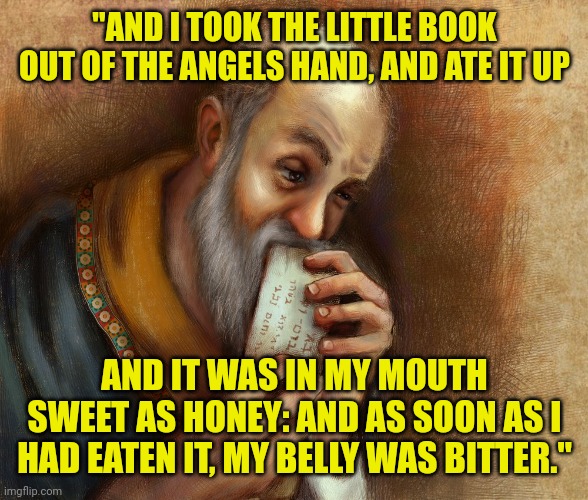
"And the voice which I heard from heaven spake unto me again, and said, Go and take the little book which is open in the hand of the angel which standeth upon the sea and upon the earth. And I went unto the angel, and said unto him, Give me the little book. And he said unto me, Take it, and eat it up; and it shall make thy belly bitter, but it shall be in thy mouth sweet as honey. And I took the little book out of the angel's hand, and ate it up; and it was in my mouth sweet as honey: and as soon as I had eaten it, my belly was bitter." (vs. 8-10 kjv)
In this chapter we are still talking about one of the most mysterious books in God's library, the seven sealed book of the Apocalypse, the legal instrument that authorizes the Redeemer to execute the terms of that instrument, which includes taking possession of all that was lost by sin and removing all liens and encumbrances upon fallen man's title to the heavens and earth, and by kicking out the foreigners and invaders, which includes all who have rejected God and his word, and the Messiah, and casting out of the world "that old serpent the Devil." It is the time when the weeds (tares) will be removed from among the wheat so that only wheat remains as Jesus taught in the parable of the wheat and tares. (Matt. 13)
In the last chapter we took notice of what is recorded in the first part of Revelation chapter ten where a "mighty angel" (who is none other than Christ) holds the seven sealed scroll in his hand and who, by its authority, carries out the things specified in the writing that is on the inside of that document, which things all have to deal with "the redemption of the purchased possession" (Eph. 1: 14) and with "the restitution of all things" (Acts 3: 21). What an important book this is to us!
The Lord Jesus in the form of a "mighty angel" takes the scroll and gives it to the apostle John and tells him to eat it and of the effects that John experiences as a result.
Wrote Seiss:
"The ultimate disposal made of this document is also such as to correspond with the character I have assigned to it, and to identify it as the same that was taken by the Lamb from the hand of sovereign majesty. John says, “The voice which I heard out of the heaven [I heard] again speaking with me, and saying, Go, take the book [or roll] which is opened in the hand of the Angel who standeth upon the sea and upon the land. And I went to the Angel, saying to him, Give me the little book. And he saith to me, Take, and eat it. And I took the little book [or roll] out of the hand of the Angel, and ate it.” Thus the history of this Βιβλιον terminated. And for what does our blessed Redeemer take the book out of the right hand of eternal sovereignty? Why does he appear in the court of heaven as a once slain Lamb that he may be accounted worthy to take the book and to open the seals thereof?"
Bible commentators are not all in agreement as to what is signified by the apostle John being told to eat the little scroll whose seals had been broken and its contents revealed and its instructions that are to be executed. Many see John as acting strictly as a representative for all the people of God, so that what he does in eating the scroll, and in what he is commanded to do, is applicable to every saved person. Seiss takes this view on John acting as such a representative person on this occasion and in other places in the Apocalypse. When John is called up to heaven in chapter four verse one by a voice from heaven, Seiss says this signifies the coming "rapture" of believers at the second coming of Christ. I disagree completely with him on that point. Later in the last verse of chapter ten the angel tells John, after his eating the scroll, "you must prophesy again before many peoples, and nations, and tongues, and kings," and Seiss does not believe that John fulfilled or will fulfill this ministry himself, but in the persons he represented. Again, I firmly believe this is not correct. However, more on that shortly.
Wrote Seiss:
"There is no book like the roll which the Lamb takes from the right hand of the Sitter on the throne. It embodies in itself all the prophetic, priestly, and royal rights of Christ, in the attitude of our Goel, or Redeemer. It compasses the very spring and kernel of all sacred prophecy, all evangelic preaching, all true faith, all abiding hope. It is the eternal charter, from the right hand of eternal sovereignty, on which reposes the whole right, authority, work, kingdom, and dominion of Jesus, as the Lord and Saviour of men. And the grand intent and purpose of all that he has done in reference to that document, for which he has obtained it and freed it of its seals, and for which he holds it open in his hand as he proceeds to take possession of the earth is, that his people may have the benefit of it—that they may take it from his hand, feed on it, incorporate it with their inmost being, make it the subject of their hopes, their prophecies and their prayers, and in the strength and virtue of it live and reign with him forever. And if we have at all hit upon the nature of the document which John beheld upon the right hand of Him that sitteth upon the throne, the analogy of faith, and the whole congruity of things, come into play to establish and confirm the belief that this βιβλιον, or βιβλαριδιον, in the hand of the Angel, is the same book, and that the Angel who holds it is none other than the Lion from the tribe of Judah, the Root of David, the Lamb that was slain, the blessed Jesus."
Though I agree that the benefits of the Lion Lamb being found worthy to take the scroll and to loose its seven seals extends to all the chosen people of God, yet John's eating of the book is not intended to teach the same truth. John's eating the book is for John's primary benefit and new commission. But again, more on that shortly. First, however, let me cite from John Gill on whether the little scroll of Revelation chapter ten is the same seven sealed book of chapter five. Gill agrees with Seiss that it is the same, writing the following in his commentary:
"...but the same book is here designed, which in Revelation 5:1 is represented as in the right hand of him that sat on the throne, as shut and sealed; but the lion of the tribe of Judah, the Lamb in the midst of the throne, having taken it out of his hand, unloosed its seals, and opened it; and whereas we never read of his laying this book down, or of his delivering it to any other, he may be well supposed to be this mighty angel, who held it open in his hand..."
Returning to the commentary of Seiss, we note that he said:
“And the Angel, whom I saw standing upon the sea and upon the land, lifted up his right hand into the heaven, and sware by Him that liveth for the ages of the ages, who created the heaven and the things in it, and the earth and the things in it, and the sea and the things in it, that there shall be no more delay; but in the days of the voice of the seventh angel, when he shall sound, the mystery of God is [to be] fulfilled, even as he preached glad tidings to his servants the prophets.”
The KJV says "time shall be no more" but that is not correct, and is why better translations have "no more delay." On that we could say much, but doing so would enlarge this chapter and we might lose some readers who will not want that much at this time. However, I will say that the second coming of Christ and all that the Apocalypse discloses as occurring in conjunction with it has been delayed now for about two millenniums, being the time of God's longsuffering. But, there will come a time when God's longsuffering and all delay of coming judgment will be ended.
Wrote Seiss:
"The Mystery of God is nothing more nor less than the final sum of all God’s revelations and doings for the reinstatement of man into his lost inheritance. The fulfilment of this mystery is the final accomplishment of the last items of the Divine administrations which make up that sum—the ultimate realization of all the foreannouncements made to and by any and every one of God’s prophets in all the ages—the Gospel of the kingdom of heaven at length merged into full and everlasting fruition of that kingdom—the consummation of all things. And concerning this consummation, sundry particulars are here observable."
The time period when the "mighty angel" or Lion Lamb takes possession of earth, sea, and sky is the time when the seals are broken, its contents revealed and its terms executed, and when "the mystery of God should be finished." By "mystery of God" being "finished" is exactly what Seiss says above.
John's Commission At The Second Coming
"And he said unto me, Thou must prophesy again before many peoples, and nations, and tongues, and kings. And there was given me a reed like unto a rod: and the angel stood, saying, Rise, and measure the temple of God, and the altar, and them that worship therein. But the court which is without the temple leave out, and measure it not; for it is given unto the Gentiles: and the holy city shall they tread under foot forty and two months. And I will give power unto my two witnesses, and they shall prophesy a thousand two hundred and threescore days, clothed in sackcloth." (Rev. 9: 11- 10: 1-4 nkjv)
When John eats the scroll as commanded, it is then said that he will prophesy again before many peoples, nations, tongues, and kings. Seiss again thinks that this is not true of John as an individual but is symbolic of others, which is what many other bible commentators say. However, there is absolutely no reason for doing this. Some commentators will say that John fulfilled this commission by writing the rest of the book of Revelation from this point onward, a view that I find ridiculous for several reasons. That interpretation would necessitate that he be eating the scroll as each scene of the Apocalypse occurs. I also find it ironic that Seiss, who upholds a literal interpretation of Revelation, except in cases where there is warrant to do otherwise, is quick to interpret the words of John's new commission figuratively.
I rather am convinced that the apostle John is one of the two witnesses of the Apocalypse, described in Revelation chapter eleven. I have written on this in the past (See here and here). I also have some drafts of articles proving that John is one of these two prophets and I hope I can finish that series soon.
John did not fulfill his new commission when he was let go from his exile on Patmos and then began to preach to the churches in Asia Minor, which some traditions say occurred. There are also some traditions that say John was martyred, or that emperor Domitian tried to boil him in oil but he was miraculously kept from harm and was not killed. Actually there is no record of John dying, although some traditions say he died an old man. We have, however, some interesting words about John in these words of the risen Christ to Peter about John and about John's commentary on the prophetic words of Christ:
"Then Peter, turning around, saw the disciple whom Jesus loved following, who also had leaned on His breast at the supper, and said, “Lord, who is the one who betrays You?” Peter, seeing him, said to Jesus, “But Lord, what about this man?” Jesus said to him, “If I will that he remain till I come, what is that to you? You follow Me.” Then this saying went out among the brethren that this disciple would not die. Yet Jesus did not say to him that he would not die, but, “If I will that he remain till I come, what is that to you?” (John 21: 20-23 nkv)
Consider also the fact that the scroll is not eaten by John until it is taken by Christ and unsealed it, and until he has set his feet upon the land and sea and declared that there is no more delay. Since John's eating of the scroll is therefore in the future, so too must be his prophesying to the entire human population as one of the two witnesses, described as occurring in chapter eleven following the scenes of chapter ten. We see this in the similar case of Ezekiel.
"And you, son of man, do not be afraid of them nor be afraid of their words, though briers and thorns are with you and you dwell among scorpions; do not be afraid of their words or dismayed by their looks, though they are a rebellious house. You shall speak My words to them, whether they hear or whether they refuse, for they are rebellious. But you, son of man, hear what I say to you. Do not be rebellious like that rebellious house; open your mouth and eat what I give you.” Now when I looked, there was a hand stretched out to me; and behold, a scroll of a book was in it. Then He spread it before me; and there was writing on the inside and on the outside, and written on it were lamentations and mourning and woe. Moreover He said to me, “Son of man, eat what you find; eat this scroll, and go, speak to the house of Israel.” So I opened my mouth, and He caused me to eat that scroll. And He said to me, “Son of man, feed your belly, and fill your stomach with this scroll that I give you.” So I ate, and it was in my mouth like honey in sweetness. Then He said to me: “Son of man, go to the house of Israel and speak with My words to them." (Eze. 2: 6-9 - 3: 1-4 nkjv)
John's eating of the scroll of the Apocalypse was for the purpose that he might speak to everyone on earth as one of the two witness prophets who prophesy in Jerusalem for forty two months during the time of the great tribulation. Further, we see how the book written on the inside and outside in Ezekiel's vision is full of "lamentations, mourning, and woe," which is what we see occurring in the Apocalypse in conjunction with the second coming of Christ and day of judgment, and in connection with the commission of the apostle John and the other witness prophet, which is none other than Elijah the prophet.


No comments:
Post a Comment