In the previous chapter we gave much information (though there is much more) on what is that special mysterious book in the divine library that is described in chapter five of the Apocalypse as a book or scroll with seven seals. In this follow up chapter we will see what occurs in Revelation chapter ten to this same book. First, we will notice the book in relation to a "mighty angel" and then in relation to the apostle John.
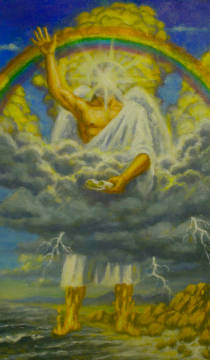
"And I saw another mighty angel come down from heaven, clothed with a cloud: and a rainbow was upon his head, and his face was as it were the sun, and his feet as pillars of fire: And he had in his hand a little book open: and he set his right foot upon the sea, and his left foot on the earth, And cried with a loud voice, as when a lion roareth: and when he had cried, seven thunders uttered their voices...And the angel which I saw stand upon the sea and upon the earth lifted up his hand to heaven, And sware by him that liveth for ever and ever, who created heaven, and the things that therein are, and the earth, and the things that therein are, and the sea, and the things which are therein, that there should be time (delay) no longer: But in the days of the voice of the seventh angel, when he shall begin to sound, the mystery of God should be finished, as he hath declared to his servants the prophets." (Rev. 10: 1-3, 5-7 kjv)
Upon this glorious scene Dr. Seiss wrote:
"John writes, “And I saw another, a mighty angel descending out of the heaven.” This person I take to be the Lord Jesus himself. He is called an Angel, but there is nothing in that to prove him a created being. Angel is a title of office, not of nature. In the Old Testament the Son of God is continually described as the Jehovah-angel. We had a somewhat corresponding vision in the first chapter; yet, he who there appeared, announced himself as the First and the Last, the Living One, who became dead and is alive forever. We had an account of an angel in the seventh chapter, and again in the eighth, whom there was reason to regard as none other than the Lord Jesus. We do know that he appears in the Apocalypse as a Lamb, as a Lion, and as an armed Warrior, and there is nothing to hinder his appearance also as an Angel."
I firmly believe this is correct and good commentary. There are three chief things to ascertain in studying this passage. First, is this "little book" or "scroll" the same as that with the seven seals? Second, who is this "mighty angel" who has possession of the little book? Third, what is this significance in what the angel does in connection with the little book?
Seiss wrote further:
"The attire of this angel indicates Deity. John beholds him “clothed about with a cloud.” Wherever clouds are connected with glorious manifestations, there we find the presence of Divinity. If there is cloud, there is mystery; and if there is mystery, there is suggestion of Deity. The Lord descended on Mount Sinai in a thick cloud. He appeared on the mercy-seat in a cloud. When Israel was delivered, “the Lord went before them by day in a pillar of cloud.” When the glory of the Lord filled the tabernacle, “a cloud covered the tent of the congregation.” When God reproached Israel for their murmurings, “the glory of the Lord appeared in the cloud.” “The Lord said unto Moses, Lo, I come unto thee in a thick cloud.” The Psalmist gives it as the characteristic of the Almighty, that “clouds and darkness are round about him;” that “he maketh the clouds his chariot:” and that about him are “thick clouds.” When the King of glory cometh in his divine majesty to judge the earth, the exclamation is: “Behold, he cometh with clouds.” Clouds, therefore, belong to the attire of Deity, particularly in his manifestations toward fallen men. They indicate his unapproachableness, his infinite majesty, his consuming power toward sin, which cannot live before his uncovered glory, and yet his drawing near to communicate with the dwellers upon earth. No mere angel is ever arrayed in such drapery, and the vision is that of the glorious God-man himself, in the midst of the grand administrations of judgment."
Again, I am sure that this is correct. Seiss continued:
"He has “the rainbow on his head;” not a rainbow, but the rainbow. This is a further mark to show that he is not a created angel. We had this rainbow in the fourth chapter, where it is given as one of the grand appurtenances of the throne. It refers back to God’s ancient covenant with the earth. It was originally ordained as God’s mark in the cloud, and the sign of His, and no mere angel’s covenant. We never read of any one surrounded with the rainbow, but the person is God. The clouds are indicative of Divine judgment, and storms, and rains, and floods of wrath; and so the rainbow is indicative of Divine mercy in the midst of judgment, and a covenant of security to the believing, even though everything seem to be going to destruction. A garment of cloud, and a tiara of the iris, would, therefore, well befit the Saviour, in the administrations which we are now considering, but would in no manner of truth be suitable to a mere angel, however mighty."
As Seiss has stated, Jesus Christ, the eternal Son of God, was known in the old testament as the
"angel of the Lord" or
"Malak Yahweh." In an old post in the Baptist Gadfly blog I wrote on Christ being the angel of the Lord and who was himself Yahweh. (See
here) It was the angel of the Lord who spoke out of the burning bush to Moses and whose name was
"I Am That I Am." Jesus is an angel by office, meaning he is the messenger of the Godhead, which is part of his activity as
"the Word of God," but also specially in his dual character as both God and man. In the old testament he is revealed as the
"Angel of the Covenant" (Malachi 3:1) because he is the one who establishes the covenant between God and humanity, and as the
"Angel of His Presence" (Isaiah 63:9). Christ is also called
"the Apostle of our confession" (Heb. 3: 1) because he is divinely sent by the Father to communicate divine messages to men. So Paul wrote earlier in the Hebrew epistle:
"God, who at various times and in various ways spoke in time past to the fathers by the prophets, has in these last days spoken to us by His Son, whom He has appointed heir of all things, through whom also He made the worlds; who being the brightness of His glory and the express image of His person, and upholding all things by the word of His power, when He had by Himself purged our sins, sat down at the right hand of the Majesty on high." (1: 1-3 nkjv)
By God's Son being the person through whom God speaks to mankind he is functioning as an "angel" and as an "apostle." Further, the way Paul describes the Son of God in the above text is not only as an angel or apostle, but as possessing divine attributes and trappings. Seiss also shows that the description of this "mighty angel" has the emblems of deity. John Gill in his commentary agrees with Seiss when he wrote (emphasis mine):
"...however, a created angel is not intended: not the angel that made proclamation for the opening of the book, and unsealing it, Revelation 5:2; between which, and having the book in his right hand open, is a wide difference; nor any other, though the epithet "mighty" belongs to angels in common; and though this angel swears by the living God; and though it was an angel by whom Christ signified the things contained in this book to John; but the uncreated Angel, the Lord Jesus Christ, seems rather designed, as appears both by comparing this with Daniel 12:7; and from the power he gave to the two witnesses, Revelation 11:3; which cannot agree with a created angel; and besides, who so proper to hold the book open as he who unloosed the seals, and opened it, and to whom the epithet "mighty" may be applied in the highest sense, as God; and who as man may be said to swear by the living God, and to whom the whole description well agrees? he is sometimes called an Angel simply, Genesis 48:16; sometimes the Angel of the Lord, and who appears to be Jehovah himself, the second Person, Genesis 16:7, compared with Genesis 19:1; and sometimes the Angel of God's presence, Isaiah 63:9; and the Angel of the great council in the Septuagint on Isaiah 9:6; and the Angel, or messenger, of the covenant, Malachi 3:1; and may be so called, because he is a messenger from God as man and Mediator, being sent by him to declare his will and redeem his people...he appears now as "another" angel, distinct from the seven angels who had trumpets given them to sound..."
Wrote Seiss:
“And his face as it were the sun.” This again identifies him as the same who appeared unto John in his first vision. It is there said of Him who walks in the midst of the golden candlesticks, that his countenance was “as the sun shineth in his strength.” This luminousness of face is also one of the ascertained characteristics of Christ, in connection with the final revelation of his kingdom. Peter speaks of the appearance on the Mount of Transfiguration, as a foretaste and earnest of “the power and coming of our Lord Jesus Christ;” and yet, in that sublime picture, the record is, “his face did shine as the sun.” It was thus that he appeared unto Saul of Tarsus, on his way to Damascus. (Acts 26:13.) And from the most ancient times, the prophets were accustomed to refer to him as the outbeaming glory of God—the very Sun of Righteousness.
“And his feet as it were pillars of fire.” These are manifestly the same feet beheld in the vision of the first chapter. There they dazzled the eyes of the seer, like fine brass melted and glowing in a furnace; and they were the feet of Him who was dead, but is alive forevermore, and has the keys of death and of hell. There they presented an image of terrible pureness, and here they furnish an image of steadfast and consuming majesty, which no one can encounter and live. Nothing of the kind is ever affirmed of a created angel."
So, having seen clearly that this "mighty angel" cannot be a created angel but the uncreated Son of God, who in his functions and offices is a prophet, priest, king, apostle, and angel. Further, if the "little book" in the hand of this mighty angel is the same book with seven seals, then it is even more obvious that the mighty angel is none other than the Lion Lamb who is the Redeemer. That all being so, what is the significance in what this mighty angel does in connection with the book with seven seals?
Wrote Seiss:
“And he set his right foot upon the sea, but the left upon the earth.” This was a distinct and deliberate act, and is full of significance. To set one’s foot in a place, expresses a purpose to take possession of that place. Jehovah said to Israel, “Every place whereon the soles of your feet shall tread shall be yours.” (Deut. 11:24.) Abraham could not “set his foot on” any part of Palestine in this sense, inasmuch as God gave him none inheritance in it. And when this mighty Angel deliberately sets his right foot on the sea, and the left on the land, he thereby claims possession of it, and asserts his purpose to take it as his own, and to establish his occupancy and rule over it. It is an act befitting the character and office of Christ, but hardly a created angel. He is the rightful sovereign of sea and land. His taking of the sealed book from the hand of eternal majesty, and his breaking and destroying of its seals, proved and legitimated his right to the possession of the earth; and here we have his assertion of that right, and his purpose to enforce it. Long has both sea and land been under the dominion of his enemies, but now he sets foot on each, and takes hold upon them as his own."
The little book in the hand of the glorified Lord Jesus, now with its seals broken and its contents revealed, signals the time when Christ begins to foreclose and to repossess the heavens and the earth, to remove the aliens, squatters, intruders, the proud, yea, all those who "know not God and obey not the Gospel of our Lord Jesus Christ" and to act as the Redeemer and Avenger, to send tribulation upon the wicked world. It is then that the meek will inherit the earth as Jesus promised. (Matt. 5: 5)
Wrote Seiss:
"And with the symbolic act, and as part of it, there is a corresponding utterance. “He cried with a great voice, even as a lion roareth.” It was not a cry of distress and fear, but a shout of power, and the herald of vengeance upon enemies and usurpers. We have already seen who it is that is called “the Lion from the tribe of Judah.” Of old it was written, “The Lord shall roar out of Zion, and utter his voice from Jerusalem; and the heavens and the earth shall shake.” “The Lord shall roar from on high, and utter his voice from his holy habitation: he shall give a shout, as they that tread the grapes, against all the inhabitants of the earth. A noise shall come even to the ends of the earth; for the Lord hath a controversy with the nations, he will plead with all flesh, he will give them that are wicked to the sword.” (Jer. 25:29–31.) And the great voice before us connects directly with these predictions. It is not the voice of a created angel, but the cry of the almighty Judge himself. As yet he is in his cloud, like the lion in his covert. But when he comes forth to set his feet upon the earth, the shout, like of those who tread the grapes, shall be given, and the winepress of the Divine fury shall be trodden. It is the cry for and the herald of the oncoming judgments of God..."
In short, this scene conveys the idea that Christ is now claiming the right to the world, to possess it and to rule over it, to kick out the wicked ones and to give it all to his redeemed people. This is the time Paul described when he wrote:
"Then comes the end, when He delivers the kingdom to God the Father, when He puts an end to all rule and all authority and power." (I Cor. 15: 24 nkjv)
It will also be the time when "the wicked will be cut off from the earth, And the unfaithful will be uprooted from it." (Prov. 2: 22 nkjv)
Wrote Seiss:
"As the Angel proceeded to set his right foot upon the sea and his left upon the land, the Apostle saw “in his hand a little book, or roll.” This is a marked feature, and not without important significance. It is not the main thing in the vision, as Alford and some others have erroneously supposed, but it is an expressive accessory to the thrilling revelation."
Wrote Seiss further:
"The Apocalypse abounds with references to books and records of a remarkable character. The first verse of the fifth chapter disclosed to our view a very notable document, in connection with which all the interest, up to the chapter now before us, has arisen. We had a good deal to observe concerning that book, or roll, at the time. We were then constrained to look upon it as representing the title-deed of the inheritance, forfeited by man, and recovered by the Lamb. We saw it lifted by that Lion-lamb, amid the adoring shouts of eternity, and one of its seals after another broken open, followed with miraculous commotions, which shook the earth from centre to circumference, and affected even the great orbs of immensity. When the last of the seals was broken, that book was still in the hands of Him who alone, in all the universe, was found worthy to take it, break its seals, or even to look upon it."
I cannot understand why any bible interpreter would fail to see how this little book is the same book with the seven seals as it is the most obvious way to look at it.
Wrote Seiss further:
"The breaking of that seal introduced the seven trumpet-angels; and then, for the time, we lost sight of the wonderful document around which all this interest and these wonders concentre. And as this mighty Angel can be none other than the self-same Lion-lamb who took the book from the hand of eternal majesty, why may not this roll in his hand be the same identical roll lifted from the throne? Some commentators have ridiculed the thought, but I take it to be a most reasonable supposition. If the book in the hand of this Angel be not the same book which the Lamb took from the throne in heaven, then that marvellous document, after all the wonderful interest and events created by it, most strangely and ingloriously disappears, and is never heard of any more forever. Such awe and exultation at its first appearance, and such mighty occurrences attending the mere opening of its seals, beget the expectation and belief, and indeed require, that we should hear of it again; that it should not be so miserably hustled off the scene; and that it should have an end befitting its character and its introduction into these visions. But an unaccountably sorry fate does it receive, if we are not to recognize it in the roll in the hand of this Angel."
Mankind's destiny and salvation is at stake in what happens to this book. I find the reasoning of Seiss to be so cogent that I don't see how anyone can deny that he is properly interpreting the scene.
Wrote Seiss:
"It is said of the little book now before us that it was “opened.” This implies that it had been shut, sealed; and that what kept it shut, its seals, had been broken off; all of which accords precisely with what we saw of the book taken by the Lamb."
Again, these are solid arguments to prove that the little book is the same book with the seven seals.
Wrote Seiss:
"The nature of the case would also seem to call for the presence here of the same document which the Lamb had taken from the throne. The Angel is engaged in the solemn and sublime act of formally claiming the possession of the earth. He needs his warrant for such an act. Redemption proceeds on a legal foundation. Christ as our Redeemer had to be made under the law. It was necessary that he should fulfil all righteousness. All his successes, triumphs, and exaltations were achieved on the basis of having meritoriously met and answered all demands of the law. He could neither rise from the dead, ascend to the right hand of the Father, propose free forgiveness to men, or dare to repossess man of the forfeited inheritance, except as he had satisfactorily atoned for all man’s sins, and in himself meritoriously won and purchased all that he now or ever holds or claims for his redeemed. It was only as he was slain for mankind, and atoned for their unrighteousness, and thus overcame, that he was pronounced worthy to take the book, or open its seals, or act the Goel for those whose inheritance had been disponed away, and overrun by aliens. And so neither could he claim and take possession of the earth, and clear it of all foes and usurpers, except upon warrant from the law giving that right as the just due of his perfect righteousness. No man can claim land without showing that he holds his title-deed for it. No one can proceed to execute penalties even upon transgressors, without warrant from the government. And so our mighty Goel in proceeding to set his right foot on the sea, and his left on the land, claiming possession of the earth, and about to inflict extirpating punishments upon the rebels who infest it, holds in his hand the open title to it, worthily obtained from the right hand of eternal majesty, displays it to all observers as his warrant from the throne, and challenges the potencies of earth and hell to yield or perish; whilst all the thunders of Almighty power utter themselves for his support."
What a wonderful and significant scene is described in Revelation chapter ten! In the next chapter we will see what else occurs in conjunction with this glorious book in the divine library.


No comments:
Post a Comment