Thursday, June 16, 2022

How old is the gospel? (iii)


The nations, both which existed before the flood and those existing after the flood, had the gospel message handed down to them. But, what they did with that message was to corrupt it, to change the meaning of the message, so that the real message was often lost. This is what Paul affirms in Romans chapter one and ten, as we will see. 

In beginning this chapter let us look at one way in which the nations heard the word of God in old testament times. Let us begin with these words of Moses, one who was "learned in all the wisdom of the Egyptians" as well as in the oracles of Yahweh. (Acts 7: 22)

"Surely I have taught you statutes and judgments, just as the LORD my God commanded me, that you should act according to them in the land which you go to possess. “Therefore be careful to observe them; for this is your wisdom and your understanding in the sight of the peoples who will hear all these statutes, and say, ‘Surely this great nation is a wise and understanding people.’" (Deut. 4: 5-6)

Though people and nations in old testament times did not have the technology to communicate with each other over long distances as we do today, we must not therefore assume that nations did not communicate with one another. The methods of communication may have been slow, and often by word of mouth (though not without written communication), but each nation had knowledge of other nations, as the above words indicate. Moses says that other nations "will hear all these statutes," will hear the word of God. How hear? Well, one was by word of mouth, by traders and travellers. Another was through ambassadors. Israel had her ambassadors to other nations and other nations had their ambassadors sent to Israel. (See II Chron. 32: 31; 35: 21; Isa. 18: 1-3; 30: 4, 33: 7; Eze. 17: 15)

So, we may assume that many nations knew of Israel's scriptures, which theocracy contained the laws and statutes, the scriptures, but also the promises of salvation through the promised Messiah. Said Moses again:

"This day I will begin to put the dread and fear of you upon the nations under the whole heaven, who shall hear the report of you, and shall tremble and be in anguish because of you." (Deut. 2: 25)

If the "nations under the whole heaven" could "hear the report" of Israel's deliverances, so too could they hear of Israel's prophets and prophecies of the promised Messiah. Notice this text also along this line:

"Moreover concerning a stranger, that is not of thy people Israel, but cometh out of a far country for thy name's sake; (For they shall hear of thy great name, and of thy strong hand, and of thy stretched out arm;) when he shall come and pray toward this house." (I Kings 8: 41-42)

Notice that people who live in far countries were able to "hear of thy great name," and hear "of thy strong hand and stretched out arm." Also, the effect of those heathen peoples in distant lands, upon hearing of Israel and Israel's God, would "come pray toward this house," i.e., in the temple of Solomon. This was certainly true of Rahab the harlot who dwelled in Palestine in the days when Joshua led the chosen people to the land of Canaan. 

"And she (Rahab) said unto the men, I know that the Lord hath given you the land, and that your terror is fallen upon us, and that all the inhabitants of the land faint because of you. For we have heard how the Lord dried up the water of the Red sea for you, when ye came out of Egypt; and what ye did unto the two kings of the Amorites, that were on the other side Jordan, Sihon and Og, whom ye utterly destroyed. And as soon as we had heard these things, our hearts did melt, neither did there remain any more courage in any man, because of you: for the Lord your God, he is God in heaven above, and in earth beneath. Now therefore, I pray you, swear unto me by the Lord, since I have shewed you kindness, that ye will also shew kindness unto my father's house, and give me a true token: And that ye will save alive my father, and my mother, and my brethren, and my sisters, and all that they have, and deliver our lives from death." (Josh. 2: 9-13)

Another text dealing with this same time period and which shows how people from afar often heard of Israel and her God is this:

"And it came to pass, when all the kings of the Amorites, which were on the side of Jordan westward, and all the kings of the Canaanites, which were by the sea, heard that the Lord had dried up the waters of Jordan from before the children of Israel, until we were passed over, that their heart melted, neither was there spirit in them any more, because of the children of Israel." (Josh. 5: 1)

Also, in the days of king David, we find David writing:

"God be merciful unto us, and bless us; and cause his face to shine upon us; Selah. That thy way may be known upon earth, thy saving health among all nations. Let the people praise thee, O God; let all the people praise thee. O let the nations be glad and sing for joy: for thou shalt judge the people righteously, and govern the nations upon earth. Selah." (Psa. 67: 1-4)

"For this I will praise you, O Lord, among the nations, and sing to your name." (Psa. 18: 49)

Such verses show us that the truth of God, which was being given to Israel and her prophets, was not kept hid from the nations, but broadcasted far and wide. Later too we find the prophets after David preaching to the nations of the world. Said the prophet Jeremiah:

"Hear the word of the LORD, O ye nations, and declare [it] in the isles afar off..." (Jer. 31: 10)

This is the same message that Abel, Seth, Enoch, and Noah proclaimed to the antediluvian peoples. It was also what every old testament prophet said to all the nations. Those nations who did hear the word of the Lord, did receive copies of Israel's sacred scriptures, would have known of the promised Messiah and many would have put their trust in him. So we find Isaiah saying:

Turn to me and be saved, all the ends of the earth! For I am God, and there is no other." (Isa. 45: 22)

Notice that even in the Old Testament that God sent the message of salvation to "all the ends of the earth." And, no doubt, many from among the heathen nations believed the report, believed in God and accepted his salvation, and trusted in the promised Messiah. This being the case, we see the prophet Zechariah saying:

"Thus says the Lord of hosts: In those days ten men from the nations of every tongue shall take hold of the robe of a Jew, saying, ‘Let us go with you, for we have heard that God is with you.’ (Zech. 8: 23)

Notice the words "for we have heard that God is with you." How did they hear? Primarily by word of mouth, no doubt. No doubt also is the fact that many who heard of such things sought out the word of the Lord from Israel and obtained copies of her scriptures from her scribes. Notice these words which Isaiah records, and which are quoted by the apostle Paul in Romans chapter ten (which we will look at in the next concluding chapter).

"O Zion, You who bring good tidings, Get up into the high mountain; O Jerusalem, You who bring good tidings, Lift up your voice with strength, Lift it up, be not afraid; Say to the cities of Judah, “Behold your God!” Behold, the Lord God shall come with a strong hand, And His arm shall rule for Him; Behold, His reward is with Him, And His work before Him." (Isa. 40: 9-10)

Even though the gospel message ('good tidings') in this instance was intended primarily for "the cities of Judah" and for the inhabitants of Jerusalem, yet were not intended for them alone. Israel and her prophets were given the words of God, and the gospel message, yet they were to proclaim them to the nations. Thus, missionaries and evangelism were not simply new testament works, but was also the work of Israel and her ambassadors, messengers, and prophets. Every believing Hebrew, wherever he traveled, was duty bound to spread the news. Wrote the Psalmist:

"He declares His word to Jacob, His statutes and His judgments to Israel. He has not dealt thus with any nation; And as for His judgments, they have not known them." (Psa. 147: 19-20) 

Paul also wrote of this favored status, saying:

"Who are Israelites; to whom pertaineth the adoption, and the glory, and the covenants, and the giving of the law, and the service of God, and the promises; Whose are the fathers, and of whom as concerning the flesh Christ came, who is over all, God blessed for ever. Amen." (Rom. 9: 4-5)

No other nation was given prophets and the oracles of God. Only Israel was entrusted with them. Yet, it was never God's intention for Israel to keep them to themselves. They were duty bound to teach the nations. Though she often failed in this work, nevertheless many in far off lands did hear, did obtain copies of her scriptures. Further, as we will see in the next chapter, many of the nations of the Gentiles rejected Israel's scriptures, and her God, and so those nations lost what gospel revelation they had. For this reason, many died in those nations who never heard the truth about God and his way of salvation. Does this mean it was totally unavailable to them? In some cases yes, and in some cases no. Did those who died without knowing the one true God and his way of salvation go to hell without a chance or opportunity of salvation? Yes and no. The question rather should be this - "did they all have an equal chance?" Definitely not.

In all times, the message of the gospel was available. Even the heathen who did not know anything of the Hebrew scriptures nevertheless would have astronomical charts of the twelve constellations with their various names and if they were star gazers and astronomers, they could have deciphered the gospel message from the Zodiac or Mazzaroth, as no doubt the Magi who came seeking the Christ child did when following the star of Bethlehem. They could also look at the starry heavens and say "who has made all these?" 

Wednesday, June 15, 2022

"Calvinists are Stumped by Colossians 2:12"

In a follow up to my posting "A Debate On John 6" (See here), wherein Dr. Flowers had a Calvinist of the born again before faith view flustered in a video discussion, I want to refer to another case where Dr. Flowers did the same thing with another Calvinist in regard to the born again before faith error. The video is titled "Calvinists are Stumped by Colossians 2:12" (See here). Again, Dr. Flowers has the Calvinist brother agitated and confused. The brother could not explain how his view did not contradict the text which says people are "raised through faith in the powerful working of God." After this, Dr. Flowers shows a portion of a video where the Calvinist brother is talking to Dr. James White about the discussion, confessing to Dr. White his confusion and inability to answer the argument. Dr. Flowers (who has debated Dr. White many times on this issue) then plays Dr. White's answer to the Calvinist brother. Honestly, Dr. White never dealt with the passage, as Dr. Flowers points out. Listen to it yourself and see what you think. As of today there are almost 22,000 comments! To see my posting on this passage see "Quickened By Faith" (here).

Now, let me say in closing that I disagree with Dr. Flowers on several things, but on this issue I agree with him. I hate that he is so opposed to all aspects of Calvinist thought. Reading many of the comments he gets from folks who watch his attacks on Calvinism finds many saying the most awful things about Calvinists. That is very unbecoming. Some of the most holy and learned believers have come from the Calvinist tradition. 

Tuesday, June 14, 2022

How old is the gospel? (ii)


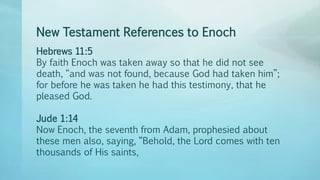
Enoch prophesied saying 
"Behold the Lord comes"

Adam and Enoch lived 308 years together, but Adam did not witness Enoch’s transfiguration because he died 57 years before the transfiguration. However, Adam probably taught Enoch what he knew about Lord God and the gospel message of salvation. 

Enoch knew a lot about the coming of the Lord, of the coming of the "seed of the woman," of "Coma," the "desired one." He not only knew that the Lord was coming, via an incarnation, but knew that there would be two comings of the Lord. The coming spoken of in the above text in Jude describes his second coming. Though it is true, as many bible teachers have said, that the idea of two comings of Messiah was not clearly understood by many in ancient times, or in the old testament period, yet they nevertheless should perhaps have understood it as Enoch. 

Enoch did understand, as did Abel, that the promised seed would come first to suffer as a sacrificial lamb, and that he would suffer the penalty, as a substitute, for the sins of all who put their faith in that illustrious seed of the virgin. But he also understood that the promised Redeemer would also destroy the wicked and all who refused to place faith in God's Messiah. All of this information about the promised Redeemer was pictorially represented in the Zodiac's twelve major constellations with their Decans or side pieces. Frances Rolleston in "MAZZAROTH; or, the CONSTELLATIONS," observed:

"It has been observed that the names of the antediluvian patriarchs, as enumerated in Genesis 5 and 1 Chronicles 1, contain the whole scheme of the Gospel. The assertion has been differently explained by different expositors; all however agree in referring it to the meanings of the names in Hebrew." (See here)

This is true, and I have written on it before. (See here) The days of the week in ancient Hebrew also carry the message of the gospel. 

The question then is this - how extensive was the preaching of Enoch and the dissemination of the first gospel? Certainly the first Zodiac, with its pictures, star names, and message was widely circulated by the antediluvian peoples, who were all star gazers and astronomers. Of course, as the prophets and the apostle Paul taught in Romans chapter one, the Gentiles corrupted the true meaning of the Zodiacal signs, and the message handed down to them about the protoevangelium. 

The questions we must also ask are this - "did Enoch preach about the coming of the seed of the woman?" And, "did he preach the gospel of salvation through that promised Redeemer?" The answer of course is yes; And, it was the preaching of that gospel that was the means of salvation for those in his day, or in the days preceding the deluge. Keep in mind that Adam and Seth, because they lived long lives, lived many years during the life of Enoch. Further, the dissemination of that gospel revelation was mostly by word of mouth, or what was orally communicated throughout the world. It is possible that it was written down also, with some of what was written down being incorporated by Moses into the Genesis record, where he acted more as an editor than as a writer of his own thoughts. 

The Preaching Of Noah

"And Lamech lived an hundred eighty and two years, and begat a son: And he called his name Noah, saying, This same shall comfort us concerning our work and toil of our hands, because of the ground which the LORD hath cursed." (Gen. 5: 28-29)

"Noah" means "rest." It also involves the idea of comfort, and of deliverance from toil, a toil which was part of the curse pronounced upon the human race as a result of the sin of its head Adam. Perhaps Lamech, Noah's father, thought that his son would be the Redeemer in much the same way that Eve perhaps thought of Cain, her firstborn. When Cain was born, Eve said - "I have gotten a man from the Lord," which may mean "I have gotten a man, the Lord." Of course, she was wrong, for Cain, rather than being the promised Savior turned out to be "of that wicked one." (I John 3: 12) 

Nevertheless, it is obvious that Eve, and every godly woman in the old testament time period, looked to be the mother of the promised Savior, "the desire of women." (Dan. 11: 37) But, in the case of Lamech, he too desired to see the Redeemer come, thinking perhaps that Noah would be the one. Certainly the prophetic language "the same shall comfort us concerning our work and toil of our hands because of the ground which the LORD cursed," well applies to the Christ. Noah no doubt offered comfort to the antediluvian sinners in his preaching the gospel message of salvation by grace through faith. Lamech, had he understood the fact of the virgin birth (as he should have from the sign of Virgo) would not have thought that Noah was the desired one, seeing he was not virgin born.

It is probably the case that the Zodiac (or Mazzaroth) was completed prior to the days of Noah. Whatever gospel revelation was written in the constellations would have been known by him. He no doubt preached, like Enoch, his great grandfather, about the coming promised Redeemer, and about how all hope of salvation was through him, and how all who placed their faith in him would be redeemed. Says the apostle Peter:

"And spared not the old world, but saved Noah the eighth person, a preacher of righteousness, bringing in the flood upon the world of the ungodly." (II Peter 2: 5)

Like his great grandfather Enoch, Noah preached about a coming judgment, which first occurred through the global flood that destroyed all but the saved, and which will occur finally, the second time, when the Lord Jesus Christ comes the second time. Again, however, the question is - "how extensively spread was the message of Noah?" I firmly believe that all, or nearly all, of the antediluvian peoples had heard the message of the protoevangelium, of Enoch and Noah. Why would we think that they had not? Of course, as we will see later in this series, the nations soon corrupted the message or else suppressed it, so that some peoples no longer had the pure revelation. 

The Abrahamic Revelation

In your seed all the nations of the earth shall be blessed, because you have obeyed My voice.” (Gen. 22: 18)

"Now to Abraham and his Seed were the promises made. He does not say, “And to seeds,” as of many, but as of one, “And to your Seed,” who is Christ...What purpose then does the law serve? It was added because of transgressions, till the Seed should come to whom the promise was made..." (Gal. 3: 16, 19)

This revelation made to Abraham was not a secret that Abraham kept to himself. The fact that the one who would save the world would bless all the nations with salvation, would be the seed of Abraham, was no doubt a prophecy that was reported far and wide, both in the days of Abraham and those following. Abraham became the father of many nations and this promise that the Redeemer of man would be born of his seed no doubt was orally communicated to his posterity. Those who believed in that promise were the ones who were given title to that promise. Again, however, as we have stated, many of his descendants did not believe the revelation, or else altered it by incorporating myth with it. 

In the same chapter in which the above promise was made to Abraham we have the story of God's tempting or testing of Abraham, wherein he told him to sacrifice his "only begotten son" Isaac upon the altar. We know that one of the purposes of this test was to reveal something about the promised seed, and the way in which that seed would effect redemption. It would be through his dying as a sacrifice, a truth that Abel also understood. It was also a picture of the fact that the promised Redeemer would be God's only begotten Son. 

"Now it came to pass after these things that God tested Abraham, and said to him, “Abraham!” And he said, “Here I am.” Then He said, “Take now your son, your only son Isaac, whom you love, and go to the land of Moriah, and offer him there as a burnt offering on one of the mountains of which I shall tell you...So Abraham took the wood of the burnt offering and laid it on Isaac his son; and he took the fire in his hand, and a knife, and the two of them went together. But Isaac spoke to Abraham his father and said, “My father!” And he said, “Here I am, my son.” Then he said, “Look, the fire and the wood, but where is the lamb for a burnt offering?” And Abraham said, “My son, God will provide for Himself the lamb for a burnt offering.” So the two of them went together.” (22: 1-2, 6-8)

The picture of Isaac, the one born miraculously, and the only begotten son of Abraham, carrying the wood up Mt. Moriah to the place where he was to be sacrificed is a picture of Christ carrying his cross to the place of his crucifixion. Also in the story, the ram caught in the thicket was a picture of Christ. The ram was sacrificed in the place of Isaac. Isaac becomes both a picture of Christ being sacrificed and a picture of the redeemed being spared by the substitution of the ram. 

"Then Abraham lifted his eyes and looked, and there behind him was a ram caught in a thicket by its horns. So Abraham went and took the ram, and offered it up for a burnt offering instead of his son." (vs. 13)

This story with its prophetic significance would have been believed and understood by believers in Abraham's day and later. In that story the gospel was being told. 

The Prophecies of Moses

“The Lord your God will raise up for you a Prophet like me from your midst, from your brethren. Him you shall hear...I will raise up for them a Prophet like you from among their brethren, and will put My words in His mouth, and He shall speak to them all that I command Him. And it shall be that whoever will not hear My words, which He speaks in My name, I will require it of him. " (Deut. 18: 15, 18-19)

Our Lord said to those who were refusing to believe in his messiahship - "If you believed Moses, you would believe me, for he wrote about me." (John 5: 46)

Those who heard the words of Moses would have the means to believe in Christ. Did some exist in Moses' day who did not hear the words of Moses? Or did not know of the protoevangelium? Or the teachings of Enoch? Or the revelation God made to Abraham? Yes, no doubt. But, does that mean it could not be found by the seeker? No. 

How far and wide did the knowledge of the prophets, from Abel to Moses, concerning the coming of the promised Savior, reach among the inhabitants of the world? I think far more heard it than many realize. Did some not hear it in its purity? Yes. Did they then die without a chance or opportunity of being saved? Well, yes and no. But, we will deal with that in the next chapters. 

In concluding this chapter, let us consider some of the leading prophecies that came after Moses. Recall how I cited these words in the preceding chapter.

“Yes, and all the prophets, from Samuel and those who follow, as many as have spoken, have also foretold these days." (Acts 3: 24)

Let us then look at some of the leading prophecies of the Messiah following the days of Samuel.

The Prophecies of Later Prophets

First, David the prophet and king had much to say about the coming Messiah. Several of his Psalms are called "Messianic," such as Psalm 2, 22, etc. Peter, on the Day of Pentecost, after the resurrection and ascension of Christ, says:

"For David says concerning Him: ‘I foresaw the Lord always before my face, For He is at my right hand, that I may not be shaken. 26Therefore my heart rejoiced, and my tongue was glad; Moreover my flesh also will rest in hope. 27For You will not leave my soul in Hades, Nor will You allow Your Holy One to see corruption. 28You have made known to me the ways of life; You will make me full of joy in Your presence.’ 29“Men and brethren, let me speak freely to you of the patriarch David, that he is both dead and buried, and his tomb is with us to this day. 30Therefore, being a prophet, and knowing that God had sworn with an oath to him that of the fruit of his body, according to the flesh, He would raise up the Christ to sit on his throne, 31he, foreseeing this, spoke concerning the resurrection of the Christ, that His soul was not left in Hades, nor did His flesh see corruption. 32This Jesus God has raised up, of which we are all witnesses." (Acts 2: 25-32)

Surely the prophecies of David were added to the prophecies of the Messiah that we have already mentioned, beginning with the protoevangelium. Surely these prophecies were taught to the people of Israel by king David, as well as to his son Solomon. Further, in the days of Solomon the queen of Sheba (Ethiopia) came "from the uttermost part of the earth" to hear the wisdom of Solomon. Surely that wisdom included the various prophecies of the coming of the seed of the woman. In fact many nations learned of the wisdom of Solomon, which we can presume included Israel's sacred writings, and the prophecies of a coming Messiah. Notice these texts:

"And there came of all people to hear the wisdom of Solomon, from all kings of the earth, which had heard of his wisdom." (I Kings 4: 34)

"Now when the queen of Sheba heard of the fame of Solomon concerning the name of the LORD, she came to test him with hard questions." ( Kings 10: 1)

"And all the earth sought to Solomon, to hear his wisdom, which God had put in his heart." (I Kings 10: 24)

“The queen of the South will rise up in the judgment with this generation and condemn it, for she came from the ends of the earth to hear the wisdom of Solomon; and indeed a greater than Solomon is here." (Matt. 12: 42)

Notice that the wisdom of Solomon, along with the sacred writings then available, were sought after by all the nations. As we will see in the next chapters, this was not uncommon, and so many more people were familiar with the word of God in those times than many think. 

The later prophets also spoke of the gospel message of a coming Messiah. There are many such prophecies, and we have no need to cite all of them. However, let us note just a few of the leading prophecies, or gospel messages, delivered by Isaiah. Isaiah is so full of gospel revelation that many bible teachers have called the writings of the prophet "the gospel of Isaiah."  

Isaiah the prophet gave the world several prophecies of the coming of the virgin's seed. Notice these:

"Therefore the Lord himself shall give you a sign; Behold, a virgin shall conceive, and bear a son, And shall call his name Immanuel." (Isa. 7: 14)

"For to us a child is born, to us a son is given, and the government will be on his shoulders. And he will be called Wonderful Counselor, Mighty God, Everlasting Father, Prince of Peace." (9: 6)

"Who has believed our report? And to whom has the arm of the Lord been revealed? 2 For He shall grow up before Him as a tender plant, And as a root out of dry ground. He has no form or comeliness; And when we see Him, There is no beauty that we should desire Him. 3 He is despised and rejected by men, A Man of sorrows and acquainted with grief. And we hid, as it were, our faces from Him; He was despised, and we did not esteem Him. 4 Surely He has borne our griefs And carried our sorrows; Yet we esteemed Him stricken, Smitten by God, and afflicted. 5 But He was wounded for our transgressions, He was bruised for our iniquities; The chastisement for our peace was upon Him, And by His stripes we are healed. 6 All we like sheep have gone astray; We have turned, every one, to his own way; And the Lord has laid on Him the iniquity of us all. 7 He was oppressed and He was afflicted, Yet He opened not His mouth; He was led as a lamb to the slaughter, And as a sheep before its shearers is silent, So He opened not His mouth. 8 He was taken from prison and from judgment, And who will declare His generation? For He was cut off from the land of the living; For the transgressions of My people He was stricken. 9 And they made His grave with the wicked— But with the rich at His death, Because He had done no violence, Nor was any deceit in His mouth. 10 Yet it pleased the Lord to bruise Him; He has put Him to grief. When You make His soul an offering for sin, He shall see His seed, He shall prolong His days, And the pleasure of the Lord shall prosper in His hand. 11 He shall see the labor of His soul, and be satisfied. By His knowledge My righteous Servant shall justify many, For He shall bear their iniquities. 12 Therefore I will divide Him a portion with the great, And He shall divide the spoil with the strong, Because He poured out His soul unto death, And He was numbered with the transgressors, And He bore the sin of many, And made intercession for the transgressors." (chapter 53)

Thus, we see how the old testament peoples had much gospel revelation available to them. Wrote Paul in Hebrews:

"For indeed the gospel was preached to us as well as to them (the Hebrews who came out of Egyptian slavery); but the word which they heard did not profit them, not being mixed with faith in those who heard it." (Heb. 4: 2)

The apostle Peter wrote:

"For for this cause was the gospel preached also to them that are dead, that they might be judged according to men in the flesh, but live according to God in the spirit." (I Peter 4: 6)

On this verse Dr. Gill commented in his commentary (emphasis mine):

"the word "dead" is used in the same sense as in the preceding verse, where it manifestly signifies such who had been alive, but were now dead in a natural sense, whom Christ would judge as well as those that will be found alive when he comes; wherefore the Gospel has been preached also to them that are already dead, as well as to those who are now alive. And by these are meant, not the dead, whose souls are in hell, for to them, there, the Gospel never was, nor never will be preached, nor they saved, as Origen, and his followers, have vainly thought...for though the Gospel had been preached from the beginning, from the fall of Adam, to certain persons, and at certain periods of time, yet not to all the individuals of mankind who were then dead, especially in the Gentile world; nor the Old Testament saints in general, who were now dead, though they had the Gospel preached to them in types and figures, in promises and prophesies; nor the men in the times of Noah, to whom the Gospel was preached by him, and who, some of them, as supposed, though they were judged and punished in their bodies in the view of men, being drowned in the waters of the flood, yet repenting and believing, upon Noah's preaching to them, they live in their spirits in eternal life, according to the free mercy and grace of God; but though the Gospel was preached to them, yet they remained disobedient to it, even all of them, but Noah's family, for anything that appears; and are styled the world of the ungodly, and are now spirits in the prison of hell, and therefore cannot be said to live according to God in the Spirit..."

So, how old is the gospel? As old as the world itself. How far was it disseminated? Very far as we have seen and will yet see further in the next chapters.

Friday, June 10, 2022

WHO ARE THE SEVENTH DAY BAPTISTS?

    Just when I think I've pretty much covered most kinds of Baptists in my studies, I have stumbled upon another kind. This week I spoke with a pastor from the Seventh Day Baptists in Rhode Island. His church is over 300 years old, meeting in the same location as their founding. The church is First Seventh Day Baptist Church of Hopkinton, Rhode Island.

   As I have stated in other articles, it never ceases to amaze me at how many kinds of Baptists there are. The Seventh Day Baptists (hereafter referred to as SDB) are not particularly unique or strange, as they are very orthodox Baptists in all areas. The only major variance is their habit of observing the Saturday Sabbath. This is because they believe the ten commandments should be followed by Christians as part of the moral Law. (As Christians we all believe this, with most believing the "Lord's Day" which is the first day of the week, has now superceded Saturday.) They are quick to point out that sabbath-keeping has NOTHING to do with salvation, and they happily cooperate with other Baptists for missions and fellowship. They are not even legalistic, like the Seventh Day Adventists, about HOW to observe the Sabbath, and do not require individuals to observe any particular standard other than attending public worship. So some may adhere to a strict observance with no tv, games, movies etc. Others may do all of those things with no judgement or exclusion. You will find the same variance among those who worship on Sunday. The Sabbath begins at sundown on Friday, in which most churches will have an evening service, followed by morning service on Saturday morning. 

   Their articles of faith state the things most Baptist confessions state, but they do not mention either predestination or free will. Most are neither Calvinist nor Arminian, much like the Eastern District Primitive Baptists, but some are calvinistic. Their tradition allows for varying views in the atonement, but they believe such thoughts should be held privately, and they abstain from preaching any kind of "ism" from the pulpit. One of their pastors wrote so eloquently by saying "Calvinism is not the Gospel. Arminianism is not the Gospel. The Gospel is the Gospel. And the Gospel says "Christ died for sinners, and all who turn to Him in repentance and faith shall escape condemnation and be saved." They simply leave their soteriology at that.

   Some of their early leaders were James Ockford, William Saller, Peter Chamberlain, Francis Bampfield, and Edward and Joseph Stennett. The first historical documentation of an SDB church is in the year 1650, at the founding of Mill Yard Church in London. Shortly after this time, the first London Baptist Confession was written, and the first time the SDB churches broke fellowship with other Baptists. This was not however due to the fact that the London Confession was calvinistic, but because the churches who adopted it required all individuals in their association to adhere to it.  They never went as far as some other Baptists in declaring non fellowship though, as they accept any Baptist baptism and all baptized by immersion are welcome at the Lord's Table. They observe two ordinances, with feet washing being optional and not considered an ordinance. In December 1671, Stephen Mumford and his wife were joined with five others to establish the first Seventh Day Baptist church in America. SDB's have been prominent in American history. One such man is Samuel Ward (1725-1776) who served as governor of Rhode Island, Chief Justice, member of the Continental Congress  and was supposed to be a signer of the Declaration of Independence, but passed away before he could do so. He was married to the granddaughter of Roger Williams, who founded the first Baptist church in America. Samuel Stennett, a prominent SDB pastor and theologian, had a Doctorate of Divinity from King's College in England, and wrote many hymns, one of which is "On Jordan's Stormy Banks I stand". Just another example of early Baptists who valued higher education and biblical studies.

   The SDB's were missions minded from the outset, sending their first missionaries in the 1760's, but their first united mission society for the promulgation of the Gospel was started in 1843. So much for the notion of the hardshells that no Baptists were involved in missions before the 1830's. Since their history goes back to 1650 at least, there can be no claim that ALL Baptists were like the Old Line Primitive Baptists are now, as many of them claim.

   Another interesting fact, is that musical instruments have always been welcome in their midst. While many of their churches were acapella in the beginning, others were not. Those churches that were, did so because they simply had no instruments. As soon as a church had the funds to buy instruments like organs or pianos, they did so. Even in Colonial America they used stringed instruments in worship. SDB's love music and it is one of their hallmarks, in that they have accepted many styles of music in their history, when many other Baptists did not. Some Separate Baptists joined their churches, before moving further south in the colonies. I believe those Separate Baptists retained this love of music when they left the SDB's and became "Sunday" Baptists. There is some evidence that Shubal Stearns was influenced by the SDB love of music and allowed instruments in his churches, which I will write about at a later date. The modern contemporary Christian music group "Citizen Way" are Seventh Day Baptists.

   In closing let me say that these Seventh Day Baptist brethren are joyful, easy, open and loving. They have a lively faith and wish for nothing more than reaching the lost. The song written by Samuel Stennett, has come to  be of great meaning to me. We sang this many times in my church growing up, and it's lyrics have greater meaning now as I get older. Read these lyrics with me, and see how they convey both a longing for that heavenly home, assurance of salvation, an asking for others to come and join the journey and be saved,and a future home where sickness and death shall be no more. I can't help but shout for joy as I sing this song now! Do you know if you have a home in heaven? Are you sure? Oh who will come and go with me?!!!!!!

1 On Jordan's stormy banks I stand,
and cast a wishful eye
to Canaan's fair and happy land,
where my possessions lie. 

 Refrain:
I am bound for the promised land,
I am bound for the promised land;
oh, who will come and go with me?
I am bound for the promised land.

2 O'er all those wide extended plains
shines one eternal day;
there God the Son forever reigns,
and scatters night away. [Refrain]

 3 No chilling winds or poisonous breath
can reach that healthful shore;
sickness and sorrow, pain and death,
are felt and feared no more. [Refrain]

4 When I shall reach that happy place,
I'll be forever blest,
for I shall see my Father's face,
and in his bosom rest. [Refrain]

Wednesday, June 8, 2022

How old is the gospel?


In all ages the gospel has been preached or disseminated and faith in it has been the means of realizing the salvation which it announces. Though the gospel message has increased in details since it was first announced, its basic elements have remained the same. The importance of understanding this is important in answering the question about the fate of those who die without hearing the gospel. The first persons to find salvation found it through faith in the gospel (Adam, Eve, Abel, etc.), as we will see. 

The gospel is as old as the garden of Eden into which the first man and woman were placed. The promise or prophecy of a savior or deliverer was made by God after the fall of Adam and Eve. In the words spoken to the serpent (who we know to be Satan) there is revealed the essence of the gospel message. That revelation is called by theologians the "protoevangelium." That word simply means "first gospel." 

"And the Lord God said to the woman, “What is this you have done?” The woman said, “The serpent deceived me, and I ate.” So the Lord God said to the serpent: “Because you have done this, You are cursed more than all cattle, And more than every beast of the field; On your belly you shall go, And you shall eat dust All the days of your life. And I will put enmity Between you and the woman, And between your seed and her Seed; He shall bruise your head, And you shall bruise His heel.” (Genesis 3: 13-15)

From this oracle we see a promised savior, one who would defeat the serpent and his seed, who would undo or remedy the damage done by the serpent. It was not merely a prophecy of the serpent's destruction and defeat, but of undoing what he had done, which is the essence of redemption. That is the way Adam and Eve and their children understood the oracle, as we will see. 

The constellation of Virgo, the first sign in the ancient Zodiac (or Mazzaroth - Job 38: 32), elaborates on the protoevangelium as understood by the first family and their immediate descendants. (See my posting here) In that sign a virgin is seen giving birth to the promised deliverer. 

A Promised Savior and Redeemer

The one who would destroy the serpent, and his work and seed, is presented as a savior and redeemer. A redeemer in old testament understanding was a near kinsman. (See our series on Redemption) So in this case, the protoevangelium presents the Redeemer as "the seed of the woman." That fact is pregnant with meaning and significance. One thing that jumps out of that expression is the idea of a person being of the seed (sperma) of a woman. In the bible a child is always the seed of the man. So, "seed of the woman" is highly unusual and therefore significant. It no doubt signifies that the Redeemer would be born miraculously of a virgin. It also gives the promised Redeemer the significant title of "the seed." Until the time of Abraham the promised Redeemer and Deliverer was known as "the virgin's seed," and "the desired one," and "the coming one." From the revelation given later to Abraham by Lord God the woman's illustrious seed became also known at "the seed of Abraham." (Gen. 22: 18)  Wrote the apostle Paul:

"Now to Abraham and his Seed were the promises made. He does not say, “And to seeds,” as of many, but as of one, “And to your Seed,” who is Christ...What purpose then does the law serve? It was added because of transgressions, till the Seed should come to whom the promise was made..." ( Gal. 3: 16, 19)

Jesus said: "Abraham rejoiced to see my day, and he saw it and was glad." (John 8: 56) Also, in Galatians Paul also wrote:

"And the Scripture, foreseeing that God would justify the Gentiles by faith, preached the gospel to Abraham beforehand, saying, “In you all the nations shall be blessed.” So then those who are of faith are blessed with believing Abraham." (3: 8-9)

Not only was the gospel announced in the garden of Eden but was also announced to others after that, such as Seth, Enoch, Noah, and Abraham. Adam no doubt was a prophet and received additional revelation about the gospel and true worship. So too with Abel and Seth. Whatever gospel knowledge they had would have been disseminated by their offspring so that it would have been known by the antediluvian peoples.  

Adam and Eve and their descendants had a basic understanding of the gospel. They believed in a promised Savior and Redeemer. Those who were saved in the days preceding the flood, up to the time of Noah, were saved by hearing of the promised Redeemer and by placing faith in him for salvation. All their hope of redemption from the curse of sin, from the work of the serpent, was in that promised seed, that "one who is to come," or "the coming one." If Adam, Seth, and Enoch (the seventh from Adam) were the ones who drew the constellations, and gave names to them and to their leading stars, then we see that their knowledge of the gospel was quite extensive. But, more on this shortly. First, let us talk about Abel.

The Faith of Abel

"By faith Abel offered to God a more excellent sacrifice than Cain, through which he obtained witness that he was righteous, God testifying of his gifts; and through it he being dead still speaks." (Heb. 11: 4)

We are told by the apostle Paul that "faith comes by hearing and hearing by the word of God." (Rom. 10: 17) He also asked:

"How then shall they call on him in whom they have not believed? and how shall they believe in him of whom they have not heard? and how shall they hear without a preacher? And how shall they preach, except they be sent? as it is written, How beautiful are the feet of them that preach the gospel of peace, and bring glad tidings of good things!" (vs. 14-15)

Since Abel had faith he must have heard the word of God. What word was that? Surely it was the word of the protoevangelium. It no doubt included faith in other oracles that Lord God gave to the first family. Who taught Abel about sacrifices and worship? Abel believed in the promised Redeemer, the one who would be born of a woman, and yet who would be the Lord himself, and who would be wounded in his heel by the Serpent and his seed, and yet thereby crush the head of the Serpent. By offering an animal sacrifice he showed that he understood how the promised Redeemer would save from the fall by himself suffering the penalty announced, which was death. 

The good news concerning the Lord Jesus Christ has been published since the foundation of the world. The ancient first sign of "Mazzaroth" (Job 38: 32), or the Zodiac, tells of the coming of the "seed of the woman" (the Virgin Maiden of Virgo). Virgo has in her right hand the Spica of Wheat or the Seed, and the name of the brightest star in Virgo means "the seed." Jesus, when referring to his coming death, said to the Greeks - "except a corn of wheat fall into the ground and die, it abides alone, but if it die, it brings forth much fruit." (John 12: 24) 

The Virgin in the constellation of Virgo also has in her left hand a "branch" and this is one of the most ancient names of the Messiah or "seed of the woman." (See Isa. 4: 2; 11: 1; Jer. 23: 5; 33: 15) The first Decan of the Virgo constellation is the sign of "Coma" and this word means "the Desired One," and which is also a title of Christ "the seed" in scripture. (See Haggai 2: 7; Dan. 11: 37) The other two Decans also testify of Christ, the divine seed who would be Redeemer, Judge, Shepherd, and be both God and man. So, the gospel revelation is as old as the garden of Eden. 

Prophets Since The World Began

From the following texts we see how the prophets of God have been in existence since the world began, extending back to the first family, and that their prophetic message included information about the coming of the promised Deliverer.

“Blessed is the Lord God of Israel, For He has visited and redeemed His people, And has raised up a horn of salvation for us In the house of His servant David, As He spoke by the mouth of His holy prophets, Who have been since the world began, That we should be saved from our enemies And from the hand of all who hate us, To perform the mercy promised to our fathers And to remember His holy covenant, The oath which He swore to our father Abraham: To grant us that we, Being delivered from the hand of our enemies, Might serve Him without fear." (Luke 1: 68-74)

From this passage of scripture we see how the prophets of God have existed "since the world began" and that they spoke concerning salvation through the promised Savior. 

“Therefore the wisdom of God also said, ‘I will send them prophets and apostles, and some of them they will kill and persecute,’ “that the blood of all the prophets which was shed from the foundation of the world may be required of this generation, “from the blood of Abel to the blood of Zechariah who perished between the altar and the temple. Yes, I say to you, it shall be required of this generation." (Luke 11: 49-51)

Notice how Abel is put in the category of prophets. It was he, along with others, who drew the constellations, and gave them and their leading stars their names. Of course, it was God who gave names to the stars (Psa. 147: 4; Isa. 40: 26), but these were revealed to Adam, Seth, and Enoch who all together gave us the names of the stars and constellations. If one studies the twelve constellations and their associated Decans (minor constellations), beginning with Virgo and ending with Leo, he will see the story of the gospel, and see that those first prophets had great understanding of the gospel. And, all the nations who studied the Zodiac would be instructed in the gospel. See J. A. Seiss's book "Gospel in the Stars."

“Repent therefore and be converted, that your sins may be blotted out, so that times of refreshing may come from the presence of the Lord, “and that He may send Jesus Christ, who was preached to you before, “whom heaven must receive until the times of restoration of all things, which God has spoken by the mouth of all His holy prophets since the world began. “For Moses truly said to the fathers, ‘The LORD your God will raise up for you a Prophet like me from your brethren. Him you shall hear in all things, whatever He says to you. ‘And it shall be that every soul who will not hear that Prophet shall be utterly destroyed from among the people.’ “Yes, and all the prophets, from Samuel and those who follow, as many as have spoken, have also foretold these days." (Acts 3: 19-24)

Again, another statement that the prophets have been since the world began and that all the prophets foretold of the days of Christ.

In the next chapter we will see how this gospel knowledge was disseminated in the antediluvian world and in the world after the flood. 

Sunday, June 5, 2022

The Prophet Job a Type of Christ (iv)


"The Patience Of Jesus Christ"

Revelation 1: 9

Job's Patient Endurance

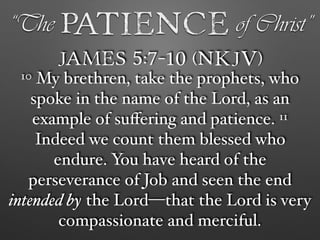
The patience of Job points to the patience of Christ. James said to the believers "you have heard of the patience of Job." Well may we also say, based upon the words of the apostle John in the Apocalypse,"you have heard of the patience of Christ."

In the above verses from James the word "patience" is twice used (kjv) but come from two different Greek words. The first is from "makrothymia." The Greek word for "patience" in the second instance is from "hypomonē."

Both words include, besides patience, the ideas of steadfastness, constancy, endurance, perseverance. In the NT hypomene is "characteristic of a man who is not swerved from his deliberate purpose and his loyalty to faith and piety by even the greatest trials and sufferings." Strong also says it denotes a "cheerful (or hopeful) endurance, constancy:—enduring, patience, patient continuance (waiting)." 

Makrothymia includes the idea of forbearance (putting up with, or tolerating), longsuffering, and also the idea of fortitude. The New KJV uses the word "perseverance" for hypomene, which is probably the best single word equivalent for it. We may also use the word "endurance." 

Patience is defined as "the capacity to accept or tolerate delay, trouble, or suffering without getting angry or upset." That certainly was exemplified in both Job and Christ. It is also true that patience is consequential from hope and expectation, from faith and belief. So the apostle Paul says "if we hope for that we see not, then do we with patience wait for it." (Rom. 8: 25) He also puts faith before patience when he says it is "through faith and patience" that the promises are realized. (Heb. 6: 12) The patience of Job was great because his faith and hope were great.

Job is famous for his sufferings, yes, but more rather for his patiently enduring those sufferings with grit, perseverance, and fortitude. But, the fortitude of Christ is greater, as the antitype is greater than the type. 

The Fortitude of Christ

"Therefore, since we are surrounded by so great a cloud of witnesses, let us also lay aside every weight, and sin which clings so closely, and let us run with endurance (patience kjv) the race that is set before us, looking to Jesus, the founder and perfecter of our faith, who for the joy that was set before him endured the cross, despising the shame, and is seated at the right hand of the throne of God. For consider Him who endured such hostility from sinners against Himself, lest you become weary and discouraged in your souls." (Heb. 12: 1-3)

Christ Jesus is set forth as an example in patience, in enduring trials and hardships, even as an innocent victim. Job too is an example, but here Christ is set forth as the greater example, a greater than Job. The fortitude of Christ and Job are our examples in patience and perseverance. 

Fortitude is defined as "strength of mind that enables a person to encounter danger or bear pain or adversity with courage." 

This is certainly true of both Job and Christ. Both showed great courage in pain and adversity. There was strength of mind, will, and character in both. They were men of focus and purpose. Think of an athlete who finishes a race in spite of an injury or severe pain. In a good article from Got Questions, in answer to the question "What does the Bible say about fortitude?" (here), the author writes:

"Although the word fortitude is rarely used in the most popular versions of the Bible, the concept is addressed often. Instead of fortitude, the word endurance, strength, or perseverance is used more often in our Bibles. Not only is fortitude a great quality, but we are commanded to pursue it (1 Timothy 6:11; 2 Timothy 2:3; 1 Peter 1:5–6)."

I agree. Fortitude is a good word to include in our list of words to define biblical patience. The same article continues:

"We are also instructed to have fortitude when being disciplined by the Lord (Hebrews 12:7). Rather than become bitter and turn away from God when He takes us through fiery trials (1 Peter 4:12), we are to endure, develop fortitude, and grow in our faith and character to be more like Christ (Romans 8:29). Fortitude is not needed on sunny days at the beach; it’s needed in the storms of life."

In this respect we should consider Christ Jesus as the greatest example of fortitude, to "consider Him who endured such hostility" from his trials and persecutions. He endured the agony of his scourgings, beatings, and death by crucifixion without the least murmur or complaint. These words of Isaiah are applicable to Christ in his agony. 

"I gave my back to the smiters, and my cheeks to them that plucked off the hair: I hid not my face from shame and spitting. For the Lord GOD will help me; therefore shall I not be confounded: therefore have I set my face like a flint, and I know that I shall not be ashamed." (Isaiah 50: 6-7)

The "grit" and fortitude of Christ are affirmed in the above words when it expresses Christ's state of mind as the setting of his face like flint. Dr. John Gill explained the meaning of this, writing:

"hardened against all opposition; resolute and undaunted; constant and unmoved by the words and blows of men; not to be browbeaten, or put out of countenance, by anything they can say or do. He was not dismayed at his enemies who came to apprehend him, though they came to him as a thief, with swords and staves; nor in the high priest's palace, nor in Pilate's hall, in both which places he was roughly used; nor at Satan, and his principalities and powers; nor at death itself, with all its terrors." (Gill's Commentary)

We see this prophesy fulfilled in the life of Christ when Luke writes these words:

"And it came to pass, when the time was come that he should be received up, he stedfastly set his face to go to Jerusalem, And sent messengers before his face: and they went, and entered into a village of the Samaritans, to make ready for him. And they did not receive him, because his face was as though he would go to Jerusalem." (Luke 9: 51-53)

Again, let us cite from Dr. Gill on this.

"or "strengthened his face", as the Vulgate Latin and Ethiopic versions; set his face like a flint, as in (Isaiah 50:7) denoting not impudence, as hardening of the face is used in (Proverbs 21:29) but boldness, courage, constancy and firmness of mind: or "he prepared his face", as the Syriac; or "turned his face", as the Arabic, he looked that way, and set forward; or as the Persic version renders it, "he made a firm purpose", he resolved upon it, and was determined to go to Jerusalem, his time being up in Galilee; and though he knew what he was to meet with and endure; that he should bear the sins of his people, the curse of the law, and wrath of God; that he should have many enemies, men and devils to grapple with, and undergo a painful, shameful, and accursed death; yet none of these things moved him, he was resolutely bent on going thither, and accordingly prepared for his journey." (Gill)

In the new testament the apostle Paul exhorts Christians, "as good soldiers of Christ," to "endure hardness" (II Tim. 2: 3). Certainly Christ, the captain or commanding general, is the great example to his soldiers in regard to such endurance of hardship and trial. He exemplifies that fortitude, courage, and endurance that soldiers need in warring. 

In the OT we see where the Lord many times said to his servants "be strong and of a good courage." (Num. 13: 20; Deut. 31: 6,7,23; Josh. 1 several times, etc.) Certainly the prophet Job showed great strength and good courage during his ordeal. So too did Christ. So should we as his servants. Wrote the apostle Peter:

"For this is commendable, if because of conscience toward God one endures grief, suffering wrongfully. For what credit is it if, when you are beaten for your faults, you take it patiently? But when you do good and suffer, if you take it patiently, this is commendable before God." (I Peter 2: 19-20)

Both Job and Christ are to be highly commended and given credit for they surely, because of conscience toward God, endured great grief, and suffered wrongfully. They took it patiently. 

In both cases, Job and Christ suffered their many ills through the agency of Satan. In both cases Satan was defeated. Neither Job nor Christ were overcome by their adversities. 

This concludes our look at how Job is a picture of Christ. 

Saturday, June 4, 2022

When I Survey

When I survey my writings (in the several blogs) I have come to some conclusions. 

First, I am fairly satisfied with what I have written. Having done lots of reading, especially in theology, I know what good writing is. It reminds me of that hard college course I took in "advanced composition." I compare my writings with those of others. I do not profess to be the best writer but I do not profess to being a novice either. I am satisfied with the content for the most part. I am also satisfied that I have generally written in correct grammar which is something that requires both knowledge and practice. 

Second, I am thankful for those who have read my writings and offered praise and criticism. 

Third, I wish I had acquired a larger audience. I have pondered on the reason for this, asking why some writings (books) have become popular while other good writings have not. Why did "A Purpose Driven Life" become popular? Why did Spurgeon's sermons and writings become popular? Why have other good writings not become popular? I am sure that some of the best writings by servants of God have become buried in oblivion, mostly because they were written by people who are not well known. Of these we may say that they are "unknown, and yet well known." (II Cor. 6:9)

Fourth, when I survey my writings against the Hardshell Baptists I have come to several conclusions. Let me enumerate some of them.

1. My writings on the history of the "Primitive" or "Old School" Baptists have shown that the overwhelming majority of such churches today are not "original" at all, and that what they now believe is not what their forefathers believed. I have shown historical proof for this conclusion. No Hardshell has come forward today with counter evidence to prove that I am wrong. I have shown how they have lied about their history, even distorting on purpose the writings of their forefathers. Elder Crouse did this in the early 20th century in regard to the beliefs of Elder John Clark and the Fulton Convention Hardshells did it in the year 1900 when they perverted the 1689 London Confession of faith. No Hardshell today has ventured to engage us on their history. Wonder why?

2. My writings against their errors on the question of means, from the scriptures, has also not been refuted. Wonder why none have come forward to defend their views and demonstrate where I have misinterpreted scripture? I have produced many texts of scripture that uproot their man made premises and propositions and yet none of them have come forward to refute them. Wonder why?

3. The only response I get from the Hardshells who do read my writings, with the exception of Jason Brown, is to make personal attacks against me. What does this say about them? Thankfully, however, there have been a few who have been helped by my writings and left the Hardshell cult and are happy about it. I only wish that more would come to see their errors.

4. I also conclude that I have done my duty to this cult by witnessing to them. When they stand before God they will be reminded of how they were warned by me and others. 

About my writings in general, when I survey them, I notice the variety of subjects I have written upon. If I published all these writings into books and pamphlets they would be many, very many. I am fairly well pleased with them and sometimes wonder why some have not been more popular. Some examples would be my series on Redemption, on the Weak Brothers, Predestination, Landmarkism, etc. They represent my legacy, my confession of faith. 

I know my remaining days are few, especially since I suffer from several maladies. But, I still feel a need to finish writing on several things. I have hundreds of draft writings. Will they ever get written? 

I thank God for brother Kevin Fralick who has been with me from the beginning of this "Old Baptist" blog and of the addition of brother Kenny Mann. I am also thankful for the support of others through the years, such as Elders Jeremy Sarber and Stephen Emmons. Sometimes when I have gotten discouraged these brothers have come forward with words of encouragement. 

Friday, June 3, 2022

The Prophet Job a Type of Christ (iii)


"He who justifies the wicked and he who condemns the righteous
Both of them alike are an abomination to the Lord." 
(Prov. 17: 15)

Job was falsely accused. So too was Christ. Both were condemned though righteous. Their accusers and condemners were therefore "an abomination to the Lord." Each condemned the innocent and the righteous, and indirectly justified the wicked.

First in the story of Job we find that "the Satan" was his chief accuser. In the Bible Satan is called "the accuser of the brethren." (Rev. 12: 10) "Satan" also denotes an adversary (which all accusers are). The apostle Peter speaks of "your adversary the Devil" (I Peter 5: 8). Peter also wrote:

"Having a good conscience; that, whereas they speak evil of you, as of evildoers, they may be ashamed that falsely accuse your good conversation in Christ." (I Peter 3: 16)

In the previous chapter (post) we saw how both Job and Christ were hated and ridiculed, mocked and persecuted. In this chapter we will focus on how both were innocent and righteous men who were falsely accused. Though Satan was the chief accuser against Job he was not the only one. All four of the men who accused Job were false accusers and were no doubt influenced by Satan. To those men Job was an evildoer, a sinner of the worst kind. So too was Christ accused, as we will see. He too was accused and tempted directly by Satan.

Job Falsely Accused

"Have I sinned? What have I done to You, O watcher of men? Why have You set me as Your target, So that I am a burden to myself?" (7: 20)

Though the word "accuse" is not used in the book of Job, yet the idea is there, as we see in the above words. Like any innocent person would do in the face of a false accusation, Job asks what are the charges against him. He asks his accusers to plainly state their charges and present the evidence to support them. So too did our Lord ask his accusers to do the same. 

"And when he had thus spoken, one of the officers which stood by struck Jesus with the palm of his hand, saying, Answerest thou the high priest so? Jesus answered him, If I have spoken evil, bear witness of the evil: but if well, why smitest thou me?" (John 18: 22-23) On another occasion he asks his accusers: Which of you convicts Me of sin? And if I tell the truth, why do you not believe Me?" (John 8: 46)

In both cases there was no evidence of guilt in either Job or Christ. The blasphemy against Job and Christ was wholly unjustified. In both cases we may say to their accusers - "You have condemned and killed the just; and he does not resist you." (James 5: 6) To his accusers Job said: "I am afraid of all my sufferings; I know that You will not hold me innocent." (9: 28)

Many commentators believe that Job is addressing God in these words. He is the "you" who will not hold Job innocent. In my view it is another example of how the majority view of commentators is not always right. Job believes that God will hold him innocent, will judge him as righteous, and will demonstrate that his sufferings were not the direct result of sin. It makes more sense to see the above words as addressed to those of his three friends who spoke previously to this time (Job chapters 4-8). Eliphaz and Bildad have rendered their judicial decisions about Job's case and they have accused Job of deserving his calamities, and that he was not innocent. The pronoun "you" is second person singular, but this does not necessarily mean the "you" is God. It could be that it is addressed to either Eliphaz or Bildad who both had just spoken. It also could be a reference to them as a single group. 

So too, many in Christ's time likewise had no intention of ever seeing Christ as an innocent sinless man. They thought he was a sinner because he ate and received sinners. They also thought he spoke blasphemy. 

To Job it was said - “There is no end to your iniquities.” (Job 22: 5). What a false accusation! So different too from the description God gives of his servant Job! Eliphaz also says:

“You have given no water to the weary to drink, and you have withheld bread from the hungry. You have sent widows away empty-handed, and the arms of the orphans you have crushed.” (Job 22: 7-8)

This was a false accusation. Job would later respond to it, and to other false accusations, in Job chapter 31. There he says:

"If I have withheld the poor from their desire, or have caused the eyes of the widow to fail; Or have eaten my morsel myself alone, and the fatherless hath not eaten thereof; (For from my youth he was brought up with me, as with a father, and I have guided her from my mother's womb;) If I have seen any perish for want of clothing, or any poor without covering; If his loins have not blessed me, and if he were not warmed with the fleece of my sheep; If I have lifted up my hand against the fatherless, when I saw my help in the gate: Then let mine arm fall from my shoulder blade, and mine arm be broken from the bone." (16-22)

Job did not fail to give water to the thirsty or bread to the hungry. He never failed to help widows and orphans! He denies the unjust accusation. Job's religion was pure religion, and which, as James said, consisted in such.

"Pure religion and undefiled before God and the Father is this, To visit the fatherless and widows in their affliction, and to keep himself unspotted from the world." (James 1: 27)

Job did remember the poor as did the apostles and all true believers. (Gal. 2: 10)

Bildad says to Job - "If you were pure and upright, Surely now He would awake for you, and make the habitation of thy righteousness prosperous." (8: 6) 

On this accusation the Pulpit commentary says:

"If thou wert pure and upright. Job had asserted this, not in so many words, but substantially (Job 6:29, 30). We have God's testimony that it was true (Job 1:8; Job 2:3); not, of course, in the sense that he was absolutely free from sin, but in that qualified sense in which "just," and "righteous," and "pure," and "holy" can be properly used of men. Bildad implies, without boldly asserting it, that he does not believe Job to deserve the epithets, either absolutely or in a qualified sense. If he were so, Surely now he (i.e. God) would awake for thee." 

Does God always come to the rescue of the innocent to save them from harm and false accusation? No, he does not. Does he always deliver the righteous from suffering unjustly and prosper him in this world? No, he does not. As I have pointed out in the series on Elihu's speeches, Elihu and the three senior friends of Job all taught what we call today the "prosperity gospel," teaching that if one is living in the will of God he will be blessed with wealth and health. 

Now let us notice how these same type of false accusations were made against Christ Jesus.

"There was again a division among the Jews because of these words. Many of them said, “He has a demon, and he is mad; why listen to him?” (John 10:19–20)

Jesus the perfectly righteous was accused of being a "demonic" person, full of evil. He was accused of being crazy or insane. Mark also records that "the chief priests accused him of many things" (Mark 15: 3).

"Now the chief priests and all the council sought testimony against Jesus to put Him to death, but found none. For many bore false witness against Him, but their testimonies did not agree. Then some rose up and bore false witness against Him, saying, “We heard Him say, ‘I will destroy this temple made with hands, and within three days I will build another made without hands.’ ” But not even then did their testimony agree." (Mark 14:  55-57)

"Many bore false witness against him." The false accusations made against Job foreshadowed those made against Christ. 

"Then the whole multitude of them arose and led Him to Pilate. And they began to accuse Him, saying, “We found this fellow perverting the nation, and forbidding to pay taxes to Caesar, saying that He Himself is Christ, a King.” (Luke 23: 1-2)

Just as Job was falsely accused and persecuted, so was Christ. So too have his followers been falsely accused and persecuted.

The Suffering Servant

Both Christ and Job may be called "suffering servants of Yahweh." Christ preeminently so, for he is the antitype and Job is the type. The sufferings of Job prefigured the sufferings of Christ. Job was a type of Christ in that he was a righteous innocent sufferer. 

Job underwent a humiliation and exaltation that finds it’s antitype in the suffering and glorious exaltation of the Redeemer. Just as God meant good for Job through his sufferings (Job 42:12), so He meant good for Christ through His sufferings. Jesus is the righteous sufferer who shows forth the righteousness of God. 

"Then the LORD said to Satan, “Have you considered My servant Job, that there is none like him on the earth, a blameless and upright man, one who fears God and shuns evil?” (Job 1: 8; 2: 3; 42: 7, 8)

Christ is greater than Job and of him it may be said in the highest sense "there is none like him on the earth." Of the righteousness, holiness, sinlessness, and moral purity of Christ, there is much testimony in scripture. Confessed Job:

“Oh, that my grief were fully weighed, And my calamity laid with it on the scales! For then it would be heavier than the sand of the sea— Therefore my words have been rash. For the arrows of the Almighty are within me; My spirit drinks in their poison; The terrors of God are arrayed against me." (Job 6: 2-4)

These words may well be applied to Christ. Oh that we would weigh fully the grief and sorrows of Christ, the suffering servant of the prophet Isaiah. Says Isaiah of the Messiah:

"By His knowledge My righteous Servant shall justify many, For He shall bear their iniquities." (Isa. 53: 11)

“Behold! My Servant whom I uphold, My Elect One in whom My soul delights! I have put My Spirit upon Him; He will bring forth justice to the Gentiles." (Isa. 42: 1)

Christ is "the Righteous One," and "the Holy One," and "the Just One" (Acts 3: 14; 7: 52; 22: 14). 

In the new testament there is constant reference to "the sufferings (or afflictions) of Christ" (II Cor. 1: 5; Col. 1: 24; I Peter 1: 11; 5: 1) In the case of Job and of the other suffering prophets there also was "suffering affliction." The time of his sufferings is called the time of "the captivity of Job." (42: 10) In like manner we may speak of "the captivity of Messiah." Turning the captivity of someone in the OT denoted a restoration of lost fortunes. Christ, after his suffering and death, was restored to the right hand of God and to all the joys and heaven. 

The sufferings of Job were in several respects. He had losses. He who was rich became poor even though righteous. So too Christ. Wrote the apostle Paul:

"For you know the grace of our Lord Jesus Christ, that though He was rich, yet for your sakes He became poor, that you through His poverty might become rich." (II Cor. 8: 9)

On the other hand, Christ is superior to Job. Job's losses and sufferings were not a result of his choice, but Christ's were by his choice. 

God treated Job as an enemy for a higher purpose. God the Father forsook Christ and treated him as an enemy in a moment of time when he was seen by God as bearing the sins of the people. So Christ prayed "My God, my God, why have you forsaken me?" (Matt. 27: 46) And so it is also written: "Yet it pleased the Lord to bruise him; he hath put him to grief" (Isa. 53: 10). 

Notice also these words of the prophet:

"I gave my back to those who strike, and my cheeks to those who pull out the beard; I hid not my face from disgrace and spitting. But the Lord GOD helps me; therefore I have not been disgraced; therefore I have set my face like a flint, and I know that I shall not be put to shame. He who vindicates me is near. Who will contend with me? Let us stand up together. Who is my adversary? Let him come near to me. Behold, the Lord GOD helps me; who will declare me guilty?" (Isa. 50: 6-9)

Job said: “God hath delivered me to the ungodly, and turned me over into the hands of the wicked.” (Job 16:11). This would be a fitting summary of what happened when the Savior was crucified, yet it was spoken by Job. Job also said:  “They have gaped upon me with their mouth; they have smitten me upon the cheek.” (Job 16:10) Again, this is another statement by Job that is very applicable to the Savior and to the above words of Isaiah.

We are told that “the Lord turned the captivity of Job, when he prayed for his friends” (Job 42:10), friends who had symbolically crucified him with words. Jesus also prayed for the soldiers who, by military order, had literally crucified him: “Father, forgive them; for they know not what they do.” (Luke 23:34)

In the next posting we will consider the patience of Job and Christ and finish this short series.