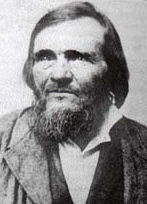

Daniel Parker or Wilson Thompson?
In the previous chapter I made an aside comment that said that Wilson Thompson was promoting several of the leading ideas in Two Seedism several years before Parker published his books on Two Seed doctrine. That does not mean, however, that Parker did not come to believe in Two Seedism before Thompson. Based solely on who published fundamental Two Seed ideas first, we must say that Thompson did in his first book "Simple Truth" in 1821, from which we cited previously in chapter XVIII. So who formulated the doctrine known as "Two Seedism" among the "Primitive" or "Old School" Baptists? Every historian, or semi historian, says it was Elder Daniel Parker, who first gave it prominence in his first book on the subject titled "Views on the Two Seeds." This book is said to have been published in 1826, and was followed by other writings of Parker on the subject. So we have: (1) "Views on the Two Seeds," (2) "A Supplement, Explanation of My Views on the Two Seeds," and (3) "Second Dose of Doctrine of the Two Seeds." He published the "Church Advocate," a newspaper, from 1829 to 1831.
In "Kentucky Baptist History, 1770 - 1922" by William Dudley Nowlin, in the section titled "The Anti-Missionary Controversy of Baptists in Kentucky from 1832 to 1842," we read (See here):
"In 1810, an old brother in Tennessee advocated in a crude form the Two-Seed Doctrine. Parker rebuked him for it, but in 1826 set forth in pamphlet an elaboration of the same views."
If this is correct, then Parker came to believe in Two Seed ideas many years before he published his first work on the doctrine. We don't know, however, when Thompson first came to believe in Two Seed ideas. Obviously Parker did not originate the ideology for the above citation says that Parker learned it from an old brother in Tennessee. Also, in earlier chapters we have seen where a couple of the leading ideas in Two Seedism were promoted by Joseph Hussey at the beginning of the 18th century. I have also stated in previous chapters that I believe that Parker was not smart enough to originate the Two Seed system by himself and so he was simply parroting what he had learned from others. I am sure that the first leading apologists for several leading propositions of Two Seedism, such as Wilson Thompson, Gilbert Beebe, and Samuel Trott, were much more learned than Parker. So, as an historian, I am trying to find the origin of this system. How many of the Calvinistic Baptists prior to the time of Thompson or Parker promoted this system?
Nowlin wrote further:
"The following quotation is taken from page 11 of a copy of the first minutes of the General Association of Baptists in Kentucky, organized at Louisville, Friday, October 20th, 1837.
"The Anti-missionary spirit owes its origin to the notorious Daniel Parker. He was the first person called Baptist that lent a hand to the Infidel, and Papist in opposing the proclamation of the gospel to every creature, and the translation and circulation of the Scriptures in all languages and among all people. Possessing a strong native intellect, and a bold adventurous imagination - with a mind cast in nature's most capacious mold, but for want of cultivation admirably calculated to be the receptacle of notions, the most crude, extravagant and chimerical, he generated an Utopian scheme of theology, the tendency of which was to subvert all practical religion. The grounds of his opposition to missions were that the devil was an eternal 'self-subsistent being' (to use his own phrase); that though God created all, yet the devil begat a part of mankind; that those begotten of the devil were his bona fide children, and to their father they would and ought to go; and of course sending them the gospel and giving them the Bible were acts of such gross and supreme folly that no Christian should be engaged in them. On the other hand he taught that the remaining portion of the human family were the actual sons of God from eternity, and being allied to Jesus Christ ere 'the morning stars sang together and all the sons of God shouted for joy' by the nearest and dearest ties of consanguinity, being no less than 'particles' of his body - bone of his bone and flesh of his flesh, the Redeemer nolens volens, take them to mansions prepared for them in bliss; and hence Mr. Parker very wisely concluded, that if such were the case, the Lord had very little use for the Bible or Missionary Societies. . .But there were many who embraced only half the doctrine of Mr. Parker and though they manifested no great apprehension for the liege subjects of the Prince of Darkness, yet they expressed great alarm lest the missionaries should help the Lord to perform his work, and convert the souls of some in a way God never intended they should be. They were such staunch friends of the Lord's doing all his work, that they set upon and terribly assailed their missionary brethren, for fear they should by some means assist the Lord in the salvation of his elect. In their zeal against these ambitious strides of the missionaries, they have occasioned great disturbance and distress - and destroying the Peace of Zion, the progress of religion has been greatly retarded, and the influence and usefulness of many ministers and churches utterly paralyzed."
There are several observations to be made about some of the statements above, some of which I have put in bold type. First, Parker was not against preaching the gospel to all nor to the church sending out men to be missionaries. Second, the minutes of the General Association says that Parker "generated" his scheme, but I find that not to be clearly established, for we have seen how several of the leading ideas in Two Seedism preceded Parker. Further, Parker was not opposed to the printing and circulating of the Bible, but felt like it should be done by the churches or by the government, and not by societies. Finally, as we will see, Daniel Parker does not seem to have denied that the preaching of the Gospel was a means in the eternal salvation of the elect, though other Two Seeders would embrace that view and promote it.
It is also to be noted that Daniel Parker did not seem to deny that God uses the means of gospel preaching to save his elect, although many Two Seeders who followed him would come to take that position, as we will see in upcoming chapters. Parker also was not against sending missionaries, but believed that they should be under the control of the local church or association.
We do see from the above that he held to the eternal union of Christ and his elect, and so believed in the preexistence of Christ in his humanity and of the elect.
About Parker believing that the Devil was eternal and uncreated, we will have more to say shortly.
In "DANIEL PARKER'S DOCTRINE OF THE TWO SEEDS" by 0. Max Lee (1962), his Thesis Paper (See here), a well written and scholarly work on Parker, and who had access to nearly all of Parker's writings, wrote the following, citing from Spencer's history of Kentucky Baptists (all emphasis mine):
"Parker is as well-known for his two-seed views as for his anti-missionism. He published Views on the Two Seeds in 1826. The following year he published the Second Dose of Doctrine of the Two Seeds. Described as a modification of ancient Manichaeism, these two works attempted to prove that the two existing spiritual principles of good and evil were eternal and self-existing." (pg. 11)
Lee writes further:
"While seeking an answer to this question, Parker heard of a strange doctrine called the two seeds. First hearing of the two-seed doctrine from an unnamed brother in Tennessee, Parker vacillated between acceptance and rejection of the doctrine, coming at last to believe that God had revealed it to him for some special purpose. Having come completely to accept the doctrine, he determined "to proclaim on the house top, that which had been revealed to me in secret." (pg. 37-38 - citing from Parker's periodical "The Church Advocate")
So, we see that Parker did not originate the doctrine of the Two Seeds. The question then is, who did? Where did this brother from Tennessee get it? Where did Wilson Thompson get it? We have shown that the idea of the preexistence of souls was not new, nor the idea that Christ in his human nature preexisted his incarnation was not new, and the idea of some kind of eternal union between Christ and his elect was also not new. It is also interesting that it was in eastern Tennessee where Parker learned of this doctrine, and this was an area where Two Seed ideology was widely believed by Predestinarian Baptists, such as in the Powell's Valley Association, about which I have in years past written about, citing from "The History of the Baptists of Tennessee" by Lawrence Edwards (August, 1940). You can read that (here). This is the same association that my father and I were once part of and from which we were excluded over father's belief about the "origin of Satan." Father believed that Satan was a fallen angel, and this was opposed by many in that association, a fact that showed that Two Seed thinking was still prevalent in that association towards the end of the 19th century. I write about all this in my second chapter of my series, or book, "The Hardshell Baptist Cult." (See here)
Lee writes further, citing from Parker's second book "Second Dose":
"Parker believed that good and evil had two separate sources. There are two causes or sources from whence causes and effects do flow, these two causes are opposite, one to the other, both are mysteries, and we have no knowledge of either, only as they are revealed and made known to us. One is the mystery of Godliness, and the other the mystery of iniquity. And neither can produce any- thing opposite or contrary to its own nature." (pg. 40)
Continuing to cite from "Second Dose" Lee writes:
"Parker emphatically declared that God did not create Satan. Furthermore, he stated that Satan was self-existent: "There is an existing opposite to Jehovah, which never did receive its origin from God, the fountain of perfection. If the Devil were not self-existent, Parker held that God must have made him; if such were true, Parker said that he "would as soon believe that there was no god. To hold that God was responsible for the creation of Satan, Parker surmised, would make God the author of both good and evil." (pgs. 40-41)
So, it is quite obvious that Parker did believe that Satan was uncreated and self-existing. He says that God did not create Satan. Does he mean that God did not make Satan an evil being or that he did make him but he became Satan by sin? Surely Parker believed that God made Adam and yet Adam became evil, so why could he not see that it was the same with Satan and the fallen angels?
Lee writes further:
"Having proved to his own satisfaction that Satan was self-existent, Parker insisted that Satan, although powerful, was not equal with God." (pg. 42)
Again, citing from "Second Dose" Lee wrote:
"According to Parker, "the nature and certainty of the relationship or union which exists in Christ with his Church" was a crucial issue in his two-seeds doctrine. Parker said that an eternal oneness existed between Christ and His Church." (pg. 55)
This being true, it gives further credence to my contention, stated in the first few chapters, that the idea that Christ existed as a composite being of human and divine natures from some point in time from eternity past was taught by Joseph Hussey and Samuel Stockwell and Isaac Watts, etc., as we saw in chapter VII. This led to the idea that God's elect were also in Christ and joined to him in eternity past.
Again, citing from "Second Dose," Lee cites these words of Parker:
"I wish to be understood as believing, and now aiming to prove, that Christ and his Church are one; and if they are now, or ever will be one, that, that oneness has existed as long as Christ has existed, as it is as impossible for a head to exist without a body, as for a body to exist without the head." (pg. 55)
"This oneness or union, while existing prior to God's creation, was demonstrated in the creation itself." (pg. 55)
As we have seen, this was the view of Beebe and Trott as promoted in their writings in the "Signs of the Times." It is one of the leading tenets of Two Seedism.
I have written about the Bear Creek Association, here in North Carolina, of which I was once a member, and how it once held strongly to Two Seedism, and even now has an article of faith that is clearly expressive of Two Seedism. (See my posting here) It is titled "Bear Creek Association & Two Seedism." I have also cited from Elder Hosea Preslar, an opponent of Two Seedism and an associate of Elder John Watson, and who was once living in the area of the Bear Creek and testified to its Two Seedism when writing to the periodical "The Primitive Baptist." (See here) That article of faith reads as follows:
"Art. 2. We believe in the man Jesus being the first of all God's creation and the pattern of all Gods perfection in nature, providence, grace and glory, and in relative union with the Divine Word, and thus united with the whole Trinity."
We have seen how the belief that Christ, in his humanity, was created or begotten by God some time in eternity past, was taught by Hussey, et. al. From the above it is also said that God created the cosmos and Adam after the image of this preexistent Christ. This scheme, as I have stated in previous chapters, makes Christ to be the first Adam, rather than the second or last Adam, and makes Adam to be the second Adam rather than the first Adam.
Lee writes further, citing from Parker's book "Views":
"Having come into the world, the Church sinned. Adam, who stood with the Church (the elect) in him, partook of the forbidden fruit, causing him and the Church to deserve God's wrath. But because of Christ's union with and love for the Church, he married her human nature, assumed her debt of sin, and redeemed her from the curse of the law. Such a manifestation of love, while having no equal, was a logical outgrowth of the eternal union which existed between Christ and his Church." (pg. 56)
We have seen how Beebe argued at length on this point, affirming that since the church (or the elect) were already the wife of Christ in eternity, Christ as husband was obligated to assume her debts. We have also stated that those who opposed Two Seedism saw this as overthrowing election by grace, or unconditional election, since Christ was obligated to save his wife. In upcoming chapters we will see Lemuel Potter argue this in his rebuttals against Two Seedism.
Next I want to cite from the "Primitive Baptist" periodical for November 21, 1838 and from a letter sent to it by Elder Richard Newport (New Harmony, Indiana; Sept. 25th, 1838 - See here), who was a close associate of Parker and who wrote to correct a previous letter to that periodical that he believed had said erroneous things about Parker. That letter was written by a brother named J.H. Parker.
Newport writes (emphasis mine):
"I do know, and that is, that Mr. J. H. Parker is a very unguarded writer; and if he is always as unguarded in writing and speaking, he is entirely unworthy of confidence. I allude to his remarks in reference to "a certain Daniel Parker," who Mr. J. H, P. says, was an esteemed Baptist preacher in Kentucky, &c. I answer, D. Parker never lived in Kentucky. He once lived in Sumner county, Tennessee, where his labors were abundantly blessed and his memory is yet fondly cherished by sound Old School Baptists. Mr. J. H. P. says, D. P. "went off in a doctrine of his own," "and published a pamphlet called the First Dose, and immediately another called the Second Dose." D. Parker published a pamphlet in Illinois, entitled, "Views on the two seeds, taken from Genesis, 3 chap. 15 v." And some time after, another, entitled, "The Second Dose of doctrine on the two seeds."
"Mr. J. H. P. says, that Daniel Parker taught through those pamphlets and in his preaching, that the "devil was from everlasting a self existing being, equal to God in power, wisdom and glory." D. P. never wrote, published, nor preached such a doctrine. He has given it as his opinion, that God is not directly nor indirectly the author of sin and corruption, consequently that corruption exists in itself, the fountain from whence all evil flows; but that the devil is equal with God he positively denies; neither has he given utterance to one sentence, from which any candid man, possessed of common sense could infer such an idea."
Obviously Newport wants to defend his friend Daniel Parker. He does not deny that Parker taught that the Devil was not originally created by God, and never, "directly or indirectly," was the cause of his existence and his being evil. However, this belief of Parker does make Satan equal with God as far as being uncreated. It is true that Parker never said that Satan was equal with God in power. Newport tries to soften the views of Parker by saying that this was merely Parker's "opinion," as if Parker did not push his views on others.
Newport writes further:
"Mr. J. H. Parker says, "he then moved to the State of Indiana," &c. D. P. never moved to the State of Indiana. He did move from Tennessee to Crawford county, Illinois; where he lived many years before he published those pamphlets, which, according to J. H. Parker he published in Kentucky. Daniel Parker did publish a monthly periodical, entitled, "The Church Advocate," two years, in which he vindicated the doctrine of the Old School Baptists, and boldly and successfully opposed the missionary legerdemain, and particularly that of lying and misrepresentation, before there was another periodical of the kind in the United States."
As I have written in time past in my blog "The Old Baptist Test" Elder Newport was himself a Two Seeder. I wrote this back in 2011 in my series on "Hardshells & Predestiation" saying - "Elder Newport was part of the "Two Seed" faction and aligned with Elder Daniel Parker, one of the first founders of the Hardshell denomination." (See here) Though he denied the doctrine of the "absolute predestination of all things" that Beebe believed, he did believe in the foundational ideas of Two Seedism. What is interesting in this letter to the "Primitive Baptist" is Newport's testimony that says that Parker, in promoting his Two Seed views was stating what was "the doctrine of the Old School Baptists." So, again, we ask - "when did Two Seedism begin among the Baptists?" Was it believed in the 17th or 18th century? We know that one element of it was taught by Hussey. But, what of the other tenets?
Newport continued:
"Mr. J. H. Parker says, "he then moved to Mexico, and the last I heard of him the Spaniards killed him on account of his doctrine." D. Parker moved from Illinois to the province of Texas, where he now lives, (or did some six weeks ago,) beloved by his acquaintances as a valuable and useful citizen, and admired by the sound Baptists as a plain, consistent and faithful gospel preacher. Several Old School Baptist churches are the fruit of his successful labors in that country."
When Parker moved to Texas, it was not a state nor part of the United States, but was a part of Mexico. So, in this respect, J.H. Parker was not wrong. Notice again that Newport says that Parker was a sound Baptist who was admired by all such.
In Lamote, Illinois, on July 26, 1833, elders Richard M. Newport and Thomas Young, and deacons Richard M. Highsmith, William Grigg, Joseph Neal, Jesse Page, John Wood, and Fredrick Markley organized the Pilgrim Predestinarian Regular Baptist Church. (See here and here for source) It was this church that in whole followed Parker to Texas and became the first church in Texas. Mexico forbade the organization of Christian churches and to get around that decree the church was organized in Illinois before moving to Texas.
Newport continued:
"Having lived a neighbor to Elder Daniel Parker fourteen years in Illinois, I think I know him. His memory is fondly cherished by thousands of sound Old School Baptists in this country, but hated and traduced by Arminians and modern missionaries."
Elder Newport was a leader in the Wabash Association of Illinois which Parker was also a part of. The Primitive Baptist Library of Carthage, Illinois, writes the following under the title "History of the Wabash District Baptist Association" (See here) and the subtitle The "Two-Seed" Doctrine Was NOT the Issue":
"After careful study, we find no indication that the "two-seed doctrine" had been raised as an issue in the division of the Wabash Association in 1823. No mention of the doctrine of two-seeds is found in the Association minutes, nor in Parker's early writings, viz., A Public Address (1820), Plain Truth (1823), or The Author's Defence (1824). Parker's Views on the Two Seeds was published three years later, in 1826, followed in 1827 by his Second Dose of Doctrine on the Two Seeds, and A Short Hint, which was his reply to Thomas Kennedy's "Explication of Proceedings at Lamotte Church." Without proof to the contrary, we must assume that pro-missionary historians and writers who attribute the division to Parker's views on "two-seeds," are merely using propaganda to advance their cause."
If it is true that Parker did not believe or preach his view on the Two Seeds prior to 1826, then clearly Wilson Thompson believed and taught several of the leading tenets of Two Seedism years prior to Parker. One wonders whether there was collusion between Parker and Thompson after Thompson wrote his first book in 1821 promoting eternal vital union, preexistence of the souls of the elect, and preexistence of the humanity of Christ. Though Newport is right about Parker not living in Indiana, yet the place where Parker lived in Illinois is on the border with Indiana. Thompson, though laboring in Ohio (and also in Missouri for a while), was heavily involved in preaching in Indiana and influential in the Whitewater Association in that state. The Primitive Baptist Library writes about this. (See here) Thompson led the anti mission part of that association when it split and elder John Sparks the Mission side. They held a debate on the question of means in regeneration in the mid 1840s and a court trial was held about the church property, the court siding with the Missionary side.
Newport wrote further:
"But when Mr. J. H. P. has appeared in the Primitive Baptist, a paper I love and admire for the truth's sake, I felt bound to take notice of him, and to admonish him, before he writes again to be sure he knows what he is writing about, and to write the truth. Brother Bennett, I am in haste. Yours in the best of bonds."
As I have stated in previous chapters, it seems that the "Signs of the Times" periodical was the leading voice for the Two Seed wing of the newly formed "Old School" or "Primitive" Baptist denomination, but the periodical "The Primitive Baptist" represented the opponents of Two Seedism. However, men on both sides often wrote to each periodical. As we will see in future chapters, Elder Joshua Lawrence, the leader in the Kehukee Association and leading writer of "The Primitive Baptist" was against Two Seedism along with its first editor Mark Bennett, who would later leave the Hardshells and joined the Mission Baptists.


No comments:
Post a Comment