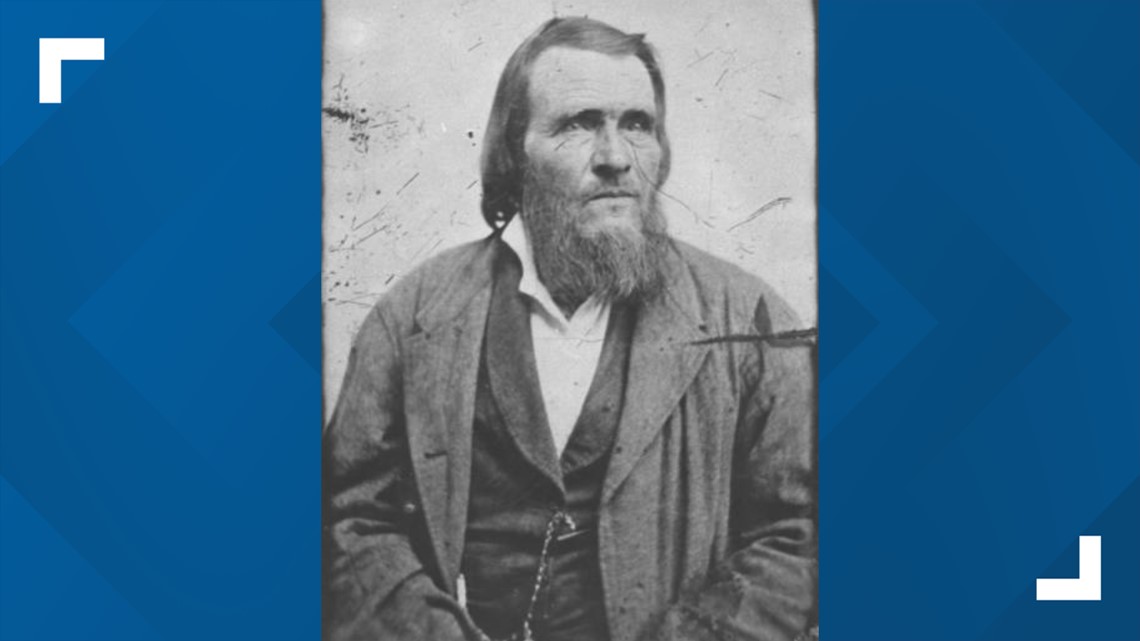
In this chapter we will review some of the things that are written in a book titled "DANIEL PARKER'S DOCTRINE OF THE TWO SEEDS" by 0. Max Lee (1962) in his Thesis Paper (See here), from which we previously cited. Following this we plan to begin a few chapters giving the rebuttals that some "Primitive Baptists" made against the Two Seeders. We have already in earlier chapters cited from Elder John M. Watson and his book "The Old Baptist Test." We will have some more citations from him, along with Elders Joshua Lawrence, George Stipp, Lemuel Potter, Grigg Thompson., S.F. Cayce, C.H. Cayce, Hosea Preslar, etc.
Wrote Lee, referring to what Parker wrote on page 4 of his book "Views on the Two Seeds" (all emphasis mine):
"It disturbed Parker to think that a creature made by God might suffer eternal punishment. Baptists believed, so Parker contended, that God chose his elect in Christ before the world began. But what about God's relationship with the non-elect? Surely God would not condemn those whom he had created in his own image." (pg. 25)
In Parker's case, he believed his Two Seed doctrine was the only answer to the problem of evil and to how a benevolent and loving God could send anyone to Hell forever. One wonders why he did not simply become a Universalist like some "Primitive Baptists" did in later years. Perhaps he felt like the scriptures so plainly taught eternal punishment for some so that did not become an option. Why then did he reject the belief that God sends some men, who are created in the image of God, to Hell, seeing that this is what divine justice demanded? This is somewhat bewildering. Why did his brethren not educate him on this point?
His conviction that "God would not condemn those whom he had created in his own image" must have been why he also denied the creation and fall of the angels, or of the fall of Satan. The view Parker accepts as the solution was no real solution, for it involved a denial that all men, those who are elect and those who are not, are created by God and in his image. He must deny that all men were created by God, and if not created by God, then by who? This no doubt is why some Two Seeders denied that those of the seed of Satan had souls, were not really humans created by God. So, not only does his solution force him to believe that Satan was not created by God, but so too were most of the human race. The scriptures are clear that all men, whether they be children of Satan or children of God, are God's creation.
Lee wrote further, alluding to what Parker wrote in the Volume II of his paper "The Church Advocate" in 1831 (pg. 279):
"As Parker continued to ponder the problem, a possible solution presented by an "old brother" continued to come to him, only to be rejected each time as heretical. The scriptural basis of this possible solution was found in Genesis 3:15: "And I will put enmity between thee and the woman, and between thy seed and her seed." Was it possible that two kinds of offspring were implicit in the verse? Could it be possible, then, that those who were eternally punished were not God's creation after all, but were a product of Satan? When Parker became convinced that such was the case, he marveled that this scripture had been used so infrequently by preachers. As he read other scriptures, it seemed obvious that there were two eternal principles, good and bad, as seen in God and the Devil. The two seeds in Genesis must indicate the two lineages from which had originated the people of the earth. Thus, the elect, God's children, came from God's seed, which resided first in Adam and later in Eve. Satan's children, the non-elect, sprang from Satan's seed which also came through Adam, but only after God had multiplied Eve's conception that she might bear the non-elect in addition to bearing the elect." (pg. 25-26)
How could he deny that God made all men when it is so plainly taught in scripture? Paul, while in Athens, Greece, said: "And He has made from one blood every nation of men to dwell on all the face of the earth." The Two Seeders often say that Cain was of the seed of Satan, therefore not created by God, but this is absurd. God created Cain and Abel, so the difference in them was not owing to their original creation but due to their acceptance of God and his redemption or rejection of it. In Colossians 1: 16 Paul says that "all things were created" by the Lord, but Parker and the Two Seeders must deny this plain truth. Notice also these texts:
"Whoever sheds the blood of man, by man shall his blood be shed, for in the image of God has God made man." (Gen. 9: 6)
"With the tongue we praise our Lord and Father, and with it we curse human beings, who have been made in God’s likeness." (James 3: 9)
Would it not be absurd for a murderer to say in court -- "Judge, I killed him because he was a child of the Devil and therefore not a human being who was made in the image of God"?
Parker says that Satan created those humans who were his children, being his product. He therefore believes in two creators. So, not only is Satan uncreated as is God, but he is a creator like God.
Wrote Lee, citing from both the "Church Advocate" vol. II for November 1830, page 41 from "Views on the Two Seeds" for December, 1830, page 64:
"Parker emphatically declared that God did not create Satan. Furthermore, he stated that Satan was self-existent: "There is an existing opposite to Jehovah, which never did receive its origin from God, the fountain of perfection. If the Devil were not self-existent, Parker held that God must have made him; if such were true, Parker said that he "would as soon believe that there was no god. To hold that God was responsible for the creation of Satan, Parker surmised, would make God the author of both good and evil." (pgs. 40-41)
This teaching of Parker is a heresy of the worst kind. To deny that God is the creator of all is so clearly against what the Bible teaches. Not all Two Seeders would affirm such, most of them avoiding the topic of Satan's origin.
Wrote Lee:
"Having proved to his own satisfaction that Satan was self-existent, Parker insisted that Satan, although powerful, was not equal with God." (pg. 42)
However, if Satan is uncreated and self-existent, then he is equal with God in those respects.
Again alluding to Parker's "Church Advocate" vol. II for June 1831 (pg. 210) Lee wrote the following under the title "A Doctrine of the Non-Elect":
"Parker's concept of the two-seeds, then, is a doctrine of the non-elect. But instead of contending that the children of Satan are eternally damned, as has been charged, the doctrine teaches that they may come to salvation. For the non-elect stand on the same ground that the Armenian [sic] says the whole world stands on, for Christ rejects none that comes to him for salvation on gospel terms, and those that seek shall find. And since the non-elect may come to Christ for salvation, their condemnation, if they are condemned, will be their own responsibility. They will be justly condemned, not because they are the serpent's seed, or that God had reprobated them to destruction before they were born, but because of their sins and acts of wicked rebellion against God, for they shall be judged according to their works. In order that the non-elect might be without excuse, Parker urged every Christian to witness to the lost." (pg. 26-27)
All this is quite interesting. Parker shows how inconsistent and contradictory he was. He says on the one hand that because they are children of Satan that they will undoubtedly go in the way of Satan, and yet says on the other hand that they may be saved and become children of God. Truly "the legs of the lame are not equal" in his views.
Lee writes further about Parker's belief that the children of Satan may be saved, citing again from page 38 of Parker's book "Views on the Two Seeds":
"And notwithstanding the doctrine of election is true, it is the duty of christians [sic] to exert themselves to show sinners their need of Christ, as though it was in their power to do it--while they should engage at a throne of grace, that God may bless their labors, for God works through and by his people; and all that christians [sic] can do is to obey...And the preachers of the gospel should realize that it is their business to preach Christ, the Saviour of sinners, and urge the necessity of repentance towards God and faith in Christ...And each saint, though ever so small, should know that there is something for them to do in the church of Christ; if they cannot preach they can pray--for the preacher is wholly defendant [sic] on the Lord for the success of his labor." (pg. 27)
Some Two Seeders agreed with Parker. Others however began to say that God does not use people or preachers to urge sinners to believe and repent in order to be saved. This is the opinion of nearly all "Primitive" or Hardshell Baptists today. Not that it was always so, for most of the first generation of anti mission Baptists believed that God did use means to bring about the new birth. For instance, Elder W. M. Mitchell of Alabama, a leading elder of "Primitive Baptists" in the early to mid 19th century, also insisted on the necessity of faith and repentance for salvation, as did Beebe and Trott. I have previously cited from Mitchell on this in a post I made in the "Old Baptist Test" blog (See here). He wrote the following in the paper "The Southern Baptist Messenger" that was begun by Gilbert Beebe's son William L. Beebe and was a periodical that promoted Two Seed ideology. Wrote Mitchell:
"The saving of sinners from their sins with an everlasting salvation is a great work, but God is a Great God and all his works are great. When it is said that “salvation is of the Lord” it is thereby declared that everything pertaining to salvation from first to last is of him. There is no salvation without the choice of God in Christ. He hath therefore from the beginning chosen us unto salvation through sanctification of the Spirit and belief of the truth...In conclusion, let us not overlook the fact that in order to salvation, it is necessary that we be born again; that we have faith, repent and believe in the Lord Jesus Christ; but as salvation is of the Lord, these things are as much of him as our redemption, calling or justification, for his “divine power hath given us all things that pertain unto, life and godliness.” 2 Pet. i. 4. “He that spared not his own Son, but delivered him up for us all, how shall he not with him also freely give us all things ?”"
You can read that issue of that periodical (here).
Lee writes further, still citing from Parker's book "Views":
"Then if children of Satan may be saved, and if the preachers are urged to exhort sinners to repentance, what good has election done? Parker answers very simply, "It has saved thousands..." (pg. 27-28)
When Parker says that the children of Satan may be saved by faith and repentance, he obviously means that they may be saved hypothetically.
Wrote Lee, still referring to Parker's book "Views":
"Another obvious question arises. If both the elect and the non-elect may be saved, what is the difference, if any, in the process of salvation for the two groups? The difference is that for the elect, God prompts their hearts to repentance through the working of his Divine Spirit. This Spirit is brought to bear on the life through the medium of the preached word. God not only ordained that the Divine Spirit would work on the individual heart; he also ordained that the Divine Spirit would gain its entrance to the heart through preaching. The non-elect receive no such prompting, however, from God's Spirit. As they were the product of sin, and not included in the covenant of grace, the sovereignty of God is not bound to bring them to the saving grace in Christ, but consistent with his divine perfections, can let them alone under the common calls of the gospel." (pg. 28)
A few things need to be pointed out in regard to these remarks. In believing that God used "the medium of the preached word" to save sinners Parker was in league with nearly all of the first "Primitive" or "Old School" Baptists. It would later change, as many Two Seeders began to deny means in the eternal salvation of sinners. Further, we can see where Parker speaks out of both sides of his mouth. He says the children of the Devil may be saved, but then says such things as the above, which affirm that they cannot be saved.
Wrote Lee further, still citing from Parker's "Views on the Two Seeds":
"The question then arises, "Will the non-elect be saved, even though their salvation is possible, if God's Spirit does not prompt them to repentance?" Parker would answer that they follow the will of their father, the Devil. Now if they (the non-elect) will, they may come, and it is their duty to obey the gospel and come; and if they will not, they are justly condemned, for God is as willing to save them, as they are to be saved, by Christ. Then why should they complain of injustice in God, when the fault is in themselves. But will they come? What is their will, but the will of their father, the Devil? And God is not bound to bring them, but consistent with his divine perfections--can let them alone to fill up their cup of wrath, against the day of wrath, etc. And thus let alone, their will is to follow their father, which they do." (pg. 28-29)
Parker believed it was the duty of all to obey the Gospel. Most "Primitive Baptists" today do not believe such, saying it is "Fullerism," believing rather the view of Joseph Hussey who denied that it was the duty of all to believe the word of God and that God does not offer salvation to all through the Gospel. Samuel Trott, who we have cited much in earlier chapters, did believe as Parker. I showed this in a post I made a few years ago (See here). In that post I wrote:
In an article in the "Signs of the Times" periodical for 1839, titled "Duty Faith & Repentance. An enquiry concerning the duty of the unregenerate to believe, repent or pray," (see here) Trott wrote: (emphasis mine)So, for today's "Primitive Baptists" to reject this belief and declare non-fellowship for those who believe like Parker and Trott, they show that they are not "Primitive" at all. I have written on this subject several times over the years. For instance (See here). I showed that if it is not a duty to believe the word of God, then it is no sin to disbelieve it. Many of the Two Seeders who would follow Parker, however, would both deny means in salvation and duty faith.
Again, notice the contradiction. Parker believed that the children of the Devil can be saved, and ought to be exhorted to believe and repent, and yet says that the children of the Devil will invariably follow their father the Devil.
Wrote Lee, citing from Parker''s "Supplement or Explanation of MY Views on the Two Seeds":
"However, being a child of Satan does not, of itself, bring condemnation. As the non-elect spring into existence by the power of God through the express creation of God, although they are the seed of the serpent, yet they are human beings, and no less accountable to God, nor no more doomed to eternal wo [sic], than if they had been the express creation of God in the display of his sovereign goodness, and not elected or chosen in Christ." (pg. 29)
Here is more contradiction. He doesn't believe God created the Devil or his children (the non-elect) and yet says that they "spring into existence by the power of God through the express creation of God." Then, after saying that, he says just the opposite, saying "IF they had been the express creation of God."
Wrote Lee, citing from Parker's "Second Dose...":
"In contrast with the failure of the non-elect to come to Christ for salvation, the elect will be brought by God to salvation so that not a single one of them will be lost. Eternal life will be enjoyed by all the elect; eternal punishment will be endured by all the non-elect. This destiny of the non-elect was not determined by a decree of God which foreordained each of them in particular to condemnation; rather it will be self-imposed in that each of the non-elect will refuse to believe in Jesus Christ. By such an explanation, Parker provided what to him was a logical and biblical understanding of the elect and the non-elect." (pg. 29-30)
"Each of the non-elect will refuse to believe in Jesus Christ." If that is true, then again he contradicts himself, for he has said that they may be saved, as we cited his words earlier when Lee wrote: "Then if children of Satan may be saved, and if the preachers are urged to exhort sinners to repentance, what good has election done? Parker answers very simply, "It has saved thousands..."
Of interest in the above citation is the fact that Parker seems clearly to affirm that people must "believe in Jesus Christ" to be saved. How can today's "Primitive Baptists," with few exceptions, say that their forefathers taught as they do, that believing in Christ is not necessary for salvation?
Wrote Lee:
"Parker's actual writing of the two-seed views came after his anti-mission efforts had been successful in both Tennessee and Illinois. While declaring the certainty of God's election and while preaching against the mission efforts of the day, he became increasingly dissatisfied with the current doctrine of the non-elect. How could it be honorable for God to condemn some of his own creation to eternal damnation?" (pg. 37)
Does the above indicate that Parker did not believe and preach Two Seedism when he lived in Tennessee, and prior to moving to Illinois?
Citing from William Warren Sweet, The Baptists, 1783-1830, Vol. I: Religion on the American Frontier (Chicago: The University of Chicago Press, 1931), pp. 75-76, Lee wrote:
"According to Parker, "the nature and certainty of the relationship or union which exists in Christ with his Church" was a crucial issue in his two-seeds doctrine. Parker said that an eternal oneness existed between Christ and His Church." (pg. 55)
He then cites these words of Parker:
"I wish to be understood as believing, and now aiming to prove, that Christ and his Church are one; and if they are now, or ever will be one, that, that oneness has existed as long as Christ has existed, as it is as impossible for a head to exist without a body, as for a body to exist without the head." (pg. 55)
This is the core tenet of Two Seedism. Christ, as a Mediator, was a begotten or created being, composed of both human and divine natures, and his Church was begotten or created in him at that same time in eternity past. Other tenets of Two Seedism are by-products of that chief tenet.
Lee then writes:
"This oneness or union, while existing prior to God's creation, was demonstrated in the creation itself." (pg. 55)
This is exactly what the article of faith of the Bear Creek Association stated in their 1832 articles of faith, as we have seen.
Wrote Lee:
"Having come into the world, the Church sinned. Adam, who stood with the Church (the elect) in him, partook of the forbidden fruit, causing him and the Church to deserve God's wrath. But because of Christ's union with and love for the Church, he married her human nature, assumed her debt of sin, and redeemed her from the curse of the law. Such a manifestation of love, while having no equal, was a logical outgrowth of the eternal union which existed between Christ and his Church." (pg. 56)
If the elect or church actually existed with Christ in eternity past, and was in union with Christ then, why the need to be united to him now? If their sins "separated" them from Christ or God (Isa. 59: 2), then they were no longer united to him. Such a doctrinal view denies that sinners are united to Christ by faith, or when they are regenerated or born again. If the elect were already married to Christ from eternity, why the need to exhort them to become joined to Christ in marriage? Did not Paul say, as we have previously shown, that he had "espoused" the Corinthian believers to Christ? (II Cor. 11: 2)
Lee wrote:
"The only extant attempt to refute the two-seed view was written by John Watson in 1855. However, this refutation was not of Parker's two-seed views; instead it was the refutation of a distorted form of the two-seed views as embodied in certain churches." (pg. 62)
I don't believe that is accurate, as a reading of Watson's book "The Old Baptist Test" shows. I agree that many of those who later embraced Two Seedism included other heretical ideas into the system that Parker did not originally believe, such as not believing in means and in preaching to and exhorting the lost, and denying the resurrection of the body, etc. Watson does show that Parker and many of his followers did believe that the Devil was not created by God, an idea that some Two Seeders would later not affirm.
Lee wrote:
"Of all the secondary sources, Watson's description of the two-seed views most nearly coincided with Parker's actual writing. However, it reflected many of the misunderstandings current in the 1850's." (pg. 62-63)
Again, I don't think Lee is right in what he says about what Watson wrote in "The Old Baptist Test." Watson accurately described the views of Parker and of those in Tennessee who became Two Seeders.
Lee wrote:
"In seeking to refute the two-seed views, Watson understood the doctrine to include (1) the denial of the resurrection of the bodies of the just and unjust, (2) the absence of souls in the non-elect, and (3) the rejection by God of the use of any kind of means to bring about salvation. Parker had explicitly taught the opposite in his two-seed views." (pg. 63)
Watson never did say that Parker himself denied the resurrection, nor that the souls of the non-elect had souls, nor that God used means in salvation, but he did say that this is what Two Seeders who followed Parker added to the Two Seed system of Parker.
Lee wrote:
"Some groups which held generally to the two-seed views rejected certain portions of the doctrine. One such group, the Old School Baptists of Bethel and Muddy River Associations (Illinois), strenuously denied that the proclamation of the gospel had anything to do in bringing sinners to a knowledge of the truth. Daniel Parker had declared just as strenuously that God used such means to bring sinners to repentance." (pg. 63-64)
I agree that Daniel Parker did not teach what later Two Seeders would teach, for they came to deny that God uses means in salvation. Elder Hosea Preslar, who lived in middle Tennessee where Elder Watson lived, and who was a close associate of his, wrote a book titled "Thoughts On Divine Providence" which says that Two Seeders, with the exception of Parker himself, did preach that God uses no means in the salvation of sinners. I cited extensively from him in this posting (here). Here are some of the things Preslar said in that book about the Two Seed views:
"And as to their views of the use and design of the gospel being for nothing but for the edification of the Church, and believers being the only subjects of gospel address, I believe it not." (Page 186)
"But some object (the "ultraist" Hardshells - SG) to these ideas and say all this is the work of the spirit of God; and the gospel has nothing to do with it. Ah, a gospel without a spirit! Well, God save me from a gospel that has not His spirit. God says His word is quick and powerful, and He says by Peter, This is the word which by the gospel is preached unto you; I Peter 1: 25. And as to the subjects of Gospel address, it is to every creature the disciples were commanded to preach the gospel; and Paul said, Whom we preach warning every man, and teaching every man, in all wisdom, etc.; Col. 1: 28. So we see that their idea on that point is false as the balance, and we will now give their last, but not least error a passing notice."
He then states his view, and the view of Watson, and of most of the "Primitive Baptists" in the 1830s who were not Two Seeders, writing:
"...the other is the child of God, that was begotten by the word of truth; James 1: 14; I Cor. 4: 15; I John 5: 1." (Page 112)
"This is the new man begotten by the word of truth; yea, begotten of God; I John 5: 18." (page 185)
So, those "Primitive Baptists" today who deny means are not in league with Parker, but are in league with most Two Seeders who followed Parker. Recall that I cited from Lawrence Edward's history of Tennessee Baptists who wrote this about the Two Seed division in the Powell Valley Association:
"At the 1879 meeting of the Powell Valley association the tenth item of business said: Committee appointed to draft advice to the churches in regard to the Two-Seed doctrine, who reported as follows:We as an association advise our sister churches to have no fellowship with what is generally known as the two-Seed Heresy or those who teach the doctrine of an Eternally damned or Eternally Justified outside of the preaching of the gospel of the Kingdom of God and teach that the unbeliever is no subject of gospel address. We believe that God makes use of the Gospel as a means of calling his Elect and this means is the work of the Spirit in the church."
So, it was pretty well established as a fact that it became a leading tenet Two Seedism to deny means in the eternal salvation of sinners. That being true, we can say that that aspect of Two Seedism still survives in nearly all "Primitive Baptist" churches today.


No comments:
Post a Comment