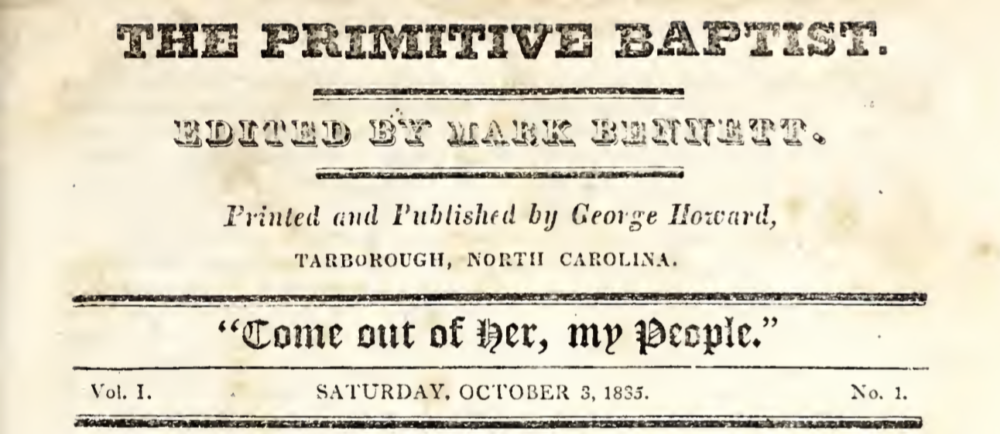
The above image is of the first issue of "The Primitive Baptist." Its first editor was Elder Mark Bennett who was asked to fill that position by Elder Joshua Lawrence. This paper continued till the late 1860's when it was discontinued. This paper is not the same paper that was later begun by Elder S.F. Cayce in 1886 and later taken over by his son Elder C. H. Cayce (Claude) upon the death of his father. This Web (hathitrust; here) page gives you access to the former periodical from 1835 to 1860, volumes 1-26.
As we will see in upcoming chapters, the latter periodical of the Cayce's was, like the first, opposed to Two Seedism or "Parkerism." However, the older periodical taught that the word of God or Gospel preaching was a means in the eternal salvation of sinners, while the latter did not. As we will see also, though Daniel Parker believed in such means, many Two Seeders did begin to teach that view. So, though Cayce's paper did not accept Two Seedism, they did accept Two Seedism's denial of means. Even the "Signs of the Times" would later deny means in "regeneration," as did Wilson Thompson, though they did not deny that the Gospel was a means in the "new birth," for they did not believe they were the same.
The original "Primitive Baptist" periodical was the leading paper that represented the opposers of Two Seedism, as we will see when we give some citations from one of its two chief spokesmen, Elder Joshua Lawrence, who was the leader in the "Kehukee" Association which declared non-fellowship against Baptists who supported mission societies and other things in 1827, called "The Kehukee Declaration and Address," five years before the "Black Rock Address" (1832) that did the same, and of which Elder Gilbert Beebe was a leader, and who the members of that group (who wrote that Address) decided to support the creation of the "Signs of the Times" periodical and choosing Beebe to be its editor. You can download that Address on this web page (here). Lawrence was the primary drafter of that Declaration and Address.
I have written a good bit through the years about the beliefs of Joshua Lawrence and of Mark Bennett. Bennett, after a few years editing the "Primitive Baptist," found that he could no longer oppose missionaries and theological education, whether seminaries or Sunday Schools. He also after this had a couple debates with Elder Grigg Thompson, who we have mentioned before and will have more to say later. In their first debate Thompson seemed to deny that God used means in regeneration, while Bennett affirmed them. A belief in means was the position of Lawrence, Bennett, and most of the writers to that periodical. Thompson may have believed like his father (Wilson Thompson) and most "Primitive" or "Old School" Baptists that regeneration and the new birth were distinct, and that the former was wrought by God apart from those means but the latter was accomplish by those means. That was Gilbert Beebe's and Samuel Trott's view. On that I have also written extensively in the "Old Baptist Test" blog.
The "Signs of the Times" periodical was the first and leading paper for the Two Seed wing of the newly formed denomination, while the "Primitive Baptist" periodical of Lawrence and Bennett represented the non-Two Seed wing. The former periodical favored the name "Old School" while the latter favored "Primitive." A large majority of those who supported the "Signs of the Times" believed in the "absolute predestination of all things," but was a minor view of those who supported the "Primitive Baptist." However, few seemed to want to make differences on the extent of predestination a test of fellowship nor on Two Seedism or on whether regeneration involved God using means. That would change, however, after the Civil War, in the latter quarter of the 19th century.
When Did Daniel Parker Become Convinced?
As we have seen, it was in 1810 that Elder Parker, while in east Tennessee, learned of the Two Seed ideology, in crude form, from an old brother there. At first he rejected it as heresy, as O. Max Lee told us in his book from which we have previously cited. But, after pondering on it for a period of time, he embraced it. We are not told when that occurred. Did he fully embrace it while in Tennessee, and before he moved to Illinois? Did he teach it in the bounds of the Concord Association, which would later be split over Two Seedism? It seems to me that Parker must have taught Two Seedism in Tennessee among the churches of that Association (middle Tennessee) for it was believed by a large number of those in that Association, of which Elder Watson worked hard to fight against, as we have seen. If Parker believed it, and even taught it while in Tennessee, then he believed and taught it prior to Wilson Thompson did in 1820 through his book "Simple Truth." If he believed and taught it then, he must also have believed and taught it when he moved to Illinois. On page 38 of Lee's book, he said (citing Parker's testimony in Parker's paper "Church Advocate" vol. II; Sept. 1831, page 271):
"Having come completely to accept the doctrine, he determined "to proclaim on the house top, that which had been revealed to me in secret."
If that is true, we must say that he preached Two Seedism from the very time he became convinced of its truth. So, if he never preached it till he got to Illinois and published his first book, then he was not convinced of it while in Tennessee. So then, when and how did the Two Seeders in Tennessee come to embrace it? Did they embrace it when they got copies of Parker's first book on it in 1826? If so, how could they embrace that view so quickly and in great numbers? That requires greater research by historians. I say all this because I am trying to discern whether Wilson Thompson or Daniel Parker should be credited with first promoting Two Seedism's tenets. The same may also be asked of the anti-mission Baptists of Illinois and Indiana, and in the Wabash Association. When and how did they first learn of it? Were they already believers in it before Parker and Thompson? Which one of them first introduced this to those folks? Also, why did so many quickly embrace such a monstrous system?
In chapter XXII I cited from the "Primitive Baptist" (1839) where Elder Richard Newport wrote to that periodical objecting to what J.H. Parker wrote about Daniel Parker (no relation that I am aware of). I have since then seen where J.H. Parker responded to the criticisms and corrections of Newport. I feel I should include J.H. Parker's response to Newport. From "The Primitive Baptist" for May 11th, 1839 there is an article from Jonathan H. Parker of Lexington, Kentucky. Parker writes in response to what Newport wrote about him and also what a brother named Levi Lancaster wrote about him. Parker wrote (emphasis mine):
"I discovered in the Primitive Baptist, 16 No. vol. 3d, page 254, a piece written by Levi Lancaster, in answer to a piece published in that paper written by myself concerning the split and the doctrine held and preached by the party that rent from the Little River Association. It appears that I touched a tender place.
But to the point. It appears that what galled Mr. Lancaster and others was, that I said in my letter they were what the people called Parkerites. I still say so, and Mr. Lancaster knows as well as myself, that the preachers (or most of them) among them, did and do yet preach the two seed doctrine. But if Mr. Lancaster is the man I think he is, I stayed all night at his house on my way home from the Association held at Crocket's Creek church, the year before the rent look place; and if he was a member of the church then I do not now recollect, though that matters not. He treated me and those with me very kindly, and I am sorry for him if he has numbered himself with those that advocate and preach the two seed doctrine of Daniel Parker. I can only say to Mr. Lancaster at present, if the cap fits he must wear it."
Apparently J. H. Parker credits Daniel Parker with being the originator of "the two seed doctrine" and not Wilson Thompson. Was he aware that Thompson in 1820 taught the doctrine of eternal vital union, a key tenet of Two Seedism?
Parker writes further in response to Newport:
"Again, vol. 3rd, No. 22, page 350, I see a piece headed New Harmony, Indiana, over the signature of Richard M. Newport. First. He says he wished to make a few remarks on J. H. Parker's publication. He states that he does not know who J. H. Parker is, or what he is doctrinally; neither does he know certainly, what is the character or condition of the Little River Association. But he says there is one thing he does know, and that is, that J. PL Parker is a very unguarded writer.
Now, brethren, it is not common for persons to introduce themselves; but by this I wish to try to make Mr. Newport partially acquainted with me. I will here say to him, that what I wrote concerning the doctrine held and preached by Daniel Parker is truth and cannot be denied; and I am somewhat astonished that any man, and particularly a preacher, should stand up and confront the public and at the same time know that he (Daniel Parker) did preach and publish the two seed doctrine, and so do his followers. I had liked to have said, that I believe that Mr. Newport knows it himself, and I think I will not retract. But, brethren, on a minute's reflection we can see from the course pursued by R. M. Newport, that we need not be the least astonished, for actions speak louder than words, for no person could have taken exceptions at my publication only those that are of the same cast. Newport further states, if J. H. Parker is always as unguarded in writing and speaking, he is entirely unworthy of confidence. Now, brethren Editors, and brethren, I think that I am as well known amongst the brethren in the different parts of the United States as Newport is; and as to the respect or confidence they have in me, I leave that to those to judge that know me. Though I do not expect those holding and preaching the two seed doctrine to have confidence or respect towards me, as they are well aware that I always opposed their doctrine. And, brethren, to come out in plain words, I do not want or wish their confidence or respect."
As I have before stated, I believe that Newport was a Two Seeder. J.H. Parker wrote further:
"Newport further states, that J. H. Parker says that Daniel Parker once was an esteemed Baptist preacher in Kentucky. It is truth. J. H. P. still says so, in this publication. Newport says, Daniel Parker never lived in Kentuckv. Brethren, I never said he did; and if Newport will reflect on himself as he did on me, he will find that he writes a little more unguarded than I do. R. M. Newport further states, that J. H. P. says that D. P. went off in a doctrine of his own, and published the 1st and 2nd doses, as referred to in my publication, &c. Newport there acknowledges that he (D. P.) did publish such pamphlets on the two seeds, and then tries to solve it in a mild manner by quotations to the scriptures, &c. R. M. Newport further states, that J. H. P. says that D. P. taught through those pamphlets. I think if RM. Newport will read my publication again, he will see that he is unguarded in his writings, as I did not say that he taught through those pamphlets directly; but I now say so. Newport further states, that J. H. Parker says that D. P. taught thro' those pamphlets, that the devil was from everlasting a selfexisting being, equal with God in power, wisdom and glory. Brethren, it is possible that I may be mistaken as to the glory being attached to the devil; but I still think it belongs to the Parkerites, as they sat him (the devil) on an equal footing with the God of heaven who created them; and I do know, and that from good authority, that D. P. did preach and tried to establish the doctrine before mentioned, and so do his proselytes in different States, say in Kentucky, Illinois, Indiana, and some in Tennessee; but the greater number are in Illinois. The reason that I believe the greater number are in Illinois is, I once attended the Association called the Muddy River Association on the Big Bay, in Pope county, Illinois, as a corresponding messenger of the Little River Association, and found a majority of that Association, (I mean those present) to be of the two seed order."
Many Parkerites did believe that Satan was uncreated and that his children eternally existed in him. Others, like Beebe, did not avow this part of Two Seedism. The question "where did the Devil come from?" I have never seen where Beebe addressed it. Many Two Seeders simply want not to discuss it, it being one of the items in their system that they want to ignore.
Parker wrote further:
"Now, brethren, it is out of the question for any man to publish any thing that he knows nothing about; for if Newport had known me, he would have known that I always stood in opposition to the missionaries, and the two seeders, and all of their inventions. But as I have said before in my publication, there are missionaries amongst the Little River Association, which is the Association that I belong to; but there are no two seeders, followers of D, P., they have all left and gone after their own flock."
Parker wrote further:
"Brethren, there is such a doctrine in the world, which I expect most of you know; and that D. Parker is or was the father of it; and why those embracing it will deny it when it comes before the public, I am at a loss to decide. When if you will go to Illinois, in the boundary of the Muddy River Association, a great many of the preachers that call themselves after the Old School or Primitive Baptists, do contend for the two seed doctrine and preach it, and sometimes almost to the separation of man and wife; as one brother told me himself, that it came very near separating him and his wife. For further proof on the subject of the two seed system, I refer you to the Signs of the Times, vol. 6th, No, 25, page 198, and you will see there, that there they have formed themselves in an Association, and sent their creed and circular to the Editor for insertion; and you will see there, that the Editor of the Signs of the Times condemns the doctrine, I must now come to a close."
When I first read the above statement of J. H. Parker I was stunned. Did Elder Beebe condemn the Two Seed doctrine? How could Parker say that in view of all that we have cited from Beebe in the "Signs of the Times" that affirmed "eternal vital union" between Christ and the church? It is true that Beebe did not believe in an eternal Devil as did Daniel Parker, not deny that all men had souls, nor deny the resurrection of the body, as did some Two Seeders, but he did believe that Christ as Mediator, as a composite of divine and human natures, did preexist his incarnation and that the church also had an existence in him as such. We have seen where Beebe, Trott, and T. P. Dudley said that being "created in Christ Jesus" or becoming a "new creature in Christ," occurred not in regeneration or rebirth but before the world began. So, I located that issue of the "Signs of the Times" that Parker mentioned to see if Beebe did indeed condemn Two Seedism. Here is that article by Beebe for the year 1838 under the heading "THE TWO SEED SYSTEM":
"In the Minutes and Circular of the Bethlehem Predestinarian Association, published, by their request, in this number, they have frankly avowed their faith in what they call the doctrine of two seeds and hint that they have, on account of that sentiment, been denied the privilege of remaining with those from whom they had hoped for better things. We know but little more concerning the sentiment than what is embraced in their Minutes and Circular; but to us the sentiment appears highly speculative. That the words of divine revelation declare two seeds among the family of Adam, viz: the children of promise, which are accounted for the seed, the chosen generation, &c', and also of the seed of the serpent, the generation of vipers, the seed of evil doers, &,c., we fully admit; but that the former of these actually and personally existed in eternity, in any other sense than that their life was children with Christ in God, and that the latter had an actual existence in the bottomless pit before they existed on earth, is a doctrine which neither the word nor Spirit has ever revealed unto us; the sentiment is new to those who have taken the stand with us under the name of Old School Baptists, and to admit a discussion of the sentiment in our paper would be, in our opinion, a departure from the original stand taken by us and fully asserted in our prospectus."
From these words we can see how divisions over Two Seedism were occurring in the 1830s. However, it is also true that many churches and associations tolerated Two Seedism so that both those who opposed it and those who espoused it remained together in fellowship. As time went on, however, more and more divisions were occurring, especially towards the end of the 19th century. For instance, in a post I made on July 27th, 2015 I cited from "The History of the Baptists of Tennessee" by Lawrence Edwards (1940) who gave us the following information on the Powell Valley Association of which father and I were once a part of. You can read that posting (here). Lawrence wrote in chapter V, "THE TWO-SEED HERESY AND ABSOLUTE PREDESTINATION" wrote:
"The Two-Seed doctrine, which was beginning to occupy the attention of the churches in the early 1870's, continued to plague the Primitive Baptists, especially those of the Powell Valley association, until 1889, when a split occurred in the association. The Nolachucky association, too, felt the impact of this conflict, but no complete rift, such as the Powell Valley experienced, occurred in any of the other East Tennessee associations.
At the 1879 meeting of the Powell Valley association the tenth item of business said: Committee appointed to draft advice to the churches in regard to the Two-Seed doctrine, who reported as follows:
We as an association advise our sister churches to have no fellowship with what is generally known as the two-Seed Heresy or those who teach the doctrine of an Eternally damned or Eternally Justified outside of the preaching of the gospel of the Kingdom of God and teach that the unbeliever is no subject of gospel address. We believe that God makes use of the Gospel as a means of calling his Elect and this means is the work of the Spirit in the church."
The Powell Valley Association had many churches in East Tennessee where Daniel Parker says he first learned of the Two Seed theory.
In the above writing of Beebe he says he does not believe in Two Seedism as J. H. Parker stated. I was stunned to read this, because we have already presented numerous writings of Beebe where he did affirm the eternal vital union of the church and Christ, which necessarily entails that he believed in both the preexistence of the man Christ Jesus and of the souls of his elect. He says that the sentiment of the circular was highly speculative. Is he referring to his own view on the Two Seeds and on eternal vital union? Or, to other aspects of Two Seedism? He says that he does not believe that the church or elect "actually" or "personally existed in eternity." He does affirm that the children of God did exist in the "sense" that "their life was children with Christ in God." Frankly, that statement is unclear, and seems to contradict what he had just previously stated.
Beebe does deny that the children of the Devil (non-elect) had an existence prior to their existence on earth, and says that such a view is new among Old School Baptists.
Wrote Beebe further:
"Although the Association believe that the nine articles of her faith (on which the Association has united) fully implies the doctrine of the two seeds, we see nothing in the articles to which we would seriously object; and if they imply what we do not believe, we cannot perceive it. It being the request of the Association expressed in the sixth item of her Minutes that we should publish her communication, notwithstanding the objectionable sentiment contained in it, we have cheerfully complied with their wish; and we hope our brethren may be delivered from any error or vain speculation into which they may have fallen in an unguarded moment."
I have done an Internet search for the circular that Beebe is discussing but have not found it. We are not even told which state the Bethlehem Predestinarian Association is located, though I would guess Indiana. What is interesting is Beebe's statement that he saw "nothing in the articles" of that Two Seed Association "to which he would seriously object," although there was an "objectionable sentiment" contained in the articles of faith or circular. It seems to me that Beebe is trying to take a position that will keep him in good standing with both the Two Seeders and the opposers of Two Seedism. Beebe made his living off of his publishing business and publishing the "Signs of the Times," and like many who do so, often try to do nothing that will cause him to lose subscribers.
A few months later in Vol. VII, number 4, of the "Signs of the Times," for Feb. 15th, 1839, Beebe writes the following editorial:
"The life which the saints had in Christ before they fell in Adam. That the saints had any personal individual existence, other than that which was given them in Christ, we shall not contend; but that they existed as the spiritual body of which Christ is the Head, is as clearly proven in scripture as is the existence of Christ as Head of his body; and that the body of Christ was created in Christ, as that Eve was created in Adam; and that they were chosen in him before the foundation of the world, and in him were, predestinated to all that they were, by Jehovah destined to be, either in time or eternity, if fully implied in the first chapter of this epistle."
Clearly Beebe believes that the church preexisted in Christ before they became partakers of flesh and blood. In chapter VI I cited these words of Beebe:
In chapter VIII I cited these words from Beebe, written by him in the "Signs of the Times" for June 15th, 1864:
"Our relationship as children of God was not predicated upon our becoming “partakers of flesh and blood;” for the relationship was complete before Adam’s dust was fashioned into a man. But for his own glory God ordained that his children should become in time partakers of flesh and blood, share in the apostasy of that flesh and blood, and in that condemnation consequent thereon, and from that condemnation and wrath be redeemed, and these bodies washed, cleansed, purified and adopted in due time into the fellowship and liberty of the children of God. Our life of God in Christ required no adoption; for it is born of God."
Here he positively states that the children of God existed before becoming flesh and blood, just as Christ preexisted before his incarnation. All I can say is that Beebe was inconsistent, although he clearly believed in the preexistence of the souls of the elect just as did Daniel Parker, Wilson Thompson, T.P. Dudley, etc.


No comments:
Post a Comment