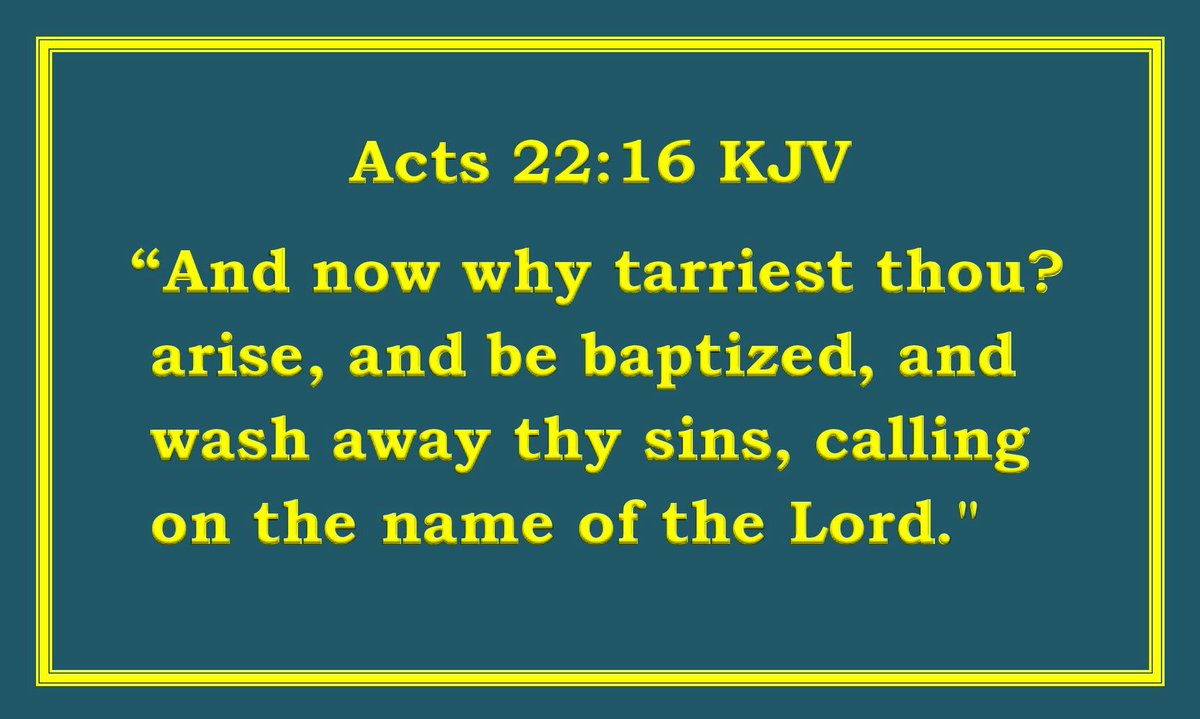
I have had several debates in my younger years with several ministers of the "Church of Christ" over whether water baptism was essential to salvation. The above text is one they rely heavily upon to uphold their belief. What can we say about it?
On the surface it does seem to favor their view. But, we must not jump to conclusions. We must examine the context, both the immediate and the general context of the new testament.
At the time when Ananias said the above words to Saul (who became Paul) he also prayed for him to receive his sight, and before he was baptized he received both his sight and the Holy Spirit (Acts 9:17-18) This also was the case with the Gentile Cornelius who also received the Spirit before his baptism. (Acts 10: 44-48) Receiving the Spirit saves a man.
The Greek aorist participle, epikalesamenos, translated "calling on His name" refers either to action that is simultaneous with or before that of the main verb, "be baptized." Paul’s calling on the name of Christ surely occurred before his water baptism, for he had been praying. After having been made a believer in Jesus by the appearance of Christ he says to Christ - "Lord, what do you want me to do?" (Acts 9: 6) So, at this point he has already acknowledged Christ as Lord. Later Paul would write, saying - "no one can say Jesus is Lord except by the Holy Spirit." (I Cor. 12: 3) The participle may be translated "having called on His name" and thus makes more sense, the context clearly indicating the order of events.
Since Paul was a believer and had confessed Christ as Lord by the Spirit, then he was already saved and cleansed of sin before his water baptism. This is because a believer is one who has "been born of God" (I John 5: 1), and has been "purified by faith" (Acts 15: 9), and has been "justified from all things" (Acts 13: 39), and has been "saved." (Acts 16: 31)
So, since Paul was already washed of his sins, why is he told to get baptized for his sins to be washed away?
Barnes in his commentary wrote:
"And wash away thy sins - Receive baptism as emblematic of the washing away of sins. It cannot be intended that the external rite of baptism was sufficient to make the soul pure, but that it was an ordinance divinely appointed as expressive of the washing away of sins, or of purifying the heart. Compare Hebrews 10:22."
An example of this is seen in these verses from the gospel of Luke:
"And it came to pass, when he was in a certain city, behold a man full of leprosy: who seeing Jesus fell on his face, and besought him, saying, Lord, if thou wilt, thou canst make me clean. And he put forth his hand, and touched him, saying, I will: be thou clean. And immediately the leprosy departed from him. And he charged him to tell no man: but go, and shew thyself to the priest, and offer for thy cleansing, according as Moses commanded, for a testimony unto them.” (Luke 5: 12-14 kjv)
Jesus told a leper who he had just "cleansed" to "go and offer for your cleansing," meaning for a ceremonial cleansing, or sign of it, or "for a testimony" of it. Water baptism is called a "likeness" (homoiomata; Rom. 6: 5), which word means image, figure, or likeness. Peter calls it a "like figure" of salvation (I Peter 3: 21). Thus baptism is a picture or visible image of the invisible washing of sins that occurs objectively and subjectively, the former as respects legal standing, and the latter as respects cleansing of the soul, mind, heart, conscience, and spirit. So, Baptists who do not believe that water baptism actually cleanses away sin, are able nevertheless to sing --
"1 O bliss of the purified, bliss of the free!
I plunge in the crimson tide opened for me.
O’er sin and uncleanness exulting I stand,
And point to the print of the nails in his hand." (From the Song "Sing of His Mighty Love")
"I heard an old, old story how a Savior came from glory,
How He gave His life on Calvary to save a wretch like me;
I heard about His groaning, of His precious blood's atoning,
Then I repented of my sins and won the victory.
O victory in Jesus, my Savior, forever.
He sought me and bought me with His redeeming blood;
He loved me ere I knew Him, and all my love is due Him,
He plunged me to victory beneath the cleansing flood." (From the song "Victory In Jesus")
When Baptists sing of being plunged into the blood they are speaking of the blood of Christ being applied to the inner man when they believed and repented, and their water baptism is the visible image of that mystical invisible event.
Even Alexander Campbell, when he was a Baptist, and before he started his own sect, said the following in his debate with Presbyterian W. L. McCalla (1823):
"The blood of Christ, then, really cleanses us who believe from all sin. Behold the goodness of God in giving us a formal proof and token, of it, by ordaining a baptism expressly "for the remission of sins." The water of baptism, then, formally washes away our sins. The blood of Christ really washes away our sins. Paul's sins were really pardoned when he believed, yet he had no solemn pledge of the fact, no formal acquital, no formal purgation of his sins, until he washes them away in the water of baptism."
"The intelligent and well instructed Christian, however, is baptized to obtain the formal remission of his sins."
"He appointed baptism to be, to every one that believed the record he has given of his Son, a formal pledge on his part of that believer's personal acquittal or pardon..." (pg. 135-37)
That is right. This is the true reason for calling baptism a "sacrament." I wrote about this in this post (here). It is the pledge or badge of the Christian. In that post I wrote:
"The English is simply a transliteration of the Latin word "sacramentum" which means an oath. That is the basic meaning of a sacrament. It means an oath, an obligation, a vow. In legal terminology it means a pledge. For example, it means money deposited by the parties before a legal suit. That is, you pledge by paying this money before a legal case.
But this word had a particular meaning. It was used of a military oath of allegiance. A military oath of allegiance was called the sacramento, when the Roman armies made their oath of allegiance to their country and to their emperor. This they sometimes did by the raising of their hands as you see today when a president takes an oath, or when somebody takes an oath in a court of law, symbolizing that he or she is doing this in all honesty and truth, with a good conscience. "I will speak the truth, the whole truth, and nothing but the truth.""
But this word had a particular meaning. It was used of a military oath of allegiance. A military oath of allegiance was called the sacramento, when the Roman armies made their oath of allegiance to their country and to their emperor. This they sometimes did by the raising of their hands as you see today when a president takes an oath, or when somebody takes an oath in a court of law, symbolizing that he or she is doing this in all honesty and truth, with a good conscience. "I will speak the truth, the whole truth, and nothing but the truth.""
Why is baptism called the sacrament? Precisely because there the pledge is made. We make our oath of allegiance to Jesus as our King. We crown Him King of our lives. We owe our loyalty to Him once and for all at baptism. It is a pledge made to God from a good conscience. It is very important that the conscience is good."
See also my post on I Peter 3: 21 (here) and how baptism is "the answer of a good conscience before God" and how Peter says that water baptism does not wash away the "filth of the flesh," i.e. moral filth. I show that Peter says that baptism is the badge of a believer.


No comments:
Post a Comment