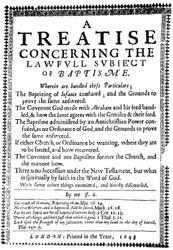
By John Spilsbury
1593 - 1668
The above is the front cover of John Spilsbury's work defending Baptist views on water baptism wherein he refuted the baptizing of infants. It was published in 1643, one year before he signed the 1644 London Particular Baptist Confession of Faith. Below is a publication by layman Thomas Bakewell Presbyterian Paedo Baptist wherein he took aim at Spilsbury's book (above) and also at the 1644 Confession as it relates to whether the confession was correct to limit salvation to those who are believers.
I have written on this dispute and will call attention to it again now in this series for the purpose of showing that the idea of "faith" being something that is merely a seed planted in infants when they are baptized by believing parents was also a belief similar to what Hardshell Baptists embraced in the 19th century as part of their arguments against 1) the Gospel or word of God being a means in regeneration or eternal salvation, and 2) the idea that cognitive faith (involving trust) in Christ and the Gospel is a necessary condition or means for salvation. In the last chapter we showed how both Hardshells and Paedo Baptists agree that faith may be in a non-cognitive seed form, even in infants, and even in adults.

As we saw in the preceding chapter, Hassell spoke of "faith" as sometimes denoting a "latent" or "hidden" faith deposited in some before they ever come to actual faith. Many of his Hardshell brethren likewise spoke of "seed faith" that lies dormant until called forth to actual faith by the Gospel. In chapter 41 of "The Hardshell Baptist Cult" (See here) I have several citations from the written debate that occurred between Thomas Bakewell and John Spilsbury. It does not seem to be available online as it was when I first took notes from reading it. It still shows it is available at elbourne.org when doing a Yahoo search (as in this search page here), but the link for the document seems to be broken. Even if you go to elbourne.org the document containing the debate is not there.
Well has a writer said of this debate and its relevance to the heresy of Hardshellism.
"Please note that the majority of modern Baptists and many so-called Old Baptists hold the same theology, concepts and conclusions that Thomas Bakewell held. Bakewell was a Presbyterian. This means that the modern Baptists and many of the so-called Old Baptists, if they had lived during those days, would have sided with Bakewell against John Spilsbury. John Spilsbury was one of the most important Particular Baptist leaders and writers of that or any other era. Is it any wonder then that those who are in truth and reality the old Baptists are despised by the modern Baptists and many of the so-called Old Baptists? The sad part is that these rejectors of the old Baptist faith and order are calling themselves Baptists, and even Old Baptists." (emphasis mine - SMG)
"Please note that the majority of modern Baptists and many so-called Old Baptists hold the same theology, concepts and conclusions that Thomas Bakewell held. Bakewell was a Presbyterian. This means that the modern Baptists and many of the so-called Old Baptists, if they had lived during those days, would have sided with Bakewell against John Spilsbury. John Spilsbury was one of the most important Particular Baptist leaders and writers of that or any other era. Is it any wonder then that those who are in truth and reality the old Baptists are despised by the modern Baptists and many of the so-called Old Baptists? The sad part is that these rejectors of the old Baptist faith and order are calling themselves Baptists, and even Old Baptists." (emphasis mine - SMG)
I cannot find the source for this but believe it was made by Dr. R.E. Pound. Since he has passed away a lot of his writings are no longer available on the Internet. Pound was well versed in the history of the Baptists, including the "Primitive" or "Old School" Baptists. I will now begin to give some of the back and forth words between Bakewell and Spilsbury.
Bakewell's Attack
Bakewell writes to Spilsbury as follows (emphasis mine):
Bakewell writes to Spilsbury as follows (emphasis mine):
"In their next article (of the 1644 Confession of Spilsbury and the Particular Baptists) they believe that all who know God and Christ shall have eternal life, but vengeance shall be rendered on all that know not God and Christ: but here I doubt they exclude all infants that die in their infancy from salvation, because they are not capable of such knowledge of God and Christ. You answer saying you know not what is this knowledge, neither hath the Scripture revealed any such that were saved. But was not Jeroboam's child saved, when the Lord Himself saith that there was some good thing in him towards the Lord God of Israel, I Kings 14:15? And did David rejoice that his child was damned, and did he desire to go to hell to his child and rejoice in believing it, 2 Sam. 12:23? And why should not infants that die be saved, when as they may be sanctified, which is eternal life began already? And they may be sanctified as well as Jeremiah and John the Baptist, Jer. 1:5; Luke 1:15. Then, are you a teacher and know not these things?"
"But you say you will not judge them, when as you make it an article of your faith to believe that none shall be saved without this knowledge of God in Christ, which infants are not capable of; yet they may have the seeds of grace in them wrought by the Spirit of God; neither can this be denied, when as they are sanctified by the Spirit of God. Again if I should believe this article, I fear I should condemn many of God's people, which have the faith of adherence, but not the faith of evidence: for many that live a holy life, may want a clear evidence that God is reconciled to them in Christ, therefore I dare not give my faith to believe this article."
Of course Spilsbury does not deny that infants may be saved but he says he does not build a doctrine upon it and says that the scriptures are clear that say a person must believe in order to be saved or baptized. You can read more citations from both Bakewell and Spilsbury in the above chapter I referenced. I simply cite the above to show that the idea of a non-cognitive faith, latent or dormant faith, which knows and believes nothing, is a tenet of the Paedo Baptists. Yet, there is one difference. Hardshell Baptists not only say that baptized babies of believing parents may have this seed or root of faith but also say that many adults have this same seed faith and have it though they have not heard nor believed the Gospel or word of God and have remained pagans, atheists, agnostics, or Muslims.
In the Gospel Messenger for April 1891 (Vol. 13, No. 4; Read here) in an editorial titled "Salvation is By Grace," Hassell wrote (emphasis mine):
"In Rom. iii. 23, 24, Paul says, "For all have sinned, and come short of the glory of God, being justified freely by his grace through the redemption that is in Christ Jesus;" plainly teaching that all mankind are sinners, and that those who are justified are justified freely by his grace through the redemption of Christ. We learn from Rom. iii. 23, that it is the believer that is thus justified; and from Rom. iv. 16, that "it is of faith that it might be by grace, to the end the promise might be sure to all the seed," just as "grace" and "faith" are used synonymously in Rom. iii. 24, and v. 1."
In chapter fourteen of this series I wrote the following under "Ways Hardshells Define Faith":
1. Faith means Christ
2. Faith means Grace
3. Faith means a seed deposit
4. Faith means ability to believe
5. Faith means evidence of salvation
In the above citation Hassell says "faith" and "grace" are synonyms, which is ridiculous. Faith is a gift of grace no doubt, but that is different from saying faith is a synonym for grace. If that is so, then why do the Hardshells deny that salvation is by faith? Why do they say that being saved by faith means salvation is by works and not by grace? He even cited the words of Romans 4: 16 that say "it is of faith that it might be by grace." To read it as saying "it is of grace that it might be by grace" is nonsense. So too when Paul says "for by grace are you saved through faith." (Eph. 2:8) Further, if faith and grace are synonyms, then to be saved by grace is to be saved by faith. It is interesting that Hassell would cite from Romans chapter three, and verse 24 but omit the next verse which says - "whom God has set forth to be a propitiation through faith in his blood." Sinners are justified and have propitiation by grace and through faith.
In another editorial by Hassell, titled "Faith and Its Relation to Salvation," in "The Gospel Messenger" for May 1898 (you can read here), Hassell wrote:
"The Scriptures are so plain upon the subject that all of the ablest Protestant and even Catholic authors frankly admit that faith is the gift of God, the work of God, the fruit of His Spirit (1 Cor. xii. 3—11; 2 Cor. iv, 5, 13; Gal. v. 22; Eph. i. 19—23; ii. 8—10; Philip, i. 29; Heb. xii. 2; John i. 12, 13; vi. 29, 37, 44, 65; x. 26—30; xvii. 1—3, 8—10; Acts xiii. 48; xiv. 27; 1 Joh v, 1.)"
Why does Hassell and his fellow Hardshells insist that "faith" is a "gift of God" if it is what merely is a fruit or by-product of salvation? At times he says faith is an essential part of regeneration and then at other times says it is not, but is what comes later and is only evidence of it.Yes, faith is a fruit of the Spirit, but so too is love, joy, peace, longsuffering, gentleness, goodness, meekness, and temperance. (Gal. 5: 22-23) Are these also gifts given to all who are regenerated? What about patience or perseverance? Why deny that these are also gifts of God and his grace? Why deny that they are sovereignly and efficaciously given to all the elect when they are regenerated?
Consider also that by faith being a "fruit" of the Spirit means it is birthed by the Spirit, for we read in the scriptures of the "fruit of the womb." The apostle John speaks of faith being begotten of God when a sinner is begotten. (I John 5: 4) See my post on this (here). When faith is begotten a sinner is begotten. Further, the faith that is begotten is not some seed or root of faith that infants may possess or adults may possess without actually believing in Christ or the scriptures.
Consider also that the words "faith is a fruit of the Spirit" does not equate to mean "faith is a fruit of regeneration." The Spirit produces or begets faith before regeneration, for faith unites a sinner to Christ, and by that union a person is then regenerated or born of the Spirit. We could also say that godly sorrow or conviction of sin is also a production or fruit of the Spirit but it precedes salvation. So Paul said: "godly sorrow works repentance to salvation." So people first see their need for Christ and salvation, which is a result of the word and Spirit of God, before they actually reach out by faith and receive the healing remedy.
Hassell wrote further:
"The word faith occurs two hundred and forty-seven times in the Scriptures; and a comprehensive view of all these passages shows that, as understood by the inspired writers, faith is an experimental manifestation, a conscious realization of personal and spiritual union with Christ."
Hassell betrays his own scholarship by such commentary. I challenge anyone to examine what the Bible as a whole says about faith or believing and then come to the conclusion that it often means something other than cognitive belief in someone or some truth. What does he mean by faith being "an experimental manifestation"? From what he has said elsewhere I am sure he means that faith is not a means of salvation but merely a means whereby a person realizes he is saved. But, I do not believe that the inspired writers thought of faith in this way. Rather than thinking that faith in Christ is a "conscious realization of personal and spiritual union with Christ" the inspired writers saw it as the means of union with Christ. Christ and the Spirit are said to be "received" and this reception is what a convicted sinner actively does by faith in Christ.
Hassell wrote further:
"It is the root-grace, from which spring all the other graces of the Spirit, reverence, fear, repentance, hope, love, joy, peace, thankfulness, contentment, humility, self-denial, patience, resignation, fortitude, zeal, and sincerity; and faith is blended with all these gracious emotions and their exercises."
How is faith "the root grace" if regeneration precedes faith? Would not regeneration be the root grace? It is true that faith is the root grace because "without faith it is impossible to please God" (Heb. 11: 6) and because "whatever is not of faith is sin." (Rom. 14: 23) If a person were regenerated apart from faith, he still could not please God. He would also still be under God's wrath. (John 3: 36)
Hassell wrote further and defines faith as follows:
"It is looking to Christ, hearing Him, tasting, eating, and praising Him, laying hold upon Him, receiving Him, coming to Him, fleeing unto Him, and resting upon Him."
Here Hassell gets it right. It is bewildering that he could say this about faith and yet say all the other erroneous things about faith! By this definition of faith there is no such thing as hidden, dormant, seed faith, the kind that is non-cognitive, and that believes and knows nothing. Can a man be saved who has not looked to Christ as the bitten Israelites looked to the brazen serpent on the pole? (John 3: 14-15) Can a man be saved who has not "heard" the voice of the Son of God? Can a person be saved who has not "eaten" Christ the bread of life by faith? Can a person be saved who has not "come" to Christ for life? Can a person be saved who has not "received" or "laid hold of" Christ? It seems that Hassell's above definition of faith, which is the right one, uproots what he has said elsewhere.
Hassell wrote further:
"The blessed object of evangelical faith is always one and unchangeable — the eternal Son of God, our precious Saviour."
That is true, but what about this latent hidden faith? What is the object of it? Does it believe anything? Can a person be saved who does not have faith in Christ?
Hassell wrote further:
"In an act of faith, of course it is not God who believes (for God believes nothing. He knows all things), but it is the creature who believes; yet the Scriptures already cited prove that the revelation and power of God cause the faith, whether we regard faith as a feeling, act, principle, habit, or state of the soul."
"Whether we regard"? Are we not to define Bible words by what they mean in the language and day in which they were used and by how they are used by the biblical writers? Where in all the scripture is "faith" defined as a "feeling" or "habit" or "state of the soul"? Does it not always mean belief or trust?
Hassell wrote further:
"And when the Scriptures state that we are saved, justified, sanctified, or kept by or through faith, the language is of an experimental nature, and the meaning is that, by or through believing in God, we experience or realize our interest in His saving, justifying, sanctifying, and keeping power — faith is the manner in which the power of God, the life of Christ, in our souls, manifests itself in our salvation."
What a sweeping assertion is made here by Hassell! Every text that says people are saved, justified, sanctified, or kept by faith, means that it really does not do those things but simply makes a person to "realize" that he has an "interest" in salvation, justification, etc.? That faith only "manifests" that a person has already been saved and justified and regenerated? Who gave Hassell and the Hardshells the right to handle the word of God in this manner? Will the Lord not hold them responsible for this twisting of his word? Jesus said "except you believe that I am he, you will die in your sins." If Hassell is right, then failure to realize you are saved will damn your soul!
Hassell wrote further:
"When Paul, quoting from Moses (Rom. iv. 3 — 25; Gen. xv. 6), says that Abraham's faith was counted or imputed to him for righteousness, he plainly means as shown by the context and other Scriptures (Rom. iii. 21—31; v. 15—21; 1 Cor. i. 30, 31; 2 Cor. v. 21; Philip, iii. 3 — 11), that, not the act but the object of Abraham's faith, the righteousness of God, the righteousness of Christ, His active and passive obedience, all that Christ did and suffered, were imputed to Abraham for righteousness, and Abraham by faith realized."
It is true that faith is not the ground or legal basis why any condemned sinner is justified, yet it is the way in which this justification is put to a person's account (or imputed). In this chapter in my series "The Hardshell Baptist Cult" (See here) I cited from Dr. A.H. Strong's Systematic Theology where he said:
A. We are justified by faith, rather than by love or by any other grace:
(a) not because faith is itself a work of obedience by which we merit justification, for this would be a doctrine of justification by works,
(b) nor because faith is accepted as an equivalent of obedience, for there is no equivalent except the perfect obedience of Christ,
(c) nor because faith is the germ from which obedience may spring hereafter, for it is not the faith which accepts, but the Christ who is accepted, that renders such obedience possible, but
(d) because faith, and not repentance or love or hope is the medium or instrument by which we receive Christ and are united to him. Hence we are never said to be justified dia pistin, = on account of faith, but only dia pisteos, = through faith, or ek pisteos, = by faith. Or, to express the same truth in other words, while the grace of God is the efficient cause of justification and the obedience and sufferings of Christ are the meritorious or procuring cause, faith is the mediate or instrumental cause." (pg. 160, 161)
(a) not because faith is itself a work of obedience by which we merit justification, for this would be a doctrine of justification by works,
(b) nor because faith is accepted as an equivalent of obedience, for there is no equivalent except the perfect obedience of Christ,
(c) nor because faith is the germ from which obedience may spring hereafter, for it is not the faith which accepts, but the Christ who is accepted, that renders such obedience possible, but
(d) because faith, and not repentance or love or hope is the medium or instrument by which we receive Christ and are united to him. Hence we are never said to be justified dia pistin, = on account of faith, but only dia pisteos, = through faith, or ek pisteos, = by faith. Or, to express the same truth in other words, while the grace of God is the efficient cause of justification and the obedience and sufferings of Christ are the meritorious or procuring cause, faith is the mediate or instrumental cause." (pg. 160, 161)
What Hassell is essentially affirming is that faith in Christ or in the one true God is not a necessary condition for being saved from sin, and that is one of the worst and dangerous heresies, a lie of the devil, or "doctrine of demons." How many have gone to Hell because of this teaching by the Hardshells? When the Bible says Abraham was justified by his act of faith, the word faith does not mean the object of faith. If I have faith in the local bank and trust company does my faith mean the bank? Boy, would that not be nice?
Hassell wrote further:
"We are said to be justified not for or on account of our faith as a cause, but by or through faith, as a medium by or through which we realize our union with Christ and our interest in His righteousness."
It is good that Hassell agrees with Strong that faith is not the ground of justification. But, when he says that faith is "a medium by which we realize" our union or justification, then he teaches a dangerous heresy. By saying this he is making faith non-essential for salvation. How he can uphold such a proposition in view of the avalanche of scriptures that says faith is essential is bewildering. Also, he has already said in other places that faith is a part of regeneration!
Hassell wrote further:
"The faith of God's elect is the effect and evidence of regeneration or the new birth (John i. 12, 13; iii. 3 — 16; 1 Pet. i. 21 — 23; 1 John v. 1); and it is the source or spring of obedience..."
We have already refuted this proposition. The texts he cites do not say that faith is an effect or evidence of having been born of God. First of all, Hassell does not believe that faith is an automatic effect of being born of God, for he and his brethren believe that most of the regenerated never come to faith in Christ.
Second, how can he read John 1: 12-13 and say that faith follows becoming children of God since the text says "as many as received him, to them he gave the right to become the children of God"?


No comments:
Post a Comment