Thursday, July 22, 2021

God's Elect or World's Elite? XXXI


"Always be prepared to give a defense to everyone who 
asks you to explain the hope you have." 
(I Peter 3: 15)

In the last chapter we focused on the importance of pathos in logos (speech or discourse). There must be passion in the speaker and the message must affect the emotions. We saw pathos in the speech of Christ and of the apostle Paul. Let us enlarge upon Paul's pathos, especially since he had more to say about logos and Christian speech, in answer to the Sophists and Rhetoricians, than any other new testament writer. 

Paul vs. Sophists

"You know, brothers and sisters, that our visit to you was not without results. We had previously suffered and been treated outrageously in Philippi, as you know, but with the help of our God we dared to tell you his gospel in the face of strong opposition. For the appeal we make does not spring from error or impure motivesnor are we trying to trick you. On the contrary, we speak as those approved by God to be entrusted with the gospel. We are not trying to please people but God, who tests our hearts. You know we never used flattery, nor did we put on a mask to cover up greed—God is our witness. We were not looking for praise from people, not from you or anyone else, even though as apostles of Christ we could have asserted our authority. Instead, we were like young children among you." (I Thess. 2: 1-7 NIV)

In the above words we can see the manner of speaking of the apostle contrasted with that of the Sophists. The Sophist in his discoursing makes his "appeal" ("exhortation" kjv) "from error or impure motives," but the apostle makes his appeal from the truth, from the purest of motives, from good ethos. Sophist discourse is intended to "trick" or fool people, much like marketers and advertisers do today, but the discourse of the apostle was intentionally frank and honest with his hearers. 

Sophist discourse and speech was designed to "tickle the ears" of an audience, to "please people" so that the speaker might be praised. Sophists looked for popularity and fame, for power and influence. Such was not the case with the apostle. The Sophists were in it for the money and not out of any love for the truth nor for the real benefit of people. The speaking of the Sophist was designed to improve the well being of the Sophist and not to improve the well being of the people whom they seek to fool. 

Notice how Paul speaks of making "appeal" to hearers of his discoursing, to his homilies. Notice also his reasoning, his logical argument, his offering proof and evidence, his logos. Notice also how he appeals to the people to consider his ethos, his character and life as proof of his assertions. Notice also how he clearly speaks with sincerity, with emotion, and how he appeals not to the intellect alone but also to the feelings and emotions of those he addressed. He says of himself and his companions - "we were as small children among you," meek and humble, not proud and arrogant, not authoritarian. 

You can see the shifting moods of the apostle in each sentence he writes. When he speaks of having to discourse in the face of "much opposition" he no doubt spoke with emotion. When he says things in defense of the attacks upon him by the Sophists he no doubt feels a different mood and calls upon his hearers to feel what he is feeling in the remarks he makes. Now, let us look at another example of Paul's preaching essentials.

Paul vs. Tertullus 
Their Debate

"And after five days Ananias the high priest descended with the elders, and with a certain orator (Greek "rhetor" lawyer, advocate, or forensic discourse or debate) named Tertullus, who informed the governor against Paul. And when he was called forth, Tertullus began to accuse (kategoreo, a legal term for what prosecutors do) him, saying, Seeing that by thee we enjoy great quietness, and that very worthy deeds are done unto this nation by thy providence, We accept it always, and in all places, most noble Felix, with all thankfulness. Notwithstanding, that I be not further tedious unto thee, I pray thee that thou wouldest hear us of thy clemency a few words. 

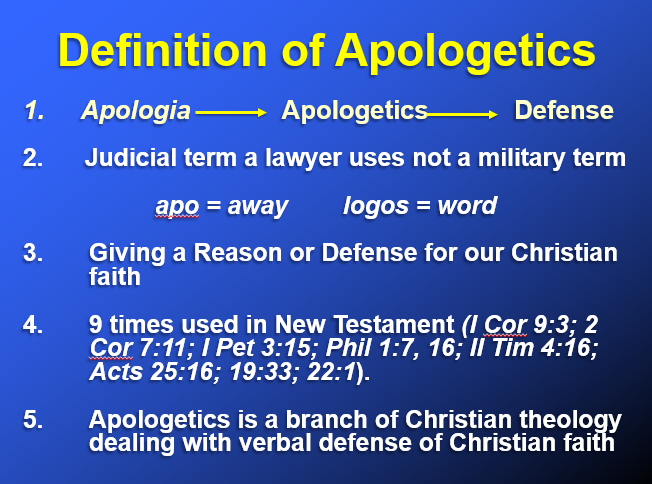
Notice the courtroom setting and drama. Notice the elites who are present, the wise and powerful, and the Sophist flattery which begins the oration of Tertullus. He begins by heaping lofty praise upon the governor (Felix), the one who is to try the case. He uses terms applicable to a deity, speaking of Felix as the source of great social peace and well being of all the people, and of his benevolent "providence" and numerous "worthy deeds." He speaks of Felix as "most noble." "Noble" is from "kratistos" and means "most illustrious," or "most excellent," and was the word used when addressing persons of high rank or office. Notice too the lengthy introduction and the use of pathos by Tertullus and how his speech is mostly without any logos or logical argument. Also notice how Paul's debate with Tertullus and the presentation of his case to Felix was an example in Apologetics as defined in the heading. Tertullus continues, saying:

"For we have found this man a pestilent fellow, and a mover of sedition among all the Jews throughout the world, and a ringleader of the sect of the Nazarenes: Who also hath gone about to profane the temple: whom we took, and would have judged according to our law. But the chief captain Lysias came upon us, and with great violence took him away out of our hands, Commanding his accusers to come unto thee: by examining of whom thyself mayest take knowledge of all these things, whereof we accuse him. And the Jews also assented, saying that these things were so. Then Paul, after the governor had nodded to him to speak, answered: “Inasmuch as I know that you have been for many years a judge of this nation, I do the more cheerfully answer for myself, “because you may ascertain that it is no more than twelve days since I went up to Jerusalem to worship. “And they neither found me in the temple disputing with anyone nor inciting the crowd, either in the synagogues or in the city. “Nor can they prove the things of which they now accuse me. “But this I confess to you, that according to the Way which they call a sect, so I worship the God of my fathers, believing all things which are written in the Law and in the Prophets. “I have hope in God, which they themselves also accept, that there will be a resurrection of the dead, both of the just and the unjust. “This being so, I myself always strive to have a conscience without offense toward God and men. “Now after many years I came to bring alms and offerings to my nation, “in the midst of which some Jews from Asia found me purified in the temple, neither with a mob nor with tumult. “They ought to have been here before you to object if they had anything against me. “Or else let those who are here themselves say if they found any wrongdoing in me while I stood before the council, “unless it is for this one statement which I cried out, standing among them, ‘Concerning the resurrection of the dead I am being judged by you this day.’ ”(24: 1-21)

Here we see Paul versus Tertullus in a debate setting, the kind of setting we see in trials in court, where the prosecutor and defense attorney debate the law and the facts. Tertullus is a prosecutor representing the high priest and the elders, being hired to prosecute the case, to make the formal accusation. Being an orator for hire, I am sure he was paid well for his rhetorical skills. Paul, unlike the high priest or elders, does not hire someone to speak for him but represents himself. Felix is the judge, being governor and the ruling authority to decide the case. The prosecutor is called upon by Felix to speak first.

He begins with saying "we have found this man a pestilent fellow" and "a mover of sedition" and that "throughout the whole world." He is accused of being a "ringleader" of a cult, of "the sect of the Nazarenes." He also has "profaned the temple." Tertullus is telling Felix that Paul's guilt has already been proven by his accusers and that all that is needed from Felix is merely a formal ratification.

When Paul gives his "answer," his apologia, he denies the charges and accusations. He tells Felix that they have no proof or evidence to back up their accusations. He gives counter evidence to disprove the accusations. Paul says he was not guilty of treason nor an instigator of riots. As far as being a "sect," Paul in essence says - "what my accusers call a 'sect' is the way I worship God, the God of my fathers." In this he appeals to logos, to reason and logic. But, there is also pathos in what he says clearly. Why would it not? His life is at stake in the decision of the court of Felix.  Paul no doubt spoke with pathos when he said "I believe everything in the law and prophets." He says "I agree that there will be a resurrection of just and unjust men." He says his conscience is clean and he has no guilt for any of the wrongdoings of which he is accused. He says his having brought alms to the people shows that he has no sinister motives towards his people, and that he was not doing what he does out of greed. Paul also says that the absence of his Jewish accusers at the trial, the absence of eye witnesses, demonstrates the verity of what he is saying. There is ethos, pathos, and logos revealed in the above exchange between Tertullus and Paul.  

Paul wrote:

"For when we came into Macedonia, we had no rest, but we were harassed at every turnconflicts on the outside, fears within. But God, who comforts the downcast, comforted us by the coming of Titus, and not only by his coming but also by the comfort you had given him. He told us about your longing for me, your deep sorrow, your ardent concern for me, so that my joy was greater than ever. Even if I caused you sorrow by my letter, I do not regret it. Though I did regret it—I see that my letter hurt you, but only for a little while— yet now I am happy, not because you were made sorry, but because your sorrow led you to repentance. For you became sorrowful as God intended and so were not harmed in any way by us. Godly sorrow brings repentance that leads to salvation and leaves no regret, but worldly sorrow brings death. See what this godly sorrow has produced in you: what earnestness, what eagerness to clear yourselves, what indignation, what alarm, what longing, what concern, what readiness to see justice done." (II Cor. 7: 5-11 NIV)

Wow! What pathos in these words! Notice all the bold words above. They are words that speak of various moods and emotions, of passion, of feelings, such as "fears within," "deep sorrow," "longing," "ardent concern," "joy," "happy," "regret," "hurt" (feelings), "earnestness," "eagerness," "indignation," "alarm," "readiness," etc. Paul is unlike the Stoics in regard to the emotions. He does not see all emotion and passion as in need of repressing. Many feelings are good and should be paid attention to and properly interpreted. Why do you feel the way you do? That is what Paul would have all to consider. Is it a good feeling? What are the consequences or fruit of the feeling? 

Another instance of Paul's pathos in speech can be seen in this case.

"And when the people saw what Paul had done, they lifted up their voices, saying in the speech of Lycaonia, The gods are come down to us in the likeness of men. And they called Barnabas, Jupiter; and Paul, Mercurius, because he was the chief speaker. Then the priest of Jupiter, which was before their city, brought oxen and garlands unto the gates, and would have done sacrifice with the people. Which when the apostles, Barnabas and Paul, heard of, they rent their clothes, and ran in among the people, crying out, And saying, Sirs, why do you these things? We also are men of like passions with you, and preach unto you that you should turn from these vanities unto the living God, which made heaven, and earth, and the sea, and all things that are therein: Who in times past suffered all nations to walk in their own ways. Nevertheless he left not himself without witness, in that he did good, and gave us rain from heaven, and fruitful seasons, filling our hearts with food and gladness. And with these sayings scarce restrained they the people, that they had not done sacrifice unto them." (Acts 14: 11-18)

On this occasion the Pagans thought that Paul and his companion were "gods" come down in human flesh. This was due to the miracle of the healing of a lame man. Notice how Paul and Barnabas react with passion and how they appeal to logos and pathos, to intellect and emotion. Men do not tear their clothes in a Stoic manner! Notice the passion in their rhetorical "Sirs, why do you do these things?" Though there is no exclamation mark in the above, it may well be added. "Why do you do these things?!" Or, in modern speech, we may translate as "what are you doing?!" Next he says "we are men of like passions with you." There we have the word "passions." That word is from the Greek word "homoiopathes" which compound word includes a form of the word "pathos." It is an adjective describing the kind of "men" they were claiming to be. "We are passionate men, just as you are," Paul essentially says. 

Who can fail to see the passion in Paul's exhortation when he says that "we preach unto you that you should turn from these vanities"? He surely does not mean that he stoically exhorted them. He certainly did it with both logos and pathos. Elsewhere Paul wrote: 

"By the humility and gentleness of Christ, I appeal to you—I, Paul, who am “timid” when face to face with you, but “bold” toward you when away!" (II Cor. 10: 1 NIV)

Who can fail to see the pathos in Paul's "appeal" making? He did not simply appeal to men's minds, to their intellect and reason, but to their feelings. So should we.

Wednesday, July 21, 2021

On The Corona Virus Pandemic

I have not commented much on the pandemic with the Wuhan virus. The reason why we get so many visits for my top popular post on the white horse of the Apocalypse (one in a series) is because many are doing Internet searches on the virus and the vaccines as it may relate to the end times. 

Most of the comments (getting more each day) are about connecting the white horse rider (Rev. 6: 1,2) with the present virus. I don't believe it has anything to do with it. However, I do believe pandemics are coming under the four horsemen, particularly of the pale horse, and therefore I believe that the present pandemic is not of the same magnitude to what is coming soon. At best the Corona Virus is but a prelude. 

On a small scale we do see pandemic (pale horse) and civil and ethnic conflicts around the world, including America (red horse) but we do not yet see the four horsemen, except in miniature. It will get much worse.

Postscript:

I guess if I just want to have a popular post with lots of comments I would write on stuff like that!

Watching The Signs Of The Times


"The Pharisees also with the Sadducees came, and tempting desired him that he would shew them a sign from heaven. He answered and said unto them, When it is evening, you say, It will be fair weather: for the sky is red. And in the morning, It will be foul weather to day: for the sky is red and lowring. O you hypocrites, you can discern the face of the sky; but can ye not discern the signs of the times?" (Matt. 16: 1-3)

What time is it according to God's prophetic clock? Where are we today in the prophetic line of time? There is what is called the "doomsday clock" and the last time I checked it was almost ready to strike twelve and bring an end to the present "day" and the beginning of a "new day" (age or era). In this even believers are making prognostications of the future with so many threats to human survival prevalent today, such as nuclear weapons, chemical weapons, biological weapons, space weapons, and secret weapons that the public knows nothing about. Lots of "doomsday preppers," including among the billionaires, today. 

All know that the present state of the world is a powder keg and that the slightest spark will set it off. They are not wrong to think this. However, the believer sees all this and also recognizes it. He too sees it all as being omens, portents, preludes to something catastrophic soon coming. In fact, one of the things I learned (as a preparation for being converted) as a young man was that I lived in a world that could blow up and end at any time. That thought was not incorrect. It is one of the reasons why I have believed, since then, that I would see "the consummation of all things," the events of the Apocalypse. It was also used by the Spirit to teach me my need to find a refuge from the coming storm and I asked Christ to come into my heart and make me a new man, to be my refuge and rock of ages.

The Lord does not want his people to be ignorant of "the signs of the times." You can forecast the weather, but you have no forecast for what is coming, as a result of seeing the signs, the demarcations, the trail marks? Prognostication of tomorrow's weather results from studying present weather conditions. So too do present signs of the times give us authority to forecast events. Rather than condemning all forecasting, all prediction, by believers, Jesus encourages it. 

What the social, religious, and political climate (weather) signs are today tell us what the climate (metaphorically) will be tomorrow, what will result from it. Many Christians have no problem trusting that the weatherman will generally get his predictions right and they know that he cannot be 100% right all the time. So too with forecasting future events, especially the ones of which Jesus and the scriptures inform us. Many Christians have made bad forecasts, however, even those who make the best prophetic forecasts do not always get it right. But, we do not stop forecasting because we are not perfect therein. 

What are the signs of the coming of the Lord? Do we see any fulfilled in the past? In the present? Or impending? I cannot imagine a believer not being interested in these things. Surely this is not a foolish and unlearned question that is unfitting for believers. We all make predictions based upon cause and effect. We consider consequences of things. Besides weathermen, stock brokers make predictions. Farmers too, based in large part upon "times and seasons." Jesus, in his Olivet discourse, dealing with the signs of his coming (parousia), spoke of the metaphor of a fig tree to show forecasting by believers is encouraged.

"Now learn a parable of the fig tree; When his branch is yet tender, and puts forth leaves, you know that summer is nigh: So likewise you, when you shall see all these things, know that it is near, even at the doors." (Matt. 24: 32-33)

Notice the adverb of time "when." When you see a tender branch you can forecast that summer is near just as the weather man by weather signs. Our Lord is basically saying: "When you see "all these things," these events (which are prophetic "signposts" for you), then you will "know" that my coming is "at the door." If you are not paying attention to those things then you will not know that he is at the door. You will be caught by surprise.

In the old testament times there is mention of some Israelites who were "men that had understanding of the times." (I Chron. 12: 32) These are the kinds of men we should be as believers who wait and watch for the return of the Lord.

Jesus, in his Olivet discourse, said:

"And this gospel of the kingdom shall be preached in all the world for a witness unto all nations; and then shall the end come." (Matt. 24: 14)

Notice again how Christ gives believers a sign of his coming, an event that will immediately precede his parousia. That sign is the preaching of the gospel in all the world and that has occurred. We should therefore be expecting Christ's apocalypse to begin any time. 

Believers who say "no one can know when Christ is coming" do not know what they are talking about. Yes, Christ did say that "no one knows the day nor the hour" (vs. 36) but he did not say that no one would know the year or month. Christ had previously said "All these are the beginning of sorrows." (vs. 8) The meaning is "the beginning of a travail after the manner of women in giving birth." 

Paul also spoke of the coming judgments of Christ's apocalypse as coming upon the world "as travail upon a woman with child." Doctors forecast the month of birth for a pregnancy. They are generally correct, but not always. But, being imperfect in forecasting does not keep them from the practice. They also forecast a day within the month, and this is much more imperfect. 

When the "birth pains" begin it is a sign of impending birth. That first birth pain will not tell you the precise time of birth but it does indicate imminence. Each birth pain becomes another sign. When they get close together and more intense, then we can make solid forecasts and say "the baby is almost here." So too can believers see the present signs, the times and seasons, the birth pains of tribulation and distress, and know that they need to get ready. All the prophetic signs (events) are as birth pains. Wrote Paul:

"But of the times and the seasons, brethren, you have no need that I write unto you. For yourselves know perfectly that the day of the Lord so comes as a thief in the night. For when they shall say, Peace and safety; then sudden destruction comes upon them, as travail upon a woman with child; and they shall not escape. But you, brethren, are not in darkness, that that day should overtake you as a thief. You are all the children of light, and the children of the day: we are not of the night, nor of darkness. Therefore let us not sleep, as do others; but let us watch and be sober. For they that sleep sleep in the night; and they that be drunken are drunken in the night. But let us, who are of the day, be sober..." ( Thess. 5: 1-8)

Notice again the adverbs of time, the "when this, then that." These events are signs, given to us of God for our preparedness for his coming. Are you watching and waiting? Are you prepared? Do you know what time it is? Do not be one of those who "put far off the evil day." (Amos 6: 3) Don't think you have all the time in the world to turn to God. You have no promise of tomorrow. Fearful of what is happening in the world? Of pandemics and wars? The only refuge to be found is in the Lord Jesus Christ. Turn to him today before it is too late. "Today is the day of salvation." (II Cor. 6: 2)

It was a bad appraisal of the people, an indictment, when the Psalmist said:

"We see not our signs: there is no more any prophet: neither is there among us any that knows how long." (Ps. 74: 9)

John Sparks History of Regular Baptists

In this posting I want to cite from "The Roots of Appalachian Christianity: The Life and Legacy of Elder Shubal Stearns" by John Sparks (here) and make some comments upon what he says.

Wrote Sparks (emphasis mine):

"Ultimately the largest and most successful of the three early Baptist sects was the group known in the British Isles as the Particulars, and in the colonies as the Regulars. Originally these were essentially Puritan Independents, complete with five-point Calvinist theology, who had repudiated their belief in infant baptism in favor of believers' immersion and the traditional concept of church and state for religious liberty. In light of the modern, right-wing, "old-timey" conservative connotation of the title of "Regular Baptist," however, the group was progressive, refined, and innovative and is in fact the ancestor of most modern American Baptist groups that bear the name including, to a certain extent, the Southern Baptist Convention. Ironically, this is the group that the Old Landmarkers most often try to link all the way back to Jerusalem." 

Many of the forefathers of the "Primitive" or "Old School" Baptists were Regular Baptists. Some also came from the Separate Baptists. Some also came from the United Baptists (such as Grigg Thompson), from the groups that came from the union of Regulars and Separates. Notice what Sparks says about the Regulars and compare it with those sentiments of Regular Baptists who became Hardshell (such as Lemuel Potter). The old Regulars were not "anti" as regards missions, religious education (both for youth, i.e. Sunday Schools and catechisms and for those having a calling to preach). They were progressive and innovative. But, if this is so, then how can the Hardshells claim otherwise about their ancestors?

Sparks continued:

"Landmarkers most often try to link all the way back to Jerusalem by an apostolic succession as well, usually by contending that a group of ancient Old Landmark or sometimes Primitive Baptists stayed hidden in a remote corner of Wales for twelve to fifteen hundred years and then associating all anti-Papist activity they can find by Lollards, Waldensian immigrants from France, and even the bizarre Cathar cult of Provence and Languedoc with these same so-called ancient Baptists." (Pg. 8-9)

Exactly! The links in the chain of succession for the PBs have been put together by men who know little of the sects that make up those links! But, the average cult member just accepts that succession chain without questioning it.

Sparks said:

"So much for the Old Landmarkers for now, though unfortunately the author must allude to them again from time to time simply to display how they have corrupted historical tradition. The author hopes that he can give an accurate enough account of religious events in America during Shubal Stearns's life to expose the follies of Old Landmark contentions for the same time period, many of which have kept the study of Appalachian mountain religion in such confusion." 

Landmarkers can be very cunning in the way they present their "chains" of succession. But, it is an example of corrupting history. What is said about the "Old Landmarkers" by Sparks is true of those who call themselves "Primitive Baptists" (with some exceptions).

Sparks wrote:

"Unlike the General Baptists, both the Particulars in Britain and the Regulars in America were staunch believers in a formally trained ministry and the use of prepared pulpit discourses. The English Particulars founded a Baptist college at Bristol at a surprisingly early date in their history as an organized denomination; some well-to-do colonial Regular congregations imported graduates of this institution to fill their own pulpits much as the New England Puritans depended on Harvard and Yale at the same time. In years to come the American Regulars would found their own schools at Hopewell, New Jersey, and at Providence, Rhode Island. Likewise the Regulars believed in a paid ministry as opposed to the General Baptist preachers' custom of earning their living at secular employment. And along with the great majority of Protestant denominations both in the Old Country and the colonies, the Regulars made a strong stance on the religious education of children. Although Sunday schools in the modern sense did not yet exist, most faiths employed catechisms for their members' young to memorize, and evidence exists that the American Regulars endorsed such a document for the benefit of their own churches at an early date—quite possibly the very same catechism, Milk for Babes by the famous John Cotton, used by the mainline Puritans themselves."

The Regulars were historically from the beginning "staunch believers in a formally trained ministry"? I thought Hardshells taught that such was a "new thing" and "innovation" in the early nineteenth century?  

Have we not shown how corrupted are "Primitive Baptist" "histories"? How they are as Dr. R.E. Pound said, "wish history"? Have not we repeatedly said that they have a "revisionist history" of themselves? Is this not also a common practice of cults? Do they not all run from their history and try to distort and revise it?

Tuesday, July 20, 2021

On The Origins of Non Predestinarian Primitive Baptists

 When I first started in this historical journey of the different types of Baptists, I was told there was no such thing as a Primitive Baptist who rejected individual predestination (limited atonement). I didn't believe this and here's why. I found it very hard to believe that "the day after"after the split, the two sides embraced different doctrines and theologies. It just never made sense that the gulf that now exists when it comes to doctrine, existed before the split. If it had, the split would have occurred much earlier before the subjects of mission societies, Sunday schools etc arose. One side or the other changed their theology, and the question is, which side?  The division that occurred in the Baptist family during the early 1800's was not over doctrinal issues. The division was about methodology and whether or not certain institutions were authorized by Scripture. Among Missionary Baptists there were churches which embraced Calvinism and some which did not. Wouldn't the same be true among those Anti-missions Baptists? The answer turned out to be yes.

  So why are there so many who believe that ALL Primitives are (or were) Calvinists which turned hyper? Here is why. At the time of the split, I would venture to say the mission/ anti-mission split was about 50/50. Many associations split right down the middle. For the next few decades, the numbers on both sides remained fairly constant, with both sides founding new churches as the population grew. However, over the years there seems to have been numerous defections on the Primitive side, with many joining the Missionary side, having found nothing in Scripture that 1) would frown in any way the teaching of Scripture to children outside the church setting, 2) forbade the use of instruments, especially since the joy found in Christ should be at least as abundant as any joy found in the Law, which used instruments, 3) that forbade education of ministers, since Paul himself was educated in the Law. This is what I call "the first defection".

   The second defection occurred between the years of 1890 and 1920, when the "no means" doctrine became more solidified. This saw a huge defection of Primitive Baptist churches to the Missionaries, some going into the Southern Baptists (with those who were Calvinistic remaining so), some being independent, and others joining the Old Regulars, or the United Baptists. These defections would greatly increase the percentage of hyper Calvinist PB's within the Primitive movement, but not their numbers. The majority of these defections (tho not all) involved Primitive Baptists that embraced a general atonement, as they would be united in the belief that one must hear the gospel in order to be saved. This just makes common sense. However there remained many PB associations that were non predestinarian (non Calvinist) yet also non Arminian.

   You can see this clearly as an example of what happened in the Hiwassee United Baptist Association. This association in east Tennessee, split into missionary and anti-missionary early on. Yet both associations not only remained friendly with one another, but encouraged continued fellowship. The Hiwassee United Baptists split over "new innovations", yet they remained united in doctrine. In resolutions adopted in 1864 by the Hiwassee Baptist Association (missionary) and the Hiwassee Primitive Baptist Association they stated the following:

 "Be it resolved, 1. That the original constitution of said Association be the basis of such (re)union, and that the above named bodies reciprocally recognize the ministerial and church acts of each other, giving to brethren on both sides the right hand of fellowship, and that ministerial support is not only the right but the duty of our churches, but the method of accomplishing the same legitimately belongs to The church as a sovereignty under Christ, the only lawgiver in Zion, and where there are contiguous churches, that they unite in one body, and when members have been excluded by either body for disorderly conduct and received by the other, they should be dropt and required to make satisfaction to the excluding body, according to the rules of the Gospel."
 "Resolved, 3. That we advise the brethren composing the above named associations, more intimately to associate with one another in their religious meetings, and cultivate that brotherly love, and christian affection, which is so well calculated to endear brethren to one another; that the time may speedily come when we may be perfectly joined together in one mind and one Judgment, for which object, let every true christian pray."

   Here you can clearly see that even the Primitive Baptist side agreed that ministers should be supported (paid).  You can also see in resolution 1, that churches which had split, were encouraged to become one body again ("contiguous" churches), and the church discipline issued by either side was considered valid by both.. While a formal reunion never took place, some on the primitive side decided to formally align once again with their original association. Read the letter from Paint Rock Church in 1869 to the missionary side of the Hiwassee Baptist Association below. 

 "Paint Rock Church sendeth christian salutations to the messengers and delegates who may compose the Forty- seventh Session of the Hiwassee Baptist Association when convened with Fellowship Church, Meigs County, Tennessee, September 1869. Very dear brethren who may be present as above-named, you may think strange on the reception of this our friendly epistle from your little sister in gospel bonds; though we hope you will hear us while you may relate to you that we, your little sister had, in gone-by days, somewhat strayed off from you, or at least departed from the old land-marks of the Fathers, but we are thankful that through the light of Divine Grace, we have been enabled to see our error and return from the same by rescinding those erroneous acts, and the repealing of those acts of exclusion which we had declared against any and all of our Brothers and Sisters for a mere political opinion, and giving a notice of such repeal to our Brothers and Sisters, that they may renew their former fellowship with us, and among those whom we had excommunicated is Brother Martin Sharp, who we have cordially welcomed with us again, and chose him to bear this our letter to you, that you may know our whereabouts, to approve or disapprove our course, as you may choose - Brethren, we had lettered to our late Association, think best as we went off by mass to return the same way, if so be our sister churches would thus elect, if your clemency would thus favor our return. Brethren, pray for us, your little sister in Gospel bonds; Farewell. This done in church conference, this first Saturday in September 1869."

   Notice how the Primitive side declared that they were the ones who "departed" and wanted to return. It seems as the hyper calvinist side became more extreme in the views, the more non Calvinists and mild Calvinists desired to return to the former unions.

   The Hiwassee Baptist Association as well as the Hiwassee Primitive Baptist Association is not now, nor have they ever been predestinarian (Calvinist), or Arminian. To this day, both groups are united in doctrine. The same is true of the Eastern Association of Primitive Baptists and the association they split from. The same is also true of the Original Tennessee Association of Primitive Baptists, the Southern Association of Primitive Baptists, the Beaulah Association of Primitive Baptists and the Oak Grove Primitive Baptists. I am sure to discover more. Many more who used to exist, eventually reunited with their old associations, or became independent baptist churches.

   The Hiwassee Association of Primitive Baptists still exist with a total of about 20 churches, some in the association itself, some as independent PB churches, and some becoming non PB independent churches. They use instruments, have Sunday schools and camps, and have minister exchange/recognition with missionary churches, with one church calling a missionary minister to pastor. This happened among many, many PB associations that I have studied. Could this be further proof that the hardshells are the ones who "departed" the faith, especially when it comes to hearing the gospel and preaching to the lost?  Have the hardshells hidden and repressed, even destroyed history?  "Those who don't remember the past, are condemned to repeat it". Ken Mann


Father Is Pleased

My heart felt conviction is that God my Father is pleased with my apologetic work. If I did not believe so, I would have quit long ago. 

But, I believe my earthly father, Eddie K. Garrett Sr., is also pleased with it as he watches me from Heaven. Though he disagreed with me on several important doctrines, I know that he loved the Lord and is Heaven. I also know that saints in Heaven observe what is going on on earth. See my post Making Saved Departed Loved Ones Happy. Therefore I know that my earthly father is pleased also with my labor in the word and doctrine. 

An Example Of Spirit Filled Worship In Song

"Is that the old ship of Zion?" sung by the Kingsman Quartet. (here)

Listen and hear the praises from the congregation as it is sung! That is the kind of emotional moving of the Spirit I have been talking about in spirit filled jubilant worship!

This song grips me every time I hear it! Listen to the pathos! The praise! I hope to meet these church members who whooped it up!

Monday, July 19, 2021

God's Elect or World's Elite? XXX


Well, amen to that, brother Spurgeon!

In the former chapter we spoke of persuasion, both of the Sophists and of the apostle Paul. We looked at Aristotle's "means of persuasion" involving ethos, pathos, and logos. We dealt with ethos, how it was promoted and taught by Sophists, and how it was viewed by the apostle Paul as a part of speech (logos). In this posting we will look at pathos as regards speech and of its place in biblical speech. Having already defined pathos, let us consider the role of emotions in discourse, both in the speaker and in the hearer. 

Spurgeon said:

"To win a soul, it is necessary, not only to instruct our hearer, and make him know the truth, but to impress him so that he may feel it. A purely didactic ministry, which should always appeal to the understanding, and should leave the emotions untouched, would certainly be a limping ministry. “The legs of the lame are not equal,” says Solomon; and the unequal legs of some ministries cripple them. We have seen such an one limping about with a long doctrinal leg, but a very short emotional leg. It is a horrible thing for a man to be so doctrinal that he can speak coolly of the doom of the wicked, so that, if he does not actually praise God for it, it costs him no anguish of heart to think of the ruin of millions of our race. This is horrible! 

I hate to hear the terrors of the Lord proclaimed by men whose hard visages, harsh tones, and unfeeling spirit betray a sort of doctrinal desiccation: all the milk of human kindness is dried out of them. Having no feeling himself, such a preacher creates none, and the people sit and listen while he keeps to dry, lifeless statements, until they come to value him for being “sound”, and they themselves come to be sound, too; and I need not add, sound asleep also, or what life they have is spent in sniffing out heresy, and making earnest men offenders for a word. Into this spirit may we never be baptized!""

"A sinner has a heart as well as a head; a sinner has emotions as well as thoughts; and we must appeal to both. A sinner will never be converted until his emotions are stirred. Unless he feels sorrow for sin, and unless he has some measure of joy in the reception of the Word, you cannot have much hope of him. The Truth must soak into the soul, and dye it with its own colour. The Word must be like a strong wind sweeping through the whole heart, and swaying the whole man, even as a field of ripening corn waves in the summer breeze. Religion without emotion is religion without life."  ("What Is It to Win a Soul?" in The Soul Winner)

The Lord wants people to control their emotions, to not be ruled by them, and to this extent the Stoics were correct. Intellect should rule emotions and not vise versa. But, it is not always the case in human experience. Humans are creatures of emotions, as we will see further. Also, oftentimes emotions provoke thought. 

Stoics so downplayed the role of emotion in life and decision making that the term "stoical" has come to mean "without emotion," like is seen in the character "Spock" in the "Star Trek" series who being Vulcan, purely logical, suppressed all expressions of emotion. The Stoic idea of suffering without emotion, without complaint, to simply "grin and bear it," or "keep a stiff upper lip," has some truth in it, though it is an extreme, and not healthy or wise. To ask people not to express their emotions in times of suffering is going too far. Venting our feelings is a built in defense mechanism to help us endure suffering. Sharing feelings is often therapeutic, within limits of course. 

Pathos In Jesus's Preaching

“O Jerusalem, Jerusalem, the one who kills the prophets and stones those who are sent to her! How often I wanted to gather your children together, as a hen gathers her chicks under her wings, but you were not willing!" (Matt. 23: 37)

It is interesting how many times English translators put exclamation marks on many of the utterances of Christ, the prophets, apostles, and evangelists whose words are in scripture. Though there are no such punctuation in the Greek new testament, yet translators add them to express the emotion and passion in what is said, and this is true with the exclamation mark. If the mark is absent in the Greek text, how then do translators and readers know when it is appropriate? Is it not because the very words and contexts manifest emotion and passion themselves? 

Examining the reactions of various hearers and audiences who heard the prophets, Christ, and the apostles and other evangelists and teachers of the word of God, one can see how the word of God when spoken or written has produced lots of emotional reactions, such as fear and trembling, anger and wrath, joy and happiness.

Who cannot see the passion in the words of Christ uttered above? "O Jerusalem, Jerusalem"! "You were not willing"! "How often I wanted"! We can also see the passion in the "woe" sayings of the Lord. Such pleading! In the bible this is often called "praying" or "beseeching." 

"Now then we are ambassadors for Christ, as though God did beseech you by us: we pray you in Christ's stead, be ye reconciled to God." II Cor. 5: 20)

Other words denoting praying and beseeching word be exhorting, pleading, imploring, etc. They also imply earnest and sincere appeals to the mind and emotion. Another instance of the pathos of Christ may be seen in these words:

"Woe unto you, lawyers! for ye have taken away the key of knowledge: ye entered not in yourselves, and them that were entering in ye hindered. And as he said these things unto them, the scribes and the Pharisees began to urge him vehemently, and to provoke him to speak of many things: Laying wait for him, and seeking to catch something out of his mouth, that they might accuse him." (Luke 11: 52-54)

Notice the first exclamation mark. But, others could have been added after each of the statements, such as "you have taken away the key of knowledge"! "You have not entered yourselves"! "You have hindered people from coming"! He appealed both to their hearts and minds, to their thoughts and emotions. But, so too did Christ's opponents for they "urged" him "vehemently," with intense emotion (wrong kind), and to "provoke," or to "incite" feelings. Christ sought to excite the right thoughts and emotions, unlike his sophisticated ranters. 

Paul's Emotional Appeals (pathos)

Passion in the preaching of the prophets, Christ, the apostles, etc., is hard to notice since we are limited in not being able to hear the sound of their voices, having no audio recordings, and are therefore not able to hear the inflection of the voices, the tone, the emotion attached to the words of their discourses. Nor do we have videos enabling us to see their facial expressions. All we have are their words read on paper or orally heard read. Yet, their choice of words, the hortatory exhortations they give, and the rhetorical questions they ask, emanate passion. Let us notice these examples of Paul's ethos and pathos as a speaker.

“For many, of whom I have often told you and now tell you even with tears, walk as enemies of the cross of Christ.” (Phil. 3:18 ESV)

That was truly preaching with emotion and passion. Said Paul again:

“Therefore be alert, remembering that for three years I did not cease night or day to admonish everyone with tears.” (Acts 20:31 ESV)

But, not only did Paul show passion in preaching with tears, but he also showed forcefulness and strong voice and intense emotion in his argumentation. 

"For he mightily convinced the Jews, and that publicly, shewing by the scriptures that Jesus was Christ." (Acts 18: 28)

"Mightily" is from the Greek word "eutonos" and means forcibly and vehemently, and the idea of intense emotion and passion is necessarily involved. Paul asked the Corinthians:

"What will you? shall I come unto you with a rod, or in love, and in the spirit of meekness?" (I Cor. 4: 21)

There is pathos of all kinds in these words. They show how Paul was not always in the same mood when preaching, his mood being determined by the time, circumstance, and the audience. He could preach with a "rod" of correction, which could also be translated as "branch" or "switch," which is something that most unruly children got from their parents till modernism took over family government. In either case the idea is a discourse that would whip the hearers, would correct them, would rebuke and chastise them. But, it must be done from the purest of motives. Who can doubt that when a verbal whipping is being given that it is from a passionate address of the speaker? A passion that will be observable through both verbal and non verbal cues? Gill in his commentary says that such speaking involves roughness and severe looks.

Notice also how the apostle puts coming (for the purpose of speaking) "with a switch" in opposition to coming "in love" and in "the spirit of meekness." Did he not speak in love even when speaking as with a rod of correction, beating them? Yes, but not if one judges it by the sound or tone, or by a worldly standard. It does indicate that coming with the rod involves coming with some righteous anger and hatred for serious wrongdoing. It certainly is set opposite to coming "in the spirit of meekness," in gentleness and with great care. 

In "Preaching must be passionate and engaging" under "10 Essentials of Preaching" (here) we have some very good observations on this topic (emphasis mine). 

"Solid preaching is not monotone or monochromatic. It goes beyond reading the Bible out loud, and it goes beyond reading dryly from a manuscript."

"This requires changing vocal patterns (tone of voice, volume, and pace, etc.), making eye contact, and using one’s body (facial expressions, hand gestures, maneuvering around the pulpit) as a means of communication—just as the preacher would in interactions in daily life."

Adrian Rogers was excellent in all these areas. Every pastor would do well to listen to his sermons as they are a good example of preaching with ethos, pathos, and logos.

The author continued: 

"Further, to be passionate in preaching requires a man to believe in what he is preaching. As D. Martyn Lloyd-Jones put it in his landmark lectures titled Preaching and Preachers, the preacher is not serving merely as an advocate, but as a witness! He is not merely reciting facts about God and His Word. Rather, he is testifying to the power of the great God revealed in the Word. Lloyd-Jones would say elsewhere in his Preaching and Preachers lectures that preaching is “theology on fire”a useful phrase and image that speaks to the passion which must undergird and flow out of any sound preaching. Solid preaching is both passionate and engaging."

Yes, theology on fire! Passion and fire in preaching! If the fire is in us as it was in the prophet Jeremiah, then we would show it in our discourses. Think of the preaching of John the Baptist! He was a strong voice preaching in the wilderness, "crying aloud" to sinners to "repent and believe the gospel for the kingdom of God is at hand." 

Another good article on pathos in discourse comes from "Place of Pathos in Preaching - The critical importance of emotion in preaching" (here) by Jeffrey Arthurs. He writes (emphasis mine):

"Pathos means "feeling or emotion" (Conley 317). When used in discussions of persuasion, it is "all those materials and devices calculated to put the audience in a frame of mind suitable for the reception of the speaker's ideas" (Thonssen and Baird 358). Pathos deserves a central place in homiletical theorizing and practice—a higher place than it currently receives."

"This paper does not pit pathos against logos. I believe that preaching must include a strong cognitive element, or else it is not preaching. Without a dominant idea derived from a biblical text, supplemented with other ideas, a sermon is merely "sound and fury signifying nothing.""

"However, while preaching cannot be less than the communication of a biblical idea, it should be more. De Quincey compared the two arts of rhetoric, logos and pathos, to rudder and sail. The first guides discourse and the second powers it (Thonssen and Baird 358). Even a traditionalist like John Broadus argued that preachers need "the capacity for clear thinking, with strong feelings, and a vigorous imagination" to produce "forcible utterance" (in McDill 10)."

"An entire paper devoted to pathos may raise red flags since emotional appeal is the stuff of demagogues, so let me extend my disclaimer to say that no ethical communicator uses pathos to induce an audience to act contrary to reason. That is manipulation, not persuasion."

All these statements on pathos in discourse are excellent. Good Christian speakers, preachers, laymen, parents, etc., will make sure of their substance and argument (logos) but they should also speak with passion and with the heart in it.

The author continued:

"Ethical (and effective) communicators use pathos to prompt people to act in accord with the truth. This paper is not a plea to discount or circumvent logos." 

"Neither is it a plea to bypass the role of the Holy Spirit in preaching. It is an argument that the Holy Spirit converts and sanctifies the whole person, not just the mind, and the Holy Spirit appeals to the mind and emotions to move the will."

These are good observations. The author asked - "Why does pathos deserve a central place in preaching?" I think we can answer that question easily after seeing pathos in the words of Christ and his apostles. The author answers saying "Pathos influences decision making." 

The author continued:

"The old dichotomy between logic and emotion, the head and the heart, does not reflect how humans actually make decisions. As rhetorical scholar Roderick Hart argues, "To contrast people's 'logical' versus 'emotional' tendencies is to separate human features that should not be separated in analysis since they cannot be separated in fact. When people react to anything[they] react with all of themselves" (121-122). Arnold and Wilson state simply that "people do not reason or feel, they reason because they feel, they feel because they think they have reason" (318). The dichotomy between pathos and logos may be useful in the academy, but in the marketplace the two cannot be separated."

Again, this is so true. Logos without pathos is not our example.

Said the author further:

"Even if we allow the dichotomy to stand, we find that pathos influences the will more than logos. This was Cicero's observation: "Mankind makes far more determinations through hatred, or love, or desire, or anger, or grief, or joy, or hope, or fear, or error, or some other affection of mind, than from regard for truth, or any settled maxim, or principle of right" (in Thonssen and Baird 360)."

"C. S. Lewis states, "People don't ask for facts in making up their minds. They would rather have one good, soul-satisfying emotion than a dozen facts" (in Martindale and Root 482). Dozens of communication theories support this contention."

"The argument so far may sound like an advertising handbook: "Just discover the hidden needs of your listeners, present your product so that it seems to fill those needs, and make sure you bypass rationality in the process." As I stated in the opening apology, many persuaders use pathos unethically. I place advertisers high on that list. But the fact that they manipulate with emotion does not mean that preachers should jettison it."

"Pathos is primary in human decision making because God made us to respond to emotional appeals, and he himself uses pathos. He motivates us through awe of his immensity, fear of his holiness, confidence of his goodness, and joy of his grace. Pathos is crucial, not incidental, to God's communication."

Primacy should be given to logos, but it must not be alone. It must be passionate. Said the author further:

"As Robinson says, "Some passages are alive with hope, some warn, some create a sense of joy, some flash with anger at injustice, others surge with triumph. A true expository sermon should create in the listener the mood it produced in the reader. The task of the poet, the playwright, the artist, the prophet, and the preacher overlap at this point—to make people feel and see "(82-83). From the earnest pleading of Charles Spurgeon, to the pastoral warmth of Jack Hayford, to the exuberance of E. V. Hill, effective preachers represent God—his ideas and emotions. When preachers use pathos (and logos and ethos), they handle the Word skillfully."

Oh so true! Just as we are told to sing "with feeling," so too should we preach and testify. Think of all the warnings given in scripture. Who can picture the giver of the warnings being casual in speech? Would there not be some urgency? Do preachers not "sound the alarm" in their preaching? Said the author:

"Unfortunately, most of our training equips us to exegete and communicate the ideas of the text, not the feelings."

Agreed. Impassioned stale speech moves very few. It you have exciting news to tell, should your enthusiasm and passion not be manifested? Said the author further:

"Simply by keeping in mind that the text aims to create an experience, not just transmit an idea, preachers should be able to identify the dominant mood of the passage."

Oh, so true! Think of all the passion and emotion in the utterances in the Psalms! Said the author:

"When preachers genuinely feel the mood(s) of the text, the audience will notice and may respond. Rhetorician and preacher Hugh Blair said, "The only effectual method [of moving the listeners' emotions] is to be moved yourself. There is an obvious contagion among the passions" (Lectures on Rhetoric and Belles Lettres, in Thonssen and Baird 364)."

Good observation! Jesus, the prophets, apostles, etc., spoke with emotion in their discoursing. They were passionate about what they were teaching and proclaiming. "Effective heralds, said the author, "demonstrate that the truth has gripped them and that it should grip the listeners. Effective heralds embody the text." He also said "we must speak naturally, not fearing to reveal our feelings in public."