Thursday, September 23, 2021

Children Of God By Faith?

"For you are all sons of God through faith in Christ Jesus." (Gal. 3: 26 nkjv)

When I was a young Hardshell minister this verse caused me (other Hardshells too) lots of problems. This verse seemed to teach, prima facie, that faith was the means or condition for becoming the children or sons of God. I used to ask other PBs about their views on the text. Most would say it means "you are all manifestly the children of God through faith in Christ Jesus." That used to bother me. Now, it still bothers me but in a different way. It bothers me now that Hardshells can be so stubborn in their refusal to accept what is plainly stated in scripture. It bothers me when such teachers of the word take such liberties with the word of God! Who gave them the right to add the word "manifestly" to the text? Does not adding that word change the whole meaning of the text? I used to hear them give the same explanation to John 1: 12-13. They would say that those who received Christ were given "power to manifestly become children of God." 

This is not the way to "handle" the word of God. It is dishonest. It is adding to the word of God and God pronounces severe punishment on those who do so. (See the final words of the book of Revelation). I will not do it. The text says that people are sons of God by faith in Christ. Why can't our Hardshell brothers not just accept the plain word of God? 

Elder John Clark, editor of Zion's Advocate (1854 - 1880), often referred to our text in his battle with the Hardshells who began to deny means and advocate against preaching to lost sinners. The first Hardshells had no problem telling men that faith in Christ was necessary in order to be labeled "sons of God."

They are sons of God by rebirth, but rebirth follows faith in our text. Would any of our anti means Hardshell brothers want to come here and defend their view in light of the above text?

No Life In The Bible?


The following is a citation from professor John Crowley ("Primitive Baptists of the Wiregrass South") and cited by me (here)

"During this time, a major dispute erupted between the Alabaha and its parent organization, the Suwannee River Association. In 1860, Job E. W. Smith, moderator of the Suwannee River Association, preached at the Alabaha River Association’s annual meeting. During his sermon, Smith unequivocally advocated for the antimeans position when he held up the Bible and told the congregation, “You have been told that this is the word of God; do you believe it? I say it is not, it is ink and paper.” Smith also stated “the Gospel had no saving efficacy in it to the awakening of sinners; it was only for the feeding of the flock.” The Alabaha, who had long advocated the instrumentality of the Gospel, declared that Smith’s words were “a departure from the faith” and recommended “that this body withdraw her correspondence from the Suwannee Association until she becomes reclaimed.” (pg. 34)

Notice how the anti means Hardshells believe that there is no life in the word preached, or in the bible. They do not believe that the scriptures are the word of God, are the words of Christ, which are "the words of eternal life" (John 6: 68). Jesus said "my words are spirit and they are life." (vs. 63)

Paul wrote to the Hebrews and said that "the word of God is living and powerful" (4: 12). Paul said that believers "hold firmly to the word of life" (Phil. 2: 16). The words of God are "living oracles." (Acts 7: 38)

The scriptures are the breath of God. Paul said “all scripture is breathed out by God” (2 Timothy 3:16).

A man who does not take into himself the scriptures does not have the life or breath of God. When we take God's word into our hearts (faith act) we inhale God as it were, his life and Spirit. Paul asked:

"Did you receive the Spirit by the works of the law, or by the hearing of faith?" (Gal. 3: 2)

When the word of God, especially the gospel, is heard and received (believed) so too is the Spirit of God heard and received. In receiving the Spirit the believer also receives Christ and spiritual life.

Elder Hosea Preslar wrote of the Hardshell "Two Seeders" and their anti means view, saying:

"And as to their views of the use and design of the gospel being for nothing but for the edification of the Church, and believers being the only subjects of gospel address, I believe it not." (Page 186)

"But some object to these ideas and say all this is the work of the spirit of God; and the gospel has nothing to do with it. Ah, a gospel without a spirit! Well, God save me from a gospel that has not His spirit. God says His word is quick and powerful, and He says by Peter, This is the word which by the gospel is preached unto you; I Peter 1: 25. And as to the subjects of Gospel address, it is to every creature the disciples were commanded to preach the gospel; and Paul said, Whom we preach warning every man, and teaching every man, in all wisdom, etc.; Col. 1: 28. So we see that their idea on that point is false as the balance, and we will now give their last, but not least error a passing notice."  (pg. 187) (See here)

Yes, the Hardshells preach a gospel "without a spirit." And, without life. The gospel they preach has no life in it.

I am glad that I am no longer a Hardshell, one who believes that there is no life in the word preached.

Many Christians sing the hymn "Wonderful Words of Life" I wrote on this. See here. Some PBs also sing it, but do they believe what it says?

"Wonderful Words Of Life"

Sing them over again to me,
Wonderful words of life,
Let me more of their beauty see,
Wonderful words of life;
Words of life and beauty
Teach me faith and duty.

Refrain:

Beautiful words, wonderful words,
Wonderful words of life;
Beautiful words, wonderful words,
Wonderful words of life.

Christ, the blessed One, gives to all
Wonderful words of life;
Sinner, list to the loving call,
Wonderful words of life;
All so freely given,
Wooing us to heaven.

Sweetly echo the Gospel call,
Wonderful words of life;
Offer pardon and peace to all,
Wonderful words of life;
Jesus, only Savior,
Sanctify us forever.

The scriptures are words of life. They give life to all who receive them.

Wednesday, September 22, 2021

D. L. Moody on the Doctrine of Election


The above is a chart of D. L. Moody on the Doctrine of Election and Whosoever Will. I always liked this chart. Moody said:

"Do not stumble at the doctrine of election. Preach the gospel to all, and (as some one has said) if you convert any one who was not 'chosen,' God will forgive you."1 "The elect" are the "whosoever will's": the "non-elect" are the "whosoever wont's".2" (See here)

1 D. L. Moody, Notes from My Bible, p. 167. 

 2 D. L. Moody, Notes from My Bible, p. 108. 

People are often fearful of the doctrine of unconditional election, thinking that it means that they might be non elect and have no opportunity for salvation. But, this is not the impression we wish to leave with people when we speak of God choosing men to salvation before the world began. All we want is for men to give all the credit to God for their salvation. 

The doctrine of election answers the question "why did I believe and repent and another did not?" Is it owing to my independent choice, because I chose right while the other chose not? Or, is it because God had a special love for me and gave me special grace, above "common grace"? Should I credit God for my faith and repentance or credit myself? 

Calvin on Faith & Regeneration


The following is from "The Baptist Gadfly" which I posted in March, 2009.

I have cited numerous quotations from John Calvin to show that he did not believe that regeneration preceded faith. Those who insist that this is the view of the first Calvinist reformers are in error and are generally unwilling to acknowledge their error even when shown the proof of it. Clearly, as one can see from this citation, John Calvin did not put regeneration before faithCalvin put faith before repentance and regeneration and he did not become Arminian in doing so. He did not relinguish a view in "total depravity" or a belief that faith was the gift of God.

"Although we have already in some measure shown how faith possesses Christ, and gives us the enjoyment of his benefits, the subject would still be obscure were we not to add an exposition of the effects resulting from it. The sum of the Gospel is, not without good reason, made to consist in repentance and forgiveness of sins; and, therefore, where these two heads are omitted, any discussion concerning faith will be meager and defective, and indeed almost useless. Now, since Christ confers upon us, and we obtain by faith, both free reconciliation and newness of life, reason and order require that I should here begin to treat of both. The shortest transition, however, will be from faith to repentance; for repentance being properly understood it will better appear how a man is justified freely by faith alone, and yet that holiness of life, real holiness, as it is called, is inseparable from the free imputation of righteousness. That repentance not only always follows faith, but is produced by itought to be without controversy (see Calvin in Joann. 1:13). For since pardon and forgiveness are offered by the preaching of the Gospel, in order that the sinner, delivered from the tyranny of Satan, the yoke of sin, and the miserable bondage of iniquity, may pass into the kingdom of God, it is certain that no man can embrace the grace of the Gospel without retaking himself from the errors of his former life into the right path, and making it his whole study to practice repentanceThose who think that repentance (regeneration SG) precedes faith instead of flowing from, or being produced by it, as the fruit by the tree, have never understood its nature, and are moved to adopt that view on very insufficient grounds.

Certain learned men, who lived long before the present days and were desirous to speak simply and sincerely according to the rule of Scripture, held that repentance consists of two parts, mortification and quickening. By mortification they mean, grief of soul and terror, produced by a conviction of sin and a sense of the divine judgment. For when a man is brought to a true knowledge of sin, he begins truly to hate and abominate sin. He also is sincerely dissatisfied with himself, confesses that he is lost and undone, and wishes he were different from what he is. Moreover, when he is touched with some sense of the divine justice (for the one conviction immediately follows the other), he lies terror struck and amazed, humbled and dejected, desponds and despairs. This, which they regarded as the first part of repentance, they usually termed contrition. By quickening they mean, the comfort which is produced by faith, as when a man prostrated by a consciousness of sin, and smitten with the fear of God, afterwards beholding his goodness, and the mercy, grace, and salvation obtained through Christ, looks up, begins to breathe, takes courage, and passes, as it were, from death unto life. I admit that these terms, when rightly interpreted, aptly enough express the power of repentance; only I cannot assent to their using the term quickening, for the joy which the soul feels after being calmed from perturbation and fear. It more properly means, that desire of pious and holy living which springs from the new birth; as if it were said, that the man dies to himself that he may begin to live unto God.

Wherefore, it seems to me, that repentance may be not inappropriately defined thus: A real conversion of our life unto God, proceeding from sincere and serious fear of God; and consisting in the mortification of our flesh and the old man, and the quickening of the Spirit. In this sense are to be understood all those addresses in which the prophets first, and the apostles afterwards, exhorted the people of their time to repentance. The great object for which they labored was, to fill them with confusion for their sins and dread of the divine judgment, that they might fall down and humble themselves before him whom they had offended, and, with true repentance, retake themselves to the right path.

In one word, then, by repentance I understand regeneration, the only aim of which is to form in us anew the image of God, which was sullied, and all but effaced by the transgression of Adam."

In another posting on Calvin and the ordo salutis I wrote (See here):

John Calvin vs. "Born Again Before Faith"
The doctrine that an unbeliever is born again before placing saving faith in Jesus Christ is a heresy held by almost all of today’s Reformed Calvinists. As Bob Ross has decisively proven, this heresy is not taught in any of the historic Baptist confessions. It is likewise not found in the Baptist Faith and Message, the confession of the Southern Baptist Convention. In fact, the BF&M teaches exactly the opposite of "born again before faith."

"Born again before faith" theology is not only rejected by Southern Baptists, it was rejected by John Calvin himself! In the book Theology of the Reformers (Broadman, 1988), Dr. Timothy George, the five-point Calvinist dean of the Beeson School of Divinity, says that John Calvin taught that faith precedes regeneration, which is exactly what the BF&M teaches and what Southern Baptists believe.

"This being placed into Christ (insitio in Christo) occurs in regeneration which, Calvin was careful to point out, follows from faith as the result: Since faith receives Christ, it leads us to the possession of all His benefits. Repentance too, which is part of regeneration, is the consequence of faith." (225-226)
Again, Calvin is clear that faith unites to Christ and all the aspects of salvation follow that union.

Brother Ross also wrote:

"In his comment on 1 Corinthians 13:13, Calvin says, "In fine, it is by faith that we are born again, that we become the sons of God -- that we obtain eternal life, and that Christ dwells in us."" (here)

Now, let us no more hear of Calvin teaching that one is born again before and without faith. It is only the later Hyper leaning Calvinists who teach this heresy.

On a more extensive look at Calvin on this topic see my posting "Calvin - Faith & John's Gospel" (here). In this posting I give what Calvin said about John 1: 12-13 and the ordo salutis question. I agree with much of what he says.

Tuesday, September 21, 2021

Hardshell Prayer Requests

"Brethren, my heart's desire and prayer to God for Israel is, that they might be saved" 

(Rom. 10: 1)

"Primitive Baptist Churches" (Hardshell variety), like other churches, have "announcements" at church services. Generally these come during the introductory remarks of the pastor or speaker and before prayer is led and spoken by the church. They also have "prayer requests." These are most often for a sick member or relative or friend of a member, or some member who is suffering hardship and trial. Sometimes they are for God's blessing on something. 

One interesting fact about Hardshell "prayer requests" is that they never include prayer for the lost. Oh, they may occasionally pray "Lord save your people," but they never ask for prayer to be made for a particular lost sinner to be saved. I would love to hear one prayer request that says "pray for my son. He is living in sin. Pray that God will save him."

Is prayer not intercession? Are we not to pray and intercede for all men? Would this not include their salvation?

"I exhort therefore, that, first of all, supplications, prayers, intercessions, and giving of thanks, be made for all men...For this is good and acceptable in the sight of God our Saviour; Who will have all men to be saved, and to come unto the knowledge of the truth." (I Tim. 2: 1, 3-4)

Intercessions, supplications (pleadings, requests) and prayers should be for "all men" and with a view to them being "saved" and enlightened.  

I have been in Baptist churches where there were a lot of prayer requests for salvation at the end of services, at a time when opportunity was given for anyone to speak. That is far better than in Hardshell churches where there is never a request for prayer for an unregenerate sinner.

Also, see my postings titled "Praying for the Lost?" (here) and "Hardshell Prayers" (here) and "Watson & Thompson on the Means of Prayer" (here).

Direct Public Address To Sinners


Our Old Baptist forefathers believed in speaking directly and straight forwardly to sinners, to unregenerate sinners and pleading with them to heed the call of the Lord in the gospel. We have shown this many times. But, once the Hardshells adopted their anti means view of salvation, their salvation without faith, and their creation of the "time salvation" paradigm, they quit directing their addresses in discourse to those who were lost sinners. This is a new practice among Baptists. It is not "old school." It is the end result of Hyper Calvinism, the logical end for those who embrace the ABCs of Hyper Calvinism. 

Even though Elder Grigg Thompson took the anti means view (mid 19th century), yet he did not stop preaching directly to sinners, which was the preaching he had heard from the early 19th century. See my posting "Elder Grigg Thompson Warns Sinners" (here). For more such addresses to lost sinners, by Thompson and others of his time, see chapter 42 of "The Hardshell Baptist Cult" here

I beg my Hardshell brothers to return to the ancient practice of exhorting the lost. The ministry is not to restrict preaching and direct address to those already saved. The failure to preach to the lost and to exhort them to repent and believe is the cause of their decline and death. It would be good if my Hardshell brothers would read my series "Addresses to the Lost" for an in depth look at the preaching of Christ and the apostles as our examples. The link above to chapter 24 will take you to the whole series (in the archives). I have also shown how this became a hot issue and cause of division in the late 19th century. Elder John Clark, editor of "Zion's Advocate," opposed the view of the "modern innovators" along with others and affirmed that he would, like his forefathers, continue to preach to sinners (as did Grigg). Old "Cades Cove" church in Kentucky split over this issue, as did other churches.

The above words of Charles Spurgeon expresses the biblical view, yea, the heart of those who love and care about the salvation of their neighbors. 

In a sermon titled "Preaching to Sinners" (See here) Charles Spurgeon said:

"We shall always, I trust, as a church, cultivate an anxious desire for the conversion of all who come within our gates, yea, and of all who dwell around us. Never, I hope, will you wish the pastor to preach so that you shall be fed, careless as to whether sinners are saved or not (This became the Hardshell attitude, belief, and practice  - preaching is only sheep food); nor will you make yourselves into a snug corporation for purposes of profit and mutual admiration (what many churches have become today!). We long to see the wedding furnished with guests, and our Redeemer seeing of the travail of his soul. The public ministry must not be confined to a part of the truth, for it should reflect the whole counsel of God as far as mortal mind can do so. It is my delight to preach the doctrine of election, and all the other grand teachings which declare Jehovah’s special love to his chosen; but at the same time I have felt it to be my duty to preach the gospel to every creature. We know no other limit to our invitation than this, ‘Whosoever will, let him take the water of life freely.’ ‘Ho, everyone that thirsteth, come ye to the waters, and he that hath no money; come ye, buy, and eat; yea, come, buy wine and milk without money and without price.’"

Well, amen to that! Spurgeon continued:

"I have been amused lately with a story told me by a dear fellow-labourer in the gospel. One of his church-members came to him, and said that she was going to unite herself with another church, a church higher in doctrine, and less given to evangelistic efforts. She said, ‘When you preach the doctrines of grace I am very happy; but when I hear you inviting sinners to Christ, my heart goes down into my shoes.’ ‘That is a very sad thing,’ said the minister, ‘but I cannot alter my preaching on that account, for I think you are wrong.’" 

Oh how sick are Christians like our Hyper Calvinistic and Hardshell brothers! Many of those who oppose gospel exhortations to the lost and appeals to them about their soul's salvation were themselves saved through such preaching. Spurgeon continued:

"There is not a sinner in the world who is to be told that he may not come to Jesus and receive the whole of the blessings of the gospel. What a blessing to have a free salvation to preach as well as a full salvation! At least, I feel it to be so. Everyone must speak according to his light; but while I see clearly the doctrines of distinguishing grace, I see also the universality of the gospel command."

My sentiments exactly! That is Old Baptist doctrine. Spurgeon said:

"Many years ago I had a good old friend, who, like myself, had a very sweet tooth for Calvinistic doctrine; and I cannot do with any other doctrine any more than he could. He said to me one day, ‘I love to hear you preach the doctrines of grace, but I feel very uncomfortable when you are giving free invitations to sinners; I feel as if I could not sit in the place.’ I said to him, ‘Well, shall I give up inviting sinners in order to please you?’ ‘No,’ he replied, ‘by no manner of means; for about a month or two ago my son-in-law, about whom I was very anxious, went to hear your sermon, and you were very persuasive with sinners, and set Christ before them most freely. I did not enjoy it at all; but when I got home I found my son-in-law in tears, and that sermon, by the blessing of the eternal Spirit, brought him to the Saviour. Therefore I think you had better go on in your own style, and don’t alter your preaching to please a poor old man like me.’ I answered, ‘That is just how I feel; I would gladly agree with you in everything, but I dare not try to appear consistent by leaving out one side of the truth.’ He said to me afterwards, ‘If I do not quite agree with your invitations to sinners, it is clear that God blesses them; and therefore I must look into the matter, and see whether I am right or not. You have declared the doctrines of grace, yet you have freely given the invitations of the gospel; and I hope, my dear sir, you will long continue to preach what you feel you have learned in your own soul.’ I have followed his advice, and I hope to do the same as long as the Lord spares me. We shall proclaim the doctrine of God’s sovereignty without toning it down, and electing love without any stuttering over it; but we shall proclaim the other truth also."

Amen brother! Concerning that "sweet tooth for Calvinism" see my posting "Is Calvinism The Pearl Of Great Price?" (here).

Spurgeon continued:

"Those who differ from us in one direction ought also to remember that there are others who differ from us on the other side. A sister has written to me saying that even if I do believe in election she would not have me preach it, but keep it in my own mind, and get comfort from it for myself. I do not know who the friend is, for she forgot to put her name to her letter; but I would like her to know that I cannot accept her idea for a moment. I feel sure she does not expect me to do as she says, for if I did I should act like a Jesuit: I should say one thing and believe another, and that be far from me. I hope that no earthly power could bring me to do that; no, not even an anonymous letter from a good lady. Everything that I believe to be in God’s word I shall preach, whether my hearers accept it or not. It is to me a great comfort that such numbers do receive my teaching; and I never feel surprised when I meet with those who do not. I do not expect everybody to eat everything that I put on the table. I may flavour a dish with too much salt or too much pepper at times, but your own prayerful judgments will guide your tastes. We must preach all the truth; and this one thing is certain, we shall never give up loving the souls of men, or cease from trying to bring in the last from the highways and hedges. We shall throughout life echo that blessed call of our Lord Jesus — ‘Come unto me, all ye that labour and are heavy laden, and I will give you rest.’ Labourers and burden-bearers shall hear continually that gracious ward; and if they do not come to Jesus, their blood shall be upon their own heads, for the invitation is as free as the blessing is full. The gospel trumpet rings out clearly over hill and dale. ‘The Spirit and the bride say, Come. And let him that heareth say, Come. And let him that is a thirst come. And whosoever will, let him take the water of life freely.’ We cannot make men come; that is the work of the Holy Spirit; but we can persuade them by the love of Jesus and by the terrors of the Lord. We can preach Christ to sinners if we cannot preach sinners to Christ; and we know that the Lord’s word shall not return unto Him void."

Oh that my Hardshell brothers today would listen to what Spurgeon is saying!

Spurgeon in another sermon said:

"In the process of reconciling the sinner to Himself the Lord uses means. He might, if He had pleased, have influenced all human hearts by His Spirit, without a pleading ministry selected from among men, but He has not chosen to do so. God exercises His power over the human mind not miraculously, but in conformity with the laws of the mind. The Spirit of God beseeches and prays men to be reconciled. He deals with us not as with marble or wood, carving and shaping us by mere power. Acting upon the mind of man He does not act according to the laws of matter, but deals with mind after the mode in which minds must be dealt with. And therefore His Divine Grace operates upon human wills by persuasion—"as though God did beseech you by us." And by pleading—"we pray you, in Christ's stead, be you reconciled to God."" ("God Beseeching Sinners by His Ministers here)

Let us reason with sinners. Let us warn them. Let us tell them what God told us to tell them. If we plant God will give the increase.

Saturday, September 18, 2021

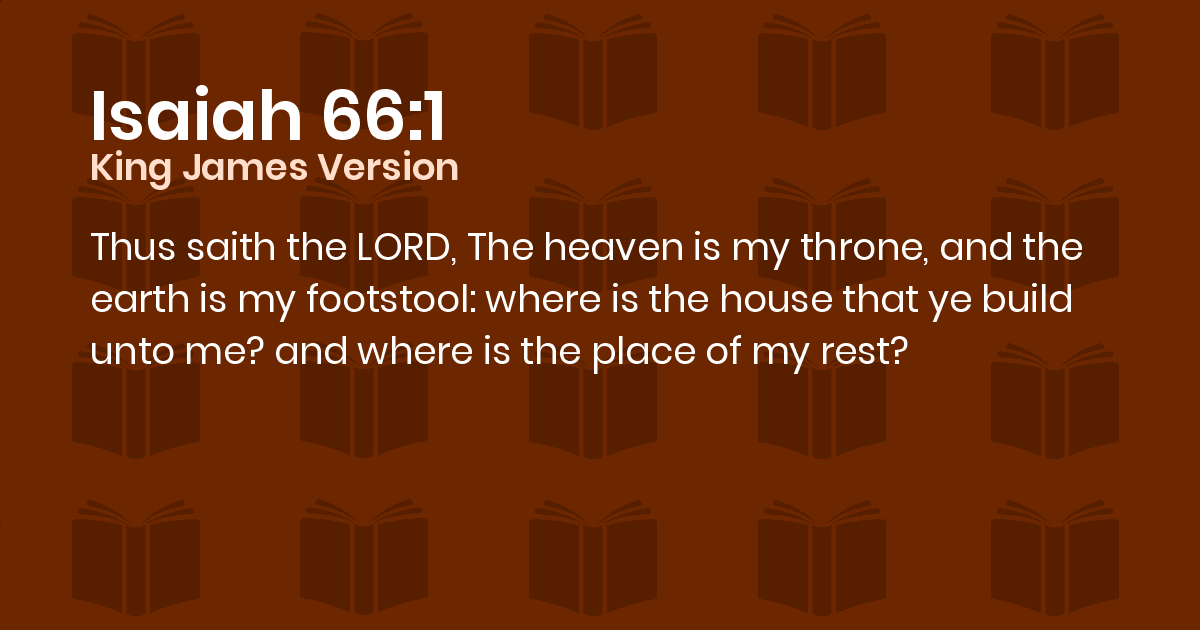
Where Is My Place Of Rest?


"Do you not know that you are a temple of God and that the Spirit of God dwells in you?" 
(I Cor. 3: 16)

"Where is the place of my rest?" When God asks a question it is foolish to ignore it. Rather should we muse upon it and seek the right answer. So it is with this question.

There is much information about salvation being an experience where the believer himself enters into "God's rest." (See Heb. 3 & 4) In these cases the ones who are doing the resting are believers and their rest is manifold, being enjoyed in this life partially and in eternity fully, in a literal place of rest in the new heavens and earth. But, in the above texts it is God who is entering into rest. Of course, this does not mean that God gets tired, but it means the place he calls home, the place where he especially dwells. 

Temples of wood and stone (material structures) are not only historically seen as places of worship but as places where God(s) dwelt, and the place where the worshipers could "meet" and "commune" in the deity's house. In the new testament, the "temple of God" is used to describe the person of believers (in which God is said to dwell) and to describe the church, the body of Christ, believers as a group or corporate entity. Of the latter Paul said - "in whom you also are being built together into a dwelling of God in the Spirit." (Eph. 2: 22) Of the former Paul wrote:

"Do you not know that you are a temple of God and that the Spirit of God dwells in you? If any man destroys the temple of God, God will destroy him, for the temple of God is holy, and that is what you are." (I Cor. 3: 16-17)

Of the former, of individual believers, Paul again wrote:

"Or do you not know that your body is the temple of the Holy Spirit who is in you, whom you have from God, and you are not your own?" (I Cor. 6: 19)

The temple is the place of God's rest. Two times in the new testament we are told that "God does not dwell in temples made with hands." (Acts 7: 48; 17: 24) But, the human body is not made with hands, not a human creation, but is made by God. Thus, when he dwells in a believer he is not dwelling in temples made with hands. When God, the whole Trinity, Father, Son, and Spirit, take up their abode in the believer, God finds his place of rest. Said the Lord Jesus:

“If anyone loves Me, he will keep My word; and My Father will love him, and We will come to him and make Our abode with him." (John 14: 23)

"Behold, I stand at the door and knock. If anyone hears My voice and opens the door, I will come in to him and dine with him, and he with Me." (Rev. 3: 20)

Yes, we find joy in knowing that a "rest remains for the people of God," and that we are promised entrance into it, but we joy even more to know that God has found his rest, his home and domicile, in us! Glory hallelujah! Wrote the hymnwriter:

"Joy to the world! The Lord is come Let earth receive her King! Let every heart prepare Him room."

Will you prepare room for the Lord in your heart? Once he enters he is there to stay! He says "I will never leave you."

Personal Responsibility In Bible Study

In my first introductory article on "Waiting for the Huiothesia" (See here) I wrote:

"We cannot escape personal responsibility in our Bible studies. Each Bible student must judge of the reliability of "translations," because translations are in fact but "interpretations.""

I firmly believe this is so. I do not accept any bible translation as without error. Many translations, in any given passage or text, will give different renderings in English to convey the original language. Some of these translations are extremely important for they give different meanings to the text. How can we know which translation is right in a given place? Do we trust someone else to tell us which is right? Or, is the responsibility ours to hear all the arguments and reasoning and decide for ourselves? To use proper rules of bible interpretation? Translations are interpretations.

What think ye?