The present debate with the Reformed Baptist brought the brother to say that I John 5: 1 in the Greek taught that the birth preceded and was completed before faith. Of course, I have shown, as have others, that the text teaches no such thing! But, is it not insulting of these Reformers to indict the great Calvinists and Reformers of the past? Men who were experts in Greek (as Luther, Calvin, etc.) did not conclude that I John 5: 1 taught that the birth preceded faith! They therefore insult those men when they say "the Greek of that text proves that regeneration precedes faith." Such arrogant presumption! Luther and Calvin did not know Greek? Balderdash!
Wednesday, October 18, 2023
Reformed Baptists Irritate Me
I am having another e-mail discussion with a Reformed Baptist about several things, particularly about the ordo salutis, and whether faith precedes or follows regeneration (rebirth). I had another long debate recently with a Hardshell Baptist (who believes like the Reformed folks) on this question and he did not want it published although I thought many would enjoy reading it. He also chose not to continue the debate.


Thursday, October 12, 2023
EVEN SATAN BELIEVES
When I was a child, the church and my family told me Jesus was the Son of God, and I believed them.
They told me He was sinless and I believed them.
They told me He died for my sins, and I believed them.
They told me He rose from the dead and I believed them.
I just took everyone's word for it, but I had never taken God's word for it. Then one day, I decided to believe God instead of everybody else. It was then that I was saved!Tuesday, October 10, 2023
Beliefs about the Afterlife (xxx)
“Eye has not seen, nor ear heard,
Nor have entered into the heart of man
The things which God has prepared for those who love Him.”
(I Cor. 2: 9 nkjv)
In the closing chapters of this series we will focus on what life will be like in eternity for redeemed human beings who become immortal and possessed with eternal life. We will look at what redeemed saints will be doing as they live, what joys and pleasures they will experience, what occupies their time and attention, and whether they have any sighs, bad thoughts, or any lack of peace. We will consider whether pleasures will be for both body and spirit, or spirit alone. We will consider the mental and emotional life of immortals. We will look at the nature of the resurrected and glorified body which will have become immortal and no longer bound by nature's physical laws, for it will be a "spiritual body."
What will it be like to live forever? What will it be like to live in heaven on earth? What will it be like to live forever without fear of dying and without any spiritual faults or sin? What will we be doing for all eternity? Will we ever get bored? Is sinning and falling from heaven possible? Will we have free will in heaven or the capability to do evil? Will we have super powers? Be supermen? Super human? How will we relate to time and space? Will we be good hedonists? Will we have 'free will'? Will having free will mean that we will be capable of sin and fall again? How will God insure his people from apostasy and transgression in eternity? Can God insure such a thing? Will we remember our former lives on earth? How will we view our mortal lives on earth?
Will the human race continue to be a self propagating species as a race? Who are "the nations" in the new heavens and earth over whom the saints rule? (Rev. 21: 24) Will there be people who are yet mortal? People who do not have glorified and resurrected bodies? If yes, then this will have far reaching effects for how we view life in eternity in the new heavens and earth, not to mention other areas of bible doctrine.
Thus, we have hundreds of questions about life in eternity as immortal beings, as the children of God, as mature sons and daughters of God. However, the bible does not give exhaustive amounts of information about it, as all confess who have studied this subject. However, there is much indeed that is revealed and it is that which will occupy our attention in these closing chapters of our series on the Afterlife.
The two texts at the heading of this posting (chapter) speak of life in eternity as being one of bliss, where there is "fullness of joy" and "pleasures forevermore." God has prepared blissful things "for those who love him." Both the word "paradise" and "heaven" cause the mind to think of a place of bliss, ecstasy, serenity, and every other good feeling and thing; A "utopia." Christ spoke about Paradise more than once, both before his death, resurrection, and ascension, and after it. In his post ascension appearance to John the apostle on the isle of Patmos, he had John to write the following:
“He that hath an ear, let him hear what the Spirit saith unto the churches; To him that overcomes will I give to eat the tree of life, which is in the midst of the paradise of God.” (Rev. 2: 7)
While he was on the cross he said to the penitent believing sinner being crucified to his right "Verily I say unto thee, Today shalt thou be with me in paradise.” (Luke 23: 43)
Another mention of paradise occurs in 2 Corinthians 12:4. Paul writes: “How that he was caught up into paradise, and heard unspeakable words, which it is not lawful for a man to utter.” In verse two he identifies paradise with "the third heaven." This would be "the highest heaven."
Scholars tell us that the English word "paradise" is from the ancient Greek word paradeiso and the Hebrew pardec and literally means a "park" or "garden." It speaks of a pleasure ground or grove. So Eden was called (Gen. 2: 5), being a garden of delight. In the old testament it sometimes referred to an orchard. Says the encyclopedia (See here):
"The word paradise originated from Old Persian pairidaeza, which meant "walled enclosure, pleasure park, garden." Pairidaeza came into Hebrew, Aramaic, and Greek retaining its original meanings. It appears three times in the Hebrew scriptures (Neh. 2:8, Eccl. 2:5, Sg. 4:13) and also in later rabbinic literature. In the Septuagint, the Hebrew word for "garden" was usually translated by the Greek paradeisos. In Genesis 2–3 paradeisos refers to the original Garden of Eden (lit., "delight")."
In Ezekiel we have God saying to the king of Tyre (representing Lucifer the fallen angel) "thou hast been in Eden the garden of God." (28: 13) Eden was a paradise on earth, reflecting paradise in heaven. Further, the texts in Revelation speak of at least one tree in the Edenic garden, the "tree of life," one that produced twelve kinds of fruit and whose leaves were for the health of "the nations." (Rev. 22: 2) We also see a beautiful and glorious river running through the midst of the new Eden, in the "new heavens and earth" (21: 1), things which were present in the Eden where Adam was placed. In the midst of this glorious paradise is the city of God, "New Jerusalem," "the holy Jerusalem," with its streets of gold, jasper walls, pearly gates, etc. It is a picture of a "great city" (Greek megalopolis). Other texts also show that paradise is a place of gardens, with trees, plants, and exquisite landscapes.
"And Lot lifted up his eyes, and beheld all the plain of Jordan, that it was well watered every where, before the LORD destroyed Sodom and Gomorrah, even as the garden of the LORD, like the land of Egypt, as thou comest unto Zoar." (Gen. 13: 10; See also Isaiah 51: 3; Eze. 36: 35; Joel 2: 3)
The God of the Bible, as well as the gods of the heathen, are all intimately connected with having lavish gardens (in fact there is a place called "garden of the gods" in Colorado, being a 1300+ acre park). So too did wealthy kings have their gardens. Famous among these are the "hanging gardens of Babylon" and the many gardens of king Solomon. In Song of Solomon there is frequent mention of the several luscious gardens of king Solomon and what joys and pleasures were experienced there. There is mention of a "garden inclosed" and describes it in these words:
"A garden inclosed is my sister, my spouse; a spring shut up, a fountain sealed. Thy plants are an orchard of pomegranates, with pleasant fruits; camphire, with spikenard, Spikenard and saffron; calamus and cinnamon, with all trees of frankincense; myrrh and aloes, with all the chief spices: A fountain of gardens, a well of living waters, and streams from Lebanon. Awake, O north wind; and come, thou south; blow upon my garden, that the spices thereof may flow out. Let my beloved come into his garden, and eat his pleasant fruits." (4: 12-16 kjv)
"The cedars in the garden of God could not hide him: the fir trees were not like his boughs, and the chesnut trees were not like his branches; nor any tree in the garden of God was like unto him in his beauty. I have made him fair by the multitude of his branches: so that all the trees of Eden, that were in the garden of God, envied him." (Eze. 31: 8-9)
Thus, paradise, or heaven, or the new heavens and earth, has all manner of trees and vegetation. It is a place to enjoy, to eat and drink, to fellowship with others, to stroll, to admire all the sights, smells, tastes, etc.
The phrase “under their vine and fig tree” is found three times in Scripture: Micah 4:4, 1 Kings 4:25, and Zechariah 3:10.
"But they shall sit every man under his vine and under his fig tree; And none shall make them afraid: For the mouth of the Lord of hosts hath spoken it." (Mic. 4: 4)
The words "dwell safely" are added in I Kings 4: 25. I take that to mean that there will be both common and private areas for all the inhabitants of the new heavens and earth. Each of the redeemed of mankind will have an apartment in the New Jerusalem mega complex and each will no doubt have his or her own private estates.
Everlasting Pleasures
The Psalmist says that "fulness of joy" and "pleasures forevermore" are at the right hand of God. To be at the right hand of God is to be in heaven and in the immediate presence of God and of the host of heaven.
Some Christian teachers have tried to make a distinction between "joy" and "pleasure" that is not warranted. These say that "joy" is spiritual, while "pleasure" is carnal. But, that is not so. There is nothing negative about the word "pleasure" in itself, and the above Psalm verse proves it. Yes, there are what are called the "pleasures of sin," (Hebrews 11: 25) which Moses refused to "enjoy." Such language implies that there are pleasures that are not sinful; And, the word "enjoy" in the phrase "enjoy the pleasures of sin for a season," shows that there is a carnal "joy." Paul spoke of how divine love "rejoices not in iniquity." (I Cor. 13: 6) The same text speak of "rejoicing in the truth" as opposed to "rejoicing in falsehood" as well as iniquity.
Those who become immortal and experience physical resurrection will have a "spiritual body," but that does not mean that all bodily feelings and sensations are gone. Though immortal, they will take pleasure in eating heavenly manna, and enjoy the taste of the twelve kinds of fruit on the tree of life (though I don't think they will need to urinate nor empty waste through the colon, but that is another question for another time). They will also enjoy the pleasant odors from the spices of the gardens of paradise (as is described in the texts above). They will enjoy varied and sundry pleasures from all their five senses, just as they did on earth while in their mortal bodies. Pleasant sights to see? Heaven and life in eternity in the new heavens and earth, in paradise, will provide many wonderful and delightful things to see with our eyes. And, what about pleasures from hearing? As we delight to hear music and "a very lovely song of one that has a pleasant voice and can play well on an instrument" (Eze. 33: 32), so will we also in eternity. Heaven will have music fit for god like beings, for God and his family, for the angels and other glorious creatures who dwell in the presence of God.
And what can we say about intellectual pleasures and mental delights? Of the "life of the mind"? Will it not be characterized by peace and joy? Will there not be happy thoughts? Thrilling discoveries?
Will we be able to use these words: thrilling, excitement, fun, fascinating, inspiring, etc.? What about laughter and comedy? Will it be gone? Will everything be sober and serious, like being in a high church or funeral service? Will we have pets? Will we be able to travel to other parts of the cosmos? To teleport? To disappear and appear someone else? What will be our relationship to each other? To the angels? To the brute creation and to animals? Will we sleep? Will we eat? Will we need to use the commode? Will we get tired? Will our bodies have powers like superman? What increased attributes will we have as the children of God? What will keep us from being bored? What will prevent our having an accident so as to hurt our bodies or to die?
In the next concluding chapters of this series, which has become a book, we will look at these questions and the leading texts on life in eternity.
"Then shall the King say unto them on his right hand, Come, ye blessed of my Father,
inherit the kingdom prepared for you from the foundation of the world"
(Matt. 25: 34 kjv).
Saturday, October 7, 2023
PaedoBaptist Shedd on Regeneration & Means

William Greenough Thayer Shedd
1820-1894
When I was a young Hardshell I was surprised to discover that the Hardshell idea of regeneration without faith and apart from the word of God or gospel as a means was not a view that only they believed. But, when I first began to read Paedo-Baptist writings, I saw that I was mistaken about Hardshells being the only ones who believed such, for other groups also believed like the Hardshells and said that regeneration preceded faith and occurred apart from the means of the word. I discovered this in Shedd's Systematic Theology (which I bought the three volume set). I was so happy to read Shedd on regeneration, and said to myself "that is what we Primitive Baptists believe." I felt good for not being alone in this view. Now, many years later, I see how both the Hardshells and the Paedo-Baptists like Shedd are wrong and against both the Bible and the oldest Baptist confessions (such as the Presbyterian Westminster and 1689 London Baptist Confession).
Today many, if not all, of those who claim to be "Reformed Baptists," believe what Shedd states. However, they will try to say that they believe in means in regeneration or new birth even though they put regeneration before faith. But, in this they are not consistent. Those who say that regeneration precedes faith embrace the idea, sooner or later, that regeneration is apart from the means of truth and say that means are used after regeneration to produce faith and conversion. Let us hear now from Shedd.
"The term regeneration has been used in a wide and in a restricted sense. It may signify the whole process of salvation, including the preparatory work of conviction and the concluding work of sanctification. Or it may denote only the imparting of spiritual life in the new birth, excluding the preparatory and concluding processes. The Romish church regards regeneration as comprehending everything in the transition from a state of condemnation on earth to a state of salvation in heaven and confounds justification with sanctification. The Lutheran doctrine, stated in the apology for the Augsburg Confession and in the Formula of Concord, employs regeneration in the wide meaning, but distinguishes carefully between justification and sanctification. In the Reformed church, the term regeneration was also employed in the wide signification. Like the Lutheran, while carefully distinguishing between justification and sanctification, the Reformed theologian brought under the term regeneration everything that pertains to the development as well as to the origination of the new spiritual life. Regeneration thus included not only the new birth, but all that issues from it. It comprised the converting acts of faith and repentance and also the whole struggle with indwelling sin in progressive sanctification."
This is what Bob Ross and I have contended for all along. The first Reformers and Calvinists (time of Luther and Calvin and shortly thereafter) did not affirm that regeneration preceded faith. They saw evangelical conversion as being the same as regeneration or the new birth. Later Calvinists split the work of regeneration in half, calling the first "regeneration" (or first conversion or narrowly defined) and the second "conversion" (or second conversion or broadly defined).
Most who adopted this division confessed 1) that this new paradigm was created by post reformation Calvinists and was not the original view of the first Calvinists, and 2) that the restricted definition of "regeneration" was an invention of theologians and not how the bible defines it, for the bible defined it broadly so as to include conversion.
Wrote Shedd:
"This wide use of the term passed into English theology. The divines of the seventeenth century very generally do not distinguish between regeneration and conversion, but employ the two as synonyms. Owen does this continually (On the Spirit 3.5), and Charnock likewise (Attributes, Practical Atheism). The Westminster Creed does not use the term regeneration. Instead of it, it employs the term vocation or effectual calling. This comprises the entire work of the Holy Spirit in the application of redemption. Under it belongs everything pertaining to the process of salvation, from the first step of conviction of sin to the act of saving faith in Jesus Christ (cf. Fisher, On the Catechism)."
I too do not make regeneration and conversion to be distinct separate experiences as do the Hardshells and Reformed Baptists. It is full blown Hyper Calvinism and often involves Antinomianism. Further, the older orthodox view was held to by Luther, Calvin, and expressed in both the Westminster (Presbyterian) and London Baptist confessions of faith. Note also how Shedd mentions how John Owen and Stephen Charnock (pronounced as "Harnock") did not define regeneration to exclude conversion but saw it as the same thing.
Shedd said:
"The wide and somewhat vague use of the term regeneration was suggested by a few scriptural texts."
He says the bible is "somewhat vague" to define "regeneration" (or rebirth) broadly, and then he tries to improve on how the bible describes such an experience; But I will stick with the Bible's definition and encourage others to do so! Further, it is not a "few" texts that suggest such a restricted definition, but the hair splitting theologians in the Hyper Calvinistic tradition. I tell you, such language now (as opposed to when I was a Hyper Calvinist) makes my blood to boil. To say that the scriptures are vague in how they define regeneration or rebirth and to say that later Hyper Calvinist theologians came out with an improvement of the biblical definition is to show disrespect to the scriptures and to mishandle them. Further, the effects of such "clarifying" and improving of the way the scriptures define the new birth was no improvement upon the scriptures, and was in fact a view that led to even further departures from the biblical record. A regeneration without a conversion is no regeneration at all.
Shedd continued:
"But this wide use of the term regeneration led to confusion of ideas and views." But, as stated, many of those who share Shedd's view admit that the bible generally defines regeneration as conversion, giving it a broad definition and "wide use," and yet say that the bible's way of describing the experience "led to confusion of ideas and views"! Oh my! That is simply not acceptable to me. Shedd thinks that the way the bulk of bible texts speak of regeneration or rebirth (which shows that conversion was regeneration), and the way the first Calvinists also did, is inferior to the way the theologians later defined them (narrowly so as to exclude faith, repentance, and evangelical conversion).
Shedd continued:
"As there are two distinct words in the language, regeneration and conversion, there are also two distinct notions denoted by them."
That is faulty reasoning and I have run into it before. Hardshell apologist Jason Brown also argued the same. I respond by saying that there are numerous words (along with the ideas connected with them) used to refer to the same exact experience or phenomenon. In the scriptures these words are used to speak of that same initial experience of salvation: saved, regenerated, renewed, transformed, converted, reborn, quickened (or made alive), risen (or resurrected), re-created, enlightened, etc. If we use the logic of Shedd and other Hyper Calvinists, then we would have to say that each of the above words denotes a distinct experience separate from the experience denoted by the other words. If you put that kind of logic in a bird it will fly backwards.
Shedd continued:
"Consequently, there arose gradually a stricter use of the term regeneration and its discrimination from conversion. Turretin (15.4.13) defines two kinds of conversion, as the term was employed in his day. The first is habitual or passive conversion. It is the production of a habit or disposition in the soul: Habitual or passive conversion occurs through the infusion of supernatural habits by the Holy Spirit. The second kind is actual or active conversion. It is the acting out in faith and repentance of this implanted habit or disposition: Actual or active conversion occurs through the exercise of those good habits in which the acts of faith and repentance are both granted by God and called forth from man. After thus defining, Turretin remarks that the first kind of conversion is better denominated regeneration because it has reference to that new birth by which man is renewed in the image of his maker; and the second kind of conversion is better denominated conversion because it includes the operation and agency of man himself. De Moor on Marck (23.2), after distinguishing between conversio activa and passiva, says that the latter is synonymous with vocation."
Note again the admission that the divorcing of conversion from the experience of regeneration or rebirth was a later development that certain Hyper Calvinist leaning Calvinists and Reformed Churches imposed upon the scriptures. It is insulting to men like Luther, Calvin, Owen, etc., to say that they could not see how the scriptures divorced conversion (faith and repentance) from the regeneration experience. So Turretin defined regeneration better than Paul, Peter, John, Christ, etc.? Further, rather than help explain the bible on the subject, such Hyper Calvinists (on the ordo salutis) rather made it more inexplicable. Rather than removing confusion they increased it. Further, though men like the late R.C. Sproul said that Augustine believed that regeneration preceded faith, others have shown from the writings of Augustine that he believed no such thing. For instance, Augustine wrote: "We are united by faith, quickened by understanding. Let us first adhere to Him through faith, that there may be that which may be quickened by understanding." (As cited by writer Daniel Musick here)
Wrote Shedd:
"We shall adopt this distinction between regeneration and conversion. Regeneration, accordingly, is an act; conversion is an activity or a process."
"We shall adopt it"? Even though it is not what we see in scripture? I think this is not a good adoption at all and has created so much division in the body of Christ.
Wrote Shedd:
"Regeneration is the origination of life; conversion is the evolution and manifestation of life."
Where is the text that says men have to be quickened, regenerated, or born again before they can believe, repent, or be converted? Where is the scripture that says men believe because they are already saved and that faith only manifests that they are saved? That is what the Hardshells and their Two Seed believing forefathers also said. Conversion manifests that one is of the seed of God, one of the elect.
Wrote Shedd:
"Regeneration is wholly an act of God; conversion is wholly an activity of man."
Again, we have another man-made proposition as the previous and these propositions are accepted as inspired truth and they are taken to the scriptures and the scriptures made, by hewing and hacking, twisting and distorting, to square with or otherwise support those propositions. I deny both parts of the proposition. That is, I deny that regeneration is defined only by what God does and this blog is filled with proof to sustain my denial. Jesus acted to bring Lazarus to life, but his coming to life was his act. It was Lazarus who did the "coming forth." Jesus acted and Lazarus acted. It took both for Lazarus to be resurrected.
I also deny that "conversion is wholly an activity of man." So, if that be so, then God cannot get any credit for our being converted, or to say it another way, God is not the one who converted us. You see where the divorcing of regeneration from conversion (or defining regeneration narrowly) leads, and how it is a slippery slope and leads to other errors?
Wrote Shedd:
"Regeneration is a cause; conversion is an effect. Regeneration is instantaneous; conversion is continuous."
Here is another false proposition. Where is the text that says regeneration is the cause of faith and repentance, or of conversion? There are many texts that say faith precedes. Again, this blog is filled with postings showing this (see my series on Regeneration Precedes Faith proof texts).
Further, it can be argued that both regeneration and conversion are both instantaneous and continuous. Calvin thought regeneration was continuous throughout a believer's life, but that it began with faith. I agree. We are initially regenerated (transformed and renewed) but we are also progressively being regenerated. The same with conversion. There is initial conversion and continuous conversion (the same with repentance).
Wrote Shedd:
"While the operation of the Holy Spirit upon the human will is inexplicable (John 3:8), yet certain particulars are clear. (a) The influence of the Spirit is distinguishable from that of the truth, from that of man upon man, and from that of any instrument or means whatever. His energy acts directly upon the human soul itself. It is the influence of spirit upon a spirit, of one of the trinitarian persons upon a human person. Neither the truth nor a fellowman can thus operate directly upon the essence of the soul itself."
Though I agree that the influence of the Spirit is not limited to that which is through the word of God (a point that was much argued between Alexander Campbell and the Baptists), yet the Spirit does not regenerate apart from the application of truth to the heart. Further, the above is too much metaphysics and theological hair splitting for me (as it is for most Christians). I wrote a whole series on how regeneration or the new birth is both mediate and immediate and is both viewed as an experience where a person is both active and passive. It cannot be made to be all one or the other, in the same way that Dr. Archibald Alexander affirmed that regeneration cannot be defined by what causes it but must include the effects. (See the blog archives, using the search engine with Archibald Alexander)
Wrote Shedd:
"That the influence of the Holy Spirit is directly upon the human spirit and is independent even of the word itself is further proved by the fact that it is exerted in the case of infants without any employment of the truth. John the Baptist was filled with the Holy Spirit even from his mother's womb (Luke 1:15)."
But, as I have rebutted this line of argument many times with the Hardshells and other Hyper Calvinists, where is the text that says that even dying infants are regenerated apart from faith and conversion? Do they go to heaven then as unbelievers? Did not John the Baptist hear the good news from the mouth of Mary and leap for joy? I rest my case. So, the example Shedd gives does not prove his proposition.
Wrote Shedd:
"Sixth, regeneration is a work of God in the human soul that is below consciousness. There is no internal sensation caused by it. No man was ever conscious of that instantaneous act of the Holy Spirit by which he was made a new creature in Christ Jesus. And since the work is that of God alone, there is no necessity that man should be conscious of it. This fact places the infant and the adult upon the same footing and makes infant regeneration as possible as that of adults."
Well, that certainly was not the case with Paul who was formerly the persecuting Saul of Tarsus. He was very much conscious of his regeneration and conversion! Shedd says of Paul "he was never conscious of that instantaneous act of the Holy Spirit which made him a new creature in Christ Jesus"! Egad! How awful is that? Further, we can refer to many texts where Paul or other bible writer refers to the time when the ones they were writing to were born again. How many Christians don't know when they were converted or first believed? When they sing that line in "Amazing Grace" that says "the hour I first believed," do they not know when that was? Spurgeon knew when he was called to life in the Methodist chapel. Notice these words of Paul in regard to his regeneration or rebirth:
"But when it pleased God, who separated me from my mother's womb, and called me by his grace, To reveal his Son in me, that I might preach him among the heathen; immediately I conferred not with flesh and blood: Neither went I up to Jerusalem to them which were apostles before me; but I went into Arabia, and returned again unto Damascus." (Gal. 1: 15-17 kjv)
It seems that Paul does not agree with Shedd for he knew when he was saved and was not unconscious as he was being drawn to Christ.
Wrote Shedd:
"Seventh, regeneration is not effected by the use of means, in the strict signification of the term means. The Holy Spirit employs means in conviction, in conversion, and in sanctification, but not in regeneration."
Well, that is simply not biblical. It is a view that Shedd and other Hyper Calvinists invented because of their reliance upon human logic and reason rather than on the word of God. Notice how Shedd adds his caveat by saying "in the strict signification of the term" regeneration. But, the bible does not define it so strictly as did Shedd and as stated, many of his cohorts even admit that the bible defines it broadly as including conversion. Quite frankly, I don't care how learned Shedd and his ilk are, the above statement is simply an example of biblical ignorance.
Wrote Shedd:
"The appointed means of grace are the word, the sacraments, and prayer. None of these means are used in the instant of regeneration; first, because regeneration is instantaneous and there is not time to use them; second, because regeneration is a direct operation of the Holy Spirit upon the human spirit. It is the action of Spirit upon spirit, of a divine person upon a human person, whereby spiritual life is imparted. Nothing, therefore, of the nature of means or instruments can come between the Holy Spirit and the soul that is to be made alive. God did not employ an instrument or means when he infused physical life into the body of Adam."
Again, this is not what one discovers from the scriptures but what he has deduced by reasoning from the doctrine of total depravity erroneously and not sticking with the plain statements of scripture. All the propositions highlighted above in bold letters are propositions that are not upheld in scripture. In fact, there are many scriptures that affirm just the opposite as I have shown through the years.
Wrote Shedd:
"In like manner, the word and truth of God, the most important of all the means of grace, is not a means of regeneration, as distinct from conviction, conversion, and sanctification. This is evident when it is remembered that it is the office of a means or instrument to excite or stimulate an already existing principle of life. Physical food is a means of physical growth; but it supposes physical vitality. If the body is dead, bread cannot be a means or instrument. Intellectual truth is a means of intellectual growth; but it supposes intellectual vitality. If the mind be idiotic, secular knowledge cannot be a means or instrument. Spiritual truth is a means of spiritual growth, in case there be spiritual vitality. But if the mind be dead to righteousness, spiritual truth cannot be a means or instrument. Truth certainly cannot be a means unless it is apprehended. But the natural man receives not the things of the Spirit of God, neither can he know them because they are spiritually discerned (1 Cor. 2:14)."
I used to hear the Hardshells parrot such things as Shedd says above. Many of them no doubt read them from Shedd and those of his kind. The above is not biblical. The fact is, dead minds are objects of the Spirit's work through the word. Yes, it is illogical to think that giving bread to the dead will revive them. But, Jesus taught differently. He said that one must eat his flesh and drink his blood in order to obtain spiritual life. I have used several examples over the years to show that Shedd's and Hardshell logic on this point is faulty. Do we not use defibrillators to restart the heart of someone who is clinically dead? Do we not use "jumper cables" to start a dead battery?
Wrote Shedd:
"That regeneration is not effected by the use of means will appear from considering those cases in which means are employed. First, the word and truth of God are means of conviction, because there is in the human conscience a kind of vitality that responds to the truth as convicting and condemning. The apostasy did not kill the conscience stone-dead. If it had, no fallen man could feel remorse. Adam's fall has benumbed and stupefied the conscience, but there is still sufficient vitality left in it for it to be a distressing witness to man. Consequently, the Holy Spirit employs truth as a means of exciting and stimulating the human conscience, not of regenerating it in the strict sense of the term. The conscience is not "made alive from the dead" in the sense that the will is. It has not lost all sensibility to moral truth. It possesses some vitality that only needs to be stimulated and toned up. This is done in conviction and by the use of truth as an instrument. Second, the word and truth of God are means of conversion, because regeneration has preceded and has imparted spiritual life to the soul. There is now a spiritual vitality that can respond to the truth. The understanding having been enlightened by regeneration, when the particular truth that the blood of Christ cleanses from all sin is presented, it is apprehended."
Friends, Hardshell heretics give a hearty amen to these words of Shedd. It is Hyper Calvinism and has awful consequences for believing it. Where is the scripture that says the things Shedd says above?
Wrote Shedd:
"The new life is not implanted because man perceives the truth, but he perceives the truth because the new life is implanted. A man is not regenerated because he has first believed in Christ, but he believes in Christ because he has been regenerated. He is not regenerated because he first repents, but he repents because he has been regenerated."
Well, that is not what the bible or first Calvinists during the Reformation taught. The bible teaches that sinners are born again by faith, born again by virtue of union with Christ who is life, and union is by faith.
Wrote Shedd:
"Eighth, regeneration is the cause of conversion. The Holy Spirit acts in regeneration, and as a consequence the human spirit acts in conversion."
Again, the bible no where affirms this to be the case. Rather, it shows that conversion and regeneration are terms referring to the same experience.
Tuesday, October 3, 2023
Beliefs about the Afterlife (xxix)
"you are God’s field, you are God’s building"

Christ The Building Inspector
As spiritual builders we need to be sure of building structures that endure, that are not destroyed by wind and fire, and that are judged by Christ, the chief builder and carpenter, as well as architect, to be "well built." We know that Christ will say to his faithful servants in the day of judgment "well done good and faithful servant," or to them considered as builders, "well built."
Any builder knows that his building, both materials and workmanship, will be inspected by trained experts in local government agencies who oversee the construction process. There are footing and foundation inspections, framing and structural, plumbing, electrical, heating and air, etc. There is also what is called the "final inspection" before the property is permitted to be used and receive utilities.
Applying this to the judgment of our buildings constructed upon Christ and his word during the course of our lives, we may say that we too are being constantly inspected providentially. Our fellow believers judge our spiritual buildings. So too does the Holy Spirit who sends men of God to help us correct our buildings where needed. They will point out things that will not pass inspection, and things in the construction that need to be changed, things not up to code. Further, as I have already stated, we will not have any inferior constructions to go with us into heaven when we die. But, that does not negate that there will be a final inspection (trial or test) wherein we will see our own faulty construction disapproved, with loss of reward, or hopefully will find our work honored and recognized and given awards, trophies, and crowns.
What Loss Suffered?
The big question is to ascertain what is meant in the text by the words "he will suffer loss but he himself will be saved."
Let us make some initial observations.
1) No believer builds a perfect building in his or her life
2) A believer's spiritual construction will be a mixture of good and bad
3) Some who go to heaven have built nothing (such as those who died in infancy)
4) If salvation in the end depends upon having built perfectly, no one would be saved
5) What is lost and ruined (burned up) is not the foundation of stone nor the builder on the foundation
The loss is a loss of rewards, or awards, or crowns. Christ will recognize and give honors to all the saints for their deeds done in his name by faith and according to his word. He will praise and congratulate them. The praise for building well is similar to the praise for managing well, as good stewards and administrators, the money (talents or pounds) entrusted to the servants of God. The "good and faithful servants" not only took care of the money their Lord left to them, but increased it by investing, and were given reward, some more, some less, for their well doing as stewards.
As we have observed in the previous chapters, Paul and John wrote about labor lost, or labor that did not yield much advantage or profit. There will be some saints who will have little labor to be rewarded; And part of their loss will be knowing how they wasted much of their time, labor, and talents. So, every believer should do as Jude, the Lord's brother, urged when he wrote:
"But ye, beloved, building up yourselves on your most holy faith, praying in the Holy Ghost, Keep yourselves in the love of God, looking for the mercy of our Lord Jesus Christ unto eternal life." (Jude 1: 20-21)
Again, though believers strive for perfection, they never attain it in this life. In building up ourselves, our character, our beliefs, our activities, our homes and family, our institutions, the church, etc., we will find ourselves falling short in many ways. That cannot be helped. All we can do is strive to build a perfect building.
What Reward?
"If anyone’s work which he has built on it endures, he will receive a reward."
The test for the quality of work done in building is whether it "endures" the fire of "the day." If it passes through the fire unharmed (not burned), then the worker/builder will be given reward. We could say the same with other scriptural metaphors. So we can say that the one who finishes the marathon race will obtain the crown of victory (Stephanos crown), or say whatever buildings endure the earth shaking or whatever survives the tornado, will bring reward to the builders. There will be some, sadly, who will see a lifetime of work in ministry all go up in smoke because it did not pass God's trial by fire, the final inspection.
Jesus talked a lot about rewards in the eternal state and he encouraged his servants to seek them and work for them. Notice these texts:
Matthew 5:11-12 “Blessed are you when men cast insults at you, and persecute you, and say all kinds of evil against you falsely, on account of Me. Rejoice, and be glad, for your reward in heaven is great, for so they persecuted the prophets who were before you.”
Matthew 6:20 “But lay up for yourselves treasures in heaven, where neither moth nor rust destroys, and where thieves do not break in or steal…”
Matthew 16:27 "For the Son of Man is going to come in the glory of His Father with His angels; and will then recompense every man according to his deeds."
These words about rewards for labor on behalf of Christ and his kingdom cannot be made to apply to this life only (although, as we have seen, pleasing God in our work has its rewards in this life and in the next). They speak of what will be given when Christ returns.
The verses also indicate that our good works become a sort of "storing up treasures." This fact tells us that some believers will have more treasure in heaven than other believers, for they stored up more on earth. Further, the reward is shown not to be the same for all, for some will have "great" reward, while others have not so great reward. How much do we have in the Bank of Heaven?
Saved Nevertheless?
We should not interpret the text to mean that a professing Christian is all one or the other, that is, that there is no Christian who is always building with the right materials, nor a Christian who is always building with perfect craftsmanship and without any faulty construction. We all fall short.
So, what does Paul mean when he says "he will suffer loss; but he himself will be saved, yet so as through fire"? This is a good text to use to prove that people, once saved, cannot be lost, and that they are eternally secure, and that their perseverance in the faith is guaranteed according to God's working in them.
At one time I considered that the ones who had their buildings burned up manifested that they did not really have Christ as the foundation. I interpreted the words "but he himself will be saved" as "but he himself will be preserved" (for the word saved often means preserved), meaning that the unsaved who go to Hell are not burned up in the fires of Hell as are their works. We know that those who go to Hell will be in fire and yet not be consumed. But, that view is not held by anyone that I have read and is probably not what Paul is saying. However, it is a possible interpretation. We can say of every professing Christian who is a hypocrite and not really saved, that all his works in building will be burned up and yet he will not be burned up but will continue to exist in it forever.
Barnes in his commentary writes (emphasis mine):
"He shall suffer loss - :
(1) He shall not be elevated to as high a rank and to as high happiness as he otherwise would. That which he supposed would be regarded as acceptable by the Judge, and rewarded accordingly, shall be stripped away, and shown to be unfounded and false; and in consequence, he shall not obtain those elevated rewards which he anticipated. This, compared with what he expected, may be regarded as a loss.
(2) he shall be injuriously affected by this forever. It shall be a detriment to him to all eternity. The effects shall be felt in all his residence in heaven - not producing misery but attending him with the consciousness that he might have been raised to superior bliss in the eternal abode - The phrase here literally means, "he shall be mulcted." The word is a legal term, and means that he shall be fined, that is, he shall suffer detriment."
I believe this is correct.
Barnes says further:
"But he himself shall be saved - The apostle all along has supposed that the true foundation was laid 1 Corinthians 3:11, and if that is laid, and the edifice is reared upon that, the person who does it shall be safe. There may be much error, and many false views of religion, and much imperfection, still the man that is building on the true foundation shall be safe. His errors and imperfections shall be removed, and he may occupy a lower place in heaven, but he shall be safe."
I also agree with this and is what I have been affirming so far in our analysis of this text. We should all be careful in what we believe the bible to teach knowing these things. We must know that our foundational beliefs about Christ must be correct or we will not be saved. We must also take comfort in knowing that though we had biblical errors built upon that foundation, we will lose reward but still be saved.
Barnes says further:
"Yet so as by fire - ὡς διὰ πυρός hōs dia puros. This passage has greatly perplexed commentators; but probably without any good reason. The apostle does not say that Christians will be doomed to the fires of purgatory; nor that they will pass through fire; nor that they will be exposed to pains and punishment at all; but he "simply carries out the figure" which he commenced, and says that they will be saved, as if the action of fire had been felt on the edifice on which he is speaking. That is, as fire would consume the wood, hay, and stubble, so on the great Day everything that is erroneous and imperfect in a Christian shall be removed, and that which is true and genuine shall be preserved as if it had passed through fire. Their whole character and opinions shall be investigated; and that which is good shall be approved; and that which is false and erroneous be removed."
Well, such a truth fact is both good and bad. Good because our errors in certain areas of doctrine will not keep us from entering into eternal life as children of God. Bad because our errors in those secondary doctrines will bring us loss of rewards.
Barnes says further:
"The simple idea, therefore, is, that that which is genuine and valuable in his doctrines and works, shall be rewarded, and the man shall be saved; that which is not sound and genuine, shall be removed, and he shall suffer loss."
In the next chapter we will look at the life in eternity as immortal beings.
Monday, October 2, 2023
Peck on Hardshell Errors

John Mason Peck
(1789–1858)
"But there are some things which Regular Baptists have been accused of propagating, and some speculations preached by good men, which cannot be found, or legitimately inferred, by implication from this Confession of Faith. These things are not there, and can not be implied from the doctrines taught:
1. "That God is the author of Sin." So far from any such idea being taught directly, or deduced by any fair implication, just the reverse is taught explicitly. In chapter 3d, entitled "God's Decree" -- but which we have given in the foregoing synopsis, as being more intelligible to our readers, "God's Council and Foreordination, or Predestination" -- after stating the doctrine that God's council and foreordination includes "all things whatsoever cometh to pass," the chapter in explanation says, "yet so as thereby is God neither the author of sin, nor is violence offered to the will of the creature, nor yet the liberty or contingency of second causes taken away, but rather established."
2. Regular Baptists in the Mississippi Valley have enunciated a dogma as unscriptural, unphilosophical and useless as this. Some may yet imagine and teach that the Spirit regenerates the elect without means, or the subordinate agency of his gospel. But in this they teach directly contrary to the unequivocal declarations of the Confession of Faith, no less than against the scriptures. The doctrine of means, or the instrumentality of the gospel in regeneration, as well as in all its adjuncts, is taught very plainly and directly in chapters 1st, 7th, 8th, 10th, 13th, 14th, and 20th; and is taught by implication in several other chapters. The only exception made is in chapter X, under "Effectual Calling," sec. 3: --
"Elect Infants, dying in Infancy, are regenerated and saved by Christ through the Spirit, who worketh, when and where, and how he pleaseth. So also all other persons, who are incapable of being outwardly called by the ministry of the word."
The construction put on the first clause of this section by brethren in the Philadelphia Association was this: That the phrase "Elect Infants" includes all who died in a state of unconscious infancy -- that the second clause referred to adult idiots, and others, who were rendered incapable of being "outwardly called by the ministry of the word," by some providential acts.
The authors and revisors [sic] of this "Confession" would have repudiated with the expressions of horror, the mischievous speculation that God has an elect people, scattered among the nations of the earth -- that he knows his own -- and that he quickens or regenerates these without the gospel or any of the instrumentalities he has provided. REGULAR BAPTISTS were missionary Baptists, and knew the meaning of the great commission to preach the gospel to every creature, specially in view of their conversion and salvation.
"The Confession of Faith teaches the doctrine of "particular election," without regard to human merit; but it also teaches the necessity of preaching the gospel to all men, without which sinners capable of hearing the gospel cannot be saved. The anti-christian dogma that the gospel need not be preached to sinners of every class and grade, for the specific purpose of being the instrument of their conversion and salvation through the mighty working of the Holy Spirit, has no place in the Confession of Faith of Regular Baptists."
To see the lengthy write up I did on the response of Elder Gilbert Beebe, Hardshell founder and editor of "The Signs of the Times," the first Hardshell periodical, see my post titled "Beebe vs. Howell & Peck" (here).
J.M. Peck was one of the leading opponents of the anti missionaries. He held debates with Daniel Parker, one of the ringleaders of the new Hardshell cult. He certainly showed how the Hardshells were not "primitive" or "original" in their views on several areas of doctrine.
The time of the writing of Peck's words above show that even in the late 1850s, many Hardshells were beginning to deny means altogether. However, that anti means view did not gain prominence till the last quarter of the 19th century. Further, many of the first Hardshells believed that regeneration and the new birth were not the same thing, that the former preceded the latter, and that the former was apart from means while the latter was by means.
Also notice how Peck says that all who die without faith in Christ are lost. Again, this is counter to Dr. Flowers, Dr. Graham, and C.S. Lewis, as well as our Hardshell brothers. John Gill said the same as Peck, affirming, just like the 1689 Confession, that all the heathen who die in ignorance of Christ are lost.
On Today's Madness
Frankly, once again I am bewildered by why my posting "Red Horse Of The Apocalypse XI" (here) has received little attention since I have had it as the featured post the past week. I put it there again because my sister and I often speak of the madness in our country, and in the world, at the present time. I have oft said to her, and others, that it is predicted. The rider on the red horse brings chaos and civil war, with people killing one another in great numbers. One of my posts on the white horse rider has been number one in the top ten for a long time. But, in my opinion, the whole series on the white horse is good to read, as are all the posts on each of the four horsemen. So, as an editor and observer of the signs of the times, I have pondered what this says.
Friends, we are living in a time of mass insanity. People, a seeming majority, have gone mad. I could begin a list of proofs for this that would be a mile long. For instance, these insane people can't define man or woman. These are dark times. Though I do not think we are in "the great tribulation" (Rev. 7: 14) as yet, nor in the "day of trial that will come on all the earth" (Rev. 3: 10), yet we are on the precipice or on "the eve of destruction." You need a place of safety, a refuge. I have written about that also.
It is maddening that more Christians and Bible readers are not more aware that the madness we see is totally out of the ordinary and is a sign of impending wrath and judgment from the Almighty.
I encourage all to read this posting on end time madness; not because I am a great writer, but simply because of the information it contains from the word of God. Let us be "men who had understanding of the times" (I Chron. 12: 32).
"A prudent man sees danger and hides himself; but the simple go on, and suffer for it." (Prov. 27: 12)
Sunday, October 1, 2023
Why Alexander Campbell Left The Baptists?
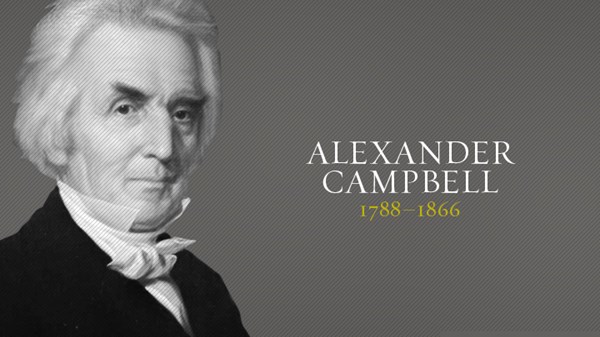
The following are some citations from my 2009 posting in "The Baptist Gadfly" blog titled "Campbell vs. Peck on Fuller" (See here). In this post I simply want to focus attention on the words of Campbell wherein he says that his "controversy with the Baptists began on this dogma" of regeneration before faith and conversion. Keep in mind that those Baptists who argued that regeneration occurred before conviction, and before conversion (faith and repentance), did not believe that the new birth was the same as regeneration. I have shown this to be true when showing how the leading view of those Hyper leaning Calvinists in the day of Campbell was to say that the new birth had three distinct stages like a physical birth. First there is the planting of the seed (regeneration), then the development in the womb (conviction), and finally the birth (deliverance or conversion).
Interesting is the fact that Campbell himself held to the same view, but he later came to see how the birth was in the act of baptism. He would say the order was faith, repentance, regeneration, conversion and baptism, rebirth. What he opposed was the idea that there was any regeneration prior to faith. I also oppose that idea, as did other Baptists of the day, such as J.M. Peck.
REPLY TO MR. PECK—No. III.
Elder Peck:
"You next enter upon the dogma that the Spirit, Without The Word, regenerates the soul of the sinner. My controversy with the Baptists began on this dogma. You admit it was the dogma of some of them; but you say they were of an antinomian cast: yet you only except Andrew Fuller. Well, if the old Baptists were all or chiefly antinomians—and especially all those with whom I was associated; and if the new Baptists since Fuller's time have discarded this antinomianism, is it not time that, at least on this point, there should be an end of the controversy between the good Fullerite Baptists and us?
To Elder A. Campbell (by Peck - emphasis mostly mine - SG):
"In a former communication you called on me to endorse a particular dogma, that the Spirit, without the ward, regenerated the soul of the sinner. This you alleged to have been the old Baptist faith. This dogma you charged upon Gill, Fuller, and the old Baptist writers generally. In this you are certainly mistaken. None of these writers depreciated the value and importance of the gospel of Christ, or divine truth in conversion. Probably you have heard this dogma preached by some illiterate Baptists of antinomian cast of doctrine, during your connexion with the denomination; but you do great injustice to the fathers of the last age by such allegations.
Notice how Peck affirms that those Hyper Calvinists who were putting regeneration or the new birth prior to faith were "illiterate Baptists of the antinomian cast." (Those who do so say that the word is not a means in regeneration) This was the cast in 1811 that later gave rise to the Hardshell sect and anti mission schism.
Error on the ordo salutis by some Hyper Calvinistic Baptists is what got Campbell on the way to creating his own sect. There are lessons to be learned from this historical event.
Subscribe to:
Posts (Atom)